


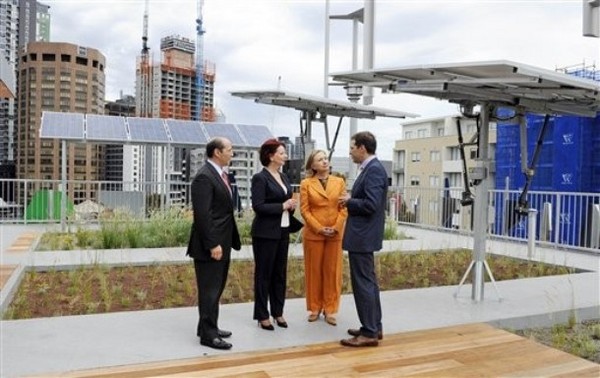
HILLARY Clinton certainly didn't want to embarrass Julia Gillard in Melbourne.
So the US Secretary of State pretended that the US abandoning cap and trade legislation, and a carbon price more generally, had no implications for Australia.
In fact, it makes the Australian policy a nonsense.
But on other subjects Clinton was able to be much more direct and blunt. In her informative press conference with Foreign Minister Kevin Rudd she said the US and Australia needed to have a long, deep discussion about the supply of rare earth minerals.
At the moment, as Clinton pointed out, China controls the trade of 97 per cent of such minerals, which are essential, in tiny quantities, to the production of plasma screens and many other modern, hi-tech devices.
After a fierce diplomatic row with Japan over a Chinese fishing boat which rammed a Japanese navy vessel in the Japanese Senkaku Islands earlier this year, the Chinese put a heavy slowdown, amounting almost to a short ban, on the export of such minerals to Japan.
Start of sidebar. Skip to end of sidebar.
End of sidebar. Return to start of sidebar.
This showed the world that Beijing, with very little provocation, would use commercial leverage for strategic intimidation, which was exactly the concern which lay behind the debate about whether the Chinese government-owned Chinalco should be allowed to buy a big stake in the Australian assets of the giant Anglo-Australian miner, Rio Tinto.
Although Clinton and Rudd were polite about China the fact that she raised the issue so publicly and so bluntly indicates the background reality: that Beijing's action startled, appalled and riveted strategic decision makers all over the Asia-Pacific and the world. Both the US and Australia hold reserves of rare earth minerals but have got out of the business of producing them. That can be expected to change.
But the deeper question is whether this is what a powerful China really looks like and, if so, how do we deal with that?
Clinton was also determined that Australians understand Rudd's personal role in the development of Asian institutions, and the critical question of the US's participation in them.
It is the fashion in this country to deride Rudd's Asia-Pacific Community concept, but Clinton made it abundantly clear that Rudd's thinking had been a powerful factor in the US joining the East Asia Summit.
And the EAS, with the US President a key member, is really Rudd's APC by another name.
Rudd, too, reiterated Australia's welcome for greater US military usage of Australian military facilities.
Rudd as prime minister and now Foreign Minister has led the debate within the government, and within the broader community, on this because he understands the absolute importance of deepening US engagement in the region.
Perhaps the most interesting question at the Clinton-Rudd press conference came from an American journalist to Rudd: could the US, with its ongoing commitments in Afghanistan and Iraq, and its economic and budgetary problems, continue to have the kind of military presence in Asia that Rudd has said is necessary for Asia-Pacific stability?
Yes it could, and yes it would, was Rudd's unequivocal answer.
Not only that, but Australia would do everything in its power to make sure this happens.
And, officially, AUSMIN hasn't even begun.
Just maybe the Rudd knockers will suck back and look at the problems arising in the Asia-Pacific, especially with China, and look at the subject with a wider appreciation of facts rather than through their traditional narrow and uninformed appraisals. China is a growing problem for regional security and needs to be checked earlier rather than later and this will only happen with an alliance of Australia/US/Japan.
The decision by China to use it's monopoly on rare earth compounds as a weapon of strategic leverage was inevitable. The fact that the West is so dependent on this trade and having been rudely reminded of China's monopoly of it- creates a whole new paradigm within the future military strategic outlook for the USA, and indeed ourselves. Galvanised by a genuine concern about the prospect of a future trade war in rare earth materials, the USA will take whatever actions it deems necessary to meet the challenge made by China in this one act against Japan. China is greatly dependent on the trade of energy and raw materials from countries like Australia. The USA presently has the blue water Navy to control the passage of those materials around the world, - hence the rapid expansion of the Chinese Navy. The reality is that China may have made a bad strategic blunder as in one beligerent act against Japan it has demonstrated it's future intentions.
You can't trust the Chinese Communist Party; not even the population of China can do that!
1200 characters left
[To view video please enable JavaScript and Flash.]
Ever dreamed of converting a masonic hall into a "poetic" house? You'll need lots of money...
SHELL has sold down a big chunk of its 34 per cent stake in Woodside, ending speculation it would launch another bid for the company.
MOBILE carriers could become virtual newsagents following a world-first deal.
MIKE Rann is under growing pressure to explain connections with an area of Italy to which he has committed millions of taxpayer dollars.
Read Full Article »