


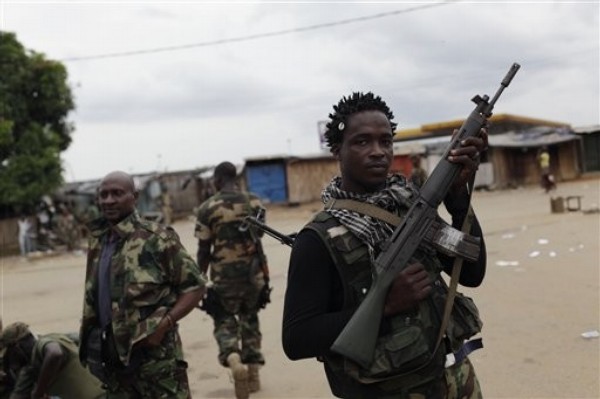
Something pretty extraordinary is happening in Africa. Libya may get all the headlines, but with little notice, another U.N.-backed intervention is taking place in the Ivory Coast, with French aircraft bombing the presidential palace to force out strongman Laurent Gbagbo who insisted on staying in power despite losing the 2010 election. In both cases international intervention has been explicitly premised on the doctrine of “responsibility to protect” (R2P)"”the notion, which arose after the massacres in Rwanda and Bosnia in the 1990s, that the international community has a right, indeed a responsibility, to intervene in other nations’ internal affairs to stop the most egregious human rights abuses.
The doctrine has raised understandable concern among some American conservatives, and no doubt, like any other doctrine, it is subject to abuse. On the whole, though, it is a salutary step forward for individual rights and human dignity. No longer can dictators claim the privilege to abuse their populations any way they see fit; now there is at least a chance that outside powers will intervene to stop the bloodshed and bring the perpetrators to justice.
True, the rule is hardly universal.
It is possible to point to numerous countries, from Iran and Syria, to Burma and North Korea, where war criminals remain free to do their worst. But Nick Kristof of the New York Times (with whom I do not usually agree), offered exactly the right rejoinder to the charge of inconsistency:
[J]ust because we allowed Rwandans or Darfuris to be massacred, does it really follow that to be consistent we should allow Libyans to be massacred as well? Isn't it better to inconsistently save some lives than to consistently save none?
Perhaps the best lodestar when it comes to evaluating most public policies is: Does it or does it not advance the cause of individual liberty? I am convinced that R2P meets this test even if it reins in unfettered notions of national sovereignty. Some conservatives fret that this will limit America's freedom of action and lead to the imposition of international rules by unelected bureaucrats on our own shores. While problematic applications of international law can be imagined, the reality is that it is nearly impossible to coerce the strongest states"”Russia, China, or the U.S."”by means of international organizations. If only we could do more to bring Russia and China to abide by international norms! But we can't; they have veto power at the U.N. Since we too have veto power, we enjoy protection from overly intrusive international interventions"”and we can use our power to shield friends like Israel from such interventions too.
The prospect of Israeli generals or American statesmen being arrested and brought to trial in the Hague is deeply troubling. But that hasn't happened yet, and odds are it won't"”at least not any time soon. What has happened is that the international community, with France in the lead, has used its might to protect innocent people in Libya and the Ivory Coast from being slaughtered by bloodthirsty dictators. That is undeniably a positive step, and it should not detract from well-justified criticisms of the U.N. to give that organization credit for providing cover for such Western-led action which in the days of old would have been known as "liberal imperialism."�
Something pretty extraordinary is happening in Africa. Libya may get all the headlines, but with little notice, another U.N.-backed intervention is taking place in the Ivory Coast, with French aircraft bombing the presidential palace to force out strongman Laurent Gbagbo who insisted on staying in power despite losing the 2010 election. In both cases international [...]
The Muslim Brotherhood's patience and prudence should not be mistaken for moderation
The financial, moral, and spiritual cost of extended unemployment insurance
Exposing the scandalous methods behind an extraordinarily influential "˜World Heath Report'
The administration's attempt to craft a new relationship with Moscow failed
The use and misuse of the Haggadah in our time
A memoir, and a tribute
A review of Amy Chua's "Battle Hymn of the Tiger Mother"
A review of Edmund Morris's "Colonel Roosevelt"
How a great American discovery was turned into a disgrace
A second life for the works of the neglected Canadian-Jewish novelist
Why he still fascinates, 54 years after his death
Television journalists see Iraq as a failure of sensitivity
In response to Paul A. Rahe's "How to Think About the Tea Party"�
In response to Jonathan S. Tobin's "A Monument to Themselves"�
This month's joke
Copyright Commentary Magazine 1997-2011 All Rights Reserved
Read Full Article »