


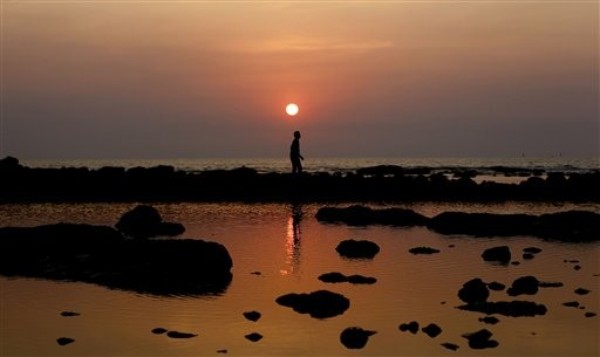
The Bab el-Mandeb, the strait that separates the Red Sea from the Indian Ocean, has conjoined Africa and Asia for centuries. It likely was the first route taken by Homo sapiens on their journey out of Africa, and the traffic between the Horn and Arabia has continued apace to this day. Men, goods, and ideas have gone back and forth, giving the Arabian Sea a degree of integration and similarity that is obfuscated by the arbitrary taxonomy of modern geography: Africa vs. Asia; the Horn of Africa vs. Arabia vs. South Asia. Only some 3,300 kilometers (about 1,800 nautical miles) separate Mumbai from Djibouti, the extreme range of a series of seaports and islands that dot the Arabian Sea: Massawa, Djibouti, Aden, Berbera, Mogadishu, Socotra, Muscat, Hormuz, Gwadar, Karachi, Mumbai.
The harsh, unforgiving environment is another factor of uniformity, as is the seasonal rhythm of the monsoon winds, which influences cattle migrations, harvests and, back in the era of sailboats, the coming and going of merchants. And there is khat, a shrub grown on the plateaus of Ethiopia and Yemen whose leaves are chewed ubiquitously by the locals for its euphoric properties and for suppressing appetite in times of famine. Given its central location in the Eurasian trade route for at least the past 2,500 years, the region has been continuously exposed to the flux of historical change, to new ideas and technologies passing through. Yet, the ancient states that once existed—the Sabean kingdom, Aksum—passed and were not replaced. Major civilizations are born on the beds of large rivers, but the lands that skirt the Gulf of Aden and the Arabian Sea have run dry, an arid belt stretching from the Nile to the Indus.
Read Full Article »