


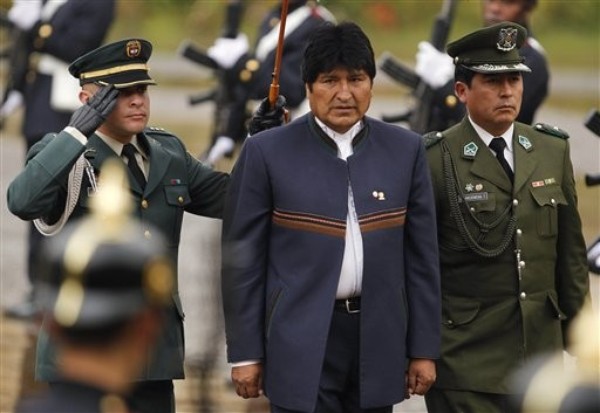
Less than a decade ago, few people outside of Bolivia could name its president. Today, Evo Morales isnot only a global figure; he is an icon for critics of globalization. During the peak of neoliberalism at the end of the 20th century, the Zapatistas in Mexico advocated “changing the world without seizing power.” Now, in the first decade of the 21st century, Evo Morales, Bolivia’s first indigenous president, embodies the desire to change the world while in power—borrowing Subcomandante Marcos’ concept, “to rule by obeying the people” (mandar obedeciendo), a phrase prominently displayed on billboards with the president’s image throughout Bolivia.
Evo Morales took office on December 18, 2005, with an astounding 54% of the vote. He immediately set into motion a nationalist project with two main agendas: the nationalization of oil and gas and a Constitutional Convention. With the first measure Morales proposed to do away with the “plunder of natural resources,” in the words of his party, the Movement Toward Socialism (MAS); the second sought to do away with “internal colonialism.” Bolivian indigenous movements often use this term to characterize the domestic persistence of the exclusion of the native peoples—the majority of Bolivians—and the covert violence that continued to smolder under the liberal-democratic principles of citizens’ equality. Morales thus appears like the David who confronts the “imperialistic” Goliath, an image that greatly explains his popularity both within Bolivia and abroad.
Read Full Article »