


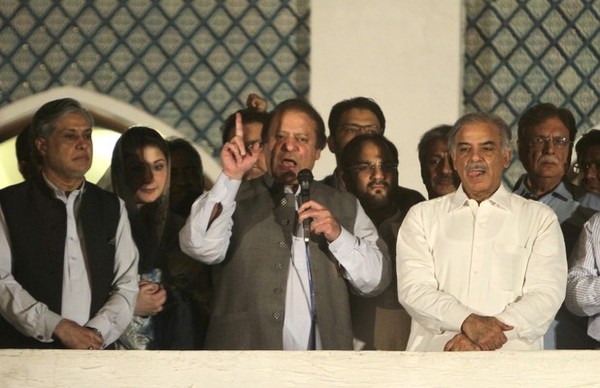
The newly-elected Pakistani government of Nawaz Sharif is set to enact policies - most notably negotiating with the Pakistani wing of the Taliban - that will forever alter the dynamics of this strategically vital Muslim country.
Sharif won the greatest number of seats but fell short of a majority in the National Assembly in a truly historic election for Pakistan's 65 year history as an independent state.
These were the first elections since independence in 1947 in which a civilian government completed its full five year term and transferred power to another civilian government through a relatively - considering Pakistan's difficult political environment - free and fair electoral process.
This was also the first election to be held under a totally independent judiciary and a caretaker government whose ministers had been agreed to by all major parties, and the first time that an independent electoral commissioner had been agreed to by all major political players.
This was also the first time that a politician had been elected for the third time as prime minister. Nawaz Sharif was prime minister between 1990 and 1993, but was removed on corruption charges; and again between 1996 and 1999 before being toppled by the then-Army Chief of Staff, General Pervez Musharraf.
The elections were marred with violence, particularly in the lead up to polling day. Well over 100 people were killed and scores injured by the Pakistani Taliban, the Tehrik-i-Taliban Pakistan (TTP), whose members believe that elections are un-Islamic and that Sharia should be law of the land.
Surprisingly, and against everyone's expectations, only one bomb went off on election day, killing 11 people.
However, the worry in the aftermath of these elections is the approach that Nawaz Sharif intends to take towards the TTP.
Sharif made it abundantly clear in the lead up to the election that he intends to negotiate with the TTP and will not demand any pre-conditions to talks. His political rival Imran Khan, the cricketer-turned-politician, believes in the same approach, so he can expect his support on that front. This will be important because Imran Khan's party, Pakistan Tehreek-e-Insaf (PTI), will probably hold the balance of power in the national parliament.
