


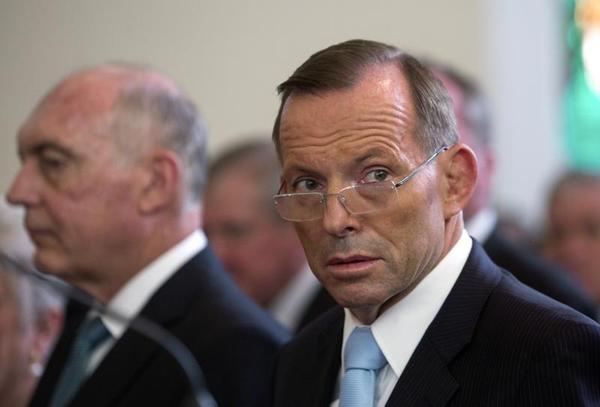
It looks bad. A prime minister in deep political trouble, beset by woeful polling, budget problems and internal dissent.
Yet as Tony Abbott faces a crucial test of his leadership this morning, he should take heart; other prime ministers have been in similar - or even worse - positions, held on to the leadership and won subsequent elections.
It remains a long way back for the Prime Minister but historical parallels suggest he can still survive and prosper.
Paul Keating in 1993 and John Howard in 2001 faced record low polling, adverse public reaction to budget and policy measures, internal dissent and the prospect of massive election losses.
Both men went on to win their next election and, in Howard's case, the next two elections to become Australia's second-longest serving prime minister. This was a man who, as opposition leader in 1988, was written off as "Mr 18%" and asked on the cover of The Bulletin magazine why he bothered with politics.
In late 1991, Keating took over from Bob Hawke as Labor fell in the polls to trail the Coalition by 36 per cent to 51 per cent, with Hawke trailing John Hewson as preferred prime minister by 32 per cent to 43 per cent.
The change to Keating did not help. In January 1992, Labor recorded its lowest Newspoll primary vote on record, 34 per cent, compared with the Coalition's 52 per cent.
According to Newspoll, voter satisfaction with Keating as prime minister was abysmal from the beginning.
In January 1992, satisfaction with the former treasurer was just 21 per cent and dissatisfaction was 42 per cent. By July 1992, satisfaction was up to 24 per cent, but dissatisfaction had grown to 68 per cent.
In February 1993, just before the election, satisfaction with Keating as prime minister was 26 per cent and dissatisfaction was running at 63 per cent.
Heading into the election campaign that year, Labor continued to trail the Coalition on two-party- preferred terms by 46.5 per cent to 53.5 per cent. Yet Hewson famously lost the "unloseable election" and on election day in March, Labor and Keating had lifted the party's primary vote to 44.8 per cent, narrowly beating the Coalition's 44.3 per cent. Keating defied the polls and political predictions to win the election in his own right.
Three years later, he was gone, defeated by Howard after failing to recover from the "slash and burn" John Dawkins budget.
In early 2001, the Howard government was reeling from reaction to the GST, high petrol prices, a loss of faith with the public, state election losses in Western Australia and Queensland, and the St Patrick's day massacre in the federal electorate of Ryan, which the Liberals lost with a 10 per cent swing against them. The then federal Liberal president Shane Stone infamously wrote a memo that said Howard was seen as "mean and tricky" and there was a push to replace him with his deputy, Peter Costello.
In February 2001, the Liberal primary vote was 31 per cent. It dropped to 27 per cent in March and to a low of 26 per cent before the budget in May.
In February and March, the Coalition's primary vote was just 37 per cent - a point below what it was for the current Coalition government last December.
Labor's primary vote was 46 per cent - seven percentage points higher than it was in December.
