


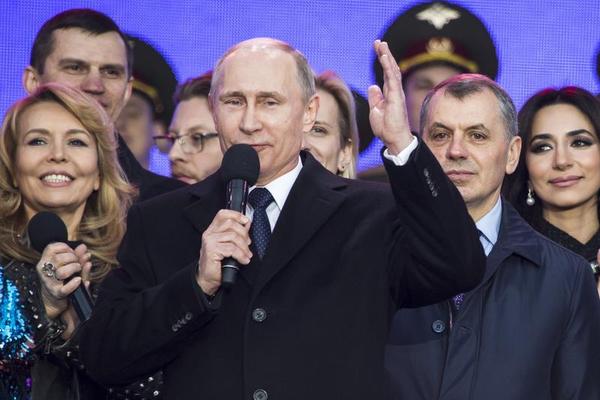
During the vast majority of his tenure as Russia's de facto or de jure leader since 2000, Putin's popularity has been based on his ability to deliver economic growth and prosperity. But as Russian growth has declined in recent years, he has shifted his strategy, seeking to emphasize a brand of traditional Russian values (not unlike those promoted under Nicholas I in the first half of the 19th century, a leader whose rule coincidentally ended with his death during the disastrous Crimean War in 1855) and a highly chauvinistic version of Russian nationalism. Essentially, Putin's foreign policy is now the foundation of his domestic legitimacy. So far, it is working wonderfully for him.
The question we must ask ourselves as we enter the second year of this conflict is: how long can this last? The Russian government has already burned through approximately $150 billion of its currency reserves, which today, while still significant, stand at less than $360 billion. Assuming that the oil price stays in what appears to be the "new normal" range of $40 to $70 per barrel and that no further economic sanctions are imposed, Russia can probably hold out for a couple of years before the economic situation becomes truly desperate. But we will certainly see more bankruptcies, layoffs, further cutbacks in social welfare spending, and possibly deeper economic contraction. How long then does the legendary Russian capacity to endure suffering last? Nobody knows the answer to those questions, but virtually all sense further instability and danger just beyond the horizon.
These sensitivities have been heightened in recent weeks with the tragic murder of opposition figure Boris Nemtsov and Putin's totally unexplained eleven-day disappearance from public view starting March 6.
For the Obama Administration and our European allies, Putin's Russia has emerged as a gigantic, unwanted policy dilemma. Most of us do not want to see Russia proceed on the road to economic collapse, but we have no control over Putin's policies and the egregious violations of international norms he has carried out in Ukraine must be addressed. Most of us do not want to see an escalation of the conflict in Ukraine, but despite several opportunities over the past year to resolve the conflict, each ceasefire has ended with further escalation on the part of the insurgents, to the point that the winter offensive just months ago was the most intense military fighting in Europe since World War II.
Most of us do not want to see a total breakdown in U.S.-Russia relations, as cooperation with Russia is critical to U.S. foreign policy and national security goals in a number of areas. For example, in the first half of 2014 the U.S. and Russia together carried out the highly complex operation to remove and decommission all of the declared chemical weapons in Syria - a remarkable achievement and a boon for international security (just imagine if ISIS were able to get access to some of this arsenal). If one believes, as I do, that an agreement over the Iranian nuclear program is crucial for global security, it is undeniable that Russian cooperation in these negotiations is critical as well.
There is no magic bullet that will solve this policy dilemma, and it would be highly presumptuous on my part to suggest that I possess a clear answer. For now, we can hope and wait to see whether the Minsk II ceasefire holds. I am not optimistic, and if it does not, there will be no third such agreement. Its failure would signal the onset of a lengthy and very dangerous period for Russia's relations with the West, one that would have much in common with the Cold War that we so happily concluded a quarter century ago.
(AP photo)
