


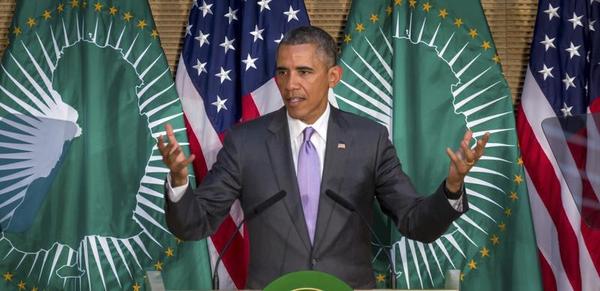
THE PRESIDENT: Thank you. (Applause.) Thank you so much. Madam Chairwoman, thank you so much for your kind words and your leadership. To Prime Minister Hailemariam, and the people of Ethiopia -- once again, thank you for your wonderful hospitality and for hosting this pan-African institution. (Applause.) To members of the African Union, distinguished guests, ladies and gentlemen -- thank you for welcoming me here today. It is a great honor to be the first President of the United States to address the African Union. (Applause.)
I'm grateful for this opportunity to speak to the representatives of more than one billion people of the great African continent. (Applause.) We're joined today by citizens, by leaders of civil society, by faith communities, and I'm especially pleased to see so many young people who embody the energy and optimism of today's Africa. Hello! Thank you for being here. (Applause.)
I stand before you as a proud American. I also stand before you as the son of an African. (Applause.) Africa and its people helped to shape America and allowed it to become the great nation that it is. And Africa and its people have helped shape who I am and how I see the world. In the villages in Kenya where my father was born, I learned of my ancestors, and the life of my grandfather, the dreams of my father, the bonds of family that connect us all as Africans and Americans.
As parents, Michelle and I want to make sure that our two daughters know their heritage -- European and African, in all of its strengths and all of its struggle. So we've taken our daughters and stood with them on the shores of West Africa, in those doors of no return, mindful that their ancestors were both slaves and slave owners. We've stood with them in that small cell on Robben Island where Madiba showed the world that, no matter the nature of his physical confinement, he alone was the master of his fate. (Applause.) For us, for our children, Africa and its people teach us a powerful lesson -- that we must uphold the inherent dignity of every human being.
Dignity -- that basic idea that by virtue of our common humanity, no matter where we come from, or what we look like, we are all born equal, touched by the grace of God. (Applause.) Every person has worth. Every person matters. Every person deserves to be treated with decency and respect. Throughout much of history, mankind did not see this. Dignity was seen as a virtue reserved to those of rank and privilege, kings and elders. It took a revolution of the spirit, over many centuries, to open our eyes to the dignity of every person. And around the world, generations have struggled to put this idea into practice in laws and in institutions.
So, too, here in Africa. This is the cradle of humanity, and ancient African kingdoms were home to great libraries and universities. But the evil of slavery took root not only abroad, but here on the continent. Colonialism skewed Africa's economy and robbed people of their capacity to shape their own destiny. Eventually, liberation movements grew. And 50 years ago, in a great burst of self-determination, Africans rejoiced as foreign flags came down and your national flags went up. (Applause.) As South Africa's Albert Luthuli said at the time, "the basis for peace and brotherhood in Africa is being restored by the resurrection of national sovereignty and independence, of equality and the dignity of man."
A half-century into this independence era, it is long past time to put aside old stereotypes of an Africa forever mired in poverty and conflict. The world must recognize Africa's extraordinary progress. Today, Africa is one of the fastest-growing regions in the world. Africa's middle class is projected to grow to more than one billion consumers. (Applause.) With hundreds of millions of mobile phones, surging access to the Internet, Africans are beginning to leapfrog old technologies into new prosperity. Africa is on the move, a new Africa is emerging.
Propelled by this progress, and in partnership with the world, Africa has achieved historic gains in health. The rate of new HIV/AIDS infections has plummeted. African mothers are more likely to survive childbirth and have healthy babies. Deaths from malaria have been slashed, saving the lives of millions of African children. Millions have been lifted from extreme poverty. Africa has led the world in sending more children to school. In other words, more and more African men, women and children are living with dignity and with hope. (Applause.)
And Africa's progress can also be seen in the institutions that bring us together today. When I first came to Sub-Saharan Africa as a President, I said that Africa doesn't need strongmen, it needs strong institutions. (Applause.) And one of those institutions can be the African Union. Here, you can come together, with a shared commitment to human dignity and development. Here, your 54 nations pursue a common vision of an "integrated, prosperous and peaceful Africa."
As Africa changes, I've called on the world to change its approach to Africa. (Applause.) So many Africans have told me, we don't want just aid, we want trade that fuels progress. We don't want patrons, we want partners who help us build our own capacity to grow. (Applause.) We don't want the indignity of dependence, we want to make our own choices and determine our own future.
