


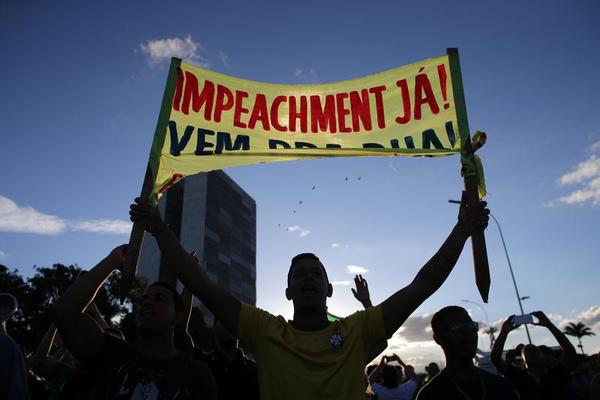
Brazil's political crisis took a bizarre turn on March 17 when President Dilma Rousseff, who has been fighting off impeachment demands for the last year, appointed her predecessor, Luiz Inacio Lula da Silva, to a Cabinet position. It was a transparent bid to help her political ally evade arrest on corruption charges. Rousseff's move was particularly brazen coming a day after 3 million peaceful demonstrators took to the streets in 100 cities to demand her resignation. It is clear that the ruling Workers' Party is prepared to fight dirty to protect Rousseff, Lula, and its grip on power -- no matter the cost to the nation.
Even before Rousseff was sworn in to serve a second four-year term on Jan. 1, 2015, prosecutors began to uncover evidence that dozens of members of the Workers' Party and other parties received kickbacks from bloated contracts issued by the state-owned oil company Petrobras. One Brazilian jurist called the ruling party a "criminal conspiracy." In testimony offered as part of a plea bargain, former Workers' Party Senate leader Delcidio Amaral told prosecutors that Rousseff sought to influence the ongoing investigation into systemic corruption.
Earlier this month, Federal judge Sergio Moro ordered Silva detained for questioning about his role in organizing illicit payments to support the Workers' Party's campaigns and members. Based on allegations that the former president received a ranch and a luxurious beachfront apartment for helping steer Petrobras contracts to party supporters, his indictment and arrest last week were considered imminent. Moro has unsealed evidence in the case against the former president, including recordings of phone conversations in which Rousseff and Silva allegedly discussed his appointment to the Cabinet to evade prosecution by the lower court.
With Silva as Rousseff's chief of staff, any case against him would be out of Moro's jurisdiction. Instead, he would be subject only to the Supreme Federal Court, most of whose members are Workers' Party loyalists. Immediately after Silva was sworn in at the presidential palace in Brasilia, federal judge Itagiba Catta Preta Neto issued an injunction seeking to block the appointment on the grounds that it would interfere with an ongoing federal investigation. Rousseff's allies expect that the injunction will not stand, and Silva will argue that he answers only to the Supreme Court.
The Workers' Party-packed Supreme Federal Court already has acted to shield Rousseff's administration. Last December, in an 8-3 ruling, the court scuttled the ongoing congressional inquiry into Workers' Party corruption -- allowing Rousseff's allies to stack a new impeachment committee in the Chamber of Deputies with her loyalists. The Supreme Court also gave the Senate, which is considered friendlier turf for Rousseff, the option of ignoring an impeachment referral from the lower house.
Although the sprawling corruption scandal is at the heart of Rousseff's woes, her mismanagement of the Brazilian economy has also agitated public opinion. The country slipped into a recession in 2014, and the economy is expected to contract by nearly 4 percent again this year, fomenting what some have called the worst conditions since the 1930s. Unemployment averaged 8.5 percent last year, up substantially from the prior year. The Brazilian currency, the real, has depreciated 4 percent against the U.S. dollar. Several international investment agencies have stripped the country of its investment grade rating.
The leftist Workers' Party and Rousseff, who has a background as a member of the militant National Liberation Command, are made of tough stuff. They seem indifferent to the damage this political crisis is doing to Brazil's economy and international reputation. Nor did they hesitate to hot-wire the constitution to interfere in congressional impeachment proceedings or to use their political muscle in the highest court in the land to shield their partisans from justice.
Rousseff's move to protect Silva may prove to be a decisive counterpunch to her opponents, or the final blow to her own viability as president. It remains to be seen whether Brazilians will tolerate Rousseff's defiant gambit to protect an allegedly corrupt crony -- a former president, no less. The spectacle of Workers' Party chieftains conspiring to manipulate a Cabinet post in order to elude justice and conceal corruption may provoke deep and broad popular rejection.
After this recent episode of shameless scheming, it is difficult to imagine Rousseff's government surviving if the population rises up in a prolonged national strike. The longer this crisis drags out, the worse the consequences for Brazil's democratic institutions, its struggling economy, and its 200 million people.
(AP photo)
