<?phpxml version="1.0" encoding="utf-8"?>
		<feed xmlns="http://www.w3.org/2005/Atom">
				<title>RealClearWorld - Articles</title>
				<link rel="alternate" type="text/html" href="http://www.realclearworld.com/articles/" />
				link rel="self" type="application/atom+xml" href="http://www.realclearworld.com/articles/atom.xml" />
				<id>tag:www.realclearworld.com,2009:/articles//4</id>					
				<updated>Mon, 16 Dec 2019 09:30:34 -0600</updated>
				<entry>
					<title>Making an Offer South Korea Can&#039;t Accept</title>
					<link rel="alternate" type="text/html" href="https://www.realclearworld.com/articles/2019/12/15/making_an_offer_south_korea_cant_accept_113128.html" />
					<id>tag:www.realclearworld.com,2009:/articles//113128</id>
					<published>2019-12-15T00:00:00Z</published>
					<updated>2019-12-15T00:00:00Z</updated>


					<summary>Washington last year asked Seoul for a 50% increase in financial support to cover some of the costs of basing 28,000 U.S. troops on South Korean territory. American and Korean negotiators eventually settled on a $925 million, one-year deal&amp;nbsp;that marked an 8.2% increase of South Korea&amp;rsquo;s contribution from the previous year. U.S. President Donald Trump, evidently dissatisfied, is now demanding&amp;nbsp;$5 billion, a 400% increase,&amp;nbsp;in the current round of cost-sharing talks.
What makes Trump&amp;rsquo;s $5 billion shakedown especially vexing is the fact that South Korea...</summary>
										
					<author><name>Eric Gomez</name></author><category term="Eric Gomez" scheme="http://www.sixapart.com/ns/types#category" /><content type="html" xml:lang="en" xml:base="http://www.realclearworld.com/articles/"><![CDATA[<p>Washington last year asked Seoul for a 50% increase in financial support to cover some of the costs of basing 28,000 U.S. troops on South Korean territory. American and Korean negotiators eventually settled on a $<a href="https://www.nytimes.com/2019/02/10/world/asia/us-south-korea-military-costs.html" data-auth="NotApplicable" data-ogsc="">925 million, one-year deal</a>&nbsp;that marked an 8.2% increase of South Korea&rsquo;s contribution from the previous year. U.S. President Donald Trump, evidently dissatisfied, is now demanding&nbsp;<a href="https://www.reuters.com/article/us-southkorea-usa-talks/us-south-korea-break-off-defense-cost-talks-amid-backlash-over-trump-demand-idUSKBN1XT0EN" data-auth="NotApplicable" data-ogsc="">$5 billion, a 400% increase</a><span data-ogsc="rgb(5, 99, 193)"><u>,</u></span>&nbsp;in the current round of cost-sharing talks.</p>
<p>What makes Trump&rsquo;s $5 billion shakedown especially vexing is the fact that South Korea has been a very good ally when it comes to burden sharing. Trump&rsquo;s insistence that U.S. allies ought to bear a greater burden for their defense, a sentiment expressed by many previous U.S. administrations, is reasonable, but some allies -- South Korea in particular -- do a good job of shouldering their fair share.</p>
<p>It&rsquo;s unclear how Trump came up with the $5 billion figure, but this seems to be a first push at getting an ally to pay his&nbsp;<a href="https://www.bloomberg.com/news/articles/2019-03-08/trump-said-to-seek-huge-premium-from-allies-hosting-u-s-troops" data-auth="NotApplicable" data-ogsc="">&ldquo;cost plus 50&rdquo; formula</a> -- the full cost of deployed troops plus 50 percent extra. Currently, South Korean payments go toward the salaries of their citizens employed as workers on U.S. bases and military construction expenses, though Seoul has not covered either of these two categories in full.&nbsp;<a href="https://www.defense.gov/explore/story/Article/1802202/us-south-korean-alliance-top-topic-at-pentagon/" data-auth="NotApplicable" data-ogsc="">According to the Pentagon</a>, the $925 million Seoul paid in 2019 represents about 41% of the &ldquo;day-to-day non-personnel-stationing costs&rdquo; for American forces in South Korea. This percentage implies that South Korea would pay roughly $2 billion if it covered these costs in full, which comes to less than half of Trump&rsquo;s demand.</p>
<p>South Korea is understandably flabbergasted by Trump&rsquo;s $5 billion figure. Criticism in the South Korean press that U.S. troops would constitute little more than a glorified mercenary force should Seoul cave to Trump&rsquo;s demand is fair, given that getting to $5 billion would probably require South Korea to pay the troops&rsquo; salaries.&nbsp;<a href="https://www.reuters.com/article/us-southkorea-usa-talks/us-south-korea-break-off-defense-cost-talks-amid-backlash-over-trump-demand-idUSKBN1XT0EN" data-auth="NotApplicable" data-ogsc="">American negotiators walked out of initial talks</a>, throwing doubt on hopes that the United States would eventually step back from the figure and give Seoul some breathing room. Additional reactions in South Korea have emphasized the significant erosion in trust between the allies as a result of Trump&rsquo;s demand. Song Min-soon, a prominent, mainstream former diplomat, even&nbsp;<a href="https://www.japantimes.co.jp/news/2019/11/12/asia-pacific/nuclear-weapons-cost-sharing-south-korea/#.XdRmU5NKgdU" data-auth="NotApplicable" data-ogsc="">raised the possibility of South Korea developing nuclear weapons</a>&nbsp;to be less dependent on the United States.</p>
<p>South Korea has consistently shown&nbsp;a serious commitment to burden-sharing and self-defense in recent years. In July 2017, president Moon Jae-in announced that he would increase military spending from 2.4% to 2.9% of gross domestic product during his time in office; most NATO countries don&rsquo;t spend 2% of their GDP on defense. About one-third of South Korea&rsquo;s military budget is devoted to the acquisition of highly capable, modern weapons systems. These include missile defense interceptors and radars, destroyers equipped with the Aegis battle management system, submarines, and the U.S.-made F-35 aircraft. Seoul also picked up 90% of the $10.8 billion tab for the construction of Camp Humphreys, America&rsquo;s largest overseas military base.</p>
<p>Trump&rsquo;s cost-sharing hardball with South Korea will have knock-on effects for alliance politics in 2020. Similar agreements with Japan and NATO are coming up for renewal, and negotiations on new terms will begin next year.&nbsp;<a href="https://foreignpolicy.com/2019/11/15/trump-asks-tokyo-quadruple-payments-us-troops-japan/" data-auth="NotApplicable" data-ogsc="">According to a report by&nbsp;<em>Foreign Policy</em></a>, the Trump administration plans on asking Japan to increase their contribution from $2 billion per year to $8 billion, an increase of 300%. On the Korean peninsula, a rift in the U.S.-South Korea alliance created by the $5 billion demand will almost certainly hinder cooperation on diplomacy with North Korea.</p>
<p>Alliances should not be sacrosanct. The United States should not be afraid to demand more financial, military, and political support from allies that have much more at stake in facing regional challenges than far-away Washington. However, South Korea has consistently demonstrated its willingness to grow its monetary and military contribution to its own defense. Requesting a 500% increase in host-nation support from such an ally&nbsp;is not a smart strategic move; it&rsquo;s thinly veiled extortion.</p>
<p><em>Eric Gomez is a policy analyst at the defense and foreign studies department of the Cato Institute. The views expressed are the author's own.</em></p><br/><br/>]]></content>
				</entry>
				<entry>
					<title>Argentina&#039;s Economic Sins Come Back to Bite</title>
					<link rel="alternate" type="text/html" href="https://www.realclearworld.com/articles/2019/12/10/argentinas_economic_sins_come_back_to_bite_113127.html" />
					<id>tag:www.realclearworld.com,2009:/articles//113127</id>
					<published>2019-12-10T00:00:00Z</published>
					<updated>2019-12-10T00:00:00Z</updated>


					<summary>The economic policies promised by Argentina&apos;s incoming leftist administration would add to the country&apos;s already excessive external and public sector debt levels.&amp;nbsp;
As a result, Buenos Aires is unlikely to reach a deal with the International Monetary Fund. That,&amp;nbsp;in turn,&amp;nbsp;could prevent an orderly debt restructuring and increase the risk of another default that could have ripple effects across the region.&amp;nbsp;


Editor&apos;s Note: This assessment is part of a series of analyses supporting Stratfor&apos;s 2020 Annual Forecast. These assessments...</summary>
										
					<author><name>Stratfor Worldview</name></author><category term="Stratfor Worldview" scheme="http://www.sixapart.com/ns/types#category" /><content type="html" xml:lang="en" xml:base="http://www.realclearworld.com/articles/"><![CDATA[<div class="EURn YjJk">
<div>
<div class="_1rhy">
<div class="fs18">
<ul>
<li><address>The economic policies promised by Argentina's incoming leftist administration would add to the country's already excessive external and public sector debt levels.&nbsp;</address></li>
<li><address>As a result, Buenos Aires is unlikely to reach a deal with the International Monetary Fund. That,&nbsp;in turn,&nbsp;could prevent an orderly debt restructuring and increase the risk of another default that could have ripple effects across the region.&nbsp;</address></li>
</ul>
</div>
</div>
</div>
</div>
<div class="_14hG article-body-wrap">
<div>
<div class="paragraph">
<div class="">
<div class="fs16">
<p><strong>Editor's Note: </strong><em>This assessment is part of a series of analyses supporting Stratfor's 2020 Annual Forecast. These assessments are designed to provide more context and in-depth analysis on key developments over the next quarter and throughout the year.</em></p>
<p>When he takes office on Dec. 10, <a href="https://worldview.stratfor.com/article/argentina-has-elected-leftist-president-now-what-fernandez-economy">Argentina's new president, Alberto Fernandez</a>,&nbsp;will quickly find his hands tied, having raised expectations of simultaneously increasing government spending while lowering inflation. But while those campaign promises may have earned Fernandez the seat, the International Monetary Fund (IMF) and the many other foreign creditors who keep Argentina's lights on won't tolerate such visions of grandeur. Without a long-term program to solve the country's economic crisis, or the cash to make good on its heaping pile of&nbsp;IOUs, Buenos Aires will likely be forced to once again default on a large part of its debt next year,&nbsp;sending the already impoverished country even deeper into a tailspin.&nbsp;</p>
<h3>Old Economic Habits Die Hard</h3>
<p>Argentina is again up to old tricks that led to eight previous defaults in the country's 200-year history. After settling in 2017 with holdout creditors from its most recent&nbsp;default, President Mauricio Macri's administration began borrowing heavily in foreign currencies to help finance government budget deficits &mdash; a dangerous move economists refer to as "original sin." As a result, the country's external debt grew by $100 billion to $285 billion between 2016 and 2018, nearly doubling as a percentage of gross domestic product (GDP) to 54 percent. The debt incurred by Argentina's government and public sector to finance its domestic budget deficits, meanwhile, rose from less than 53 percent of GDP to 77 percent in the same period.&nbsp;</p>
<p>Given this growing twin debt burden, the country's current financial obligations extend far beyond Buenos Aires' ability to pay. In June, the IMF estimated that Argentina would need $92 billion in external financial support to make good on its scheduled repayments in 2020. In contrast, available resources are insufficient, making both the external debt and the public debt, including domestic obligations, unsustainable. For at least the next three to five years, <a href="https://worldview.stratfor.com/situation-report/argentina-government-seeks-restructure-debt">Argentina is expected to lack either the resources or the&nbsp;ability</a> to earn sufficient funds needed to make repayments, while also financing necessary imports, such as refined oil and parts for domestic industrial production. Of the Central Bank of Argentina's $43 billion in foreign currency reserves, the bank's usable net reserves likely don't exceed $10 billion &mdash; less than 15 percent&nbsp;of the total loan repayments Buenos Aires will owe&nbsp;in 2020 alone.</p>
<p>Amid the uncertainty, investors have started pulling their assets from the country. And this, combined with Argentina's&nbsp;meager domestic savings and soaring inflation, have continued to stymie economic growth. The private sector's distrust of the local currency has also made the Argentine economy highly dollarized, with people seeing U.S. currency as a haven&nbsp;for saving and inflation protection. Nearly 80 percent&nbsp;of the government's domestic debt, for example, is owed in&nbsp;U.S. dollars. Unsurprisingly, as Argentina's economy continues to spiral, both poverty and unemployment levels have skyrocketed. And while intended to fight inflation, the prohibitively high interest rates set by the Central Bank of Argentina rates have only appreciated the exchange rate for the peso even further, another obstruction to&nbsp;the economic growth needed to grow incomes and avoid greater social unrest.</p>
<h3>A Return to Populism&nbsp;</h3>
<p>Macri had <a href="https://worldview.stratfor.com/situation-report/argentina-macri-announces-plan-soften-impact-economic-crisis">initially opted for a gradual approach</a> to the reduction of the country's deficit and accumulation of debt. But financial markets started to catch on that the country was up to its old habit of racking up foreign currency debt without fixing its domestic economic problems. Macri resorted to IMF support in 2018, but a program front-loaded with money was back-loaded with <a href="https://worldview.stratfor.com/article/argentina-economic-crisis-portends-political-chaos-macri-fernandez-presidential-elections">unpopular fiscal cutback measures that ultimately led to his political demise</a>.</p>
<p>Fernandez will step into this economic maelstrom amid great uncertainty over his leftist economic policies. Fernandez's recently unveiled Cabinet includes Martin Guzman, a professional economist but&nbsp;severe critic of Macri&rsquo;s economic policy, who will serve as an economy minister. A former official of the Fernandez de Kirchner government, meanwhile, will serve as the head of the country's central bank.&nbsp;Fernandez's repeated vague assertions that the debt will be paid, caveated by the need to avoid further "austerity,"&nbsp;have fueled anxiety among financial markets. More recently, Fernandez also said public finances were in a "deplorable state"&nbsp;and that Argentina would repay debt only when the economy is growing. But if and when that growth will occur, of course, remains fair from certain. &nbsp;&nbsp;</p>
<p>In turning Argentina's economy around, Fernandez also has the added challenge of minimizing the role of radical Peronistas, including his vice president-elect, the former president Cristina Kirchner de Fernandez and former Economy Minister Axel Kicillof, whose hard-line push for more social spending increasingly resonates among the country's impoverished citizenry. Both have taken confrontational approaches toward creditors in the past and will probably do so again if given the opportunity.</p>
<h3>Implications for the IMF Loan</h3>
<p>With Argentina's debt selling at distressed prices in secondary markets, many creditors are probably steeled at least to extend their maturities. But they won't agree to be scalped by accepting large value reductions of their debt, or acting without assurances that Argentina will eventually pay most of what it owes. The IMF's endorsement of Argentina's economic policies would provide such an assurance by signaling that Buenos Aires will not repeat its past mistakes ad infinitum, and will thus be key to ensure creditor cooperation.</p>
<p>To salvage its $57 billion agreement with Argentina&nbsp;(its largest-ever loan), the IMF will probably accept some increased social spending in the short term&nbsp;and may potentially even allow the country to rack up a small fiscal deficit to boost domestic goods and services spending for at least the next year. It will not, however, accept a program built on unrealistically optimistic economic projections. Instead, the IMF will demand a credible long-term plan consistent with the path Macri's administration initially promised. In addition to addressing fiscal and structural economic imbalances that impede debt sustainability, such a plan would also likely demand reining in public spending to an amount that can be financed without assuming "immaculate"&nbsp;economic growth with fantasy projections of increased tax revenues.&nbsp;</p>
<p>Fernandez's vision of long-term higher spending and, by implication, increased primary budget deficits will thus prove unacceptable to the IMF. Other, potentially problematic policies that Fernandez and his advisers have suggested include:&nbsp;</p>
<ul>
<li><strong>Increasing wages while extending price controls, and relying only on "social pacts"&nbsp;to discourage further wage and price increases. </strong>This would encourage black-market activities by ignoring pent-up inflation, further discouraging domestic investment.</li>
<li><strong>Promoting exports to improve the exchange rate of the peso without a hard peg to restrain inflation. </strong>The IMF would view this as currency manipulation, which is prohibited by its Articles of Agreement. Such a move would also result in further flight from pesos into U.S. dollars or euros, increasing the risk of a government default since the majority of its debt obligations are in dollars (with its revenues mainly in pesos).</li>
<li><strong>Financial repression by artificially lowering interest rates.</strong> This would threaten the health of the country's banking system, much of which is funded in U.S. dollars. It's possible Fernandez would reinstate a Kirchner-era requirement for banks to buy government debt, regardless of the return.</li>
<li><strong>A permanent tax on exports to raise revenue. </strong>Macri's export taxes were intended to be only temporary. While easy to administer, a permanent tax would not only further discourage exports but also create multiple exchange rates that the IMF usually opposes.&nbsp;</li>
</ul>
<h3>A Dangerous Domino Effect</h3>
<p>Fernandez does not have the luxury of time. The budget he'll inherit from the Macri administration is currently in near balance, but not for long. Many debt payments since September are past-due and new ones will follow quickly, including a massive $570 million interest payment owed in January. Some hedge funds in New York and London are already suing Buenos Aires to recover unpaid claims connected with the country's last debt restructuring in 2005. And further action to seize Argentine assets in the coming year is likely.&nbsp;</p>
<p>But despite these risks, Fernandez and his political allies are unlikely to have a sudden change of heart that puts the IMF program back on track in the medium term. Instead, Fernandez is more likely to break decisively with his business-friendly predecessor and reinforce his populist credentials by substantially increasing social spending and subsidies, killing any potential IMF deal &mdash; and with it, any hopes for increased cooperation with other foreign creditors. As a result, the new president risks leaving Argentina with budget deficits that can't be financed without default or other disruptive actions, such as forcing banks to buy government debt or forcing conversion of private dollar bank accounts into pesos.&nbsp;</p>
<p>A default could shut Argentina out of international financial markets for the foreseeable future by reinforcing its reputation as an unreliable debtor. It could also have regional spillovers at a time when Latin American growth is among the most sluggish globally. Argentina's increased default and credit risks could spill over into higher borrowing costs and added budget expenses for countries such as Brazil that are already facing tight domestic constraints amid heightened social unrest. Moreover, with Argentina's trade policies becoming more protectionist, added tensions within the South American trade bloc Mercosur could cause the already troubled union to collapse entirely, and inhibit interregional trade even further.</p>
<p>But if there's one lesson Fernandez and his fellow Peronist populists have learned from Argentina's never-ending cycle of debt defaults, it's that it's easier to force creditors to bear the burden of economic adjustment, than it is to make the tough political choices needed to actually address the country's perennial economic weaknesses. And while that lack of political will might prove convenient in the short term, a looming return to the disruptions of the Kirchner years could very well throw Argentina right back into financial chaos.</p>
</div>
</div>
</div>
</div>
</div><br/><br/>]]></content>
				</entry>
				<entry>
					<title>Kashmir Crisis Calls for U.S. Engagement</title>
					<link rel="alternate" type="text/html" href="https://www.realclearworld.com/articles/2019/12/09/kashmir_crisis_calls_for_us_engagement_113126.html" />
					<id>tag:www.realclearworld.com,2009:/articles//113126</id>
					<published>2019-12-09T00:00:00Z</published>
					<updated>2019-12-09T00:00:00Z</updated>


					<summary>Pakistan and India have jointly administered the Jammu and Kashmir region since 1948, when the United Nations negotiated a cease-fire between the two South Asian countries and decreed that the Kashmiri people would determine their own future. That there is a hotly disputed region adjoining two nuclear-armed adversaries should be momentous enough to engage the United States in resolving the matter.&amp;nbsp;
Not only could the conflict go nuclear, but American security and economic interests are also at risk. Both India and Pakistan are important trading partners, and Afghanistan -- once a...</summary>
										
					<author><name>Chris Shays &amp; George Hochbrueckner</name></author><category term="George Hochbrueckner" scheme="http://www.sixapart.com/ns/types#category" /><content type="html" xml:lang="en" xml:base="http://www.realclearworld.com/articles/"><![CDATA[<p data-ogsb="white"><span data-ogsc="black">Pakistan and India have jointly administered the Jammu and Kashmir region since 1948, when the United Nations negotiated a cease-fire between the two South Asian countries and decreed that the Kashmiri people would determine their own future. That there is a hotly disputed region adjoining two nuclear-armed adversaries should be momentous enough to engage the United States in resolving the matter.&nbsp;</span><span data-ogsc="black"></span></p>
<p data-ogsb="white"><span><span data-ogsc="black">Not only could the conflict go nuclear, but American security and economic interests are also at risk. Both India and Pakistan are important trading partners, and Afghanistan -- once a source of terrorist attacks against the United States and today the scene of America&rsquo;s longest war -- lies at the heart of the region.</span></span><span data-ogsc="black"></span></p>
<p data-ogsb="white"><span><span data-ogsc="black">The United States is at last showing interest, precipitated by a crisis.&nbsp;<a href="https://sherman.house.gov/media-center/press-releases/asia-subcommittee-to-hold-a-hearing-on-human-rights-in-south-asia-on" target="_blank" data-auth="NotApplicable" data-ogsc="">Recently</a>, the House Foreign Affairs Subcommittee on Asia, the Pacific, and Nonproliferation held a hearing on the state of human rights in Jammu and Kashmir. The hearing follows an Aug. 5 announcement by India that it would no longer adhere to the articles that gave Kashmir its special independent status. India then deployed tens of thousands of&nbsp;troops to the region. It imposed a communications lockdown and curfew on the nearly 8 million Kashmiris living in the disputed region. More recently, India has begun breaking up the region into smaller areas and annexing them.</span></span><span data-ogsc="black"></span></p>
<p data-ogsb="white"><span><span data-ogsc="black">Since then, even though no foreign or independent media are allowed to visit the region, stories of human rights violations, the arrests of thousands of Kashmiris, and torture have still trickled out, causing understandable concern -- including on Capitol Hill.</span></span><span data-ogsc="black"></span></p>
<p data-ogsb="white"><span><span data-ogsc="black">At the hearing,&nbsp;</span><span>Amnesty International's Francisco Bencosme noted, "It's completely unthinkable that you will detain children, political leaders and youth adults, close down all communication, put people under a curfew to bolster tourism in the region."<span></span><span data-ogsc="black"></span></span></span></p>
<p data-ogsb="white"><span><span data-ogsc="black">Many of the members of Congress at the Oct. 22 hearing expressed concern and outrage at the situation. Chairman Brad Sherman conceded that Kashmir was &ldquo;the most dangerous geopolitical flash-point in the world.&rdquo; Yet, escalating tensions on the Line of Control separating Indian and Pakistani administered Kashmir, including Indian troops firing across it, continue unabated.</span></span><span data-ogsc="black"></span></p>
<p data-ogsb="white"><span><span data-ogsc="black">When we served in the U.S. Congress, the United States understood the meaning and value of promoting and protecting freedom, democracy, and human rights. If these values are weak anywhere, they are weak everywhere. The situation in Kashmir represents a breakdown in those values.</span></span></p>
<p data-ogsb="white"><span><span data-ogsc="black"><span>In fairness, President Donald Trump and members of Congress from both sides of the aisle have encouraged a peaceful solution. President Trump has made it known more than once -- including during meetings this summer with Pakistani Prime Minister Imran Khan and with Indian Prime Minister Narendra Modi -- that he was ready to help de-escalate tensions and mediate a settlement of this longstanding issue</span></span></span></p>
<p><span><span data-ogsc="black">Kashmir is not just an internal matter for one or the other country to manage.</span><span>&nbsp;<span>Kashmir has already sparked wars between India and Pakistan. It can easily animate another one -- but this time a conflict between nuclear-armed nations. This at a time when our own presence in the region is in flux as we try to end the war in Afghanistan.<a></a>&nbsp;&nbsp;The situation in Kashmir -- and its long-term solution -- deserves a multilateral approach, led by the United States.</span></span></span><span data-ogsc="black"></span></p>
<p data-ogsb="white"><span><span data-ogsc="black">The recent hearing in Congress at least gets a toe in the water. But many questions remain, perhaps the most critical and urgent being&nbsp;<span>whether the Trump administration has undertaken a serious analysis of the implications of an armed conflict between Pakistan and India. Pakistan has already stated its willingness to defend Kashmiris, while India has made statements regarding its first-use policy of nuclear weapons.</span>&nbsp;<span>Are we really going to ignore the most militarized region on earth?</span></span></span><span data-ogsc="black"></span></p>
<p data-ogsb="white"><span><span data-ogsc="black"><span>We hope not. America&rsquo;s leadership is under threat and being questioned. Our diplomatic, moral, economic and political leadership is being undermined by a thousand little cuts. As&nbsp;<em>The New York Times&nbsp;</em>noted in its recent&nbsp;<a href="https://www.nytimes.com/2019/10/02/opinion/editorials/kashmir-india-pakistan-un.html" target="_blank" data-auth="NotApplicable" data-ogsc=""><span data-ogsc="rgb(5, 99, 193)">editorial&nbsp;</span></a>on Kashmir, one reason behind the United Nations&rsquo; lack of action on Kashmir is an overall decline in American leadership.</span></span></span><span data-ogsc="black"></span></p>
<p data-ogsb="white"><span><span data-ogsc="black">Let&rsquo;s hope Kashmir becomes a symbol of America&rsquo;s moral influence on the world, not another example of the failure of our leadership.</span></span></p>
<p data-ogsb="white"><em>First elected in 1987, Representative&nbsp;<strong>Chris Shays</strong>&nbsp;served as the Congressman for the Stamford, Conn., area for more than 20 years. He and his wife&nbsp;Betsi, both former members of the Peace Corps stationed in Fiji, maintain their dedication to public service today,&nbsp;with Shays having served&nbsp;on the board of directors of a management and technology consulting firm, as well as in a commissioner role with UNESCO, since his time in Washington. <span data-ogsc="black">From the Long Island area, Representative&nbsp;</span><strong data-ogsc="black">George&nbsp;Hochbrueckner&nbsp;</strong><span data-ogsc="black">first served as Congressman for New York&rsquo;s First District in 1986. Retiring from his elected official responsibilities after nearly a decade on Capitol Hill and five terms in the New York State Assembly, Hochbrueckner&nbsp;still works to bring accessibility to Washington as a policy consultant and continues to give back to the community. The views expressed are the authors' own.</span></em></p><br/><br/>]]></content>
				</entry>
				<entry>
					<title>How the Energy World of Tomorrow Reshapes Geopolitics</title>
					<link rel="alternate" type="text/html" href="https://www.realclearworld.com/articles/2019/12/09/how_the_energy_world_of_tomorrow_reshapes_geopolitics_113125.html" />
					<id>tag:www.realclearworld.com,2009:/articles//113125</id>
					<published>2019-12-09T00:00:00Z</published>
					<updated>2019-12-09T00:00:00Z</updated>


					<summary>To understand geopolitics we need to understand power, which in turn derives from the perception of national wealth. The way nation-states use their wealth to defend their interests helps to shape our perception of their place and their role in the world. Soil resources are among the most important elements of wealth. But it is the human being who evaluates those elements -- as such, the human resource is superior to them.
Hydrocarbons played a vital role in World War II, and the use of energy has evolved in the decades since. In order to understand the way the energy sector is perceived...</summary>
										
					<author><name>Antonia Colibasanu</name></author><category term="Antonia Colibasanu" scheme="http://www.sixapart.com/ns/types#category" /><content type="html" xml:lang="en" xml:base="http://www.realclearworld.com/articles/"><![CDATA[<p dir="ltr"><span>To understand geopolitics we need to understand power, which in turn derives from the perception of national wealth. The way nation-states use their wealth to defend their interests helps to shape our perception of their place and their role in the world. Soil resources are among the most important elements of wealth. But it is the human being who evaluates those elements -- as such, the human resource is superior to them.</span></p>
<p dir="ltr"><span>Hydrocarbons played a vital role in World War II, and the use of energy has evolved in the decades since. In order to understand the way the energy sector is perceived today, as well as the geopolitical consequences of this perception, we must understand how World War II redefined the world itself. The strategies developed by the two opposing world powers during the Cold War, inspired by the lessons of the Second World War, were based on access to energy resources and the use thereof. This is no longer the case today, although energy security remains an important part of shaping a national strategy. What has changed is the way we perceive reality today. We&rsquo;re increasingly individualistic, which grows our importance as human beings and communities in defining the role of the nation-state in an increasingly &ldquo;not-so-global&rdquo; world.&nbsp;&nbsp;</span></p>
<p dir="ltr"><strong>Energy nodes: redefining the world</strong></p>
<p dir="ltr"><span>The end of World War II also marked the end of longstanding European empires. Among the winners, the United States was the most powerful. Their economy was the least affected by the global conflagration. From the military point of view, the United States remained the only naval force of global significance. If before the war America&rsquo;s geographical position had required it to invest in the naval capabilities needed to secure its borders, after the war, the United States made of this need a strategic advantage. The United States understood that in order to secure its borders, it would now have to secure the world's oceans.</span></p>
<p dir="ltr"><span>In fact, Washington has since taken control of global trade networks. The security element of that control was the global presence of the U.S. fleet, and this was reinforced by the commercial policies derived from the Bretton Woods agreements that founded a new economic system. During the Cold War, if a country wanted to benefit from the free-trade system, it had to cooperate with the United States on a security level. Such collaboration underwrote the foundation of NATO and that alliance's international partnership networks. Thus, Bretton Woods was not just about the economy. It was more than anything about security. The United States used its position to anchor lasting alliances for a war with the Soviet Union -- a war that seemed likely to occur.</span></p>
<p dir="ltr"><span>The economic system established at Bretton Woods not only made it possible for the West to win the Cold War, but it also supported the development of NATO. Because prosperity was created through the free-trade system, that system is what symbolically won the war. Symbols matter: They usually live longer than they are programmed to live in policy papers. Thus, the victorious system of free trade constituted the basis for the globalization that ensued. Through trade networks that established deep links among communities, the risk of renewed global conflict would be reduced. This was the theory on which development models from the early 1990s were created.</span></p>
<p dir="ltr"><span>The commercial network during the Cold War was supported by an energy strategy that aimed to ease access to global energy resources for all U.S. allies. They had to be able to purchase energy relatively cheap -- and especially oil, the strategic raw material for the global production of goods and services. Before World War II, Western European countries got their energy via long-established colonial routes. After the war, and especially after the Suez Crisis of 1956, when America refused to help the British and French to maintain their control over a key colonial trade route, Western Europe became completely dependent on the United States. A new supply chain had been established by expanding the network of partnerships of the North Atlantic alliance. The allies used this network to try to block Soviet influence even as they expanded their own.&nbsp;</span></p>
<p dir="ltr"><span>With this, energy consumption increased. Throughout the Cold War, the relevant global producers worldwide were the Soviet Union -- whose exploitation of its resources was limited by difficult geography -- and the Middle East, which became the main source of oil for U.S.-allied countries. The United States, a world-class producer during World War II, became a net importer of hydrocarbons in 1973. The pressure imposed by the country&rsquo;s energy needs led to the establishment of strategic relations with states such as Saudi Arabia or Algeria, even though these nations did not share the democratic values and principles supported by Washington. Other Western countries followed suit.</span></p>
<p dir="ltr"><strong>Relaxation and optimism: energy security in transition</strong></p>
<p dir="ltr"><span>After the end of the Cold War, optimism for a better world grew. Free trade grew into something more than just a symbol that won the war -- it became the preferred system to increase national wealth. It was facilitated by digitalization, which was supported, in turn, by consumers' desire to transcend borders, looking for diminishing cultural differences. We all had the feeling, in the 1990s, that things could only get better. This feeling held despite the difficulties Russia and other states formerly in the Soviet orbit had in transitioning toward the new system. The transformative process was animated by faith.</span></p>
<p dir="ltr"><span>However, hoping for the better didn&rsquo;t improve the map and the infrastructure of oil supply -- this was not simplified. On the contrary, for both Europe and America, it became even more complex. In the early 2000s, the list of top exporters to the United States was made up of Canada, Mexico, Saudi Arabia, and Venezuela. Europe's dependence on Russia increased after the Cold War, even though for Western European countries, sources of supply diversified and included countries in North Africa or the Middle East. Hundreds of contracts had to be closed daily, both on the spot and secondary markets. Increasingly complex realities caused new commercial risks to proliferate.</span></p>
<p dir="ltr"><span>In 2001, the United States was the first country to wake up from the sweet dream of globalization. That was the moment when it became obvious that the end of the Cold War produced new risks. These risks had to be taken into account alongside those already present in commercial contracts and transactions on the global energy market. Large corporations, both private and state-owned, have had to manage more or less by themselves the political and security risks associated with the energy supply chain, becoming active players alongside states in the global energy market. This, together with the reality of an increasingly complex world characterized by accelerated economic development and limited resources, has helped drive a trend of increasing differences in wealth among nation-states and among social classes. It has also meant increasing energy demand, which translates to an increase in the oil price.</span></p>
<p dir="ltr"><span>At the same time, the founding members of the Bretton Woods system understood that while that system still existed, its operating conditions had changed. Under the new reality of the 2000s, states lost much of their control over the evolution of the oil price. The United States and American businesses realized that without U.S. coordination of economic flows, which was impossible in the new context, they might lose their competitive advantage in the energy market.</span></p>
<p dir="ltr"><span>The financial crisis that began in 2007 further exposed the problems of an unmanaged economic system. The rules seemed too few, the dependencies too intricate. The European Union, due to its enlargement toward the east, had begun to understand the problem of energy dependence on Russia. At the same time, China's emerging economy was becoming a major energy consumer. Russia, after significant investments in the development of the energy sector, was growing in importance as a producer, both regarding the European market, but also regarding the potential for cooperation with China.</span></p>
<p dir="ltr"><span>The rules that governed economic transactions were the same as those established at Bretton Woods, but the institutions and alliances established at that time and in the 1990s were becoming outdated. Old partnerships such as NATO no longer restrained new forms of cooperation. A collaboration based on economic interests was emerging between Russia and Germany. EU member states in Europe&rsquo;s east prioritized regional dynamics, while those in the west were occupied with internal socio-economic issues and deprioritized the EU integration process. In the Middle East, Turkey has tried to grow into a regional power, although it risks domestic instability. The United States has become increasingly concerned with domestic issues, even if it does remain globally active.</span></p>
<p dir="ltr"><strong>Resettlement and disarray</strong></p>
<p dir="ltr"><span>The world is changing again. If in 2001 business realized that the United States does not control the world anymore, since 2007 it has been apparent that American society has begun to change. The same thing has happened in Europe. European society has slowly started responding to the negative effects of globalization, similar to the Americans. Differing geographical and social contexts mean that these responses have differing influences on the energy sector.</span></p>
<p dir="ltr"><em>In America...</em></p>
<p dir="ltr"><span>The price of oil has increased from approximately $15 per barrel in 1989, to $20 in 2000, to $70 in 2007, and $100 in 2011. Invoices for just about everything else have mirrored these increases. When the cost of living goes up because the price of energy is rising and you have no opportunity to increase your income, you think about lowering your expenses. Moreover, when you see the rising price of oil and you hear that pollution is slowly killing the planet, you think it might be better to consume less energy. You might consider buying more energy-efficient products. As consumers make these demands, producers adapt their offers.</span></p>
<p dir="ltr"><span>Of course, big changes do not usually happen from one day to the next. But when an adaptation must be made suddenly, as in the context of an economic crisis, the restructuring can produce energy efficiency. Of course, government policies also help -- especially in countries where the safety net and social policies are important. This is not the case in the United States, where dynamism is the rule for adaptation, but it is the case in European states. Consumer habits do not modify radically except under conditions that create a favorable environment for change, usually generated by economic shocks, which require less time to impact society. These changes, while important, usually remain marginal and become an inspiration for future innovations. &ldquo;Marginal&rdquo; in a market of 2 million consumers can mean that a niche of several thousand people came into being. But in a market of more than 300 million consumers, a marginal change influences production worldwide. Changing consumption patterns at the individual level in the United States have produced just such a global change, to the degree of constituting a new starting point.</span></p>
<p dir="ltr"><span>More important is the way in which American society reacted to the challenges brought about by the financial crisis. For the first time after the end of the Cold War, society began to see America&rsquo;s global involvement as problematic for their country&rsquo;s stability. Among the sources of U.S. socio-economic problems, as perceived by the population, the political class&rsquo;s lack of concern for the needs of &ldquo;ordinary citizens&rdquo; became prominent. Increasingly, due to this perception, American foreign policy has begun to be seen as favoring the rich and powerful, while the "others," the vast majority of the electorate, see themselves to be contributors to the state&rsquo;s policies, rather than beneficiaries of them.</span></p>
<p dir="ltr"><span>The U.S. business environment in the energy sector was among the first to react to the new international context, which was beginning to emerge as early as 2001. Due to price pressures and increased security risk for the development of business in the international environment (for oil companies in particular), energy companies returned to domestic investments favoring new technologies. Technological progress in the energy field has meant an increase in shale oil production. From 6.8 million barrels per day in 2006, to 13 million barrels per day in 2015, shale oil production is expected to </span><a href="https://www.eia.gov/todayinenergy/detail.php?id=38152"><span>turn America from an importer</span></a><span> to a net exporter by 2020. This reality, together with the elements that have redefined consumption patterns in the world&rsquo;s most important energy market, creates a new basis for discussions on energy security.</span></p>
<p dir="ltr"><em>In Europe...</em></p>
<p dir="ltr"><span>The effects of the financial crisis have spread more slowly on the European continent. Nonetheless, they continue to produce long-term consequences. Socio-economic problems have returned nationalism to prominence. The feelings of the population toward its traditional political class, largely perceived as more or less damaged and corrupted, are similar to those seen in American society, but their effect is doubled. They not only influence the internal political life of member states, but also the operation and perception of the European Union. Brexit is just one of the effects of societal dissatisfaction, while EU integration serves as a mirror to it.</span></p>
<p dir="ltr"><span>The Energy Union started as a solution to Europe&rsquo;s energy dependence on Russia -- and more generally, as a response to the effects of long-term socio-economic problems. The project is currently suspended somewhere between the economic mathematics and political discussions. Energy infrastructure projects are not necessarily the result of political will at the EU level, but serve the national interests of member states. The classic example, in this sense, is the Nord Stream II project. Socio-political problems of different member states supported by different economic realities have resulted in the formation at the EU level of regional interest groups: the states of Eastern Europe vs those of Western Europe, founding states vs newcomer states, so-called core states vs peripheral states, and so on.</span></p>
<p dir="ltr"><span>In addition to these issues, the rise in the price of oil and the emergence of the politics of social responsibility and environmental protection, but also the increasing need for the population to grow its savings and rely less on the social contract, have fostered a similar attitude toward individual energy consumption. Like the American population, Europeans want to consume and pay less.</span></p>
<p dir="ltr"><strong>Shaping global disorder, from the market to the sovereign interest</strong></p>
<p dir="ltr"><span>In order to establish effective strategies in the new global context, we must understand the new attributes of the population. That&rsquo;s what defines the market. So </span><span>who is </span><span>the population? And </span><span>what does it look like</span><span>? Demographics must be taken into account in order to understand consumption patterns. One behaves in a certain way at 20 years old, otherwise at 40 and differently at 70. If the majority of a state&rsquo;s population is old, we can make a general geopolitical comment on the ways in which it can develop and on its specific security needs, which derive from the national interest but also depend on the demographic context. With an eye on these variables among others, we can anticipate how a state will position itself in the market of consumer goods, services, and energy.</span></p>
<p dir="ltr"><span>In the case of the two traditional energy consumers -- the United States and Europe -- demographics and other social factors indicate a natural decrease of energy consumption for the next 15 years. The older baby boomers started to retire in 2007. Their disappearance from the labor market will naturally yield a drop in energy consumption. Sure, the United States still has a healthy demography with a solid foundation, but consumption habits differ among generations. And due to the consumption habits of the children and grandchildren of baby boomers, trained in the idea of efficiency, the mentioned decrease becomes possible.</span></p>
<p dir="ltr"><span>In Europe, the West has already begun to face a demographic problem. Its effects may be observed in the socio-political sphere, especially in national immigration policies. In the West, the refugee crisis of 2015 added pressure to a demographic environment that was already troubled. Eastern Europe, though with a better demographic, is not far behind the West. The number of retirees </span><a href="https://appsso.eurostat.ec.europa.eu/nui/show.do?dataset=spr_exp_pens&amp;lang=en"><span>has grown rapidly</span></a><span> since 2013 in Germany, Italy, Greece, and France. </span><a href="https://www.imf.org/en/Publications/Departmental-Papers-Policy-Papers/Issues/2019/07/11/Demographic-Headwinds-in-Central-and-Eastern-Europe-46992"><span>Eastern Europe&rsquo;s pensions</span></a><span> are under pressure, and a large proportion of the young population is working outside the region. The causes are thus different from region to region, but market contractions are expected just the same. In the long term, the generational preferences fueled by technological progress will diminish the demand from traditional consumers and increase the need for innovation.</span></p>
<p dir="ltr"><strong>New risks on a new map</strong></p>
<p dir="ltr"><span>All of these factors lead to a redrawing of the global map -- both of its energy resources, and its energy security needs. Energy producers will continue to seek new markets -- less in an effort to reshape retail markets, and more in order to support their development models. They will target Asia, and especially China, but that region&rsquo;s consumption capabilities are limited. In a period of anemic economic growth, countries such as Russia and producers in the Middle East will go through periods of economic instability. These can end by reforming the national development models, but can also lead to internal or international conflict.</span></p>
<p dir="ltr"><span>The United States started to visibly withdraw from the role of global manager, including at the political level, as early as 2016. The protagonists of the 2016 presidential campaign were Donald Trump -- who proposed (and later put into practice) the renegotiation of all U.S. alliances and agreements -- and Hillary Clinton, who opposed the conclusion of all free trade agreements negotiated over the past 25 years, including those she had personally helped to negotiate. Moreover, the United States in 2015 reduced the presence of armed forces in operating theaters to values that </span><a href="https://fas.org/sgp/crs/natsec/R42738.pdf"><span>had not been seen since before 1941</span></a><span>. With domestic production on the rise, the United States no longer has the same interest in securing global energy-supply routes.</span></p>
<p dir="ltr"><span>While the U.S. interest has shrunk, the entire world is dependent on the system imagined, managed, and protected by the United States after the end of World War II at Bretton Woods. Its withdrawal means that the world&rsquo;s energy exporters will have to find markets and secure their supplies, while importers will have to find ways to secure and streamline their energy sources.</span></p>
<p dir="ltr"><span>The new context reshapes some of the key issues of global geopolitics. With the withdrawal of the United States from the Persian Gulf (unlikely, in full, in the very near future), conflict could escalate between Saudi Arabia and Iran. Both states have economic problems, and both are facing complicated processes of societal reform. Both have oil reserves, as well as complicated relationships with the United States. At the regional level, such a conflict would attract the participation of Turkey, a state that is trying to restore its role of regional power, a knot between Europe and Asia.</span></p>
<p dir="ltr"><span>If tensions escalate in the Middle East, it will affect not only the energy markets, but also global stability. The United States will remain involved where they have an interest in doing so, trying to minimize their exposure to risk. Given the possible scenarios in the Middle East, America will act as slowly as possible - and the other powers (especially Russia, but also Turkey) will try to prevent a complete U.S. exit.</span></p>
<p dir="ltr"><span>Due to the existing dependence between the United States and European states, one of Washington&rsquo;s geopolitical imperatives is to prevent conflict on the continent. It is possible that the aggressiveness of Russia, weakened by social problems and with an economy dependent on the price of oil, will continue. In order to discourage Russian aggression, the United States supports the establishment of a regional alliance in Eastern Europe. But a socio-political crisis in Russia would spread instability not only in its European neighborhood, but also in Central Asia. This scenario would attract the involvement of the United States, Europe, and Asia.</span></p>
<p dir="ltr"><span>In a twist of fate, America&rsquo;s calculated withdrawal, which is predicated on the fact that it can ensure the consumption of its own energy production, can be to its detriment in the long term. The multipolar world that emerged after 2007 does not empower the "regional players" by default -- they don&rsquo;t become simple network administrators. Nor does it add any new attributes that enhance their wealth and make them stronger or more responsible. Further, the withdrawal of America does not mean a dilution of its wealth or power. However, the current resettlement will produce consequences that involve more complex calculations for risk managers in the private space and for the operationalization of national strategies.</span></p>
<p dir="ltr"><strong>2019: a new beginning</strong></p>
<p dir="ltr"><span>2019 announced a world without the United States as "global policeman" -- but Washington will continue to be the greatest global power. Geography has become more fluid. The energy map no longer simply includes hydrocarbon producers and consumers. Innovation has modified pretty much everything relating to the energy supply chain, from the extraction process to the build-up of infrastructure and consumption. Through innovation, the human resource has become more valuable than any of the world&rsquo;s natural resources -- human intelligence and creativity determine the development of new models for the energy sector.</span></p>
<p dir="ltr"><span>However, ideological divisions and geographical differences persist and will deepen. Sovereignty, supported by nationalism, is increasing, not decreasing. Over the long term, the nation-state will likely evolve, reshaped by social perceptions of politics and by the rise of individualism. It is likely that new states will take shape and others will expand their area of control.</span></p>
<p dir="ltr">Physical borders will continue to be diluted by digitalization, while infrastructure, by connecting emerging social networks, will become part of physical geography. However, connectivity also creates claustrophobia and new fears, determined by the new challenges of society. As such, discussions about how human communities can reduce their dependencies will continue. And this will influence the way the energy sector in the world of tomorrow will develop, and the new types of geopolitical players that will emerge.</p>
<p><em>A version of this article was first published, in Romanian, in Energia, a policy book by Club Romania. Antonia Colibasanu is a senior geopolitical analyst and&nbsp;the Chief Operating Officer of Geopolitical Futures. She serves as an associate professor at the Regional Department of Defense Resources Management Studies located in Brasov, Romania, and has served as Honorary Adviser to Romania's energy minister. The views expressed are the author's own.</em></p><br/><br/>]]></content>
				</entry>
				<entry>
					<title>Turkey Tests the Waters in the Eastern Mediterranean</title>
					<link rel="alternate" type="text/html" href="https://www.realclearworld.com/articles/2019/12/08/turkey_tests_the_waters_in_the_eastern_mediterranean_113124.html" />
					<id>tag:www.realclearworld.com,2009:/articles//113124</id>
					<published>2019-12-08T00:00:00Z</published>
					<updated>2019-12-08T00:00:00Z</updated>


					<summary>Turkey is seeking to rewrite the rules in the Eastern Mediterranean. Last week, the Turkish government signed a maritime agreement with one of Libya&amp;rsquo;s two aspiring governments that strengthens Turkey&amp;rsquo;s position in the region. While legally ambiguous and fraught with logistical challenges, the deal represents Turkey&amp;rsquo;s latest effort to assert its dominance in the Eastern Mediterranean, to capitalize on the region&amp;rsquo;s energy resources and to restore the regional influence it lost over a century ago when the Ottoman Empire fell.
Catching Up in the Energy...</summary>
										
					<author><name>Caroline Rose</name></author><category term="Caroline Rose" scheme="http://www.sixapart.com/ns/types#category" /><content type="html" xml:lang="en" xml:base="http://www.realclearworld.com/articles/"><![CDATA[<p>Turkey is seeking to rewrite the rules in the Eastern Mediterranean. Last week, the Turkish government signed a maritime agreement with one of Libya&rsquo;s two aspiring governments that strengthens Turkey&rsquo;s position in the region. While legally ambiguous and fraught with logistical challenges, the deal represents Turkey&rsquo;s latest effort to assert its dominance in the Eastern Mediterranean, to capitalize on the region&rsquo;s energy resources and to restore the regional influence it lost over a century ago when the Ottoman Empire fell.</p>
<p><strong>Catching Up in the Energy Race</strong></p>
<p>We wrote earlier <a href="https://geopoliticalfutures.com/turkey-the-nato-summit-spoiler/">this week</a> about how Ankara was trying to create a buffer for itself to the south, with Operation Peace Spring in northeastern Syria. Turkey&rsquo;s efforts in the waters to its west have some related motivations, but they&rsquo;re also about cashing in on the Eastern Mediterranean&rsquo;s natural resources. For decades, Turkey has been excluded from benefiting from the oil and gas boom in the Eastern Mediterranean, which has an estimated 3.5 trillion cubic meters of natural gas and 1.7 billion barrels of crude oil. Greece, Cyprus, Egypt and Israel have been quicker and more successful than Turkey in identifying oil and gas fields along their coasts. After Israel identified two natural gas fields in 1999, for example, its government, alongside those in Greece, Cyprus and Egypt, was quick in the early 2000s to reach agreements delineating exclusive economic zones and to launch hydrocarbon exploratory patrols with multinational companies. This enables those countries not only to benefit financially from the discoveries but also to improve their energy independence.</p>
<p>Turkey has struggled to match its Mediterranean peers. Its seismic surveying vessels and deep-sea drills have cost Ankara over $1 billion in the past decade, and yet they have not yielded any oil or gas discoveries. Apparently devoid of such resources along its 994-mile (1,600-kilometer) Mediterranean coastline and with growing demand for and dependence on imported oil and gas, Turkey has been compelled to drill in waters that neighboring governments, namely Greece and Greek Cyprus, argue are part of their sovereign EEZs.</p>
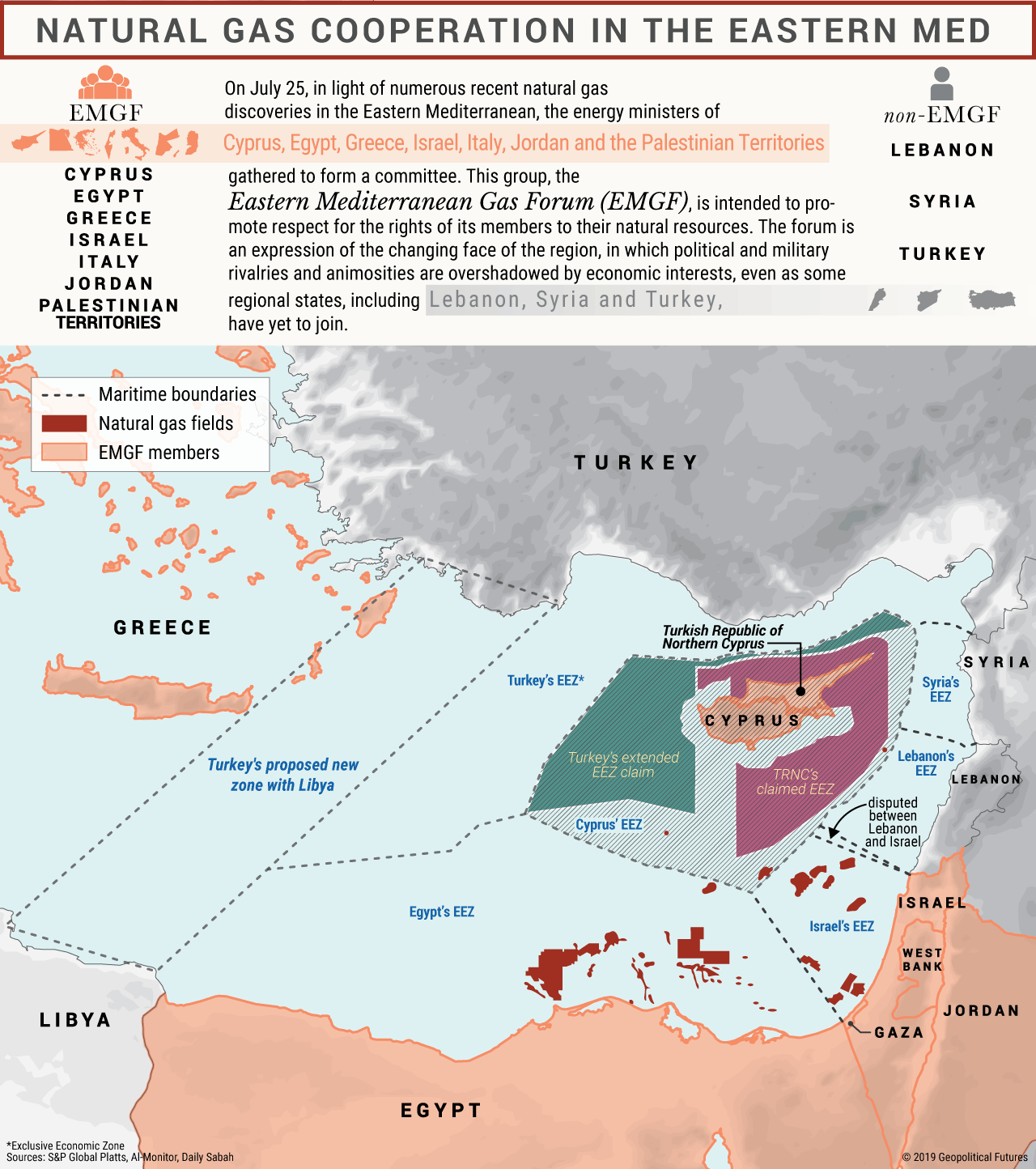
<p>Of course, this isn&rsquo;t just about fossil fuels. The rivalries in this region are long-standing, and countries like Greece are unenthused by the prospect of an old foe reemerging. Ankara&rsquo;s historical claims in the Aegean Sea and on Cyprus and certain Greek islands have alarmed its Mediterranean neighbors. Moreover, Turkey is not party to major international maritime legal agreements, such as the U.N. Convention on the Law of the Sea, giving it leeway in redefining economic zones and territorial waters in the region. Greece and other Mediterranean powers have forged a regional strategy to box Turkey out of their economic projects and regional collaborative frameworks. Take, for example, the EastMed Pipeline, a $7.36 billion underwater natural gas pipeline that will ship gas from Israeli and Cypriot fields across Cyprus and Greece to interconnector terminals in Italy. <a href="https://warontherocks.com/2019/04/squaring-the-triangle-why-turkey-and-the-eastmed-project-need-each-other/">EastMed will attract lucrative gas export agreements in Europe</a>, where the demand for energy is rising. Despite Turkish interests in the pipeline and the fact that the project intersects with Turkish waters, Mediterranean governments have shut Ankara out, perceiving it as an unwelcome rival &ndash; even after Turkey offered to offset the pipeline&rsquo;s underwater costs by having it run overland through Turkish territory (which would, admittedly, increase Turkey&rsquo;s leverage over gas transmission). Additionally, Israel, Egypt, the Palestinian territories, Jordan, Greece and Cyprus excluded Turkey from the<a href="https://geopoliticalfutures.com/natural-gas-cooperation-in-the-eastern-med/"> Eastern Mediterranean Gas Forum</a>, a cooperative platform for dialogue on natural resources. Turkey has therefore devised a counterstrategy to get on its rivals&rsquo; level as a Mediterranean power, becoming increasingly assertive in what it sees as its historical and legitimate territory.</p>
<p><strong>The Turkey-Libya Agreement</strong></p>
<p>On Nov. 27, Turkish President Recep Tayyip Erdogan met for two hours with the head of the U.N.-backed Libyan Government of National Accord, Fayez Sarraj. They emerged with two memorandums of understanding, one on security and military cooperation and another called the &ldquo;Restriction of Maritime Jurisdictions.&rdquo; Turkey has backed the GNA for years, partly because of its interest in Libya&rsquo;s oil reserves &ndash; estimated to be the largest in Africa and the 10th-largest globally &ndash; and partly to <a href="https://geopoliticalfutures.com/turkeys-libya-problem/">counter its Arab and other adversaries</a> (including Saudi Arabia, Egypt and Russia), which back the opposite side in the Libyan conflict, the Libyan National Army. In this respect, the Turkey-GNA defense agreement is no surprise; Ankara has a history of providing Sarraj&rsquo;s forces with drones, military equipment and financial resources to counter Khalifa Haftar&rsquo;s LNA in eastern Libya. However, it is the maritime agreement that demands special attention. The <a href="https://www.kathimerini.gr/1054856/gallery/epikairothta/politikh/sthn-katoxh-ths-a8hnas-to-mnhmonio-toyrkias-kai-livyhs-to-plhres-keimeno">agreement</a> demarcates new, &ldquo;equitable&rdquo; maritime zones, on which both sides exercise sovereignty. The Turkish government hinted that the maritime deal would lead to lucrative oil and gas contracts off the Libyan coast, hydrocarbon exploration activities that would also support Libya&rsquo;s economic recovery after its civil war, and even a Turkish base in western Libya to increase security cooperation.</p>
<p><img class="aligncenter size-full wp-image-154396" src="https://geopoliticalfutures.com/wp-content/uploads/2019/12/Eastern-Med-Disputes_zoom-out.png" border="0" alt="Natural Gas Cooperation in the Eastern Med" width="600" /><br /><em><a href="https://geopoliticalfutures.com/wp-content/uploads/2019/12/Eastern-Med-Disputes_zoom-out.png" data-width="1280" data-height="1444">(click to enlarge)</a></em></p>
<p>A Turkish diplomat released a map on Twitter shortly after the deal was forged, outlining Turkey&rsquo;s revised EEZ and <a href="https://twitter.com/CErciyes/status/1201423920936734720">continental coastline</a> (augmented by 30 percent). The new EEZ links up with Libya&rsquo;s EEZ, which was a strategic maneuver. On paper, the revised zone bifurcates Greece&rsquo;s EEZ by cutting across Crete&rsquo;s EEZ, and if enforced, it would effectively undercut any Greek attempt to forge its own delimitation agreements with Egypt, Israel and Cyprus. The deal also attempts to undermine the EastMed Pipeline, which marginalizes Turkey&rsquo;s regional strategy by cutting through its territorial waters and excluding it from export sales. The maritime deal enables Turkey to augment its maritime control in zones where the underwater pipeline is planned, threatening the pipeline&rsquo;s construction and operation. But more significantly, the maritime deal offers Turkey greater strategic depth, from North Africa to the Aegean Sea to the Gulf of Antalya, and it challenges Turkey&rsquo;s adversaries to respond to its reinterpretation of its sovereign maritime boundaries.</p>
<p>Turkey&rsquo;s strategy in the Mediterranean rests on two approaches. First, the Turkish government knows that it cannot match its adversaries and break out of its isolation alone, so it has sought out and found two partners in the region: the Turkish Republic of Northern Cyprus and the Libyan GNA. These allies are feeble, but that makes them exploitable, and for Turkey that&rsquo;s part of the appeal. The TRNC quite literally depends on Turkish support for its existence. The GNA&rsquo;s enemy has the support of Saudi Arabia, Russia and Egypt &ndash; some of Turkey&rsquo;s greatest rivals. Despite stepping up oil production and making progress toward resolvin<u>g</u> the country&rsquo;s liquidity crisis, the GNA has struggled to maintain control over key economic sectors and militia groups, which are rampant in the country. Furthermore, wavering American support for the GNA and indications of support for Haftar have left Sarraj&rsquo;s government insecure. Turkey deliberately accompanied the maritime deal with a series of security promises that gave Turkey rights to coastal Libyan drilling fields and authorized an enlarged Turkish naval presence at Libyan ports. It is important to note, however, that the revised EEZ was demarcated along coastal areas outside of the GNA&rsquo;s control, which will be a logistical challenge for Turkey. This situation could exacerbate the civil war and prove to be a significant flashpoint, where Turkey will seek to strong-arm the GNA and Egypt, and Eastern Mediterranean allies will be more motivated to support LNA forces.</p>
<p>The second element of Turkey&rsquo;s Mediterranean strategy relies on the use of a historical narrative to assert Turkish rights in the region. Turkish officials have begun to reference the &ldquo;Blue Homeland,&rdquo; the concept that the eastern coast of Crete and half of the Aegean Sea &ndash; nearly 18,000 square miles &ndash; belong to Turkey. The Blue Homeland is popular among neo-Ottomanists in Erdogan&rsquo;s Justice and Development Party, as it harkens back to the peak of the empire&rsquo;s geopolitical power. Erdogan even posed in front of a map of the Blue Homeland when presenting at the National Defense University. Of course, Ankara is aware that such concepts violate Greek sovereignty and that any attempt at military consolidation could spark an international crisis. But legality is beside the point &ndash; Turkey&rsquo;s ultimate objective is psychological: imposing permanent Turkish influence in the region and notifying its Mediterranean peers that it is here to stay.</p>
<p>Turkey&rsquo;s agreement with Libya has sparked outrage among its Mediterranean rivals, who accuse Ankara of violating the Convention on the Law of the Sea and the jurisprudence of existing EEZs. Regional governments have been quick to dismiss the deal as legally invalid and &ldquo;ridiculous,&rdquo; and questions have been raised about whether the GNA was even empowered to make the deal in the first place, since Sarraj does not have the legal authority to sign any accord outside the scope and purview of the U.N.-brokered Skhirat Agreement that established the government. But Greece and Cyprus have expressed deep concern about the possible ramifications of the maritime deal. Cyprus has appealed to the International Court of Justice to help it defend its claims to its offshore natural resources. Greece has launched a campaign to garner support from the West, making appeals to both the European Union and NATO, as well as accelerating negotiations with Egypt on their own EEZ delimitation agreement.</p>
<p>Turkey&rsquo;s strategy in the Eastern Mediterranean is about shifting the balance with regional powers and asserting a new psychological reality regarding Turkish influence and sovereign rights in the region. It fits well into Turkey&rsquo;s broader ambition to develop a bolder, more visible,<a href="https://geopoliticalfutures.com/turkey-in-the-bigger-picture/">self-sufficient foreign policy</a>. This policy has Ankara probing in the Balkans, Central Asia, the Levant and the Caucasus, but the Eastern Mediterranean will continue to be where Turkey is playing its most high-stakes game.</p><br/><br/>]]></content>
				</entry>
				<entry>
					<title>Confusion, Unforced Errors, and the Costs of Having No Strategy</title>
					<link rel="alternate" type="text/html" href="https://www.realclearworld.com/articles/2019/12/05/confusion_unforced_errors_and_the_costs_of_having_no_strategy_113123.html" />
					<id>tag:www.realclearworld.com,2009:/articles//113123</id>
					<published>2019-12-05T00:00:00Z</published>
					<updated>2019-12-05T00:00:00Z</updated>


					<summary>Presidents are said to lack an effective grand strategy when they allow the ends and means of American foreign policy to drift out of balance. Walter Lippmann called it solvency: the idea that the United States must not entertain international ambitions that outstrip available resources. To pursue an insolvent strategic approach, Lippmann argued, would be to saddle the nation with an intolerable burden of risk. At some point, all overcommitments are exposed as unfulfillable promises -- jarring moments of truth that spark domestic recrimination and international instability in equal...</summary>
										
					<author><name>Peter Harris</name></author><category term="Peter Harris" scheme="http://www.sixapart.com/ns/types#category" /><content type="html" xml:lang="en" xml:base="http://www.realclearworld.com/articles/"><![CDATA[<p>Presidents are said to lack an effective grand strategy when they allow the ends and means of American foreign policy to drift out of balance. Walter Lippmann called it solvency: the idea that the United States must not entertain international ambitions that outstrip available resources. To pursue an insolvent strategic approach, Lippmann argued, would be to saddle the nation with an intolerable burden of risk. At some point, all overcommitments are exposed as unfulfillable promises -- jarring moments of truth that spark domestic recrimination and international instability in equal measure.</p>
<p>Under Trump, America&rsquo;s grand strategy is more than just insolvent: it&rsquo;s non-existent. Not only has the administration failed to find an alignment between ends and means -- there isn&rsquo;t even agreement over what the ends and means ought to be. Does the President want to ensure U.S. primacy or shrink America&rsquo;s global role? Does he believe in militarism or retrenchment? Is the United States interested in making the world economy fairer (&ldquo;leveling the playing field&rdquo;) or abandoning globalization altogether? The answers to these questions seem to change with alarming frequency.</p>
<p>Not surprisingly, Trump&rsquo;s erratic approach to international affairs has made it difficult for the United States to maintain its alliances with foreign nations. From Europe to East Asia to the Middle East, several of America&rsquo;s allies seem to have concluded that their long-term security interests might no longer depend upon closeness with the United States. French President Emmanuel Macron&rsquo;s candid remarks that the NATO alliance has been left &ldquo;<span><a href="https://www.economist.com/europe/2019/11/07/emmanuel-macron-warns-europe-nato-is-becoming-brain-dead">braindead</a></span>&rdquo; by Trump are only the latest example of this growing sentiment.</p>
<p>How could it be otherwise? During his first year in office, Trump famously <span><a href="https://www.theatlantic.com/international/archive/2017/05/trump-declines-to-affirm-natos-article-5/528129/">declined</a></span> to endorse NATO&rsquo;s mutual defense clause despite being given multiple opportunities to do so, only <span><a href="https://www.vox.com/world/2017/6/9/15772292/trump-article-5-nato-commit">relenting</a></span> because of sustained pressure from his exasperated team of advisers. More recently, he has ordered the withdrawal of <span><a href="https://www.cnn.com/2019/11/27/politics/trump-nato-contribution-nato/index.html">U.S. funding</a></span> for NATO&rsquo;s collective budget, has called the U.S.-Japan alliance &ldquo;<span><a href="https://www.reuters.com/article/us-g20-japan-trump/trump-says-unfair-defense-treaty-with-japan-needs-to-be-changed-idUSKCN1TU0AJ">unfair</a></span>,&rdquo; and has insisted that South Korea pay an exorbitant <span><a href="https://nationalinterest.org/blog/korea-watch/sma-negotiations-why-trumps-demand-5-billion-south-korea-wrong-98337">$5 billion</a></span> in exchange for U.S. forces being based on the Korean Peninsula. These are pretexts, perhaps, for curtailing America&rsquo;s commitments to its most important allies in Europe and the Asia-Pacific.</p>
<p>The problem is not that Trump is <em>uniformly</em> hostile to America&rsquo;s strategic partners. If this were the case, foreign leaders would at least have a clear sense of U.S. foreign policy in the age of Trump. But Trump is no isolationist. He has ordered thousands more U.S. troops to bolster the defenses of nations such as <span><a href="https://www.nytimes.com/2019/10/11/world/middleeast/trump-saudi-arabia-iran-troops.html">Saudi Arabia</a></span>, the <span><a href="https://www.msnbc.com/am-joy/watch/trump-approves-troop-deployment-to-saudi-arabia-uae-69621317602">United Arab Emirates</a></span>, and <span><a href="https://www.dw.com/en/trump-confirms-more-us-troops-will-be-sent-to-poland/a-50554660">Poland</a></span>, and he has even suggested the conclusion of a new mutual defense treaty with <span><a href="https://www.reuters.com/article/us-usa-israel-defense/trump-floats-possible-defense-treaty-days-ahead-of-israeli-elections-idUSKBN1VZ0FM">Israel</a></span>. These are not the actions of a President who rejects the notion of collective security altogether.</p>
<p>Rather, the trouble with Trump is that he has not articulated a clear and reliable vision of how U.S. alliances serve America&rsquo;s self-interest. Are some alliances worth defending as ends in themselves? If so, which, and why? If not, are collective security arrangements at least an appropriate means by which the United States should pursue its core national interests? How valuable are they in comparison to unilateral applications of U.S. power? Three years after Trump scored his shock triumph in the Electoral College, no foreign leader can be sure of the answers to these questions.</p>
<p>The truth is that there are no general principles that guide Trump&rsquo;s approach to alliances. There are some strategic partnerships that Trump views as extensions of his personal friendships with foreign leaders -- those with Israel and Saudi Arabia, for example. At other times, Trump treats allies as little more than tributaries of a U.S. Empire, as with Japan and South Korea. And then there are those allies that are having to get used to the idea that President Trump simply does not care a great deal about their security.</p>
<p>Trump&rsquo;s failure to offer reassurance about the role of alliances in American grand strategy will severely weaken U.S. power and influence in the world for a long time to come. Even if this is not readily apparent at the moment, the problem will confront US leaders at some point. This will come about either when the United States faces an international crisis that it cannot manage alone, or when some future U.S. leader tries to implement a coherent grand strategy but finds themselves conspicuously lacking that unique power asset that every president since Harry S. Truman has deemed invaluable: an unparalleled system of formal and informal alliances to anchor and amplify U.S. power in every part of the globe.</p>
<p>Even those who scoff at the &ldquo;liberal&rdquo; international order and advocate a less activist role for the United States should be desperately unhappy with Trump&rsquo;s mishandling of U.S. alliances. While realists and restrainers often balk at the steep costs that go along with sustaining the largest network of alliances the world has ever seen, their goal of reducing America&rsquo;s overseas commitments will be difficult to meet unless likeminded allies can be convinced to share the burden of providing international security. In other words, alliances are still an important means at America&rsquo;s disposal even if the desired end is something much less than liberal hegemony.</p>
<p>Trump, of course, has no long-term goal in mind when he trashes America&rsquo;s alliance system. His wrecking-ball approach to U.S. alliances will do nothing to turn today&rsquo;s junior partners into tomorrow&rsquo;s self-sufficient pillars of global security. For all his bluster about being an expert dealmaker, the president fails to understand that foreign powers will only pursue policies that align with U.S. interests if they can be somewhat sure that their place in American grand strategy is etched in stone. By leaving America&rsquo;s allies guessing about his administration&rsquo;s intentions and those of his successor, Trump will leave behind an international architecture that is much less conducive to American peace, security, restraint, and retrenchment.</p>
<p>For more than 70 years, one of America&rsquo;s unique power resources has been its global network of formal and informal alliances. No matter what &ldquo;ends&rdquo; they have oriented their foreign policies toward achieving, generations of U.S. leaders have recognized the advantages of maintaining stable and credible alliances. In just three years, Trump has done lasting damage to this irreplaceable source of international influence. America is much weaker as a result. It will remain so long after Trump exits the Oval Office.</p>
<div class="_2le66D_cFAbkq67CrgZcmE">
<div class="">
<div class="wide-content-host">
<div class="B1IVVpQay0rPzznhParFr KcNy0Xfd9-is-_CEp3QOI">
<div>
<div class="_3U2q6dcdZCrTrR_42Nxby JWNdg1hee9_Rz6bIGvG1c allowTextSelection">
<div>
<div>
<div>
<div>
<div>
<p><em>Peter Harris is an assistant professor of political science at Colorado State University. You can follow him on Twitter: @ipeterharris.</em></p>
</div>
</div>
</div>
</div>
</div>
</div>
</div>
</div>
</div>
</div>
</div><br/><br/>]]></content>
				</entry>
				<entry>
					<title>With Lula Free, Is Brazil Next in Line for Protests?</title>
					<link rel="alternate" type="text/html" href="https://www.realclearworld.com/articles/2019/12/04/with_lula_free_is_brazil_next_in_line_for_protests_113122.html" />
					<id>tag:www.realclearworld.com,2009:/articles//113122</id>
					<published>2019-12-04T00:00:00Z</published>
					<updated>2019-12-04T00:00:00Z</updated>


					<summary>Tumultuous street protests have shaken governments across Latin America, most recently in Colombia. Brazil&amp;rsquo;s leaders worry that similar protests could reach their country as well. The site of massive rallies a few years ago, so far Brazil appears immune to the violent unrest convulsing the continent. But the same kindling that took fire in Bolivia and Chile pervades their country: anger at elites, persistent inequality, weak employment prospects, and endemic corruption. While there are plenty of reasons to believe that Brazil will not follow its neighbors into violent unrest,...</summary>
										
					<author><name>Ryan Berg</name></author><category term="Ryan Berg" scheme="http://www.sixapart.com/ns/types#category" /><content type="html" xml:lang="en" xml:base="http://www.realclearworld.com/articles/"><![CDATA[<p><span>Tumultuous street <a href="https://www.wsj.com/articles/tens-of-thousands-take-to-streets-as-latin-american-protests-spread-to-colombia-11574366636">protests</a> have shaken governments across Latin America, most recently in <a href="https://www.realclearworld.com/articles/2019/11/25/helping_colombia_weather_a_crisis_113120.html">Colombia</a>. Brazil&rsquo;s leaders worry that similar protests could reach their country as well. The site of massive rallies a few years ago, so far Brazil appears <a href="https://www.americasquarterly.org/content/brazil-next">immune</a> to the violent unrest convulsing the continent. But the same kindling that took fire in Bolivia and Chile pervades their country: anger at elites, persistent inequality, weak employment prospects, and endemic corruption. While there are plenty of reasons to believe that Brazil will not follow its neighbors into violent unrest, domestic factors like the release of former president Luiz In&aacute;cio &lsquo;Lula&rsquo; da Silva from prison could provide the necessary spark. </span></p>
<p><span>Just one month ago, Brazil&rsquo;s government appeared ready to enter a cycle of political and economic reform. President Jair Bolsonaro finally achieved his prized legislative victory -- a critical overhaul of the nation&rsquo;s <a href="https://www.wsj.com/articles/brazil-senators-approve-pension-system-overhaul-11571786238">pension system</a> -- freeing up critical resources for much-needed education reform and new efforts at public security. With his government and the economy <a href="https://www.wsj.com/articles/brazils-economy-expands-at-fastest-pace-in-six-quarters-11575377914">starting to deliver</a>, Bolsonaro&rsquo;s ministers are advocating <a href="https://www.reuters.com/article/us-brazil-economy-taxes/brazil-to-send-tax-reform-to-congress-includes-vat-guedes-idUSKBN1WP2GV">tax reform</a> as the next step to unleash the country&rsquo;s considerable economic potential. According to the <a href="https://data.worldbank.org/indicator/IC.TAX.DURS?locations=BR">World Bank</a>, Brazil spends more hours than any country on earth complying with its tax code -- 1,500 a year on average -- and more than eight times its regional peers Mexico and Argentina. Reform of such a <a href="https://www.bloomberg.com/news/articles/2019-11-05/brazil-s-massive-tax-code-could-be-majorly-revamped">behemoth</a> obstacle to growth seemed like an obvious follow-on to pension reform.</span></p>
<p><span>However, the surprisingly destructive protests in neighboring Chile have <a href="https://www.bloomberg.com/news/articles/2019-12-04/brazil-s-reformist-zeal-at-risk-as-unrest-fears-add-to-elections?utm_campaign=socialflow-organic&amp;cmpid=socialflow-twitter-business&amp;utm_medium=social&amp;utm_source=twitter&amp;utm_content=business">persuaded</a> Bolsonaro to slow the implementation of economic reforms. Brazil&rsquo;s Finance Minister, Paulo Guedes, considers Chile&rsquo;s economy to be an inspiration and has studied the model closely. (Like the <a href="https://uk.reuters.com/article/us-brazil-politics-chicagoboys-explainer/explainer-chiles-chicago-boys-a-model-for-brazil-now-idUKKCN1OY1OU">Chilean advisors</a> who liberalized its economy in the 1980s, Guedes also has a PhD in economics from the University of Chicago.) In light of the region&rsquo;s activism, Guedes <a href="https://www.bloomberg.com/news/articles/2019-12-04/brazil-s-reformist-zeal-at-risk-as-unrest-fears-add-to-elections?utm_campaign=socialflow-organic&amp;cmpid=socialflow-twitter-business&amp;utm_medium=social&amp;utm_source=twitter&amp;utm_content=business">commented</a> that he would rather not provide Brazilians with &ldquo;excuses to smash things in the streets.&rdquo;</span></p>
<p><span>Compounding these dynamics, Brazil&rsquo;s Supreme Court recently <a href="https://www.nytimes.com/2019/11/08/world/americas/lula-brazil-supreme-court.html">intervened</a>, forcing the release of Lula, Bolsonaro&rsquo;s principal rival on the left. Lula was convicted of graft in 2017 and has served 19 months in prison, but the Court ordered him released pending the exhaustion of the appeals process.</span></p>
<p><span>Since his release, Lula has cast a long shadow over Bolsonaro&rsquo;s presidency. If an imprisoned Lula <a href="https://www.ozy.com/the-new-and-the-next/the-shadow-of-lula-lingers-over-bolsonaros-brazil-even-from-jail/97156/">distracted</a>&nbsp;Bolsonaro, a liberated Lula who has embarked on a <a href="https://www.reuters.com/article/us-brazil-corruption-court-tour/brazils-lula-calls-for-saturday-rally-national-tour-idUSKBN1XI2FJ">national speaking tour</a> of opposition rallies could prove debilitating. While it is unlikely that Lula will be eligible to run for the presidency in 2022 -- a law known as <em>ficha limpa </em>(&ldquo;clean slate&rdquo;) would require the overturning of his convictions -- he understands that he can slow Bolsonaro&rsquo;s momentum from the outside. Indeed, at a recent Workers&rsquo; Party conference he <a href="https://apnews.com/aae8b5a3395a416eb65f58cf7946dee2">promised</a> to &ldquo;make their lives hell,&rdquo; boasting that he is the &ldquo;biggest polarizer of this country. What I want is to polarize.&rdquo;</span></p>
<p><span>Lula still commands a sizable and loyal base within Brazil, most of which is against the current government. Brazilians have not yet heeded his appeal to add their voices to the cry of protest across the region, but his prodding may be enough to get the average Brazilian -- usually disconnected from the events of wider Latin America -- to pay closer attention. Certainly, the Bolsonaro administration is leaving nothing to chance. Last week, in an <a href="https://www.washingtonpost.com/world/the_americas/as-protests-sweep-latin-america-bolsonaro-warns-brazil-dont-try-it-here/2019/11/26/a076ac24-105d-11ea-924c-b34d09bbc948_story.html">emergency decree</a> to Brazil&rsquo;s Congress, President Bolsonaro requested the authority to intervene with the military in response to any street violence. </span></p>
<p><span>At present, several factors mitigate against massive upheaval in Brazil. Although Bolsonaro&rsquo;s <a href="https://g1.globo.com/politica/noticia/2019/09/25/governo-jair-bolsonaro-tem-aprovacao-de-31percent-e-reprovacao-de-34percent-diz-pesquisa-ibope.ghtml">approval ratings</a> have fallen since his election last year, they are far better than his counterparts&rsquo; in <a href="https://www.reuters.com/article/us-chile-protests/support-for-chiles-pinera-lowest-for-president-since-pinochet-era-poll-idUSKBN1X60NW">Chile</a> and <a href="https://www.latimes.com/world-nation/story/2019-11-21/colombia-protesters-wave-of-discontent">Colombia</a>. Steady progress in fixing Brazil&rsquo;s economy and <a href="https://noticias.r7.com/brasil/numero-de-homicidios-cai-pelo-setimo-mes-consecutivo-13112019">modest improvements</a> in public security, combined with Bolsonaro&rsquo;s anti-establishment rhetoric, may be just enough to stave off unrest and insulate him from citizen anger toward the region&rsquo;s political elites. Fatigue from 14 years of Workers&rsquo; Party rule, the resulting political polarization, and the convincing results of a bitterly fought election may also factor into the country&rsquo;s relative calm.</span></p>
<p><span>Yet if Lula manages to goad Brazilians into disrupting major urban centers, Bolsonaro may be uniquely unsuited to defuse tensions. His proclivity to <a href="https://www.nytimes.com/2019/11/30/world/americas/amazon-fires-dicaprio-bolsonaro.html?nl=todaysheadlines&amp;emc=edit_th_191201?campaign_id=2&amp;instance_id=14109&amp;segment_id=19204&amp;user_id=f9dd94b6efb50f93b2eb2a5dc2c52f20&amp;regi_id=539338431201">fan the flames</a> of controversy makes him more prone to stoking social unrest than to quelling it. Worse, Bolsonaro&rsquo;s son, Eduardo, recently mused about reinstating<em> Ato Institucional N&uacute;mero 5&nbsp;</em>(<a href="https://www.brasildefato.com.br/2019/10/31/entenda-o-que-foi-o-ai-5-ato-ditatorial-defendido-por-eduardo-bolsonaro/">Institutional Act Number 5</a>) if &ldquo;the left radicalizes.&rdquo; AI5, as it is known, was a major decree issued by Brazil&rsquo;s military dictatorship that suspended constitutional guarantees and curtailed press freedoms. This has inflamed Bolsonaro&rsquo;s opponents, who have long warned of his nostalgia for Brazil&rsquo;s military dictatorship.</span></p>
<p><span>While Brazil experienced mass activism in its recent past, such as when millions turned out to protest the endemic corruption revealed by the Lava Jato investigation, the country is tranquil for the time being. However, the vulnerability of Latin America&rsquo;s political establishment to mass mobilizations, combined with Lula&rsquo;s campaign for Brazilians to join the ruckus, will give officials in Brasilia many sleepless nights.</span></p>
<p><span><em>Ryan Berg is a research fellow at the American Enterprise Institute (AEI), where his research includes Latin American foreign-policy and security issues. The views expressed are the author's own.</em></span></p>
<p>&nbsp;</p><br/><br/>]]></content>
				</entry>
				<entry>
					<title>A Failure of Leadership in the Muslim World</title>
					<link rel="alternate" type="text/html" href="https://www.realclearworld.com/articles/2019/11/25/a_failure_of_leadership_in_the_muslim_world_113121.html" />
					<id>tag:www.realclearworld.com,2009:/articles//113121</id>
					<published>2019-11-25T00:00:00Z</published>
					<updated>2019-11-25T00:00:00Z</updated>


					<summary>Bad news about China&amp;rsquo;s persecution of the Uighurs has been coming thick and fast.
In October, the Citizen Power Institute released a report on the use of forced labor. The report finds that up to 1 million imprisoned Uighurs and members of other Muslim ethnic groups have been made to work in China&amp;rsquo;s cotton value chain, which produces cotton, textiles, and apparel. In November, the New York Times released&amp;nbsp;more than 400 pages of internal Chinese government documents that exposed how China organizes the mass detention of Uighurs.
On July, 22 countries issued a joint...</summary>
										
					<author><name>James Durso</name></author><category term="James Durso" scheme="http://www.sixapart.com/ns/types#category" /><content type="html" xml:lang="en" xml:base="http://www.realclearworld.com/articles/"><![CDATA[<p>Bad news about China&rsquo;s persecution of the Uighurs has been coming thick and fast.</p>
<p>In October, the <span><a href="https://www.citizenpowerforchina.org/">Citizen Power Institute</a></span> released a <span><a href="https://www.citizenpowerforchina.org/single-post/2019/08/27/Report-Released-Cotton-The-Fabric-Full-of-Lies">report</a></span> on the use of forced labor. The report finds that up to 1 million imprisoned Uighurs and members of other Muslim ethnic groups have been made to work in China&rsquo;s cotton value chain, which produces cotton, textiles, and apparel. In November, the <em>New York Times</em> <span><a href="https://www.theamericanconservative.com/dreher/beijing-uighur-policy-show-no-mercy-muslims-china/">released</a>&nbsp;</span>more than 400 pages of internal Chinese government documents that exposed how China organizes the mass detention of Uighurs.</p>
<p>On July, 22 countries <span><a href="https://edition.cnn.com/2019/07/11/asia/xinjiang-uyghur-un-letter-intl-hnk/index.html">issued</a></span> a joint statement criticizing China for "disturbing reports of large-scale arbitrary detentions" and "widespread surveillance and restrictions" of Uighurs and other minorities in the country's Xinjiang region. The next day, 37 countries, nearly half of them Muslim-majority and none of them democracies, <span><a href="https://edition.cnn.com/2019/07/17/asia/uyghurs-muslim-countries-china-intl/index.html">defended</a></span> China's human rights record and dismissed the reported detention of up to 2 million Muslims.</p>
<p>Azeem Ibrahim of the U.S. Army War College Strategic Studies Institute has <span><a href="https://foreignpolicy.com/2019/10/04/silence-xinjiang-hong-kong-protests-china-allies/">pointed out</a></span> that the acquiescence of Muslim-majority countries illustrates &ldquo;&rsquo;Muslim solidarity&rsquo; is a convenient and effective slogan to be thrown at domestic audiences&rdquo; but, when push comes to a shove from China, you can &ldquo;forget about the <em>umma</em>.&rdquo;</p>
<p>This is a serious issue, not a provocation like <span><a href="https://en.wikipedia.org/wiki/Everybody_Draw_Mohammed_Day">Everybody Draw Mohammed<span>&nbsp; </span>Day</a></span>. Why are leaders in the Islamic world refusing to take a stand?</p>
<p>Two reasons stand out immediately. First, faith leaders in the Islamic world probably reckon it is futile to chastise the Communist Party of China for actions taken against a non-Han people practicing what the Party sees as an <span><a href="https://www.npr.org/2019/10/08/764153179/china-has-begun-moving-xinjiang-muslim-detainees-to-formal-prisons-relatives-say">&ldquo;illegal superstition&rdquo;</a></span>. China&rsquo;s leader, President Xi Jinping, isn&rsquo;t some <span><a href="https://en.wikipedia.org/wiki/Jyllands-Posten_Muhammad_cartoons_controversy">Danish cartoonist</a></span> -- there would be consequences for speaking out.</p>
<p>Continuing in that pragmatic vein, the Saudi Aramco IPO is looking <span><a href="https://www.spglobal.com/en/research-insights/articles/saudi-aramco-ipo-is-mission-impossible">parlous</a></span> and oil prices are <span><a href="https://seekingalpha.com/article/4306053-saudi-aramco-an-asset-class-drawbacks-outweigh-benefits">below</a></span> the $65-per-barrel price Aramco uses to builds its financial assumptions. Saudi Crown Prince Mohammad bin Salman, known as MbS, needs money to complete <span><a href="https://vision2030.gov.sa/en">Saudi Vision 2030</a></span><span>,</span> but he would prefer that money to have no strings attached to concerns about human rights -- so, enter the dragon. China has stepped up as a <span><a href="https://www.reuters.com/article/us-saudi-asia-china-idUSKBN16N0G9">source</a></span> of capital as the kingdom tries to shift its economy away from energy exports. Xi recently <span><a href="https://www.scmp.com/news/china/diplomacy/article/2175920/chinese-president-xi-jinping-offers-support-saudi-crown-prince">said</a></span> China was taking a &ldquo;strategic high view and long-term perspective,&rdquo; meaning let&rsquo;s agree not to talk about Uighurs or Jamal<span>&nbsp;</span>Khashoggi. MbS reciprocated by <span><a href="https://www.breitbart.com/national-security/2019/02/24/saudi-crown-prince-defends-chinas-re-education-camps-for-uighur-muslims/">endorsing</a>&nbsp;</span>China&rsquo;s policies: &ldquo;We respect and support China&rsquo;s rights to take counter-terrorism and de-extremism measures to safeguard national security.&rdquo;</p>
<p>And it&rsquo;s not just the Saudis. &ldquo;Nobody knows nothin&rsquo;&rdquo; seems to be the operating principle when someone says &ldquo;Uighur&rdquo;.</p>
<p>Turkish President Recep Tayyip Erdogan initially <span><a href="https://www.aljazeera.com/news/2019/02/humanity-turkey-urges-china-close-uighur-camps-190209202215688.html">criticized</a></span> Beijing, but recently <span><a href="https://www.aljazeera.com/news/2019/07/turkey-erdogan-solution-china-muslims-190704163630632.html">muted</a></span> his comments. With economic relations stalled with the United States and the European Union, the economy weak, and the U.S. Congress threatening sanctions for Russian defense purchases and Turkey&rsquo;s incursion into Syria, Turkey will continue its <span><a href="https://thediplomat.com/2019/10/erdogans-chinese-gamble/">turn</a></span> east. In June, China&rsquo;s central bank gave Istanbul a $1 billion <span><a href="https://www.bloomberg.com/news/articles/2019-08-09/turkey-got-1-billion-from-china-swap-in-june-boost-to-reserves">cash injection</a></span>, and in August the Industrial and Commercial Bank of China provided a $3.6 billion <span><a href="https://www.aa.com.tr/en/energy/invesments/chinese-bank-to-loan-36-billion-to-turkey/21019">loan package</a></span> for Turkey&rsquo;s energy and transportation sectors.</p>
<p>Pakistan&rsquo;s normally voluble Prime Minister Imran Khan could only <span><a href="https://www.cnn.com/2019/03/28/asia/imran-khan-china-uyghur-intl/index.html">say</a></span> &ldquo;[f]rankly, I don&rsquo;t know much about that&rdquo; when asked about the plight of the Uighurs, but that may be because of China&rsquo;s planned <span><a href="https://www.businessinsider.com/pakistan-wont-call-out-china-uighur-oppression-shows-power-of-money-2019-1">investment</a></span> of $62 billion in ports, infrastructure, industry and energy-generation facilities in Pakistan. And while Pakistan&rsquo;s Islamist militants as a rule are always ready to raise the issue of persecuted Sunnis, on the issue of Xinjiang&rsquo;s Uighurs all we get is a <span><a href="https://thediplomat.com/2019/09/the-deafening-silence-of-pakistani-jihadists-and-radicals-on-chinas-uyghurs/">&ldquo;deafening silence.&rdquo;</a></span></p>
<p>Money matters, but it isn&rsquo;t all about cash. The governments friendly to Beijing know that supporting human rights for Uighurs will lead their own citizens -- even worse, their countries&rsquo; religious minorities -- to demand human rights of their own.</p>
<p>China-friendly governments may be successfully dealing with some short- or medium-term cash-flow problems, but they are eroding their legitimacy as defenders of the faith. Into the breach may step groups like the separatist <span><a href="https://www.cfr.org/backgrounder/east-turkestan-islamic-movement-etim">East Turkestan Islamic Movement</a></span> (ETIM), which may inspire youth, radicals, and the devout.</p>
<p>ETIM was <span><a href="https://www.treasury.gov/press-center/press-releases/Pages/po3415.aspx">designated</a></span> a terrorist organization in 2002 by the United States and the United Nations. The U.S. designation might have come in exchange for China&rsquo;s support for the U.S. attack on Iraq. China&rsquo;s actions have been ETIM&rsquo;s best recruiting sergeant. If ETIM narrows its target list to Chinese officials and installations, it may find blind eyes being turned as it takes the fight to its enemies in China&nbsp;and ignores the governments in Central and South Asia.</p>
<p>Uighurs with combat experience in <span><a href="https://apnews.com/79d6a427b26f4eeab226571956dd256e">Syria</a></span> and <span><a href="https://www.dw.com/en/why-chinas-uighurs-are-joining-jihadists-in-afghanistan/a-18605630">Afghanistan</a></span> will want another mission, and fighting is more fun than farming. These new mujahedeen will be ready to fight a Communist regime that suppresses their religion and culture.</p>
<p>What are some lessons for Washington? <span>&nbsp;</span></p>
<p>First, if the United States thinks a foreign-policy initiative makes sense, despite disapproval from some Muslim countries, press ahead. The <span>&nbsp;</span>Trump administration may be testing this idea <span>&nbsp;</span>by <span><a href="https://en.wikipedia.org/wiki/Embassy_of_the_United_States,_Jerusalem">moving</a></span> the American embassy from Tel Aviv to Jerusalem, <span><a href="https://en.wikipedia.org/wiki/United_States_recognition_of_the_Golan_Heights_as_part_of_Israel">recognizing</a></span> Israeli sovereignty over the Golan Heights, and <span><a href="https://www.jpost.com/Israel-News/West-Bank-settlements-not-illegal-US-decides-in-historic-US-policy-shift-608222">reversing</a></span> the U.S. position on the illegality of Israeli settlements on the West Bank. <span>&nbsp;</span></p>
<p>And, if China wants troublemakers like Pakistan as allies, let Beijing have them.</p>
<p>What should the U.S. do?</p>
<p>First, sincerely warn China of the trouble that lies ahead if a serious terrorist campaign is kicked off by ETIM or a likeminded group. Remind them that their policies may lead to a situation wherein nearby countries offer only perfunctory responses to Chinese demands for counter-terrorism assistance, especially if the terrorists only hit Chinese targets. China will ignore any warnings by the Americans, but Washington will know that it tried. <span>&nbsp;</span></p>
<p>Provide political support for Central Asian countries like Kazakhstan for <span><a href="https://www.france24.com/en/20190606-us-praises-kazakhstan-over-uighur-rights">refusing</a></span> to return fleeing Uighurs to China, but follow their lead on how much publicity to give the effort. (Use your &ldquo;inside voice,&rdquo; America.) If China cancels investments in Central Asian countries as retaliation, support offsetting development assistance from the World Bank, the European Bank for Reconstruction and Development, the Asian Development Bank, and the Islamic Development Bank.</p>
<p>Then, consider allowing the 22 Uighurs who were held at the Guantanamo Bay detainment camp but found to be "<span><a href="https://en.wikipedia.org/wiki/No_longer_enemy_combatant">no longer enemy combatants</a></span>" to settle in the United States. It&rsquo;s likely the Chinese <span><a href="https://www.theatlantic.com/international/archive/2019/03/us-uighurs-guantanamo-china-terror/584107/">snookered</a></span> the Americans in the aftermath of 9-11 by portraying all Uighur activists as terrorists, which landed 22 of them in Gitmo for over a decade. In 2009, Congress opposed President Barack Obama&rsquo;s plan to resettle two Uighurs in the United States. Ten years later, it&rsquo;s time for Congress to show that its concern for the Uighurs is more than press-release deep.</p>
<p>Highlight that the United States continues to be the world&rsquo;s leading <span><a href="https://www.state.gov/reports/2018-report-on-international-religious-freedom/">advocate</a></span> of religious freedom for all, even as the Organization for Islamic Cooperation bent to China&rsquo;s will and <span><a href="https://www.oic-oci.org/docdown/?docID=4447&amp;refID=1250">commended</a></span> it for &ldquo;providing care to its Muslim citizens&rdquo;.</p>
<p>Last, continue work on a trade deal with China, while continuing to sanction Chinese entities that use forced Muslim labor. Then, deal or not, on November 4, 2020, increase the pressure even more. <span>&nbsp;</span></p>
<p><em>James Durso (@james_durso) is the Managing Director of Corsair LLC. He was a professional staff member at the 2005 Defense Base Closure and Realignment Commission and the Commission on Wartime Contracting in Iraq and Afghanistan.&nbsp; Mr. Durso served as a U.S. Navy officer for 20 years and specialized in logistics and security assistance. His overseas military postings were in Kuwait and Saudi Arabia, and he served in Iraq as a civilian transport advisor with the Coalition Provisional Authority.&nbsp;The views expressed are the author's own.</em></p><br/><br/>]]></content>
				</entry>
				<entry>
					<title>Helping Colombia Weather a Crisis</title>
					<link rel="alternate" type="text/html" href="https://www.realclearworld.com/articles/2019/11/25/helping_colombia_weather_a_crisis_113120.html" />
					<id>tag:www.realclearworld.com,2009:/articles//113120</id>
					<published>2019-11-25T00:00:00Z</published>
					<updated>2019-11-25T00:00:00Z</updated>


					<summary>Colombians took to the streets on Nov. 21 to protest a series of grievances. Demonstrators oppose the government&amp;rsquo;s proposed economic reforms and deplore the country&amp;rsquo;s flailing peace process. They harbor a general sense of dissatisfaction with center-right President Iv&amp;aacute;n Duque. The protests reveal that Colombia is not immune to the recent wave of civil unrest that is destabilizing Latin America. Beyond the implications for the Duque administration, the growing unrest should serve as a wakeup call to the United States and the international community about the need...</summary>
										
					<author><name>Andrs Martnez-Fernndez</name></author><category term="Andrs Martnez-Fernndez" scheme="http://www.sixapart.com/ns/types#category" /><content type="html" xml:lang="en" xml:base="http://www.realclearworld.com/articles/"><![CDATA[<p><span>Colombians took to the streets on Nov. 21 to protest a series of grievances. Demonstrators oppose the government&rsquo;s proposed economic reforms and deplore the country&rsquo;s flailing peace process. They harbor a general sense of dissatisfaction with center-right President Iv&aacute;n Duque. The protests reveal </span><span>that Colombia is not immune to the recent wave of civil unrest that is destabilizing Latin America. Beyond the implications for the Duque administration, the growing unrest should serve as a wakeup call to the United States and the international community about the need to remedy its insufficient support for Colombia, which is dealing with the most dramatic refugee crisis in the region&rsquo;s history. Failing to do so will likely lead to further polarization and instability in Colombia. </span></p>
<p><span>Colombia has been left to bear the brunt of the Venezuelan migration crisis, but the developing country&rsquo;s humanitarian response is woefully underfunded. The international community has donated a fraction of the funding that it has disbursed to address the Syrian refugee crisis. In a plea to the world, Colombia&rsquo;s foreign minister <a href="https://www.reuters.com/article/us-venezuela-politics-colombia/colombia-laments-lack-of-aid-for-growing-venezuela-migration-crisis-idUSKCN1VA28D">highlighted</a> this disparity by pointing out that relief funds from the international community equated to $68 per migrant, compared to the more than $500 per migrant donated to support refugees from Syria, South Sudan, and Myanmar. </span></p>
<p><span>Fundraising <a href="https://www.state.gov/remarks-at-the-international-solidarity-conference-on-the-venezuelan-refugee-and-migrant-crisis/">levels</a> for the United Nation&rsquo;s Regional Response Plan have reached just half of the goal set out for 2019. A recent effort to bolster these funds, including a major international conference in Brussels this October, saw little in the way of <a href="https://www.devex.com/news/donors-offer-solidarity-for-venezuela-crisis-but-few-dollars-95925">new funding</a> from the European Union, whose response to the Venezuelan crisis is dwarfed by its past support for similar humanitarian efforts. The Duque administration has reallocated funds from other policy priorities and shifted costs to already strained local communities and municipalities, but it needs further international support to fully address the crisis. </span></p>
<p><span>Colombia has absorbed more than 1.4 million Venezuelan refugees, yet there has been minimal resulting social unrest targeting Venezuelan migrants. A sense of solidarity and gratitude for Venezuela&rsquo;s past openness to Colombians fleeing the country&rsquo;s armed conflict has spared refugees from public frustrations. Notably, candidates in Colombia&rsquo;s recent regional elections did not use the subject of Venezuelan migrants as a <a href="https://migravenezuela.com/web/articulo/pacto-politico-contra-la-xenofobia-en-elecciones-2019-/1015">political cudgel</a>, despite the clear potential for abuse. Indeed, Colombian political parties across the ideological spectrum <a href="https://migravenezuela.com/web/articulo/pacto-politico-contra-la-xenofobia-en-elecciones-2019-/1015">pledged</a> to reject xenophobia in their political campaigns. </span></p>
<p><span>However, Colombia&rsquo;s admirable support for Venezuelan refugees does not mean that the status quo is sustainable. The costs of the refugee crisis have repercussions in other aspects of Colombian politics and society, leading to higher levels of <a href="https://www.semana.com/nacion/articulo/encuesta-invamer-duque-baja-en-aprobacion/626214">public frustration</a>. Funding shortfalls from the international community leave Colombia to perform a perilous balancing act between public services, the costly implementation of a troubled peace accord, and support for Venezuelan migrants.</span></p>
<p><span>The consequences are clear: Local public services including healthcare, education, transportation, and law enforcement are stretched thin and are unable to meet the increased demands resulting from the influx of refugees. Homeless Venezuelan families are now a fixture in Colombian cities. Many desperate Venezuelan migrants are vulnerable to <a href="https://www.hrw.org/news/2019/08/08/colombia/venezuela-attacks-civilians-border-area">exploitation</a> by criminal organizations, forced into prostitution, gangs, and even transnational criminal organizations and guerrilla groups like the National Liberation Army. Colombia&rsquo;s peace process with the Revolutionary Armed Forces of Colombia is also suffering from the scarcity of resources, undermining implementation and leading to rising anger from supporters of the accord who see this as a purposeful effort by Duque. </span></p>
<p><span>Below the surface, the failure to properly fund a response to the crisis is also taking a toll on the Colombian public&rsquo;s sense of solidarity with Venezuelan migrants. Polling points to rising frustration toward the government&rsquo;s open-door policy. One recent <a href="https://www.semana.com/nacion/articulo/encuesta-invamer-aumenta-el-rechazo-a-los-venezolanos/626177">poll</a> found that a record-high 62% of Colombians had an unfavorable view of Venezuelan migrants, a 13% increase from November 2018. This trend indicates the Colombian people&rsquo;s dwindling solidarity with Venezuelans, which risks turning refugees into a more direct target of public grievances. <span>&nbsp;&nbsp;</span></span></p>
<p><span>Without proper attention to these underlying challenges -- and funding to address them -- the situation in Colombia will get worse. The United States should sharpen its efforts to secure commitments from countries in Latin America, Europe, and elsewhere to support Venezuelan refugees. This includes both humanitarian support as well as support for the restoration of democracy and stability in Venezuela. The United States should also support Colombia&rsquo;s laudable stance on Venezuelan migrants by granting temporary protective status to Venezuelans in the United States. Washington&rsquo;s failure to pass such a measure undermines its efforts to highlight the urgency and severity of the crisis. <span>&nbsp;</span></span></p>
<p><span>If the international community remains complacent, it should not be surprised when social unrest and division spread in Colombia. </span></p>
<p><em><span>Andr&eacute;s Mart&iacute;nez-Fern&aacute;ndez is a Senior Research Associate with the American Enterprise Institute&rsquo;s Latin American Studies Program where he works on transnational organized crime and economic development in the Americas. The views expressed are the author's own.</span></em></p><br/><br/>]]></content>
				</entry>
				<entry>
					<title>China Woos the &#039;Trump of the Tropics&#039;</title>
					<link rel="alternate" type="text/html" href="https://www.realclearworld.com/articles/2019/11/22/china_woos_the_trump_of_the_tropics_113119.html" />
					<id>tag:www.realclearworld.com,2009:/articles//113119</id>
					<published>2019-11-22T00:00:00Z</published>
					<updated>2019-11-22T00:00:00Z</updated>


					<summary>The love affair between Jair Bolsonaro and Donald Trump was in full swing in June on the sidelines of the G20 summit in Osaka. The two presidents, who share a laundry list of commonalities including support for gun rights and hard-line immigration policies, bonded over their mutual distrust of Chinese trade policy. Changes are apparently afoot, however, after Bolsonaro -- who once accused China of trying to &amp;ldquo;buy up Brazil&amp;rdquo; -- visited with Chinese President Xi Jinping in Beijing earlier this month.
Brazil would like China to import more of Brazil&amp;rsquo;s value-added...</summary>
										
					<author><name>Steve Sherman</name></author><category term="Steve Sherman" scheme="http://www.sixapart.com/ns/types#category" /><content type="html" xml:lang="en" xml:base="http://www.realclearworld.com/articles/"><![CDATA[<p>The love affair between Jair Bolsonaro and Donald Trump was in full swing in June on the sidelines of the G20 summit in Osaka. The two presidents, who share a laundry list of commonalities including <a href="https://www.pri.org/stories/2019-02-18/security-reformers-bolsonaro-s-brazil-look-america-s-pro-gun-campaigners">support</a> for gun rights and hard-line immigration <a href="https://www.theguardian.com/world/2019/mar/19/jair-bolsonaro-donald-trump-wall-immigration">policies</a>, <a href="https://www.aa.com.tr/en/americas/trump-bolsonaro-discuss-free-trade-china-during-g20/1518411">bonded over</a> their mutual distrust of Chinese trade policy. Changes are apparently afoot, however, after Bolsonaro -- who once <a href="https://www.inkstonenews.com/politics/brazil-elects-china-critic-jair-bolsonaro-president/article/2170853">accused</a> China of trying to &ldquo;buy up Brazil&rdquo; -- <a href="https://www.scmp.com/news/world/americas/article/3037631/china-part-brazils-future-jair-bolsonaro-says-he-and-xi-jinping">visited with Chinese President Xi Jinping</a> in Beijing earlier this month.</p>
<p>Brazil would like China to import more of Brazil&rsquo;s value-added products and to court more Chinese investment in Brazil. One needs look no further than Foreign Minister Ernesto Ara&uacute;jo for a sign of how radically the Bolsonaro government&rsquo;s China policy has pivoted. Ara&uacute;jo is a fervent admirer of Donald Trump&rsquo;s and was once a staunch anti-China voice. In fiery posts on his blog, he has <a href="https://www1.folha.uol.com.br/mundo/2018/11/contra-o-globalismo-e-o-pt-conheca-frases-do-novo-chanceler-brasileiro.shtml">accused</a> &ldquo;Maoist China&rdquo; of being behind a globalist plot to &ldquo;rule the world&rdquo;. In a remarkable contrast, Ara&uacute;jo recently declared that &ldquo;[Chinese investment in Brazil&rsquo;s infrastructure] is a useful and helpful presence for us. There are no restrictions on Chinese investment. We want more Chinese investment&rdquo;.</p>
<p>Ara&uacute;jo has taken considerable <a href="https://www.japantimes.co.jp/news/2019/10/23/business/financial-markets/nikkei-hits-one-year-high-hopes-u-s-china-trade-deal/#.XbBHyuczZTY">pains</a> to insist that the elevated <a href="https://www.japantimes.co.jp/news/2019/10/23/business/financial-markets/nikkei-hits-one-year-high-hopes-u-s-china-trade-deal/#.XbBHyuczZTY">hopes</a> of a U.S.-China trade deal are good news for Brazil. It makes one wonder how much Brasilia fears losing the competitive <a href="https://qz.com/1684207/mexico-canada-and-australia-are-winning-the-us-china-trade-war/">advantages</a> it has enjoyed during the trade dispute. Whatever the case, Ara&uacute;jo&rsquo;s 180-degree turn and Bolsonaro&rsquo;s trip to speak to Xi are just the latest stages of a steady rapprochement between Brazilian and Chinese officials.</p>
<p>Vice President Hamilton Mour&atilde;o and a number of lawmakers, including Bolsonaro&rsquo;s eldest son, Flavio, participated in a <a href="https://finance.yahoo.com/news/expenses-paid-trip-china-dazzles-230000842.html">trip to China</a>&nbsp;that was&nbsp;funded by the Chinese government earlier this year. Since no Brazilian taxpayer money was spent during the trip, lawmakers were able to spin it as a positive exercise in extending bilateral relations between Brasilia and Beijing -- ostensibly with no strings attached.</p>
<p>However, the visit&rsquo;s itinerary included an invitation to controversial technology firm Huawei -- apparently to assuage any doubts about Huawei&rsquo;s involvement in Brazil&rsquo;s 5G program. The tactic appears to have worked. The Trump administration has put extensive <a href="https://www.aljazeera.com/ajimpact/defying-brazil-huawei-move-5g-network-190715210649133.html">pressure</a> on U.S. allies to follow its example in excluding Huawei from development of 5G networks -- but Brasilia pushed back after its cushy tour of Huawei.</p>
<p>Brazil&rsquo;s deputy government leader in the Senate, Chico Rodrigues, praised Huawei after his return, saying&nbsp;that satisfying Brazil&rsquo;s technological needs was more important than &ldquo;concerns over spying.&rdquo; Rodrigues&rsquo;s newfound enthusiasm seemed to confirm that Huawei is welcome to expand its presence in Brazil: Huawei <a href="https://www.reuters.com/article/us-huawei-tech-brazil/chinas-huawei-to-invest-800-million-in-new-brazil-factory-idUSKCN1UZ1B6">plans</a> to build an $800 million factory in Sao Paulo and is reportedly <a href="https://www.straitstimes.com/business/companies-markets/huawei-may-tie-up-with-china-mobile-to-bid-for-brazil-telco">considering</a> forming a joint venture with China Mobile to bid for Brazilian telecom firm Oi.</p>
<p>Meanwhile, another of the Brazilian president&rsquo;s sons, Eduardo Bolsonaro, has cozied up to paper firm <a href="https://globalnews.ca/news/122490/asian-paper-giant-sees-growth-opportunity-in-canada/">Paper Excellence</a>, which is part of <a href="https://www.reuters.com/article/us-indonesia-palmoil-widjaja/widjajas-indonesia-empire-spans-resources-finance-idUSTRE67918F20100810">controversial Sino-Indonesian conglomerate Sinar Mas</a> and considered using <a href="https://www.valor.com.br/international/news/5596197/paper-excellence-purchase-remaining-eldorado-shares-july">China Development Bank (CDB) funds</a> to buy shares of Brazilian pulp producer Eldorado. The younger Bolsonaro had previously <a href="https://qz.com/1665165/eduardo-bolsonaros-vision-for-brazil-and-the-us/">excoriated</a>&nbsp;China&rsquo;s lending practices, often <a href="https://foreignpolicy.com/2019/04/25/chinas-debt-diplomacy/">seen</a> as predatory. &ldquo;If you do something China doesn&rsquo;t like, they can take out all the investment, all the money they put in the country,&rdquo; Bolsonaro said in June. &ldquo;We want to keep our sovereignty.&rdquo; Only a few weeks later, the president&rsquo;s son <a href="https://www.bloomberg.com/news/articles/2019-07-31/bolsonaro-s-son-weighs-into-dispute-over-brazil-pulp-producer">posted</a> a photograph of himself on social media receiving an oversized check for 31 billion Reais ($8.2 billion), symbolising future investment in Brazil, from Paper Excellence owner Jackson Widjaja, a worrisome development given the company&rsquo;s association with China&rsquo;s Belt and Road initiative. The photo cast doubt on Eduardo Bolsonaro&rsquo;s commitment to follow through on his pledge to protect Brazil from predatory lending.</p>
<p>Bolsonaro&rsquo;s recent trip to Beijing, which apparently <a href="https://www.americasquarterly.org/content/china-brazil-trade">shocked</a> aides when he announced it, suggests that the Brazilian president has also warmed up to Chinese investment. Bolsonaro&rsquo;s softening on relations with China is likely to ruffle feathers in Washington, and it might alarm the international community. It comes in the context of broader Chinese expansion in Latin America in parallel to its Belt and Road Initiative (BRI) elsewhere.</p>
<p>China&rsquo;s strategic investment in South American energy companies is particularly illuminating. China National Petroleum Corporation now holds 20% of Rio de Janeiro&rsquo;s Comperj refinery, while China&rsquo;s State Grid Corporation paid more than $4 billion in 2016 to buy a controlling stake in energy generation company Companhia Paulista For&ccedil;a e Luz.</p>
<p>To make matters worse, some of Beijing&rsquo;s investments are in highly sensitive infrastructure projects. Bolivia&rsquo;s national &lsquo;emergency response system,&rsquo; for example, was developed by a Chinese company and financed with a loan from Beijing. If Brazil allows Huawei a key role in rolling out its 5G network, as now looks likely, Washington may take that a sign of <a href="https://www.americasquarterly.org/content/china-brazil-trade">where Brasilia's loyalties lie</a>.</p>
<p>There&rsquo;s little doubt that Brazil&rsquo;s relationship with China would be adversely affected if Bolsonaro chose to side with Trump on sensitive security and geopolitical issues. It remains to be seen whether Brazil will embrace a deeper collaboration with China on trade, infrastructure and technology deals or will take a more tactical approach that won&rsquo;t alienate its Western allies.</p>
<p><em>Steve C. Sherman is a writer, radio commentator, former Iowa House Republican candidate, and the author of &ldquo;Mercy Shot&rdquo; (Ancient Path Publishing, 2013). The views expressed are the author's own.</em></p><br/><br/>]]></content>
				</entry>
				<entry>
					<title>Iraq&#039;s Chance</title>
					<link rel="alternate" type="text/html" href="https://www.realclearworld.com/articles/2019/11/19/iraqs_chance_113118.html" />
					<id>tag:www.realclearworld.com,2009:/articles//113118</id>
					<published>2019-11-19T00:00:00Z</published>
					<updated>2019-11-19T00:00:00Z</updated>


					<summary>While much of the West focuses itself inward, something astonishing is happening in Iraq, a country in which thousands of Western lives have been lost and the sum of&amp;nbsp;Western dollars spent runs into the hundreds of billions. Iraq&apos;s future as a free and responsible nation may well depend on its outcome. The future of pluralism in Iraq&amp;rsquo;s political system&amp;nbsp;may also hang in the balance, as may the long-term survivability of the country&amp;rsquo;s Christians and other minorities.
Since early October, millions of marginalized Shiites have led an unending mass protest...</summary>
										
					<author><name>Stephen Rasche</name></author><category term="Stephen Rasche" scheme="http://www.sixapart.com/ns/types#category" /><content type="html" xml:lang="en" xml:base="http://www.realclearworld.com/articles/"><![CDATA[<p>While much of the West focuses itself inward, something astonishing is happening in Iraq, a country in which thousands of Western lives have been lost and the sum of&nbsp;Western dollars spent runs into the hundreds of billions. Iraq's future as a free and responsible nation may well depend on its outcome. The future of pluralism in Iraq&rsquo;s political system&nbsp;may also hang in the balance, as may the long-term survivability of the country&rsquo;s Christians and other minorities.</p>
<p>Since early October, millions of marginalized Shiites have led an unending mass protest against the entrenched corruption of the Shiite-majority government, and against the interference of its theocratic Shiite neighbor, Iran, which has spent years tightening its grip on Iraq&rsquo;s internal affairs. The open opposition is unprecedented in its bravery and scope.&nbsp;</p>
<p>More than 300 people have been killed since the protests began -- most by thinly disguised Tehran-backed militias -- as Iran&rsquo;s proxies struggle to stop the demonstrations.&nbsp;Many thousands of civilians have been seriously injured. The government has attempted to cut internet access, but pictures and video of the protests have continued to reach the outside world, sharing a story of horror and courage. Peaceful, non-violent protestors demanding a non-sectarian, secular country, with a new constitution that provides true equality for minorities and marginalized Muslims alike, are shown being gunned down by live ammunition or by the lethal use of military-grade tear-gas canisters. These weapons are fired like rockets directly into masses of unarmed people.</p>
<p>The demonstrations, and the violent response to them, have brought together Iraq&rsquo;s majority and minority populations in a remarkable way. Christians -- including their clerical leadership -- have joined openly in supporting the protests. Signs expressing solidarity with minority communities are also widely seen, held in the hands of Muslim protesters.&nbsp;&nbsp;</p>
<p>Iraq&rsquo;s Constitution is explicitly based on sharia. Religious minorities are flagged on government ID cards and treated as second-class citizens, persecuted as convenient by Sunni and Shiites alike. In such a context, the anti-theocratic element of these protests is something that seemed unimaginable until it happened.&nbsp;</p>
<p>It is also perhaps the last meaningful ray of hope for a future of true equality for the Christians who have seen their population decline slowly for centuries -- precipitously in the past 100 years, and with increasing speed over these last two decades.&nbsp;</p>
<p>A country with one of the oldest and richest Christian cultures on earth, Iraq is now down to its last 200,000 Christians -- at most. Just under two decades ago, that number was as high as 1.5 million, but war and persecution, most recently at the hands of ISIS, have taken a heavy toll.&nbsp;</p>
<p>ISIS has not had a monopoly on persecuting Iraqi Christians in the past century. They have been targeted throughout the 20<sup>th</sup>&nbsp;century. Even after ISIS was driven from Iraq&rsquo;s Nineveh plain, Iran-backed militias set about colonizing former Christian areas and engaging in mafia-style shakedowns, punctuated with occasional violence, against the local Christian communities.</p>
<p>The Christians have not been alone. Other non-Muslim communities are increasingly beleaguered as well. The Mandaean and Kaka'i populations have largely collapsed. Many Yazidis, brutally decimated by ISIS, have fled Iraq, while many more remain in refugee camps, unable to return to their homes near Sinjar. These recent years have thus witnessed a growing movement to rid Iraq of its last remaining minorities. Iraq's once-sizeable Jewish population of about 150,000 was forced out more than half a century ago.&nbsp;</p>
<p>The millions of Iraqis in the streets these past weeks are clear in openly rejecting this history of faction-driven marginalization. The protesters, mainly younger and more Western-oriented, are demanding a new constitution that eliminates the failed sectarian rule of their country and removes the power of the ruling elites that have pillaged the country's wealth since 2003.&nbsp;</p>
<p>As the protests have continued to swell, growing numbers of government officials have publicly admitted to a failure to serve the people. In the streets, the protesting masses remain undeterred in their demands. What hangs in the balance in the coming days and weeks is whether this opening for a legitimately pluralistic and free Iraq, with equal opportunity for all, will live to move forward, or whether these goals will be crushed for good by Iran with the complicity of its proxies and of allies now clinging desperately to power in Iraq.&nbsp;</p>
<p>Meanwhile in Iran, violent protests erupted throughout the country starting last Friday. In these protests, images of Iran&rsquo;s political and religious leaders have been publicly defaced in a manner strikingly similar to what has been taking place in Iraq since October. While the Iranian protests were initially linked to a recent hike in domestic gas prices, Iraqi protestors believe that their neighbors have been watching events unfold in Iraq and are taking courage from them.<span>&nbsp; </span></p>
<p>In a telling joke now circulating in Iraq, the protesters claim that the clerics of Iran have been trying to export their revolution to Iraq for 40 years, but the people of Iraq have exported their own revolution to Iran in just 40 days.<span>&nbsp; </span>Iran is now under a virtual news and social-media blackout.</p>
<p>In recent days, Western governments including the United States have begun to make clear to Iraqi leaders that for their country to avoid a permanent future as a failed pariah state - a dark possibility which still lurks just around the corner - the ongoing killing and attacks against non-violent protesters must end now. Internet and social-media communications must be restored, and Iraq&rsquo;s government must respond to the overwhelming will of the people and step down.<span>&nbsp; </span>It is a moment of historic importance for Iraq and the Middle East, and a distracted West needs to wake up to it today.</p>
<p><em>Stephen M. Rasche is Vice Chancellor at the Catholic University in Erbil, Kurdistan Region, Iraq, where he is Director of the Institute for Ancient and Threatened Christianity.&nbsp;&nbsp;He is the author of the upcoming book&nbsp;The Disappearing People: The Tragic Fate of Christians in the Middle East. The views expressed are the author's own.</em></p><br/><br/>]]></content>
				</entry>
				<entry>
					<title>The Vicious Cycle in Syria</title>
					<link rel="alternate" type="text/html" href="https://www.realclearworld.com/articles/2019/11/15/the_vicious_cycle_in_syria_113117.html" />
					<id>tag:www.realclearworld.com,2009:/articles//113117</id>
					<published>2019-11-15T00:00:00Z</published>
					<updated>2019-11-15T00:00:00Z</updated>


					<summary>The Pentagon is having a tough time giving a good reason for its recent&amp;nbsp;decision&amp;nbsp;to keep U.S. troops in Syria. Officially, they claim that it will stem a potential resurgence of the Islamic State. But there&amp;rsquo;s far more to this move than keeping a broken ISIS at bay. For Washington, stopping Moscow and Damascus from gaining control of the oil fields in Deir Ezzor is a major priority. &amp;ldquo;What we&amp;rsquo;re hoping to do is something to deter the Russians and the Syrians from getting into that area,&amp;rdquo; a Trump administration official told&amp;nbsp;Al...</summary>
										
					<author><name>Dimitri Simes</name></author><category term="Dimitri Simes" scheme="http://www.sixapart.com/ns/types#category" /><content type="html" xml:lang="en" xml:base="http://www.realclearworld.com/articles/"><![CDATA[<p data-ogsc="black"><span><span data-ogsc="black">The Pentagon is having a tough time giving a good reason for its recent&nbsp;</span></span><span data-ogsc="black"><a href="https://mailtrack.io/trace/link/e97f65e89d2514d214866a81450235180493b2fc?url=https%3A%2F%2Fru.reuters.com%2Farticle%2FworldNews%2FidAFKBN1X0103&amp;userId=3427085&amp;signature=8dd7d5ea4e561f6d" target="_blank" data-auth="NotApplicable" data-ogsc="rgb(149, 79, 114)"><span>decision</span></a><span>&nbsp;</span><span>to keep U.S. troops in Syria. Officially, they claim that it will stem a potential resurgence of the Islamic State. But there&rsquo;s far more to this move than keeping a broken ISIS at bay. For Washington, stopping Moscow and Damascus from gaining control of the oil fields in Deir Ezzor is a major priority. &ldquo;What we&rsquo;re hoping to do is something to deter the Russians and the Syrians from getting into that area,&rdquo; a Trump administration official told&nbsp;</span></span><span data-ogsc="black"><a href="https://mailtrack.io/trace/link/a6e329ebf12f7da093a0b182486b1fb04a2b444d?url=https%3A%2F%2Fwww.al-monitor.com%2Fpulse%2Foriginals%2F2019%2F10%2Fpentagon-weighs-options-deter-russia-syria-oil.html&amp;userId=3427085&amp;signature=2f7888eb80cf6216" target="_blank" data-auth="NotApplicable" data-ogsc="rgb(149, 79, 114)"><em><span>Al Monitor</span></em></a></span><span><span data-ogsc="black">.&nbsp;</span></span><span data-ogsc="black"></span></p>
<p data-ogsc="black"><span><span data-ogsc="black">Moreover, Iran hawks within the Trump administration have long advocated for moving U.S. forces to Eastern Syria to serve as a bulwark against Tehran&rsquo;s influence in the country. Omar Abu Layla, an activist and journalist in Deir Ezzor, told<span>&nbsp;</span></span></span><span data-ogsc="black"><a href="https://mailtrack.io/trace/link/822120eebfcc2252b28a114e7a89788ee5b1a345?url=https%3A%2F%2Fnationalinterest.org%2Fprint%2Fblog%2Fmiddle-east-watch%2Finside-iran-hawks-hijacking-trumps-syria-withdrawal-plan-90041&amp;userId=3427085&amp;signature=7756dc7d59e06bae" target="_blank" data-auth="NotApplicable" data-ogsc="rgb(149, 79, 114)"><em><span><span>The National Interest</span></span></em></a></span><span><span><span data-ogsc="black">&nbsp;</span></span><span data-ogsc="black">that U.S. Special Envoy James Jeffery&rsquo;s team had assured him months ago that the United States would only leave the province once it had rid Syria of Iran-backed forces.&nbsp;</span></span><span data-ogsc="black"></span></p>
<p data-ogsc="black"><span><span data-ogsc="black">If this story sounds familiar, that&rsquo;s because it is. Trump first announced a U.S. troop withdrawal in December 2018. But instead of providing their commander-in-chief with a plan for an orderly exit on America&rsquo;s terms, members of the national security apparatus acted as though the president&rsquo;s decision didn&rsquo;t matter. Washington continued to offer the Kurds unrealistic promises of remaining in Northeastern Syria indefinitely. It also<span>&nbsp;</span></span></span><span data-ogsc="black"><a href="https://mailtrack.io/trace/link/fc11d9d710bf59c9026634fcf7dd27aadd0a76d4?url=https%3A%2F%2Fwww.bbc.com%2Fnews%2Fworld-middle-east-49485698&amp;userId=3427085&amp;signature=6400ce32f6beb8fb" target="_blank" data-auth="NotApplicable" data-ogsc="rgb(149, 79, 114)"><span><span>pressured</span></span></a></span><span><span><span data-ogsc="black">&nbsp;</span></span><span data-ogsc="black">them to destroy their fortifications near the border with Turkey and<span>&nbsp;</span></span></span><span data-ogsc="black"><a href="https://mailtrack.io/trace/link/14d6dfce9c12909ce154e514655f39111882624f?url=https%3A%2F%2Fwww.thedailybeast.com%2Fthe-us-spoiled-a-deal-that-might-have-saved-the-kurds-former-top-official-says&amp;userId=3427085&amp;signature=8acf6ff6a729f913" target="_blank" data-auth="NotApplicable" data-ogsc="rgb(149, 79, 114)"><span><span>urged</span></span></a></span><span><span><span data-ogsc="black">&nbsp;</span></span><span data-ogsc="black">them not to strike a deal with Moscow and Damascus.&nbsp;</span></span><span data-ogsc="black"></span></p>
<p data-ogsc="black"><span><span data-ogsc="black">As Aaron Stein<span>&nbsp;</span></span></span><span><span data-ogsc="rgb(10, 10, 10)" data-ogsb="rgb(254, 254, 254)">of the Foreign Policy Research Institute</span></span><span><span><span data-ogsc="black">&nbsp;</span></span></span><span data-ogsc="black"><a href="https://mailtrack.io/trace/link/b34f4b38d57e8238634dc09b54dcf8ce9344f097?url=https%3A%2F%2Fwarontherocks.com%2F2019%2F10%2Fu-s-officials-ignored-trump-on-syria-and-we-are-all-paying-the-price%2F&amp;userId=3427085&amp;signature=27d718c8fba314f1" target="_blank" data-auth="NotApplicable" data-ogsc="rgb(149, 79, 114)"><span><span>pointed</span></span></a></span><span><span><span data-ogsc="black">&nbsp;</span></span><span data-ogsc="black">out, this attempt to roll back the president&rsquo;s orders for a Syria withdrawal helped bring about the current crisis. Washington and its Syrian Democratic Forces partners found themselves completely unprepared to deal with Turkey&rsquo;s offensive in Northeastern Syria, even though Turkish President Recep Tayyip Erdogan had<span>&nbsp;</span></span></span><span data-ogsc="black"><a href="https://mailtrack.io/trace/link/d6e8f3b3d9988ab51bf03c0bd10094d7112bd097?url=https%3A%2F%2Fwww.washingtonpost.com%2Fworld%2Fmiddle_east%2Fturkeys-erdogan-delays-operation-against-kurdish-forces-in-syria%2F2018%2F12%2F21%2Fea505452-418f-4d98-bc7d-7ae527c46d18_story.html&amp;userId=3427085&amp;signature=50bcc29e438a2e58" target="_blank" data-auth="NotApplicable" data-ogsc="rgb(149, 79, 114)"><span><span>long signaled</span></span></a></span><span><span><span data-ogsc="black">&nbsp;</span></span><span data-ogsc="black">that such an operation was forthcoming. When Ankara finally launched its Operation Peace Spring on Oct. 10, American forces were forced to<span>&nbsp;</span></span></span><span data-ogsc="black"><a href="https://mailtrack.io/trace/link/a7011be2d5d8a9273f11ff95a47b6e8e7ea0dfaa?url=https%3A%2F%2Fedition.cnn.com%2F2019%2F10%2F11%2Fpolitics%2Fturkey-artillery-fire-us-syria%2Findex.html&amp;userId=3427085&amp;signature=968bb201638ed153" target="_blank" data-auth="NotApplicable" data-ogsc="rgb(149, 79, 114)"><span><span>withdraw</span></span></a></span><span><span><span data-ogsc="black">&nbsp;</span></span><span data-ogsc="black">under Turkish fire and to even<span>&nbsp;</span></span></span><span data-ogsc="black"><a href="https://mailtrack.io/trace/link/a4b22f3c211fbb7f4187097e0a19e4d63658a234?url=https%3A%2F%2Fwww.thetimes.co.uk%2Farticle%2Fus-bombs-own-syrian-base-to-stop-rivals-plundering-its-weapons-hnvn20f9x&amp;userId=3427085&amp;signature=0bb3b738821d4e19" target="_blank" data-auth="NotApplicable" data-ogsc="rgb(149, 79, 114)"><span><span>bomb</span></span></a></span><span><span><span data-ogsc="black">&nbsp;</span></span><span data-ogsc="black">their old bases on their way out.&nbsp;</span></span><span data-ogsc="black"></span></p>
<p data-ogsc="black"><span><span data-ogsc="black">The United States risks finding itself in the middle of another such crisis by remaining in Syria. Deir Ezzor is fraught with dangers for U.S. troops. The Assad regime has long hoped to regain the area&rsquo;s oilfields, which are some of Syria&rsquo;s most lucrative, to fund its post-war reconstruction. Before the outbreak of the Syrian Civil War in 2011, the Deir Ezzor fields produced nearly a<span>&nbsp;</span></span></span><span data-ogsc="black"><a href="https://mailtrack.io/trace/link/ec76c73bfa5f8bb83c8f261a1a825475e8668256?url=https%3A%2F%2Fwww.petroleum-economist.com%2Farticles%2Fpolitics-economics%2Fmiddle-east%2F2019%2Fsyria-desperately-seeks-fuel&amp;userId=3427085&amp;signature=dac06f2c549fbeb6" target="_blank" data-auth="NotApplicable" data-ogsc="rgb(149, 79, 114)"><span><span>third</span></span></a></span><span><span><span data-ogsc="black">&nbsp;</span></span><span data-ogsc="black">of the country&rsquo;s oil.&nbsp;</span></span><span data-ogsc="black"></span></p>
<p data-ogsc="black"><span><span data-ogsc="black">Could Damascus launch an attack on U.S. troops in Deir Ezzor? As a recent RealClearPublicAffairs report<span>&nbsp;</span></span></span><span data-ogsc="black"><a href="https://mailtrack.io/trace/link/c9f3d39be10a80c165860d987b4183b7226c172b?url=https%3A%2F%2Fwww.realclearpublicaffairs.com%2Fpublic_affairs%2F2019%2F10%2F21%2Fdisentangling_from_syrias_civil_war_the_case_for_us_military_withdrawal_32050.html&amp;userId=3427085&amp;signature=2a1c50aa03409320" target="_blank" data-auth="NotApplicable" data-ogsc="rgb(149, 79, 114)"><span><span>notes</span></span></a></span><span><span data-ogsc="black">,&ldquo;[t]he multifaceted nature of the Syrian civil war and the fog of war create various opportunities for unintentional clashes or small skirmishes that could trigger larger conflicts.&rdquo; The proximity of American and Syrian government forces certainly creates risks.</span></span><span data-ogsc="black"></span></p>
<p data-ogsc="black"><span><span data-ogsc="black">While such a move would undoubtedly be a massive gamble for Assad, it&rsquo;s happened before. In February 2018, U.S. troops and the SDF beat back an<span>&nbsp;</span></span></span><span data-ogsc="black"><a href="https://mailtrack.io/trace/link/c38d972fc7b8aa4cb37d373be0c66d3c92884a3b?url=https%3A%2F%2Fwww.nytimes.com%2F2018%2F05%2F24%2Fworld%2Fmiddleeast%2Famerican-commandos-russian-mercenaries-syria.html&amp;userId=3427085&amp;signature=21a618a598d4e8b3" target="_blank" data-auth="NotApplicable" data-ogsc="rgb(149, 79, 114)"><span><span>offensive</span></span></a></span><span><span><span data-ogsc="black">&nbsp;</span></span><span data-ogsc="black">by Syrian government forces and Russian paramilitaries on the Conoco oilfield near Deir Ezzor. While it successfully held off a limited attack then, the United States would have a much harder time defeating a more sustained assault now.&nbsp;</span></span><span data-ogsc="black"></span></p>
<p data-ogsc="black"><span><span data-ogsc="black">After all, who will be the United States&rsquo; local partners in Deir Ezzor? Although the SDF has agreed to join American forces in guarding the oilfields, after Turkey&rsquo;s military operation, its capabilities are far more limited and its attitude toward Washington is far more distrustful. Moreover, the region has been the site of<span>&nbsp;</span></span></span><span data-ogsc="black"><a href="https://mailtrack.io/trace/link/38a1c905361d3d9188bec0b71402ff269cc3eb4c?url=https%3A%2F%2Fwww.reuters.com%2Farticle%2Fus-syria-security-deir-al-zor%2Fanti-kurdish-protests-grow-in-syrias-deir-al-zor-residents-locals-idUSKCN1SE039&amp;userId=3427085&amp;signature=362f8c2cc11b808f" target="_blank" data-auth="NotApplicable" data-ogsc="rgb(149, 79, 114)"><span><span>anti-Kurdish protests</span></span></a></span><span><span><span data-ogsc="black">&nbsp;</span></span><span data-ogsc="black">by its Arab inhabitants -- a fact that is likely to further reduce the SDF&rsquo;s effectiveness.&nbsp;</span></span><span data-ogsc="black"></span></p>
<p data-ogsc="black"><span><span data-ogsc="black">That leaves the United States with little choice but to rely on the Deir Ezzor Military Council, one of the most<span>&nbsp;</span></span></span><span data-ogsc="black"><a href="https://mailtrack.io/trace/link/238171f3356d98eaa927eba24e0970b31759638c?url=https%3A%2F%2Fwww.vice.com%2Fen_us%2Farticle%2Fkz4ypa%2Fthis-could-be-trumps-next-disaster-in-syria&amp;userId=3427085&amp;signature=9ea3a5eb99019276" target="_blank" data-auth="NotApplicable" data-ogsc="rgb(149, 79, 114)"><span><span>unsavoury and ill-disciplined</span></span></a></span><span><span><span data-ogsc="black">&nbsp;</span></span><span data-ogsc="black">rebel factions, for support.&nbsp;</span></span><span data-ogsc="black"></span></p>
<p data-ogsc="black"><span><span data-ogsc="black">Back on Oct. 13, Trump had the right idea. He<span>&nbsp;</span></span></span><span data-ogsc="black"><a href="https://mailtrack.io/trace/link/701b1fe8cd1339a80aac55c9c58071416346a731?url=https%3A%2F%2Fwww.nytimes.com%2F2019%2F10%2F13%2Fus%2Fpolitics%2Fmark-esper-syria-kurds-turkey.html&amp;userId=3427085&amp;signature=8f29642b84776a2f" target="_blank" data-auth="NotApplicable" data-ogsc="rgb(149, 79, 114)"><span><span>declared</span></span></a></span><span><span><span data-ogsc="black">&nbsp;</span></span><span data-ogsc="black">the withdrawal of all 1,000 U.S. troops from Syria. Yet&nbsp;it only took his administration a week to completely reverse course. On October 21, Defense Secretary Mark Esper<span>&nbsp;</span></span></span><span data-ogsc="black"><a href="https://mailtrack.io/trace/link/53d9706fa70680a2c44abd30ae1afe555a949949?url=https%3A%2F%2Fru.reuters.com%2Farticle%2FworldNews%2FidAFKBN1X0103&amp;userId=3427085&amp;signature=240e1a9a336d803a" target="_blank" data-auth="NotApplicable" data-ogsc="rgb(149, 79, 114)"><span><span>announced</span></span></a></span><span><span><span data-ogsc="black">&nbsp;</span></span><span data-ogsc="black">that the United States would maintain a military presence in Deir Ezzor. According to some recent<span>&nbsp;</span></span></span><span data-ogsc="black"><a href="https://mailtrack.io/trace/link/c2e921865d98e3878be702240d0c4953dca33d71?url=https%3A%2F%2Fwww.nytimes.com%2F2019%2F10%2F30%2Fworld%2Fmiddleeast%2Fus-troops-syria-trump.html%23click%3Dhttps%3A%2F%2Ft.co%2FgvU0oRy47Q&amp;userId=3427085&amp;signature=689f8f9e3378f6f3" target="_blank" data-auth="NotApplicable" data-ogsc="rgb(149, 79, 114)"><span><span>predictions</span></span></a></span><span><span data-ogsc="black">, the total number of U.S. troops in Syria after Trump&rsquo;s &ldquo;withdrawal&rdquo; could end up being as high as 900.&nbsp;</span></span><span data-ogsc="black"></span></p>
<p data-ogsc="black"><span><span data-ogsc="black">So, then, America&rsquo;s last stand in Syria has begun. Less than a battalion of U.S. troops must hold the line against more numerous enemies in a territory far from any friendly bases. The local coalition supporting them is fractured and unlikely to be effective on the battlefield.&nbsp;</span></span><span data-ogsc="black"></span></p>
<p data-ogsc="black"><span><span data-ogsc="black">Turkey&rsquo;s military operation is over, but another storm is brewing.&nbsp;</span></span><span data-ogsc="black"></span></p>
<p data-ogsc="black"><em><span><span data-ogsc="black">Dimitri Simes Jr. is a Young Voices contributor, writing on international affairs and defense policy. Follow him on Twitter @DimitriASimes. The views expressed are the author's own.</span></span></em></p><br/><br/>]]></content>
				</entry>
				<entry>
					<title>America Must Try to Thaw Its Relationship With Russia</title>
					<link rel="alternate" type="text/html" href="https://www.realclearworld.com/articles/2019/11/13/america_must_try_to_thaw_its_relationship_with_russia_113116.html" />
					<id>tag:www.realclearworld.com,2009:/articles//113116</id>
					<published>2019-11-13T00:00:00Z</published>
					<updated>2019-11-13T00:00:00Z</updated>


					<summary>There is no denying that U.S.-Russia ties have seen better days.&amp;nbsp;President Donald Trump&amp;rsquo;s attempt to improve relations between the two countries notwithstanding, Washington and Moscow view one another through a hostile lens. American diplomats are bearing much of the brunt of this shift; in the latest instance of Russian intimidation, the Kremlin arbitrarily delayed the evacuation of a sick U.S. military attach&amp;eacute; from the Russian capital&amp;nbsp;this past August.
&amp;nbsp;Relations between the two nuclear superpowers can always get worse, which is precisely why...</summary>
										
					<author><name>Dan Depetris</name></author><category term="Dan Depetris" scheme="http://www.sixapart.com/ns/types#category" /><content type="html" xml:lang="en" xml:base="http://www.realclearworld.com/articles/"><![CDATA[<p>There is no denying that U.S.-Russia ties have seen better days.&nbsp;President Donald Trump&rsquo;s attempt to improve relations between the two countries notwithstanding, Washington and Moscow view one another through a hostile lens. American diplomats are bearing much of the brunt of this shift; in the latest instance of Russian intimidation, the Kremlin arbitrarily delayed the evacuation of a sick U.S. military attach&eacute; from the Russian capital&nbsp;<a href="https://www.nytimes.com/2019/11/02/us/politics/russian-harassment-american-attache.html" data-auth="NotApplicable" data-ogsc="">this past August</a>.</p>
<p><span style="font-style: inherit; font-weight: inherit;">&nbsp;</span><span style="font-style: inherit; font-weight: inherit;">Relations between the two nuclear superpowers can always get worse, which is precisely why Washington and Moscow should try to prevent any further deterioration. The most impactful way to inject some much-needed restraint into the relationship is by investing time and energy into new strategic stability talks&nbsp;while keeping peace-building agreements alive.</span></p>
<p><span style="font-style: inherit; font-weight: inherit;">In the decades since the fall of the Soviet Union, Russia and the United States have built a pile of grievances. Foreign-policy leaders in Washington remain highly disturbed by what Vladimir Putin&rsquo;s Russia has become: a declining power seeking to reclaim some of its former Soviet glory by sowing disinformation operations in the West and lending an economic, military, and political lifeline to kleptocratic governments from Syria to Venezuela. Meanwhile, policymakers in Moscow are angry and distrustful of U.S. intentions. They see U.S.-led regime-change campaigns in the Middle East and two decades of NATO expansion as a concerted campaign to knock Russia down and curtail its freedom of maneuver.</span></p>
<p><span style="font-style: inherit; font-weight: inherit;">The situation has degenerated to such an extent that meetings at the head-of-state level, once viewed as standard practice, are now condemned as dangerous and naive. In both capitals, bilateral diplomacy has become captive to zero-sum thinking. Statecraft has been put on a short leash.</span></p>
<p><span style="font-style: inherit; font-weight: inherit;">Washington and Moscow have a long road ahead of them just to stabilize the relationship, let alone improve it. It may take a new generation of American and Russian leaders before mutual animosity makes room for constructive pragmatism.</span></p>
<p><span style="font-style: inherit; font-weight: inherit;">But in the meantime, it would be a dereliction of duty if the United States and Russia failed to at least begin this long and difficult process. While modern-day Russia may be militarily and economically weaker than its Soviet predecessor, the United States can&rsquo;t wish Moscow away or pretend it doesn&rsquo;t exist. Even more so for Moscow, whose ambitions for great-power status are far grander than its anemic economy and military strength can support.</span></p>
<p><strong>Strategic sense</strong></p>
<p><span style="font-style: inherit; font-weight: inherit;">It is naive to think the United States and Russia can solve every issue dividing them. But the one area that can be addressed is promoting stability and predictability at the strategic level. With&nbsp;<a href="https://www.ploughshares.org/world-nuclear-stockpile-report" data-auth="NotApplicable" data-ogsc="">over 12,600 nuclear weapons</a>&nbsp;between us, it is simply untenable and unwise to passively allow an arms-control regime that has kept a lid on the arsenals of the world&rsquo;s two biggest nuclear powers to disintegrate.&nbsp;<a href="https://www.wsj.com/amp/articles/trump-moves-closer-to-ending-another-post-cold-war-treaty-11572177600" data-auth="NotApplicable" data-ogsc="">Withdrawing from agreements</a>&nbsp;like the Open Skies Treaty -- treaties that aim to promote military transparency in order to limit misunderstandings and miscalculations -- is a recipe for heightened tensions. Legitimate worries about Russian violations, such as restrictions of surveillance flights in the Russian exclave of Kaliningrad, should be worked through diplomatically rather than used as an excuse to destroy the accord altogether.</span></p>
<p><span style="font-style: inherit; font-weight: inherit;">Similarly, holding <a href="https://www.nytimes.com/2019/11/01/world/europe/nuclear-arms-pact-expire-russia.amp.html">hostage</a>&nbsp;the extension of New START -- an agreement that caps the number of deployed launchers and nuclear warheads on each side -- to the fantasy of a bigger, better, and more ambitious deal leaves open the possibility of a 21st century arms race. It is not in the U.S. national security interest to let New START expire and lose all of the access and verification mechanisms on Moscow&rsquo;s nuclear weapons infrastructure that come with it.</span></p>
<p><span style="font-style: inherit; font-weight: inherit;">The basic equation is elementary but no less important: The less verification and information there is, the more likely the United States and Russia will assume the very worst about one another&rsquo;s intentions. Such a scenario is not only unnecessary, but an insult to common sense -- particularly when a potential disaster could have easily been avoided.</span></p>
<p><span style="font-style: inherit; font-weight: inherit;">Washington and Moscow don&rsquo;t have to be the best of friends for the two capitals to deal with one another, especially when the issue is as serious as nuclear stability. For two powers that possess 90 percent of the world&rsquo;s nuclear stockpile, the only wise option is to maintain a degree of strategic cooperation. If U.S. and Russian officials were able to strive toward this objective during the most intense days of Cold War competition, surely they can do so today.</span></p>
<p><span style="font-style: inherit; font-weight: inherit;">The time is fast approaching when new negotiations will be required to address a growing array of more sophisticated weapons. It will be far easier to write new rules of the road with an arms-control regime in place than without one. With New START scheduled to expire in February 2021 and the Open Skies Treaty hanging on by a thread, Washington must smarten up before another moment is wasted.</span></p>
<p><em><span style="font-style: inherit; font-weight: inherit;">Daniel R. DePetris is a fellow at Defense Priorities and a columnist at the Washington Examiner. The views expressed are the author's own.</span></em></p><br/><br/>]]></content>
				</entry>
				<entry>
					<title>Spain&rsquo;s 4-Year Search for a Government Continues</title>
					<link rel="alternate" type="text/html" href="https://www.realclearworld.com/articles/2019/11/11/spains_4-year_search_for_a_government_continues_113115.html" />
					<id>tag:www.realclearworld.com,2009:/articles//113115</id>
					<published>2019-11-11T00:00:00Z</published>
					<updated>2019-11-11T00:00:00Z</updated>


					<summary>A Spanish Government Remains Elusive
Spain&apos;s Nov. 10 general election resulted in another fragmented parliament, leaving&amp;nbsp;no single party able to govern alone. The Socialists&amp;nbsp;won 120 of the 350 seats in the Congress of Deputies, followed by the conservative People&apos;s Party (88 seats), the far-right Vox (52 seats) and the left-wing Unidas Podemos (35 seats).&amp;nbsp;
The new Spanish parliament will hold its first session on Dec. 3. After that, King Felipe IV will begin consulting with all the parties to see if a government can be formed. This process does not have a...</summary>
										
					<author><name>Stratfor Worldview</name></author><category term="Stratfor Worldview" scheme="http://www.sixapart.com/ns/types#category" /><content type="html" xml:lang="en" xml:base="http://www.realclearworld.com/articles/"><![CDATA[<h3>A Spanish Government Remains Elusive</h3>
<p>Spain's Nov. 10 general election resulted in another fragmented parliament, leaving&nbsp;no single party able to govern alone. The Socialists&nbsp;won 120 of the 350 seats in the Congress of Deputies, followed by the conservative People's Party (88 seats), the far-right Vox (52 seats) and the left-wing Unidas Podemos (35 seats).&nbsp;</p>
<p>The new Spanish parliament will hold its first session on Dec. 3. After that, King Felipe IV will begin consulting with all the parties to see if a government can be formed. This process does not have a specific timetable, however, meaning it could take months. If no alliances emerge, Spain may have to hold yet another general election in early 2020. In the meantime, prolonged uncertainty about the country's political future &mdash;&nbsp;driven in part by the successionist push in Catalonia &mdash;&nbsp;risks exacerbating the country's economic slowdown.&nbsp;</p>
<h3>More Coalition Talks in Tow</h3>
<p>An alliance between center-left and left-wing parties (including the Socialists, Unidas Podemos, and Mas Pais) would control only 158 seats, well short of the 176 needed to appoint a government. Similarly, an alliance of center-right and right-wing forces (including the People's Party, Vox and Ciudadanos) would control only 150 seats, which would make it even harder for them to access power.</p>
<p>This means that smaller, regional parties will play a key role in the appointment of Spain's new government. Several of them, however, are <a href="https://worldview.stratfor.com/article/independence-minded-catalonia-will-tread-more-cautious-path">pro-independence groups from Catalonia</a> that will demand the organization of a legally binding independence referendum for the region in exchange for their support &mdash; a condition that neither the center-left nor the center-right will accept. Negotiations to form a government will thus last for weeks, if not months, meaning that Spain will continue to operate under a caretaker government with limited powers.</p>
<h3>A Looming Economic Threat</h3>
<p>Spain's party system has become <a href="https://worldview.stratfor.com/article/political-risk-rises-europe-heres-why-fragmentation-nationalism-spain-germany-france-poland">increasingly fragmented in recent years</a>; indeed, the Nov. 10 vote was the country's fourth national election in as many years. But despite the&nbsp;political uncertainty, the Spanish economy &mdash;&nbsp;which is still one of the fastest-growing in Western Europe &mdash;&nbsp;has remained notably resilient. There are signs, however, that it is losing steam.&nbsp;The European Union now expects the growth rate of Spain's gross domestic product, which had hit 2.4 percent in 2018, to cool to&nbsp;1.9 percent in 2019&nbsp;before slowing to 1.5 percent in 2020.</p>
<p>Many of the factors dragging on the Spanish economy are external, including the U.S.-China trade war and Brexit-related uncertainty. But the fact that Spain likely will not have a fully functioning government for months means that the caretaker authorities in Madrid will have little to no room to introduce legislative reforms to address the economy.&nbsp;</p>
<h3><strong>The Secessionists vs. the Nationalists</strong></h3>
<p>In Catalonia, pro-independence parties secured roughly 43 percent of the vote in the latest election, showing that <a href="https://worldview.stratfor.com/article/independence-minded-catalonia-will-tread-more-cautious-path">support for succession in the region remains strong</a>. But despite their popularity, the parties remain internally divided, which reduces the chances of the regional government making any drastic unilateral moves to secede from Spain.</p>
<p>Meanwhile, on the national level, Spain's far-right Vox party is now the third-largest in parliament after more than doubling its&nbsp;seat count&nbsp;in the Nov. 10 vote. Vox's jump in popularity shows that a significant sector of the <a href="https://worldview.stratfor.com/article/how-geopolitics-bringing-nationalism-back-spain">Spanish electorate is increasingly turning to the nationalist right</a>, partially as a reaction to Catalan secessionism. Should Vox enter a coalition government, its push to recentralize Spain and to crack down on secessionists would significantly increase tensions between the central government in Madrid and the regional government in Barcelona. But considering the current composition of the parliament, a Spanish government including Vox remains unlikely &mdash;&nbsp;at least, for now.</p><br/><br/>]]></content>
				</entry>
				<entry>
					<title>Why Iran Declines to Renegotiate</title>
					<link rel="alternate" type="text/html" href="https://www.realclearworld.com/articles/2019/11/11/why_iran_declines_to_renegotiate_113114.html" />
					<id>tag:www.realclearworld.com,2009:/articles//113114</id>
					<published>2019-11-11T00:00:00Z</published>
					<updated>2019-11-11T00:00:00Z</updated>


					<summary>BLOOMINGTON: President Donald Trump has attempted to reach a new&amp;nbsp;agreement&amp;nbsp;with the Islamic Republic of Iran since withdrawing the United States of America from the Joint Comprehensive Plan of Action in May 2018. Tehran&amp;rsquo;s leaders have a singular opportunity to craft a new deal favorable to them due to his eagerness. They could arrange for the lifting of economic sanctions and pumping in of American and European finance, technology and industry. In Trump&amp;rsquo;s own words, a new pact would &amp;ldquo;make Iran great&amp;rdquo; without seeking...</summary>
										
					<author><name>Jamsheed Choksy &amp; Carol Choksy</name></author><category term="Carol Choksy" scheme="http://www.sixapart.com/ns/types#category" /><content type="html" xml:lang="en" xml:base="http://www.realclearworld.com/articles/"><![CDATA[<div class="field field-name-body field-type-text-with-summary field-label-hidden">
<div class="field-items">
<div class="field-item even">
<p>BLOOMINGTON: President Donald Trump has attempted to reach a new<span>&nbsp;</span><a href="https://www.whitehouse.gov/briefings-statements/remarks-president-trump-marine-one-departure-49/">agreement</a><span>&nbsp;</span>with the Islamic Republic of Iran since withdrawing the United States of America from the Joint Comprehensive Plan of Action in May 2018. Tehran&rsquo;s leaders have a singular opportunity to craft a new deal favorable to them due to his eagerness. They could arrange for the lifting of economic sanctions and pumping in of American and European finance, technology and industry. In Trump&rsquo;s own words, a new pact would &ldquo;<a href="https://www.cnn.com/videos/politics/2019/06/22/trump-white-house-make-iran-great-again-sot-nr-vpx.cnn">make Iran great</a>&rdquo; without seeking &ldquo;<a href="https://www.whitehouse.gov/briefings-statements/remarks-president-trump-president-macron-france-joint-press-conference-biarritz-france/">leadership change</a>.&rdquo;</p>
<p>France, Germany, Britain, Russia, China, Iran and even the US discussed a new<span>&nbsp;</span><a href="https://af.reuters.com/article/commoditiesNews/idAFL2N26G00K">framework</a><span>&nbsp;</span>at the UN General Assembly in late September, according to French President Emmanuel Macron. The proposed new deal would have Iran permanently abjuring nuclear weapons, conforming to a long-term framework of peaceful nuclear technology, and contributing to regional stability and noninterference in return for the US lifting sanctions. Restricting the Islamic Republic&rsquo;s ballistic missiles was set aside for future discussion. Iran&rsquo;s Foreign Minister Mohammad Zarif<span>&nbsp;</span><a href="https://en.mehrnews.com/news/150756/Macron-s-4-point-plan-doesn-t-reflect-Iran-s-views-Zarif">disputed</a><span>&nbsp;</span>these terms, however, upon returning to Tehran.</p>
<p>On the military front Tehran&rsquo;s Syrian ally, Bashar al-Assad, is well re-ensconced, and in Yemen, the Houthis are causing Saudi Arabia major scares &ndash; with tactical and material support from Islamic Revolutionary Guard Corps. Iran remains self-assured that its<span>&nbsp;</span><a href="https://www.tehrantimes.com/news/440707/General-Iran-still-digging-missile-tunnels-24-7">ballistic missiles</a><span>&nbsp;</span>are well bunkered to withstand an American aerial onslaught. Iran&rsquo;s confidence is boosted after<span>&nbsp;</span><a href="https://www.military.com/daily-news/2019/09/23/attacks-saudi-oil-plants-reveal-weaknesses-us-made-defenses.html">missiles and drones</a><span>&nbsp;</span>evaded US-made air-defense systems during the alleged-Houthi attack on Saudi Aramco. The US Air Force&rsquo;s testing, on September 28, of the mobility readiness of command and control away from its Persian Gulf<span>&nbsp;</span><a href="https://www.stripes.com/news/air-force/air-force-shifts-middle-east-command-center-from-qatar-to-south-carolina-1.601074">base</a><span>&nbsp;</span>in Qatar mistakenly added to Tehran&rsquo;s belief in eventually gaining<span>&nbsp;</span><a href="https://www.rand.org/blog/2019/05/irans-network-of-fighters-in-the-middle-east-arent.html">strategic<span>&nbsp;</span></a>superiority within the region. So has Moscow&rsquo;s proposal for a new Gulf security<span>&nbsp;</span><a href="http://www.mid.ru/foreign_policy/international_safety/conflicts/-/asset_publisher/xIEMTQ3OvzcA/content/id/3733575?p_p_id=101_INSTANCE_xIEMTQ3OvzcA&amp;_101_INSTANCE_xIEMTQ3OvzcA_languageId=en_GB">plan</a>.</p>
<p>Iran&rsquo;s society ranks 60/189, ahead of Turkey, Egypt and Iraq though below much-less populated and far wealthier neighbors on the Persian Gulf&rsquo;s southern shores like the UAE, Qatar and Saudi Arabia, on the UNDP&rsquo;s<span>&nbsp;</span><a href="http://hdr.undp.org/en/2018-update">Human Development Index</a>. The UN Sustainable Development Solutions Network&rsquo;s<span>&nbsp;</span><a href="https://s3.amazonaws.com/happiness-report/2019/WHR19_Ch2.pdf">World Happiness Report</a><span>&nbsp;</span>places Iran&rsquo;s people 117/156, again above Iraq and Egypt though below the Persian Gulf states. The World Economic Forum&rsquo;s<span>&nbsp;</span><a href="http://www3.weforum.org/docs/WEF_Forum_IncGrwth_2018.pdf">Inclusive Development Index</a><span>&nbsp;</span>ranks Iran 27/76 among emerging nations, just after China.</p>
<p>For now, Iran is weathering US economic sanctions. The nation has maintained<span>&nbsp;</span><a href="https://www.al-monitor.com/pulse/originals/2018/12/iran-asia-china-buoys-iran-us-sanctions-oil-japan.html">export of oil</a><span>&nbsp;</span>to China, and even to Syria and India, through trade and transport mechanisms that skirt US regulations. China, in particular, continues<span>&nbsp;</span><a href="https://www.atlanticcouncil.org/blogs/iransource/despite-sanctions-china-is-still-doing-some-business-with-iran/">doing business</a><span>&nbsp;</span>with Iran in the energy, mining and transportation sectors. Even Britain circumvented US sanctions in October to make a<span>&nbsp;</span><a href="https://www.thetimes.co.uk/article/uk-dodged-sanctions-to-settle-with-iranian-bank-mellat-5xwkclgdm">1.25 ($1.54) billion settlement</a><span>&nbsp;</span>with a partially state-owned Iranian bank. Iran has achieved<span>&nbsp;</span><a href="https://oilprice.com/Energy/Energy-General/The-Key-To-Irans-Success-In-The-Face-Of-Sanctions.html">self-sufficiency</a><span>&nbsp;</span>in gasoline refining. Planning ahead, Iran began<span>&nbsp;</span><a href="https://www.tehrantimes.com/news/440868/Iran-to-start-economic-interaction-with-Eurasian-bloc-from-October">cooperating</a><span>&nbsp;</span>with the Eurasian Economic Union. The oil ministry is laying a pipeline, with completion expected by March 2021, for carrying oil to an<span>&nbsp;</span><a href="https://en.mehrnews.com/news/148887/Iran-to-commence-exporting-oil-via-east-of-Strait-of-Hormuz-as">export terminal</a><span>&nbsp;</span>east of the Strait of Hormuz. Tehran and Beijing are finalizing a 25-year Chinese<span>&nbsp;</span><a href="https://www.petroleum-economist.com/articles/politics-economics/middle-east/2019/china-and-iran-flesh-out-strategic-partnership">commitment</a><span>&nbsp;</span>to invest $280 million into Iran&rsquo;s energy sector.</p>
<p>Military and social accomplishments coupled with economic endurance have emboldened officials of the Islamic Republic, including IRGC commanders, who abjure any compromise with the US. They harbor ill will for past American involvement &ndash; from the 1953 reinstallation of the shah, through chemical weapons supplies to Iraq during the 1980s war, to the ongoing sanctions.</p>
<div class="pullquote floatleft">Ayatollah Ahmad Khatami, speaking after Friday prayers at Tehran in late August stressed that &ldquo;<a href="https://www.tehrantimes.com/news/439744/Khatami-Trump-should-better-die-frustrated-in-his-own-wish">negotiation under pressure is surrender</a>,&rdquo; adding &ldquo;given the approach adopted by the US and Trump, they&rsquo;re going to have to take this dream to their grave.&rdquo; In early September, the Majlis (Parliament) National Security and Foreign Policy Committee issued a &ldquo;<a href="https://www.tehrantimes.com/news/440038/Zarif-warned-over-Rouhani-s-pro-talk-remarks-MP">firm warning</a>&rdquo; over President Hassan Rouhani&rsquo;s remarks on readiness to negotiate with &ldquo;anyone&rdquo; to resolve Iran&rsquo;s problems.</div>
<p>Supreme Leader Ayatollah Ali Khamenei, who maintains authority largely by playing political factions against one another, has asserted: &ldquo;I had<span>&nbsp;</span><a href="https://www.tehrantimes.com/news/436260/Ayatollah-Khamenei-I-had-cautioned-about-JCPOA">cautioned<span>&nbsp;</span></a>about [agreeing to] the JCPOA&hellip; repeatedly reminded the president and foreign minister.&rdquo; Indeed, Khamenei has begun characterizing US sanctions as a &ldquo;<a href="https://en.mehrnews.com/news/150759/US-failed-to-inflict-symbolic-defeat-on-Iran-via-maximum-pressure">short-term problem</a>&rdquo; facing the country that could generate &ldquo;long-term benefits&rdquo; by reducing dependence on oil and gas revenues.</p>
<p>So, upon returning from the UN General Assembly, Rouhani had little choice but to<span>&nbsp;</span><a href="https://www.tehrantimes.com/news/440732/Rouhani-says-Iran-s-status-has-improved-over-the-past-year-and">assert</a><span>&nbsp;</span>at a cabinet meeting that &ldquo;all the contacts revolved [only] around the issue of reviving the 5+1 group.&rdquo; Zarif too held a press conference once back in Tehran to<span>&nbsp;</span><a href="https://www.tehrantimes.com/news/440673/Saudis-must-know-they-cannot-buy-security-Zarif">reassure</a><span>&nbsp;</span>opponents of reconciliation that there had been &ldquo;no bilateral talks between Rouhani and Trump.&rdquo; Despite those attempts to placate the anti-US faction, the president&rsquo;s brother was<span>&nbsp;</span><a href="https://en.mehrnews.com/news/150727/Pres-Rouhani-s-brother-sentenced-to-5-years-in-prison-on-corruption">convicted</a><span>&nbsp;</span>of corruption and sentenced to five years imprisonment, viewed inside Iran as a warning to the executive branch it must toe the uncompromising line.</p>
<p>As a result, the more Trump has clamored for a deal, the more Iranian leaders have stuck steadfastly to their<span>&nbsp;</span><a href="https://en.mehrnews.com/news/150931/Iran-to-legally-pursue-compensations-for-US-JCPOA-violations">preconditions</a><span>&nbsp;</span>of lifting sanctions, restoring the JCPOA, and even paying compensation for losses. Tehran has even countered with the possibility of &ldquo;leaving the<span>&nbsp;</span><a href="https://en.mehrnews.com/news/152067/Iran-capable-of-60-uranium-enrichment">NPT [Non-Proliferation Treaty]</a>&rdquo; and enriching uranium up to 60 percent. Iran&rsquo;s shopkeeper-to-customer approach to a nuclear deal may be dangerous, however. The American president&rsquo;s caution should not be misunderstood as weakness. To date, Trump&rsquo;s policy toward Iran has been restrained and consistent &ndash; offer rewards and impose penalties. He has punished the Islamic Republic through economic and cyber rather than military attacks &ndash; most recently by sanctioning the<span>&nbsp;</span><a href="https://en.mehrnews.com/news/151805/FM-Zarif-lambastes-US-for-sanctioning-Iran-s-construction-sector">construction sector</a><span>&nbsp;</span>on October 31. But Trump is not a rejected customer who quietly leaves.</p>
<p>In early October, under American pressure, the state-owned China National Petroleum Corporation<span>&nbsp;</span><a href="https://www.marketwatch.com/story/iran-says-chinas-state-oil-company-has-pulled-out-of-5-billion-deal-2019-10-06">pulled out</a><span>&nbsp;</span>of a $5 billion deal to develop the South Pars gas field as had France&rsquo;s Total S.A. As US sanctions ramp up, the International Monetary Fund estimates Iran&rsquo;s<span>&nbsp;</span><a href="https://www.imf.org/en/Countries/IRN">GDP</a><span>&nbsp;</span>will continue to fall by 9.5 percent in 2019 while<span>&nbsp;</span><a href="https://www.imf.org/en/Countries/IRN">inflation</a><span>&nbsp;</span>will rise to 35.7 percent.<span>&nbsp;</span><a href="https://www.worldbank.org/en/country/iran/overview">Unemployment</a><span>&nbsp;</span>will keep increasing, from 12.1 percent in 2018, according to the World Bank, due to foreign sanctions coupled with domestic mismanagement. So, the majles may authorize the Central Bank to<span>&nbsp;</span><a href="https://en.mehrnews.com/news/148294/Govt-agrees-to-slice-four-zeros-off-national-currency">devalue</a><span>&nbsp;</span>the rial. The United States has vastly more<span>&nbsp;</span><a href="https://www.globalfirepower.com/countries-listing.asp">firepower</a><span>&nbsp;</span>ready to be deployed as well. Hence, compromising with Washington rather than repeatedly demanding the JCPOA be fulfilled is in the Islamic Republic&rsquo;s self-interest.</p>
<p>Tehran&rsquo;s aggression and deception including downing an unarmed US drone, seizing a British oil tanker, promising not to sell oil to the brutal regime of Syria but then doing so through a third party, perhaps mining commercial transport in the Persian Gulf, and facilitating strikes on Saudi energy facilities have compounded skepticism of its good faith. Despite implementation of the JCPOA in January 2016, Iran&rsquo;s Atomic Energy Organization apparently<span>&nbsp;</span><a href="http://isis-online.org/isis-reports/detail/parsing-irans-claims-about-quickly-reconstituting-the-ir-40/8">retained</a><span>&nbsp;</span>capability to reconstitute its facilities. Tehran&rsquo;s subsequent violation of commitments by increasing<a href="https://en.mehrnews.com/news/151956/Pres-Rouhani-announces-measures-for-4th-JCPOA-step"><span>&nbsp;</span>uranium enrichment</a><span>&nbsp;</span>utilizing advanced centrifuges and<span>&nbsp;</span><a href="https://en.mehrnews.com/news/150961/Second-part-of-Arak-reactor-to-come-on-stream-in-few-weeks">reactivating</a><span>&nbsp;</span>the Arak heavy water reactor has added to negative views. Such deeds make it difficult for the current or a future US president to reinstate the JCPOA, per<span>&nbsp;</span><a href="https://en.mehrnews.com/news/150734/Iran-deputy-FM-reiterates-call-on-nuclear-deal-preservation">Iran&rsquo;s demand</a>, although doing so is a path endorsed by the other signatories. However, a fresh agreement constraining Iran&rsquo;s bad behaviors would be acceptable.</p>
<p>Speaking at the White House on January 2, Trump claimed, &ldquo;Iran is in trouble. And you know what? I&rsquo;d love to negotiate with Iran.<span>&nbsp;</span><a href="https://www.whitehouse.gov/briefings-statements/remarks-president-trump-cabinet-meeting-12/">They&rsquo;re not ready&hellip;<span>&nbsp;</span></a>But they will be.&rdquo; Yet, for now, Iran&rsquo;s regime is enduring &ndash; with Rouhani<span>&nbsp;</span><a href="https://www.tehrantimes.com/news/440732/Rouhani-says-Iran-s-status-has-improved-over-the-past-year-and">insisting</a><span>&nbsp;</span>on October 8, &ldquo;the Iranian nation&rsquo;s power and status have improved after one-and-a-half-years of constant economic pressure.&rdquo;</p>
<p>Consequently, conditions do not bode well for reinstating the JCPOA or negotiating a new nuclear deal soon.</p>
</div>
</div>
</div>
<div class="field field-name-field-bodyend field-type-text-with-summary field-label-hidden">
<div class="field-items">
<div class="field-item even">
<p><em>Jamsheed K. Choksy is Distinguished Professor of Central Eurasian and Iranian Studies in the Hamilton Lugar School of Global and International Studies at Indiana University.</em></p>
<p><em>Carol E. B. Choksy is Senior Lecturer of Strategic Intelligence in the School of Informatics, Computing, and Engineering at Indiana University.</em></p>
</div>
</div>
</div><br/><br/>]]></content>
				</entry>
				<entry>
					<title>Afghanistan&#039;s Election Should Not Prompt U.S. Withdrawal</title>
					<link rel="alternate" type="text/html" href="https://www.realclearworld.com/articles/2019/11/06/afghanistans_election_should_not_prompt_us_withdrawal_113113.html" />
					<id>tag:www.realclearworld.com,2009:/articles//113113</id>
					<published>2019-11-06T00:00:00Z</published>
					<updated>2019-11-06T00:00:00Z</updated>


					<summary>As millions of women and girls in Afghanistan wait for the presidential election results, expected to be announced in November, they are worried. Their concern is that the country could backslide on the immense gains Afghan women have made since the fall of the Taliban. And if the United States uses a potentially chaotic election as an opportunity for a rash withdrawal, this outcome is likely.
In September, over 2 million Afghans headed to the polls, out of the 9.6 million people registered to vote. These preliminary numbers are from the Independent Election Commission, and unfortunately they...</summary>
										
					<author><name>Farhat Popal</name></author><category term="Farhat Popal" scheme="http://www.sixapart.com/ns/types#category" /><content type="html" xml:lang="en" xml:base="http://www.realclearworld.com/articles/"><![CDATA[<p>As millions of women and girls in Afghanistan wait for the presidential election results, expected to be announced in November, they are worried. Their concern is that the country could backslide on the immense gains Afghan women have made since the fall of the Taliban. And if the United States uses a potentially chaotic election as an opportunity for a rash withdrawal, this outcome is likely.</p>
<p>In September, <span><a href="https://www.bbc.com/news/world-asia-49874970">over 2 million</a></span> Afghans headed to the polls, out of the 9.6 million people registered to vote. These preliminary numbers are from the Independent Election Commission, and unfortunately they show that participation among women was lower than anticipated.</p>
<p>Taliban violence and intimidation played a role in the low turnout. Additionally, the Commission required all voters be photographed for use with facial recognition software as an anti-fraud measure. Prior to the election, Afghan women&rsquo;s-rights activists demanded this requirement be lifted as some women would be reluctant to have their photos taken, whether due to their own views or the views of a relatively conservative Afghan society.</p>
<p>Afghan women obtained the right to vote in 2004, and have been politically active since. However, the risk to their safety in exercising that right is disheartening. Encouragingly, despite low turnout, the Afghan people stood united in late September and had a unified message: We want peace, we want democracy, we want a bright future. The United States should stand beside the Afghan people as a partner and friend during this critical time in the country&rsquo;s history.</p>
<p>To ensure Afghans did not vote in vain, the IEC and candidates will need to adhere to the democratic process. The president-elect will need to have legitimacy in the eyes of the Afghan population and a strong mandate for peace negotiations with the Taliban. It is only through national unity that Afghanistan will address the acute challenges of violence and insecurity that extremist groups pose, and secure the vast gains women have made in the last 18 years.</p>
<p>The United States and international community can support this effort by dedicating funding to implement Afghanistan&rsquo;s National Plan for Women, Peace and Security. This will ensure that women are active, integrated participants in any future peace talks and have a role in the implementation of any peace agreement and verification mechanism.</p>
<p>Moreover, stability requires equal access to justice, respect for human rights, effective rule of law and good governance, transparent and effective institutions, and access to quality education. Afghan women have made substantial advances in these areas, and we should continue to support them by ensuring gender equality remains a top priority. Washington and its allies can accomplish this by funding sustainable-development programs, and doing so in a way that maximizes grants to local women&rsquo;s groups who know their context best.</p>
<p>For example, the cost of treatment, distance to a health facility, and social and cultural norms limit women&rsquo;s access to health care, mobility, and agency. Nearly 9 in 10 ever-married women aged 15 to 49 in the 2015 Afghanistan Demographic and Health Survey reported at least one problem in accessing health care. The United States can continue supporting the Ministry of Health in improving the public healthcare system by focusing on women&rsquo;s health and ensuring adequate female providers are available at clinics across the country.</p>
<p>Further, while entrepreneurship has been an important focus of the United States and the international community&rsquo;s efforts, more programs could build capacity for women to enter service and trade-based workforces, in addition to advancing entrepreneurship. Expanding women&rsquo;s economic empowerment programs benefits not only women and their families, but also Afghanistan&rsquo;s economic growth. Women need more training to develop the skills to occupy IT, legal, and administrative jobs.</p>
<p>To support women&rsquo;s access to positions of influence, the United States and international community should develop training in coordination with Afghan women politicians. It is only by ensuring that women are directly consulted and able to meaningfully participate in every aspect of social, political, and economic life that peace in Afghanistan will be achievable and sustainable over the long-term.</p>
<p>Afghan women refuse to go back to an era when their voices were silenced. Every Afghan who recently voted did so with the picture of a peaceful and prosperous Afghanistan. They want to build a future for themselves and generations to come, and this is a triumph in and of itself. The United States should encourage its progress. The process may be chaotic, but democracy usually is.</p>
<p><em><span>Farhat Popal is the Senior Program Manager of the Women's Initiative at the George W. Bush Institute. The views expressed are the author's own.</span></em></p><br/><br/>]]></content>
				</entry>
				<entry>
					<title>Baghdadi&#039;s Death and the Future of ISIS</title>
					<link rel="alternate" type="text/html" href="https://www.realclearworld.com/articles/2019/11/04/baghdadis_death_and_the_future_of_isis_113112.html" />
					<id>tag:www.realclearworld.com,2009:/articles//113112</id>
					<published>2019-11-04T00:00:00Z</published>
					<updated>2019-11-04T00:00:00Z</updated>


					<summary>The killing of Abu Bakr al-Baghdadi, the self-proclaimed caliph of the Islamic State, is not the end of ISIS. But what ISIS becomes now is not clear either.&amp;nbsp;
Some believe that Baghdadi&amp;rsquo;s elimination is little more than a symbolic victory. Revolutionary insurgencies and terrorist organizations usually have a succession arranged in case the top leader is killed. A new ISIS leader will be named soon, and the overall danger is undiminished.&amp;nbsp;ISIS will go on in various countries as a guerrilla warfighting organization and a terrorist network. It may be less centrally...</summary>
										
					<author><name>Ronald Tiersky</name></author><category term="Ronald Tiersky" scheme="http://www.sixapart.com/ns/types#category" /><content type="html" xml:lang="en" xml:base="http://www.realclearworld.com/articles/"><![CDATA[<p><span>The killing of Abu Bakr al-Baghdadi, the self-proclaimed caliph of the Islamic State, is not the end of ISIS. But what ISIS becomes now is not clear either.<span class="apple-converted-space">&nbsp;</span></span></p>
<p><span>Some believe that Baghdadi&rsquo;s elimination is little more than a symbolic victory. Revolutionary insurgencies and terrorist organizations usually have a succession arranged in case the top leader is killed. A new ISIS leader will be named soon, and the overall danger is undiminished.<span class="apple-converted-space">&nbsp;</span>ISIS will go on in various countries as a guerrilla warfighting organization and a terrorist network. It may be less centrally organized than before, but just as lethal.<span class="apple-converted-space">&nbsp;</span></span></p>
<p><span>The other judgment (which I share) is that killing Baghdadi is of considerable significance. Baghdadi established ISIS. He was the founding father, the heroic leader. He was the caliph of the new Islamic State created in a blitzkrieg across Syria and Iraq, just as Prophet Mohammed&rsquo;s army swept out of the Arabian Peninsula in the 7<sup>th</sup><span class="apple-converted-space">&nbsp;</span>century. To his followers, Baghdadi was the personification of Islam&rsquo;s long-awaited resurrection and return to dignity.&nbsp;Several hundred thousand local and foreign fighters traveled long distances to live in a <em>sharia</em> state, and they brought their families. These people pledged their lives to Baghdadi. Often the foreign fighters were the most dedicated. Only a few years after the events, it&rsquo;s too easy to forget this.<span class="apple-converted-space">&nbsp;</span></span></p>
<p><span>The story of ISIS/Islamic State is nothing new. It&rsquo;s just the most recent version of a recurring historical phenomenon. ISIS represents an ideology, an &ldquo;idea.&rdquo; It is a fanaticism that at its very core is totalitarian. It cannot be otherwise, because what a political movement does on the outside is a function of what it is inside itself.<span class="apple-converted-space">&nbsp;</span></span></p>
<p><span>ISIS&rsquo;s relation to the Islamic State resembles the Nazi party&rsquo;s relation to the Third Reich and the Bolshevik party&rsquo;s relation to the Soviet Union. The party and the state merge to form a totalitarian party-state, focused on a heroic leader. Islamic State is about religious supremacy, Nazism about race supremacy, and Communism about class supremacy. &nbsp;</span></p>
<p><span>It was vitally important to smash the Islamic State as a regime ruling a territory, to prevent it from becoming permanent. It was vital that the Islamic State go the way of the Third Reich rather than that of the Soviet Union.</span></p>
<p><span>ISIS will go on making war. But now it is a decentralized guerrilla insurrection in various countries. The dream of a global Islamic caliphate governing huge territories is dead. &nbsp;</span></p>
<p><span>A disillusioned ISIS may well change its name, and this may confuse Western discussion about it. ISIS itself, with its new name, was the successor to an earlier group whose leader was Abu Musab al-Zarqawi. Furthermore, local ISIS networks are likely to merge with other jihadist groups, even al Qaeda. &nbsp;&nbsp;</span></p>
<p><span>Islamist jihad is a fanaticism or it is nothing. It is intense emotion and extreme passion focused in a political movement. ISIS is surely about war and destruction. But if war and looting was the main attraction, hundreds of thousands of Syrian and Iraqi militants, plus tens of thousands of foreign fighters and their families, would not have joined up, traveled long distances to live in a<span class="apple-converted-space">&nbsp;</span><em>sharia</em><span class="apple-converted-space">&nbsp;</span>state, and pledged themselves to Baghdadi.<span class="apple-converted-space">&nbsp;</span></span></p>
<p><span>It is often said that an ideology cannot be killed. True enough, but that&rsquo;s not the end of the story. The number of people that believe in it can be ground down. And as the ranks thin, the intensity of their belief will wither. Continuing failure has consequences.</span></p>
<p><span>The goal of the U.S.-led military action was to reduce the fight against ISIS to local and national police action against local terrorist attacks. Countries such as the United States and France are blessed in this sense. Syria and Iraq are not so lucky. &nbsp;&nbsp;</span></p>
<p>&nbsp;</p>
<p><em>The views expressed are the author's own.</em></p><br/><br/>]]></content>
				</entry>
				<entry>
					<title>America Should Embrace Restraint in Dealings With Russia</title>
					<link rel="alternate" type="text/html" href="https://www.realclearworld.com/articles/2019/10/31/america_should_embrace_restraint_in_dealings_with_russia_113110.html" />
					<id>tag:www.realclearworld.com,2009:/articles//113110</id>
					<published>2019-10-31T00:00:00Z</published>
					<updated>2019-10-31T00:00:00Z</updated>


					<summary>Dara Massicot of the RAND Corporation believes that the Russians will release a new military doctrine by 2020. Massicot argues that the new Russian military doctrine will contain nine fundamental changes to the previous doctrine, from 2014. Understanding these changes will be essential for any Western policymaker hoping to anticipate&amp;nbsp;Russia&apos;s strategic intentions.
From the perspective of most American policymakers, the most interesting aspect of Massicot&amp;rsquo;s piece is her claim that while the new Russian doctrine will make coded barbs about&amp;nbsp;Washington, Moscow...</summary>
										
					<author><name>Brandon Weichert</name></author><category term="Brandon Weichert" scheme="http://www.sixapart.com/ns/types#category" /><content type="html" xml:lang="en" xml:base="http://www.realclearworld.com/articles/"><![CDATA[<p>Dara Massicot of the RAND Corporation <span><a href="https://www.realclearpublicaffairs.com/public_affairs/2019/09/11/anticipating_a_new_russian_military_doctrine_in_2020_what_it_might_contain_and_why_it_matters_18936.html">believes</a></span> that the Russians will release a new military doctrine by 2020. Massicot argues that the new Russian military doctrine will contain nine fundamental changes to the previous doctrine, from 2014. Understanding these changes will be essential for any Western policymaker hoping to anticipate&nbsp;Russia's strategic intentions.</p>
<p>From the perspective of most American policymakers, the most interesting aspect of Massicot&rsquo;s piece is her claim that while the new Russian doctrine will make coded barbs about&nbsp;Washington, Moscow will stop just shy of officially declaring&nbsp;the United States a military threat. This underscores the fact that, no matter what differences Moscow and Washington may have, the Russians continue to seek a diplomatic solution to tensions with the United States. However, seven other points that Massicot believes will be in the new Russian doctrine indicate that Moscow is no longer content to play by the rules of the 1990s and early 2000s, when the United States was the unipolar power.</p>
<p>Russia has embarked on a slow and steady revitalization of its armed forces. While the Russian Federation&rsquo;s military and economic power pales in comparison to its Soviet predecessor, the changes to Russia&rsquo;s military have done much to make&nbsp;Moscow a regional power again. In the 1990s, a succession of U.S. presidents supported expanding NATO and the European Union into regions that Moscow historically viewed as their sphere of influence. These moves aggravated Russia. As early as 1994, at a meeting of NATO&rsquo;s leadership with then-Russian President Boris Yeltsin, the Russian leader cautioned his audience that they risked taking the world from the Cold War into a <span><a href="https://www.independent.co.uk/news/russia-warns-nato-of-a-cold-peace-1386966.html">&ldquo;cold peace.&rdquo;</a></span></p>
<p><strong>Welcome to the Cold Peace</strong></p>
<p>Today, this is precisely the state of U.S.-Russian relations. The breakdown was not entirely the fault of Western leaders. But given Russia&rsquo;s decrepit state following the Cold War, most of the breakdown can be <span><a href="https://www.amazon.com/Who-Lost-Russia-World-Entered/dp/1786070413">attributed</a></span> to a bizarre combination of Western arrogance and ignorance of Russia. For its part, Russia is a country that <span><a href="https://www.timeanddate.com/time/current-number-time-zones.html">crosses</a></span> 11 of the world&rsquo;s 24 time zones. What&rsquo;s more, Russia&rsquo;s borders are <span><a href="https://www.youtube.com/watch?v=lfe1wEQzSzM">historically unstable</a></span>. Russia has been invaded and nearly destroyed three times in its long history. It was conquered by the rampaging Mongols, who swept from Asia through Russia and all of the way down into the Middle East. After the Russians managed to secure their independence from the Mongols, their security was hardly assured. In fact, Russia would endure endless threats from its south -- from Muslim raiders emanating from Ottoman territories -- and from its West in neighboring Europe.</p>
<p>Russia would then experience two more serious attempts at invasion and conquest. The first was by Napoleon in 1815. The second was Hitler in 1941. In both cases, Russian geography and a tenacity in the face of extreme hardship allowed Russia to survive. Yet the mentality of constantly being surrounded by hostile forces and always being under threat of encirclement, invasion, and conquest has been translated from one Russian generation to the next. This mentality, more than anything, explains Russian behavior in the post-Cold War era -- especially under the very traditional Russian strongman leadership of Vladimir Putin and his cadre of Russian nationalist-imperialists.</p>
<p>As Benn Steil <span><a href="https://foreignpolicy.com/2018/02/12/russias-clash-with-the-west-is-about-geography-not-ideology/">argued</a></span> in the pages of <em>Foreign Policy</em> last year, Russia&rsquo;s real argument with the West is not so much ideological. (They abandoned Communism and not even Putin longs for its return.) Instead, Russia&rsquo;s real gripe is with geography. Moscow must contend with an impossible geography that most Americans could never comprehend. Russia&rsquo;s massive land borders which adjoin not one, but <em>three</em> potential zones of conflict -- Europe to Moscow&rsquo;s west, the Greater Middle East to Moscow&rsquo;s south, and China to Moscow&rsquo;s east. Given this, Russian foreign policy has long taken a cold, realistic view of foreign policy wherein Russian leaders have striven for regional dominance and global balance of power. <span><a href="https://www.newenglishreview.org/custpage.cfm?frm=189386&amp;sec_id=189386">Culturally and historically</a></span>, Russian leaders live in a world of continuous threats being just around every strategic corner. So, they govern their country with a strong hand (the <span><a href="https://www.kirkusreviews.com/book-reviews/martin-sixsmith/russia-1000-year/"><em>silnaya ruka</em></a></span>), and they create military and foreign policies that reflect their desire to have <span><a href="https://www.iwp.edu/events/the-true-ambitions-of-russian-foreign-policy-today/">buffer zones</a></span> around their country that they can use to prevent any foreign threat from invading.</p>
<p><strong>Toward a true balance with Russia</strong></p>
<p>For years, Washington&rsquo;s actions have rankled Moscow&rsquo;s leadership. This explains why the new Russian military doctrine will have &ldquo;coded barbs&rdquo; about American power. Russia under Vladimir Putin (or any of his successors) will not allow for the United States to operate globally with the kind of geostrategic impunity Washington enjoyed in the immediate aftermath of the Cold War. Yet Moscow fully understands that it <span><a href="https://nationalinterest.org/blog/buzz/5-ways-nearly-guarantee-america-would-beat-russia-war-54382">cannot</a></span> and <span><a href="https://www.nytimes.com/2019/06/25/magazine/russia-united-states-world-politics.html">should not</a></span> seek to wage war with the United States, unless Washington does something that Moscow believes will pose a direct threat to its own territorial integrity or internal political stability.</p>
<p>Despite differences in character and objectives, there is much that Washington and Moscow have in common. Both countries are seriously threatened by jihadist terror. Both are deeply concerned by China&rsquo;s rise. While both sides disagree on the issue of rogue states like Iran or North Korea, neither want to see nuclear weapons proliferate. Washington might be able to get Moscow to assist in restraining Russia&rsquo;s Iranian proxy in the Middle East, if the United States could create a deal with Russia that addresses key points of disagreement (like Ukraine or Russia&rsquo;s <span><a href="https://www.reuters.com/article/us-mideast-russia-geopolitics-analysis/after-saudi-attacks-russia-makes-its-regional-presence-felt-idUSKBN1WF15K">return</a></span> to the <span><a href="https://www.amazon.com/What-Russia-Up-Middle-East/dp/150952231X">Middle East</a></span>). Both countries also have a long and storied history of cooperating on matters relating to space policy -- although, like everything else today, American actions are driving Russia into the waiting arms of China.</p>
<p>The longer that the United States and the Russian Federation refuse to talk to each other, the more likely it is that the two sides will <span><a href="https://www.sciencedirect.com/science/article/pii/S0030438719300584">blunder</a></span> into war against each other. That both the United States and Russian Federation are readying for war is not earth-shattering news. Every power does this. But an American policy that embraces <span><a href="https://www.amazon.com/Restraint-Foundation-Strategy-Cornell-Security/dp/1501700723">restraint</a></span> when dealing with the panicky Russians just might prevent a great-power disaster from occurring soon. Russia&rsquo;s refusal to declare the United States a &ldquo;military threat&rdquo; is a clear indicator that there&rsquo;s still hope for diplomacy. Washington should accept this as an opening and make some fundamental changes to the way it deals with Russia and views the world.</p>
<p>Otherwise, there just might be <span><a href="https://amgreatness.com/2018/11/12/are-we-in-store-for-another-great-war/">another</a></span> great-power world war soon. After all, <span><a href="https://www.amazon.com/Illusion-Relation-Military-National-Advantage-ebook/dp/B006W11I3O/ref=sr_1_1?crid=IBVJ1SUYW9K1&amp;keywords=norman+angell+the+great+illusion&amp;qid=1572018590&amp;s=books&amp;sprefix=norman+angell%2Cstripbooks%2C152&amp;sr=1-1">few believed</a></span> that Britain and Germany would go to war in 1914. Yet this is precisely what occurred. Another great-power conflict today, with the advent of nuclear weapons, would be even more destructive than the killing fields of the First World War.</p>
<p><em>The views expressed are the author's own.</em></p><br/><br/>]]></content>
				</entry>
				<entry>
					<title>The Potential War Map of Eastern Europe</title>
					<link rel="alternate" type="text/html" href="https://www.realclearworld.com/articles/2019/10/31/the_potential_war_map_of_eastern_europe_113111.html" />
					<id>tag:www.realclearworld.com,2009:/articles//113111</id>
					<published>2019-10-31T00:00:00Z</published>
					<updated>2019-10-31T00:00:00Z</updated>


					<summary>Last week, I gave a birds-eye view of how Russian military policy and NATO&amp;rsquo;s Eastern European military policy shape each other. This week, I&amp;rsquo;d like to home in on the areas in which those policies would converge, starting with the Suwalki Gap.
The Suwalki Gap
The frequently cited Suwalki Gap is the only communication route connecting Poland &amp;ndash; the operational base of NATO and the U.S. &amp;ndash; to the Baltic states, which abut Russia and thus are vulnerable to Moscow&amp;rsquo;s military advances. This narrow area is essential to sustaining NATO cohesion and...</summary>
										
					<author><name>Jacek Bartosiak</name></author><category term="Jacek Bartosiak" scheme="http://www.sixapart.com/ns/types#category" /><content type="html" xml:lang="en" xml:base="http://www.realclearworld.com/articles/"><![CDATA[<p>Last week, I gave a birds-eye view of <a href="https://geopoliticalfutures.com/exploring-the-eastern-flank-of-the-european-war-theater/">how Russian military policy and NATO&rsquo;s Eastern European military policy shape each other</a>. This week, I&rsquo;d like to home in on the areas in which those policies would converge, starting with the Suwalki Gap.</p>
<p><strong>The Suwalki Gap</strong></p>
<p>The frequently cited Suwalki Gap is the only communication route connecting Poland &ndash; the operational base of NATO and the U.S. &ndash; to the Baltic states, which abut Russia and thus are vulnerable to Moscow&rsquo;s military advances. This narrow area is essential to sustaining NATO cohesion and guaranteeing the collective security afforded by NATO. In military terms, NATO&rsquo;s Line of Communication, or LOC, through the gap is extremely difficult to establish and maintain; it traverses a challenging terrain over a long distance, from Warsaw to Tallinn, and since it is flanked by Belarus and Kaliningrad, it is vulnerable to Russian anti-access/area denial assets. (Indeed, the importance of Belarus and Kaliningrad cannot be overstated. They affect NATO&rsquo;s general strategy, the escalation ladder, nuclear aspects, political dimension, cohesion of the alliance, and so on.)</p>
<p><a href="https://geopoliticalfutures.com/wp-content/uploads/2019/10/Poland-Russia_locator.png" data-width="1280" data-height="1127"><img class="aligncenter size-full wp-image-135694" src="https://geopoliticalfutures.com/wp-content/uploads/2019/10/Poland-Russia_locator.png" border="0" alt="Important Points in the European Theater" width="600" /></a><br /><em>(<a href="https://geopoliticalfutures.com/wp-content/uploads/2019/10/Poland-Russia_locator.png" data-width="1280" data-height="1127">click to enlarge</a>)</em></p>
<p>However, the Suwalki Gap is less important to Poland &ndash; whose independence would remain intact even if Russia invaded the Baltics &ndash; than it is to Latvia, Lithuania and Estonia. And it is far less important than the Smolensk Gate &ndash; more on that in a moment. The Baltic states are like three pieces of meat on a skewer comprising a single road route from Poland that passes through terrain less than 90 kilometers (60 miles) wide at its narrowest point. The fact that a single LOC can be cut by a potentially hostile Russian force, therefore, demands an analysis of what it would take to discourage Russian aggression.</p>
<p><strong>The Smolensk Gate</strong></p>
<p>The Smolensk Gate is situated between the Dnieper and Dzwina river systems in an area that has historically been the primary avenue of invasion from Russia to Poland. The terrain itself channels the movement of military forces, rendering it the most strategic area in Central and Eastern Europe and making Belarus a key element of the geostrategic architecture of Central and Eastern Europe.</p>
<p>For Poland, the Smolensk Gate makes the Baltic states a secondary area of operation in any major confrontation with Russia. Poland is most vulnerable on this axis, as is Russia. Essentially, Belarus serves as the potential battlefield. NATO security policy in Eastern Europe must take this reality into account since it decouples the interests of Poland from the U.S. and the Baltic states. Russian military theorists understand as much, hence the 2016 formation of the powerful 1st Guards Army at the entrance to the Smolensk Gate. This single Russian army has more offensive weapons than all of the Baltic states, Poland, Germany, Belgium, the Netherlands and Luxembourg combined. The covering force on this axis consists of one skeleton Polish brigade and one Polish cavalry regiment. Behind the 1st Guards Tank Army is the 20th Guards Army, which is currently being organized and which will have equally substantial firepower.</p>
<p>Eastern Europe is less a conventional flank than it is a strategic region with three fronts: the Baltics, Belarus and Ukraine, with Poland, to borrow a term from Carl von Clausewitz, serving as its center of gravity. NATO force deployment will determine the course of any war and thus the fate of the Baltic states, Poland and Belarus. While NATO military planners are focused on the operational-tactical issues, the alliance needs to also conceptualize the geostrategic aspects of Russian coalitional warfare plans.</p>
<p>To be sure, those plans exist. Since 1999, three Russian Zapad military exercises have simulated invasions of the Baltic states and Poland. Russia&rsquo;s 6th Army, too, has frequently practiced invading them. Moscow has recently reinforced the 6th Army with additional self-propelled multiple rocket-launcher systems and practiced massive notional fire-strikes against the Baltic states. As part of its force package against the Baltic states, the Russians have added artillery to the 76th Air Assault Division at Pskov.</p>
<p><strong>Russia&rsquo;s Point of View</strong></p>
<p>From Russia&rsquo;s point of view, Europe comprises three strategic directions: northwestern, western and southwestern. The western and southwestern directions in this European theater of operations include three fronts: the Baltic, the Belarusian and the Ukrainian. Within this area, the Dzwina, Dnieper, Niemen, Bug, Vistula and Narew rivers create a complex, intersected battlefield with the massive swampy terrain of the Polesia dividing the Belarusian and Ukrainian fronts.</p>
<p><a href="https://geopoliticalfutures.com/wp-content/uploads/2019/10/Ukranian_Front.png" data-width="1280" data-height="921"><img class="aligncenter size-full wp-image-135695" src="https://geopoliticalfutures.com/wp-content/uploads/2019/10/Ukranian_Front.png" border="0" alt="Ukrainian Front" width="600" /></a><br /><em>(<a href="https://geopoliticalfutures.com/wp-content/uploads/2019/10/Ukranian_Front.png" data-width="1280" data-height="921">click to enlarge</a>)</em></p>
<p>Contrary to the conventional wisdom that the Baltic front lacks sufficient depth to be successfully defended, the region is approximately 300 kilometers deep and features rivers, streams, swamps and densely forested terrain that impedes maneuver warfare. The terrain provides ample opportunity to conduct defensive operations to halt rapid movement and to attrite attacking forces.</p>
<p>The Belarusian front, which ends at the Smolensk Gate, is located north of the Polesia and south and east of the Dzwina and Niemen rivers and features reasonably accessible terrain for at least part of the year. Forces may, at times, move reasonably rapidly. Except for the upper Niemen and Shchara rivers and their respective swampy valleys, there are no prohibitive terrain barriers preventing movement. This has always been the shortest and most convenient approach from Russia to Poland, with staging areas near Minsk, Orsha and Vitebsk, backed by the strategic depth of Russia proper and its vast resources.</p>
<p>Any Russian approach along the Belarusian front will cut off the Baltic states, deny them access to their ports and may rapidly bring war to central Poland near the northwestward curve of the Vistula River, i.e. to the very heart of Poland. The geography of central Poland lures potential attackers into an area north of Warsaw that cuts the Gdansk operational line and denies any cross-Vistula reinforcement form western Poland. Yet, that gives the defender sensible options for counteraction from the south (but east of the Vistula River) to cut the operational line of the attacking forces, provided that the attacking forces on the Ukrainian front do not threaten to flank any such counteroffensive.</p>
<p>The Ukrainian front of Podole, Wolyn and Ukraine proper has no substantial barriers and is perfect for mass tank warfare, except for the massive Dnieper River. East of the Zbruch River, the steppe rolls along the Dniester River with no forests or obstacles making tank use even easier.</p>
<p>The approaching forces may enter Poland through the permissive terrain of Przemysl Gate, which allows for a concentration of attacking forces. This region used to be perfect for massive cavalry deployments and maneuver warfare dating back to ancient times along the famous route of the big steppe nomads conquering Europe from Asia.</p>
<p>The last line of defense before the Vistula River and Warsaw is the Niemen and Bug rivers, which connect south with the Boh and Dniester rivers in what is now Ukraine. The area is cut horizontally by the Polesia swamps, creating two separate fronts, one of which has historically been neglected to the benefit of the other. Napoleon neglected the Ukrainian front in the south in 1812, when he could have sealed his victory by separating grain-rich Ukraine from the Russian Empire. After seizing the Smolensk Gate, Hitler failed to exploit the prospect to close in on Moscow and instead decided to turn south to the Ukrainian front losing precious time and &ndash; as a consequence &ndash; losing the war. In 1920, the Soviets failed to advance fast enough on the Ukrainian front, thus failing to connect with the Belarusian front units. This permitted Polish forces to defeat Soviet armies approaching on the Belarusian front in the battle of Warsaw in August and later in the battle on the Niemen River in September 1920, thereby sealing the victory in the war for Poland.</p>
<p>The new realities recall the contemporary Polish military and planners of the eternal patterns of the battlefield of Central and Eastern Europe, proving that continuity in geopolitics and military strategies imposed by geography is more than just a fashionable phrase.</p><br/><br/>]]></content>
				</entry>
				<entry>
					<title>Abu Bakr al-Baghdadi&#039;s True Legacy</title>
					<link rel="alternate" type="text/html" href="https://www.realclearworld.com/articles/2019/10/29/abu_bakr_al-baghdadis_true_legacy_113109.html" />
					<id>tag:www.realclearworld.com,2009:/articles//113109</id>
					<published>2019-10-29T00:00:00Z</published>
					<updated>2019-10-29T00:00:00Z</updated>


					<summary>he legacy that the deceased Islamic State leader, Abu Bakr al-Baghdadi, has left differs greatly from the one he aspired to.
Al-Baghdadi oversaw the widening of a rift in the jihadist movement that now often results in open combat between al Qaeda and the Islamic State.
The militant leader also institutionalized sectarian attacks, the declaration of many Muslims as apostates, extreme violence and the hypersexualization of jihadist activity.&amp;nbsp;


When a black-clad figure strode to the dais in the great al-Nuri Mosque in Mosul on June 29, 2014, few probably expected such a...</summary>
										
					<author><name>Scott Stewart</name></author><category term="Scott Stewart" scheme="http://www.sixapart.com/ns/types#category" /><content type="html" xml:lang="en" xml:base="http://www.realclearworld.com/articles/"><![CDATA[<div class="EURn YjJk">
<div>
<div class="_1rhy">
<div class="fs18">
<ul dir="ltr">
<li><em>he legacy that the deceased Islamic State leader, Abu Bakr al-Baghdadi, has left differs greatly from the one he aspired to.</em></li>
<li><em>Al-Baghdadi oversaw the widening of a rift in the jihadist movement that now often results in open combat between al Qaeda and the Islamic State.</em></li>
<li><em>The militant leader also institutionalized sectarian attacks, the declaration of many Muslims as apostates, extreme violence and the hypersexualization of jihadist activity.&nbsp;</em></li>
</ul>
</div>
</div>
</div>
</div>
<div class="_14hG article-body-wrap">
<div>
<div class="paragraph">
<div class="">
<div class="fs16">
<p dir="ltr">When a black-clad figure strode to the dais in the great al-Nuri Mosque in Mosul on June 29, 2014, few probably expected such a momentous, if <a href="https://worldview.stratfor.com/article/organizational-hubris-islamic-state">hubristic</a>, declaration&nbsp;&mdash; namely, that the man had reestablished the Islamic caliphate and that the world's Muslims owed him allegiance as "Caliph Ibrahim." The statement from the self-appointed leader &mdash; better known as Abu Bakr al-Baghdadi &mdash; represented the first serious attempt at reconstituting the caliphate since 1924, when the secularizing Turkish Republic abolished the institution following the Ottoman Empire's dissolution.&nbsp;</p>
<p dir="ltr">When al-Baghdadi elevated himself to the <a href="https://worldview.stratfor.com/article/iraq-examining-professed-caliphate">high office</a>&nbsp;following his Islamic State group's stunning battlefield successes in Syria and Iraq, he envisioned a legacy in which all Muslims would fall in line and help him establish sovereignty over all the Earth. Al-Baghdadi saw himself as the one to "Make Islam great again"&nbsp;(to borrow a phrase) and expected to achieve the same success that the Prophet Mohammed's followers enjoyed when they greatly expanded the original caliphate in the late seventh century A.D. But as we now look back at the life &mdash; and <a href="https://worldview.stratfor.com/article/syria-al-baghdadi-dies-us-operation-islamic-state-threat-will-persist">death</a>&nbsp;&mdash; of al-Baghdadi, it becomes clear that he was a failure. Not only did he fail to unify all Muslims and lead them on a global conquest, his only lasting legacies might be his group's deep split with others in the jihadist movement, depraved violence (against believer and nonbeliever alike), and rape on an epic scale.</p>
<h3 dir="ltr">A "Name It and Claim It" Approach</h3>
<p dir="ltr">The Islamic State grew out of al Qaeda, but the two ultimately became sworn enemies. In the 2000s, differences in strategy and doctrine initially kept al Qaeda leader Osama bin Laden from embracing and supporting Abu Musab al-Zarqawi, one of al-Baghdadi's predecessors in what would eventually become the Islamic State. In time, <a href="https://worldview.stratfor.com/article/al-zawahiri-letter-and-coming-jihadist-fracture">al Qaeda upbraided al-Zarqawi</a>; close to a decade leader, al-Baghdadi would go further, ultimately creating a rift within the jihadist movement&nbsp;that <a href="https://worldview.stratfor.com/article/can-islamic-state-and-al-qaeda-find-common-ground">became an irreconcilable gulf</a>.&nbsp;</p>
<p dir="ltr">One of the main strategic differences between al-Baghdadi's Islamic State and al Qaeda was that&nbsp;bin Laden argued for a <a href="https://worldview.stratfor.com/article/al-qaeda-2017-slow-and-steady-wins-race">more gradualist approach</a> to establishing an Islamic polity. The al Qaeda leader argued that it would be impossible for jihadists to overthrow Middle Eastern governments and establish a caliphate as long as the "far enemy" (the United States and its European allies) were active in the region. In the eyes of al-Zawahiri and other al Qaeda leaders, the soundness of bin Laden's strategy was validated in 2006, when al Qaeda in Iraq (AQI) failed in its attempt to declare an Islamic state; in 2011 and 2015, when al Qaeda in the Arabian Peninsula (AQAP) experienced major setbacks after seizing large portions of Yemen; and in 2012, when al Qaeda in the Islamic Maghreb (AQIM) experienced losses after it declared a jihadist polity in northern Mali.&nbsp;</p>
<p dir="ltr">Al-Baghdadi and his supporters, however, rejected this logic, pursuing a much more urgent approach &mdash; "name it and claim it," if you will. They argued that the time for holding and governing territory was now and that they could use the resources and people of the territory they conquered to help fuel their efforts to expand. This philosophy is what drove al-Baghdadi to so quickly trumpet the reestablishment of the caliphate after seizing large chunks of Iraq and Syria. The Islamic State argued that the caliphate had become a historical fact, that no one could stop its spread, and that all Muslims must join the effort or risk being declared apostates. Al-Baghdadi and his supporters further sought to use the announcement of the caliphate to catapult their momentum forward and help fuel their global expansion efforts. Clearly, tens of thousands of Muslims did respond to their call, but this number was simply not large enough to retain &mdash; much less expand &mdash; the caliphate. Once the United States and its coalition allies launched their operations to target the Islamic State in&nbsp;September 2014, <a href="https://worldview.stratfor.com/article/jihadist-trap-here-and-now">the movement went into a steady downward spiral</a>.</p>
<h3 dir="ltr">The Enduring Image&nbsp;</h3>
<p dir="ltr">Al-Zarqawi established the aggressive policies of the group, one of which was to widely declare Muslims who opposed it as apostates (a religious doctrine known as "takfir"), but al-Baghdadi expanded and institutionalized the practice. The group executed tens of thousands of ostensible apostates whose main crime was to work with the U.S.-led coalition, the Syrian regime or the Iraqi government, and incited attacks against the mosques, schools and religious processions of non-extremist Muslims. Unsurprisingly, the group also turned its guns on non-Muslims, particularly northern Iraq's Yazidi community. Moreover, it destroyed Yazidi, Christian, Jewish and classical religious sites in Iraq and Syria, encouraging franchise groups and grassroots supporters to follow suit. The brazen behavior contrasted sharply with guidelines in 2013 from bin Laden's successor as al Qaeda leader, Ayman al-Zawahiri, who forbade the killing of other Muslims except in self-defense and outlawed attacks against houses of worship of any faith.&nbsp;</p>
<p dir="ltr">Al-Zarqawi also promoted over-the-top violence &mdash; a practice that earned him the nickname "the prince of slaughterers." Al-Baghdadi, however, outdid his predecessor, as his followers took extreme violence against other human beings to a grotesque new level. The group staged elaborate videos in which Islamic State fighters beheaded lines of people, shot and pushed scores of prisoners into the Tigris River, threw alleged homosexuals from tall buildings, drowned alleged spies in a swimming pool, and&nbsp;<a href="https://worldview.stratfor.com/article/islamic-states-use-extreme-violence">immolated a captured Jordanian fighter pilot</a> alive in a cage. And thanks to an unprecedented media operation, they broadcast their barbarity across the globe.</p>
<p dir="ltr">Another aspect of al-Baghdadi's legacy is the hypersexualization of Islamist extremism. Don't get me wrong &mdash; rape has always been a weapon of war, but al-Baghdadi's Islamic State took the practice to new depths of perversion. First, the group encouraged thousands of Muslim women and girls to emigrate to the caliphate to become war brides and bear children to jihadist fighter husbands. Second, he legalized the slavery of non-Muslim women as his fighters captured thousands of Yazidi and Christian women and girls. The Islamic State sold or gifted these sex slaves to its fighters and permitted their sale among fighters, resulting in mass rape across areas controlled by the Islamic State. Al-Baghdadi himself even took a kidnapped American aid worker as his personal sex slave. She was accidentally killed in an American airstrike on al-Baghdadi's hideout in February 2015; in a fitting gesture, the U.S. military named the operation to kill al-Baghdadi in her honor. Jihadist message boards discussed issues like what age a slave needed to reach before her master could rape her and doled out advice to jihadist brides on how to approach their husbands' sex slaves. This sexual assault on a mass scale appeared to have attracted a large number of foreign fighters, who were lured by the promise of readily available Muslim brides and non-Muslim sex slaves. As the U.S.-led coalition uprooted the Islamic State fighters from territory they had occupied,&nbsp;<a href="https://worldview.stratfor.com/article/living-islamic-state">they encountered large quantities of Viagra</a>. Osama bin Laden, by contrast, might have owned a collection of pornography, but he never condoned the institutionalized and extensive sexual warfare that the Islamic State conducted in Iraq and Syria.&nbsp;</p>
<p dir="ltr">Five years after an international coalition put him on the run &mdash; limiting his ability to run the Islamic State's military operations &mdash; al-Baghdadi is now dead. The self-proclaimed caliph failed to bequeath a polity that united the world's Muslims and restored past glories, leaving behind instead a far more ignoble legacy: a divided and warring jihadist movement, the declaration of vast numbers of Muslims as apostates, sectarian bloodshed, barbaric violence, and the hypersexualization of conquest.</p>
</div>
</div>
</div>
</div>
</div><br/><br/>]]></content>
				</entry>
				<entry>
					<title>Lebanon&#039;s Oligarchy Under Pressure</title>
					<link rel="alternate" type="text/html" href="https://www.realclearworld.com/articles/2019/10/23/lebanons_oligarchy_under_pressure_113108.html" />
					<id>tag:www.realclearworld.com,2009:/articles//113108</id>
					<published>2019-10-23T00:00:00Z</published>
					<updated>2019-10-23T00:00:00Z</updated>


					<summary>Since Oct. 17, Lebanese protesters have taken to the streets against the ruling oligarchy. The protesters show no sign of backing away from demands for officials to step down and be held accountable.
What triggered these protests was a government decision to impose a tax on WhatsApp calls. This popular uprising took the political class by surprise. While some have belittled this leaderless movement by describing it as the &amp;ldquo;WhatsApp revolution,&amp;rdquo; deeply rooted political and socio-economic problems have&amp;nbsp;pushed many Lebanese to say enough is enough.
External...</summary>
										
					<author><name>Joe Macaron</name></author><category term="Joe Macaron" scheme="http://www.sixapart.com/ns/types#category" /><content type="html" xml:lang="en" xml:base="http://www.realclearworld.com/articles/"><![CDATA[<p>Since Oct. 17, Lebanese protesters have taken to the streets against the ruling oligarchy. The protesters show no sign of backing away from demands for officials to step down and be held accountable.</p>
<p>What triggered these protests was a government decision to impose a tax on WhatsApp calls. This popular uprising took the political class by surprise. While some have belittled this leaderless movement by describing it as the &ldquo;WhatsApp revolution,&rdquo; deeply rooted political and socio-economic problems have&nbsp;pushed many Lebanese to say enough is enough.</p>
<p>External influences have been decisive in breaking apart the core of oligarchy rule in Lebanon over the past 15 years. The assassination of Lebanese Prime Minister Rafiq Hariri in 2005 was a milestone. The political fallout eventually ended Syria&rsquo;s role as the major power broker in Lebanon. It also created a political divide between one camp supported by Iran and Syria and another endorsed by the United States and Saudi Arabia. In May 2008, Iran dealt a blow to U.S.-Saudi influence in Lebanon when Hezbollah militarily subdued the March 14 Alliance in confrontations across Lebanon. The second milestone was the Syrian uprising in 2011. The conflict spilled over as Lebanese leaders took sides in what ultimately became a civil war.</p>
<p>Lebanon has since become the forgotten crisis. The international community&rsquo;s emphasis is on keeping political and social order in the country, and for good reason. The country has hosted&nbsp;Syrian refugees and international peacekeeping forces, and there was a need to manage&nbsp;a maritime dispute between Lebanon and Israel over who benefits&nbsp;from Eastern Mediterranean gas exploration. In 2014, the United States, Saudi Arabia, and Iran agreed on a formula that involved empowering relatively neutral politicians to lead the country. In 2016, Washington and Tehran renewed this deal, which brought to power two rivals, President Michel Aoun and Prime Minister Saad Hariri. Hezbollah gradually became kingmaker in Lebanese politics as external powers took a step back. The current uprising wants to end Lebanese leaders&rsquo; dependence on the great powers&rsquo; management and to dismantle the sectarian political system that emerged from the Taif Accord that ended Lebanon&rsquo;s civil war nearly three decades ago.</p>
<p>Meanwhile, there has been a gradual decline in the influence of Lebanon&rsquo;s two most important leaders, Saad Hariri and Hezbollah Secretary General Hassan Nasrallah. This decline has weakened the country&rsquo;s political regime. Riyadh has gradually withdrawn from Lebanon politically and financially, and Saudi Arabia&rsquo;s regional leverage is also waning. Moreover, Saudi Arabia not only cut off its support of Hariri, but it also arrested him in November 2017 and tried to force him to resign. Shorn of crucial financial support, Hariri&rsquo;s base began to shrink, as was evident in the 2018 parliamentary elections. Cities and towns that traditionally back Hariri have seen street protests in the past few days; there is nothing to hold people back.</p>
<p>Nasrallah&rsquo;s national appeal has faded since Hezbollah in 2005 shifted to a partisan posture in Lebanese politics to fill the vacuum left by Syria. Nasrallah&rsquo;s decision in 2013 to intervene in Syria at Iran&rsquo;s request took a financial toll on Hezbollah and its supporters, but it also led to a surge in deaths on a foreign battlefield -- these fighters were often given no public funeral, nor were explanations given for their deaths. Nasrallah has been in hiding since the July 2006 war with Israel, and he communicates in speeches broadcast on large screens, rather than attending himself, which limits his interaction with Hezbollah supporters. Moreover, the Iranian regime has given Lebanon less time and fewer resources over the past few years as Tehran has expanded its regional activities and come under U.S. sanctions.</p>
<p>Nasrallah and Hariri shed a political rivalry that had long fed sectarian narratives, mobilized their bases, and secured the support of their regional benefactors. They have both lost their value for their supporters.</p>
<p>We are witnessing a systemic failure in Lebanon. The country&rsquo;s function as a rentier state with a co-sectarian form of power-sharing is breaking down. Lebanese politics has been paralyzed since 2005, unable to resolve issues over power and the distribution of resources, and unable to implement needed reforms. The Syrian civil war has shut down Lebanon&rsquo;s trade with its neighbors and slowed the country&rsquo;s economic growth. This has exposed the country&rsquo;s structural problems. Public debt now exceeds $85 billion, which is more than 150% of GDP. Most of this debt is internally owed to Lebanese banks. Basic services are not fully provided, including electricity, clean water and air, public transportation, and garbage collection.</p>
<p>The staggering income inequality in Lebanon is also an issue. According to <span><a href="https://al-akhbar.com/In_numbers/264937">Oxfam</a></span>, seven Lebanese billionaires have personal wealth of $13.3 billion, which is tenfold of what half the population holds. Moreover, the wealthiest 1% in Lebanon have more wealth than 58% of the Lebanese population. This income disparity has been brought up by protesters, who link it to corruption. Protesters have expressed that they are unwilling to foot the bill for the economic crisis -- Lebanese leaders should pay instead. But it is not clear how this objective might be reached. Moreover, the Lebanese public sector is now inflated, ineffective, underpaid, and in large part corrupt. Any decision to cut its size without offering job alternatives will end the basic offering of the rentier system. Most politicians are not ready to face the fallout, given the scarce resources they receive from their regional backers.</p>
<p>This is a pivotal moment in modern Lebanese history. Protesters have rebuked the whole political class, as well as its sectarian agenda that masks a thrust for power. The oligarchy is now united in hoping to manage these protests by improving the conditions of the status quo, rather than altering it. Unlike the 2005 protests challenging the Syrian regime, these protests are run by ordinary citizens and not by political leaders. They are decentralized, both in rural and urban areas. Local groups are emerging in every city. Incidentally, they coordinate their activities via WhatsApp, the same communications platform the government wanted to tax. It is a leaderless uprising without a clear roadmap for demands or a mechanism to implement them. This is the most exciting and most worrisome aspect of this uprising. But the Lebanese street has awoken, and their demands won&rsquo;t easily be put to rest.</p>
<p><em>Joe Macaron is a resident fellow at the Arab Center in Washington DC. The views expressed are the author&rsquo;s own.</em></p><br/><br/>]]></content>
				</entry>
				<entry>
					<title>Is Europe Giving Up on Ukraine?</title>
					<link rel="alternate" type="text/html" href="https://www.realclearworld.com/articles/2019/10/22/is_europe_giving_up_on_ukraine_113107.html" />
					<id>tag:www.realclearworld.com,2009:/articles//113107</id>
					<published>2019-10-22T00:00:00Z</published>
					<updated>2019-10-22T00:00:00Z</updated>


					<summary>There are worrying signs that the big players in the European Union may be ready to give up on Ukraine. April 2019 marked the fifth anniversary of the conflict in the Donbas, and while deliberations were recently held to try and resolve this crisis, France and Germany have signaled their fatigue with the conflict and a desire to return to a normal relationship with Moscow. &amp;nbsp;
Throughout the course of the conflict, Ukraine has made real strides toward EU integration. The Eastern European state rebuilt its military capabilities, acquired visa-free travel, established the High...</summary>
										
					<author><name>Mark Temnycky</name></author><category term="Mark Temnycky" scheme="http://www.sixapart.com/ns/types#category" /><content type="html" xml:lang="en" xml:base="http://www.realclearworld.com/articles/"><![CDATA[<p>There are worrying signs that the big players in the European Union may be ready to give up on Ukraine. April 2019 marked the fifth anniversary of the conflict in the Donbas, and while deliberations were <a href="https://www.atlanticcouncil.org/blogs/ukrainealert/that-other-ukraine-controversy-that-just-wont-go-away/">recently held</a> to try and resolve this crisis, France and Germany have signaled their fatigue with the conflict and a desire to return to a normal relationship with Moscow. &nbsp;</p>
<p>Throughout the course of the conflict, Ukraine has made real strides toward EU integration. The Eastern European state rebuilt its military capabilities, acquired visa-free travel, established the High Anti-Corruption Court, and introduced crucial decentralization reforms.</p>
<p>But critics have argued that Ukraine&rsquo;s anti-corruption reforms have failed since no one is behind bars and raised concerns over the Zelenskyy administration&rsquo;s ties with some of Ukraine&rsquo;s notorious oligarchs. Given these criticisms, and the lack of progress in the east, some European leaders seem to want a new approach with Ukraine.</p>
<p>Enter the new &ldquo;<a href="https://www.reuters.com/article/us-ukraine-russia-eu/eu-divisions-over-russia-mount-as-france-germany-seek-peace-in-ukraine-idUSKCN1WL04D">Russia reset</a>&rdquo; policy. During the G7 summit held in August 2019, French President Emmanuel Macron unexpectedly announced he would relaunch a campaign to improve the relationship between France and Russia. Moreover, the French President allegedly agreed with US President Donald Trump&rsquo;s remarks that &ldquo;<a href="https://www.cnn.com/2019/08/20/politics/donald-trump-russia-g8-g7/index.html">Russia should be invited to the G7 conference in 2020</a>.&rdquo;</p>
<p>The announcement at the G7 summit came just two months after the Parliamentary Assembly for the Council of Europe&rsquo;s decision to <a href="http://assembly.coe.int/nw/xml/Votes/DB-VotesResults-EN.asp?VoteID=37964&amp;DocID=18997&amp;MemberID=&amp;Sort=2">reinstate</a> Russia as a full voting member within the assembly. Russia had been expelled five years ago for its aggression in Ukraine.</p>
<p>Macron&rsquo;s remarks stunned several world leaders, particularly those from Eastern Europe. While France and Germany seek to reestablish the norm on the European continent, the Baltic states and Poland oppose this new approach. These Eastern European states argued the Russian Federation has done little to improve its image, and thus should not be rewarded for its minimal efforts. Nonetheless, it appears President Macron and German Chancellor Angela Merkel are determined to rebuild their relationship with Russia, and as a result, they have pushed Ukraine to end the Donbas conflict.</p>
<p>This &ldquo;Russia reset&rdquo; strategy does not end there: according to reports, should the Donbas conflict end, some EU members are concerned this would lead to a <a href="https://www.reuters.com/article/us-ukraine-russia-eu/eu-divisions-over-russia-mount-as-france-germany-seek-peace-in-ukraine-idUSKCN1WL04D">partial lifting</a> of Russian sanctions.</p>
<p>Potentially easing these sanctions is not a new phenomenon. During a gathering at the Council of Europe in October 2017, Czech President Milo&scaron; Zeman deemed sanctions as &ldquo;<a href="http://www.radio.cz/en/section/curraffrs/presidents-comments-over-russia-sanctions-draw-sharp-response">ineffective</a>,&rdquo; believing they were not succeeding in their objective in punishing Russia&rsquo;s aggressive behavior in Ukraine. Meanwhile, Italian Deputy Prime Minister <a href="https://www.telegraph.co.uk/news/2018/10/17/italy-risks-clash-britain-eu-threatens-veto-renewal-russia-sanctions/">Matteo Salvini</a> and Bulgarian President <a href="https://www.atlanticcouncil.org/blogs/new-atlanticist/central-and-eastern-europe-s-pushback-against-sanctions-on-russia/">Rumen Radev</a> argued the implementation of sanctions had harmed their economies.</p>
<p>Representatives from Spain, Austria, Greece, and Cyprus <a href="https://www.newsweek.com/who-are-europeans-demanding-russia-sanctions-be-lifted-683472">supported these claims</a>. According to these EU members, were they to lift sanctions, this would also improve the state of their economies, and this would help repair the relationship between the EU and Russia.</p>
<p>Finally, but perhaps most important, is the topic of Russian natural gas and its transit to the European continent. Currently, one-third of Russian <a href="https://www.brookings.edu/blog/order-from-chaos/2019/08/30/heading-for-another-ukraine-russia-gas-fight/">gas exports</a> to Europe travel through Ukraine, and this transit generates a large amount of money for Ukraine. Based on this route, several Central European states carefully follow Ukraine&rsquo;s relationship with Russia. Previous disputes between these two states saw Russia cut off natural gas flows to Ukraine, particularly during the winter months, and this severely affected the European continent. Thus, several European countries are reliant upon Ukraine and its pipeline.</p>
<p>Due to the Russia-Ukraine disputes, however, Russia and some of the EU states are taking measures to reroute these gas flows into the European continent. Russia is in the process of building two new pipelines which would bypass Ukraine. This is none other than <a href="https://www.forbes.com/sites/arielcohen/2018/06/18/russias-nord-stream-ii-pipeline-is-ukraines-worst-nightmare/#1db3d5453524">Nord Stream II</a>, which travels from Russia to Germany through the Baltic Sea, and <a href="https://www.reuters.com/article/russia-turkey-gas/russias-gazprom-starts-filling-first-part-of-turkstream-with-gas-idUSR4N27101F">TurkStream</a>, which travels from Russia to the Balkans by way of the Black Sea and Turkey.</p>
<p>Once these pipelines are completed, the European continent will become more <a href="https://foreignpolicy.com/2019/10/07/gazproms-nord-stream-2-will-help-putin-cut-off-natural-gas-supplies-to-europe/">dependent</a> on Russia. Meanwhile, Ukraine would lose a substantial amount of revenue as Russian gas exports would be rerouted to these new channels, and Ukraine would lose its leverage over the EU.</p>
<p>Of course, critics will contend that EU support for Ukraine remains strong, pointing to large assistance budgets, but the bigger picture does not necessarily bolster that claim. France and Germany want to rebuild their relationship with Russia, and this would come at the expense of Ukraine.</p>
<p>As Ukrainian President Volodymyr Zelenskyy continues to face numerous challenges both at home and abroad, Ukraine&rsquo;s European allies must continue to hold the line on sanctions and press Moscow to compromise at the negotiating table. Otherwise, if they were to abandon Ukraine for the sake of normalizing relations with Russia, the EU&rsquo;s values will mean very little.</p>
<p><a href="https://twitter.com/MTemnycky"><em>Mark Temnycky</em></a><em> is an </em><a href="http://www.aipsmedia.com/healthsystem_project/AIPS/Documents/STAT_ENG.pdf"><em>AIPS</em></a><em> accredited journalist who covers politics and sports in Europe. He is a contributor to the Atlantic Council&rsquo;s </em><a href="https://www.atlanticcouncil.org/category/blogs/ukrainealert/"><em>UkraineAlert blog</em></a><em> and has been published by news outlets such as </em><a href="https://www.forbes.com/sites/realspin/2016/02/17/lets-call-ukraine-by-its-proper-name/#57e6ca9f5406"><em>Forbes</em></a><em>, </em><a href="https://www.euractiv.com/section/global-europe/opinion/paces-russian-restoration-will-set-a-dangerous-new-precedent-in-europe/"><em>EurActiv</em></a><em>, and </em><a href="https://euobserver.com/opinion/137318"><em>EUobserver</em></a><em>. He has been featured in the </em><a href="http://nbuviap.gov.ua/images/ukraina_y_vigykax/2019/5.pdf"><em>National Library of Ukraine</em></a><em>, </em><a href="https://www.radiosvoboda.org/a/28384818.html"><em>Radio Svoboda</em></a><em>, and </em><a href="https://www.kyivpost.com/author/mark-temnycky"><em>Kyiv Post</em></a><em>.</em></p><br/><br/>]]></content>
				</entry>
				<entry>
					<title>Great Powers Invest in Infrastructure. The West Was the Prime Example.</title>
					<link rel="alternate" type="text/html" href="https://www.realclearworld.com/articles/2019/10/22/great_powers_invest_in_infrastructure_the_west_was_the_prime_example_113106.html" />
					<id>tag:www.realclearworld.com,2009:/articles//113106</id>
					<published>2019-10-22T00:00:00Z</published>
					<updated>2019-10-22T00:00:00Z</updated>


					<summary>How the West responds to its eroding strategic lead in building, updating and replacing infrastructure will do much to shape the 21st century.
As Western governments struggle to find ways to invest in infrastructure, China talks of spending up to $8 trillion in overseas projects through its Belt and Road Initiative.
The associated infrastructure costs of new technologies are great, the investment risky. But the payoffs are greater and the failure to invest is riskier.


For the past 250 years, it has been easier to move people, goods, capital and ideas around the West than anywhere...</summary>
										
					<author><name>Ian Morris</name></author><category term="Ian Morris" scheme="http://www.sixapart.com/ns/types#category" /><content type="html" xml:lang="en" xml:base="http://www.realclearworld.com/articles/"><![CDATA[<div class="EURn YjJk _2vZJ" data-reactid="231">
<div data-reactid="232">
<div class="_1rhy" data-reactid="234">
<div class="fs18" data-reactid="235">
<ul>
<li><em>How the West responds to its eroding strategic lead in building, updating and replacing infrastructure will do much to shape the 21st century.</em></li>
<li><em>As Western governments struggle to find ways to invest in infrastructure, China talks of spending up to $8 trillion in overseas projects through its Belt and Road Initiative.</em></li>
<li><em>The associated infrastructure costs of new technologies are great, the investment risky. But the payoffs are greater and the failure to invest is riskier.</em></li>
</ul>
</div>
</div>
</div>
</div>
<div class="_14hG article-body-wrap" data-reactid="236">
<div data-reactid="237">
<div class="paragraph" data-reactid="238">
<div class="" data-reactid="239">
<div class="fs16" data-reactid="240">
<p>For the past 250 years, it has been easier to move people, goods, capital and ideas around the West than anywhere else on earth. Western Europe and North America have led the way not just in inventing new technologies of transport and communication, but also &mdash; and equally importantly &mdash; in building the infrastructure without which these technologies would be useless. The West has sunk astonishing amounts of energy and capital into updating and replacing its infrastructure, over and over again, as new technologies have emerged.</p>
<p>Having the best infrastructure has been a key to global dominance since the 18th century, but in the early 21st, there are alarming signs the West is losing its strategic lead. Everywhere, infrastructure is creaking and crumbling. Every part of the system seems to be getting old at the same time. How the West deals with this challenge &mdash; or, perhaps, opportunity &mdash; will do much to shape the geoeconomics and geopolitics of the 21st century.</p>
<h3>The Frustrations of Aging Infrastructure</h3>
<p>Almost everyone in the West has experienced the frustrations of aging infrastructure. As I began writing this column, in fact, I was getting my electricity from a gasoline-powered home generator. With meteorological models predicting that much of Northern California was about to see winds of 40-55 miles per hour (64-88 kilometers per hour) and&nbsp;gusts reaching 60-70 mph, Pacific Gas and Electric (PG&amp;E), California's main electricity provider, turned off the power.</p>
<p>PG&amp;E had good reasons for doing this. In November 2018, a poorly maintained steel hook holding up one of its high-voltage cables failed. When the cable fell to the tinder-dry forest floor, sparks ignited the Camp wildfire, killing at least 85 people and largely destroying the town of Paradise. The transmission line that started the fire was 98 years old (typically, such lines are expected to last about 50 years), and, according to internal PG&amp;E documents dating to 2013, 49 of the steel towers supporting it required replacement. Nothing, however, was done. Lawsuits filed in the wake of the disaster have left PG&amp;E &mdash; now caught up in acrimonious bankruptcy hearings &mdash; with more than $30 billion in liabilities.</p>
<p>PG&amp;E is responsible for about 20,000 miles of power lines. So far as the company knows, its transmission towers are on average 68 years old (they were meant to last 65 years). The oldest tower dates to 1911, and the company simply has no idea of the age of roughly one-third of its towers. Hotter summers and declining winter rainfall are making California's fire seasons longer, and the state's drought from&nbsp;2013 to 2017 left millions of dead trees surrounding many of PG&amp;E's cables. So, there is a lot to worry about. Consequently, with high winds once again threatening to bring down cables, PG&amp;E pulled the plug on Oct. 9. Unlike some smaller utilities, the company does not have the technology to localize shutoffs, so, despite living in one of the richest places on earth, some 700,000 separate accounts &mdash; representing perhaps as many as 2 million individuals &mdash; were affected. To make matters worse, PG&amp;E's website crashed repeatedly as millions of people logged on trying to find out whether, or when, they would lose electricity (although I got a quick and accurate response by telephone on the third day of the cuts). The shutoff probably cost PG&amp;E a further $2.6 billion.</p>
<p>On a talk show I heard driving to work one day during the shutoff, several angry callers accused California of having become part of the "Third World" &mdash; the kind of place where the electricity goes off if the wind blows. A confused political response only made things worse. Just 36 hours after telling Californians that this was "the new normal," Gov. Gavin Newsom, recognizing the level of public outrage, insisted that "this can't be the new normal."</p>
<p>Unfortunately, Newsom had it right the first time. This is indeed the new normal, and not just for California. Every four years, the American Society of Civil Engineers (ASCE) issues a report card on American infrastructure. ASCE awarded it an appalling D+ grade in both 2013 and 2017. The society estimates that the United States needs to spend $4.5 trillion &mdash; almost one-quarter of annual gross domestic product&nbsp;&mdash; by 2025 to get its roads, bridges, dams, ports, airports and power grid up to standard. Most American power lines and generators were built in the 1950s and 1960s, with 50-year lifespans. Almost one in three of the nation's bridges is over 50 years old; some railway lines in Amtrak's northeast corridor, from Washington to Boston, have been around for 111 years; and the U.S. Department of Transportation gives 32 percent of urban roads and 14 percent of rural ones failing grades. American airports are equally troubled. ASCE expects that 24 out of the 30 busiest airports will soon be exceeding their maximum passenger capacity on at least one day per week. Boarding a plane in an American airport and getting off in one of Beijing's glittering new terminals can be quite a study in contrasts: One flight I took recently was over an hour late leaving San Francisco because no one could get the door to the jetway open. Nothing like that happened at the other end.</p>
<p>The United States is hardly the only Western nation that has failed to maintain its infrastructure. Many of the United Kingdom's facilities are even older and have been underfunded even longer. I well remember the rail network grinding almost to a halt in 2000 after yet another deadly crash had revealed how many of the country's tracks were unsafe &mdash; only for would-be train travelers to take to their cars, creating record-beating traffic jams on England's inadequate roads.</p>
<p>But despite widespread agreement on the need for infrastructure investment, few Western governments have found ways to fund it. In the United States, President Donald Trump's 2018 proposal to use $200 billion of federal money to attract a further $1.3 trillion in investment from other sources seems to have gone nowhere. China, on the other hand, spent $328 billion on infrastructure in the first nine months of 2019 alone, and talks of investing a staggering $4 trillion to $8 trillion in overseas infrastructure through its Belt and Road Initiative. Anyone wondering how Sino-American competition will play out could do worse than to watch the infrastructure.</p>
<h3>Great Costs, Greater Payoffs</h3>
<p>Great powers have always invested in infrastructure. The earliest governments, formed 4,000-5,000 years ago along the Tigris, Euphrates, Nile, Indus and Yellow rivers, all paid close attention to irrigation. Around 500 B.C., the Persians built a royal road from Susa in southwest Iran to Sardis near the Aegean coast and tried to dig a canal at Suez. Rome, of course, built its famous roads and aqueducts, and in the seventh century, China's Tang Dynasty rulers linked the Yellow and Yangtze rivers with the Grand Canal. Only great states, with great revenues, could fund and maintain such projects, and the crumbling of roads and silting-up of canals was always a sign of state failure.</p>
<p>Modern infrastructure differs from ancient, though, in its constant need for updating. As late as 1700, Roman roads, rutted and patched as they were, were still the best in Europe, but two generations later, Thomas Telford and John Macadam found new ways to surface and grade roads so that bigger coaches could go faster. English engineers furiously straightened and dredged rivers and dug canals. By 1800 they had reduced travel times from London to Manchester by two-thirds and those to Edinburgh by three-quarters.</p>
<p>What really changed the game, though, was the invention of the steam engine, which converts heat into motion by burning coal to boil water and using the steam to power pistons. James Watt and Matthew Boulton built the first cost-effective version in 1776, and in 1804, Richard Trevithick used a miniaturized, high-pressure engine to send a wheeled cart along steel tracks. The first commercial railway opened in 1825, and in the 1840s, half of all British private investment went into railroads. Travel times between the furthest corners of the United Kingdom fell from days to hours.</p>
<p>Because of North America's greater size, creating comparable infrastructure had greater costs, but the payoffs were greater too. Continuous tracks linked New York to San Francisco in 1869 and a Montreal-to-Vancouver line connected Canada in 1885. As well as opening the Midwest and Prairies' fertile fields to urban markets, these railroads also accelerated the United States&nbsp;and Canada's coherence as continentwide, bicoastal nations, unlike anything known in Europe. Further technological advances and massive infrastructure investments effectively drew North America closer to Europe and shifted the world's wealth and power westward. The first steamship crossed the Atlantic in 1827, and by 1840, there were enough steamships (and berths to receive them) for the Cunard Line to begin regular services. Just four years later, Samuel Morse sent the first telegraph message ("What hath God wrought") from Washington, D.C., to Baltimore, Maryland; the first transatlantic telegraph cable was laid in 1866.</p>
<p>As the necessary infrastructure got built, steamships, canals, railroads and telegraphs shrank the rest of the planet too, to the geostrategic benefit of the most technologically advanced powers in North America and Europe. Britain slashed travel times to its all-important Indian colony by helping fund the Suez Canal, which opened in 1869. The next year, trains were running across India on a Bombay-Calcutta (Mumbai-Kolkata) railway, and in the 1870s, underwater telegraph cables linked London to India and Australia.</p>
<p>By then, though, more transformations had begun. London's Gas Light and Coke Company had opened the world's first gasworks in 1812, burning coal to produce gas for streetlights. By 1820, almost every town in England had gas lighting, requiring the construction of scores of gasworks, hundreds of miles of gas mains and hundreds of thousands of lamps. Over the next 30 years, gaslight spread across Europe and North America &mdash; but American cities had barely finished building their first gasworks when an entirely new technology, electric lighting, was demonstrated in Paris and London. The electric lights of the 1840s were dim and unreliable, but in 1879, Thomas Edison produced commercially viable light bulbs that were 10 times brighter than the strongest gas mantles and 100 times brighter than candles. Just three years later, he opened electricity-generating plants in London and New York. Across the next half-century, countries had to design and build a vast and entirely new infrastructure of generators, turbines, transmission lines and domestic and industrial wiring. Some of it, as PG&amp;E bears witness, is still in service today.</p>
<p>In 1883, just one year after Edison began generating electricity, the German engineers Gottlieb Daimler and Wilhelm Maybach built an internal combustion engine able to burn gasoline, a byproduct of the crude oil being pumped out of the ground for distillation into kerosene (used in portable oil lamps). Gasoline had such a high energy density that engines could be made small enough to mount in family cars, creating yet another vast new market &mdash; and demand for more entirely new infrastructure. Rigs and pipelines were required to reach more deeply buried oil, refineries to separate gasoline from the heavier fractions, factories to make cars, roads for them to run on and, of course, huge networks of refueling stations and mechanics to keep the machines going. Even more powerful engines made aircraft possible, calling forth still more kinds of infrastructure.</p>
<p>And on it has gone, with telephones, radios, televisions, the internet, container ships and communication satellites each requiring new infrastructure, sometimes complementing and sometimes replacing what had gone before. Many of the inventors of these new technologies were American, but what really made the United States the world's greatest power was the efforts of companies like PG&amp;E in building the infrastructures that made the technologies work, pushing roads, cables, pipelines, transmitters and receivers out across the continent's mountains, forests, swamps and deserts. The nonstop infrastructural revolutions of the 19th and 20th centuries have consumed staggering amounts of capital, but without them, the West would never have attained global dominance.</p>
<h3>Risky to Embrace, Riskier to Ignore</h3>
<p>One lesson we might draw from the history of infrastructure is that unless the United States spends $4.5 trillion on roads, power lines and the like across the next five years (and Western Europe spends even more) the West can expect to see its geostrategic dominance erode; and that the closer China gets to investing $4 trillion to $8 trillion in its Belt and Road Initiative (and perhaps a comparable amount in internal construction), the faster it will catch up. In my book <em>Why the West Rules &mdash; For Now</em>, I made slightly tongue-in-cheek calculations that Eastern social development will catch up with Western in 2103; but if current trends in infrastructure spending continue, the West might be passing off the&nbsp;baton&nbsp;well before then.</p>
<p>However, that is not the only possible interpretation. It would not have made much sense to have spent a fortune on building better gasworks in the age of electrification, or on perfecting the coal-fired boiler once oil-fired versions were available. The 2020s and 2030s are likely to see even greater inventiveness, and even greater demands for entirely new infrastructure than between&nbsp;the 1840s and 1890s. Will it really be wise for the West to spend a trillion dollars replacing huge, centralized power plants that burn coal, oil, natural gas and nuclear energy&nbsp;and&nbsp;install thousands of miles of new cables to carry their electricity to consumers? The next few decades are likely to bring much more cost-effective solar- and wind-powered generation, producing power locally and needing an entirely different infrastructure of transmission networks that might&nbsp;only be&nbsp;a few miles across.</p>
<p>Changes in transport promise to be even greater. Electric cars will require a new infrastructure of recharging stations, replacing the 20th century's gas stations. But even as money is being poured into this, telecommuting and Uberfication are already making a great number of cars less necessary. The arrival of driverless vehicles, called up at the tap of an app, will only accelerate this trend. We will need fewer trucks, goods trains, container ships and cargo planes to move materials around as 3-D printing takes off, and "vertical farming" in factories might have similar consequences, by moving food production closer to consumers. We should expect to need fewer roads, ports and train lines &mdash; and far fewer of the parking spaces that consume as much as 20 percent of the surface of some cities. Perhaps these can be reclaimed, like so many 19th century canals, and turned into parks and outdoor cafes.</p>
<p>Leaping to embrace new technologies and pay the associated infrastructure costs is a risky business, as it has been since the 18th century. But not making the leap might be riskier still.</p>
</div>
</div>
</div>
</div>
</div><br/><br/>]]></content>
				</entry>
				<entry>
					<title>Restraint and the Rise of China</title>
					<link rel="alternate" type="text/html" href="https://www.realclearworld.com/articles/2019/10/22/restraint_and_the_rise_of_china_113105.html" />
					<id>tag:www.realclearworld.com,2009:/articles//113105</id>
					<published>2019-10-22T00:00:00Z</published>
					<updated>2019-10-22T00:00:00Z</updated>


					<summary>Two big ideas threaten to overturn decades of conventional wisdom about how U.S. power should be used overseas. The first idea is a general admonition that the United States should give up its role as guardian of the liberal international order and adopt a more circumscribed grand strategy of restraint. The second is an emerging consensus that America&amp;rsquo;s leaders should reverse the trend toward economic integration with China and should instead implement a policy of economic, political, and military containment of Beijing&amp;rsquo;s growing geopolitical clout. Each idea seems to be...</summary>
										
					<author><name>Peter Harris</name></author><category term="Peter Harris" scheme="http://www.sixapart.com/ns/types#category" /><content type="html" xml:lang="en" xml:base="http://www.realclearworld.com/articles/"><![CDATA[<p>Two big ideas threaten to overturn decades of conventional wisdom about how U.S. power should be used overseas. The first idea is a general admonition that the United States should give up its role as guardian of the liberal international order and adopt a more circumscribed grand strategy of <span><a href="https://www.amazon.com/Restraint-Foundation-Strategy-Cornell-Security/dp/1501700723">restraint</a></span>. The second is an <span><a href="https://www.politico.com/magazine/story/2019/10/15/donald-trump-china-trade-war-hostility-229851https:/www.politico.com/magazine/story/2019/10/15/donald-trump-china-trade-war-hostility-229851">emerging consensus</a></span> that America&rsquo;s leaders should <span><a href="https://www.amazon.com/China-Trade-Power-Economic-Engagement/dp/1907994815">reverse</a></span> the trend toward economic integration with China and should instead implement a policy of economic, political, and military containment of Beijing&rsquo;s growing geopolitical clout. Each idea seems to be gaining traction with elected officials in both parties. The only problem is that the ideas might be incompatible.</p>
<p><strong>Calls for restraint</strong></p>
<p>The argument that the United States should severely curtail its overseas commitments is <span><a href="https://nationalinterest.org/feature/realism-resurgent-rise-quincy-institute-65116">gathering steam</a></span> in America&rsquo;s foreign-policy community. It is easy to see why. After 9/11, the United States began a significant program of military interventionism meant to stamp out foreign threats to U.S. national security. Around <span><a href="https://watson.brown.edu/costsofwar/files/cow/imce/papers/2018/Human%20Costs%2C%20Nov%208%202018%20CoW.pdf">7,000</a></span> U.S. soldiers have died in those wars -- most of them in Afghanistan and Iraq, but also in warzones such as Syria, Libya, and Yemen. These wars have also cost taxpayers more than <span><a href="https://watson.brown.edu/costsofwar/costs/economic">$5.9 trillion</a></span>. Despite these efforts, international terrorism <span><a href="https://www.usip.org/sites/default/files/Taskforce-Extremism-Fragile-States-Interim-Report.pdf">remains</a></span> an enduring and evolving threat, raising <span><a href="https://publications.armywarcollege.edu/pubs/3323.pdf">serious doubts</a></span> about whether endless warfighting has done anything to improve U.S. national security.</p>
<p>For some, it is hard to admit that America lacks the military power to enforce a peaceful settlement on the rest of the world. Commentators such as <span><a href="https://www.washingtonpost.com/opinions/global-opinions/the-us-cant-win-the-wars-in-afghanistan-and-syria--but-we-can-lose-them/2019/01/30/e440c54e-23ea-11e9-90cd-dedb0c92dc17_story.html">Max Boot</a></span> insist that the United States should accept open-ended wars as the price of &ldquo;policing the frontiers of Pax Americana.&rdquo; But so-called restrainers are advocating for <span><a href="https://www.nytimes.com/2019/09/14/opinion/sunday/endless-war-america.html">retrenchment</a></span>. They insist that blind faith in overseas interventionism has led U.S. leaders to squander American blood, treasure, and credibility; junking militarism is an overdue first step toward improving America&rsquo;s security environment and recalibrating foreign policy to better protect the nation&rsquo;s core interests.</p>
<p>Of course, calls for restraint rest on the assumption that retrenchment can be done safely. Either the international system is <span>already</span> placid enough to support a much-reduced global role for the United States, or else a grand strategy of restraint would help to <span>make</span> the international environment benign from the U.S. perspective.</p>
<p><strong>Big ideas at odds</strong></p>
<p>This assumption, however, cuts right against the grain of the other big idea that is refashioning the domestic debate over U.S. foreign policy: the notion that the United States must urgently organize a wide-ranging response to the rise of China. According to today&rsquo;s China hawks, the international environment is anything but benign. Not only does a rising China present a clear military threat to the United States and its Asian allies, but Chinese leaders also seem to be bent upon remaking the U.S.-led (&ldquo;liberal&rdquo;) international order in their own image.</p>
<p>Indeed, the relationship between the United States and China is sometimes portrayed as an almost Manichaean struggle between opposite social and economic systems. Beijing&rsquo;s terrible abuses of the Uighurs in the western province of Xinjiang, its stymieing of democracy in Hong Kong, the development of an Orwellian social-credit system to assess Chinese citizens&rsquo; reputations -- all of these policies and others like them contribute to the perception that nothing less than the <span><a href="https://www.washingtonpost.com/opinions/2019/06/27/chinas-efforts-undermine-democracy-are-expanding-worldwide/">survival of democracy</a></span> is at stake in the geopolitical competition with China.</p>
<p>Whereas restrainers blame U.S. activism for creating or exacerbating a stormy international security environment, the China hawks take the opposite view: When it comes to dealing with Beijing, America&rsquo;s leaders have <span><a href="https://www.foreignaffairs.com/articles/china/2018-02-13/china-reckoning">not been forceful enough</a></span>. Allowing China&rsquo;s authoritarian government to expand its influence in East Asia and the wider world would be a disaster, and the United States cannot leave the job of containing China to others who are less able to put up a fight. Only the adroit application of hard U.S. military and economic power can stop the rise of the 21<sup>st</sup> Century&rsquo;s most dangerous international actor.</p>
<p>It is clear, then, that restrainers and China hawks disagree over how to characterize America&rsquo;s security environment. Either the world is a safe enough place to warrant U.S. retrenchment, or else it is so dangerous that Americans must prepare for another cold war with a menacing geopolitical rival -- it cannot be both.</p>
<p>Or can it?</p>
<p><strong>Finding a synthesis</strong></p>
<p>In fact, there might be some ways to square the circle -- that is, for restrainers and China hawks to both be right about the exigencies facing the United States. For example, perhaps the restrainers are correct to argue that the international system is <span>mostly </span>devoid of serious threats to U.S. national security, with the Western Pacific being the only exception. According to this view, the United States should retrench&nbsp;from Europe, the Middle East, and elsewhere in order to focus on the one region where overseas activism is required: <span><a href="https://foreignpolicy.com/2011/10/11/americas-pacific-century/">East Asia</a></span>.</p>
<p>Another possible synthesis is found in the idea that the United States should orchestrate a concert of regional powers to contain China. By passing some responsibilities to formal and tacit allies who already have an interest in opposing Beijing -- Taiwan, Japan, South Korea, Australia, and India, for example -- the United States could feasibly scale back its own overseas commitments while still meeting its objective of limiting China&rsquo;s international ambitions.</p>
<p>Even so, the possibility must be taken seriously that restrainers and China hawks will not be able to agree on a reading of the present international context. After all, some restrainers simply do not accept that China&rsquo;s rise will inevitably threaten core U.S. interests in East Asia. Scholars such as <span><a href="https://www.tandfonline.com/doi/abs/10.1080/01402390.2018.1558056?journalCode=fjss20">Joshua Shifrinson</a></span> argue that Beijing might, in fact, have strong incentives to cooperate with Washington over the long term. If this is right, it makes little sense to antagonize China and risk bringing about the very outcome that the hawks wish to avoid: a hostile bilateral relationship and the prospect of a catastrophic great-power conflict.</p>
<p>On the other hand, if China comes to be accepted as an <span><a href="https://www.nytimes.com/2019/07/20/us/politics/china-red-scare-washington.html">existential threat</a></span> to the United States, then it will be difficult for the restrainers&rsquo; belief in a placid international system to simultaneously take hold in the imagination of the American public or political class. On the contrary, it is possible that competition with China will galvanize domestic support for <span>more </span>overseas engagement. Taking on China could easily become a rationale for expanding America&rsquo;s already large global footprint, from Asia to Africa to Latin America. This would kill calls for retrenchment.</p>
<p>At some point, America&rsquo;s leaders might well have to decide on this question: Can the United States safely pursue a sustained reduction of its overseas commitments, or does the rise of China compel a more aggressive foreign policy? Whatever the outcome, the twin debates taking place over retrenchment and U.S.-China relations cannot be treated as discrete, parallel discussions. How one question gets resolved will inevitably influence, if not determine outright, how the other is settled.</p>
<p><em>Peter Harris is an assistant professor of political science at Colorado State University. You can follow him on Twitter: <a href="https://twitter.com/ipeterharris">@ipeterharris</a>. The views expressed are the author's own.</em></p><br/><br/>]]></content>
				</entry>
				<entry>
					<title>How African Countries Can Benefit From the Trade War</title>
					<link rel="alternate" type="text/html" href="https://www.realclearworld.com/articles/2019/10/20/how_african_countries_can_benefit_from_the_trade_war_113104.html" />
					<id>tag:www.realclearworld.com,2009:/articles//113104</id>
					<published>2019-10-20T00:00:00Z</published>
					<updated>2019-10-20T00:00:00Z</updated>


					<summary>When elephants fight, it is the grass that suffers. This African proverb is often applied to the continent when discussing macroeconomic matters. Conflict among the world&amp;rsquo;s great powers frequently leaves us caught in the middle and suffering the consequences. Yet despite the latest round of escalations in the U.S.-China trade war, African countries must reject the fallacy that we will inevitably suffer. While the U.S.-China trade war undoubtedly holds risks for smaller countries in Africa, it also opens up valuable economic opportunities.
Instead of rejecting globalization and...</summary>
										
					<author><name>Bogolo Kenewendo</name></author><category term="Bogolo Kenewendo" scheme="http://www.sixapart.com/ns/types#category" /><content type="html" xml:lang="en" xml:base="http://www.realclearworld.com/articles/"><![CDATA[<p><em>When elephants fight, it is the grass that suffers</em>. This African proverb is often applied to the continent when discussing macroeconomic matters. Conflict among the world&rsquo;s great powers frequently leaves us caught in the middle and suffering the consequences. Yet despite the<span><a href="https://www.washingtonpost.com/business/2019/08/15/china-promises-countermeasures-trade-war-unmoved-by-us-tariff-delay/"> latest round of escalations</a></span> in the U.S.-China trade war, African countries must reject the fallacy that we will inevitably suffer. While the U.S.-China trade war undoubtedly holds risks for smaller countries in Africa, it also opens up valuable economic opportunities.</p>
<p>Instead of rejecting globalization and turning inward in the face of this bitter trade conflict, we must seek out creative strategies to navigate an increasingly bipolar world. Botswana, where I am the minister of investment, trade and industry, is working to forge a balanced foreign policy. The United States and China each have much to offer African countries and they, along with the rest of the world, have begun to understand the vital importance we will play in <span><a href="https://www.brookings.edu/blog/africa-in-focus/2019/01/25/africa-is-an-opportunity-for-the-world-overlooked-progress-in-governance-and-human-development/">tomorrow&rsquo;s global economy</a></span>. If we approach Washington and Beijing with tailored strategies that leverage what each country has to offer, we will not just survive the trade war, we will increase our own economic agency for decades to come.</p>
<p>The United States and China can both be strong partners, economically and culturally, as shown by a steady increase in investment over the last few decades. As populations soar and urbanization rises across the continent, a <span><a href="https://www.afdb.org/fileadmin/uploads/afdb/Documents/Publications/2018AEO/African_Economic_Outlook_2018_-_EN_Chapter3.pdf">$130 billion-170 billion infrastructure funding gap</a></span> threatens to <span><a href="https://www.un.org/en/africa/osaa/pdf/policybriefs/2015_financing_infrastructure.pdf">curtail prospects for future prosperity</a></span>. Through its Belt and Road initiative, China has emerged as a key funding source in closing the gap, <span><a href="https://www2.deloitte.com/insights/us/en/industry/public-sector/china-investment-africa-infrastructure-development.html">accounting for over 20% of all infrastructure financing</a></span> across African markets since 2012. From multi-billion dollar railroads in <span><a href="https://www.thebusinessyear.com/top-10-china-infrastructure-projects-in-africa-2018/focus">Nigeria, Kenya, and Angola</a></span> to a crucial role in establishing a <span><a href="http://country.eiu.com/article.aspx?articleid=765649460&amp;Country=Congo%20(Brazzaville)&amp;topic=Economy&amp;subtopic=Forecast&amp;subsubtopic=Economic+growth">Special Economic Zone in the Republic of Congo</a></span>, Chinese investments are helping African countries make sorely needed improvements in infrastructure.</p>
<p>While large-scale infrastructure finance may capture the headlines, Chinese investments are transforming a host of other industries in Africa. In Ethiopia, a <span><a href="http://www.xinhuanet.com/english/2019-01/03/c_137717546.htm">Chinese-built industrial park </a></span>is creating tens of thousands of jobs, providing practical skills training and helping to transform Ethiopia into a light-manufacturing hub. Moreover, Chinese telecoms hardware manufacturers such as Huawei and ZTE are building <span><a href="https://www.cnbc.com/2017/07/28/china-is-everywhere-in-africas-rising-technology-industry.html">broadcasting networks, data centers, and fiber-cable services</a></span> on every corner of the continent, from Egypt to South Africa to Nigeria.</p>
<p>Despite rising levels of Chinese financing, the United States remains Africa&rsquo;s largest foreign direct investor, accounting for more than&nbsp;<span><a href="https://www.brookings.edu/blog/africa-in-focus/2018/04/16/competing-in-africa-china-the-european-union-and-the-united-states/">$50 billion of FDI flows</a></span> into the region. Many of the largest corporations in the United States -- <span><a href="https://www.freeenterprise.com/purpose-and-prosperity-how-5-u-s-companies-are-closing-the-skills-gap-in-africa/">from Microsoft to John Deere</a></span> -- are expanding into African markets. Meanwhile, venture capitalists and private equity firms have begun to recognize the growing wave of African entrepreneurship; four of the top five countries with the <span><a href="http://edition.cnn.com/2014/05/13/business/numbers-showing-africa-entrepreneurial-spirit/">highest percentage of individuals starting their own businesses</a></span> are in sub-Saharan Africa, led by Nigeria and Zambia. Global investors have taken note and private equity investment has surged across the continent. Our region of Southern Africa has turned into an investment destination, with private equity investment levels doubling to $2.3 billion<u>&nbsp;</u>in 2017.</p>
<p>Close partnerships with American investors will be crucial for future investment growth. The United States boasts <span><a href="https://corporatefinanceinstitute.com/resources/careers/companies/top-ten-private-equity-pe-firms/">nine of the ten largest private equity firms in the world</a></span>, and these firms have increased their African investments in recent years. Emerging Capital Partners (ECP) has made <span><a href="https://www.ecpinvestments.com/">more than 60 investments and completed nearly 50 exits in Africa</a></span>, raising over $3.2 billion in growth capital for African markets since its founding in 2000. Other private equity firms have followed ECP&rsquo;s lead. Carlyle Group, the largest by total capital raised, established a sub-Saharan Africa Fund in 2011 and has since made strategic investments in industries from <span><a href="https://www.carlyle.com/our-business/corporate-private-equity/africa-buyout">health care to financial services and retail across the continent</a></span>.</p>
<p>Though harnessing the strengths of the United States and China must remain a priority, some ripple effects of the trade war cannot be sidestepped. U.S. tariffs have led to <span><a href="https://www.csis.org/analysis/innocent-bystanders-why-us-china-trade-war-hurts-african-economies">fluctuating commodity prices and local currencies</a></span> as weakening demand has&nbsp;<span><a href="https://www.scmp.com/news/china/diplomacy/article/3023019/us-china-trade-war-hits-africas-cobalt-and-copper-mines-4400">caused mine closures and job losses</a></span>. Yet the trade conflict is opening up new opportunities for African countries. Take textiles. Until 2004, WTO quotas limited China&rsquo;s textile exports. Meanwhile, the <span><a href="https://agoa.info/about-agoa.html">African Growth and Opportunity Act</a></span> (AGOA), passed in 2000, allowed African producers to access the U.S. market duty-free. Initially, textile exports more than doubled from pre-AGOA levels from 2000 to 2004. When the WTO quotas expired, African textile <span><a href="https://agoa.info/data/apparel-trade.html">exports plummeted</a></span> due to increased Chinese competition and never fully recovered to previous levels. As Washington has levied hefty tariffs on Chinese textiles, <span><a href="https://www.bloomberg.com/news/articles/2019-08-05/vietnam-won-the-u-s-china-trade-war-but-is-now-in-trouble-itself">significant trade diversion is underway</a></span>, which could provide a fillip to African textile manufacturers.<span>&nbsp;</span>At the same time, Chinese tariffs on American agricultural products hold great promise for agriculture across the continent, creating an opening for outflows of higher value-added agricultural products. <span><a href="https://www.scmp.com/news/china/diplomacy/article/3020840/avocado-strategy-how-africa-aims-rebalance-trade-china">From Namibian beef to South African citrus and Kenyan avocados</a></span>, African agricultural exports stand to benefit.</p>
<p>On economic matters, unilateral strategic partnerships may be necessary to navigate the turbulence of U.S.-China relations. However, this does not preclude multilateral collaboration where mutual interests align. Both the <span><a href="https://www.usaid.gov/ebola">United States </a></span>and <span><a href="https://www.scmp.com/news/china/article/1629123/china-send-elite-army-unit-help-fight-ebola-liberia">China</a></span> have played crucial roles in confronting ebola outbreaks. In peacekeeping, the United States remains the <span><a href="https://www.cfr.org/report/enhancing-us-support-peace-operations-africa">largest financial contributor and leading trainer of African personnel </a></span>for missions on the continent, while Chinese President Xi Jinping has expanded <span><a href="https://www.oxfordresearchgroup.org.uk/blog/the-expanding-role-of-chinese-peacekeeping-in-africa">China&rsquo;s presence</a></span> in UN missions. On these and other issues where both countries have vested interests, we must work toward facilitating cooperation and partnerships to maximize each country&rsquo;s contributions.</p>
<p>In Botswana, we charted our own path to economic success. We worked to maximize our natural resources by choosing the right partners at the right time and investing in what matters: health, education, and infrastructure. Yet we are a small country, and we may not always have full control over our economic fortunes. The United States, China, and a host of other countries -- from Japan to <span><a href="https://www.ecfr.eu/article/commentary_india_and_china_a_scramble_for_africa_7086">India</a></span> to <span><a href="https://nationalinterest.org/feature/russias-africa-ambitions-46352">Russia</a></span> to the <span><a href="https://www.brookings.edu/blog/africa-in-focus/2018/04/16/competing-in-africa-china-the-european-union-and-the-united-states/">EU</a></span> and its member states --<span>&nbsp; </span>are showing increased interest in African markets amid global economic turbulence. By engaging with them, we can work towards a more prosperous future. This is the best way forward for us, and the rest of Africa.</p>
<p><em>Bogolo J. Kenewendo is the Minister of Investment, Trade and Industry of Botswana. The views expressed are the author's own.</em></p><br/><br/>]]></content>
				</entry>
				<entry>
					<title>How the American Public Views China</title>
					<link rel="alternate" type="text/html" href="https://www.realclearworld.com/articles/2019/10/18/how_the_american_public_views_china_113103.html" />
					<id>tag:www.realclearworld.com,2009:/articles//113103</id>
					<published>2019-10-18T00:00:00Z</published>
					<updated>2019-10-18T00:00:00Z</updated>


					<summary>An important debate has cracked open about the future of the U.S.-China relationship. This was inevitable. But the debate, while increasingly contentious, has been limited to politicians, policymakers, and pundits, largely overlooking what most Americans think. 
Worse, the failure to account for public opinion is happening at a moment when both sides of the U.S. political establishment are converging on a much sharper approach toward Beijing. In October alone, the Trump administration blacklisted several of China&amp;rsquo;s top artificial intelligence startups and imposed visa restrictions...</summary>
										
					<author><name>Alexander Hitch</name></author><category term="Alexander Hitch" scheme="http://www.sixapart.com/ns/types#category" /><content type="html" xml:lang="en" xml:base="http://www.realclearworld.com/articles/"><![CDATA[<p><span>An important debate has cracked open about the future of the U.S.-China relationship. This was inevitable. But the debate, while increasingly contentious, has been limited to politicians, policymakers, and pundits, largely overlooking what most Americans think. </span></p>
<p><span>Worse, the failure to account for public opinion is happening at a moment when both sides of the U.S. political establishment are converging on a much sharper approach toward Beijing. In October alone, the Trump administration blacklisted several of China&rsquo;s top artificial intelligence startups and imposed visa restrictions on Chinese officials linked to abuses in the western region of Xinjiang. The ongoing trade dialogue is likely to be tense, and expectations for a breakthrough remain low. </span></p>
<p><span>In fact, the mood in Washington toward Beijing has darkened over the last year or more. Even before the protests in Hong Kong took off in June, U.S.-China relations had become notably more adversarial. In today&rsquo;s Washington, the stock description of China&rsquo;s future as a &ldquo;responsible stakeholder&rdquo; has been replaced by &ldquo;strategic competitor.&rdquo; Talk of great-power competition is widespread. Former Treasury Secretary Henry Paulson accurately captured the shift in mood at a speech in Singapore last year, saying &ldquo;nearly everybody is arguing that the results of U.S.-China dialogue and engagement have been poor.&rdquo;</span></p>
<p><span>Nor is Washington alone in its recent turn on U.S.-China relations. U.S. business leaders, too, have begun treating China with new caution. The recent standoff between Beijing and the National Basketball Association, and the resulting media reaction, is just the most recent example.</span></p>
<p><span>But the hostility and wariness readily apparent in the U.S. elite is so far absent among Americans overall. As polling by the <a href="https://www.thechicagocouncil.org/publication/public-prefers-cooperation-and-engagement-china">Chicago Council on Global Affairs</a> conducted earlier this year shows, two in three Americans (68%) say the United States should pursue a policy of friendly cooperation and engagement with China, rather than work to limit the growth of China&rsquo;s power (31%). In fact, these shares have held relatively constant for more than a decade.</span></p>
<p><span>Trade is a key aspect of such cooperation for Americans. <a href="https://www.thechicagocouncil.org/publication/americans-favor-us-china-trade-split-over-tariffs">A solid majority</a> of Americans (74%) support engaging in trade with China, including majorities of Republicans (65%), Democrats (82%), and Independents (73%). The benefits are seen not only as commercial: A majority of Americans (64%) say that U.S.-China trade does more to strengthen U.S. national security than to weaken it.</span></p>
<p><span>In part, American encouragement of trade with China is a spillover from robust support for international trade more broadly. Nearly nine in ten Americans (87%) now say that <a href="https://www.thechicagocouncil.org/publication/record-number-americans-say-international-trade-good-us-economy">international trade</a> is good for the U.S. economy, the highest recorded in Chicago Council Surveys since the question was first asked 2004. Additionally, eight in ten Americans (83%) believe international trade is good for American companies, a 25 percentage point increase from when the question was last asked in 2016.</span></p>
<p><span>Another reason Americans are not skittish about China is that they see the United States today as occupying a position of great strength. A majority of Americans (58%) see the United States as a <a href="https://www.thechicagocouncil.org/publication/public-prefers-cooperation-and-engagement-china">stronger military power</a> than China. In a notable shift from five years ago, more Americans also now say the U.S. economy is stronger than China&rsquo;s economy, rather than saying the reverse or that the two are equal. </span></p>
<p><span>None of this is to say that American opinion will not change. For example, </span><span>a February 2019 </span><span><a href="https://www.thechicagocouncil.org/publication/lcc/public-and-opinion-leaders-views-us-china-trade-war"><span>Chicago Council poll</span></a></span><span> found that a majority of Americans now describe the United States and China as rivals (63%) rather than as partners (32%), a steep jump from just a year earlier (49% rivals). But across a range of questions covering the full gamut of the U.S.-China relationship, it is the recent continuity in American attitudes toward China that is most remarkable. </span></p>
<p><span>If the U.S.-China relationship is indeed at an inflection point, politicians and policymakers must make their case directly to the American people, convince them, and get their buy-in. At the same time, should U.S. public opinion hold steady, politicians may feel they have less latitude to take an aggressive stance toward Beijing. After all, a great strength of the American political system is elected leaders representing the will of the people. </span></p>
<p><em>Alexander Hitch is a research associate on the Global Economy and Global Cities teams at the Chicago Council on Global Affairs. The views expressed are the author's own.</em></p><br/><br/>]]></content>
				</entry>
				<entry>
					<title>America&#039;s Options for the Middle East After Syria</title>
					<link rel="alternate" type="text/html" href="https://www.realclearworld.com/articles/2019/10/16/americas_options_for_the_middle_east_after_syria_113102.html" />
					<id>tag:www.realclearworld.com,2009:/articles//113102</id>
					<published>2019-10-16T00:00:00Z</published>
					<updated>2019-10-16T00:00:00Z</updated>


					<summary>U.S. commanders leading the war on ISIS are trying to extricate troops from Syria in an orderly manner. This is the only orderly thing that seems to be happening in Syria.
The Assad regime was rushing to control checkpoints at key locations while Turkey pressed its offensive on October 15, just nine days after the White House decided to wrap up America&amp;rsquo;s five-year war in Syria. Washington says it isn&amp;rsquo;t ending the war on ISIS though, so it&amp;rsquo;s possible airstrikes and even special operations may continue in Syria, run from Iraq or elsewhere.
The U.S. decision to...</summary>
										
					<author><name>Seth Frantzman</name></author><category term="Seth Frantzman" scheme="http://www.sixapart.com/ns/types#category" /><content type="html" xml:lang="en" xml:base="http://www.realclearworld.com/articles/"><![CDATA[<p data-reader-unique-id="1">U.S. commanders leading the war on ISIS are trying to extricate troops from Syria in an orderly manner. This is the only orderly thing that seems to be happening in Syria.</p>
<p data-reader-unique-id="4">The Assad regime was rushing to control checkpoints at key locations while Turkey pressed its offensive on October 15, just nine days after the White House decided to wrap up America&rsquo;s five-year war in Syria. Washington says it isn&rsquo;t ending the war on ISIS though, so it&rsquo;s possible airstrikes and even special operations may continue in Syria, run from Iraq or elsewhere.</p>
<p data-reader-unique-id="11">The U.S. decision to suddenly leave Syria has been excoriated as a betrayal yet also received some praise for ending the relationship with the Syrian Democratic Forces, which Turkey accuses of being linked to the Kurdistan Workers Party. That means the U.S. decision to leave Syria can be viewed through the lens of reversing an Obama-era policy of working with the Syrian Democratic Forces (SDF) instead of the Syrian rebels. But if anyone thought the United States was pivoting toward opposing the Assad regime and Iran, that isn&rsquo;t the case. Assad, Iran, Russia and Turkey are swooping in to grab the spoils.</p>
<p data-reader-unique-id="12">It&rsquo;s no use arguing over what might have been in eastern Syria. The war is over and the United States has to decide what its role is after Syria. This could become a key point in U.S. foreign-policy history&mdash;the bookend to George H. W. Bush&rsquo;s &ldquo;new world order&rdquo; where America eschews its role as global hegemon, or global policeman, as it has sometimes been seen. This could also be a domino effect, causing the United States to lose more influence in Turkey, in Iraq, and potentially the Gulf as well.</p>
<p data-reader-unique-id="13">Let&rsquo;s look at the real estate leftover after Syria. The United States is engaged in an eighteen-year war in Afghanistan that Trump has called an &ldquo;endless war.&rdquo; As such, he wants to leave Kabul the way the United States left Syria. That could happen at any time. Washington jettisoned an agreement with the Taliban that envoy <a href="https://www.wsj.com/articles/u-s-moves-to-restart-taliban-peace-process-11570964400" target="_blank" data-reader-unique-id="14">Zalmay Khalilzad had been</a> working on with the Taliban and the Qataris. But the United States could still withdraw without a deal. This would open Afghanistan to Pakistani and Russian influence, as well as India and Iran, who are looking to play a greater role. China is also on the eastern flank, it will want a say because its Belt and Road initiative prefers stability in Central Asia.</p>
<p data-reader-unique-id="45">In Iraq, U.S. forces are operating at the invitation of Baghdad. This is a key challenge because Iraq is in crisis amid the recent protests in September that killed up to 150 people. There is evidence snipers targeted protesters, and it is unclear which security units ordered the shooting. This is part of a larger problem in Iraq that involves controversy about Iran&rsquo;s role in the country. There are several parties in Iraq that are close to Iran, including the second most powerful party run by Hadi al-Amiri. Amiri, head of the Fatah Alliance, worked with the IRGC in the 1980s, and his Badr Organization is a key component of the Popular Mobilization Units&mdash;a group of mostly Shi&rsquo;ite militias that are not an official paramilitary force. Former Prime Ministers Nouri al-Maliki and Haider Abadi both run political parties and they are open to Iran&rsquo;s role in Iraq. As for Muqtada al-Sadr, who has been seen as an Iraqi Shi&rsquo;ite nationalist, he went to Tehran in September to meet IRGC Quds Force commander Qassem Soleimani and the Supreme Leader Ali Khamanei.</p>
<p data-reader-unique-id="46">With this makeup of Iraq&rsquo;s politics and paramilitary field, it is clear that the United States has only a tenuous link to the future of Iraq. It&rsquo;s true that the Washington helped usher in this future, but American forces could be asked to leave, as some pro-Iranian voices have suggested. This would weaken the Kurdistan Regional Government, the autonomous region in northern Iraq that has been a key partner with the United States on Iraqi stability. The fall of the SDF in eastern Syria has been seen as a having ramifications for the KRG.</p>
<p data-reader-unique-id="53">In the Gulf, the inability of American missile defense and Saudi Arabia U.S.-equipped military to stop the Iranian cruise missile and drone strike on Abqaiq in September was a setback for American interests. Now more U.S. forces are heading to the Kingdom. It&rsquo;s not clear what those forces will do, since it appears that Iran is putting out feelers to the UAE and Saudi Arabia. Iran thinks its supply of drone and missile technology to the Houthis has helped them humiliate the Saudis and turn Yemen into Riyadh&rsquo;s Vietnam. After almost five years, Saudi Arabia and its allies would like to end the conflict. An additional problem for the United States is that Russia&rsquo;s president Vladimir Putin was recently in Riyadh, cementing a growing Saudi relationship with Russia. This is symbolic because, one after another, countries in the region are looking to Putin as a consistent policymaker in light of the U.S. zig-zagging.</p>
<p data-reader-unique-id="54">The United States has a key partner in the Kingdom of Jordan, where it recently conducted the Eager Lion exercise <a href="https://www.defense.gov/Newsroom/News/Article/Article/1482171/american-jordanian-forces-to-support-eager-lion-2018/" target="_blank" data-reader-unique-id="55">with eight thousand troops</a> from almost thirty countries, showing that Jordan is part of the link of stability in the region between the Gulf and Israel. But Jordan is displeased with Trump&rsquo;s &ldquo;deal of the century&rdquo; and sidelining of the Palestinian Authority. It has a cold relationship with Israel.</p>
<p data-reader-unique-id="58">The U.S.-Israel relationship is going swimmingly&mdash;<a href="https://www.jpost.com/Middle-East/RAFAEL-delivers-first-TROPHY-APS-to-the-US-Army-604703" target="_blank" data-reader-unique-id="59">Rafael&rsquo;s Trophy</a> defense system was recently supplied, in partnership with Leonardo, for the Abrams tank. But there were concerns in Israel about the United States abandoning the Kurds in Syria. Could Israel be next, some wondered. Jerusalem is hamstrung by its desire to remove Iran from Syria while Iran seems to be going from strength to strength.</p>
<p data-reader-unique-id="60">In Lebanon, the United States faces the same problem as Iraq. It wants to support the official security forces, but Iranian-backed Hezbollah likely benefits from investment in the country.</p>
<p data-reader-unique-id="63">In Egypt, a key partner since the Camp David era, the current regime is less and less tolerant of critique. It is fighting ISIS and supporting Khalifa Haftar in Libya. Washington would like to forget the Libya problem, but America played a key role in toppling Qadaffi and lost Ambassador Christopher Stephens in Benghazi in 2012. Will the U.S. role in Syria be forgotten like in Libya? If so, it will show that Washington has abdicated a role in one country after another.</p>
<p data-reader-unique-id="64">The elephant in the room may be U.S.-Turkey relations. Turkey&rsquo;s president is still supposed to be coming <a href="https://www.washingtonpost.com/politics/trump-says-turkish-president-erdogan-will-visit-dc-in-november/2019/10/08/e58a2e2e-e9db-11e9-85c0-85a098e47b37_story.html" target="_blank" data-reader-unique-id="65">to Washington</a>, but U.S. sanctions on <a href="https://home.treasury.gov/news/press-releases/sm792" target="_blank" data-reader-unique-id="66">Turkish officials</a> may not pave the way for that visit. Regardless, Turkey is working more closely with Russia, buying the S-400 air defense system and conducting trade with Iran. It also wants to challenge Cyprus and the EU on energy in the Mediterranean. It is leading opposition to U.S. policy on Jerusalem. Long term, there doesn&rsquo;t seem to be way to salvage U.S.-Turkey relations, even though officially the countries will continue to be allies.</p>
<p data-reader-unique-id="70">The current setup in the Middle East could be the most challenging for the United States in recent memory. In the 1950s, Washington led through the Baghdad Pact. Later, despite setbacks in Iran or the oil embargo, it gained partners such as Egypt. In the 1990s, U.S. global hegemony was felt most strongly in the Middle East. But Iraq conflict expended a lot of energy and led to fatigue for the &ldquo;endless wars&rdquo; that Trump dislikes. The next U.S. administration, whether Trump or someone else, will also likely reduce U.S. influence, or keep it static.</p>
<p data-reader-unique-id="71">What can be done? Growing the defense technology development partnership with Israel is good for both countries. In Jordan, drills like Eager Lion help cement what remains of the U.S. partnerships in the region and Europe. In Iraq, the only real option is to balance Baghdad through close relations with Erbil and encouraging the KRG as an anchor of stability at that key geographic juncture between Iran, Turkey and Syria. On Iran, the maximum pressure campaign has not reduced Iranian influence in Iraq and Syria, and Tehran is keen to show that it can get around the sanctions.</p>
<p data-reader-unique-id="75">The Afghan war, in contrast to Syria, is truly an endless war. A U.S. withdrawal could lead to chaos but staying isn&rsquo;t projecting American power. Other U.S. partners such as Egypt and Saudi Arabia have involved themselves in conflicts, such as in Libya and Yemen, that the United States does not seem to care about. Both weak states will continue to contribute to instability around them.</p>
<p data-reader-unique-id="76">The United States doesn&rsquo;t want to play a larger role, so it doing nothing appears to be the only choice. Across a swath of the Sahel, the United States is engaged in small campaigns to aid governments using special forces. That campaign is achieving only limited results but is linked to the methodology behind the Syrian War of working &ldquo;by, with and through&rdquo; locals.</p>
<p data-reader-unique-id="0">Washington now faces the prospect of a much-reduced Middle East role. It can&rsquo;t claw back that role if American policymakers are not committed consistently to do more. In light of the withdrawal from Syria, this may be a key moment in U.S. history. Reluctantly brought in to fight ISIS in Iraq, the United States fought ISIS in Syria only by way of mission creep. The mission remains, but the creeping part has ended. Longer term, the problem is that most countries in the Middle East now look to Russia as well when they consider their next steps. Even Israel is in frequent discussions with Russia because of Moscow&rsquo;s backing of the Syrian regime. A loosely knit group of countries now makes up the key American contact in the region; Jordan, Egypt, Israel, Saudi Arabia, the UAE and Bahrain. None of them are particularly strong or have regional ambitions the way Turkey and Iran do.</p>
<p data-reader-unique-id="1">A new Middle East may be emerging, it seems to be one with much less of an American role.</p>
<p data-reader-unique-id="1"><em>Reprinted with permission from The National Interest.&nbsp;Seth J. Frantzman is the author of </em><a href="https://www.amazon.com/After-Isis-America-Struggle-Middle/dp/9657023092" target="_blank">After ISIS: America, Iran and the Struggle for the Middle East</a><em>. He is the Executive Director of The Middle East Center for Reporting and Analysis.</em></p>
<p data-reader-unique-id="1">&nbsp;</p><br/><br/>]]></content>
				</entry>
				<entry>
					<title>Signposts for an Islamic State Comeback in Iraq</title>
					<link rel="alternate" type="text/html" href="https://www.realclearworld.com/articles/2019/10/16/signposts_for_an_islamic_state_comeback_in_iraq_113101.html" />
					<id>tag:www.realclearworld.com,2009:/articles//113101</id>
					<published>2019-10-16T00:00:00Z</published>
					<updated>2019-10-16T00:00:00Z</updated>


					<summary>The gross uncertainty surrounding the future of counterterrorism operations in northeast Syria is raising understandable fears of an Islamic State comeback in Iraq. After all, the IS resurgence of 2011-2014 was partially driven by the chaotic war conditions in Syria, and suppressing the group there will be extremely challenging in the coming months amid U.S. withdrawal and Turkish invasion. Another resurgence in Iraq is hardly inevitable, however&amp;mdash;the country is subject to different internal drivers, and the United States is still well-positioned to lead international support of...</summary>
										
					<author><name>Michael Knights</name></author><category term="Michael Knights" scheme="http://www.sixapart.com/ns/types#category" /><content type="html" xml:lang="en" xml:base="http://www.realclearworld.com/articles/"><![CDATA[<div class="abstract">
<p>The gross uncertainty surrounding the future of counterterrorism operations in northeast Syria is raising understandable fears of an Islamic State comeback in Iraq. After all, the IS resurgence of 2011-2014 was partially driven by the chaotic war conditions in Syria, and suppressing the group there will be extremely challenging in the coming months amid <a href="https://www.washingtoninstitute.org/policy-analysis/view/trumps-troop-withdrawal-gives-turkey-access-to-syriaand-isis-space-to-rebui">U.S. withdrawal</a> and <a href="https://www.washingtoninstitute.org/policy-analysis/view/turkeys-syria-incursion-what-spurred-it-and-whats-next">Turkish invasion</a>. Another resurgence in Iraq is hardly inevitable, however&mdash;the country is subject to different internal drivers, and the United States is still well-positioned to lead international support of Baghdad&rsquo;s counterterrorism efforts. Yet Washington will need to stay engaged and urgently address new problems if it hopes to prevent another disastrous insurgency.</p>
</div>
<h2><strong>PAST DRIVERS THAT COULD REEMERGE</strong></h2>
<p>When the IS began to bounce back strongly in 2011, three of the four main drivers were domestic Iraqi factors unrelated to Syria. Granted, the lone Syrian driver was an important one: the IS presence there provided an adjacent safe haven, an operational training ground, a route for foreign recruits via Turkish airports, and a source of military-grade weapons, essentially incubating the force that first broke through the border and began the assault on northern Iraq. Yet the group&rsquo;s broader success in Iraq depended much more on the other three drivers:</p>
<p><strong>Sunni openness to armed uprising. </strong>Beginning in 2011, Sunni Arab communities in northern and western Iraq slipped into open revolt quite readily due to the sectarian policies of Shia prime minister Nouri al-Maliki. A powerful Sunni protest movement reflected this openness, and when IS defeated Iraqi government forces on the battlefield, Sunni residents were initially ambiva&shy;&shy;&shy;&shy;lent, while Sunni elites in IS-controlled areas viewed the outcome opportunistically.</p>
<p><strong>Politicization of the military leadership. </strong>When IS advanced to just forty miles outside the capital and captured Fallujah in January 2014, it met with zero military response. When it took Mosul five months later, six Iraqi divisions and numerous local police services disintegrated in under a week. These humiliating failures can be traced to the steady enfeeblement of the Iraqi military leadership, which the Maliki government and its supporting Shia parties had staffed with corrupt political cronies instead of capable professionals.</p>
<p><strong>U.S. withdrawal. </strong>The removal of U.S. military forces from Iraq in November 2011 eliminated a key backstop in the fight against IS. First, it left Washington with no way to monitor or ameliorate the corruption of Iraq&rsquo;s military leadership, which accelerated immediately as U.S. forces left command posts. Second, the absence of U.S. advisors spurred the quick collapse of training and logistical support to the Iraqi security forces. Third, after losing the means to accurately gauge IS activity levels via broad intelligence collection on the ground, the Iraqi and U.S. governments fooled themselves into believing the group was finished. Fourth, the proactive hunting of IS leaders and car-bomb workshops ceased once U.S. Special Forces and intelligence capabilities departed, escalating the pattern of urban mass-casualty attacks in 2012-2014.</p>
<h2><strong>WHAT HAS CHANGED SINCE 2014?</strong></h2>
<p>Fortunately, none of these drivers is back in play in today&rsquo;s Iraq, at least not to the degree seen five years ago. Perhaps most important, the current generation of Sunni Arab adults has essentially given up on armed uprising. They do not appear to be feeding recruits into residual IS activities inside Iraq. Not even the spate of <a href="https://www.washingtoninstitute.org/policy-analysis/view/as-protests-explode-iraq-must-get-serious-about-reform">recent Shia demonstrations</a> in various parts of the country has moved them to major unrest. Sunnis citizens saw what IS did when it ruled their localities: the group&rsquo;s methods were brutal, dictatorial, and ultimately unable to defend them from an eventual flood of Shia militias and wartime destruction. Since then, Sunnis have been cutting any deal they can with militia or government forces just so they can resettle in their villages and have their men serve in local self-defense units. IS still has huge arms caches in Iraq (e.g., scores of suicide vests are found by security forces each month), but the group seemingly lacks the recruits needed to use these weapons or otherwise mount a strong insurgency.</p>
<p>Even so, some of the past drivers could be reactivated due to miscalculations on the ground, and other new drivers are raising serious concerns of their own. Most worrisome is the manner in which political blocs are sabotaging national security through actions such as empowering sectarian militias operating under the cover of the Popular Mobilization Forces (PMF). If left unchecked, these trends will accumulate and eventually trigger another IS resurgence. Two troubling signs are already evident:</p>
<p><strong>Baghdad is degrading its military leadership again. </strong>Influenced by pro-Iranian, Shia-led parliamentary factions such as the Badr Organization, the Iraqi government has taken a number of recent steps that threaten to weaken its military. For example, militia leaders have connived in the <a href="https://www.washingtoninstitute.org/policy-analysis/view/helping-iraq-take-charge-of-its-command-and-control-structure">removal of various professional commanders</a>, most notably Lt. Gen. Abdul-Wahab al-Saadi of the Counter Terrorism Service and Maj. Gen. Mahmoud Khalaf al-Falahi of the Anbar Operations Command. Meanwhile, the country&rsquo;s most effective army and counterterrorism forces are seeing a slow degradation of their budgets and political profile, to the benefit of Iran-backed militias.</p>
<p><strong>Coalition forces are being shackled.</strong> The U.S.-led Combined Joint Task Force-Operation Inherent Resolve (CJTF-OIR) has managed to weather a number of political storms in Iraq, and Baghdad seems to recognize that removing international assistance would send it back down the ruinous path of 2011-2014. Yet the task force is being placed under incremental restrictions that limit its effectiveness: Iran-backed militias have used rocket attacks and kidnapping threats to create a more hostile force protection environment for CJTF-OIR advisors; Iran-backed politicians have worked to cut off communication between CJTF-OIR and the U.S.-supported Sunni Tribal Mobilization Forces based in the most intense IS operating areas; and coalition forces have had trouble flying drones and providing air support due to excessive airspace restrictions, again conceived by Iran&rsquo;s proxies.</p>
<h2><strong>POLICY RECOMMENDATIONS</strong></h2>
<p>The U.S. withdrawal from Syria is a very negative development that will force Washington to double its efforts in Iraq. In 2011, U.S. withdrawal opened the way for Baghdad to seriously degrade its military leadership, hollow out its armed forces, and drive the Sunni population toward an uprising. This will happen again if Washington mulls another drawdown or fails to reverse the troubling trends described above. Iraq needs CJTF-OIR now more than ever, and the U.S.-led coalition needs a competent Iraqi partner if it hopes to meet its primary goal of keeping IS at bay. Going forward, the coalition should focus on the following imperatives:</p>
<p><strong>Prevent new Sunni uprisings. </strong>Over time, the widows and sons of fallen IS terrorists may decide to join surviving fighters and associates in forming the nucleus of a new uprising. The United States and its large raft of coalition partners can help prevent such a resurgence by pushing the Iraqi government to:</p>
<ul>
<li>Permanently hire new Sunni recruits into local security forces, in part by detaching Sunni militias from the PMF</li>
<li>Professionalize all security forces serving in Sunni areas</li>
<li>Establish tighter command-and-control over all militias</li>
<li>Accelerate the resettlement of Sunni Arabs in their home areas</li>
<li>Release the many hundreds of illegally detained Sunnis, such as those kidnapped by the Iranian-backed terrorist group Kataib Hezbollah and <a href="https://www.washingtoninstitute.org/policy-analysis/view/militias-are-threatening-public-safety-in-iraq">held in its Jurf al-Sakhar base outside Baghdad</a></li>
</ul>
<p><strong>Protect Iraq&rsquo;s military institutions. </strong>The coalition should shield the Iraqi Army and Counter Terrorism Service by pressing Baghdad not to undermine them at the budgetary or leadership levels. CJTF-OIR is a huge donor of security assistance to Iraq, and it must speak with one assertive voice to ensure that Iran-backed political blocs do not divert this assistance in the 2020 budget or otherwise corrode the capacity of the main security forces. Coalition officials should also urge Iraq to build up non-militia border forces facing Syria, and place all militias under a unified command structure led by officers who have been trained at staff colleges and espouse a clear patriotic commitment to Iraq, not to militias or political parties.</p>
<p><strong>Protect CJTF-OIR.</strong> The only thing standing between Baghdad and an intensified urban bombing campaign is the U.S.-backed counterterrorism effort carried out by Iraq&rsquo;s professional armed forces. Senior Iraqi and coalition leaders should continue to warn militias against threatening CJTF-OIR, regularly reminding them that foreign advisors have the inherent right to self-defense and will exert it forcefully if necessary. Finally, coalition states should urgently and collectively press Iraq to restore their access to the Sunni Tribal Mobilization Forces and ease airspace restrictions.</p>
<p><em>Michael Knights is a senior fellow with The Washington Institute. In 2011-2013, he worked extensively with the U.S. government to present ground-sourced evidence of the IS resurgence.</em></p><br/><br/>]]></content>
				</entry>
				<entry>
					<title>In Syria, Turkey Will Pay the Price for an Imperfect Buffer</title>
					<link rel="alternate" type="text/html" href="https://www.realclearworld.com/articles/2019/10/14/in_syria_turkey_will_pay_the_price_for_an_imperfect_buffer_113100.html" />
					<id>tag:www.realclearworld.com,2009:/articles//113100</id>
					<published>2019-10-14T00:00:00Z</published>
					<updated>2019-10-14T00:00:00Z</updated>


					<summary>Turkey will expand its buffer zone along its border with Syria to buttress it from the effects of the Syrian civil war, but the expansion will bring repercussions from Syria, Russia, Iran, the United States and Europe.
Turkey will endure the risks of U.S. and European sanctions to gain as much as it can from a new, northeastern Syrian buffer zone, but it will not want a military clash with Syrian, Russian or Iranian forces that enter the northeast.
Turkey&apos;s expanded buffer zone will also be subject to insurgent attacks by the Kurdish-led Syrian Democratic Forces or the Islamic...</summary>
										
					<author><name>Stratfor</name></author><category term="Stratfor" scheme="http://www.sixapart.com/ns/types#category" /><content type="html" xml:lang="en" xml:base="http://www.realclearworld.com/articles/"><![CDATA[<div class="EURn YjJk">
<div>
<div class="_1rhy">
<div class="fs18">
<ul>
<li><em>Turkey will expand its buffer zone along its border with Syria to buttress it from the effects of the Syrian civil war, but the expansion will bring repercussions from Syria, Russia, Iran, the United States and Europe.</em></li>
<li><em>Turkey will endure the risks of U.S. and European sanctions to gain as much as it can from a new, northeastern Syrian buffer zone, but it will not want a military clash with Syrian, Russian or Iranian forces that enter the northeast.</em></li>
<li><em>Turkey's expanded buffer zone will also be subject to insurgent attacks by the Kurdish-led Syrian Democratic Forces or the Islamic State.</em></li>
</ul>
</div>
</div>
</div>
</div>
<div class="_14hG article-body-wrap">
<div>
<div class="paragraph">
<div class="">
<div class="fs16">
<p>The Turkish military is <a href="https://worldview.stratfor.com/article/turkey-races-clock-its-ground-forces-enter-syria-kurds-syrian-democratic-forces">moving into Syria's northeast</a> as Ankara chases its strategy of expanding a buffer space between Turkey and Syria's civil war. But while Turkey will succeed in building up this buffer zone from Afrin in the west to Iraq in the east, <a href="https://worldview.stratfor.com/article/turkeys-fragile-economy-faces-blowback-syria-kurds">it will also pay a price</a>. Turkey's actions will increase tensions not only between it and Syria and Syria's Russian and Iranian backers, but also between it and the United States, the region's former protector, and Europe. Meanwhile, an insurgency by the Kurdish-led Syrian Democratic Forces (SDF) will complicate Ankara's bid to establish a truly safe zone for Syrian refugees and Turkish security interests.</p>
<p>Turkey is moving ever closer to its goal of establishing a broad buffer zone in Syria. It wants to prevent the Syrian border from becoming like its border with Iraq, where an autonomous Kurdish region hosts Kurdish militants in the form of the Kurdistan Workers' Party (PKK). Ankara also wants to build up space to slow refugees fleeing the Syrian civil war from entering Turkey or even to return some of the 3.6 million refugees it has&nbsp;been sheltering at great expense.</p>
<p>Finally, by establishing a zone of influence along the border, Turkey aims to maintain a degree of influence in neighboring Syria and thus the Arab world &mdash; and a means to create some counterbalance against the sometimes unfriendly Russian and Iranian influence inside Syria.</p>
<h3>Why a Buffer Zone Is Tricky</h3>
<p>Building this buffer zone, however, comes with costs, from rising tensions with Syria, Russia and Iran to problems with the United States and Europe, to an ongoing Kurdish insurgency. And the more Turkey expands the buffer, the more of these costs it will incur.</p>
<p>A bigger buffer will increase tensions between Turkey and Syria and, by extension, between Turkey and Russia and Turkey and&nbsp;Iran. The Turkish incursion is coming about because the United States is signaling it is no longer protecting the SDF, creating a power vacuum for Turkey to exploit. But the SDF will not just step aside as Turkey rolls in. It has already signaled it will reach out to Damascus for protection to offset <a href="https://worldview.stratfor.com/article/syria-us-will-step-aside-turkeys-push-against-sdf-kurdish-militias-ypg-pkk">the U.S. withdrawal</a>. A partnership with Damascus will likely erode the SDF's goal of autonomy, but the SDF, without the United States, will have little choice.</p>
<p>By bringing in Damascus, the SDF will create a new front between Syria and Turkey &mdash; and, again by extension, with Russia and Iran, which&nbsp;Syria will rely on to help it take control of the northeast. A larger buffer zone in the northeast will require Turkish proxies and forces to extend their reach to maintain it, creating opportunities for mistakes and friction between Syria and its allies on one side and Turkey on the other. The recurrent de-escalation talks between Ankara, Moscow and Tehran will also increasingly have to factor in the northeast.</p>
<p>Even as the big powers seek to de-escalate the conflict, the SDF will build on the anti-Turkish insurgency already present in Afrin and extend it to whatever new buffer zones are built up in northeastern Syria. Once more, the larger the zone, the more targets there will be for the insurgency. This insurgency will also reflect the geographic reality of the region: With such a vast area to patrol, Turkey will not be able to wholly control the border, and thus will not completely cut off the SDF-PKK links it is seeking to sever. Smuggling of arms and supplies back and forth will continue on&nbsp;some scale. In addition to the increased risks from the&nbsp;SDF, the Islamic State's underground elements will also potentially strike Turkish proxies and forces as they stay in Syria. This situation will create a long-term drain on Turkish military and security resources while failing to fully address its security concerns.</p>
<h3>A Place to Resettle Syrian Refugees</h3>
<p>Turkey also will not be able to use the expanded buffer zone to solve all of its refugee-related problems. Many refugees are from Syria's west &mdash;&nbsp;which is under regime control &mdash; and will resist resettlement in the northeast; they will not want to move to an unfamiliar part of the country. The northeast also lacks housing and employment opportunities. Even in pre-civil war Syria, the Syria-Turkish border region was relatively underdeveloped, and its cities small. Housing will be hard to find, and many refugees will realize they will be placed in long-term camps, dependent on aid.</p>
<p>That does not mean Turkey will not force some refugees to go to the safe zones. With anti-Arab sentiment rising in cash-strapped Turkey, the Turkish government needs to show it is not prioritizing foreign refugees over its own citizens. But the harsher Turkey acts toward Syrian refugees, the more Ankara risks&nbsp;outrage from Europe and the United States, with disruptions in their relationships possible. In addition, to find suitable housing for refugees and to disrupt the connections between Turkish Kurdistan and Syrian Kurdistan, Turkey will be tempted to repeat its Afrin population strategy, ejecting people it considers disloyal and replacing them with other Syrian refugees. In doing so, Turkey once more would risk international outrage from its Western partners and create a new incentive for sanctions against it.</p>
<p>Finally, the more Turkey expands its buffer zones, the more it will risk its ties with the United States, particularly with the U.S. Congress, whose members are already outraged by Turkish military action against the SDF, a U.S. ally in the fight against the Islamic State. A larger or lengthier Turkish military operation will increase Congress' desire to penalize Turkey. Further humanitarian-related concerns may arise as Turkey resettles refugees and carries out military operations. Congress could introduce fresh legislation in response to such incidents, producing more tension between the United States and Turkey.</p>
<p>But because of its imperative to diminish Kurdish militancy that could lead to a Kurdish state, Ankara will have <a href="https://worldview.stratfor.com/article/turkey-ankara-strategic-gains-syria-are-worth-economic-pain-sanctions-congress-european-union">a high tolerance for some of these risks</a> as it seeks to gain as much as it can from its current military operations. While it will not want to escalate the situation to a military confrontation with Syria, Russia or Iran, Turkey will brave sanctions from the United States and Europe to achieve its buffer zone &mdash; before Syria and its allies move into parts of the northeast.</p>
</div>
</div>
</div>
</div>
</div><br/><em>A <a href="http://www.stratfor.com">Stratfor</a> Intelligence Report.</em> <br/>]]></content>
				</entry>
				<entry>
					<title>American Brexit</title>
					<link rel="alternate" type="text/html" href="https://www.realclearworld.com/articles/2019/10/13/american_brexit__113099.html" />
					<id>tag:www.realclearworld.com,2009:/articles//113099</id>
					<published>2019-10-13T00:00:00Z</published>
					<updated>2019-10-13T00:00:00Z</updated>


					<summary>Donald Trump may prove to be the ultimate Brexiteer. Back in August 2016, in the midst of his presidential campaign, he proudly tweeted, &amp;ldquo;They will soon be calling me MR. BREXIT!&amp;rdquo; On the subject of the British leaving the European Union (EU) he&amp;rsquo;s neither faltered nor wavered. That June, he was already cheering on British voters, 51.9% of whom had just opted for Brexit in a nationwide referendum. They had, he insisted, taken &amp;ldquo;their country back&amp;rdquo; and he predicted that other countries, including you-know-where, would act similarly. As it...</summary>
										
					<author><name>Tom Engelhardt</name></author><category term="Tom Engelhardt" scheme="http://www.sixapart.com/ns/types#category" /><content type="html" xml:lang="en" xml:base="http://www.realclearworld.com/articles/"><![CDATA[<p>Donald Trump may prove to be the ultimate Brexiteer. Back in August 2016, in the midst of his presidential campaign, he proudly <a href="https://thehill.com/blogs/ballot-box/presidential-races/291818-trump-they-will-soon-be-calling-me-mr-brexit" target="_blank">tweeted</a>, &ldquo;They will soon be calling me MR. BREXIT!&rdquo; On the subject of the British leaving the European Union (EU) he&rsquo;s neither faltered nor wavered. That June, he was already cheering on British voters, <a href="https://www.latimes.com/world/europe/la-fg-brexit-next-steps-20160624-snap-story.html" target="_blank">51.9%</a> of whom had just opted for Brexit in a nationwide referendum. They had, he insisted, taken &ldquo;their country back&rdquo; and he predicted that other countries, including you-know-where, would act similarly. As it happened, Mr. &ldquo;America First&rdquo; was proven anything but wrong in November 2016.</p>
<p>Ever since, he&rsquo;s been remarkably <a href="https://www.washingtonpost.com/world/2019/09/02/trump-has-lot-say-about-brexit-do-brits-listen/" target="_blank">eager</a> to insert himself in Britain&rsquo;s Brexit debate. Last July, for instance, he paid an official visit to that country and had <a href="https://www.cnn.com/2019/06/14/politics/queen-elizabeth-ii-donald-trump-fun/index.html" target="_blank">tea</a> with the queen (&ldquo;an incredible lady... I feel I know her so well and she certainly knows me very well right now&rdquo;). As <em>Politico</em> <a href="https://www.politico.com/story/2019/06/04/donald-trump-britain-brexit-1353482" target="_blank">put it</a> at the time, &ldquo;In just a matter of a few hours, he snubbed the leader of the opposition -- who wants a close relationship with the EU after Brexit and if he can&rsquo;t get it, advocates a second referendum on the options -- in favor of meeting with two avid Brexiteers and chatting with a third.&rdquo; Oh, and that third person just happened to be the man who would become the present prime minister, Brexiteer-to-hell Boris Johnson.</p>
<p>Since then, of course, he&rsquo;s praised Johnson&rsquo;s stance -- get out now, no deal -- to the heavens, <a href="https://www.reuters.com/article/uk-g7-summit-brexit/trump-dangles-very-big-trade-deal-in-front-of-brexit-britain-idUSKCN1VF08K" target="_blank">repeatedly promising</a> to sign a &ldquo;<a href="https://www.cnbc.com/2019/08/25/trump-at-g7-hints-at-very-big-trade-deal-with-britain-post-brexit.html" target="_blank">very big</a>&rdquo; trade agreement or &ldquo;lots of fantastic mini-deals&rdquo; with the Brits once they dump the European Union. (And if you believe there will be no <a href="https://www.theguardian.com/commentisfree/2019/jul/29/trump-trade-deal-britain-bonfire-regulations-liz-truss-brexit" target="_blank">strings attached</a> to that generous offer, you haven&rsquo;t been paying attention to the presidency of one Donald J. Trump.) In Britain itself, sentiment about Brexiting the EU remains deeply confused, or perhaps more accurately disturbed, and little wonder. It&rsquo;s clear enough that, from the <a href="https://www.independent.co.uk/voices/brexit-no-deal-economy-gdp-trade-us-growth-pound-a9089826.html" target="_blank">economy</a> to <a href="https://www.seattletimes.com/business/uk-medical-drug-supply-still-uncertain-in-a-no-deal-brexit/" target="_blank">medical supplies</a>, cross-Channel <a href="https://www.bbc.com/news/uk-46739895" target="_blank">traffic snarl-ups</a> to the Irish border, a no-deal Brexit is likely to prove problematic in barely grasped ways, as well as a blow to living standards. Still, there can be little question that the leaving option has been disturbing at a level that goes far deeper than just fear of the immediate consequences.</p>
<p>Remember, we&rsquo;re talking about the greatest power of the late eighteenth, nineteenth, and early twentieth centuries, the country that launched the industrial revolution, whose navy <a href="https://www.defensenews.com/naval/2019/07/25/in-a-naval-confrontation-with-iran-great-britain-can-find-neither-ships-nor-friends/" target="_blank">once</a> ruled the waves, and that had more colonies and military garrisons in more places more permanently than any country in history. Now, it&rsquo;s about to fall into what will someday be seen as the subbasement of imperial history. Think of Johnson&rsquo;s version of Brexiting as a way of saying goodbye to all that with a genuine flourish. Brexit won&rsquo;t just be an exit from the European Union but, for all intents and purposes, from history itself. It will mark the end of a century-long fall that will turn Britain back into a relatively inconsequential island kingdom.</p>
<p><a name="more"></a><span></span></p>
<p><strong>Exiting the American Century</strong></p>
<p>By now, you might think that all of this is a lesson written in the clouds for anyone, including Donald Trump, to see. Not that he will. After all, though no one thinks of him this way, he really is our own American Brexiteer. In some inchoate and (if I can use such a word for such a man) groping fashion, he, too, wants us <em>out</em>; not, of course, from the European Union, though he&rsquo;s <a href="https://www.vox.com/2018/6/28/17513972/trump-nato-russia-putin-nafta" target="_blank">no fan</a> of either the EU or the North Atlantic Treaty Organization (NATO), but from the whole global system of alliances and trade arrangements that Washington has forged since 1945 to ensure the success of the &ldquo;American Century&rdquo; -- to cement, that is, its global position as the next Great Britain.</p>
<p>Not so long ago, when it came to Washington&rsquo;s system of global power, the U.S. was the sun for orbiting allies in alliances like NATO, the Southeast Asian Treaty Organization, and the Organization of American States. Meanwhile, the U.S. military had scattered an unprecedented number of <a href="http://www.tomdispatch.com/blog/176043/tomgram%3A_david_vine,_our_base_nation/" target="_blank">military garrisons</a> across much of the planet. In the wake of the implosion of the Soviet Union in 1991, the United States briefly seemed to be not just the next but potentially the last Great Britain. Its leaders came to believe that this country had been left in a position of unique dominance on Planet Earth at &ldquo;<a href="http://www.tomdispatch.com/post/176228/tomgram%3A_andrew_bacevich%2C_how_we_got_here" target="_blank">the end of history</a>&rdquo; and perhaps until the end of time. In the years after the Soviet Union imploded in 1991, it came to be known as &ldquo;the sole superpower&rdquo; or, in the <a href="https://www.theamericanconservative.com/articles/america-indispensable-nation-no-more/" target="_blank">phrase</a> of Secretary of State Madeleine Albright, &ldquo;the indispensable nation.&rdquo; It briefly seemed to find itself in a position no country, not even the Roman or British empires, had ever been in.</p>
<p>Now, in his own half-baked, half-assed fashion, Donald Trump is promoting another kind of first: his unique version of &ldquo;America First.&rdquo; Two <em>New York Times</em> reporters, David Sanger and Maggie Haberman, evidently reminded him of that <a href="https://time.com/4273812/america-first-donald-trump-history/" target="_blank">isolationist phrase</a> from the pre-World War II era in <a href="https://www.nytimes.com/2016/03/27/us/politics/donald-trump-foreign-policy.html" target="_blank">an interview</a> in March 2016 during his election run. They described the exchange this way: &ldquo;He agreed with a suggestion [of ours] that his ideas might be summed up as &lsquo;America First.&rsquo;&rdquo;</p>
<p>&ldquo;Not isolationist, but I am America First,&rdquo; he said. &ldquo;I like the expression.&rdquo; So much so that, from then on, he would use it <a href="https://www.vox.com/2016/7/20/12198760/america-first-donald-trump-convention" target="_blank">endlessly</a> in his presidential campaign.</p>
<p>Donald Trump has, of course, been something of a collector of, or perhaps sponge for, the useful past slogans of others (as well as the <a href="https://www.thedailybeast.com/trumps-civil-war-tweet-didnt-come-from-nowherein-fact-it-came-from-here" target="_blank">present ones</a> of his right-wing followers in the Twittersphere). As any red baseball cap should remind us, the phrase that helped loft him to the presidency was, of course, &ldquo;Make America Great Again,&rdquo; or <a href="https://www.washingtonpost.com/opinions/make-america-great-again-is-no-longer-just-a-slogan-its-a-symbol-of-rebellion/2019/02/22/69710bb0-36f2-11e9-af5b-b51b7ff322e9_story.html" target="_blank">MAGA</a>, a version of an old line from Ronald Reagan&rsquo;s winning election campaign of 1980. He had the foresight to try to <a href="https://www.washingtonpost.com/politics/how-donald-trump-came-up-with-make-america-great-again/2017/01/17/fb6acf5e-dbf7-11e6-ad42-f3375f271c9c_story.html" target="_blank">trademark</a> it only days after Mitt Romney lost his bid for the presidency to Barack Obama in November 2012.</p>
<p><a href="https://www.amazon.com/dp/1608469018/ref=nosim/?tag=tomdispatch-20" target="_blank"><img src="http://www.tomdispatch.com/images/managed/nationunmade.jpg" border="0" alt="" hspace="6" align="left" /></a>Both phrases would appeal deeply to what became known as his &ldquo;base&rdquo; -- a significant crew in the heartland, particularly in rural America, who felt as if (in a country growing ever more <a href="https://www.theguardian.com/business/2017/nov/08/bill-gates-jeff-bezos-warren-buffett-wealthier-than-poorest-half-of-us" target="_blank">economically unequal</a>) the American dream was over. Their futures and those of their children no longer seemed to be heading up but down toward the subbasement of economic subservience. Their unions had been broken, their jobs shipped elsewhere, their hopes and those for their kids left in the gutter. In a country whose leadership class still had soaring dreams of global domination and wealth beyond compare, whose politicians (Republican and Democratic alike) felt obliged to speak of American greatness, they were -- and Donald Trump sensed it -- the first American declinists.</p>
<p>At the time, however, few focused on the key word in that slogan of his, the final one: <em>again</em>. As I <a href="https://www.tomdispatch.com/post/176133/tomgram%3A_engelhardt,_has_the_american_age_of_decline_begun/" target="_blank">wrote</a> back in April 2016, with that single word, candidate Trump reached out to them, however intuitively, and crossed a line that would feel familiar today to someone like Boris Johnson in a British context. With it, he had, to put it bluntly, begun to exit the American century. He had become, as I commented then, &ldquo;the first American leader or potential leader of recent times not to feel the need or obligation to insist that the United States, the &lsquo;sole&rsquo; superpower of Planet Earth, is an &lsquo;exceptional&rsquo; nation, an &lsquo;indispensable&rsquo; country, or even in an unqualified sense a &lsquo;great&rsquo; one.&rdquo; He had, in short, become America&rsquo;s first declinist presidential candidate, striking a new chord here, just as the Brexiteers would do in England.</p>
<p>As I also wrote then, &ldquo;Donald Trump, in other words, is the first person to run openly and without apology on a platform of American decline.&rdquo; This country, he made clear, was no longer &ldquo;great.&rdquo; In doing so (and in speaking out, after a fashion, against America&rsquo;s forever wars of this century), he grasped, in his own strange way, the inheritance that the post-Cold War Washington establishment had left both him and the rest of the country.</p>
<p>After all, if Donald Trump hadn&rsquo;t noticed that something was truly wrong, someone would have. As the planet&rsquo;s sole superpower with a military budget that left every other nation (even <a href="https://www.pgpf.org/chart-archive/0053_defense-comparison" target="_blank">bevies</a> of them) in the shade, the U.S. had, since 2001, invaded two countries, <a href="http://www.tomdispatch.com/post/176571/tomgram%3A_william_astore%2C_the_dark_side_of_air_power/#more" target="_blank">repeatedly</a> bombed <a href="https://nationalinterest.org/blog/the-buzz/scary-fact-america-dropped-26171-bombs-7-countries-2016-18961" target="_blank">many more</a>, and fought conflicts that <a href="https://www.tomdispatch.com/blog/176551/" target="_blank">spread</a> across much of the Greater Middle East and Africa. Those wars, when launched in 2001 (Afghanistan) and 2003 (Iraq), were visibly meant both to demonstrate and ensure American dominion over much of the planet. Fifteen years later, as Donald Trump alone seemed to grasp, they had done the very opposite.</p>
<p><strong>MR. BREXIT!</strong></p>
<p>By the time The Donald took to the campaign trail, the U.S. had not had a single true victory in this century. Not even in Afghanistan where it all began. In the years before he entered the Oval Office, the world&rsquo;s only truly &ldquo;exceptional&rdquo; power had mainly proven exceptionally incapable (in ways that weren&rsquo;t true in the Cold War years) of making its desires and will felt anywhere, except as a force for <a href="https://watson.brown.edu/costsofwar/costs/human/civilians" target="_blank">ultimate disruption</a> and <a href="https://www.unhcr.org/en-us/news/press/2019/6/5d03b22b4/worldwide-displacement-tops-70-million-un-refugee-chief-urges-greater-solidarity.html" target="_blank">displacement</a>.</p>
<p>Globally speaking, despite all its alliances, its unparalleled military power, and its loneliness at the top -- Russia remained a nuclear-armed but fragile petro-state and China was visibly rising but not yet &ldquo;super&rdquo; -- it looked distinctly like a great power in the early stages of decline. As not just Donald Trump&rsquo;s but Bernie Sanders&rsquo;s campaign suggested in 2016, there was clearly a kind of decline underway at home as well, a process of hollowing out that extended from the economy to the <a href="https://www.americanprogress.org/issues/democracy/news/2019/04/03/468234/conservative-court-packing/" target="_blank">courts</a> to the <a href="https://www.nytimes.com/2019/10/07/opinion/republicans-trump-moderates.html" target="_blank">political system</a>.</p>
<p>It was no mistake that, in January 2017, in a new age of plutocracy and degradation, a billionaire entered the White House -- or that his first major domestic act (with a Republican Congress) would be a tax cut that only <a href="https://www.motherjones.com/politics/2018/04/how-trump-turned-tax-day-into-a-giveaway-for-the-1-percent/" target="_blank">gave yet more</a> to the already extraordinarily wealthy. Nor would it be strange that, for the first time, the 400 wealthiest Americans would <a href="https://www.nytimes.com/interactive/2019/10/06/opinion/income-tax-rate-wealthy.html" target="_blank">actually have</a> a lower tax rate than any other income group.</p>
<p>Though The Donald did insist that he would make this country great again, his presidency has proven a distinctly declinist one. However instinctively, however chaotically, however impulsively, he has, after all, been hard at work cracking open the American imperial system as it once existed and directing the country into a future ripe for candidates with yet redder hats and slogans.</p>
<p>If Boris Johnson is plugging for a Britain Last moment, Donald Trump, despite his bravado and braggadocio, has been treading a similar path for the greatest power on the planet. In his trade wars, he&rsquo;s been intent on cracking open the American global economic system, whether in relation to the EU, China, or allies like Japan and South Korea. In his relations with such allies, he&rsquo;s been hard at work undermining the alliances that once ensured American power and influence, even as he cozies up to autocrats and plutocrats the world over.</p>
<p>Of course, in October 2019, its forever wars and new trade wars notwithstanding, the United States remains the strongest military power on the planet, not to speak of the wealthiest one around. So no matter what President Trump may do, we&rsquo;re not about to join Great Britain in that imperial subbasement any time soon. Still, as the Trump years should already have made clear, we are in at least the early stages of an American Brexit, globally and domestically.</p>
<p>When the Trumpian era ends, whether in 2020, 2024, or at some other unpredictable moment, count on this: the American global system will have been cracked open, the domestic political and judicial systems undermined further, and this country made even more unequal in a gilded age beyond compare, as well as split at least in two (&ldquo;<a href="https://www.thedailybeast.com/trumps-civil-war-tweet-didnt-come-from-nowherein-fact-it-came-from-here" target="_blank">civil war</a>&rdquo;!) in terms of popular sentiment.</p>
<p>There is, however, a difference between a British and an American Brexit. While a British one could harm the European Union (and <a href="https://www.cnbc.com/2019/07/18/brexit-impact-on-the-us.html" target="_blank">even perhaps</a> the American economy), its effects (except on England itself) should be relatively modest. On our overheating orb, however, an American Brexit could take the planet down with it. We are, after all, on a world in decline.</p>
<p>Think of Donald Trump as the president of that decline or, if you prefer, as MR. BREXIT!</p>
<p><em>Tom Engelhardt is a co-founder of the </em><a href="http://www.americanempireproject.com/" target="_blank"><em>American Empire Project</em></a><em> and the author of a history of the Cold War, </em><a href="https://www.amazon.com/dp/155849586X/ref=nosim/?tag=tomdispatch-20" target="_blank">The End of Victory Culture</a><em>. He runs </em><a href="http://www.tomdispatch.com/" target="_blank">TomDispatch.com</a> <em>and is a fellow of the Type Media Center. His sixth and latest book is </em><a href="https://www.amazon.com/dp/1608469018/ref=nosim/?tag=tomdispatch-20" target="_blank">A Nation Unmade by War</a> <em>(Dispatch Books).</em></p><br/><br/>]]></content>
				</entry>
				<entry>
					<title>America Undercuts Its Global Leadership by Denying Refugees</title>
					<link rel="alternate" type="text/html" href="https://www.realclearworld.com/articles/2019/10/07/america_undercuts_its_global_leadership_by_denying_refugees_113098.html" />
					<id>tag:www.realclearworld.com,2009:/articles//113098</id>
					<published>2019-10-07T00:00:00Z</published>
					<updated>2019-10-07T00:00:00Z</updated>


					<summary>The Trump administration recently announced its intention to set a refugee ceiling of&amp;nbsp;just 18,000 for fiscal year 2020, cutting the number of refugees allowed into the United States to a historic low.&amp;nbsp;It is a clear sign to the world that America is abandoning its moral leadership.
By lowering the refugee ceiling, the United States will be abandoning its commitment to the 1951 UN Convention, which ensured host countries were responsible for refugees&amp;rsquo; rights to work, move freely, and receive justice and protection.&amp;nbsp; The 1951 Refugee Convention was adopted by...</summary>
										
					<author><name>Issam Smeir</name></author><category term="Issam Smeir" scheme="http://www.sixapart.com/ns/types#category" /><content type="html" xml:lang="en" xml:base="http://www.realclearworld.com/articles/"><![CDATA[<p><span style="font-style: inherit; font-weight: inherit;">The Trump administration recently announced its intention to set a refugee ceiling of&nbsp;</span><a href="https://worldrelief.org/press-releases/world-relief-denounces-proposed-fy2020-refugee-cap-of-18000" data-auth="NotApplicable"><span style="font-style: inherit; font-weight: inherit;">just 18,000 for fiscal year 2020</span></a><span style="font-style: inherit; font-weight: inherit;">, cutting the number of refugees allowed into the United States to a historic low.&nbsp;It is a clear sign to the world that America is abandoning its moral leadership.</span></p>
<p><span style="font-style: inherit; font-weight: inherit;">By lowering the refugee ceiling, the United States will be abandoning its commitment to the 1951 UN Convention, which ensured host countries were responsible for refugees&rsquo; rights to work, move freely, and receive justice and protection.&nbsp; The 1951 Refugee Convention was adopted by the United States following the country&rsquo;s failure to accept refugees during the Holocaust. Scant decades later, it seems we have already forgotten the horrific tragedies that led to the Convention&rsquo;s adoption.</span></p>
<p><span style="font-style: inherit; font-weight: inherit;">Now embraced by most of the world, the protocol has rescued millions of people from slaughter since its ratification. Horrific genocides in Rwanda and Cambodia could have been even much worse had neighboring countries not opened their borders for fleeing refugees.</span></p>
<p><span style="font-style: inherit; font-weight: inherit;">If the administration&rsquo;s refugee cap goes into effect, it will send a signal to hosting countries around the globe that they, too, could abandon their responsibilities toward refugees. The U.S. government has cited the 1951 Convention in previous attempts to pressure countries around the globe to abide by their responsibilities; now we are stepping precariously close to hypocrisy.</span></p>
<p><span style="font-style: inherit; font-weight: inherit;">The decision will also have a long-term negative impact on the U.S. military&rsquo;s operations overseas. Our military has a long history of recruiting local interpreters to assist with its global operations. These interpreters put their lives and their families in danger as they provide valuable services to the men and women of the U.S. armed forces. They have saved many American lives. The refugee resettlement programs have resettled thousands of Afghan and Iraqi interpreters and their families over the last decade, because the United States promises safety and shelter to those interpreters in return for their service.</span></p>
<p><span style="font-style: inherit; font-weight: inherit;">While the proposed ceiling allocates up to 4,000 spots for Iraqis who have assisted U.S. forces, a bipartisan&nbsp;</span><a href="https://blumenauer.house.gov/sites/blumenauer.house.gov/files/Afghan%20SIV%20Processing%20Letter.pdf" data-auth="NotApplicable"><span style="font-style: inherit; font-weight: inherit;">letter from Congress</span></a><span style="font-style: inherit; font-weight: inherit;">&nbsp;in March estimated a backlog of more than 100,000 cases. The proposal also does not allocate spots for Afghan interpreters, whose admission rate dropped 60% between fiscal years 2016 to 2017. Further, due to the slow pace of the process it is unlikely that the 4,000 spots will be filled. Three hundred twenty-five Iraqi interpreters were admitted in fiscal year 2016, 196 in fiscal year 2017, and only 2 in fiscal year 2018 &ndash; a more than&nbsp;</span><a href="http://immigrationimpact.com/2019/09/03/iraqi-interpreters-military-visa/#.XZNY-JNKjOQ" data-auth="NotApplicable"><span style="font-style: inherit; font-weight: inherit;">99% decline</span></a><span style="font-style: inherit; font-weight: inherit;">&nbsp;over the last 3 years, according to statistics from the USCIS. Considering that these interpreters have already been vetted extensively before they can work for the U.S. army, there should not be security concerns to clear them to come to the United States.</span></p>
<p><span style="font-style: inherit; font-weight: inherit;">Abandoning our commitment to them will, in the words of the U.S. commander in Afghanistan,&nbsp;</span><a href="http://freebeacon.com/wp-content/uploads/2016/05/GenNicholsonLetter.pdf?fbclid=IwAR1v9Rzo3oap8PamOh877pggK1SCbtkdJuRm4l88in8P8Q8Xs1OBFYBAPQw" data-auth="NotApplicable"><span style="font-style: inherit; font-weight: inherit;">Gen. John W. Nicholson</span></a><span style="font-style: inherit; font-weight: inherit;">, &ldquo;bolster the propaganda of our enemies.&rdquo; This is already happening. During my last trip to Iraq, I was approached by two Iraqi interpreters who worked for the U.S. Army. They asked me nervously about the rumors of being left behind with their families to face their fate.</span></p>
<p><span style="font-style: inherit; font-weight: inherit;">There are more than 60 million displaced people in our world today. The scale of the crisis means that no single country can deal with it alone. Though the United States resettles no more than one-half of one percent of the world&rsquo;s refugees, it is still a symbolic gesture of America&rsquo;s moral stand against the injustices facing refugees. The administration's announcement is sending the wrong message to less affluent countries that are supporting large numbers of refugees, such as Lebanon, Jordan, Ethiopia, and Pakistan.</span></p>
<p><span style="font-style: inherit; font-weight: inherit;">The proposed refugee ceiling degrades America&rsquo;s historical role as a leading advocate for human rights. For over two centuries, America has been a &ldquo;city upon a hill.&rdquo; Who are we without these principles? By abandoning the weak and persecuted, we become weak ourselves.</span></p>
<p><em><span style="font-style: inherit; font-weight: inherit;">Dr. Issam Smeir&nbsp;is a Senior Mental Health Clinician with World Relief and the co-author of Seeking Refuge: On the Shores of the Global Refugee Crisis (Moody Publishers, 2016).</span></em></p><br/><br/>]]></content>
				</entry>
				<entry>
					<title>Saudi Arabia Under Siege: Is the Kingdom Quietly Crumbling?</title>
					<link rel="alternate" type="text/html" href="https://www.realclearworld.com/articles/2019/10/02/saudi_arabia_under_siege_is_the_kingdom_quietly_crumbling_113097.html" />
					<id>tag:www.realclearworld.com,2009:/articles//113097</id>
					<published>2019-10-02T00:00:00Z</published>
					<updated>2019-10-02T00:00:00Z</updated>


					<summary>Something is rotten in the Kingdom of Saudi Arabia. Prince Mohammad bin Salman, also known as MbS, was once the promising young face of the Arab monarchy. Now he&amp;rsquo;s racking up foreign-policy defeats abroad&amp;mdash;and facing disturbing murmurs at home.
Over the weekend, Houthi rebels took down a Saudi-mechanized column along the border with Yemen, capturing hundreds of soldiers. Then, the mysterious murder of a royal bodyguard set off alarm bells inside the kingdom.
With his problems closing in, the crown prince may try one last gambit: a pivot from Washington to Tehran. But...</summary>
										
					<author><name>Matthew Petti</name></author><category term="Matthew Petti" scheme="http://www.sixapart.com/ns/types#category" /><content type="html" xml:lang="en" xml:base="http://www.realclearworld.com/articles/"><![CDATA[<p>Something is rotten in the Kingdom of Saudi Arabia. Prince Mohammad bin Salman, also known as MbS, was once the promising young face of the Arab monarchy. Now he&rsquo;s racking up foreign-policy defeats abroad&mdash;and facing disturbing murmurs at home.</p>
<p data-reader-unique-id="34">Over the weekend, Houthi rebels took down a Saudi-mechanized column along the border with Yemen, capturing hundreds of soldiers. Then, the mysterious murder of a royal bodyguard set off alarm bells inside the kingdom.</p>
<p data-reader-unique-id="41">With his problems closing in, the crown prince may try one last gambit: a pivot from Washington to Tehran. But it&rsquo;s risky, and he doesn&rsquo;t have much room to maneuver.</p>
<p data-reader-unique-id="42">&ldquo;Various Saudis I've spoken to raise the possibility that what is happening could be at the hands of elements inside the Saudi government that want to embarrass MbS because they see him as putting Saudi Arabia in a corner,&rdquo; said Trita Parsi, executive vice president of the Quincy Institute. &ldquo;If you were a Saudi, and you were concerned about the future of your country, I don&rsquo;t think it&rsquo;s difficult to draw the conclusion that MbS is your first obstacle.&rdquo;</p>
<p data-reader-unique-id="43">MbS began his reign with an ambitious foreign policy. He pushed President Donald Trump to escalate against Iran, ramped up the Saudi-led war in Yemen, and launched a dramatic blockade against his rivals in Qatar. Now, his policies are blowing up in his face.</p>
<p data-reader-unique-id="89">On September 14, drones and missiles destroyed a desulphurization plant in Abqaiq, knocking out half of Saudi oil exports. But last weekend showed that the worst may be yet to come.</p>
<p data-reader-unique-id="90">The weekend of disasters began with an explosive claim by the Houthis, an Iranian-backed rebel army that has vexed the Saudi-backed government in Yemen. On a Houthi-run TV channel, Houthi Brig. Gen. Yahya Saeed announced the defeat of three Saudi brigades in a cross-border raid near the Saudi city of Najran.</p>
<p data-reader-unique-id="97">It was impossible to verify whether three brigades&mdash;equal to thousands of soldiers&mdash;were actually routed, or where the battle took place. And most of the prisoners were dressed in civilian clothes.</p>
<p data-reader-unique-id="98">&ldquo;Some reports say that these are Pakistani mercenaries hired by the Saudis. I hear these are Yemeni soldiers who are part of the coalition forces. And the Houthis&rsquo; record on truth is pretty disputable, and pretty miserable,&rdquo; claimed Randa Slim, founding director of the Initiative for Track II Dialogues at the Middle East Institute.</p>
<p data-reader-unique-id="102">But the footage released by the Houthis showed images of a clear Saudi humiliation: hundreds of soldiers dropping their weapons in surrender, Houthi fighters joyriding in U.S.-made armored cars, and expensive military equipment in flames. One crewman, his pants stained with bodily fluids, surrendered his tank to Houthi soldiers armed only with rifles.</p>
<p data-reader-unique-id="103">A day after the attack, the Houthis<a href="https://www.irishtimes.com/news/world/middle-east/houthi-rebels-free-290-prisoners-to-facilitate-talks-1.4035404?mode=amp" target="_blank" data-reader-unique-id="104"> released</a> 290 prisoners to Saudi Arabia. Both countries have been negotiating a ceasefire, and Saudi Arabia had offered a limited truce in four provinces of Yemen a day before the raid.</p>
<p data-reader-unique-id="108">"The Houthis follow a model of negotiating from a position of strength, which is not unique to Iran, but Iran wields it better than almost any other actor in the Middle East," explained Foundation for the Defense of Democracies senior fellow Behnam Ben Taleblu. &ldquo;You lay out conditions that you know are suboptimal for the adversary, but you induce them to want to take those conditions because of military conditions you have also created that impact the adversary&rsquo;s calculus.&rdquo;</p>
<p data-reader-unique-id="109">Saudi authorities have been silent about the Houthi claims, but worrying reports are leaking out of the country.</p>
<p data-reader-unique-id="116">On Sunday, royal bodyguard Gen. Abdulazziz al-Faghm was shot and killed in Jeddah. Saudi-run media<a href="http://english.alarabiya.net/en/News/gulf/2019/09/29/Saudi-King-Salman-s-personal-body-guard-dies-of-a-gunshot-wound.html" target="_blank" data-reader-unique-id="117"> blamed</a> the murder on a &ldquo;personal dispute&rdquo; with a friend named Mamdouh al-Ali. According to a police spokesman, al-Ali murdered the general during a &ldquo;heated discussion,&rdquo; and then died in a shootout with local police.</p>
<p data-reader-unique-id="118">Several reports immediately raised questions about the official narrative. Around the time of the murder, Saudi officials were asking &ldquo;regional intelligence services&rdquo; about &ldquo;a number of Saudi citizens,&rdquo; according to a <em data-reader-unique-id="119">New York Times</em><a href="https://www.nytimes.com/2019/09/29/world/middleeast/saudi-bodyguard-shooting.html" target="_blank" data-reader-unique-id="120">report</a> from Beirut and Tel Aviv. And a Saudi dissident living abroad, Ghanem al-Dosari, told <em data-reader-unique-id="121">The New Arab</em> that al-Ali had been part of a team of<a href="https://www.alaraby.co.uk/english/news/2019/9/29/saudi-dissident-was-followed-by-killer-of-kings-bodyguard" target="_blank" data-reader-unique-id="122"> agents</a> who followed him to London.</p>
<p data-reader-unique-id="129">Rumor-mongers threw fuel on the fire, spreading dramatic gossip about a battle within the palace. Mujtahidd,<a href="https://www.middleeasteye.net/opinion/saudi-arabias-whistleblower-returns-more-palace-intrigues" target="_blank" data-reader-unique-id="130"> widely-followed</a> Twitter account in Saudi Arabia, claimed that &ldquo;al-Faghm was in the palace at the time of the incident and not with a friend,&rdquo; and that MbS considered al-Faghm part of an &ldquo;old guard&rdquo; that was loyal to the House of Saud rather than the crown prince himself.</p>
<p data-reader-unique-id="131">Whether or not Mujtahidd&rsquo;s claims are true, they are stirring the pot inside the kingdom. The account boasts 2.2 million followers, and members of the royal family and religious establishment have taken the account seriously enough to<a href="https://www.businessinsider.com/mujtahidd-saudi-arabias-rebel-tweeter-2012-10" target="_blank" data-reader-unique-id="132">respond</a> to its previous claims, both directly and indirectly.</p>
<p data-reader-unique-id="139">Then, another bad omen: a new $7.3 billion train station in Jeddah suddenly<a href="https://www.cnbc.com/2019/09/30/fire-at-saudi-high-speed-train-station-injures-at-least-five.html" target="_blank" data-reader-unique-id="140">burst into flames</a> on Sunday afternoon. Thick, black smoke covered the sky. Parsi said that there has been speculation about an &ldquo;internal job&rdquo; by anti-MbS elements.</p>
<p data-reader-unique-id="141">By the end of the weekend, Saudi diplomats were springing into action, working to bring MbS a diplomatic victory on the Iranian front.</p>
<p data-reader-unique-id="148">On Monday, the Iranian president&rsquo;s office<a href="https://www.reuters.com/article/us-saudi-iran/saudi-arabia-has-sent-messages-to-irans-president-iran-government-spokesman-idUSKBN1WF10D" target="_blank" data-reader-unique-id="149"> claimed</a> that they had received a &ldquo;message&rdquo; from Saudi Arabia. The next day, Iraqi officials announced on Tuesday that they are in the process of setting up a<a href="https://www.middleeasteye.net/news/exclusive-saudi-arabia-gives-green-light-for-talks-with-Iran" target="_blank" data-reader-unique-id="150"> face-to-face</a> Saudi-Iranian meeting.</p>
<p data-reader-unique-id="151">The Iranian mission to the United Nations in New York has not responded to a request for comment.</p>
<p data-reader-unique-id="158">"They have been trying now for some time to convene a meeting now in Baghdad between Tehran and Saudi Arabia,&rdquo; Slim told the <em data-reader-unique-id="159">National Interest</em>. &ldquo;There are a number of initiatives right now. But I think unlike previous times, we are now seeing both parties willing to engage in this."</p>
<p data-reader-unique-id="166">The last major diplomatic breakthrough had occurred in August, when officials from the United Arab Emirates<a href="https://nationalinterest.org/feature/iran-extends-goodwill-gestures-its-enemies-71841" data-reader-unique-id="167"> publicly met</a> with their counterparts with Iran and began to withdraw their forces from Yemen. &ldquo;The fact that UAE decided to make those public was to send a clear message to the Saudis&mdash;and to everybody&mdash;that it&rsquo;s time to rethink that strategy of banking on the Americans defending them from Iran, and banking on the American policy,&rdquo; Slim said.</p>
<p data-reader-unique-id="168">&ldquo;I think Saudi was recalcitrant in the beginning to join the UAE in this repositioning. It was hard for them to internalize the UAE&rsquo;s decision on Yemen,&rdquo; she added. &ldquo;After the Abqaiq attack, you have seen the same kind of rethinking in Saudi Arabia of the confidence they have in the Trump administration providing their security in case of a future attack.&rdquo;</p>
<p data-reader-unique-id="169">Houthi leadership takes credit for the Abqaiq attack. Britain, France, Germany, and the United States have all pointed the finger at Iran. The Saudi military hedged its bets,<a href="https://www.npr.org/2019/09/18/761985624/saudi-arabia-says-iran-unquestionably-sponsored-attack-on-oil-facilities" target="_blank" data-reader-unique-id="170"> claiming</a> that the attack was &ldquo;unquestionably sponsored&rdquo; by Iran, but<a href="https://www.cnbc.com/2019/09/18/saudi-arabia-drone-and-missile-debris-proves-iranian-role-in-attack.html" target="_blank" data-reader-unique-id="171"> refusing to answer</a> whether Iran itself carried out the attack.</p>
<p data-reader-unique-id="172">Trump initially warned that he was &ldquo;locked and loaded&rdquo; for a response, but several days later said that it was a &ldquo;sign of strength&rdquo; not to attack.</p>
<p data-reader-unique-id="173">It soon became clear that that military retaliation wasn&rsquo;t coming, either by the United States or by Saudi Arabia.</p>
<p data-reader-unique-id="174">A year after the<a href="https://reason.com/archives/2019/02/03/bonesaw-diplomacy" target="_blank" data-reader-unique-id="175"> assassination</a> of Saudi-American journalist Jamal Khashoggi by Saudi forces, the kingdom continues to lose friends in Washington, DC. The Abqaiq attack set off a wide<a href="https://nationalinterest.org/feature/middle-east-mystery-theater-who-attacked-saudi-arabias-oil-supply-81036" data-reader-unique-id="176"> backlash</a> against the idea of going to war for Saudi Arabia. A bipartisan group of U.S. senators is now ramping up the<a href="https://www.reuters.com/article/us-usa-saudi-senate/defying-trump-u-s-senators-renew-pressure-on-saudis-with-focus-on-yemen-letter-idUSKCN1VW2JT" target="_blank" data-reader-unique-id="177"> pressure</a> on Saudi Arabia over the war in Yemen, which the United Nations says has killed 7,290 civilians and left 24 million in need of humanitarian aid.</p>
<p data-reader-unique-id="178">Slim emphasized that a variety of &ldquo;wild cards&rdquo; could speed up&mdash;or torpedo&mdash;negotiations with Iran. But one thing is for sure: MbS will not be able to count on a bailout from the United States if his Hail Mary fails.</p>
<p data-reader-unique-id="179">&ldquo;As the U.S. adopts and more restrained military position in the region and signals that it is not going to fight wars for some of its allies, those allies rediscover the utility of diplomacy,&rdquo; Parsi said. &ldquo;This option always existed for Saudi Arabia, but as long as they thought that they could get the United States to fight the wars for it, it had no interest in pursuing diplomacy.&rdquo;</p>
<p data-reader-unique-id="180"><em data-reader-unique-id="181">Reprinted with permission from <a href="https://nationalinterest.org/blog/middle-east-watch/saudi-arabia-under-siege-kingdom-quietly-crumbling-84851">The National Interest</a>. Matthew Petti is a national security reporter at the </em>National Interest<em data-reader-unique-id="182"> and a former Foreign Language Area Studies Fellow at Columbia University. His work has appeared in </em>Reason<em data-reader-unique-id="183"> and </em>America Magazine<em data-reader-unique-id="184">.</em></p><br/><br/>]]></content>
				</entry>
				<entry>
					<title>Paraguay and the Friends We Keep</title>
					<link rel="alternate" type="text/html" href="https://www.realclearworld.com/articles/2019/10/01/paraguay_and_the_friends_we_keep_113096.html" />
					<id>tag:www.realclearworld.com,2009:/articles//113096</id>
					<published>2019-10-01T00:00:00Z</published>
					<updated>2019-10-01T00:00:00Z</updated>


					<summary>Last week, Paraguayan Vice President Hugo Velazquez Moreno visited Washington for three days. Velazquez has been accused of being one of Paraguay&amp;rsquo;s more corrupt politicians. So why did the United States give him the red carpet treatment at the Departments of Treasury, State, and Justice, and on the Hill?
The answer may be that Velazquez is also Paraguay&amp;rsquo;s shrewdest political operator. The Trump administration needs Paraguay to do its bidding in Latin America. The administration&amp;rsquo;s efforts to disrupt Hezbollah assets in Latin America likely top the agenda....</summary>
										
					<author><name>Emanuele Ottolenghi</name></author><category term="Emanuele Ottolenghi" scheme="http://www.sixapart.com/ns/types#category" /><content type="html" xml:lang="en" xml:base="http://www.realclearworld.com/articles/"><![CDATA[<p>Last week, Paraguayan Vice President Hugo Velazquez Moreno visited Washington for three days. Velazquez <span><a href="https://www.ultimahora.com/denuncias-corrupcion-siguieron-velazquez-lo-largo-su-vida-publica-n2835930.html">has been accused</a></span> of being one of Paraguay&rsquo;s more corrupt politicians. So why did the United States give him the <span><a href="https://www.ultimahora.com/vicepresidente-se-reune-hoy-autoridades-eeuu-n2845293.html">red carpet treatment</a></span> at the Departments of <span><a href="https://twitter.com/ViceParaguay/status/1176207756623339520">Treasury</a></span>, State, and <span><a href="https://twitter.com/laembajada/status/1176844389689253895">Justice</a>, and <a href="https://twitter.com/ViceParaguay/status/1177020593524396034">on the Hill</a></span>?</p>
<p>The answer may be that Velazquez is also Paraguay&rsquo;s shrewdest political operator. The Trump administration needs Paraguay to do its bidding in Latin America. The administration&rsquo;s efforts to disrupt Hezbollah assets in Latin America likely top the agenda. Hezbollah <span><a href="https://foreignpolicy.com/2019/02/14/paraguay-is-a-fiscal-paradise-for-terrorists/">has entrenched</a></span> its illicit finance networks along Paraguay&rsquo;s porous borders, and the group has bought influence among Paraguay&rsquo;s politicians. It uses their cover to continue <span><a href="https://foreignpolicy.com/2019/07/19/to-fight-terrorists-follow-the-money/">laundering drug-trafficking proceeds</a></span> through the U.S. financial system. Organized crime is also <span><a href="https://www.insightcrime.org/paraguay-organized-crime-news/paraguay/">overtaking</a></span> the country. For years, <span><a href="https://www.insightcrime.org/news/brief/corrupt-paraguay-officials-allow-thriving-contraband-market-into-brazil/">corrupt politicians</a></span>have been reluctant to rein in contraband and an illicit economy <span><a href="http://www.laclave.com.py/2017/11/03/contrabando-y-trafico-por-usd-18-billones-al-ano/">reportedly</a></span> worth $18 billion a year along Paraguay&rsquo;s unruly frontier. Only a ruthless insider might be able to take the proverbial bull by the horns.</p>
<p>Accusations <a href="https://www.abc.com.py/nacionales/2019/08/01/el-largo-historial-de-hugo-velazquez/">have dogged</a> Velazquez for much of his public career, suggesting that he has been part of the problem rather than the solution. Putting him in charge may backfire spectacularly. Inviting him to Washington will confer him a legitimacy at home he does not deserve. Yet given the right incentives, Velazquez might deliver what Washington needs.</p>
<p>In recent years, Velazquez has emerged as a Paraguay&rsquo;s most effective powerbroker. Prior to entering politics, he worked as a public prosecutor. He began work in 2003 as district attorney in Ciudad Del Este, his country&rsquo;s side of the Tri-Border Area of Argentina, Brazil, and Paraguay. The area is widely reputed to be a <span><a href="https://www.miamiherald.com/news/local/article226938854.html">&ldquo;consumer mecca&rdquo;</a></span> of counterfeited global brands and contraband goods that handles hundreds of millions of dollars in retail transactions every week. From humble beginnings then, he quickly rose through the ranks of the ruling party, first entering parliament in 2013 and becoming vice president only five years later.</p>
<p>His rise is even more remarkable given his near-downfall in 2017.</p>
<p>Velazquez reportedly came very close to seeing his U.S. visa revoked -- the ultimate mark of Cain for a Latin American politician -- after a <span><a href="https://foreignpolicy.com/2016/12/23/to-combat-illegal-immigration-trump-should-target-latin-americas-hezbollah-nacro-nexus/">December 2016 Foreign Policy article</a></span> I co-authored with my colleague John Hannah revealed embarrassing details of a trip he had taken to Lebanon the year before. Velazquez, who was then the Speaker of Paraguay&rsquo;s National Assembly, <span><a href="https://www.hoy.com.py/nacionales/diputados-en-lujoso-yate-en-el-libano-no-se-gasto-dinero-publico-aseguran">traveled to Beirut</a></span> at the behest of Lebanon&rsquo;s Parliamentary Speaker, Amal movement leader Nabih Berri. He came surrounded by old friends from Ciudad Del Este, including <span><a href="https://www.ultimahora.com/caso-megalavado-velazquez-intenta-desligarse-implicados-n1039071.html">some Lebanese businessmen</a></span>whom his former colleagues at the office of Paraguay&rsquo;s Attorney General were investigating for a giant money-laundering scheme that <span><a href="https://www.infobae.com/america/america-latina/2018/11/08/investigan-en-paraguay-una-red-millonaria-de-lavado-de-dinero-y-envio-de-remesas-para-hezbollah/">allegedly benefited Hezbollah</a></span><span>.</span> (Velazquez <span><a href="https://www.ultimahora.com/velazquez-niega-ser-amigo-involucrados-megalavado-n2777272.html">denies</a></span> any association with the suspects. Despite <span><a href="https://www.abc.com.py/nacionales/2019/08/01/el-largo-historial-de-hugo-velazquez/">multiple accusations</a></span> over the years, he has never been convicted of any wrongdoing.) While in Lebanon, Velazquez did not just spend time in Beirut. He also made a stop in Kabrikha, a village in the Hezbollah-dominated south, where <span><a href="http://www.nanduti.com.py/2017/04/19/velazquez-se-reunio-en-el-libano-con-clerigos-y-parlamentarios-de-hezbollah/">he met</a></span> local Shiite clergymen and broke bread with members of parliament from Hezbollah and Amal.</p>
<p>Even for the U.S. embassy in Asuncion, that might have been a bridge too far. According to a former Paraguayan cabinet member who spoke to me on condition of anonymity, a senior official inside the U.S. embassy alerted the palace that Velazquez would lose his visa. It took significant interceding from the entourage of then-president Horacio Cartes -- who had already precipitously <span><a href="https://www.abc.com.py/edicion-impresa/politica/cartes-destituye-al-embajador-en-libano-1552942.html">fired Paraguay&rsquo;s ambassador</a></span><span> to Lebanon</span> -- to dissuade the embassy. (No U.S. embassy official at the time was able to confirm the story).</p>
<p>With such bad press and, allegedly, a hostile U.S. embassy, any other Paraguayan politician might be doomed. Not Velazquez. Three months later, Cartes <span><a href="https://www.ultimahora.com/la-noche-que-ardio-el-congreso-n2780246.html">tried to force a constitutional amendment</a></span> through Congress to enable him to run for a second term. (Mindful of their authoritarian past, Paraguayans are adamant that their constitutional requirement for a single, non-renewable presidential mandate is sacred). The effort quickly degenerated into street violence. Velazquez, until then a staunch ally of Cartes, <span><a href="https://www.apnews.com/7ecf8f6e7e994ae1a9ccf398f8aef960">led a parliamentary revolt</a></span> that derailed the effort. A month later, <span><a href="http://radio.diputados.gov.py/index.php/noticias/visita-oficial-del-diputado-hugo-velazquez-washington-estados-unidos?ccm_paging_p=20">he was welcomed to Washington</a></span> as Paraguayan democracy&rsquo;s savior. Soon after, <span><a href="http://www.diputados.gov.py/ww5/index.php/noticias/titular-de-diputados-viaja-israel-para-encuentro-de-lideres-parlamentarios?ccm_paging_p=89">he went to Israel</a></span> on an official visit. His bid to become vice president was already in the works. His Lebanon escapade was forgiven.</p>
<p>Since then, Velazquez has become arguably even more powerful than his president, thanks in no small part to the fact that last August he successfully <span><a href="https://www.ultimahora.com/colorados-se-unen-evitar-juicio-politico-mario-abdo-y-hugo-velazquez-n2836134.html">brokered a ceasefire</a></span> between rival factions of his ruling party to fend off a likely presidential impeachment. The impeachment bid came on the heels of <span><a href="https://www.bbc.com/mundo/noticias-america-latina-49170966">a recent scandal</a></span> involving a deal to sell surplus energy from a joint hydroelectric dam to Brazil. Velazquez saved the president&rsquo;s skin, notwithstanding <span><a href="https://www.ultimahora.com/polemica-acta-itaipu-pone-el-ojo-la-tormenta-hugo-velazquez-n2835142.html"><span>&nbsp;</span>well-publicized allegations of his own involvement</a></span>.</p>
<p>His chameleon nature and political survival skills serve him well in Paraguay&rsquo;s muddy political waters but are hardly the stuff Washington needs in Asuncion. Yet Velazquez may have the mettle others lack. Velazquez has presidential ambitions. Crowning him as Washington&rsquo;s man in Asuncion may entail some unpleasantness for the faint-of-heart. It has the undeniable advantage that, if asked to serve his friends&rsquo; heads on a silver platter in exchange for the throne, Velazquez and the sycophants he has surrounded himself with will choose the throne.</p>
<p>It may be risky. It might also be worth pondering.</p>
<p><em>Emanuele Ottolenghi is a Senior Fellow at the Foundation for Defense of Democracies. The views expressed are the author's own.</em></p><br/><br/>]]></content>
				</entry>
				<entry>
					<title>The Anxiety Behind China&#039;s Swagger</title>
					<link rel="alternate" type="text/html" href="https://www.realclearworld.com/articles/2019/09/30/the_anxiety_behind_chinas_swagger_113095.html" />
					<id>tag:www.realclearworld.com,2009:/articles//113095</id>
					<published>2019-09-30T00:00:00Z</published>
					<updated>2019-09-30T00:00:00Z</updated>


					<summary>I spent a few days in Beijing earlier this month to attend the annual China Development Forum (CDF). The elaborate two-day affair bringing together scholars, business people, and officials from China, the United States, and Europe exuded confidence about China&amp;rsquo;s economic prospects, internal stability, and global position. Coming on the eve of the 70th anniversary of the People&amp;rsquo;s Republic of China, this bravado was not surprising. But behind the outer show, I sensed a deeper anxiety in the Chinese elite. This has important implications for U.S. interests.&amp;nbsp;Overt...</summary>
										
					<author><name>Matthew Goodman</name></author><category term="Matthew Goodman" scheme="http://www.sixapart.com/ns/types#category" /><content type="html" xml:lang="en" xml:base="http://www.realclearworld.com/articles/"><![CDATA[<p><span>I spent a few days in Beijing earlier this month to attend the annual </span><a href="https://www.uschina.org/events/china-development-forum-special-session-2019-non-uscbc-event">China Development Forum (CDF)</a><span>. The elaborate two-day affair bringing together scholars, business people, and officials from China, the United States, and Europe exuded confidence about China&rsquo;s economic prospects, internal stability, and global position. Coming on the eve of the 70th anniversary of the People&rsquo;s Republic of China, this bravado was not surprising. But behind the outer show, I sensed a deeper anxiety in the Chinese elite. This has important implications for U.S. interests.</span><br /><span>&nbsp;</span><br /><span>Overt signs of confidence ran throughout the CDF event. Panel titles included &ldquo;The Resilience of the Chinese Economy and its High-Quality Development&rdquo; and &ldquo;The Belt and Road Initiative: Ensuring Steady and Sustainable Development.&rdquo; Several others lauded China&rsquo;s innovative capacity and progress in opening up and reforming its economy. Speaker after speaker placed the blame for U.S.-China trade tensions squarely on the Trump administration&rsquo;s shoulders and emphasized Beijing&rsquo;s resolve and ability to withstand U.S. pressure.</span><br /><span>&nbsp;</span><br /><span>The bravado was understandable. A visitor to Beijing sees little visible evidence that China&rsquo;s huge economy is buckling under the pressure of the trade war with the United States, as </span><a href="https://www.nytimes.com/2019/09/03/us/politics/trump-china-trade-war.html">President Trump seems to believe</a><span>. City streets are congested, there is no shortage of conspicuous consumption, and technology is more advanced than the United States in many areas (as anyone who tries to pay cash for a taxi ride in Beijing can attest). Moreover, it was clear from the hallway conversations at CDF that Beijing had the crowd with it on who is to blame for the trade war.</span><br /><span>&nbsp;</span><br /><span>But other conversations during my trip suggested deeper anxieties. China&rsquo;s slowing economic growth, which fell to the </span><a href="https://www.bloomberg.com/news/articles/2019-07-15/china-s-economy-slows-further-in-2nd-quarter-amid-trade-standoff">weakest pace on record</a><span> last quarter, is clearly one source of concern. In the latest troubling sign, </span><a href="https://www.reuters.com/article/us-china-economy-activity/chinas-slowdown-deepens-industrial-output-growth-falls-to-17-1-2-year-low-idUSKBN1W102H">industrial production</a><span> growth slowed to a 17-year low in August. </span><a href="https://www.bloomberg.com/news/articles/2019-09-23/xi-s-communists-under-pressure-as-high-prices-hit-china-workers">Anecdotal evidence</a><span> suggests ordinary Chinese are feeling the pinch of slower wage growth and higher prices, especially for pork. While not as damaging as the Trump administration thinks, U.S. tariffs and Chinese retaliatory duties are clearly </span><a href="https://www.reuters.com/article/us-china-economy-trade/chinas-august-exports-unexpectedly-shrink-as-u-s-shipments-slump-idUSKCN1VT02E">slowing both China&rsquo;s exports and imports</a><span>, and the uncertainty caused by the trade war is </span><a href="https://www.scmp.com/economy/china-economy/article/2164163/chinas-fixed-asset-investment-growth-falls-record-low">constraining business investment</a><span>.</span><br /><span>&nbsp;</span><br /><span>Government efforts to spur growth in the face of these headwinds are less and less effective&mdash;and are fueling concerns about financial stress. As a respected Chinese economist said at CDF, the marginal efficiency of capital, measured by the </span><a href="https://www.investopedia.com/terms/i/icor.asp">incremental capital-output ratio (ICOR)</a><span>, is declining sharply as it takes more and more units of investment to generate one additional unit of growth. Meanwhile, monetary stimulus and suspension of earlier efforts at &ldquo;deleveraging&rdquo; (debt reduction) are feeding concerns about the soundness of the financial system. One economist I met with flagged </span><a href="https://www.scmp.com/business/banking-finance/article/3022502/bad-loans-chinas-banking-system-mount-rise-36-cent-second">burgeoning non-performing loans</a><span> held by </span><a href="https://www.ft.com/content/ba8578b8-de8d-11e9-9743-db5a370481bc">small local banks</a><span>. These institutions are heavily reliant on interbank lending from larger regional&nbsp;banks, which in turn finance local government spending. And the legal resolution structure to deal with this potential house of cards is inadequate, he admitted.</span><br /><span>&nbsp;</span><br /><span>In the longer term, one gets the sense that anxious Chinese policymakers know they are in a race against time to generate sustainable growth that serves the needs of an aging population. Another respected Chinese economist who spoke at CDF predicted that growth was likely to drop to between 2.7 percent and 4.5 percent by the end of the next decade. This will not be a problem, he claimed, if China is an advanced country by then, enjoying growth that is more environmentally sustainable, more dependent on consumption and services, and less burdened by debt. Blue skies throughout my stay in Beijing indicated progress on the environmental front, but it is less clear how well China&rsquo;s other structural challenges are being tackled.&nbsp; &nbsp;</span><br /><span>&nbsp;</span><br /><span>Beyond economics, other signs of Chinese insecurity permeated the CDF event. Even before they arrived, foreign speakers received this gentle reminder from the organizers: &ldquo;Please make sure that all the maps of China include Taiwan and the South China Sea.&rdquo; Sensitivity about Chinese sovereignty is nothing new, of course, but even weathered China hands were struck by the lengths to which the conference organizers went to control messaging in this regard. When a U.S. speaker not known as a fire-breathing critic of China issued a mild rebuke to Beijing for its actions in Xinjiang and Hong Kong, the American sitting next to me in the audience who had been listening to the Chinese interpretation nudged me and said, &ldquo;The interpreters just went silent.&rdquo;</span><br /><span>&nbsp;</span><br /><span>Even private conversations with Chinese scholars and officials revealed a sense of defensiveness and victimhood that is striking for a country as ostensibly secure and successful as China. No one was willing to acknowledge any Chinese responsibility for the parlous state of U.S.-China relations; a blameless China was simply under attack from an unreasonable Washington. A prominent retired diplomat took umbrage at the U.S. accusation of Chinese &ldquo;theft&rdquo; of intellectual property: &ldquo;It offends the Chinese people to be called thieves and reminds them of the &lsquo;century of humiliation&rsquo;.&rdquo; At a private dinner, eight respected Chinese scholars&mdash;with no dissenters&mdash;asserted their firm belief that the United States was responsible for the protests in Hong Kong.</span><br /><span>&nbsp;</span><br /><span>The combination of bravado and defensiveness I saw at CDF has at least three immediate implications for the United States. First, it suggests that Beijing is unlikely to make major concessions in the bilateral trade war. Yes, the dispute is complicating Beijing&rsquo;s economic management and may even be causing political problems for Xi Jinping at home. For these reasons, a &ldquo;mini-deal&rdquo; over the next few months&mdash;say, Chinese soybean purchases and lifting of some investment restrictions in exchange for a deferral of some tariff hikes by the Trump administration and forbearance on Huawei&mdash;is possible. But it was clear to me that China is more dug-in than ever on U.S. structural concerns such as subsidies and preferences for state-owned enterprises.</span><br /><span>&nbsp;</span><br /><span>Second, Beijing is likely to move ahead with tighter controls at home. In the latest troubling example, the National Development and Reform Commission this month took another step toward putting in place a </span><a href="https://www.scmp.com/economy/china-economy/article/3027674/china-pushing-ahead-controversial-corporate-social-credit">social credit scoring system</a><span> that will assess companies&mdash;whether Chinese- or foreign-owned&mdash;based on their product quality, tax records, regulatory compliance, and other metrics. </span><a href="https://www.sinolytics.de/wp-content/uploads/2019/08/Sinolytics_The-Digital-Hand-How-Chinas-Corporate-Social-Credit-System-Conditons-Market-Actors.pdf">Foreign executives warn</a><span> that these controls will likely negate any benefits from the lifting of equity caps or notional banning of forced technology transfer under the new Foreign Investment Law.</span><br /><span>&nbsp;</span><br /><span>Third, a more defensive China could be a more dangerous one. Amped-up nationalism and a sense that China is under siege are likely to feed more assertive policies at home and abroad. How Beijing acts on the continued unrest in Hong Kong is the most immediate source of concern.</span><br /><span>&nbsp;</span><br /><span>A few months ago, I wrote about the importance of </span><a href="https://www.csis.org/analysis/self-confidence-and-strategy">self-confidence</a><span> in U.S. foreign policy. I came away from my recent trip to Beijing feeling validated in that view. China is not as weakened by the trade war as some in Washington would like to imagine, but neither is it as strong as some fear. By protecting our technological edge, enforcing global rules, winning others over to our side, and investing in our own competitiveness, the United States can confidently </span><a href="https://www.csis.org/analysis/meeting-china-challenge">meet the challenge</a><span> of a swaggering yet still-anxious China. &nbsp;&nbsp;</span><br /><span>&nbsp;</span><br /><em>Reprinted with permission from <a href="https://www.csis.org/analysis/anxiety-behind-beijings-swagger">CSIS</a>. Matthew P. Goodman is senior vice president and holds the Simon Chair in Political Economy at the Center for Strategic and International Studies in Washington, D.C.</em></p><br/><br/>]]></content>
				</entry>
				<entry>
					<title>Israel Can&#039;t Bear the Cost of a Unity Government</title>
					<link rel="alternate" type="text/html" href="https://www.realclearworld.com/articles/2019/09/30/israel_cant_bear_the_cost_of_a_unity_government_113094.html" />
					<id>tag:www.realclearworld.com,2009:/articles//113094</id>
					<published>2019-09-30T00:00:00Z</published>
					<updated>2019-09-30T00:00:00Z</updated>


					<summary>In the aftermath of Israel&amp;rsquo;s inconclusive snap election on Sept. 17, the country&amp;rsquo;s chattering class has worked hard to convince Israelis that they want a national unity government. To drive home their point, commentators have drawn parallels between Israel in 1984 and the country today. But the comparison doesn&amp;rsquo;t hold.
The Israeli economy was on the brink of collapse, with inflation running rampant, when Likud leader Yitzhak Shamir and Labor&amp;rsquo;s Shimon Peres agreed to share power in 1984. The country was also in the grip of the first Lebanon War. In 2019,...</summary>
										
					<author><name>Gidon Ben-Zvi</name></author><category term="Gidon Ben-Zvi" scheme="http://www.sixapart.com/ns/types#category" /><content type="html" xml:lang="en" xml:base="http://www.realclearworld.com/articles/"><![CDATA[<p>In the aftermath of Israel&rsquo;s inconclusive snap election on Sept. 17, the country&rsquo;s chattering class has worked hard to convince Israelis that they want a national unity government. To drive home their point, commentators have drawn parallels between Israel in 1984 and the country today. But the comparison doesn&rsquo;t hold.</p>
<p>The Israeli economy was on the brink of collapse, with inflation running rampant, when Likud leader Yitzhak Shamir and Labor&rsquo;s Shimon Peres agreed to share power in 1984. The country was also in the grip of the first Lebanon War. In 2019, Israel's economy and security are relatively stable, and they have been that way for some time. Despite regular skirmishes with Hamas in Gaza and Hezbollah in Lebanon, the Israel Defense Forces aren&rsquo;t waging a ground war on enemy territory.</p>
<p>So why the rush to convince Israelis that they want a unity government? Because in a country increasingly divided along political, religious, and economic lines, national unity has an appeal that intoxicates even seasoned observers. In their enthusiastic embrace of the idea, commentators are ignoring the danger a grand coalition would pose to the wellbeing of Israeli society. That danger relates to the problems such a government would be unable to address.</p>
<p>The cost of living in Israel is exploding. Sure, the country&rsquo;s macroeconomic performance is impressive, especially compared to 1984. But a <span><a href="http://www.oecd.org/economy/israel-economic-snapshot/">report released </a></span>by the Organization for Economic Co-operation and Development (OECD) sheds light on economic difficulties Israelis have been living with for years.</p>
<p>Daily life in Israel is grotesquely expensive. Food here is 19% more expensive than the OECD average. Meanwhile, apartment renters in Israel spend 25% of their gross adjusted disposable income on rent while homeowners paying mortgages spend 15%, a discrepancy that&rsquo;s among the highest in the OECD. Since 2009, according to Israel&rsquo;s Central Bureau of Statistics, housing prices have shot up by more than 90%.</p>
<p>If you&rsquo;re raising children in Israel, good luck. Elementary school education and academic studies are 17% more expensive than they were a decade ago, while the average cost of preschools has risen by 14%. And Israel&rsquo;s floundering public healthcare system is forcing many Israelis to supplement their mandatory universal medical insurance with out-of-pocket private policies. According to the OECD, only 8% of Israelis rely solely on public healthcare.<span>&nbsp; </span></p>
<p>Here&rsquo;s one more stat to consider: Israel ranked a lowly 38th on the economic freedom scale, dropping one place from 2018, according to the <span><a href="https://www.fraserinstitute.org/studies/economic-freedom">Economic Freedom of the World: 2019 Annual Report. </a></span>In general, the higher a country&rsquo;s level of economic freedom, the better off its citizens are.</p>
<p>What you won&rsquo;t hear advocates for a national unity government explain is the history grand coalitions have of arresting the implementation of seriously needed policy changes. Neither Shamir nor Peres were able to address any major issues during their national unity government, because the proposals of each were immediately scuttled by the other.</p>
<p>Back to the present. With neither of the two biggest parties able to form an outright 61-seat majority, the siren song of national unity beckons. But the Blue and White Party, which garnered the most seats, ran on a platform extolling the virtues of the welfare state. Blue and White's left-leaning supporters view business tycoons and unchecked corporate greed as societal ills that require increased state regulation at all levels.</p>
<p>In contrast, Prime Minister Benjamin Netanyahu heads a right-leaning bloc that supports policies intended to liberalize the Israeli economy. Netanyahu's Likud Party cites record-low unemployment, low inflation, and rising exports as proof that laissez-faire economic policies must continue and should be expanded.</p>
<p>These aren't differences of degree, they are completely contrary economic worldviews. It's difficult to imagine how one major coalition partner's need to placate its neoliberal policy supporters doesn't cancel out the other's need to push through ambitious wealth-redistribution programs.</p>
<p>Israel&rsquo;s next government will be tasked with an awesome responsibility: to develop and carry out policies that remove the disproportionately large financial burden being carried by Israel&rsquo;s working men and women. For millions of Israelis today, a government of national paralysis is not a viable option. The cost of prolonged stagnation is too high.</p>
<p><em>The views expressed are those of the author alone.</em></p><br/><br/>]]></content>
				</entry>
				<entry>
					<title>Saudi Arabia Considers the Consequences of a Strike on Iran</title>
					<link rel="alternate" type="text/html" href="https://www.realclearworld.com/articles/2019/09/30/saudi_arabia_considers_the_consequences_of_a_strike_on_iran_113093.html" />
					<id>tag:www.realclearworld.com,2009:/articles//113093</id>
					<published>2019-09-30T00:00:00Z</published>
					<updated>2019-09-30T00:00:00Z</updated>


					<summary>Determined to avoid becoming further embroiled in the Middle East, the United States will push Saudi Arabia to take the lead in any potential military strike on Iran.
But if Riyadh chooses to stage such an attack, it will have to contend with the consequences that the more credible its actions, the more significant Iran&apos;s retaliation could be.
Ultimately, Saudi Arabia has the means to strike back, but it will find it difficult to insulate itself from subsequent Iranian counterstrikes.
Accordingly, Riyadh will seek as much U.S. assistance and backing as possible before it...</summary>
										
					<author><name>Stratfor Worldview</name></author><category term="Stratfor Worldview" scheme="http://www.sixapart.com/ns/types#category" /><content type="html" xml:lang="en" xml:base="http://www.realclearworld.com/articles/"><![CDATA[<div class="EURn YjJk">
<div>
<div class="_1rhy">
<div class="fs18">
<ul dir="ltr">
<li><em>Determined to avoid becoming further embroiled in the Middle East, the United States will push Saudi Arabia to take the lead in any potential military strike on Iran.</em></li>
<li><em>But if Riyadh chooses to stage such an attack, it will have to contend with the consequences that the more credible its actions, the more significant Iran's retaliation could be.</em></li>
<li><em>Ultimately, Saudi Arabia has the means to strike back, but it will find it difficult to insulate itself from subsequent Iranian counterstrikes.</em></li>
<li><em>Accordingly, Riyadh will seek as much U.S. assistance and backing as possible before it proceeds.</em></li>
</ul>
</div>
</div>
</div>
</div>
<div class="_14hG article-body-wrap">
<div>
<div class="paragraph">
<div class="">
<div class="fs16">
<p dir="ltr">Two weeks after a devastating <a href="https://worldview.stratfor.com/article/major-attack-saudi-aramco-leaves-us-difficult-spot-iran-oil-yemen-iraq-military-response">attack on Saudi oil facilities at Abqaiq and Khurais</a>, one major question remains up in the air: What are the United States and Saudi Arabia going to do in response? Both are attempting to make a compelling case that Iran was directly culpable for the attacks. With proof of Iran's guilt, they can further isolate Tehran diplomatically, potentially paving the way for an aggressive response.</p>
<p>Saudi Arabia is caught between a rock and a hard place, however. If it does nothing, Iran will likely continue its aggression against the major U.S. partner in a bid to force the United States to ease <a href="https://worldview.stratfor.com/article/us-supersizes-its-sanctions">its sanctions</a>&nbsp;&mdash; after all, Riyadh can hardly attempt to de-escalate tensions with Tehran given that the latter's main target is the U.S. measures that the kingdom has little control over. But if Saudi Arabia strikes back at Iran to reestablish its deterrence, it would risk Iranian retaliation and put its vital energy infrastructure at serious risk of damage. With the pressure growing to make a move, Saudi Arabia might soon feel the need to take the plunge and inflict some sort of retribution on Iran.</p>
<h3 dir="ltr">The Calculations</h3>
<p dir="ltr">The United States is deeply concerned about embroiling itself in another Middle Eastern conflict <a href="https://worldview.stratfor.com/article/distracted-us-struggles-shift-its-global-focus">as it seeks to pivot its attention and resources</a> to the great power competition with Russia and China. Accordingly, if one of Iran's opponents is going to initiate a military response to the Abqaiq and Khurais attacks, the Saudis themselves are likely to spearhead the operation. Indeed, when U.S. military advisers briefed U.S. President Donald Trump about the various options for an aggressive response, he insisted that Saudi Arabia would have to contribute to any retaliatory strike, CBS News reported.</p>
<p dir="ltr">Naturally, Saudi Arabia is hardly pleased at the prospect of finding itself &mdash; regardless of whether or not it strikes back at Iran &mdash; in a deeper conflict with Iran that would expose its energy export infrastructure to further crippling attacks. Saudi Arabia could calculate that retaliation in the form of greater economic pressure in coordination with its allies could be sufficient. Alternatively, it could seek to conduct an unconventional response, such as sabotage or a cyberattack (again in conjunction with the United States), as a counterstrike. Such action, however, is unlikely to succeed in dissuading Iran; in fact, it may even embolden it. In the end, <a href="https://worldview.stratfor.com/article/iran-going-all-against-us-trump-nuclear-oil-tanker-hormuz">Iran is lashing out in the first place because of the tremendous economic pressure</a> it is facing. Given that, there is a growing possibility that Saudi Arabia could calculate that a military response is its only viable way forward &mdash; potentially devastating ramifications notwithstanding.</p>
<h3 dir="ltr">The Potential Targets</h3>
<p dir="ltr">Of course, the Saudi government has no intention of starting a full-blown conflict with Iran, so it will have to walk a tight line between striking back in an impactful enough manner while minimizing the risk of escalation as much as possible. If the Saudi armed forces do decide to launch a retaliatory attack, they would have three general options. The first is to stage a directly proportional response to Iran's oil facility attack. In this scenario, Riyadh would target a key Iranian energy facility, likely the oil storage and processing facility on Kharg Island. The advantage of this one-off strike is that it could lower the risk of incurring human casualties while simultaneously hurting Tehran enough to prove effective.&nbsp;</p>
<p dir="ltr">The second option is for Saudi Arabia to strike directly at the base from which Iran launched the missiles and drones against Abqaiq and Khurais. According to U.S. intelligence, the Iranians launched their attack on Abqaiq from the <a href="https://worldview.stratfor.com/article/us-sanctions-terrorist-iran-islamic-revolutionary-guard-corps-trump-tehran">Islamic Revolutionary Guards Corps (IRGC)</a>&nbsp;Ahvaz air base, which is close to the Iraqi border in southwestern Iran. Launching a strike against the facility would both send a powerful message and remain an entirely proportional response to the initial Iranian attack. The risk in this option, however, is that it is only marginally less inflammatory than a Saudi attack on Iranian energy facilities.</p>
<p dir="ltr">There is also a less provocative &mdash; but likely less effective &mdash; option open to the Saudis: hitting some of Iran's proxy forces in Iraq, Syria or elsewhere. While this attack might disrupt the operations of pro-Iran forces, such strikes would hardly deter Iran from future attacks, especially considering that the Saudis are already heavily involved in attacking at least one Iranian proxy, <a href="https://worldview.stratfor.com/article/yemen-coalition-cracks">Yemen's Houthi rebels</a>.&nbsp;</p>
<h3 dir="ltr">The Means</h3>
<p dir="ltr">In terms of the Saudi ability to conduct such attacks, the primary and most effective means at Riyadh's disposal is its air force. Saudi Arabia has invested heavily in its air force over the years, acquiring large numbers of sophisticated and modern warplanes from the United States and Europe. To minimize the risk to their aircraft, the Saudis would likely seek to conduct any strikes on Iran with air-launched cruise missiles such as the Storm Shadows from their Tornado fighters. The Storm Shadows have a range in excess of 1,000 kilometers (625 miles), meaning the Saudi air force could launch them from well beyond the reach of Iranian air defenses.&nbsp;</p>
<p dir="ltr">Saudi Arabia's ability to attack notwithstanding, it will always remain highly vulnerable to Iranian counterstrikes, meaning it will only do so if it feels confident enough in U.S. assistance. As a result, the kingdom will seek U.S. reinforcements like additional air defenses, as well as intelligence that both better tracks incoming threats and, potentially, provides tactical information for a Saudi strike. And as a last resort, Riyadh would also ask for a guarantee that Washington would step in if the kingdom's retaliatory strike ignites a hotter conflagration in the Middle East.&nbsp;In such a situation, the United States would find itself back fighting fires in the Middle East, just as it's trying to pass such duties off to others.</p>
<p dir="ltr"><em>Reprinted with permission from <a href="https://worldview.stratfor.com/article/saudi-arabia-considers-consequences-strike-iran-us-nuclear-aramco#/entry/jsconnect?client_id=633726972&amp;target=%2Fdiscussion%2Fembed%3Fc%3D1569844549181%26vanilla_category_id%3D1%26vanilla_identifier%3D314526%26vanilla_url%3Dhttps%253A%252F%252Fworldview.stratfor.com%252Farticle%252Fsaudi-arabia-considers-consequences-strike-iran-us-nuclear-aramco">Stratfor Worldview</a>.</em></p>
</div>
</div>
</div>
</div>
</div><br/><br/>]]></content>
				</entry>
				<entry>
					<title>Plugging the Gaps in Saudi Arabia&rsquo;s Air Defenses</title>
					<link rel="alternate" type="text/html" href="https://www.realclearworld.com/articles/2019/09/30/plugging_the_gaps_in_saudi_arabias_air_defenses_113092.html" />
					<id>tag:www.realclearworld.com,2009:/articles//113092</id>
					<published>2019-09-30T00:00:00Z</published>
					<updated>2019-09-30T00:00:00Z</updated>


					<summary>The reasons why Saudi Arabia failed to intercept the recent attack on Abqaiq and Khurais are no mystery: its air defenses were overstretched, badly coordinated, and not operated on a wartime footing. This failure does not mean that Iranian cruise missile and drone strikes will succeed every time, but it does underline the need to offer practical defensive assistance from abroad, and to restore deterrence by imposing costs on Iran.

HOW SAUDI AIR DEFENSES WORK
An integrated air defense system (IADS) like Saudi Arabia&amp;rsquo;s can be compared to the human body. The air surveillance (ASV)...</summary>
										
					<author><name>Michael Knights &amp; Conor Hiney</name></author><category term="Conor Hiney" scheme="http://www.sixapart.com/ns/types#category" /><content type="html" xml:lang="en" xml:base="http://www.realclearworld.com/articles/"><![CDATA[<div class="abstract">
<p>The reasons why Saudi Arabia failed to intercept the recent attack on Abqaiq and Khurais are no mystery: its air defenses were overstretched, badly coordinated, and not operated on a wartime footing. This failure does not mean that Iranian cruise missile and drone strikes will succeed every time, but it does underline the need to offer practical defensive assistance from abroad, and to restore deterrence by imposing costs on Iran.</p>
</div>
<h2><strong>HOW SAUDI AIR DEFENSES WORK</strong></h2>
<p>An integrated air defense system (IADS) like Saudi Arabia&rsquo;s can be compared to the human body. The air surveillance (ASV) section is the eyes and ears. The battle management system is the brain and nervous system that processes information, makes decisions, and assigns tasks to other parts of the body. The weapons-control and interception systems (surface-to-air missiles, guns, electronic warfare units) are the muscles and limbs that actually take action. No IADS can be effective unless all of these systems work together, and this level of coordination requires regular training.</p>
<p>Saudi Arabia has invested very heavily in such systems since the 1970s, but even a well-resourced IADS cannot protect every approach from every threat, especially when the kingdom&rsquo;s radars and interception systems only cover strategic segments of the country. Prioritizing threats is important in a large nation like Saudi Arabia, which has vast expanses of empty terrain, widely separated strategic targets, and potential hostile actors on multiple frontiers. Historically, it has faced four types of threats to its airspace, all of which have shaped its IADS:</p>
<ul>
<li><strong>Air raids from Iran.</strong> In the 1980s, Iran launched air and missile attacks on the kingdom during the war with Iraq, leading Riyadh to focus on the northeast. In 1984, Saudi interceptor aircraft shot down two Iranian fighters on the so-called &ldquo;Fahd Line,&rdquo; an air defense interception zone set up to the east.</li>
<li><strong>Scuds from Iraq and Iran.</strong> After Saddam Hussein targeted the kingdom with forty-one Scud missile strikes in 1991, Riyadh focused on building defenses capable of countering high-altitude ballistic missile threats from the north (Iraq) or northeast (Iran).</li>
<li><strong>Houthi attacks from Yemen.</strong> The ongoing Yemen war has compelled Riyadh to divert many of its air defense forces to the southwest. According to Saudi data, Houthi rebels launched 1,204 drones and 1,207 missiles/long-range rockets across the border between March 2015 and August 2019. Some of these strikes involved long-range ballistic missiles reaching as far as Riyadh and Yanbu, while others focused on shorter-range, low-altitude drones and rockets, presenting a complex air defense challenge.</li>
<li><strong>Iranian probes from Iraq.</strong> On May 14, Saudi oil pumping stations were targeted by two long-range drones launched from Iraq, combining a novel point of origin and a low-altitude approach.</li>
</ul>
<h2><strong>KNOWN WEAKNESSES </strong></h2>
<p>As the above threat list indicates, the September 14 attack came at a time when Saudi missile defenses were overstretched. Apparently, the combined drone/cruise missile strike entered the kingdom from the north near the border with Iraq and Kuwait, which blindsided air defenses protecting the targeted areas because most of them face east and do not have 360-degree coverage. This path, combined with the low-altitude capabilities of the weapons involved, exploited holes in the IADS caused by scarcity of radar systems and physical limitations like the curvature of the earth.</p>
<p>Iran has had decades to observe Saudi air defenses and likely recognized all of these vulnerabilities. The May 14 attack launched from Iraq may have been intended to test these same weaknesses.</p>
<p>Another problem is the Saudi system&rsquo;s failure to react when anecdotal information from social media and local reports hinted that an attack was coming. An ASV network does not have to rely solely on radars and related technology&mdash;for example, Saddam&rsquo;s Iraq developed a capable network of visual observers and acoustic stations to report the sounds of incoming cruise missiles. Yet the Saudi IADS failed to incorporate readily available information in this case, reflecting a lack of training in the northern air defenses. In contrast, more experienced personnel on the Yemen front have become adept at using visual observers to help direct radars to the right vector on narrow-beam mode, giving them the sensitivity needed to spot small targets.</p>
<p>Even if a proper warning had been issued, intercepting the attack would have been both difficult and risky with Saudi Arabia&rsquo;s current systems. Its older Skyguard radar-controlled antiaircraft guns and Shahine short-range surface-to-air missiles were designed to counter aircraft and would struggle to intercept smaller and slower cruise missiles and drones. Using these defense systems in built-up areas or civilian airspace would also raise concerns about collateral damage and misidentification. To minimize these risks while successfully engaging the attack in the two to three minutes between detection and impact, local personnel would need to take bold, precise action with little room for miscalculation.</p>
<h2><strong>BOLSTERING SAUDI DEFENSES AND DETERRENCE</strong></h2>
<p>The main problems with Riyadh&rsquo;s air defense network do not lie in the kinds of interceptor missiles it has on hand, so simply purchasing more of these systems is no solution. Moscow has offered to sell the kingdom S-400s, but if Russian interceptor missiles were the answer, then the situation in nearby Syria would look very different&mdash;Iranian forces there would not have been repeatedly hit by Israel, Islamic State drones would not regularly strike Russian sites at Hmeimim Air Base, and Russian mercenaries in Deir al-Zour would not have been pulverized by U.S. airpower in February 2018.</p>
<p>What Saudi Arabia really needs is U.S. advice on finding a combination of solutions to deter future attacks and increase the effectiveness of its IADS.</p>
<ul>
<li><strong>Passive solutions.</strong> The United States likely helped the kingdom&rsquo;s Yemen-facing defenses become adept at intercepting low-altitude attacks, so the north- and east-facing defenses should be brought up to the same standard. Analyzing weak points in the ASV system can lead to tailored solutions that reduce blind spots and build a more accurate picture of incoming threats. Frequent, unpredictable relocation of key IADS components such as Patriot radars and short-range defense systems could help complicate any future Iranian strike planning, as could the use of camouflage, concealment, and deception.</li>
<li><strong>Active solutions.</strong> Investing in more-modern short-range defense systems like the American Avenger/Sentinel or the Russian Pantsir could enable the Saudis expand the coverage of their last line of defense, especially in combination with additional modern ASV systems. In the meantime, developing more rigorous training scenarios while reinforcing accountability and critical thinking can maximize the current system&rsquo;s effectiveness at a lower cost.</li>
<li><strong>Multilateral solutions. </strong>U.S. officials should reenergize cooperation on a wide air defense network in the Gulf, since Saudi, Kuwaiti, Bahraini, and Emirati investments could do much to increase security across the region. For example, the Saudis might have responded to the latest attack in timelier fashion had they been privy to Kuwait&rsquo;s air defense picture. To quickly facilitate the testing and training required to make such cooperation feasible, the United States could use the existing Air Warfare Center in the UAE. Washington and its partners should also look more seriously at collaborative research efforts, using American technology and Gulf money to develop next-generation missile defenses (e.g., directed-energy systems).</li>
</ul>
<p>In addition, the Saudis might benefit from the fact that Iran no longer has the same element of surprise seen in the September 14 attack, at least not to the same degree. Tehran moved more boldly than many would have predicted, openly striking the most important energy target in the world at long range. As a result, however, the Saudis and their partners now understand that no targets or weapons are off limits to Iran. Tactical surprise will be more difficult to generate as well, since the accuracy and low-altitude capabilities of Iranian weapons are now better understood.</p>
<p>At the same time, Tehran is unlikely to use the same approach if it attacks Saudi Arabia again. Since 2017 alone, it has targeted the kingdom via <a href="https://www.washingtoninstitute.org/policy-analysis/view/iran-crisis-moves-into-cyberspace">cyberattacks</a>, Shia militant raids <a href="https://www.washingtoninstitute.org/policy-analysis/view/saudi-security-forces-kill-shia-militants-near-major-oil-facilities">in the restive Eastern Province</a>, Houthi <a href="https://www.washingtoninstitute.org/policy-analysis/view/houthi-messaging-may-hint-at-a-targeting-pattern">ballistic missile strikes</a>, sabotage/seizure <a href="https://www.washingtoninstitute.org/policy-analysis/view/iran-seems-prepared-for-majorbut-measuredescalation-in-the-gulf">operations against ships</a>, drones launched <a href="https://www.washingtoninstitute.org/policy-analysis/view/militias-are-threatening-public-safety-in-iraq">from Iraq</a>, and the latest cruise missile/drone attack from the north. If there is any pattern to all of this, it is that Iran does not strike twice in a row in the same place, against the same vulnerability, using the same means. In fact, it seems eager to test its own capabilities and demonstrate its range of coercive tools while remaining unpredictable.</p>
<p>This fact places a premium on improving general alertness in the Saudi IADS and maintaining tight communications with international partners. Riyadh has already signaled its willingness to move to a wartime footing by testing air raid sirens on September 20, a major step for a government that prefers to reassure the public rather than admit its vulnerabilities. Going forward, the kingdom should keep in mind that the IADS itself may become a future priority target for Iranian kinetic or cyberattacks.</p>
<p>Finally, the United States needs to work with the international community to deter Iranian attacks on Saudi Arabia. Recently announced U.S. troop deployments may buy Riyadh more time to improve its defenses and benefit from American training and equipment, but a continual U.S. presence is only one of many elements needed for a long-term solution. Tehran appears determined to keep escalating against the Saudis and the global energy market until the cost of doing so becomes excessive. One way to raise that cost is through multilateral diplomatic censure at the UN, since the regime may be sensitive to diplomatic isolation by key players such as France, Germany, Japan, and China. Washington should also work with Riyadh on inventive, quiet retaliatory measures that target key personnel or economic assets belonging to the Islamic Revolutionary Guard Corps (an option that will be discussed in a forthcoming Washington Institute study).</p>
<p><em>Reprinted with permission from <a href="https://www.washingtoninstitute.org/policy-analysis/view/plugging-the-gaps-in-saudi-arabias-air-defenses">The Washington Institute</a>. Michael Knights, a senior fellow with The Washington Institute, has studied Gulf military affairs and missile defenses for over twenty years. Lt. Col. Conor Hiney (USAF) is a 2019-2020 military fellow at the Institute. </em><em>The views expressed are those of the authors and do not reflect the official policy or position of the U.S. Defense Department or the U.S. Air Force.</em></p><br/><br/>]]></content>
				</entry>
				<entry>
					<title>Could Hong Kong Become Belfast?</title>
					<link rel="alternate" type="text/html" href="https://www.realclearworld.com/articles/2019/09/30/could_hong_kong_become_belfast_113091.html" />
					<id>tag:www.realclearworld.com,2009:/articles//113091</id>
					<published>2019-09-30T00:00:00Z</published>
					<updated>2019-09-30T00:00:00Z</updated>


					<summary>HONG KONG: The crowds surged through the streets, demanding basic political rights. They were met by club-wielding riot police firing teargas and rubber bullets. The clashes became routine, reflecting the gap between an aroused populace and an isolated and unresponsive government.
This sounds very much like Hong Kong, where I live, in the summer of 2019, but in fact describes Northern Ireland 50 years ago. As the crisis in Hong Kong shows no sign of resolution, the strife increasingly resembles the early years of what became known as &amp;ldquo;the Troubles&amp;rdquo;&amp;ndash; a conflict...</summary>
										
					<author><name>Mike Chinoy</name></author><category term="Mike Chinoy" scheme="http://www.sixapart.com/ns/types#category" /><content type="html" xml:lang="en" xml:base="http://www.realclearworld.com/articles/"><![CDATA[<p data-reader-unique-id="6">HONG KONG: The crowds surged through the streets, demanding basic political rights. They were met by club-wielding riot police firing teargas and rubber bullets. The clashes became routine, reflecting the gap between an aroused populace and an isolated and unresponsive government.</p>
<p data-reader-unique-id="7">This sounds very much like Hong Kong, where I live, in the summer of 2019, but in fact describes Northern Ireland 50 years ago. As the crisis in Hong Kong shows no sign of resolution, the strife increasingly resembles the early years of what became known as &ldquo;the Troubles&rdquo;&ndash; a conflict that lasted 30 years and left 3000 people dead. I covered Northern Ireland as a journalist in the 1970s and 1980s. Over the last three years, I have studied that history in detail while researching and writing a book about the life of the late Professor Kevin Boyle, a leader of the Northern Ireland civil rights movement and later a prominent human rights lawyer.</p>
<p data-reader-unique-id="8">While Northern Ireland, with its Victorian cities, rugged countryside and centuries of religious animosity, seems a polar opposite from teeming, cosmopolitan Hong Kong, the parallels are striking, not least because both societies confront the painful legacy of having once been British colonies.</p>
<p data-reader-unique-id="10">When the rest of predominantly Catholic Ireland achieved independence from Britain in 1922, Protestants in the North &ndash; descendants of the largely Scottish settlers who colonized Ireland on Britain&rsquo;s behalf &ndash; created a statelet to ensure their dominant position. The Troubles began as a peaceful protest movement demanding that the province&rsquo;s minority Catholic population be given the same political and civil rights enjoyed by the Protestant majority and other British citizens. As Boyle says in my book, &ldquo;I was mobilized by the sense of injustice that such a large section of the population were excluded from power in a British state.&rdquo; The initial response of the North&rsquo;s Protestant-dominated government, however, was indifference, hostility and support for police efforts to stifle the movement.</p>
<p data-reader-unique-id="11">Hong Kong&rsquo;s 2019 protests also began peacefully. The immediate issue was a law proposed by Beijing-appointed Chief Executive Carrie Lam to allow the extradition of people from Hong Kong to mainland China, where the Chinese Communist Party controls the legal system. But deeper anxieties fueled concern &ndash; a staggeringly unequal economy benefitting the wealthy while leaving many young people behind and political decision-making dominated by an alliance between Beijing and the city's out-of-touch tycoons. It was a far cry from the right to eventually elect both the chief executive and legislative council through universal suffrage that China promised Hong Kong following the end of 150 years of British colonial rule in 1997.&nbsp;In recent years, newly elected youthful lawmakers have articulated these concerns, and the sense of alienation has been exacerbated as the government expelled them from the legislature on such petty procedural grounds that the move seemed transparently political.&nbsp;</p>
<p data-reader-unique-id="12">Despite warnings from lawyers, business groups and ordinary citizens that the extradition law would jeopardize Hong Kong&rsquo;s independent judiciary &ndash; a key feature distinguishing it from the mainland &ndash; Lam insisted it would be passed. This led to huge demonstrations and clashes between protestors and police.</p>
<p data-reader-unique-id="14">In Northern Ireland, the government&rsquo;s unwillingness to address demands for basic civil rights also sparked clashes, with the police using rubber bullets and teargas in largely futile efforts at crowd control. As a journalist in Belfast wrote in 1971, teargas had &ldquo;enormous power to wield a crowd together in common sympathy and common hatred for the men who gassed them.&rdquo;</p>
<p data-reader-unique-id="15">In Hong Kong&rsquo;s densely populated neighborhoods, teargas has had a similar effect, fueling intense resentment. At the same time, just as civilians in Belfast were blinded by rubber bullets, the use of such weapons in Hong Kong, including the case of a young woman hit in the eye, added to public fury.</p>
<p data-reader-unique-id="16">By the time the Northern Ireland authorities grudgingly conceded some of the basic civil rights demands in the early 1970s &ndash; an end to gerrymandered electoral districts, equal opportunity in housing and jobs &ndash; it was too late. Growing numbers of Catholics came to see the Northern Ireland state itself as illegitimate. Demands for specific reforms gave way to calls to overthrow the system altogether. For the Irish Republican Army, or IRA, this meant the start of campaign of violence aimed at severing the North&rsquo;s British connection and creating a united Ireland.</p>
<p data-reader-unique-id="17">In Hong Kong, the original demand for the withdrawal of the extradition bill was grudgingly met in early September. The move was too little, too late. Police actions as well as pro-Beijing thugs who attacked demonstrators and civilians, along with the government&rsquo;s unyielding arrogance, produced four other demands: creation of an independent commission to investigate police behavior, overturning the designation of arrested protestors as rioters, Lam&rsquo;s resignation and genuine democratic reforms. Unless all demands are met, the protesters vow to continue.</p>
<p data-reader-unique-id="18">As in Northern Ireland, government intransigence and police over-reaction have transformed a peaceful one-issue protest campaign into a movement demanding sweeping change. While stopping short of calls for Hong Kong independence, the protests have so alarmed Beijing that it has denounced the movement as a &ldquo;color revolution&rdquo; intended to break Hong Kong&rsquo;s links with China.</p>
<p data-reader-unique-id="19">With the authorities ruling out further concessions, the level of violence has begun to increase. In recent days, a small minority of protestors have set fires at subway station entrances, thrown Molotov cocktails at police and, in a few cases, beaten those they suspected of supporting the government. Meanwhile, pro-Beijing gangs, some wielding cleavers, have fought running battles with demonstrators. The police have either looked on or arrested only members of the protest movement.</p>
<p data-reader-unique-id="21">In Northern Ireland, the failure of peaceful protest and police heavy-handedness sparked the IRA&rsquo;s campaign. Hong Kong has thankfully not yet reached this point. Still, for me, events in Hong Kong, with roads closed, transport disrupted, teargas in the air, bring back memories of the challenges of navigating daily life in Belfast in the 1970s.</p>
<p data-reader-unique-id="22">And it could get worse. As was true with the rise of the IRA, frustration and anger among more radical activists is growing, heightened by what Amnesty International has described as &ldquo;torture and other ill-treatment&rdquo; of those arrested during the protests. A 19 September Amnesty report documented cases of Hong Kong police beating detainees, threatening to apply electric shocks to their genitals and shining laser beams into their eyes. There is an eerie parallel here with one of Boyle&rsquo;s most celebrated cases. In 1972, he was the lawyer in the first case to raise the mistreatment of those detained by the Northern Ireland security forces before the European Commission of Human Rights. Boyle represented seven men beaten and tortured after being detained, including a prisoner who was given electric shocks to his genitals and others who suffered broken bones. Boyle asked the commission to conduct a broader inquiry, which did take place, into the behavior of the police and army. Amnesty has supported calls for an independent investigation in Hong Kong.</p>
<p data-reader-unique-id="23">Meanwhile, in online chat rooms frequented by protestors, local media report increased discussion of the need to fight back. In mid-summer, police seized explosives in a building where they also arrested members of a fringe political party advocating Hong Kong independence. It may be only a matter of time before a radical minority concludes that they have little choice but to adopt more violent tactics.</p>
<p data-reader-unique-id="24">In 1969, Boyle played a prominent role in a civil rights march attacked by Protestant extremists. A lifelong opponent of violence, he responded with increased efforts to find a political way forward. Others, including participants in that same march, moved towards violence and terrorism. It is not unreasonable to worry that the uncompromising approach of the Beijing and Hong Kong governments risks pushing some of the youthful protesters in a similar direction.</p>
<p data-reader-unique-id="24"><em>Reprinted with permission from <a href="https://yaleglobal.yale.edu/content/could-hong-kong-become-belfast">YaleGlobal</a>.&nbsp;Mike Chinoy was a long-time foreign correspondent, serving as CNN&rsquo;s first Beijing bureau chief and as senior Asia correspondent. He covered the Troubles in Northern Ireland in the 1970s and 1980s. He is currently a Hong Kong&ndash;based Non-Resident Senior Fellow at the University of Southern California&rsquo;s US-China Institute. His new book, </em><a href="https://www.lilliputpress.ie/product/are-you-with-me">Are You With Me? Kevin Boyle and the Rise of the Human Rights Movement</a><em>, will be published next March.</em></p>
<p data-reader-unique-id="24">&nbsp;</p><br/><br/>]]></content>
				</entry>
				<entry>
					<title>The Future of Europe: The Spanish Case</title>
					<link rel="alternate" type="text/html" href="https://www.realclearworld.com/articles/2019/09/26/the_future_of_europe_the_spanish_case_113090.html" />
					<id>tag:www.realclearworld.com,2009:/articles//113090</id>
					<published>2019-09-26T00:00:00Z</published>
					<updated>2019-09-26T00:00:00Z</updated>


					<summary>What happens to supranational organizations like the European Union that promise their members prosperity in exchange for surrendering some sovereignty once those bodies can no longer deliver on their promise? We got glimpses at the answer in the previous decade, as crisis-wracked Greece, Italy, Spain, Portugal and Ireland. Anti-EU forces gained prominence across the bloc, and one country even voted to leave it altogether (though the U.K.&amp;rsquo;s reasons for doing so are complex and go far beyond the crisis of recent years). And for almost a year, Germany, the growth engine of Europe, has...</summary>
										
					<author><name>Ryan Bridges</name></author><category term="Ryan Bridges" scheme="http://www.sixapart.com/ns/types#category" /><content type="html" xml:lang="en" xml:base="http://www.realclearworld.com/articles/"><![CDATA[<p>What happens to supranational organizations like the European Union that promise their members prosperity in exchange for surrendering some sovereignty once those bodies can no longer deliver on their promise? We got glimpses at the answer in the previous decade, as crisis-wracked Greece, Italy, Spain, Portugal and Ireland. Anti-EU forces gained prominence across the bloc, and one country even voted to leave it altogether (though the U.K.&rsquo;s reasons for doing so are complex and go far beyond the crisis of recent years). And for almost a year, Germany, the growth engine of Europe, has been straining to outrun recession. Whether this race ends in a Great Depression-like catastrophe or just a period of prolonged stagnation, Germany looks likely to lose, and it will inevitably drag the rest of Europe down with it. What does this portend for the EU as a whole? This is a question we&rsquo;re going to investigate going forward.</p>
<p>First, it&rsquo;s important to set some boundaries for this exercise. We know that European unity is in trouble, but we don&rsquo;t know what form the crisis will take. The outcome hinges on questions like whether there is a complete, sudden breakup; a gradual, partial breakup that leaves a rump EU intact; or just a creeping irrelevance and loss of influence from Brussels. If there&rsquo;s a breakup, it matters whether it is peaceful or violent. Also critical is the settlement of debt obligations and questions like what happens to a state&rsquo;s euro-denominated debt if it leaves. What if the euro is eliminated? These latter questions will be especially important for highly indebted states, but for brevity&rsquo;s sake, we&rsquo;ll have to leave them aside. We&rsquo;re also going to assume for simplicity&rsquo;s sake the most extreme scenario for the EU: total collapse.</p>
<p><strong>The Case of Spain</strong></p>
<p>We&rsquo;ll focus here on Spain &ndash; an oft-overlooked but significant member state with a unique set of circumstances. Spain&rsquo;s population and economy are both fifth-largest in the EU, with 47 million people and a gross domestic product of $1.4 trillion. Somewhat miraculously, it survived the past decade&rsquo;s crash, bailouts and austerity, and in 2019 is one of the few Western European economies still experiencing moderate growth.</p>
<p>Setting aside the financial and economic questions, a post-EU Spain&rsquo;s first challenge would be restoring domestic control. <a href="https://geopoliticalfutures.com/spains-uneven-success-story/">Domestic stability has never been Spain&rsquo;s strong suit</a>, even in the glory days of the Spanish Empire. Mountain ranges carve up the country, and none of its main rivers, save the Guadalquivir, are navigable (and they don&rsquo;t link up anyway). This is a recipe for fractiousness, and Spain has its fair share, led by Catalonia and the Basque Country on the northeastern periphery.</p>
<p><a href="https://geopoliticalfutures.com/wp-content/uploads/2019/04/spain-topography.jpg" data-width="1280" data-height="1030"><img class="aligncenter wp-image-3998 size-full" src="https://geopoliticalfutures.com/wp-content/uploads/2019/04/spain-topography.jpg" border="0" alt="" width="600" /></a><br /><em>(<a href="https://geopoliticalfutures.com/wp-content/uploads/2019/04/spain-topography.jpg" data-width="1280" data-height="1030">click to enlarge</a>)</em></p>
<p>When in the 1970s Madrid began the process of applying to join the European Communities, the EU&rsquo;s forerunner, it hoped the move would dissipate tensions with the country&rsquo;s periphery. The implication was that centralized authority would be spread simultaneously down to the Spanish regions and up to Brussels. Of course, as we now know, EC and later EU membership did not put Basque or Catalan nationalism to rest. So, an early challenge for the Spanish central government post-EU would be preventing separatists from capitalizing on the chaos and breaking away &ndash; which those regions might be more inclined to do if some sort of Western European bloc were to survive sans Spain. It&rsquo;s especially important for Spain to hold on to Catalonia because it is the second-most populated Spanish autonomous community, it has the fourth-highest GDP per capita, it hosts Spain&rsquo;s third-most important seaport at Barcelona, and like the Basque region, it borders a major military power in France.</p>
<p>The second priority for Spain would have to be restoring deep economic ties with Western Europe. Forty-two percent of Spanish trade is with France, Germany, Italy, Portugal and the United Kingdom. Spanish workers in France, Germany and the U.K. account for about 40 percent of remittances to Spain, which are an important source of funds for the country, and tourists from those three countries are the leading travelers to Spain. German and French car companies have poured investment into Spain, helping to make it Europe&rsquo;s second-largest auto manufacturer. The agri-food sector is also a key source of exports, especially to the rest of Europe. Increasing trade with the U.S. would help, but even if Spain tripled its exports to the U.S., the numbers would pale in comparison to its trade with Western Europe. No matter how disruptive the EU&rsquo;s breakup was, Europe would remain the primary focus of Spanish trade policy.</p>
<p>A close third priority, and the most important challenge for external security and defense, is in the Mediterranean and Maghreb. At the moment, all the challenges to Spain emanating from this region are unconventional &ndash; terrorism, militancy, migration and smuggling &ndash; and economic disruption would complicate Madrid&rsquo;s ability to deal with them. EU missions in which Spain participates, like military training missions in parts of the Sahel and anti-piracy operations like Operation Atalanta off the Horn of Africa, would collapse. If France would have to scale back its anti-terrorism Operation Barkhane in the Sahel, it would have significant implications for the counterterrorism effort in the region. In other words, a region that is not a major threat to Spanish security at the moment could become more volatile and therefore pose more of a threat as European powers necessarily pull back.</p>
<p>In that case, Spanish defense cooperation with the United States (as well as France and the U.K.) would take on newfound urgency. With the collapse of the EU&rsquo;s incipient military cooperation and integration, NATO would be an even greater priority. Located so far from Washington&rsquo;s main concerns (namely, Russia) in Eurasia, Spain wouldn&rsquo;t be a top priority for the United States, particularly at a time when there could be conflict elsewhere on the European continent, though it is important to note that southern Spain hosts an American naval station at Rota and air base at Moron. The U.S. and Spain do, however, have overlapping interests in keeping a lid on transnational terrorism in places like the Sahel and Maghreb. And economically, the U.S. is Spain&rsquo;s sixth-largest trade partner and a major source of remittances to Spain.</p>
<p><em>Reprinted with permission from <a href="https://geopoliticalfutures.com/the-future-of-europe-the-spanish-case/">Geopolitical Futures</a>.</em></p>
<p>The last area of importance would be Spanish relations with Latin America. The historical linkages are obvious, and in terms of trade, Latin America as a whole ranks as Spain&rsquo;s fourth-largest trade partner, behind only France, Germany and Italy. Spain mostly exports machinery and vehicles to Latin America and imports mostly mineral ores and crude oil (Mexico is Spain&rsquo;s fourth-largest source of petroleum, behind Nigeria, Algeria and Saudi Arabia). Moreover, Latin America is a launching pad for Spain to trade and build relations with East Asia.</p>
<p>The dissolution of the European Union would be devastating for all involved, but Spain is among that group of countries for which it would be especially traumatic. Spain&rsquo;s economic and financial problems are well known, but we must also appreciate the political repercussions. More than 100 years ago, as Spain was still reeling from its 1898 defeat at the hands of the United States and from the loss of Cuba, the Philippine islands, Puerto Rico and Guam, the Spanish philosopher Jose Ortega y Gasset declared: &ldquo;Spain is the problem, and Europe is the solution.&rdquo; After the Second World War, it spent decades seeking legitimation through membership in Western international organizations, but membership in the EC eluded Madrid until the death of longtime dictator Francisco Franco. For Spaniards, membership in the EC had a special symbolic significance, marking the end of authoritarianism and backwardness. This attitude toward Europe goes a long way in explaining why Spanish support for membership and integration has remained so high even after the eurozone crisis. It&rsquo;s hard to overstate the pain the EU&rsquo;s breakup would inflict on Spaniards and the Spanish state.</p>
<p><em>Reprinted with permission from <a href="https://geopoliticalfutures.com/the-future-of-europe-the-spanish-case/">Geopolitical Futures</a>.</em></p><br/><br/>]]></content>
				</entry>
				<entry>
					<title>Democracy for Hong Kong and Taiwan</title>
					<link rel="alternate" type="text/html" href="https://www.realclearworld.com/articles/2019/09/26/democracy_for_hong_kong_and_taiwan_113089.html" />
					<id>tag:www.realclearworld.com,2009:/articles//113089</id>
					<published>2019-09-26T00:00:00Z</published>
					<updated>2019-09-26T00:00:00Z</updated>


					<summary>TAIPEI: The ongoing protests in Hong Kong offer insights into China&amp;rsquo;s flexibility of governance and its patient ability to challenge the current world order. Much has and will be written on this issue. But for an answer on how governance may unfold, consider Taiwan, which for 70 years has stood in the storm&amp;rsquo;s eye of a hostile and suspicious China.
One conclusion being mooted through think tanks in Beijing and Taipei is that the most pragmatic way forward is for China to be confident and counterintuitive enough to grant Hong Kong full democracy. Such a move would take the...</summary>
										
					<author><name>Humphrey Hawksley</name></author><category term="Humphrey Hawksley" scheme="http://www.sixapart.com/ns/types#category" /><content type="html" xml:lang="en" xml:base="http://www.realclearworld.com/articles/"><![CDATA[<p>TAIPEI: The ongoing protests in Hong Kong offer insights into China&rsquo;s flexibility of governance and its patient ability to challenge the current world order. Much has and will be written on this issue. But for an answer on how governance may unfold, consider Taiwan, which for 70 years has stood in the storm&rsquo;s eye of a hostile and suspicious China.</p>
<p>One conclusion being mooted through think tanks in Beijing and Taipei is that the most pragmatic way forward is for China to be confident and counterintuitive enough to grant Hong Kong full democracy. Such a move would take the wind out of protesters&rsquo; sails, extinguish flames of discontent and enhance China&rsquo;s global standing while being no threat to its own system of governance. The identities of the think tanks and academics involved remain confidential, but this is their argument.</p>
<p>Hong Kong and Taiwan are both developed economies with highly-educated Chinese populations. Taiwan is a democracy. Hong Kong is not. Sovereign control lies with Beijing, although under the &ldquo;one country, two systems&rdquo; agreement between Britain, its freedoms, capitalist system and way of life are meant to continue until 2047.</p>
<p>The first major protests erupted in 2014 because voters were denied direct election of the chief executive. Instead a committee was created to favor Beijing&rsquo;s choice.</p>
<p>The current protests were sparked by a law allowing extradition to China, but have broadened into a range of issues including police brutality, Beijing&rsquo;s general interference in Hong Kong and the curbing of democratic freedoms. The extradition law itself has been withdrawn, but belatedly and only after sustained pressure from the streets.</p>
<p>One day of protest attracted as many as 2 million people. When more than a quarter of the population simultaneously takes to the streets, any ruler, dictator or democrat, should know they have a serious problem. Amid such mass discontent, identifying an endpoint is difficult. The think-tank advice is that Beijing, therefore, needs to jump several steps ahead and identify one that will meet broad, popular approval. The cleanest way would be to grant full democratic autonomy to the territory and, from Taiwan&rsquo;s experience, fears that this would be a dangerous precedent are likely to be unfounded.</p>
<p>Of course, a major difference between the two is that, apart from a handful of islands, Taiwan has distance from the mainland as well as de-facto independence and a fully operational military designed to withstand a Chinese invasion. Nevertheless, like Hong Kong, it also reliant of China, not least for its trade which has given its citizens a high standard of living and turned it into a fully developed economy. The paradoxical relationship whereby China is both Taiwan&rsquo;s biggest trading partner and most threatening enemy has developed in a steady trajectory over seven decades and is unlikely to change in the near future.</p>
<p>Layers of freedom: Freedom House assesses nations for democracy and scores China at 11; Hong Kong at 59 and Taiwan at 93 (Source: FreedomHouse.org Map 2019) <br />From 1949, when China&rsquo;s defeated nationalist armies fled to Taiwan, to 1979, when the One China Policy came into force, Taiwan faced a real threat of invasion. During those 30 years, both China and Taiwan were weak and poor dictatorships. Only in the 1980s did reform begin with China taking steps to become an economic power and Taiwan preparing for democracy.</p>
<p>In 1996, as Taiwan held its first presidential election, the Chinese threat of invasion emerged again with military exercises and missile tests, such that the United States deployed a carrier group through the Taiwan Strait. The election was a success. From there administrations changed between the more pro-China Kuomintang to the more pro-democracy Democratic Progressive Party that is currently in office. The DPP first won in 2000. Beijing&rsquo;s hostility and rhetoric again increased, not least because the founding policy of this now ruling party was to declare full sovereign independence from China. But once in power, hard-nosed political reality set in. The United States would not back any declaration of independence, and the new government needed to maintain some form of working relationship with China. The DPP shelved its independence plans and concentrated on improving voters&rsquo; living standards.</p>
<p>A similar political reality tempered the ambitions of the pro-China KMT party when it was last in office. In 2014, KMT drew up trade legislation which critics argued would make Taiwan vulnerable to Beijing. Protestors took to the streets and smashed their way through police lines into both the legislature and government offices. The new law was withdrawn, and the protests melted away.</p>
<p>Taiwan voters therefore have sent a clear message to the rival political parties that they want to be neither too far nor too close to China. During Taiwan&rsquo;s more than 20 years of democracy, both it and China have flourished. Trade has helped both become rich. China has forfeited nothing on the world stage by losing this unrecovered sovereign territory to a rival ideology. What could have been war has been a win-win on both sides.</p>
<p>Should China allow Hong Kong direct elections for a chief executive, voters might well deliver a pro-democracy candidate to office. But, as with the DPP in Taipei, they would need to work and compromise with Beijing. The second election might well swing the other way with a pro-China candidate and so on.</p>
<p>Contentious issues on the school curriculum, police brutality and an independent judiciary would be dealt with in-house. Any lingering cries for independence and other impossible longings would fade under a popular wave of pragmatism. Regardless of who sits in Government House, Hong Kong&rsquo;s unique selling point as a state-of-the-art financial trading hub would be retained. At present, this status is at risk.</p>
<p>Instead of Hong Kong&rsquo;s new democracy acting as a contagion across the border, it could be used as an asset. Millions of Chinese now travel to Hong Kong, Taiwan and have been educated at Western universities. The concept of democracy and free speech is no longer strange. At some stage in the near future other Chinese regions with educated populations will push for more freedoms that no amount of facial recognition, riot police and nationalist slogans can suppress. Beijing could then draw on the Hong Kong experience to determine how much to loosen or control. Should this experiment work, it would also cancel the need for a sudden and probably unpopular readjustment leading up to July 2047 when, by law, Hong Kong loses its special status rights. Instead, relations could be maintained and there would be no reason to risk unrest.</p>
<p>Then, two years later, when the Communist Party celebrates a 100 years in power, Hong Kong could be platformed as a success story. This scenario, bouncing around academic circles, may or may not have been seriously examined by President Xi Jinping and his advisors.</p>
<p>The problem, of course, is that the end point could be a fully democratized China although that would be many decades if not another century away.</p>
<p>China&rsquo;s aim is to regain what it sees as its natural position of world leadership but &ndash; unlike the the United States and Western colonial powers &ndash; without the wars, indeed without any shot fired in anger. Political change in a developing society is inevitable. The pressing urgency of Hong Kong, therefore, would be a good place for China&rsquo;s leaders to start getting their strategy right.</p>
<p><em>Reprinted with permission from <a href="https://yaleglobal.yale.edu/content/democracy-hong-kong-and-taiwan">Yale Global</a>.</em></p><br/><br/>]]></content>
				</entry>
				<entry>
					<title>Russia Expands Its Game Plan in Africa</title>
					<link rel="alternate" type="text/html" href="https://www.realclearworld.com/articles/2019/09/26/russia_expands_its_game_plan_in_africa_113088.html" />
					<id>tag:www.realclearworld.com,2009:/articles//113088</id>
					<published>2019-09-26T00:00:00Z</published>
					<updated>2019-09-26T00:00:00Z</updated>


					<summary>The upcoming&amp;nbsp;Africa summit in Sochi, Russia, will provide Moscow with a platform&amp;nbsp;to formally establish its diplomatic efforts on a pan-African scale for the first time.
Because of its financial constraints, Moscow is less likely to lure African states with large investments. 
Instead, Moscow will focus on providing mutually beneficial cooperation in the fields of security, resource extraction and nuclear power.
This cross-continent effort will build on the bilateral African relationships Russia developed&amp;nbsp;in the Soviet era, and has since maintained through military...</summary>
										
					<author><name>Stratfor</name></author><category term="Stratfor" scheme="http://www.sixapart.com/ns/types#category" /><content type="html" xml:lang="en" xml:base="http://www.realclearworld.com/articles/"><![CDATA[<div class="EURn YjJk">
<div>
<div class="_1rhy">
<div class="fs18">
<ul>
<li><em>The upcoming&nbsp;Africa summit in Sochi, Russia, will provide Moscow with a platform&nbsp;to formally establish its diplomatic efforts on a pan-African scale for the first time.</em></li>
<li><em>Because of its financial constraints, Moscow is less likely to lure African states with large investments. </em></li>
<li><em>Instead, Moscow will focus on providing mutually beneficial cooperation in the fields of security, resource extraction and nuclear power.</em></li>
<li><em>This cross-continent effort will build on the bilateral African relationships Russia developed&nbsp;in the Soviet era, and has since maintained through military support and information campaigns.</em></li>
</ul>
</div>
</div>
</div>
</div>
<div class="_14hG article-body-wrap">
<div>
<div class="paragraph">
<div class="">
<div class="fs16">
<p><strong>Editor's Note: </strong><em>This assessment is part of a series of analyses supporting Stratfor's <a href="https://worldview.stratfor.com/article/2019-fourth-quarter-forecast-geopolitics-global-business-risk">2019 Fourth-Quarter Forecast</a>. These assessments are designed to provide more context and in-depth analysis of key developments over the next quarter.</em></p>
<p><a href="https://worldview.stratfor.com/article/russia-putin-diplomacy-africa-great-power">Russia&rsquo;s strategy to exert influence in Africa</a>&nbsp;has been underway for two years, though it's so far&nbsp;largely consisted of more covert, bilateral activities. But that's slated to change come Oct. 22, when Moscow hosts its first-ever pan-African summit in the city of Sochi.&nbsp;The inaugural meeting will provide a platform for Russia to present a more positive view of its intentions in Africa, where it can act as an enabler in economic and political affairs.</p>
<p>More than 40 African leaders are scheduled so far to attend the two-day event &mdash; many of whom hail from countries Russia has never had exceptionally close relationships with. But Moscow's ability to make inroads with these new nations will be limited by its lack of&nbsp;the&nbsp;massive budget that&nbsp;its Eastern and Western rivals have long leveraged to stake their claim on the continent. Thus, Russia's expanded new diplomatic efforts in Africa will likely focus less on offering purely financial support, and more on fostering more pragmatic security and infrastructure partnerships.</p>
<h3>What Russia Has to Offer</h3>
<p>Moscow has been a notable provider of low cost, low sophistication weapons to Africa&nbsp;for roughly 60 years. Its charm offensive at the upcoming summit &mdash; just as it has been in its relations with individual countries &mdash; will likely consist of attractive acquisitions in the military domain. Russia has also always been keen on helping African states construct energy installations. And there's a chance Moscow will showcase its existing nuclear power agreements with countries &mdash; or sign new ones &mdash; during next month's Sochi meeting.</p>
<p>Such military deals or infrastructure developments could also be backed by Russian loans, though the scope would almost certainly be more restrained than those offered by Africa's many other, less cash-strapped suitors. China, for example, has long wooed African leaders with large infrastructure investments. Japan, Europe and the United States, meanwhile, have typically focused on more sustainable investment programs. And in more recent years, money from Qatar and other Gulf states has increasingly made its way into Africa as well. But such a strategy is not viable for Russia, which faces its own budgetary constraints. Moscow will thus likely remain focused on pursuing more profitable opportunities that are less likely to leave it out of pocket.</p>
<p>In doing so, Moscow may find ways to provide services and sell equipment to African states using Russian financing. Russia has many ongoing natural resource extraction projects in Africa, for example, that are <a href="https://worldview.stratfor.com/article/russia-mozambique-moscow-makes-move-southern-africa-energy-gas-jihadist">mutually profitable for both Russia and its African partners such as Mozambique</a>. Moscow frequently leverages these beneficial resource contracts to provide backing for credit or as a quid pro quo for discounts on extraction services or equipment. Under the right conditions, Russia's expanded strategy could yield similar contracts with more African countries that avoid the risk of not being paid back.</p>
<h3>Leveraging Legacy for New Ties</h3>
<p>But Russia will lean on more than just pragmatic offerings of military and infrastructure support in its new cross-continent pursuit. One of the primary pillars of Russia&rsquo;s venture into Africa has been &mdash; and will continue to be &mdash;&nbsp;<a href="https://worldview.stratfor.com/horizons/fellows/sim-tack/05062018-russia-chases-cold-war-spectre-across-africa">leveraging its remaining Soviet legacy</a>. During the Cold War, Russia supported various rebel groups and regimes across Africa in an attempt to compete with Western influence. This strategy also included directly supporting local actors in proxy wars against U.S. and European-supported forces in Angola and Mozambique, in particular.</p>
<p>Today, Russia's direct involvement in Africa is nowhere near where it was during the post-Cold War era. But its political and economic relationships have nonetheless survived thanks, in large part, to the limited overturn of governance in many African countries. The leaders or future leaders that the Soviet Union educated and trained all still hold significant influence in many of these countries. And some, such as Angolan President Joao Lourenco, even remain in powerful positions to this day &mdash; offering Russia a foot in the door.</p>
<p>Russia&rsquo;s charm offensive in Africa will continue to lean heavily on its existing ties with former Soviet allies like Egypt. And indeed, Russian President Vladimir Putin will co-host the Sochi summit with Egyptian President Abdel-Fattah el-Sisi, who also now heads the 55-member African Union. Unlike the Soviet days, however, Moscow can no longer rely on the wave of local Marxism and pan-Africanism that fueled local support behind its Africa policy nearly 40 years ago. In the era of independence wars and postcolonial struggles, these political movements saw partnering with the Soviets as key to freeing their countries from Western colonial oppression. Such outspoken movements have since died out, though that&nbsp;hasn't kept Russia from continuing to peddle the narrative of opposing Western imperialism in its pitches to&nbsp;African countries.</p>
<p>Many African leaders don&rsquo;t appreciate Western meddling in their affairs, which provides some space for this angle to be successful. But it doesn't account for the growing number of other, non-Western suitors vying for influence in Africa. Thus, at the upcoming summit, Russia will likely also try to warn African leaders of the broader risks of becoming deeply indebted to its other competitors (namely China), while also weaving in messages of Russia&rsquo;s alleged benevolent mission across&nbsp;the continent. Whether this combination of scare tactics, anti-U.S. rhetoric and pragmatic&nbsp;offerings can successfully distract from&nbsp;Russia's inability to funnel the kind of cash into Africa&nbsp;that so many other countries can remains to be seen.</p>
<p><em>Reprinted with permission from <a href="https://worldview.stratfor.com/article/russia-expands-its-game-plan-africa-diplomacy-summit-sochi-security-economic">Stratfor Worldview</a>.</em></p>
</div>
</div>
</div>
</div>
</div><br/><em>A <a href="http://www.stratfor.com">Stratfor</a> Intelligence Report.</em> <br/>]]></content>
				</entry>
				<entry>
					<title>Doubts About Rule of Law Hamper India&#039;s Economy</title>
					<link rel="alternate" type="text/html" href="https://www.realclearworld.com/articles/2019/09/24/doubts_about_rule_of_law_hamper_indias_economy_113087.html" />
					<id>tag:www.realclearworld.com,2009:/articles//113087</id>
					<published>2019-09-24T00:00:00Z</published>
					<updated>2019-09-24T00:00:00Z</updated>


					<summary>The trade war between China and the United States is doing at least one nation good. It is the latest reason India has a chance to finally emerge as the economic powerhouse it should have been long ago.&amp;nbsp;
Under Prime Minister Narenda Modi, India has whittled away at burdensome regulations, trimmed a stultifying bureaucracy, and&amp;nbsp;reduced extreme poverty. Modi came to office in 2014 with a pro-growth platform, and he was elected to a second term earlier this year. Under his leadership, India has climbed up the rankings of the World Bank&amp;rsquo;s&amp;nbsp;Doing Business...</summary>
										
					<author><name>James Glassman</name></author><category term="James Glassman" scheme="http://www.sixapart.com/ns/types#category" /><content type="html" xml:lang="en" xml:base="http://www.realclearworld.com/articles/"><![CDATA[<p>The trade war between China and the United States is doing at least one nation good. It is the latest reason India has a chance to finally emerge as the economic powerhouse it should have been long ago.&nbsp;</p>
<p>Under Prime Minister Narenda Modi, India has whittled away at burdensome regulations, trimmed a stultifying bureaucracy, and&nbsp;<span><a href="https://www.mckinsey.com//media/mckinsey/featured%20insights/employment%20and%20growth/indias%20ascent%20five%20opportunities%20for%20growth%20and%20transformation/indias-ascent-executive-briefing.ashx">reduced extreme poverty</a></span>. Modi came to office in 2014 with a pro-growth platform, and he was elected to a second term earlier this year. Under his leadership, India has climbed up the rankings of the World Bank&rsquo;s&nbsp;<span><a href="https://www.doingbusiness.org/en/rankings">Doing Business Report</a></span>, which measures whether a regulatory climate is conducive to starting and operating a business. India has moved&nbsp;<span><a href="https://www.doingbusiness.org/content/dam/doingBusiness/media/Annual-Reports/English/DB14-Full-Report.pdf">from 134<sup>th</sup></a>&nbsp;</span>to the 77<sup>th&nbsp;</sup>place in the ranking.</p>
<p>Most remarkable is that India, traditionally hewing to mercantilist policies to protect home-grown industries, has appeared to welcome outside capital. For the fiscal year ending March 31,&nbsp;<span><a href="https://www.thehindubusinessline.com/economy/india-received-highest-ever-fdi-worth-6437-b/article28762021.ece">$64 billion in foreign direct investment</a>&nbsp;</span>flowed into the country -- a record, and an increase of 42% over Modi&rsquo;s first year in office.</p>
<p>India is benefiting from the U.S.-China trade war in two ways. First, tariffs are raising the prices of goods exported by India&rsquo;s competitors. Second, global business leaders who worry about committing capital to China are looking to India instead. Still, those same leaders worry, with good reason, that India is an uncertain place to commit capital. The government isn&rsquo;t following the rule of its own law.&nbsp;</p>
<p>Perhaps the most well-known worry involves Japan&rsquo;s&nbsp;<span><a href="https://www.reuters.com/article/us-nissan-india-arbitration-exclusive/exclusive-arbitration-court-rejects-indias-plea-in-case-against-nissan-sources-document-idUSKCN1SZ0X8">Nissan Motor</a></span>, which in 2008 agreed to set up a giant plant in Tamil Nadu, a state in India&rsquo;s southeast. Today, 40,000 employees produce 480,000 vehicles a year at the plant. (India is the&nbsp;<span><a href="http://www.oica.net/category/production-statistics/2018-statistics/">fourth-largest</a>&nbsp;</span>auto manufacturer in the world after China, the United States, and Japan.)</p>
<p>Nissan claims that the Indian state owes $720 million in incentives that were part of the deal for opening the plant. The Permanent Court of Arbitration earlier this year rejected an Indian plea to dismiss the case, which was filed against Modi&rsquo;s government in 2016. The dispute drags on.</p>
<p>If the Nissan claims were isolated, they would be less cause for alarm. But according to&nbsp;<span><a href="https://ca.reuters.com/article/businessNews/idCAKCN1SZ0X8-OCABS">Reuters</a></span>, &ldquo;[t]he case is one of a string of arbitration proceedings against India by investors including Vodafone Group, Cairn Energy and Deutsche Telekom over issues ranging from retrospective taxation to payment disputes.&rdquo;</p>
<p>In the&nbsp;<span><a href="https://www.ft.com/content/ee51f54a-8d63-11e7-a352-e46f43c5825d">Vodafone case</a></span>, India is demanding $5 billion in taxes from a complex acquisition involving Hong Kong-based CK Hutchison Holdings. The Indian Supreme Court dismissed the tax claim in 2012, but the government introduced what the&nbsp;<span><a href="https://www.ft.com/content/ee51f54a-8d63-11e7-a352-e46f43c5825d">Financial Times</a>&nbsp;</span>called &ldquo;a new law&nbsp;to &lsquo;clarify&rsquo; that transactions of this nature were taxable -- with retrospective application to all cases from the previous 51 years. The move dismayed investors who complained that retroactive legislative changes would make India seem a dangerously unpredictable place to invest.&rdquo;</p>
<p>Realizing the potential damage to future foreign investment, Modi promised that maneuvers like this would be a &ldquo;thing of the past&rdquo; under his government, but India is still pursuing Vodafone.</p>
<p>In another case, dating back to 2005, a company called Devas Multimedia, partly owned by&nbsp;<span><a href="https://www.lexology.com/library/detail.aspx?g=b308052d-eefb-49da-ad65-30bcd26c44cf">Deutsche Telekom</a></span>, claimed that Antrix, an Indian state-owned satellite company, breached a lease agreement for electromagnetic spectrum. DT won the case in two separate&nbsp;<span><a href="https://www.thehindubusinessline.com/economy/deutsche-telekom-open-to-out-of-court-settlement-in-devas-antrix-dispute/article23287832.ece">arbitration hearings</a></span>and in a later appeal before the Swiss Federal Tribunal. The case still hasn&rsquo;t been resolved.</p>
<p>So long as India injects doubt into the most basic transactions, large multinational corporations will be reluctant to do business in the country. While India has swiftly climbed the ease-of-doing-business ladder under Modi, it still lags in one critical component of the index:&nbsp;<span><a href="https://www.doingbusiness.org/en/rankings">enforcing contracts</a></span>. In this category, India ranks 163<sup>rd</sup>, trailing every developed nation in the world as well as countries such as Honduras, Libya, and Zambia.</p>
<p>With trade wars raging, India has the potential to become an even stronger destination for FDI, but, as Bloomberg&rsquo;s&nbsp;<span><a href="https://www.bloomberg.com/opinion/articles/2019-05-22/modi-has-failed-to-end-india-s-tax-terror">Andy Mukherjee</a>&nbsp;</span>writes,&nbsp;global&nbsp;investors&nbsp;still fear that they &ldquo;could lose billions to policy&nbsp;fickleness.&rdquo;&nbsp;India&rsquo;s government has to give businesses the confidence that the law is the law for everyone, and that contracts will be honored. Until then, the real victims of lax enforcement will be India&rsquo;s citizens, deprived of the jobs and the prosperity that they deserve.</p>
<p><em>James K. Glassman served as U.S. Under Secretary of State for Public Diplomacy. The views expressed are the author's own.</em></p><br/><br/>]]></content>
				</entry>
				<entry>
					<title>Israeli Gridlock</title>
					<link rel="alternate" type="text/html" href="https://www.realclearworld.com/articles/2019/09/21/israeli_gridlock_113086.html" />
					<id>tag:www.realclearworld.com,2009:/articles//113086</id>
					<published>2019-09-21T00:00:00Z</published>
					<updated>2019-09-21T00:00:00Z</updated>


					<summary>Parliamentary elections held Tuesday in Israel produced a remarkable and unfamiliar result: everyone, including Benjamin Netanyahu, the longest-serving prime minister in the country&amp;rsquo;s history, lost. Neither his religious-conservative bloc nor the slightly-to-the-left party led by his primary challenger, former military chief Benny Gantz, secured enough support to form a majority. Avigdor Liberman, the head of the Yisrael Beiteinu party, a one-time Netanyahu ally and current kingmaker, could deliver a majority to the incumbent if he wanted to but appears hellbent on keeping him and...</summary>
										
					<author><name>Jacob Shapiro</name></author><category term="Jacob Shapiro" scheme="http://www.sixapart.com/ns/types#category" /><content type="html" xml:lang="en" xml:base="http://www.realclearworld.com/articles/"><![CDATA[<p>Parliamentary elections held Tuesday in Israel produced a remarkable and unfamiliar result: everyone, including Benjamin Netanyahu, the longest-serving prime minister in the country&rsquo;s history, lost. Neither his religious-conservative bloc nor the slightly-to-the-left party led by his primary challenger, former military chief Benny Gantz, secured enough support to form a majority. Avigdor Liberman, the head of the Yisrael Beiteinu party, a one-time Netanyahu ally and current kingmaker, could deliver a majority to the incumbent if he wanted to but appears hellbent on keeping him and his religious partners out of power.</p>
<p>Netanyahu has offered to negotiate with Gantz and Liberman over a potential unity government, which would feature a joint premiership like the one Shimon Peres and Yitzhak Shamir had after the 1984 election, but Gantz isn&rsquo;t interested, committing again to forming a &ldquo;broad and liberal unity government&rdquo; on Thursday. His second in command, former prime ministerial hopeful Yair Lapid, told reporters that Gantz will form such a government as soon as Netanyahu steps aside. In short, whether or not Israel is dragged into a third election this year will depend on the unlikely event that Netanyahu abdicates power or is forced to step down as leader of the Likud party.</p>
<p><a href="https://geopoliticalfutures.com/wp-content/uploads/2019/09/Israel_2019-election-results.png" data-width="1280" data-height="1033"><img class="aligncenter wp-image-120204 size-full" src="https://geopoliticalfutures.com/wp-content/uploads/2019/09/Israel_2019-election-results.png" border="0" alt="Israel Election Results" width="600" /></a></p>
<p><em>(<a href="https://geopoliticalfutures.com/wp-content/uploads/2019/09/Israel_2019-election-results.png" data-width="1280" data-height="1033">click to enlarge</a>)</em></p>
<p>It&rsquo;s hard to see a way out of the gridlock. Netanyahu has already signed an agreement with the religious parties Shas and United Torah Judaism and the far-right Yamina party to negotiate as a single bloc. Liberman is famously secular and has vowed to not be part of a government that also included them as members. Liberman, however, is also famously hawkish, especially toward Arab Israelis. He&rsquo;s already said he will refuse to participate in any government where Arabs have a seat at the table, which all but guarantees that Gantz won&rsquo;t be able to form a government either.</p>
<p>The results exemplify two powerful domestic forces dividing the Israeli electorate along religious and ethnic grounds. The religious-secular divide is growing in lockstep with a demographic rise in the percentage of religious Israelis, whose support kept Netanyahu in power for so many years, albeit by a razor&rsquo;s edge. However, corruption allegations and indictments hanging over Netanyahu&rsquo;s head, as well as higher voter turnout among Netanyahu-opposed segments of the electorate, have eaten into his majority coalition.</p>
<p>The Arab-Jewish divide is also becoming more pronounced. Three Arab parties, which represent the 20 percent or so of Arab Israelis, ran as a &ldquo;Joint List&rdquo; in this latest round of elections, earning 13 total seats in the Knesset (up from 10 in the previous election). This may not be that large of a number, but in such a fractured political environment, three seats can be the difference between a majority coalition and a new election. It&rsquo;s unclear (but highly unlikely) that Gantz would form a government with them (or that they would participate in a government with him); no Israeli government has included them, and a new one with Liberman in tow certainly won&rsquo;t either. Effectively ignoring 20 percent of the population will only make the gridlock more severe, much as it has for the past few years. On the other hand, if Gantz can assemble a unity government with Likud, and if Israeli Arab political unity holds, an Arab party could be the leader of the opposition for the first time in Israel&rsquo;s history. That&rsquo;s a lot of ifs, but even the remote chance of it happening underscores increased Arab political power in Israel.</p>
<p>Either way, at a foreign policy level, little is likely to change. If Netanyahu remains in office, literally nothing will change. If Gantz replaces him, he may prove to be different in style if not substance. In the weeks leading up to the election, Netanyahu made headlines by promising to annex &ldquo;Area C,&rdquo; the part of the West Bank that includes the Jordan Valley. Yet in July Gantz said the Jordan Valley &ldquo;will always remain under [Israeli] control.&rdquo; Some have compared Gantz to Israeli political legend Yitzhak Rabin, who also made the jump from military chief to prime minister. Joint List&rsquo;s Ayman Odeh ran afoul of some of his own constituents for even considering recommending Gantz for the post, something no Arab party has done since Rabin.</p>
<p>Gantz may have some &ldquo;Rabin&rdquo; in him, in that he is a former military man coming to politics, but he is hardly the ideological heir to Rabin&rsquo;s policies. The Labor Party, which Rabin led, earned just 6 Knesset seats in the election. And if he became prime minister, he would be coming into a completely different political environment, one far less conducive for Palestinian peace talks. He will have bigger security issues on his plate, namely, to keep Gaza calm, to combat Hezbollah&rsquo;s growing strength in Lebanon, to limit Iranian support of Iraq and Syria, and to find balance between Turkey and Iran in general. (It may not matter in any case, since his path to premiership runs through Yisrael Beiteinu and Likud, neither of which will compromise on Palestine.)</p>
<p>Netanyahu&rsquo;s opponents are relishing in his perceived defeat, but that&rsquo;s more schadenfreude than policy coup. Gantz and Netanyahu are both generally center right, and either one will have to govern with unstable coalitions liable to crumble at the first sign of trouble. What is most significant about these election results it that they confirm what the previous election results already showed: Israeli society is divided between the religious and secular on the one hand and between Arabs and Jews on the other. The demographics of those divides are such that old political arrangements have become obsolete and that new alignments require new compromises that, at least so far, are too unpalatable to the various factions and parties to make.</p>
<p><em>Reprinted with permission from <a href="https://geopoliticalfutures.com/israeli-gridlock/">Geopolitical Futures</a>.</em></p><br/><br/>]]></content>
				</entry>
				<entry>
					<title>Israel&#039;s Elections: What Has Changed?</title>
					<link rel="alternate" type="text/html" href="https://www.realclearworld.com/articles/2019/09/16/israels_elections_what_has_changed_113085.html" />
					<id>tag:www.realclearworld.com,2009:/articles//113085</id>
					<published>2019-09-16T00:00:00Z</published>
					<updated>2019-09-16T00:00:00Z</updated>


					<summary>Israelis will go to the voting booth on Tuesday for the second election in the last six months, something unprecedented in Israel&amp;rsquo;s short history. While Prime Minister Benjamin Netanyahu looked like he would cruise to a fourth premiership in April atop another right wing-religious coalition, an unexpected turn of events precipitated the call for a new vote.
What has happened since the last election, what can we expect on September 17, and why does it matter?
What Happened:
On April 9, Israelis voted to form the 21st Knesset. Netanyahu&amp;rsquo;s Likud tied with upstart centrist...</summary>
										
					<author><name>Dan Feferman</name></author><category term="Dan Feferman" scheme="http://www.sixapart.com/ns/types#category" /><content type="html" xml:lang="en" xml:base="http://www.realclearworld.com/articles/"><![CDATA[<p>Israelis will go to the voting booth on Tuesday for the second election in the last six months, something unprecedented in Israel&rsquo;s short history. While Prime Minister Benjamin Netanyahu looked like he would cruise to a fourth premiership in April atop another right wing-religious coalition, an unexpected turn of events precipitated the call for a new vote.</p>
<p>What has happened since the last election, what can we expect on September 17, and why does it matter?</p>
<p><strong>What Happened:</strong></p>
<p>On April 9, Israelis voted to form the 21<sup>st </sup>Knesset. Netanyahu&rsquo;s Likud tied with upstart centrist party Blue and White, headed by former Israel Defense Forces Chief Benny Gantz. Each party gained 35 seats out of 120. However, in the critical post-election days it seemed that Netanyahu could reach the 61 seats needed to form a coalition, and Gantz could not. Netanyahu was therefore tasked by the president with forming a government.</p>
<p>Netanyahu was already operating on a thin margin to form a coalition. But the big surprise came when Avigdor Lieberman, the leader of the hawkish secular Yisrael Beitenu party, decided to throw a wrench into the works. Claiming that he was standing up to &ldquo;ultra-Orthodox extortion,&rdquo; Lieberman said that unless the two ultra-Orthodox parties agreed to his military draft bill in the coalition agreements, he wouldn&rsquo;t join. The draft bill in question was a plan to <a href="https://beta.washingtonpost.com/world/why-israel-may-be-heading-back-to-elections/2019/05/29/bd9870f2-8233-11e9-933d-7501070ee669_story.html">formalize</a>&nbsp;the legal structure around the controversial exemption that ultra-Orthodox men receive from mandatory military service, so long as they study in religious seminaries. The aim was to gradually raise the percentage of eligible men from that community who must serve. Netanyahu was left one seat short of forming a coalition, and he had to dissolve the Knesset on May 29. Every jaw in the country was agape as the votes unfolded in parliament. Seventy-three other Knesset members voted essentially to fire themselves, including some who might not make it back this time around. <span style="text-decoration: line-through;"></span></p>
<p><strong>Comparing Pre-Election Predictions</strong></p>
<p>The day before the April elections,<span>&nbsp;</span><a href="https://www.realclearworld.com/articles/2019/04/08/israel_elections_netanyahu_gantz_likud.html" data-auth="NotApplicable">I published this primer with a few predictions</a>. Likud and Blue and White both took more seats than expected, sucking up seats from their smaller potential allies in the final stretch. The recently split Arab parties garnered considerably fewer seats than expected, due to historically low voter turnout in the Israeli-Arab sector. Turnout was dampened by frustration with their options and a sense of alienation, especially among younger voters. Had Naftali Bennett&rsquo;s New Right surpassed the 3.25% threshold necessary to make it into the Knesset, Netanyahu would have been secure with or without Lieberman. It is worth mentioning that it was Netanyahu himself who weakened Bennett in the final days of the campaign, something the prime minister probably regrets.</p>
<p>An additional surprise that has affected the current campaign was the success of the larger centrist parties and the struggles of the extremist and smaller parties. Long known for favoring an abundance of niche parties, Israelis have become used to choosing from among 40 or so parties at the ballot box and winding up with 10 or so in the Knesset. Many left-wing and centrist observers, as well as foreign pundits and the American Jewish community (which largely leans left) were especially concerned by the appearance of a number of far-right parties, most of them deeply religious, including the ultra-nationalist Otzma Yehudit (Jewish Might) party. But the far-right religious parties only combined to garner 5 seats, the same number won by the far-left party, while a number of niche parties on the right and in the center fell by the wayside. Israelis, whether driven by strategic voting considerations or ideological ones, moved to the center.<span>&nbsp;</span></p>
<p><strong>What Changed in the Interim</strong></p>
<p>The months leading to this week&rsquo;s election saw a number of maneuvers among the parties. The smaller parties&rsquo; struggles in the previous election did not go unnoticed.</p>
<p>So, what changed, from left to right? Here are the highlights:</p>
<ul>
<li><span style="font-style: inherit; font-weight: inherit;"><span></span></span><strong>The United List -<span>&nbsp;</span></strong>The Arab parties reunited, hoping to pull back some lost voters frustrated by their infighting. Of note is party head Aymen Odeh stating that his Arab list would be willing to join a coalition headed by a center-left Zionist coalition. Although somewhat overlooked, this could end up having significant ramifications. The renewed&nbsp;Arab list is expected to win 11 seats -- not much of an improvement.</li>
</ul>
<ul>
<li><span style="font-style: inherit; font-weight: inherit;"><span></span></span><strong>The Democratic Camp</strong><span>&nbsp;</span>&ndash; If you don&rsquo;t recognize this name, it's because this party didn&rsquo;t exist just four months ago. Former prime minister Ehud Barak (yes, him) came out of political retirement for the third time in a bid to energize and unite the left, bringing with him a controversial former general, as well as the granddaughter of assassinated prime minister Yitzchak Rabin, to form the Israel Democratic Party. Barak then joined forces with the far-left Meretz party, which ousted its leader and appointed the more moderate Nitzan Horowitz. The new party convinced rising political star Stav Shaffir to leave Labor after she lost a bid to head that party. Barak, often accused of being an opportunist, demoted himself to the 10<sup>th&nbsp;</sup>place on the list, making it highly unlikely he will return to Knesset himself. Barak&rsquo;s return has focused on ousting what he claims is a corrupt Netanyahu, who he says is leading Israel down an authoritarian path. They are expected to win around 5 seats.</li>
</ul>
<ul>
<li><span style="font-style: inherit; font-weight: inherit;"><span></span></span><strong>Avodah &ndash; Gesher &ndash;<span>&nbsp;</span></strong>Another surprise move took place within the struggling Labor party, or Avodah. The party ousted leader Avi Gabbay. Beyond his failure at the helm, Gabbay had seriously mulled joining Netanyahu&rsquo;s coalition in the latter&rsquo;s last-second bid to form a government. Avodah voted veteran lawmaker Amir Peretz back into power in their primary. Peretz surprised many by quickly joining forces with Orly Levy-Abekasis and her Gesher party, which failed to reach the threshold last time around. Levy-Abekasis, although focusing primarily on domestic issues, was assumed to lean right on security and diplomatic matters. The union between the two is said to be an attempt to create a &ldquo;new politics&rdquo; and focus on domestic issues, leaving the old left-right divides behind. Of note is that both Peretz and Levy-Abekasis are of Mizrahi/Sephardic (Middle Eastern) descent, whereas most left-wing figures and voters tend to be Ashkenazi (of European descent). They are expected to win around 5 seats.<span>&nbsp;</span></li>
</ul>
<ul>
<li><span style="font-style: inherit; font-weight: inherit;"><span></span></span><strong>Blue and White &ndash;<span>&nbsp;</span></strong>Recall that Blue and White is actually a union of former IDF chief Benny Gantz&rsquo;s Israel Resilience Party, Yair Lapid&rsquo;s Yesh Atid, and former IDF chief Bogie Ya&rsquo;alon and his Likud outcasts, along with another former IDF chief, Gabi Ashkenazi. The party never seemed especially united, focused, or energized to begin with. It rather relied on not making too many mistakes and providing a level-headed alternative to Netanyahu. Indeed, on most policies, it is difficult to distinguish between Blue and White and Likud. Gantz seemed flustered at times, while the controversial Lapid seemed to go off message, especially when attacking the ultra-Orthodox. Blue and White&rsquo;s main message is that of keeping Israel as a rule-of-law democracy, free of the corruption and authoritarianism that Netanyahu and his right-wing partners are supposedly advancing.&nbsp;Blue and White has said multiple times they would join a coalition with Likud, but not with Netanyahu so long as he faces indictment. Most recently, they adopted Lapid&rsquo;s push to form a secular government to minimize the influence of the ultra-Orthodox. They are expected to win around 33 seats, which would make them the largest party. However, without the Arab parties, they cannot form a coalition of center-left&nbsp;parties on their own.</li>
</ul>
<ul>
<li><span style="font-style: inherit; font-weight: inherit;"><span></span></span><strong>Likud (and Kulanu)</strong><span>&nbsp;</span>- Where does Likud stop and Netanyahu begin? It is hard to say anymore. Netanyahu seems bent on remaining in power, and any politician that threatens his status finds himself ousted&nbsp;or diminished. The same goes for rivals outside Likud such as Lieberman and Ayelet Shaked. It&rsquo;s no wonder Netanyahu just surpassed founding David Ben-Gurion as Israel&rsquo;s longest-serving premier. Almost immediately after the April elections, it became clear that Netanyahu sought to legislate immunity for himself and stave off the indictments against him. (He faces three indictments pending a hearing on corruption and breach of trust charges.) Riding a wave of foreign-policy and security successes and boasting an especially close relationship with U.S. President Donald Trump, Netanyahu continues to portray himself as the only statesman capable of navigating the turbulent Middle East. One small surprise was the return of former Likud MK Moshe Kahlon, who had been the head of Kulanu, into the ranks of the party. Having only managed 4 seats and risking an even worse result, Kahlon and what was left of Kulanu fully merged with Likud. In the meantime, another Likud MK and minister is being indicted for corruption. As of the most recent election polls, Likud without Lieberman will not have enough right-wing supporters to form a coalition without Gantz. Also of note is that Netanyahu managed to convince the right-wing Zehut party to drop out of the elections in exchange for an influential cabinet post for its leader, Moshe Feiglin, if Likud wins. Likud is polling at 31 seats ahead of the elections and Netanyahu&rsquo;s infamous &ldquo;gevald&rdquo; (woe is us) campaign is in full form. Lastly, as Netanyahu has done in the three previous elections, he has swung right at the last minute, this time promising to extend Israeli sovereignty over settlements in the Jordan Valley should he be elected. This is a bid to weaken his rivals to the right and win a few more seats from them.</li>
</ul>
<ul>
<li><span style="font-style: inherit; font-weight: inherit;"><span></span></span><strong>Yisrael Beitenu -<span>&nbsp;</span></strong>Avigdor Lieberman is the story of these elections. Lieberman supposedly forced new elections because he decided to take a stand against the ultra-Orthodox. Lieberman is one of the more cunning and veteran politicians in Israel. Originally representing Russian immigrants, who trend right and secular, Lieberman noticed this demographic has been drying up in recent years as second-generation Russian immigrants integrate more fully into society. Lieberman decided to wager his political future on a different aspect of the right-left divide. As explained in the<span>&nbsp;</span><a href="https://www.realclearworld.com/articles/2019/04/08/israel_elections_netanyahu_gantz_likud.html" data-auth="NotApplicable">previous election primer</a>, left and right in Israel can relate to security matters, economic ones, or matters of religion and state. Here Lieberman has always acted as a counterweight to the three ultra-Orthodox and Orthodox parties in the Knesset. Sensing that the security right-left battle is moot, as is the economic one, Lieberman decided to reframe the election as one of secular vs. religious. It is no headline that the ultra-Orthodox have long held outsized influence in Israel due to the coalition system, and Lieberman gained much public support by holding his ground. Of course, one more seat for Bennett and he would not have been able to do this. There is another cynical view according to which Lieberman hopes to take advantage of this situation to engineer Netanyahu&rsquo;s fall. Lieberman already announced he seeks a Likud-Blue and White-Yisrael Beitenu unity government, fully aware that Gantz would not sit with Netanyahu. Lieberman thereby hopes to force the Likud to oust Netanyahu in order to form this unity government. He also continues to portray himself and his party as the &ldquo;sane&rdquo; right, while Netanyahu is the one caving in to Hamas terrorists and &ldquo;messianic extremists.&rdquo; Lieberman&rsquo;s gamble seems to be working, as he has already increased his position from 5 to 7 seats or perhaps more.<span>&nbsp;</span></li>
</ul>
<ul>
<li><span style="font-style: inherit; font-weight: inherit;"><span></span></span><strong>Yamina (Rightward) -<span>&nbsp;</span></strong>The new combination of the Union of Right-Wing Parties and the New Right, essentially the old Bayit Hayehudi (Jewish Home) of two elections ago, was formed to ensure no hard-right votes go to waste this time. After proving to be less appealing than he thought, Naftali Bennett agreed to step aside and allow his more popular partner Ayelet Shaked to take over. Shaked left Bennett&rsquo;s &ldquo;The New Right&rdquo; after they missed the voting threshold, mulled joining the Likud, and ultimately returned to Bennett after being offered the top spot. What is more notable is that the two national-religious settler parties who comprise the rest of the &ldquo;United Right&rdquo; agreed to allow Shaked, a secular woman no less, to head their list. Yamina is battling with Likud, portraying itself as the true right, on issues such as Gaza and West Bank settlements, as well as how they would respond to the Trump peace plan. The party is expected to win 9 seats. Also of note is that Otzma, the extreme-right faction of Israeli politics, was left out of the United Right this time around. Otzma demanded a place on the list higher than what Shaked thought they were worth, and the party will run alone. Otzma's&nbsp;passing or missing the threshold could be significant for the other right-wing parties. As of the most recent polling, they look to&nbsp;sneak in with 4 seats. Netanyahu, in the run-up to the elections, is trying to chip away at Yamina and Otzma&rsquo;s votes to ensure that his is the largest party.</li>
</ul>
<ul>
<li><span style="font-style: inherit; font-weight: inherit;"><span></span></span><strong>Shas -<span>&nbsp;</span></strong>Not much has changed for Shas, the Sephardic ultra-Orthodox party. Shas head and Interior Minister Aryeh Deri might also face corruption charges, something for which he previously sat in prison. They are expected to win 7 seats.</li>
</ul>
<ul>
<li><span style="font-style: inherit; font-weight: inherit;"><span></span></span><strong>United Torah Judaism -<span>&nbsp;</span></strong>The Ashkenazi ultra-Orthodox party head and Deputy Health Minister Ya&rsquo;akov Litzman might face corruption charges of his own for allegedly aiding a convicted pedophile. The party is expected to win seats, as both ultra-Orthodox parties have strong and committed voter bases.</li>
</ul>
<p><strong>Cautious Predictions<span>&nbsp;</span></strong></p>
<p>Polls should be read carefully and taken with more than a grain of salt. Yet if Lieberman&rsquo;s gambit works -- and many on the street are convinced it just might -- we could see a historic unseating of Netanyahu not by the center-left opposition and not from within his party, but by a right-wing rival who managed to change the order of national priorities under Netanyahu&rsquo;s very nose.</p>
<p>A Blue and White-Likud unity government that includes Lieberman and perhaps Avodah/Gesher, while leaving out the ultra-Orthodox and the religious right, would be a historic development with regional and domestic implications. Such a coalition could make significant legislative headway on a number of matters long demanded by a majority of Israelis but blocked by coalition politics that give outsized power to the religious right. It could legislate on matters of religion and state, for example allowing marriage freedom. It could seek to repair damaged relations with American Jewry by pushing through the egalitarian section at the Western Wall, and it could make a renewed attempt to address the Palestinian issue and the fate of outlying settlements. Trump&rsquo;s long-awaited peace plan, were it to be revealed, might also have more of a chance under such a government, although this is likely to stall in any case due to Palestinian intransigence. Of course, Iran or Hamas could take advantage of the political chaos and of the possibility of new leadership to further its regional ambitions.<span>&nbsp;</span></p>
<p>Alternatively, another right-wing coalition led by Netanyahu and with the far-right parties, including the possible entrance of Otzma, could further cement the right&rsquo;s ambitions regarding Judea and Samaria. This could further alienate American Jews as well as Israel&rsquo;s new regional allies and those parts of the international community already critical of Israel.</p>
<p>Does all this seem like it is a lot to digest? That is because it is, and the complexity is causing many Israelis to lose interest in politics. Making things even worse, this has been an intensely personalized campaign. Personal attacks among the candidates have taken precedence over policy debates.</p>
<p><strong>Are we still talking about the same issues?</strong></p>
<p>It looks for now like Lieberman&rsquo;s gambit to make the elections all about religion and state might just work. Lieberman is keenly aware that limiting ultra-Orthodox influence on matters of religion and state is as close to a consensus issue as exists in Israel. The ultra-Orthodox and more hardline-nationalist religious right comprise perhaps 15-20% of the population, while issues like civil marriage, which is not allowed in Israel, consistently get around 60% public support in polls.<span>&nbsp;</span></p>
<p><span style="font-style: inherit; font-weight: inherit;"><span style="font-style: inherit; font-weight: inherit;">The other major issue is once again, and perhaps more than ever, Netanyahu himself. This is especially the case after the prime minister dragged the country into a costly election most Israelis see as unnecessary. Frustration explains why a record low of Israelis is expected to vote this time.&nbsp;</span><span style="font-style: inherit; font-weight: inherit;">Low voter turnout will likely help the niche parties more than it will the mainstream ones. If Netanyahu cannot form a government, this could be his last election.<span>&nbsp;</span></span></span><span style="font-style: inherit; font-weight: inherit;">&nbsp;</span></p>
<div class="article-body-text">
<p><em>Dan Feferman is a major (res.) in the Israel Defense Forces, where he served as a foreign policy planner, assistant to the deputy chief of staff, and as an intelligence analyst. He researches, writes and speaks on Israel and the Middle East. The views expressed are the author's own.</em></p>
</div><br/><br/>]]></content>
				</entry>
				<entry>
					<title>When Good Intentions Hurt</title>
					<link rel="alternate" type="text/html" href="https://www.realclearworld.com/articles/2019/09/13/when_good_intentions_hurt_113084.html" />
					<id>tag:www.realclearworld.com,2009:/articles//113084</id>
					<published>2019-09-13T00:00:00Z</published>
					<updated>2019-09-13T00:00:00Z</updated>


					<summary>In March 2019,&amp;nbsp;Cyclone Idai&amp;nbsp;devastated the coastal nations of southeast Africa. Over a million people were displaced while death tolls reached the hundreds, and hundreds more went missing. Humanitarian aid poured in to affected nations from non-governmental organizations and&amp;nbsp;governments&amp;nbsp;alike. Food and medical supplies also poured in, along with emergency personnel. Moved by the scenes of dramatic destruction, private donors rushed to provide funding for these efforts. &amp;nbsp;
For many, humanitarian aid and its promise of relief provide hope when the...</summary>
										
					<author><name>Elizabeth Brandeberry</name></author><category term="Elizabeth Brandeberry" scheme="http://www.sixapart.com/ns/types#category" /><content type="html" xml:lang="en" xml:base="http://www.realclearworld.com/articles/"><![CDATA[<p>In March 2019,&nbsp;<a href="https://www.africanews.com/2019/03/31/mozambique-malawi-zimbabwe-braced-for-cyclone-idai/" data-auth="NotApplicable"><span style="font-style: inherit; font-weight: inherit;">Cyclone Idai</span></a><span style="font-style: inherit; font-weight: inherit;">&nbsp;devastated the coastal nations of southeast Africa. Over a million people were displaced while death tolls reached the hundreds, and hundreds more went missing. Humanitarian aid poured in to affected nations from non-governmental organizations and&nbsp;</span><a href="https://www.usaid.gov/cyclone-idai" data-auth="NotApplicable"><span style="font-style: inherit; font-weight: inherit;">governments</span></a><span style="font-style: inherit; font-weight: inherit;">&nbsp;alike. Food and medical supplies also poured in, along with emergency personnel. Moved by the scenes of dramatic destruction, private donors rushed to provide funding for these efforts. &nbsp;</span></p>
<p><span style="font-style: inherit; font-weight: inherit;">For many, humanitarian aid and its promise of relief provide hope when the chance of recovery seems dim. But too often, funds for humanitarian aid are directed toward projects that seem urgent but have less meaningful impacts on overall recovery, leading to long-term effects that can be just as devastating as the original disaster.</span></p>
<p>Haiti&rsquo;s experience after it suffered a devastating 2010 earthquake offers a telling example. Moved by scenes of widespread destruction, the international community rushed to send aid. Without a doubt, this saved lives. But poor prioritization of needs and a lack of communication with the Haitian government &nbsp;severely weakened&nbsp;<a href="https://www.theguardian.com/global-development-professionals-network/2016/jan/29/humanitarian-crisis-aid-development-nation-building" data-auth="NotApplicable"><span style="font-style: inherit; font-weight: inherit;">Haiti&rsquo;s economy</span></a><span style="font-style: inherit; font-weight: inherit;"><span style="font-style: inherit; font-weight: inherit;">&nbsp;in the long run</span></span><span style="font-style: inherit; font-weight: inherit;">.</span></p>
<p>F<span style="font-style: inherit; font-weight: inherit;">ood supplies were shipped to Haiti to prevent starvation. W</span>hile this aid served its immediate purpose, large amounts of&nbsp;<a href="http://www.nbcnews.com/id/35608836/ns/world_news-americas/t/food-imports-hurt-struggling-haitian-farmers/#.XKI6hZhKg2w" data-auth="NotApplicable"><span style="font-style: inherit; font-weight: inherit;">donated rice</span></a><span style="font-style: inherit; font-weight: inherit;">&nbsp;also made their way to the local market, where it was sold at such low prices that Haitian farmers couldn&rsquo;t compete. With their main source of income greatly reduced, many farmers sought other forms of employment to support their families. When the aid organizations eventually left Haiti after completing their work, there were no longer enough farmers to grow the crops needed to sustain the nation, leaving the country dependent on expensive foreign imports for basic sustenance.</span></p>
<p>Meanwhile, the government struggled to rebuild the nation&rsquo;s&nbsp;<a href="http://www.worldbank.org/en/results/2016/10/03/reconstructing-transportation-strengthen-resilience-natural-disasters" data-auth="NotApplicable"><span style="font-style: inherit; font-weight: inherit;">infrastructure</span></a><span style="font-style: inherit; font-weight: inherit;">. While some NGOs stepped in to rebuild homes and schools, they usually hired their own workers for the projects. This directed work away from local Haitian construction companies and crews and, in the end, only a small percentage of the total lost infrastructure was rebuilt, leaving an overwhelming amount of work to be completed by the Haitian government without the help of NGOs. Compounding this challenge, the Haitian government received less than 1% of total&nbsp;</span><a href="https://www.panoramas.pitt.edu/economy-and-development/foreign-aid-haiti-and-after" data-auth="NotApplicable"><span style="font-style: inherit; font-weight: inherit;">donations</span></a><span style="font-style: inherit; font-weight: inherit;"><span style="font-style: inherit; font-weight: inherit;">&nbsp;from abroad</span></span><span style="font-style: inherit; font-weight: inherit;">, severely hampering its reconstructive capacity through limited resources.</span></p>
<p>Donors gain the most satisfaction, and feel more supportive of those in crisis, when they donate to immediate or emergency&nbsp;<a href="https://devcommslab.org/blog/why-psychological-distance-might-be-causing-us-to-misallocate-donations/" data-auth="NotApplicable"><span style="font-style: inherit; font-weight: inherit;">needs</span></a><span style="font-style: inherit; font-weight: inherit;"><span style="font-style: inherit; font-weight: inherit;">, rather than critical sustainability projects</span></span><span style="font-style: inherit; font-weight: inherit;">. Haiti&rsquo;s Action Plan for National Recovery and Development, for example, included both types of programs. They received five times more aid for emergency transportation projects than requested, but only&nbsp;</span><a href="https://www.theguardian.com/global-development-professionals-network/2016/jan/29/humanitarian-crisis-aid-development-nation-building" data-auth="NotApplicable"><span style="font-style: inherit; font-weight: inherit;">one-eighth</span></a><span style="font-style: inherit; font-weight: inherit;">&nbsp;of the amount needed for longer-term general reconstruction efforts. This led to underfunding or even cancellation of many crucial reconstruction projects, further slowing the government&rsquo;s efforts to provide aid to its own people.</span></p>
<p>In contrast, Mozambique has tried take a proactive role in its recovery needs. Instead of waiting for donors to decide how to allocate their assistance, the government directly requested medical and search-and-rescue assistance from India. The&nbsp;<a href="https://thediplomat.com/2019/03/india-underscores-indian-ocean-first-responder-role-after-mozambique-tropical-cyclone/?fbclid=IwAR2ZFbvAnC9KmjlqnBBoexPJ9SBm7EDTkps2_LIZgvJnnQTAuwDEcpaosWg"><span style="font-style: inherit; font-weight: inherit;">Indian Navy</span></a><span style="font-style: inherit; font-weight: inherit;">&nbsp;sent three vessels, rescuing hundreds and providing trained medical relief to thousands impacted by Cyclone Idai, directly supporting the government of Mozambique&rsquo;s assistance priorities and avoiding a wasteful&nbsp;</span><a href="http://theconversation.com/five-ways-foreign-aid-and-ngos-can-make-things-worse-when-disaster-strikes-50486" data-auth="NotApplicable"><span style="font-style: inherit; font-weight: inherit;">duplication</span></a><span style="font-style: inherit; font-weight: inherit;">&nbsp;of efforts. Working together and listening to the needs of those most affected is an essential, though often forgotten, requirement of successful humanitarian aid.</span></p>
<p>What can be done to reduce the unintended negative consequences of foreign humanitarian aid? One way would be the better integration of best practices by NGOs and other assistance organizations into on-the-ground programs. By connecting with researchers, both at home and abroad, organizations can work within themselves and with the media to disseminate evidence-based practices and encourage the public to learn more about how aid really works. This would also help individual donors and practitioners better recognize the real needs of disaster-stricken populations and more effectively weigh the pros and cons of an organization&rsquo;s programs when deciding where to donate or volunteer.</p>
<p>Another method would be to honor assistance requests from governments and NGOs that are local to the affected area. These institutions generally have a much&nbsp;<span style="font-style: inherit; font-weight: inherit;">better grasp of what is needed&nbsp;and&nbsp;</span>what is not needed than foreign NGOs, and they will be able to direct other organizations to the areas and populations most in need of further aid.</p>
<p>It&rsquo;s important for individual donors, NGOs, and other institutions to learn from past mistakes. What happened in Haiti didn&rsquo;t have to happen in Mozambique. By better understanding where and to whom we send our money and donate our time, we can lessen the unintended negative impacts of global humanitarian aid and increase the envisioned benefits. We can harness the power of good intentions to create change that will live far beyond contributions of time and money.</p>
<p><em><span>Elizabeth Brandeberry is the 2019 International Development Fellow at Young Professionals in Foreign Policy. The views expressed are the author's own.</span></em></p><br/><br/>]]></content>
				</entry>
				<entry>
					<title>It&#039;s Time to Escalate Against Nicaragua&#039;s Ortega</title>
					<link rel="alternate" type="text/html" href="https://www.realclearworld.com/articles/2019/09/10/its_time_to_escalate_against_nicaraguas_ortega_113083.html" />
					<id>tag:www.realclearworld.com,2009:/articles//113083</id>
					<published>2019-09-10T00:00:00Z</published>
					<updated>2019-09-10T00:00:00Z</updated>


					<summary>While the United States and the Organization of American States drag their feet, dictator Daniel Ortega retains his stranglehold over Nicaragua. At its General Assembly in June, the OAS voted to create a Commission on Nicaragua tasked with engaging in &amp;ldquo;extraordinary diplomatic efforts&amp;rdquo; to resolve the country&amp;rsquo;s crisis, including urging Ortega to return to dialogue with the opposition. The OAS has struggled to remain relevant amid the political and security crises unfolding across the Western Hemisphere, and the organization took two months to announce...</summary>
										
					<author><name>Ryan Berg</name></author><category term="Ryan Berg" scheme="http://www.sixapart.com/ns/types#category" /><content type="html" xml:lang="en" xml:base="http://www.realclearworld.com/articles/"><![CDATA[<p>While the United States and the Organization of American States drag their feet, dictator Daniel Ortega retains his stranglehold over Nicaragua. At its General Assembly in June, the OAS voted to create a Commission on Nicaragua tasked with engaging in &ldquo;extraordinary diplomatic efforts&rdquo; to resolve the country&rsquo;s crisis, including urging Ortega to return to dialogue with the opposition. The OAS has struggled to remain relevant amid the political and security crises unfolding across the Western Hemisphere, and the organization took two months to announce the<span>&nbsp;</span><a href="https://usoas.usmission.gov/oas-adopts-resolution-appointing-a-special-commission-on-nicaragua/">composition</a><span>&nbsp;</span>of the Commission. It is time for the United States to jumpstart the process. Washington must put pressure on Ortega to schedule early presidential elections, while also pushing for Nicaragua&rsquo;s suspension from the Organization of American States.</p>
<p>The evidence of suspension-worthy crimes is already exhaustive, and Nicaraguans do not need another time-consuming OAS fact-finding mission. The<span>&nbsp;</span><a href="https://www.oas.org/en/council/GT/NIC/documentation/var_documents/">Nicaragua Working Group</a>, the Commission&rsquo;s predecessor, produced five reports on the crisis in Nicaragua. The Inter-American Commission on Human Rights has also produced a definitive<span>&nbsp;</span><a href="https://www.oas.org/en/iachr/reports/pdfs/Nicaragua2018-en.pdf">report</a>, and so have a number of respected&nbsp;<a href="https://www.amnestyusa.org/wp-content/uploads/2018/05/Nicaragua-report-ENGLISH.pdf">non-governmental organizations</a><span>.&nbsp;</span>All have documented indiscriminate murders, arbitrary arrests, and the existence of torture centers.</p>
<p>Ortega&rsquo;s regime has grown bolder in its repression. Nicaragua&rsquo;s customs officials have<span>&nbsp;</span><a href="https://www.washingtonpost.com/world/the_americas/nicaraguas-ortega-is-strangling-la-prensa-one-of-latin-americas-most-storied-newspapers/2019/08/03/52c213bc-b2f0-11e9-acc8-1d847bacca73_story.html">cut off</a><span>&nbsp;</span>the import of 92 tons of newsprint, strangling famed outlets such as<span>&nbsp;</span><em>La Prensa<span>&nbsp;</span></em>that cover protests and human-rights abuses.<span>&nbsp;</span><a href="https://www.elnuevodiario.com.ni/nacionales/497233-ejercito-niega-paramilitares-nicaragua/">Paramilitary groups</a><span>&nbsp;</span>continue to harass protestors and keep entire cities paralyzed. Public prosecutors have<span>&nbsp;</span><a href="https://confidencial.com.ni/usaron-fiscalia-para-fabricar-casos-contra-presos-politicos/">fabricated cases</a><span>&nbsp;</span>against demonstrators. Ortega&rsquo;s military even<span>&nbsp;</span><a href="https://ticotimes.net/2019/08/27/costa-rica-issues-strong-and-resounding-protest-against-nicaraguan-military-incursion">crossed into</a><span>&nbsp;</span>Costa Rica in order to pursue and kill a Nicaraguan &ldquo;person of interest.&rdquo;</p>
<p>Meanwhile, the intervention of outside powers continues unabated in Nicaragua. In a repeat of Russia&rsquo;s entanglement in Venezuela, Ortega has<span>&nbsp;</span><a href="https://www.janes.com/article/89607/nicaraguan-parliament-approves-foreign-troop-entry-into-nation">accepted</a><span>&nbsp;</span>a small contingent of Russian troops through the end of 2019. With Chinese funding, he has signaled his desire to<span>&nbsp;</span><a href="https://www.dw.com/es/ortega-revive-proyecto-de-canal-interoce%C3%A1nico-en-nicaragua/a-50019224">revive</a><span>&nbsp;</span>plans for a long-shot interoceanic canal that would rival the one in Panama. Perhaps most concerning for the security of the opposition, 5,000 Cuban &ldquo;tourists&rdquo;<span>&nbsp;</span><a href="https://dialogo-americas.com/en/articles/cuban-agents-advise-nicaraguan-military-1">arrived</a><span>&nbsp;</span>in Nicaragua during the first five months of 2019, a marked increase from the 566 who arrived in the country in all of 2018. No, these people do not prefer the landmarks of dusty Managua to the sun-kissed beaches of Havana. Their mission is to shore up the Ortega regime by neutralizing the opposition and spreading best practices in systematic repression.</p>
<p>With the composition of the Commission finally announced, Ortega finds himself at a crossroads. If he blocks the Commission&rsquo;s ability to enter the country and engage in fact-finding and diplomatic efforts, as he did with the earlier Working Group, OAS member states will have a good reason to apply the suspension clause of the Inter-American Democratic Charter to Nicaragua. Faced with this possibility, Ortega may opt to afford minimal access to the Commission, and then stonewall its efforts once it is there.</p>
<p>Ortega has time on his side. Any vote for suspension from the OAS would be an uphill battle through the Organization&rsquo;s bureaucratic hurdles. The Commission is required to inform the OAS Permanent Council of its results in 75 days. In order to suspend Nicaragua through the Organization&rsquo;s unwieldy process, a vote would be required to call an extraordinary General Assembly, at which a two-thirds majority would need to vote in favor of Nicaragua&rsquo;s suspension from the multilateral body. The United States is mistaken if it believes that the same countries that voted to establish the Commission -- already a razor-thin margin -- will also vote in favor of suspension.</p>
<p>While the Organization of American States is mired in its own bureaucratic labyrinth, Washington should take the chance to ramp up pressure on Ortega, using Venezuela as its blueprint. An enhanced pressure campaign should begin with the United States dramatically expanding its use of Magnitsky Sanctions on key regime officials, including<span>&nbsp;</span><a href="https://www.the-american-interest.com/2019/01/15/us-should-slap-magnitsky-sanctions-on-ortega-regime-in-nicaragua/">Ortega himself</a>. The unanimous Congressional approval of the Nicaragua Investment Conditionality Act, which prevents additional loans from multilateral lenders like the Inter-American Development Bank until Nicaragua holds free, fair, and transparent elections, provides the United States another chokepoint for one of the critical lifelines to Ortega&rsquo;s struggling economy.</p>
<p>The Trump administration should also consider nominating a Special Envoy to Nicaragua. The envoy would be in charge of advising the opposition Civic Alliance, coordinating U.S. policy, encouraging greater involvement of allies like Canada and the European Union, and uncovering the sources of Ortega&rsquo;s illicit finance schemes.</p>
<p>The United States thus far has pinned its hopes on a diplomatic solution to Nicaragua&rsquo;s crisis. This is not without reason -- the Civic Alliance has proven to be a force capable of organizing significant and sustained protests against Ortega. But Washington is gravely misguided if it thinks establishing a second OAS Commission will resolve the crisis and bring relief to the suffering Nicaraguan people. For that, the United States needs to seize the initiative and finally escalate the pressure campaign against Ortega and his inner circle.</p>
<div class="article-body-text">
<p><em>Ryan C. Berg is a research fellow at the American Enterprise Institute where his research includes Latin American foreign policy issues. The views expressed are the author&rsquo;s own. </em></p>
</div>
<p>&nbsp;</p><br/><br/>]]></content>
				</entry>
				<entry>
					<title>The German Economy Is Running Out of Options</title>
					<link rel="alternate" type="text/html" href="https://www.realclearworld.com/articles/2019/09/04/the_german_economy_is_running_out_of_options_113082.html" />
					<id>tag:www.realclearworld.com,2009:/articles//113082</id>
					<published>2019-09-04T00:00:00Z</published>
					<updated>2019-09-04T00:00:00Z</updated>


					<summary>It&amp;rsquo;s crunch time for Germany and the European Central Bank. For close to a decade, the ECB has been cutting interest rates while urging member states that have funds for fiscal stimulus (read: Germany) to use them. The ECB grew increasingly desperate to stimulate the eurozone economy and raise inflation, and in 2015, it finally introduced its asset purchases program. It continued to urge the German government to act in order to support growth throughout the bloc, and Germany continued to refuse. From Berlin, things didn&amp;rsquo;t look so bad. The ECB&amp;rsquo;s easy money kept...</summary>
										
					<author><name>Ryan Bridges</name></author><category term="Ryan Bridges" scheme="http://www.sixapart.com/ns/types#category" /><content type="html" xml:lang="en" xml:base="http://www.realclearworld.com/articles/"><![CDATA[<p>It&rsquo;s crunch time for Germany and the European Central Bank. For close to a decade, the ECB has been cutting interest rates while urging member states that have funds for fiscal stimulus (read: Germany) to use them. The ECB grew increasingly desperate to stimulate the eurozone economy and raise inflation, and in 2015, it finally introduced its asset purchases program. It continued to urge the German government to act in order to support growth throughout the bloc, and Germany continued to refuse. From Berlin, things didn&rsquo;t look so bad. The ECB&rsquo;s easy money kept the value of the euro down, which gave a boost to German exports and the German budget, practically without Berlin having to lift a finger. Until the second half of 2018, the German economy was riding high, even as German politicians and bankers lamented the effect that the ECB&rsquo;s low interest rates were having on German savers and bank profits.</p>
<p>But now, Germany&rsquo;s economy is slowing. China isn&rsquo;t growing as quickly as before, while Brexit and the U.S.-China trade war (not to mention the threat of U.S. tariffs on European goods) have hurt business and consumer confidence. The Bundesbank, Germany&rsquo;s central bank, wrote in its August monthly report that the economy was likely to slip into a technical recession in the third quarter. After all this time, the ECB&rsquo;s dovish policies, intended to prop up struggling Southern European economies, are finally starting to make sense for the eurozone&rsquo;s largest economy, too. There are just two problems: First, Germany&rsquo;s monetary hawks, of which there are many, don&rsquo;t yet see things that way. Second and more important, the ECB&rsquo;s options for stimulus are almost entirely depleted. There&rsquo;s a bit more that can be done, but not without stretching the limits of European Union law and agitating the already testy Germans. If the German economy is going to get a boost, it&rsquo;ll need to come from within.</p>
<p>&nbsp;</p>
<p>(click to enlarge)</p>
<p>To Ease, or Not to Ease</p>
<p>At its last meeting in late July, the ECB Governing Council expressed its determination to act if inflation in the eurozone did not move closer to its 2 percent target. Investors came away expecting a further lowering of the rate charged on banks&rsquo; deposits with the ECB and a resumption of asset purchases, which were wrapped up only at the end of 2018.</p>
<p>The Governing Council meets again on Sept. 12, but Germany&rsquo;s hawks are already fearing the worst and pushing back. Bundesbank President Jens Weidmann, in an interview last week with the Frankfurter Allgemeine Sonntagszeitung, criticized the tendency to look to monetary policymakers for major responses to every blip in the data. Sabine Lautenschlaeger, a German member of the ECB&rsquo;s executive board, said it was too soon for a huge stimulus package. (The Dutch and Austrian central bank chiefs have voiced similar concerns.) The chief German economist at Deutsche Bank, Stefan Schneider, explained the German conservative perspective nicely, writing that &ldquo;Anglo-Saxon&rdquo; policymakers and economists were wrong to believe that smart policies could sustain economic expansions indefinitely. The last time a German government tried to outsmart market forces, he wrote, it ended up triggering the stagflation period of the 1970s and 1980s.</p>
<p>The German monetary hawks&rsquo; assessment is that the current slowdown is not yet a crisis and doesn&rsquo;t have to become one if policymakers just keep their wits about them. The causes of the downturn are idiosyncratic and external: the U.S.-China trade war, China&rsquo;s slowdown and uncertainty surrounding the United Kingdom&rsquo;s departure from the EU. Those factors will work themselves out, confidence will rebound and growth will resume. And if the problems are all external, the solutions can&rsquo;t be found internally &ndash; neither by monetary easing nor by a decision by Berlin to issue new debt. Only if the recession lingers or deepens should authorities jump into action.</p>
<p>The ECB, which was modeled after the Bundesbank but philosophically has resembled it less and less since the eurozone crisis began, doesn&rsquo;t see things the same way.</p>
<p>But its toolkit is nearly empty. The central bank&rsquo;s main refinancing rate is already at zero percent. The deposit rate has been at minus 0.4 percent since March 2016, and there&rsquo;s little expectation that deeper cuts would have much effect on growth. More attention has focused on the central bank&rsquo;s asset purchases program, particularly the 2.1 trillion-euro ($2.3 trillion) Public Sector Purchase Program, which involves buying government bonds. The ECB&rsquo;s self-imposed issuer limit caps its holdings of each country&rsquo;s debt at 33 percent to prevent the central bank from gaining a blocking minority (which would enable it to vote down future restructuring proposals) and to defend it against charges that the program amounts to monetary financing, which is banned under EU law. Reuters estimates that the ECB already holds 30 percent of German, Dutch and Finnish government debt. With this in mind, the ECB is reportedly considering raising the limit to 50 percent, which would surely spark legal challenges in Germany. Indeed, one such challenge is still working its way through the German Federal Constitutional Court. A ruling against the ECB would be unexpected, but if it were to happen, it might force the Bundesbank to cease participation in the Public Sector Purchase Program, potentially endangering the whole program.</p>
<p>The Fiscal Option</p>
<p>If monetary policy options are almost tapped out, Berlin may have no choice but to open the fiscal spigot &ndash; if, fiscally conservative policymakers caution, the recession deepens or lingers. Outside of Germany, calls for the government to do something &ndash; invest more in physical and digital infrastructure and climate protection, cut taxes, reduce barriers to investment, etc. &ndash; have reached a fever pitch. In recent months those calls have even spread inside Germany itself.</p>
<p>The German government started hinting at greater flexibility on spending early last month. An unnamed senior government official told Reuters in early August that Berlin may scrap its commitment to balanced budgets in order to finance a climate protection program. A high-ranking member of the Social Democratic Party, the junior partner in Germany&rsquo;s governing coalition, reportedly said the balanced-budget policy was untenable. The following week, officials in the chancellery and Finance Ministry told German weekly magazine Der Spiegel that Chancellor Angela Merkel and her finance minister were prepared to set principle aside and take on new debt to stabilize the economy in a crisis. Days later, Finance Minister Olaf Scholz attached a number to the rumors: 50 billion euros, the same size, he said, as the stimulus plan Berlin put together in 2009. (In fact, it is the size of Germany&rsquo;s second stimulus package. Two other packages in 2008 and 2009 totaled 11 billion euros and 8.5 billion euros, respectively.)</p>
<p>The days when the ECB&rsquo;s easy money policies can prop up German exports &ndash; or the eurozone economy &ndash; seem to be coming to a close. Gradually, the German political establishment is recognizing that the country&rsquo;s economy needs a boost and that no salvation is likely to come from outside sources (quite the opposite &ndash; U.S. car tariffs could hit later this year), or indeed from that central bank that it loves to hate. In the short term, tax cuts, which are already in the works, and stimulus measures like the 2009 &ldquo;cash-for-clunkers&rdquo; car scrappage scheme can help. But decades of underinvestment have taken their toll. The good news for Germany is that its years of scrimping have given it significant fiscal room to maneuver. Higher levels of spending in Germany would be a relief for other European economies and would take some of the pressure off the ECB. The bad news is that not everyone agrees that action is warranted, and even among those who do, there&rsquo;s no consensus that German policies contributed to the slowdown in the first place.</p>
<p><em>Reprinted with permission from <a href="https://geopoliticalfutures.com/the-german-economy-is-running-out-of-options/">Geopolitical Futures</a>.</em></p><br/><br/>]]></content>
				</entry>
				<entry>
					<title>Is Germany Going Soft on China?</title>
					<link rel="alternate" type="text/html" href="https://www.realclearworld.com/articles/2019/09/03/is_germany_going_soft_on_china_113081.html" />
					<id>tag:www.realclearworld.com,2009:/articles//113081</id>
					<published>2019-09-03T00:00:00Z</published>
					<updated>2019-09-03T00:00:00Z</updated>


					<summary>BERLIN - Last March, as Italy&amp;rsquo;s government was rolling out the red carpet for Chinese President Xi Jinping, French President Emmanuel Macron decided to send him a signal that Europe&amp;rsquo;s biggest countries were not about to go soft on China.
Rather than hosting Xi alone in Paris on the second leg of his European visit, as originally planned, Macron invited German Chancellor Angela Merkel and European Commission President Jean-Claude Juncker to join their meeting at the Elysee Palace. The message was clear and powerful: France was prepared to sacrifice its own interests to...</summary>
										
					<author><name>Noah Barkin</name></author><category term="Noah Barkin" scheme="http://www.sixapart.com/ns/types#category" /><content type="html" xml:lang="en" xml:base="http://www.realclearworld.com/articles/"><![CDATA[<p>BERLIN - Last March, as Italy&rsquo;s government was rolling out the red carpet for Chinese President Xi Jinping, French President Emmanuel Macron decided to send him a signal that Europe&rsquo;s biggest countries were not about to go soft on China.</p>
<p>Rather than hosting Xi alone in Paris on the second leg of his European visit, as originally planned, Macron invited German Chancellor Angela Merkel and European Commission President Jean-Claude Juncker to join their meeting at the Elysee Palace. The message was clear and powerful: France was prepared to sacrifice its own interests to ensure a common European front on China.</p>
<p>Nearly half a year later, the French are still waiting for a sign that Merkel might reciprocate. Instead, she will head to Beijing on Thursday with a large delegation of German CEOs and, according to people involved in the planning of the trip, one main objective in mind: ensuring that German-Chinese business ties remain on track amid growing risks tied to US President Donald J. Trump&rsquo;s trade war with China and protests in Hong Kong.</p>
<p>According to these sources, Merkel&rsquo;s office rejected a proposal that executives from non-German companies, including French, be allowed to join her delegation. That would have sent a signal to the Chinese&mdash;and to Macron&mdash;that Berlin was focused on the bigger picture, not just its own economic interests.</p>
<p>As the trip approaches, people who follow Merkel&rsquo;s China policy closely are worried that her government, spooked by a sudden slowdown in the economy, may be heading in the opposite direction, softening its China stance to avoid more economic damage and hedging against an increasingly erratic and unreliable United States under Trump.</p>
<p>Mikko Huotari, deputy director of the Mercator Institute of Chinese Studies (MERICS), a think tank based in the German capital, is one of them. "Berlin may be the biggest threat to a tough, united European position on China right now,&rdquo; he told me. &ldquo;The attitude is 'let's get back to business' with Beijing.&rdquo;</p>
<p>If such a shift is indeed underway, it would be remarkable and significant. It was Germany after all, together with France, that pushed the European Union (EU) to adopt a tougher line on China over the past year.</p>
<p>In response to a flurry of Chinese acquisitions on the continent, the EU agreed new rules that allow for closer scrutiny of foreign investments and began a debate on overhauling its procurement, competition, and industrial policies to push back against China&rsquo;s state-driven capitalism. Last March, before Xi&rsquo;s visit, a toughly-worded European Commission paper&nbsp;described China as a &ldquo;systemic rival&rdquo; and Macron declared&nbsp;that the era of European &ldquo;naivety&rdquo; on China was over.</p>
<p>A more conciliatory stance from Berlin undermines this narrative and is likely to aggravate tensions with the Trump administration, which has been engaged in an aggressive lobbying campaign to convince European capitals to push back harder against China.</p>
<p>This past spring, I discussed the potential for transatlantic cooperation on China with dozens of US officials. Many of them were skeptical about Berlin&rsquo;s willingness to put its economic interests in China at risk and unify Europe behind a tougher line.</p>
<p>One comment from a Washington-based official who speaks regularly with the Trump administration on trade issues, sticks with me. &ldquo;What happens when growth slows or Europe falls back into crisis? How united do you think they will be then?&rdquo; he asked. With the German economy heading toward recession, the question seems more relevant than it did a few months ago.&nbsp;</p>
<p>German officials deny that Berlin&rsquo;s stance is softening. One diplomat I spoke to described Merkel as &ldquo;absolutely clear-eyed&rdquo; on the China challenge. But he also added this: &ldquo;Look, there is a high risk that Trump starts a trade war with Europe soon. The German economy is slowing. Is now the right time to antagonize the Chinese?&rdquo;</p>
<p>In truth, the tougher European front on China has always looked fragile. Italy became the first Group of Seven (G7) country to sign up to Xi&rsquo;s Belt &amp; Road Initiative during his visit in March and countries like Hungary, Greece, and Portugal continue to welcome Chinese investments in their rail infrastructure, ports, and energy networks.</p>
<p>Post-Brexit Britain will be reluctant to take any steps that threaten its economic relationship with China. Boris Johnson, the new British prime minister, has described himself as "very enthusiastic"&nbsp;about Belt and Road and promised to ensure that the United Kingdom remains the most open economy in Europe to the Chinese.</p>
<p>In Berlin, tensions have been simmering for over a year between those in the government who believe China should be seen through a broader strategic lens and those who are loath to see the economic relationship damaged, particularly at a time when transatlantic relations are under so much strain. Lately, this second group seems to have gotten the upper hand.</p>
<p>Officials from the German foreign and interior ministries, along with the intelligence agencies, who earlier this year were urging the government to exclude Chinese telecommunications group Huawei from Germany&rsquo;s next-generation 5G mobile network because of spying and sabotage risks, appear to have lost out to people in the chancellery and economy ministry who worry such a move would antagonize Beijing, delay the 5G rollout, and hurt German competitiveness.</p>
<p>The mood among German companies is also shifting. In January, the Federation of German Industries (BDI) published a report that cautioned German companies against becoming too dependent on the Chinese market and urged Merkel&rsquo;s government to develop a more joined-up European response to Beijing. A month later however, Joe Kaeser, the CEO of Siemens and one of corporate Germany&rsquo;s most vocal advocates of a close relationship with China, took over as head of APA, an influential lobby group for German firms active in the Asia-Pacific region. Kaeser has pushed behind the scenes for a more conciliatory line, people in Berlin say, and both Merkel and her economy minister, Peter Altmaier, seem to be listening.</p>
<p>During the September 6-7 visit, which will take her to Beijing and Wuhan, Merkel is expected to press China for a breakthrough in long-running negotiations on a bilateral investment agreement with the European Union. German officials want to be able to celebrate a deal on the pact at an EU-China summit that Merkel will host in the eastern German city of Leipzig next September. Talks on the investment pact were launched in 2013 but have gone nowhere. The hope in Berlin is that China, keen to keep Europe close as Trump&rsquo;s trade war rumbles on, may now be prepared to make concessions to get the deal done. The Leipzig summit is being billed by people close to Merkel as the flagship event of Germany&rsquo;s EU presidency in the second half of 2020.</p>
<p>If Germany gets its way, it would be the strongest sign to date that Europe is charting its own course in its ties with China, ignoring pressure from hawks in the Trump administration to pare back economic links.</p>
<p>For Macron, a return by Germany to a business-first agenda with China would be a slap in the face after months of French disappointment with Merkel&rsquo;s cooperation on reforming euro zone finances and EU defense policy.</p>
<p>His entourage has been waiting for a signal from Merkel that Germany is prepared to put European unity before German business interests, as she has done on Brexit and Russia. If she fails to deliver, Mathieu Duchatel, head of the Asia Program at the Institut Montaigne in Paris, worries that Macron&rsquo;s decision to invite Merkel and Juncker in March may be seen in Beijing as a sign of French weakness rather than one of European unity or strength.</p>
<p>The wild card ahead of Merkel&rsquo;s trip is the situation in Hong Kong. Following the arrest of several prominent pro-democracy activists earlier this week, protestors clashed with police on Saturday in one of the most intense days of conflict since the marches began in June. If the violence continues, it could become difficult for Merkel to make the trip at all, let alone focus on business ties. On this, even German diplomats seem to agree.</p>
<p><em>Reprinted with permission from <a href="https://www.atlanticcouncil.org/blogs/new-atlanticist/is-germany-going-soft-on-china">The Atlantic Council</a>. Noah Barkin is a Berlin-based journalist. Follow him on Twitter @noahbarkin.&nbsp;</em></p><br/><br/>]]></content>
				</entry>
				<entry>
					<title>Understanding Macri&#039;s Failure</title>
					<link rel="alternate" type="text/html" href="https://www.realclearworld.com/articles/2019/08/30/understanding_macris_failure_argentina_113080.html" />
					<id>tag:www.realclearworld.com,2009:/articles//113080</id>
					<published>2019-08-30T00:00:00Z</published>
					<updated>2019-08-30T00:00:00Z</updated>


					<summary>The international community is in shock after Argentina&amp;rsquo;s open primary election, which is widely seen&amp;nbsp;as predictive of the results of the general election in October.
The 15-point defeat of incumbent president Mauricio Macri at the hands of Alberto Fern&amp;aacute;ndez, a former minister in the previous government, was resounding and unpredicted. Former president Cristina Fernandez de Kirchner, running for vice president, was on the ticket for tactical reasons, but she masterminded everything,
Fern&amp;aacute;ndez de Kirchner led the most corrupt government in recent...</summary>
										
					<author><name>Alvaro Vargas Llosa</name></author><category term="Alvaro Vargas Llosa" scheme="http://www.sixapart.com/ns/types#category" /><content type="html" xml:lang="en" xml:base="http://www.realclearworld.com/articles/"><![CDATA[<p>The international community is in shock after Argentina&rsquo;s open primary election, which is widely seen&nbsp;as predictive of the results of the general election in October.</p>
<p>The 15-point defeat of incumbent president Mauricio Macri at the hands of Alberto Fern&aacute;ndez, a former minister in the previous government, was resounding and unpredicted. Former president Cristina Fernandez de Kirchner, running for vice president, was on the ticket for tactical reasons, but she masterminded everything,</p>
<p>Fern&aacute;ndez de Kirchner led the most corrupt government in recent memory. She is on trial for corruption and is the object of 14 other criminal investigations. She presided over an economic disaster, with inflation running at 25%, a 7% fiscal deficit, a devalued currency. The country was isolated from the international community, and private investment collapsed due to a suffocating tax burden and the seizure of privately held assets, including pensions and major concerns such as the energy giant. She also debilitated the institutional framework of the country, including the judiciary, and led an assault on the freedom of the press that was condemned by foreign organizations. Her foreign policy was aligned with every dictator one can imagine.</p>
<p>When Macri took over in December 2015, people were much relieved. Here was a guy apparently willing to dismantle Fern&aacute;ndez de Kirchner&rsquo;s legacy and six decades of Peronismo, Argentina&rsquo;s cultural and political disease. However, Macri feared that if he applied shock therapy and opted for a deep reform of the state, the Kirchner-aligned opposition would destroy his presidency. He was obsessed with being the first non-Peronista to finish his term. He took some much-needed measures, coming to an arrangement with the foreign bondholders Fern&aacute;ndez de Kirchner had warred with for years, reducing agricultural export taxes, lifting currency controls, and raising tariffs on government-subsidized services. But he left the essential problems intact by barely making a dent in public spending, the tax burden, and the dependency of half the country on the government purse.</p>
<p>Fern&aacute;ndez de Kirchner and her late husband had almost doubled the size of the government as a percentage of the economy. Today, four years into Macri&rsquo;s administration, government at all levels still consumes 47 percent of Argentina&rsquo;s production every year. The tax burden amounts to 42 percent of GDP and, as economist Robert Cachanosky likes to remind his countrymen and -women, some 8 million people who work in the private sector sustain 20 million Argentineans who cash a government check every month. Given this state of things and the fear of rattling the cage too much, the central bank continued to print money like crazy in the first part of Macri&rsquo;s tenure. That and the structural imbalances that led to the collapse of the peso last year eroded any confidence Argentines had in the authorities&rsquo; ability to rein in inflation, which until recently was running at twice the rate inherited from Fernandez de Kirchner. In 2018, after the peso lost 50 percent of its value in a matter of months, Macri was forced to appeal for help from the International Monetary Fund. The IMF approved a $57 billion rescue plan and imposed severe discipline, all of which is now resented by the middle class, which, having suffered under Fern&aacute;ndez de Kirchner, nevertheless blames Macri rather than her for the economic hardship.</p>
<p>The victory of the Fern&aacute;ndez ticket in the primary election has led to a new, traumatic, currency devaluation as Argentines and foreigners take refuge in the dollar. Thinking that the best way to restore confidence and his own electoral prospects is populism, Macri has now announced a battery of measures that will raise public spending and increase the mounting debt -- or fuel inflation, depending on how the government decides to fund the spending spree.</p>
<p>There is a lesson in Macri&rsquo;s plight. Simply put, the only effective way to overcome a statist legacy of the kind Macri received from his predecessor is to confront the truth and enact a profound structural reform of the state on all fronts from day one. Any other approach will end up transferring responsibility for the failed system to the new guy.<span>&nbsp;&nbsp; </span></p>
<p><em>Alvaro Vargas Llosa is a senior fellow at the Independent Institute. His latest book is </em><span><a href="http://www.independent.org/store/book.asp?id=103">Global Crossings: Immigration, Civilization and America</a></span><em>. The views expressed are the author's own.</em></p><br/><br/>]]></content>
				</entry>
				<entry>
					<title>Keeping Poland Secure</title>
					<link rel="alternate" type="text/html" href="https://www.realclearworld.com/articles/2019/08/28/keeping_poland_secure_113079.html" />
					<id>tag:www.realclearworld.com,2009:/articles//113079</id>
					<published>2019-08-28T00:00:00Z</published>
					<updated>2019-08-28T00:00:00Z</updated>


					<summary>U.S. President Donald Trump is visiting Poland, where in 2017 he delivered his first major foreign policy address. Now is the time to re-examine and reaffirm the special relationship between the United States and Poland -- and why it serves both countries&amp;rsquo; best interests.
A staunch proponent of transatlanticism, Poland is arguably the most pro-American state in the European Union.&amp;nbsp;The two countries have a history of friendship, shared values, and mutual respect that goes back to the Revolutionary War.&amp;nbsp;With America&amp;rsquo;s NATO allies discussing creation of an...</summary>
										
					<author><name>Raphael Benaroya</name></author><category term="Raphael Benaroya" scheme="http://www.sixapart.com/ns/types#category" /><content type="html" xml:lang="en" xml:base="http://www.realclearworld.com/articles/"><![CDATA[<p><span>U.S. President Donald Trump is visiting Poland, where in 2017 he delivered his first major foreign policy address. Now is the time to re-examine and reaffirm the special relationship between the United States and Poland -- and why it serves both countries&rsquo; best interests.</span></p>
<p><span>A staunch proponent of transatlanticism, Poland is arguably the most pro-American state in the European Union.<span class="apple-converted-space">&nbsp;</span></span><span>The two countries have a history of friendship, shared values, and mutual respect that goes back to the Revolutionary War.<span class="apple-converted-space">&nbsp;</span></span><span>With America&rsquo;s NATO allies discussing creation of an all-European army and many -- unlike Poland -- falling short of their financial commitments to NATO, a strong U.S.-Polish relationship has become particularly important. A committed guardian of the Atlantic alliance and NATO&rsquo;s eastern flank, Poland now plays a crucial role in Western security.<span class="apple-converted-space">&nbsp;</span></span></p>
<p><span>President Trump&rsquo;s visit will coincide with the 80<sup>th</sup><span class="apple-converted-space">&nbsp;</span>anniversary of the outbreak of World War II. The atrocities of the Nazi German invasion of Poland in 1939, and the ensuing 50 years of oppressive Soviet occupation, are deeply and indelibly etched in Poland&rsquo;s national consciousness.<span class="apple-converted-space">&nbsp;</span></span></p>
<p><span>Little wonder that Poles view with alarm Russia&rsquo;s resurgence and open aggression against Georgia and Ukraine, just beyond Poland&rsquo;s eastern border. Similarly, it is not surprising that Germany should be a source of concern for Poland, for two reasons. One is Germany&rsquo;s plan to source Russian gas directly, so as to displace Ukraine as a hub for Russian energy exports to Western Europe. The other is Berlin&rsquo;s drive, sometimes through proxies in Brussels, to impose social and cultural norms on all EU member states. In particular, Poland and other Eastern European countries view Germany&rsquo;s liberal policy toward migrants as threats to their national identity and sovereignty -- and to freedom.</span></p>
<p><span>Following the Soviet Union&rsquo;s fall, the Poles re-emerged as a free people, joined NATO, and became part of a new post-Cold War geostrategic reality essential to American interests in Europe and beyond.&nbsp;But the world is changing. Supranational institutions are exerting power, new threats are on the rise, and new alliances are forming. China, Russia, and Germany each play their own disruptive roles. The Cold War-era East-West divide has shifted eastward, with Poland at the forefront.</span></p>
<p><span>President Trump and Polish President Andrzej Duda<span class="apple-converted-space">&nbsp;</span></span><span>recently reaffirmed their commitment to NATO as the cornerstone of the Polish-American relationship. They also signed a Joint Declaration on Defense, an agreement championed by the U.S. Ambassador to Poland, Georgette Mosbacher, further affirming strong bilateral relations between the two countries.<span class="apple-converted-space">&nbsp;</span></span><span>That Poland remain free, secure, and prosperous clearly serves Poland well. Equally clear is that a strong Poland serves the strategic interests of the United States.<span class="apple-converted-space">&nbsp;</span></span></p>
<p><span>Here is why:</span></p>
<p><span>First, understanding that the presence of the U.S. military personnel in Poland strengthens NATO&rsquo;s deterrence and defense capabilities, the United States plans to enhance its military footprint in Poland, at no cost to the U.S. Treasury. The plan&rsquo;s public announcement is a welcome departure from the previous U.S. administration&rsquo;s policy of &ldquo;strategic patience,&rdquo; which effectively emboldened Russia and left Poland and other U.S. allies on edge.<span class="apple-converted-space">&nbsp;</span></span></p>
<p><span>Second, deploying more U.S. troops along NATO&rsquo;s eastern flank should help alleviate a perceived security threat by strengthening Poland&rsquo;s defenses, economy, and deterrence posture -- along with that of the United States. Poland is a reliable U.S. partner, an essential pillar of European security, and a NATO member that has honored its commitment to spend 2 percent of its GDP on defense. A militarily robust Poland close to the line of potential conflict is in the direct interest of the United States. &nbsp;</span></p>
<p><span>Third, Poland has worked to make its defense capabilities compatible with U.S. systems, and Warsaw&rsquo;s military modernization program means buying important American air, sea, and land military platforms. Most recently, Poland completed a large purchase of F-35 combat aircraft. Supporting allies who strengthen transatlantic relations while striving for fairness and reciprocity is in the U.S. strategic interest.<span class="apple-converted-space">&nbsp;</span></span></p>
<p><span>Fourth, Poles recognize that enhancing the U.S. troop presence in Poland will require an investment in supporting infrastructure. They are prepared to facilitate such projects in a meaningful way, including with a most uncommon offer of billions of dollars in Polish financial contributions.<span class="apple-converted-space">&nbsp;</span></span><span>Poland will also provide additional support to U.S. forces above the NATO host-nation standard, in the establishment of</span><span class="apple-converted-space"><span>&nbsp;</span></span><span>a U.S. Division Headquarters, Combat Training Center, U.S. Air Force MQ-9 Intelligence, Surveillance and Reconnaissance squadron, U.S. special operations forces capability, and more. Moving quickly from the Declaration on Defense agreement to action and implementation of the plan will greatly benefit America&rsquo;s security.<span class="apple-converted-space">&nbsp;</span></span></p>
<p><span>Fifth, recognizing Poland&rsquo;s earnestness about the bipartisan security partnership as well as the new European defense realities, the U.S. plans to add troops to the rotating NATO military units currently in Poland. Polish leaders make a strong case for a permanent U.S. base on Polish soil. Moving some American defense assets from Germany to Poland would lower the U.S. exposure to the costly regulations and complicated interest-group politics that they face in Germany. It is in the U.S. strategic interest to strengthen NATO&rsquo;s current eastern flank, rather than the alliance&rsquo;s former, Cold War-era boundary.</span></p>
<p><span>Sixth, given the realities of recent (and not-so-recent) history, no wonder the emerging energy alliance between Germany and Russia fills Poles with apprehension. Nord-Stream 2, a new Gazprom pipeline connecting Russia to Germany across the Baltic Sea, is particularly controversial, especially when pipelines are replacing tanks as instruments of coercion. Poland sees the marriage of German technology and Russian natural resources as a way to monopolize the European energy market and achieve energy dominance in the EU, thwarting all potential competitors and alternatives, including energy imports from the United States.&nbsp;President Trump has expressed security concerns about Europe&rsquo;s over-reliance on gas supplies from Russia on several occasions, and targeted sanctions are under consideration in Washington.<span class="apple-converted-space">&nbsp;</span></span></p>
<p><span>Seventh, just as the Poles are working to become NATO&rsquo;s forward military hub, they are intent on becoming Central Europe&rsquo;s regional energy hub. They are leaders in shedding dependency on Russian gas, rightly considering Russia as both an economic competitor and a security adversary. Poland has already built the Baltic&rsquo;s only land-based liquefied natural gas terminal to import gas from the U.S. and other non-European sources. Poland is also developing an undersea Baltic pipeline with Denmark to import gas from Norway. In the process, Poles are diversifying the E.U.&rsquo;s energy sources and helping support U.S. energy exports. Poland&rsquo;s three long-term contracts, worth billions of dollars, with U.S. energy companies demonstrate additional potential for growing strategic cooperation and advancing America&rsquo;s interest in the European energy market. Poland&rsquo;s focus on energy security and energy diversity in Europe is consistent with America&rsquo;s strategic interests.</span></p>
<p><span>Lastly, Poland&rsquo;s fast-growing, free-market economy has benefited from sensible regulation, a reliable banking system, incentives for foreign direct investment, a stable currency, investment in infrastructure, and serious anti-corruption measures. Additionally, Poland&rsquo;s investment in social programs, effective tax collection, and an educated workforce have produced one of the world&rsquo;s most vigorous economies. In 2018, under the leadership of Prime Minister Morawiecki, the country graduated to a &ldquo;developed market&rdquo; status. Poland&rsquo;s &ldquo;open for business&rdquo; attitude has helped deliver uninterrupted GDP growth for over 20 years: Poland was the only EU member to avoid the 2008 recession, and the nation continues to grow. Accordingly, Poland offers great opportunities for U.S. businesses.</span></p>
<p><span>The new reality and its implications are clear: The geopolitical security center of Europe has shifted eastward, to Poland. The U.S. should strengthen its special strategic relationship with Poland and secure the enduring presence of U.S. troops in the country. Smartly positioning strategic assets in Poland to establish an effective logistical network can make Poland an economic and security hub for the West&rsquo;s eastern flank, shoring up the region&rsquo;s security&mdash;and America&rsquo;s own. The U.S. should support Poland&rsquo;s drive towards energy independence and promote trade and investment in Poland&rsquo;s thriving economy. We must recognize that supporting Poland is not only in the interest of Poland and Europe, but clearly in the best strategic interest of the United States as well.</span></p>
<p><em><span>Raphael Benaroya is an American businessman. He serves as Vice Chairman of Business Executives for National Security (BENS), a Washington, D.C.-based non-partisan NGO. The views expressed are the author's own.</span></em><span></span></p>
<p>&nbsp;</p><br/><br/>]]></content>
				</entry></feed>