


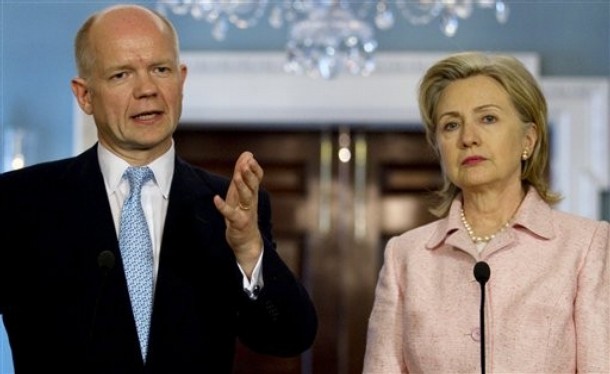
We've spent the last week observing the differences between the British and American political systems - the coalition wrangling, the swiftness of government transitions. But Steve Coll highlights an area of similarity:
On foreign policy, it was fascinating to listen to the Foreign Secretary tic through the usual issue setsâ??Iran, Afghanistan, Europe, global development, humanitarian intervention, etc.â??and to discover that there is hardly any distance between his coalitionâ??s views and that of the Labour government it is succeeding. Iâ??ll save Hagueâ??s comments about Afghan policy until next week, after a reported article Iâ??ve been working on for the magazine, in which British policy figures, has appeared. But on the Afghan war and every other subject discussed, except perhaps for the European economic crisis, where Hague emphasizes Britainâ??s skepticism about the euro monetary project, it was striking how centrist and even center-left orthodoxy has replaced the radicalism of the Thatcher years and the subsequent â??wet-dryâ? debates among British conservatives. I used to hold in my mind the truism that continental European conservative parties roughly equate to our Democratic Party in their foreign policy views, but that British foreign policy conservatism was an exception; no longer, it seems.Hague pointed out that, in opposition, his party had supported every one of Tony Blairâ??s major military interventions abroad, whether they were motivated entirely by humanitarianism or by more traditional security argumentsâ??in Sierra Leone, in Kosovo, in Bosnia, in Afghanistan, and in Iraq. (The Liberal Democrats, his coalition partners, were the only British political party to oppose the Iraq invasion.)
National security orthodoxy has an equally strong hold on this side of the Atlantic.
(AP Photo)
