« U.S. Views on NATO | Blog Home Page | World's Most Livable City Burns »
June 17, 2011
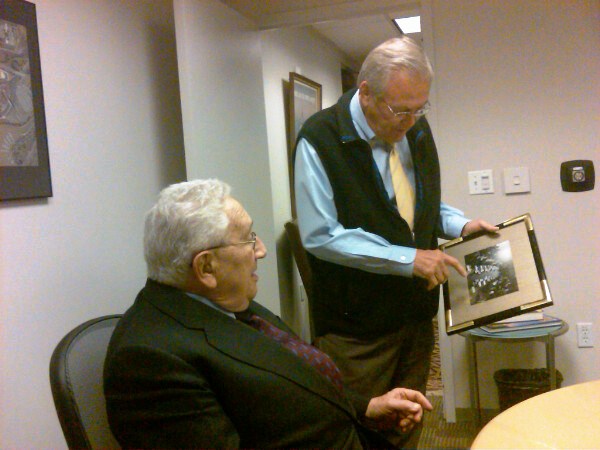
“I brought this picture out for you, Henry,” Donald Rumsfeld says to Henry Kissinger, proffering a framed black and white photo of a line of men sitting across from each other at a diplomatic gathering. “It was right after Vladivostok.”
“When you went to China with me?” Kissinger asks, perking up.
“I took you into China and introduced you to Zhou Enlai,” Rumsfeld says, with a smile and a slight chuckle. “No, no, that’s not how it worked.”
“No, but he was still alive, actually,” Kissinger says.
“Yes, you met with him,” Rumsfeld says. He has one hand in the pocket of his trademark fleece vest. “But here’s Deng Xiaoping, your friends Habib, and Winston Lord, and George Herbert Walker Bush, and Phil…”
“I remember that meeting,” Kissinger says, peering through his spectacles at the shadowy photo. “With Deng.”
The two veterans of a thousand policy arguments and diplomatic quarrels are quiet for a moment, looking into the past, at two lines of men divided by ideas and the sea, individuals who would shape the world for half a century and more.
Rumsfeld was hosting Kissinger - who inscribed a book to the two-time Defense Secretary as an “occasional adversary and permanent friend” - to promote the oracular diplomat’s new book, On China. It is a broad collection of his thoughts and anecdotes, with some reminiscing and a few policy prescriptions gained both from his more prominent diplomatic visits, conversations with Chinese leaders, and the over fifty times he’s been in the nation since. As the original, popular proponent of the long arc theory in respect to China, the former Secretary of State and National Security Advisor is now putting forward a recommendation for complementary growth and what he hopes to be a path to avoiding adversarial confrontation, written in longhand and released the same week as his eighty-eighth birthday.

Kissinger draws comparisons which may be familiar to those who’ve followed his work and speaking closely in recent years: he draws contrasts between U.S. and Chinese approaches to deterrence and international relations based on the intellectual games of the West and East - the direct adversarial approach of Chess and the longer, subtler games of encirclement in Go - as the models for explaining activity and decisionmaking.
“For the West, deterrence is the assembling of superior power either to prevent an attack or to crush the enemy if he does attack. Our concept of deterrence is aimed at capability. Their concept of deterrence is more preemptive - offensive deterrence, aimed at the psychology of the opponent,” Kissinger says, pointing to the Sino-Indian conflagration of 1962 as a real world example of this phenomenon.
The book arrives as concerns are rising that China’s current regime, due for a massive change in 2013, has traded material prosperity and racial superiority for legitimacy, even at the cost of more or less destroying any coherent communist ideology. While they’ve been successful in charting this path for more than two decades, it's been fueled in part by the short-term economic surge that comes from a birthrate-collapse-induced demographic imbalance. As China ages and its export-driven economy necessarily slows, the possibility for further upheaval is significant.
How significant depends on who you ask, and I queried Kissinger on this point. Accepting the Chinese view of cyclical nature of collapsing and rebuilding society: does he think another dynastic collapse is in the foreseeable future? Or is dynastic collapse more or less impossible without a massive wave of young people to fuel it?
“I know that the Chinese leaders that I know and have seen in action are all obsessed with the concept of stability,” Kissinger said. “And that is for two reasons - one is that with that many people the challenge of governance is just stupendous. And when you have a people who are as individualistic as the Chinese are, it becomes even more challenging.”
“When you go to a small town - which is what they call a place of 500,000 people - it looks as if everyone is on the street doing something, a tremendous amount of activity. And I said to myself, how can they possibly know in Beijing what is going on here?” Kissinger said. “I took a trip with my wife down the Yangtze, and stopped at every river town, and had to ask - how could you believe, in Beijing, what the reports say? This was still when they were a totally state-controlled economy. This being the case, there is always the danger of centrifugal forces, and it’s happened often enough in Chinese history.
“The way these issues are often put are ‘should the young people take over?’ And I’m not saying they should or they shouldn’t. I’m saying that whenever the system collapses in China, whatever the system, I know no example when this collapse did not usher in a period of tremendous chaos and tremendous bloodletting, so the idea that things go from where they are - to one revolution in a square - to change, that is not even happening in Egypt.”
Kissinger related a story from his experiences on a prior trip, under Mao, which illustrates the way local officials were even then navigating around the mandates from Beijing to meet the needs of their people.
“I went to a town in the south of China, and when I landed there, I saw two Boeing 737s sitting at the airport. And I asked the governor, ‘what are these planes doing here?’ And he told me, ‘I’m starting an airline.’ I said, ‘what are you talking about?’ And he said, ‘we are halfway between Hong Kong and Bangkok, and my people have to go to Hong Kong in order to go to Bangkok. So I’m starting an airline that will take them directly there.’ And I said, ‘how is that happening?’ And he told me ‘we pay our taxes, but we have a lot of resources, so I am doing it myself.’ Now, in Soviet Russia, just for having that thought, you would’ve been boiled in oil.
“So you have these forces in China which make the central leadership nervous,” Kissinger said. “I saw an economic study a few years ago, from Johns Hopkins, which showed that roughly 25 percent of what is listed as foreign investment in China is actually Chinese money which is laundered outside the country and then reinvested into the country as foreign investment because it gets special tax treatment. This is not a good situation, and it is a danger always felt by the government in China.”
The focal point for questions of conflict with the United States regarding China’s future is their resource mining, primarily in Africa but in other parts of the world as well (it seems ironic that the United States would be laboring so hard in Afghanistan, for instance, to keep the roads clear for China’s conflict mining). While China has thus far limited their impact to the drawing of these resources, most of those African states are states in name only, making counter-influence largely the result of bribes to the ruling classes. I was curious whether Kissinger would agree with the notion that China has effectively colonized large swathes of Africa as part of this push for minerals, and whether, given the growing race for raw materials, the U.S. can or should respond.
“Right now, China is going to Africa primarily for resources,” Kissinger said. “And they have stayed miles away from political control. But of course when you own the largest resource in any country, it gives you considerable influence. In order to keep public support, they are doing a lot of infrastructure projects. Insofar as gratitude produces political support - it does not always - their influence in Africa is undoubtedly growing.”
Yet is a balancing act even possible here? The United States is unlikely to start a war to stake out minerals claims, and doesn’t typically involve itself in public-private operations as the Chinese do - most private companies, as a rule, don’t have the U.S. Treasury behind them to engage in a massive international resource war.
“The negative for them in this approach is that they don’t have experience dealing with developing countries, and they’re very self-confident - so they often appear heavy-handed, and are heavy-handed. And of course, you cannot omit the possibility that this will merge into a more explicit political control,” Kissinger said. “I would analyze their present view to be that they do not want direct confrontation with the United States because they want their economy to continue to grow. So for the short term, I expect them to continue their present pattern. But as the process continues? It is something to think about.”
One aspect of this which makes things more complex is that China is not harvesting those resources for sale on the international market but rather for their own use. Many of those materials are rare earths we are unable or unwilling to harvest domestically, that can be and are used for high-tech industrial, commercial, and military components. The urge to respond could, therefore, be considered a relic of leftover ideas of the tie between a nation and industry in which China believes but the United States no longer does.
“Of course, if my ideas prevail, and if they are willing to play the same game - I am not saying in this book that we ought to surrender, I am saying that they have to do their fair share - we can develop what I call in the book a co-evolution. This is evolution at the same time, but not necessarily rivalry,” Kissinger said. “In that case, it can be managed. But if we cannot do that, on either side, it will turn into rivalry. But if you visualize that rivalry all over the world, it is an image of the world in continuous turmoil.”
What does seem clear is that China prizes regional hegemony and international respect, stemming in part from the memory of Ming glory and the scars of Opium War subjugation as much as the ordinary desire of any people to be considered powerful. It also wants to stake claims on several disputed territories, continental and island. Is China likely to trade old territorial claims in return for international respect, to paradoxically satisfy its present need for recognition? And if so, should the U.S. respond?
“China has led the world in GDP for 18 out of the past 20 centuries. They have never in their history had to deal with a country of equal magnitude,” Kissinger points out. “The countries that encircle them, if united, could theoretically overrun them. So foreign policy was normally, for the Chinese, management of what they call ‘barbarians’, a balancing act of pitting foe against foe… I don’t believe that the Chinese have the views the Soviets had. They generally did not expand by conquest, but by osmosis. In fact, they expanded by being defeated by people of a different culture, and then converting them to a Chinese culture. I think you will see policies that continue to follow this line.
“When we first came to China, we didn’t think we could make Mao an American liberal. We had to be concerned with the conduct of our foreign policy,” Kissinger says. “And it’s a debate that keeps going on in this country - is it our responsibility to overthrow governments we don’t agree with? Or is it our first responsibility to enhance our security by dealing with countries as they exist? If they can be modified over a period of time it is of course worth us attempting it.
“If you look at Chinese history, they’ve remained independent for thousands of years. So when a foreigner comes along and says you’ve got to change your government…,” Kissinger shrugs. “Individual Chinese dynasties have lasted longer than the whole history of the United States. So I’m more humble about what we can do in China.”
Yet Kissinger maintains that if the idea takes root that the United States is entering a period of permanent decline, it could be a very dangerous one for both parties.
“We have to learn to live with our natural potential,” Kissinger said. “We absolutely have to remain competitive, but can we move from a zero sum game? That should be the objective, but it cannot be achieved alone.”