
The Compass

« How Many Wars Should the U.S. Fight at Once? | Blog Home Page | After You »

My Path to Afghanistan

3.jpeg
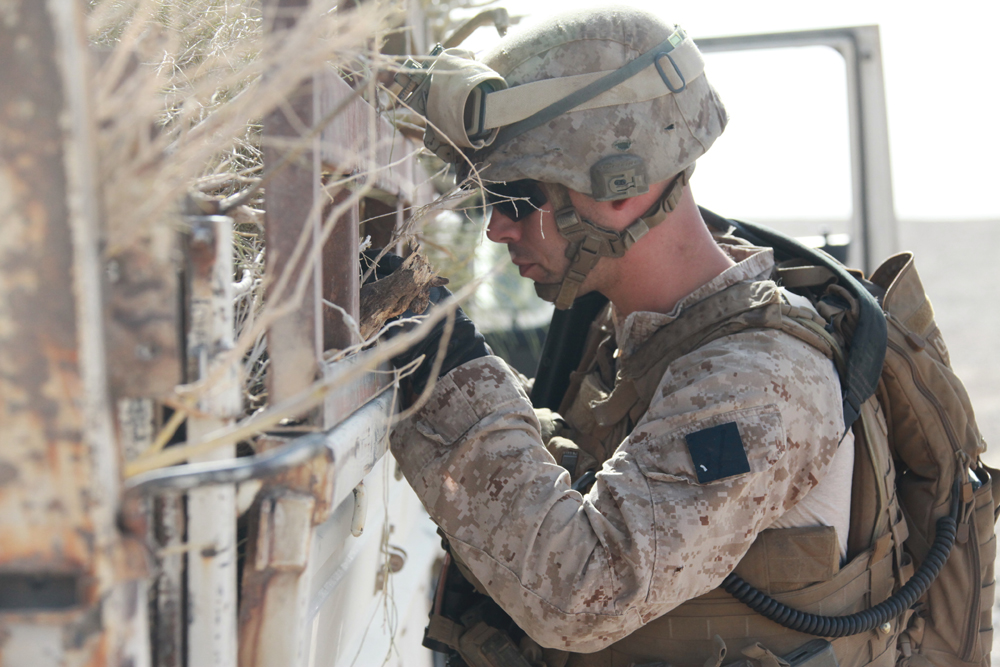
1st Lt. Austin Skinner, the platoon commander of 2nd Platoon, Company B, 1st Battalion, 23rd Marine Regiment, searches a vehicle during drug interdiction operations in southwestern Afghanistan, Aug. 18.
-- Photo by Cpl. Brian Adam Jones


By Brian Adam Jones

My path to Afghanistan was as unpredictable as America’s.

I didn’t deserve a single opportunity afforded to me, and I had several. I grew up in an upper-middle-class family in Maryland and New York City. I graduated from Phillips Exeter Academy, an elite boarding school in New Hampshire before starting college at Hofstra University on Long Island.

My biggest issue as a teenager was that my laziness exceeded my intelligence. I had no work ethic, no discipline and a frail, selective concept of morality.

The older I got, the more I realized I needed to tear things down and rebuild them the way I wanted them.

At 20, I enlisted in the Marine Corps.

Two years later, an Air Force C-17 Globemaster carried me from Manas Air Transit Center in Kyrgyzstan to Camp Bastion, Afghanistan. I looked out the small window on the door of the plane as the landscape below gradually shifted from snow-capped mountains to barren desert.

I landed in that desert late one summer morning, blasted by hot air as the back ramp of the Globemaster opened.

My mission is to communicate the efforts of the Marines here to the American public.

I’m a corporal in the Marines, and a combat journalist for the 2nd Marine Aircraft Wing (Forward).

I’ve grown a lot over the past couple years, and I owe it all to the Corps. I am a direct and proud reflection of some truly great Americans in uniform I have had the opportunity to encounter.

I stepped off the plane and onto the ground excited to begin the work of communicating the work of Marine aviation in southwestern Afghanistan.

2nd Marine Aircraft Wing (Forward) serves as the aviation combat element for the southwestern regional command of NATO’s International Security Assistance Force, so Nimruz and Helmand provinces, a region of tremendous strategic value.

Our area of operations borders both Pakistan and Iran. It includes much of the Helmand River valley, Marjah, Sangin and Lashkar Gah.

The Wing is headquartered on Camp Leatherneck, a sprawling outpost in the center of Helmand province. Adjacent to Leatherneck lies Camp Bastion, a British-run base that serves as a major hub for aviation here.

On my first mission in Afghanistan, I flew on a CH-53D Sea Stallion on a drug interdiction operation.

Loaded up with infantrymen, the behemoth helicopter flew hard and low over the Afghan desert, on a mission to stop vehicles and search them for drugs or weapons.

I was there to help communicate how such operations limit the enemy’s ability to move and finance their efforts.

Sitting in the helicopter’s canvas seat, I adjusted my flak jacket and listened to the pilot through my headset, as the aircraft sped toward a suspicious truck. I chambered a round in my rifle and clutched my camera. Though I wouldn’t have admitted it at the time, I was anxious.

Much of the sand out here has the consistency of talcum powder, and it covers everything. When the aircraft touched down, its rotors blasted the sand away, exposing cracked and weathered earth beneath it. I followed the grunts off the aircraft.

As the next 20 minutes proceeded without incident, I learned a little about the war out here.

We were in the middle of nowhere, just cracked earth for miles. An AH-1W Super Cobra attack helicopter circled overhead. The Marines quickly set up a perimeter and approached the truck with rifles at the ready.

It was a single cab pickup truck. White paint probably fresh before my lifetime had given way to rust stains from thousands of miles of trekking across the Afghan desert.

As the three Afghan men approached the Marines, they made it clear they weren’t armed. The Marines met the men with a smile and a handshake, with a flair for the diplomacy essential for a successful counterinsurgency.

I think the Marines have adapted well with the world after 9/11. The modern day enlisted Marine is a critical thinker with diverse skills and the ability to lead, analyze and execute military, diplomatic and humanitarian challenges.

In the next several weeks, I intend to highlight my experiences as a junior-enlisted Marine in a military shaped by counterinsurgency operations, in the place that started it all.

I’m excited to chronicle my experiences as a Marine in Afghanistan over the next several weeks on RealClearWorld.

To contact me with feedback or questions, email me at brian.adam.jones@gmail.com. To learn more about the 2nd Marine Aircraft Wing (Forward), visit the Facebook page.

2.jpeg

The views, opinions, positions or strategies expressed by the author are his alone, and do not necessarily reflect the Department of Defense or United States Marine Corps.