


October 2015 Archives

 Share
ShareEU Issues a Blunt Threat to Poland

Eastern European member states of the European Union could see some of their EU subsidies cut if they keep refusing to take in refugees, Dutch Finance Minister and Eurogroup chairman Jeroen Dijsselbloem said Oct. 26.
Dijsselbloem was responding to a question about the sweeping election victory of the conservative Law and Justice party in Poland, known by its Polish acronym PiS, Dutch media reported.
The PiS party, led by Jaroslaw Kaczynsky, fervently opposes offering shelter to refugees from war-torn countries such as Syria. The previous Polish government, voted out in Sunday's election, agreed to voluntarily take on 4,500 refugees according to a pan-European distribution scheme which would see approximately 160,000 refugees spread across EU member states.
Like other countries in Eastern Europe, Poland annually receives billions of euros in subsidies from the European Union, distributed via structural funds. According to Dijsselbloem, Poland's stance on refugees could endanger that money flow.
Dijsselbloem said that Poland should show something in return for Europe's largesse. "And if not, we could take a part of the EU's budget that flows to countries like Poland, the Czech Republic, and Hungary in the form of subsidies and use that money to help Turkey pay for the shelter it provides to refugees within its borders," Dijsselbloem was quoted as saying.
"You're in the European Union for better and for worse," the Eurogroup chairman added. "You can't just enjoy the benefits and walk away from the disadvantages when it suits you."
(AP photo)
Abbas Has no Control and Only Bad Choices

One of the last times I saw Yasser Arafat was in March 2002. Barricaded in his darkened headquarters in Ramallah and surrounded by besieging Israelis, he looked every inch the armed struggler. Clad in his standard green military uniform, with a black automatic machine pistol sitting ominously on his conference table in a room lit only by candles, Arafat talked like a man who would not give up the gun. I am the only undefeated general in the Arab world, he said that day. Violence was always a tool to remind Israel of the costs of ignoring him and the Palestinian problem.
Mahmoud Abbas is not Arafat. He has willfully eschewed violence for most of his career, certainly since he replaced Arafat in 2004 and became president of the Palestinian Authority. Nor, frankly, does he have Arafat's street cred; he lacks the fighter's disposition needed to promote armed struggle.
And yet, not out of strength but out of weakness, Abbas may have no choice but to ride the latest wave of violence and terror shaking Israel and the Palestinian territories. Indeed, while the current unrest actually serves part of his agenda, it also threatens his authority, or what remains of it. Herein lies the curse of the Palestinian cause: Violence keeps Palestinians relevant, but it also keeps them far from statehood.
Not Israel's policeman: Although Israeli-Palestinian security cooperation remains in Abbas's interest, largely to demonstrate that the Palestinian Authority can maintain order in territory it controls, that cooperation is not free of cost. Unlike Arafat, Abbas cannot use Palestinian security forces as he wishes -- certainly not to protect Israelis, and still less to fire on or intimidate Palestinian protestors massing against Israel in the areas of the West Bank he controls. The longer the violence continues, the greater the chance is that Palestinian security forces will face impossible choices. They may be seen as Israeli collaborators, or forced to the sidelines, or emerge as active adversaries of Israel. In each scenario, Abbas's authority and credibility will suffer, particularly if he is seen as acting on Israel's behalf.
No control: It may be inconvenient for the Israelis to admit it, but in Jerusalem at least, the recent spate of knifing attacks is emanating from areas outside of Palestinian control -- areas that have been under Israel's sovereignty since 1967. Palestinian Authority institutions do not operate or carry influence in these areas. Indeed, the so-called Jerusalem Intifada is effectively leaderless, driven by young Palestinians, the majority of whom are too young to remember the pain of the Second Intifada and who consider Abbas either an abstraction or an 80-year-old leader out of touch with their needs and frustrations.
As for tensions over the Haram-al-Sharif/Temple Mount, area, the Palestinian Authority has no jurisdiction there either, and it exercises no control. That is why U.S. Secretary of State John Kerry's recent efforts to work out arrangements to reaffirm the status quo were negotiated with Israel and Jordan -- and not with Abbas's Palestinian Authority. Indeed, other than to condemn the violence and to avoid making the situation worse through inflammatory statements about shedding blood for martyrs, Abbas cannot and will not do much to pre-empt the violence. The inconvenient truth is that many Palestinians dismiss this kind of violence perpetrated with knives, rocks and vehicles -- it is seen as low-tech terror perpetrated by individuals, the result of the frustrations of a people under occupation, whereas most Israelis see it simply as terror. The point is that even the moderate Abbas -- while he believes that peaceful action is better suited than violence to improve relations with Israel and the United States -- will not expend a lot of political capital trying to prevent this kind of popular resistance. This is especially true with Hamas trying to capitalize on the violence and present itself as the Palestinans' key defender.
Abbas is stuck. He presides over a deeply divided Palestinian national movement and has brought the Palestinians no closer to ending Israel's occupation; has an Israeli partner in Prime Minister Benjamin Netanyahu who won't meet his needs on statehood through negotiations; and is following a strategy for international recognition that cannot succeed without U.S. and Israeli buy-in.
And he confronts the ultimate conundrum on using violence.
Abbas may benefit from violence because it creates some urgency for Israelis to focus on the stateless Palestinians. But paradoxically he loses out, because that same violence slows progress toward a two-state solution by sowing Israeli anger and hardening its determination not to give in. Abbas cannot endorse an uprising, he cannot control one, and he cannot completely walk away from popular struggle.
Without a credible political process, managing this dynamic will become increasingly difficult. As an aging Abbas nears the end of his era, a younger generation of alienated, aggrieved, and leaderless Palestinians will move well beyond the Oslo years and will ignore the cautionary lessons of the Second Intifada, which brought pain and suffering to Palestinians and Israelis alike. The result is likely to be a future of more blood and pain, and one perhaps with fewer time-outs.
(AP photo)
Is ISIS Failing? 8 Questions to Consider
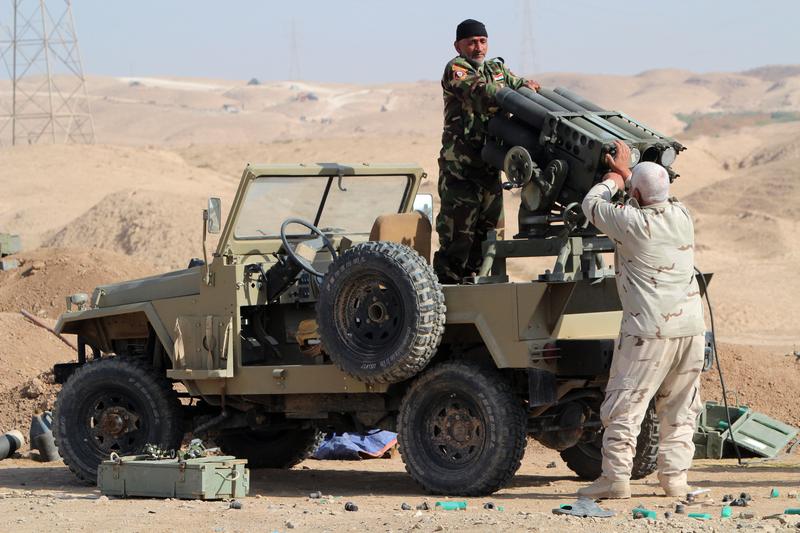
The once fearsome Islamic State group, also known by the acronym ISIS, has fallen off the front pages. The big news from the Syrian battlefield is Russia's air campaign to prop up the regime of President Bashar Assad by attacking various rebel groups. These groups include the Islamic State almost as an afterthought, and Russia's aim is to construct durable air and naval facilities on the Mediterranean coast.
Targeting the other groups first, Moscow claims to have destroyed dozens of Islamic State manpower, storage, resupply, and training targets, but Russian President Vladimir Putin's credibility is zero. In any case, in Syria and Iraq, the Islamic State's ground war has stalled. Its recent successes comprise far-away suicide bombings that may be inspired by ISIS, rather than organized by it. Claims that the Islamic State is still gaining ground or even maintaining its strength call for skepticism. Here are some of the relevant questions:
1. New recruits: how many new recruits in fact arrive each month? Where are they on the battlefield? One thousand is the official Western estimate, but is this number likely? Some of these would be new foreign fighters, others are fighters switching from al-Qaeda to ISIS for better salaries and the associated prestige. Poignant media stories about susceptible young people caught on their way to Syria have become rare. The charisma of the caliphate story is weakening. Even if the recruits number so many, what is the military quality of newly arrived, untrained fighters? With the exception of Chechen fighters - and how many are there of these? - the new arrivals lack experience. They are apparently first put into support and guard positions, but a mere few weeks training with weapons means they are likely to get killed early on. Their major asset is bravery, not fighting skills.
2. Does ISIS really control vast swaths of Syrian and Iraqi territory? This was questionable even when its army stormed out of northwest Syria last year, because most of the land is desert and mountains. Why (and how) would an irregular army estimated at a total 20,000-30,000 fighters waste manpower to control a vast swath of desert with a few villages in it? An adversary military force could probably have driven about this territory for an hour or two undisturbed. Current maps of effective ISIS control show a modest territory in a wine-glass configuration whose bulb is an area wedged between, to the east, an equal-size Kurdish-controlled area on the border with Turkey and, to the west, a small Damascus government-controlled territory around Aleppo, plus an edge of territory held by other rebels. ISIS controls the ancient city of Palmyra, but that sits in an isolated desert location in the center of the country. The glass stem is the vital area of Islamic State's territory. From its informal capital in Raqqa heading south, it involves control of the northern bank of the Euphrates River (government forces are on the south bank) on the way toward Ramadi, Fallujah, and Baghdad, where the river abuts the Tigris. This early achievement was part of Islamic State's strategic plan to control the water supply along a long area, ultimately to threaten Baghdad. Dams were closed, and the Euphrates at one point was diverted. Control of water may be Islamic State's most threatening weapon.
3. How solid is the caliphate infrastructure, and how motivated are the fighters holding it? With few recent battleground successes, morale among the fighters and occupiers may be sinking. Media reports suggest large numbers of professionals - medical personnel, businesspeople- are fleeing ISIS territory among the massive outpouring of Syrian and Iraqi refugees heading toward Europe. ISIS propaganda suggests it is worried about a drain of medical personnel, teachers, and other professionals such as oilfield managers. Some of these leave behind families they hope to bring with them later if they reach Europe.
4. Do ISIS fighting methods still terrorize the enemy? The shock value of barbarism has been played out. Videos of decapitations and other atrocities are hardly seen in Western media. While Syrian government soldiers, Kurds, and Iranian-backed militias know what might happen if they're captured, they are no longer terrified by it. Glamorized executions in other countries, such as happened on a Libyan beach, are rare. Islamic State fighters are now defeated with some frequency and are ousted from towns and strategic locations - most recently examples are the Baiji oil refinery, and a successful Kurdish/U.S. raid to rescue prisoners held in Hawija.
5. Within Islamic State's leadership, how formidable is the military command structure after many senior officers have been killed? Is it still capable of organizing serious ground offensives? How cohesive is the religious ruling structure headed by Abu Bakr al-Baghdadi, sthe o-called Caliph Ibrahim? How much conflict is there within the religious leadership? Al-Baghdadi is rarely heard from in audio messages and has never appeared again in public since his July 2014 sermon in a Mosul mosque. Is he still a charismatic leader capable of motivating deeply loyalty among new and veteran jihadists? A stalled operation is a permanent risk to the authority of al-Baghdadi and the sharia council.
6. How important is it to have contiguous territory and coherent fighting forces trying to overthrow governments? ISIS is frustrated in Iraq and under attack from several sides in Syria. The group is not expanding its contiguous territory, and, for ideological reasons, if core Islamic State is not expanding, it is failing. How significant are the pledges of allegiance of faraway jihadist groups? In Afghanistan, ISIS seems to have attracted some Taliban fighters, but the organizations still fight each other as well as the Kabul regime supported by the United States. It remains to be seen whether holding some territory in Afghanistan or elsewhere abroad would enhance core Islamic State in Syria and Iraq because they would always be under attack somewhere, no doubt in several places. A fragmented international structure would be even more fragile than the contiguous Ottoman Empire caliphate. ISIS may in fact be declining, from a threat to regimes into a beleaguered core area whose successes consist of terrorist bombings abroad.
7. How long will ISIS avoid attacks to take back its urban conquests in places such as Mosul, Raqqa, and Ramadi? Raqqa has already fallen under air attack, even though it sits within the group's core territory. Mosul and Ramadi are isolated, surrounded, even under siege, by Kurds, Baghdad, and Iranian proxy forces. Assaults to retake them are deterred mainly by the prospect of too much blood being spilled and large parts of the cities being left as ghost towns, as seen in Kobane. Lines of ISIS communication and resupply are threatened even if food and other supplies are let through to service the local population. ISIS fighters inside Mosul may number a thousand, and there are probably many fewer in Ramadi.
8. The last question concerns the Islamic State's vaunted success using social media as propaganda. Certainly the West's anti-jihadist social media campaign is basically futile, but Islamic State's propaganda success may be declining, in spite of its output. A Wall Street Journal report on Oct. 7 (page A11) notes that since mid-September, 14 videos and 17 articles have appeared trying to discredit the significance of the refugee flow to Europe. One of them uses a fiction concocted by the Communist German Democratic Republic to explain the Berlin Wall. The Wall, it said, was not built by the GDR to keep East Germans from leaving. It was built by the West to prevent its own citizens from fleeing to the Communists. The Islamic State video tells viewers the refugees are in fact Syrians moving from Damascus-controlled territory to the caliphate. There is no doubt that some young foreigners still arrive to ISIS territory on a mission, and others across the world are impressed by the jihadist mentality - some enough to commit lone-wolf attacks. But in the medium term, sheer quantity of propaganda may not be enough to replenish the ranks.
There's always the possibility that Islamic State's leadership is hiding its strength, reorganizing, and will break out sometime soon in a new military campaign. But many signs point to weaknesses throughout the apparatus and ideology. My thought is that al-Baghdadi and his cohort are very worried.
(AP photo)
The World Should Support Venezuela's Heroic Opposition
Referring to the Spanish Civil War of the 1930s, and the victory of pro-Fascist Francisco Franco, the French novelist and philosopher Albert Camus wrote: "It was in Spain that men learned that one can be right and yet be beaten, that force can vanquish spirit, that there are times when courage is not its own recompense".
The defeat of rightness and the prevalence of force are phenomena that ordinary citizens in general, and opposition leaders in particular, must now endure in Venezuela. Respect of human rights was already in a pitiful state at the time of late President Hugo Chávez, but the situation has worsened further since his designated heir, Nicolás Maduro, assumed power.
The deteriorating human-rights situation in Venezuela is closely intertwined with that country's dismal economic performance. Shortages of an ever-growing number of essential goods, longer queues, and spiraling inflation (the world's highest) form part of the everyday lot of Venezuelans. Measured in dollars, Venezuela's gross domestic product has lost 56 percent of its value during the three years of Maduro's presidency.
The regime's popularity has all too naturally hit rock bottom: Polls consistently put the government's approval rating below 20 percent - a rating that bodes ill for Chavismo as the country heads toward parliamentary elections scheduled for Dec. 6.
Yet instead of correcting the economy's course, Maduro has tried to dissipate public discontent by increasing repression.
Today, scores of political prisoners are rotting in the country's jails. Independent journalists and cartoonists live under constant threat of being indicted and jailed.
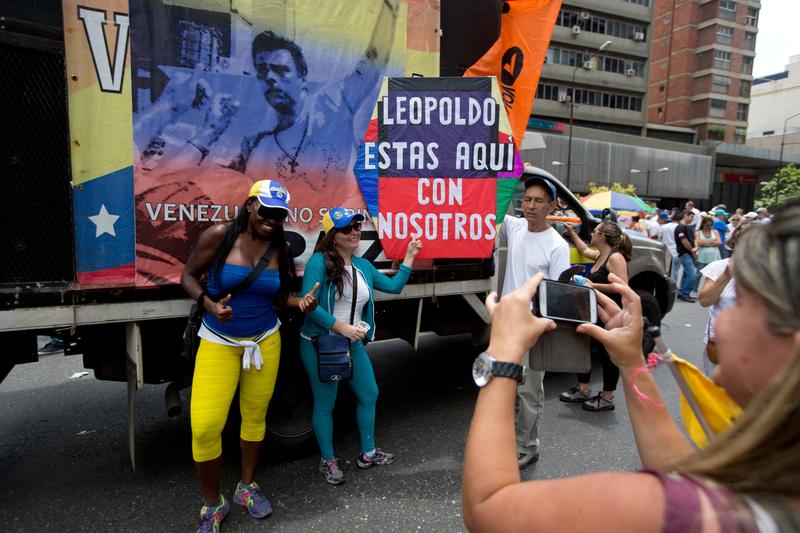
The most prominent opposition leader, Leopoldo López, has been sentenced to nearly 14 years in prison on fanciful charges devoid of credibility - such as using the "art of speech" to subliminally incite to revolt. He has been confined to a 4 square meter cell and is seldom allowed to see the sunlight. His imprisonment has been condemned by renowned personalities from all over the world, including 19 former presidents of Latin American countries and Spain; the U.N. high commissioner for human rights; and Nobel Peace laureate Desmond Tutu. Former Spanish Prime Minister Felipe González and the late Nelson Mandela's former lawyer, Irwin Cottler, have played an active role in the defense of Leopoldo López.
The Senates of Brazil, Chile, and Colombia, the European Parliament, the Inter-American Court on Human Rights, and Socialist International have all voiced concern for López's imprisonment and for the violation of human rights in Venezuela.
Mr. López is not the sole opposition leader who has had to confront the fury of the country's regime. Lawmaker Maria Corina Machado, who had won her parliamentary seat with great ease, was first beaten during a session of the National Assembly (the country's legislative body), and subsequently deprived of her mandate by an arbitrary decision of the president of that Assembly, former lieutenant Diosdado Cabello - seen by many as the power behind the throne in Venezuela.
Fabricated charges have been laid against former mayors Antonio Ledezma, Daniel Ceballos and Enzo Scarano, who are awaiting trial under house arrest. Other opposition figures have been barred from running in the Dec. 6 election.
Torture is practiced lavishly in the Helicoid prison and the so-called Tomb, composed of seven chambers located four floors below ground level. Acts of torture - including against Leopoldo López - have been denounced by the U.N. special rapporteur on torture, as well as by Amnesty International and Human Rights Watch.
It should therefore beget little wonder that Venezuela's opposition forms part of the short list of candidates for this year's Sakharov Prize for Freedom of Thought, awarded by the European Parliament and to be announced on Oct. 29.
Taken by itself, the courage of those fighting repression and enduring torture in Venezuela makes them worthy of the Sakharov Prize. A further compelling reason for granting that award to Venezuela's opposition relates to the need to counteract the deafening silence of the region's governments regarding violations of human rights in Venezuela.
Such indolence is all the more questionable as Venezuela was at the forefront of countries condemning the military dictatorships that pullulated in the region throughout the second half of the past century.
And yet, today, when Venezuela is ruled by a dysfunctional regime evolving toward a full-fledged dictatorship, the region's governments barely move a finger, or say a word, to stop the dismantlement of democracy in that country.
As stated by Santiago Canton, formerly executive secretary of the Inter-American Commission on Human Rights and now at the Robert F. Kennedy Center for Justice and Human Rights, "the cries of pain of those tortured in The Tomb are responded to with the stony silence of our governments".
Ideological complicity and spurious financial interests explain but do not justify such a silence. Under Chavismo, oil-rich Venezuela has become a profligate purveyor of funds to friendly or subservient governments, the purpose being to prop up buddies and buy governments' support to Venezuela in international forums.
That silence makes it all the more necessary for pro-democracy institutions - not the least the European Parliament - to stand up and bring the ordeal of Venezuelans to the center of international attention.
There is a third reason why it would be opportune to grant this year's Sakharov Prize to Venezuela's opposition. As mentioned before, parliamentary elections are scheduled to be held on Dec. 6, and Maduro has rejected the presence of truly independent international observers. Maduro has barefacedly said that his party would win those elections "whatever it takes." The specter of election-rigging is thus on everybody's mind.
This has led the Director for Latin America of the NGO Human Rights Watch, José Miguel Vivanco, to emphasize that "international pressure on Venezuela is needed today more than ever before".
Granting the 2015 Sakharov Prize to Venezuela's opposition would convey a clear message from the European Parliament. That message would tell Venezuelans that they are not and will not be left alone in their courageous fight for human rights, democracy, and freedom of speech.
That would be a dignifying way of exorcising the curse alluded to by Albert Camus - and of demonstrating that, in today's Venezuela, courage will have its recompense.
(AP photo)
Guns and Lack of Butter in Ukraine
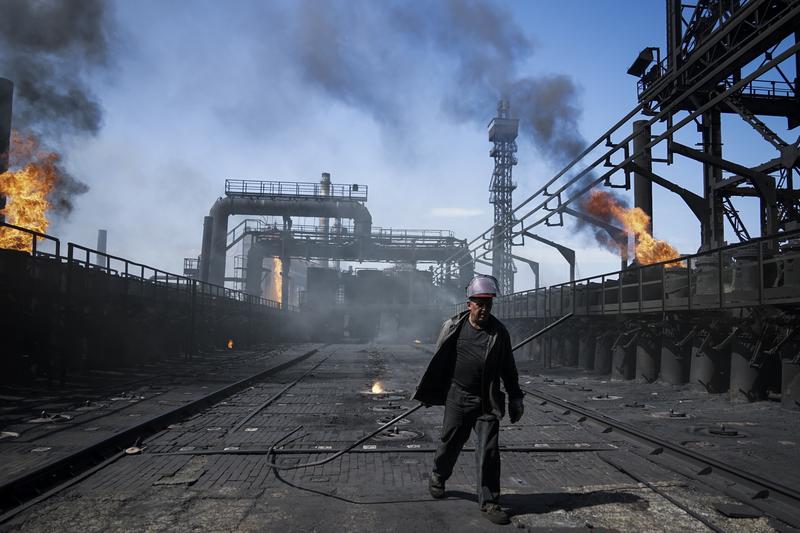
The Ukrainian economy has been hit hard over the past two years by the shock of continuous geopolitical crises. The economic instability that followed Russia's annexation of the Crimean peninsula and the commencement of the pro-Russian separatist conflict in the eastern Donbas region in 2014, on top of the country's already shaky economic outlook prior to these crises, have hit practically all industries. Ukrainian daily Obozrevatel.ua recently published a list of major companies that are nearing insolvency or are unable to pay salaries to their workers. The list includes the country's most important corporations -- some state-owned, some private. According to the publication, in Kyiv alone at the beginning of October 2015 employers owed their employees nearly 81 million hryvnia ($3.56 million), and among the regions with most wage arrears is the war-torn Donbas, where employers owe more than $13 million in salaries.
One of the major debtor in the country is the city Kyiv and the surrounding Kyiv region. According to the Ukrainian Ministry of Social Policy, the list of indebted employers includes the state-owned Quantum Research Institute, which has failed to pay its 450 staff nearly $340,000, along with government factories like Burevesnik (which owes $184,000 in salaries to its workers) and Arsenal ($92,000 in wage arrears). The last two enterprises are part of Ukrainian military-industrial base and are key to nation's security. It is not just industry that has been hit hard - Obozrevatel.ua found the Ukrainian Socialist Party also owing money to its staff.
The largest debtor in the Kyiv region is the private airline Aerosvit. The company, which two years ago was declared bankrupt, still has to pay its employees nearly $5 million. Former employees have almost lost hope at this point of receiving their promised salaries. Some Aerosvit ex-employees, on condition of anonymity, said that they are owed $44,000 each. It is rumored that when the company paid pilots their overdue salaries, the executives demanded kickbacks of nearly 5-10 percent of the debt.
The biggest debts in Ukraine belong to the enterprises of the war-torn Donetsk region, where separatist military activities backed by Russia have disrupted the economic and industrial infrastructure. Despite the war, some large steel and coal plants are still operating there. Among Donbas's largest debtors are Selidugol, Krasnoarmeyskugol, Azovzagalmash, Azovelektostal, and many others -- all together, 163 regional enterprises owed a total of nearly 300 million hryvna, or nearly $13.2 million. In particular, at the Azovzagalmash state enterprise, which is located in peaceful Mariupol, just miles from the frontlines, and is a key city between the rebel-controlled area and Russian-annexed Crimea, the employees are owed 70 million hryvna. Those who still show up for work are assured that all fault lies in the lack of government orders.
"I was not paid during the summer months ... believe me, no one here blames the management - how can they give us money if the company has no orders. I don't remember when the state placed any such orders ... The last large order was a rocket-space complex for Brazil (in 2013)," said one of the employees on condition of anonymity. And it is not any better in the industrial Dnepropetrovsk region, home of the Yuzhmash machine-building plant, once famous across the Soviet Union. According to the head of the plant's independent trade union, the factory is working only one day a week starting this October. According to the Ministry of Social Policy, Yuzmash owes its employees more than 47 million hryvnia. This amount is large enough to outpace the debts of entire regions such as Luhansk and Volyn.
Despite such problems, there is hope that Kyiv government can take appropriate steps to prop up its economy. This September, Parliament voted to approve an $18 billion debt restructuring deal. According to the Financial Times, such restructuring would allow the recently elected pro-Western government to continue economic reforms in the country while raising pensions and salaries for cash-strapped citizens, helping to stave off inflation in the second year of an economic recession.
(AP photo)
Little Green Men in Moldova?
Civil unrest in Moldova is not easing. If anything, it is picking up. Demonstrations in the capital, Chisinau, have exploded over the last few months and are increasing in ferocity and in their intransigence. The discontent stems from the alleged theft of more than $1 billion from government coffers -- a full one-fifth of the tiny, poor country's gross domestic product.
Moldova became one of the first flash points of the post-Soviet era when conflict broke out in its eastern Transdniestria region in the early nineties. The region, which sits along Moldova's border with Ukraine, proclaims its allegiance to the Russian Federation. Its political status is still unresolved. Currently Transdniestria is seen by the Moldovan authorities as an autonomous, self-governed region of the country. Transdniestria, however, sees itself as a sovereign nation, although one with limited recognition. The conflict itself remains frozen, set in place under a cease-fire agreement, similar to South Ossetia in Georgia and the Donbas region controlled by separatists in Eastern Ukraine.
Moldova itself is a divided country. One half desires closer relations with the European Union, while the other half yearns for integration with Russia. Since Moldova achieved independence, the country's pro-EU forces have managed to maintain power, but the theft of such a large sum of the people's money threatens to upset that reality. The people are demanding prosecutions and more reforms to rid the government of corruption. However, there is a possible darker side to the demonstrations and unrest. Many fear that Russia has influenced the current scenario.
With the Russian expeditionary force landing in Syria and suddenly rearranging the chessboard in that part of the world, Russian state media has gone into overdrive to support Moscow's preferred narrative of its role in the Syrian conflict and in the greater Middle East. All of the international state media organs, from Russia Today and TASS to Sputnik, have been shrill in their pronouncement of the West's weakness and of its duplicity in the fight against the Islamic State. Such rhetoric is likely is meant for a domestic audience. I have recently noticed the coordinated coverage in the Russian state press of the Moldovan conflict as well. Again, a narrative is being woven. The theme seems to be that Moldovans want the government replaced. While this likely is true, the motivation for the coverage here seems suspect.
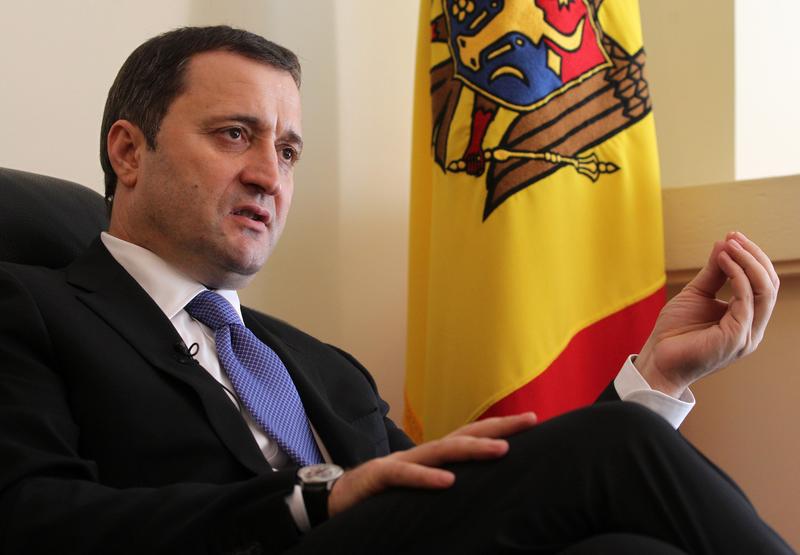
Last week, former Moldovan Prime Minister Vlad Filat was detained on corruption suspicions. No charges were filed, but on Sunday, he was placed under preventive arrest for thirty days. The Moldovan Prime Minister, Valeriu Strelet, has called for the head of the country's National Anticorruption Center head, Viorel Chetraru, to be fired for allegedly conducting slanted investigations and only taking targeted corruption actions -- in other words, for being corrupt himself.
Recently while I was Kyiv, investigating similar anti-corruption efforts, a bomb went off in the early morning hours at the Ukrainian internal federal police. No one was injured, but the target of the bombing was hard to ignore. When speaking with a Ukranian government official about the bombing, I mentioned that it was difficult to tell the motives behind such attacks and who was behind them. His response was that in the former Soviet Union, you will never know what is really happening. I feel it is the same way in Moldova today. Agendas are conflicting, power struggles are ongoing, and one can be sure that intelligence services from all sides move in the midst of the conflict, attempting to enforce their will.
One cannot help but wonder if this poor, small state, hopelessly caught in the middle of the tug-of-war between the East and the West, will not become the target of increased Russian intervention in the coming months. Russian President Vladimir Putin is on a roll: He has basically frozen the conflict in East Ukraine, annexed Crimea, and injected Russian power into the Middle East for decades to come. The Obama administration will not stop him. America must wait for new elections for that to happen.
Could little green men show up in Moldova to protect Russia's interest there? It seems quite possible.
(AP photo)
Merkel Bakes Humble Pie

Chancellor Angela Merkel this summer opened Germany's doors to refugees, resulting in a chaotic onslaught. Now Merkel has thrown in the towel. Pressured to stem the refugee tide, she personally visited Turkey to request that it do more to keep the refugees where they are. In return, Turkey flatly demanded membership in the European Union, which many EU governments oppose. But they and Merkel hardly have a choice.
Not two months after Germany's Angela Merkel courageously said "Wir Schaffen Das" (‘we will make it') to Germans to assuage concerns about the influx of refugees, she is now forced to admit that perhaps Germany and the European Union cannot make it after all.
In her own country, there are tell-tale signs that the mood is changing. Cities are hardly able to cope with the streams of refugees pouring in. Local, regional, and federal institutions are overwhelmed. In Berlin, hundreds of refugees are camped out at administrative agencies where immigration officers decide who gets refugee status. It takes on average 50 days before a case is handled. Riots have ensued in asylum centers, and cities have to rely on volunteers to help out with aid logistics.
In the meantime, on the domestic political front, the Alternativ für Deutschland party (AfD), which rose to prominence on a platform opposing the euro and aid to Greece, and which has switched its focus now to anti-refugee rhetoric, in one recent poll rose to 7 percent of the vote. Were elections held today, the AfD would sit well above the 5 percent parliamentary treshold enshrined in the German Constitution and thus would enter the Bundestag. This is worrying members of Merkel's Christian Democratic Union party, as suddenly they now have a new, serious competitor on their right to deal with.
The pressure is not just domestic. Leaders throughout the European Union were never happy with Merkel's welcome to refugees. Hungary, Austria, and Croatia fumed -- they knew what would happen: Refugees would come to their borders in mass numbers, on their way to Germany.
The refugee crisis shattered the European Union's model of consensus politics, with Eastern European member states in open revolt against Berlin and Brussels.
Asking the impossible
The mantra that has now taken hold in the European Union's body politic is that of regional refuge. Countries neighboring Syria, such as Turkey, should provide more and better shelter to the refugees so that they stay there and not move on to Europe. The idea is that if the tide is stemmed, tensions between Eastern European member states and the rest will relax, while right-wing parties will lose momentum in the polls.
In Switzerland, the right-wing, anti-immigration Swiss People's Party on Oct. 18 notched a record electoral success, becoming the largest party in parliament. Although Switzerland is not an EU member, results like these profoundly worry the predominantly centrist governments in the European Union -- governments that are already facing down increasingly popular anti-immigration parties on their own turf.
The problem is that Turkey already has more refugees than it can handle.
Turkey now offers shelter to more than 2 million Syrian refugees, figures by the United Nations High Commission for Refugees show.
During the EU leadership summit, which brought together the heads of all 28 member states on Oct. 14-15, Turkey's demands in exchange for helping the embattled EU governments became public. It wants €3 billion in refugee aid, the de facto abolishment of visa rules for Turks wishing to travel to EU countries, and the process of EU membership sped up.
It was also decided that Angela Merkel herself would travel to Turkey -- yet another demand of Turkish President Recep Tayyip Erdogan, who is currently embroiled in a hard-fought election in which he hopes that his party achieves an absolute majority in parliament. His party would then be in a position to alter the Turkish constitution so as to give Erdogan more powers.
Erdogan beamed during a press conference in which he unpacked the presents from Brussels, Merkel sitting beside him. The press conference was widely televised, also on a Turkish satellite TV channel. It was no coincidence that Merkel was summoned, and not EU President Donald Tusk or the foreign representative, Frederica Mogherini. Approximately 1.4 of the 3 million Germans of Turkish origin are eligible vote in the Turkish national election, making it the sixth-largest voting precinct; existing visa rules are a major irritant to those wishing their Turkish relatives to come and visit. The idea of EU membership is still very popular with the Turks Erdogan wishes to woo to his party's side.
Erdogan's live campaign commercial, with Angela Merkel serving as stage prop, made painfully clear that the leaders of the European Union are so desperate that they will deal with a man most of them regard as a power-hungry despot. This while Russian President Vladimir Putin's sudden entrance into the Syrian civil war has made a quick end to the situation impossible.
The searing irony is that offering full EU membership to islamic Turkey is yet another red-hot button for many European voters. Right-wing parties are sure to seize on it in the coming months, providing Europe's centrist leaders with a new headache. Angela Merkel would do well to stock up on the ingredients for humble pie.
(AP photo)
Volkswagengate: A Litmus Test for European Politics

The recent Volkswagen emissions scandal did not just expose a particularly odious scam, it also shows how incredibly powerful the automobile lobby is in Europe. Now European politicians must show that they're worth their salt and prove that it is they who run the Continent, not well-paid lobbyists.
It is said that no other European capital holds quite as many lobbyists as Brussels. This is of course not because it is the Belgian government's seat, but because it is home to the European Union's governing institutions that ultimately shape national laws in the EU's member states.
One of the most powerful lobby groups is the automotive industry. This is hardly surprising. The figures presented by the European Automobile Manufacturers Association show how much of a powerhouse the car industry is. According to the association, the industry accounts for approximately €396 billion in tax contributions in Europe. That's more than the combined annual gross domestic product of Denmark and Luxemburg.
The industry also employs a lot of people. Some 12.1 million people work in the industry, the manufacturers association claims, or 5.6 percent of the entire EU workforce. The geographical spread of the industry gives it an extra power boost.
The car industry is the biggest in Germany. The industry employs some 750,000 people, generating €384 billion in revenues, or 20 percent of total German industry revenue. Impressive figures like these show just how powerful the car industry is in German politics. Germany is at the moment the most powerful force in European politics on account of the strong German economy, which is largely made possible by the size of its auto industry. In other words, Germany relies on its automakers not only to employ so many of its citizens, but to also help keep its economic engine revving.
But it's not just Germany. With the likes of automakers PSA Peugeot Citroën and Renault in France, the Fiat group in Italy, Volkswagen-owned Skoda in the Czech Republic, and Seat, also Volkswagen-owned, in Spain -- not to mention the Netherlands, which serves as a key supplier of high-end materials to the industry -- the lobby has powerful voices from key EU member states in Brussels.
So it was hardly surprising that an expert on the European automotive lobby on Dutch TV smiled a cynical smile when asked how it was possible that companies like Volkswagen got away with cheating for so many years. In recent weeks reports have surfaced about governments being in the know for some years that car engine emissions were probably higher than lab tests showed. Yet it took an American crew of inquisitive engineers to blow the lid off the scandal. Whenever European governments were preparing to undertake steps to tighten controls and testing on car emissions, the car lobby in Brussels and the EU member states kicked into gear and successfully pleaded to water down the plans, the lobby expert said.
Even new testing procedures considered weak by engineers have in past years been rolled back by the industry, he added. Thanks in large part to the Volkswagen scandal -- which has, subsequently, exposed other automakers -- there is much talk of governments finally acting on tightening the screws.
The industry expert, however, poured cold water on any expectations about governments actually coming through this time. The car lobby is just too powerful, he said; the industry simply employs too many people and makes too much money for governments, making it too powerful to curtail. He then cited a number of recent examples when a European government announced tough measures, only to in the end present watered-down concrete proposals to parliament.
And yet here lies the challenge for European politicians. Throughout the Continent voters are railing against the idea that their voice is rendered powerless due to the establishment elite, which goes its own way regardless of what people think or want.
In the Netherlands, nearly half a million citizens last month signed a petition forcing the government to hold a national referendum on an upcoming treaty of association between the European Union and Ukraine. Most people signed it not because of the merits of the treaty, but because they want to give a clear signal to the government that they must be heard; that further expansion of the EU must stop. And of course, anti-establishment parties are thriving everywhere in Europe, as many people believe that refugee and asylum policies are enforced without any serious public debate or discussion.
It is now up to European governments and the EU body politic to show that they mean business on the car emissions issue and prove the cynics wrong.
The EU Will Survive

A few months ago, at the height of the Greek debt crisis, I wrote in this space that the lesson of history is that the EU is a survivor. In other words, Europe's integration process was not going to collapse, no matter the outcome of negotiations. The eurozone countries would find a way to keep Greece in the currency area, or the country would leave the eurozone, willingly or otherwise. Breaking the taboo on temporary or permanent exit would lead to consequences that might even increase the eurozone's integrity, because other governments would take note. When anti-austerity Prime Minister Alexis Tsipras gave in to the inevitable and accepted harsh terms for a new bailout for Greece, the way was open for EU political economy-as-usual: all-night meetings, ambiguous implementation plans, plenty of wiggle room, and the potential for political resurrection.
Tsipras, having fought the good fight for his country and maintained Greece's dignity, won a snap parliamentary election. The problem of Greece's huge debt remains to be resolved over the long term, but no one doubts that, along with that country, the eurozone and the slow roll of European integration have been rescued. Greece's travails are not only off the front pages, they're hardly even newsworthy right now.
The same general pattern will play out as Europe addresses the sudden, massive influx of refugees, asylum seekers, and economic migrants. European integration as a historical process has crossed the point of no return. The degree of integration, determined in the clash of national sovereignty versus European decision-making, will wax and wane; certain structures or functions of EU life may go on life support. One or more countries may exit the eurozone, while the Schengen Area of internal border-free travel may falter. Perhaps a country will even opt out of the European Union -- British membership is at stake in a referendum to be held sometime before 2017. But even then not all ties with the European Union would be broken. For example, access to the Common Market could be set up for a departing country under some new framework. Several possible frameworks already exist: association agreements and neighborhood agreements link a variety of countries such as Turkey, Israel, Jordan, and even Algeria and Libya, to the European Union. Brexit would not mean a complete divorce overnight, and the British would find that divorce is more painful for them than for the Continent. Indeed they might rethink such a choice. Brexit would be the start of a long negotiating process ending in another British special relationship.
When the Greek crisis broke, media commentators rushed to outshout each other: It was the deepest crisis in EU history; the Eurozone couldn't survive, and without the euro all was lost. Surprisingly, the refugee crisis brought even veteran observers to similar views. Camino Mortera, an EU specialist at the Centre for European Reform in Brussels, said, "Schengen is the essence of the European Union ... if Schengen were to collapse it could mean the whole idea of the EU is no longer valid." German Chancellor Angela Merkel, as usual, intoned the language of responsibility: The refugee issue is a deeper problem for the European Union and will take longer to resolve than the Greek debt crisis. Among other things, this crisis puts the Greek crisis into perspective.
Europe's internal relationships are under severe stress as its leaders figure out what to do with and how to absorb the refugees and would-be migrants. The first issue is attending adequately to their daily lives. In the process, issues of human rights, of sovereignty versus solidarity, and of practical organization, must be resolved. The outcome -- the lives refugees will live after the crisis has receded -- is uncertain. What is certain is that the refugees will not be allowed to starve and will be settled (some economic migrants may be sent back) in a reasonably humanitarian way, although not without conflict and controversy with local populations in some places. EU member states have conflicting views and plans over what to do, and European integration as a whole may advance or recede as a result. But the European Union is unlikely to collapse. It will adapt and continue to muddle through toward some ill-defined end point.
The European Union is just too important for European civilization, its integration too structurally and functionally elaborate, and its performance too successful in various respects, for Europeans to let it go. Europe will survive the current rise of ugly political populism in certain EU member countries. It will absorb a large number of new arrivals and carry on.
(AP photo)
Europe Needs a Few Good Leaders
Andy Langenkamp is a global policy analyst for ECR Research.
Jessup, the character played by Jack Nicholson in the 1992 film "A Few Good Men," could just as easily have been talking about the manner in which the EU has been dealing with the refugee crisis when he famously exclaimed, "You can't handle the truth! Son, we live in a world that has walls, and those walls have to be guarded by men with guns."
Many a politician and voter argue that Europe should face reality and close the borders to asylum seekers, because the ugly truth is that Europe can't handle the stream of migrants arriving on its shores (up to five million refugees could be expected to arrive over the next three years). German leader Angela Merkel disputes this, but in a less than convincing manner:
"It cannot be that Europe says, ‘We can't handle this.'"
Unfortunately, statements starting with "It cannot be" mean, for the large part, that it is sadly so, and that it will be very hard indeed to change the situation, despite justifiable moral outrage. In late September, two summits saw Europe try to get a grip on the situation -- one in which the Union's interior ministers assembled, the other its heads of government. President of the European Council Donald Tusk issued an ominous warning:
"It is clear the greatest tide of refugees and migrants is yet to come."
With European nations still very much divided on how to manage these tides, it is virtually guaranteed that we will witness new, highly strung summits during which it may appear that Europe is coming apart at the seams.
Risky ruptures
A dangerous rift has appeared between part of the European Union's east and most of its west. It is very easy to depict Central and Eastern European nations as xenophobic, and that's exactly what many in Western Europe are presently doing. However, it is more complicated than that, and because many in the West fail to understand just how complicated it is, tensions are bound to increase further.
To appreciate where the Eastern Europeans are coming from, consider this quote, reported by Politico EU, from a senior EU official who has spent years living in Eastern Europe: "It's taken countries like the U.K. 40 years to adjust to a diverse society. Football fans were throwing bananas at black players in the 1970s. These countries [in the East] have had to transition from Communism, try to catch up with the West and now in the space of a few months compress 40 years of inclusion into their societies."
Historians also point to the different histories of the western and eastern parts of the European Union. Eastern European nations suffered centuries of Ottoman rule or spent centuries resisting Ottoman and Tatar invasions. Some of those countries were only freed from Ottoman domination on the eve of World War I. All this doesn't excuse the disturbing statements issued by some leaders, but as analyst Ralph Peters recently wrote:
"Removing history from complex strategic equations doesn't make it easier to solve them, but only makes them harder to understand."
We are not only witnessing cracks between West and East, but there is also clearly visible strain experienced by countries at an individual level. In quite a few European countries anti-immigrant populism is on the rise. In Denmark, the Danish People's Party is threatening to bring down the minority government of Prime Minister Lars Rasmussen if the Cabinet gives too much ground on the refugee issue. In other EU nations, anti-immigrant parties and politicians lead the polls in the Netherlands, Austria, Sweden, and France.
Now, we are left with the impression that the European Union is unable to contain and manage the refugee crisis. The only thing Europe can hope for is that the next summit will yield more results on the three most important challenges: hotspots (places in the frontline states where refugees can be registered), relocations, and returns. It will be very difficult, maybe even impossible, to come up with an all-encompassing solution. Moreover, when relocating asylum seekers throughout Europe, how do authorities force people to move to a country that does not want them and in which they themselves do not want build up a life?
Three crises, three pillars
It's not just the refugee crisis that has placed the European Union under great strain; it is haunted by two more major crises: the eurocrisis and Russian aggression. The three crises have, in turn, threatened the three pillars of the European integration project: the eurozone, the Common Foreign and Security Policy of the EU, and the passport-free Schengen Area. In the words of Carnegie researcher Cornelius Adebahr, these three encompass the very core of nation-states: "taxes, armies, and residence."
Europe will not be able to sweep these daunting challenges under the rug anytime soon. The eurozone may be out of the darkest, most dangerous wilderness, but it has yet to reach a peaceful pasture. As concerns foreign policy and security challenges, things have quieted down quite a bit in the eastern parts of Ukraine, but don't mistake this for Putin throwing in the towel. The Russian leader will try to profit from Europe's divisions. And when it comes to the refugee crisis -- Europe had better get ready for more -- the conflicts in the Middle East and Africa show no signs of abating.
Still, Europe should not be written off too soon. Europe will probably figure out how to manage the refugee crisis, eventually. But not before it has seriously damaged relations among EU members and complicated addressing other issues, such as deepening eurozone integration and countering Putin's actions. To end with another famous line from Jack Nicholson, this time from the great crime thriller The Departed":
"I don't want to be a product of my environment. I want my environment to be a product of me."
The European Union would very much like to be in the same position, but it still is a long way from that enviable spot. Europe should acknowledge this truth and work to change it.
(AP photo)
Obama Just Doesn't Understand the Castros
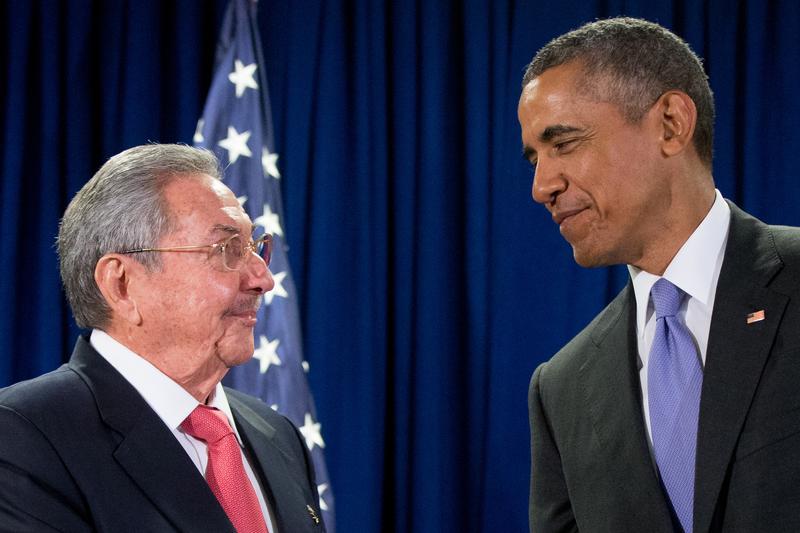
In his speech to the UN General Assembly, Cuban dictator Raul Castro attacked what he called the blockade, demanded the return to Cuba of the U.S. base at Guantanamo, and asked for an end to the Radio Marti broadcasts. He defended Venezuelan strongman Nicolas Maduro and his Ecuadorian counterpart, Rafael Correa. He sided with Bashar Assad's Syria, with Iran, with Russia, and with the cause of Puerto Rican independence. He criticized the market economy and, in a heavy-handed flourish, he closed with a quote from his brother Fidel, an obligatory gesture in Cuba's unctuous revolutionary liturgy.
Shortly thereafter, Castro met with the U.S. president. According to The Washington Post, a somewhat disappointed Barack Obama mentioned to him the overlooked matter of human rights and democracy. There was no glimpse of a political opening.
Obama doesn't understand that with the Castro brothers there is no give-and-take. To the Castros, the socialist model, as they repeat constantly, is perfect, their democracy is the planetary ideal, and the dissidents and the Ladies in White who ask for civil liberties are merely salaried servants of the yanqui embassy, invented by the media, people who deserve to be thrashed.
The Cuban government has nothing to rectify in the Castro view. Let the United States, that imperial power that abuses other nations, rectify. Let capitalism, that system that spreads misery worldwide with its free markets, repulsive competition, hurtful inequalities and lack of commiseration, rectify. To the Castros and their troops of battle-hardened Marxist-Leninists, indifferent to reality, the solution to all evils lies in the collectivism managed by army officers, and with the Castro family directing the puppet show.
Raul, Fidel, and all those around them are proud of having created the greatest of subversive cores in the 1960s, when they founded the Tricontinental and nurtured all the terrorist groups on earth who knocked at their doors or forged their own intelligence services.
They worship the figure of Che Guevara, dead as a result of those bloody goings-on, and recall with emotion the hundreds of guerrillas they trained or launched throughout the world, including against democracies in Venezuela, Argentina, Colombia, Peru, and Uruguay.
They become teary-eyed when they remember their feats in Africa, carried out for the purpose of creating satellites for the glory of the Soviet Union and the sacred cause of Communism, as they did in Angola, where they managed to dominate the other anti-colonial guerrillas. Later, in bloody combat on the Ogaden desert, they defeated the Somalis, their friends before the war, who are now confronting Ethiopia, Havana's new ally.
They feel not the slightest remorse for having executed adversaries and sympathizers, for having persecuted homosexuals or religious believers, for having confiscated estates that had been honorably acquired, for having separated families and pushed into exile thousands of people who ended up at the bottom of the sea. What does this minor individual suffering matter when compared with the glorious feat of "seizing the skies by storm" and changing the history of humanity?
Oh for the grand days of the not-so-cold war, when Cuba was the spearhead of the worldwide revolution against the United States and its minions in the West! A glorious era, betrayed by Gorbachev, when it seemed that soon the Red Army would triumphantly camp on Washington's boulevards.
Obama's mistake is thinking that his 10 predecessors in the White House erred when they decided to challenge the Castros and their revolution, identifying them as enemies of the United States and of the ideas upheld by democracy and freedom.
Obama doesn't understand the Castros, nor is he capable of gauging their significance, because he was not -- as Eisenhower, Kennedy, Johnson, Nixon, Ford, Carter, Reagan and Bush Sr. were -- steeled in the defense of this country against a very real Soviet threat.
Even Clinton, who dodged the draft rather than fight in Vietnam, in the post-Soviet era understood the nature of the Cuban government and signed the Helms-Burton Act to combat the regime. George W. Bush inherited from his father the conviction that an enemy sat crouched 90 miles away, and treated Havana in that spirit during his two terms of office.
Obama is different. When he came to the presidency, 18 years had passed since the Berlin Wall had been toppled. To him, the Cold War was a remote and foreign phenomenon. He didn't realize that there were places, like Cuba and North Korea, where the old paradigms survived.
Like many U.S. liberals and radicals, especially those in his generation, he thought that little Cuba had been the victim of the imperial arrogance of the United States and could reform and normalize as soon as his nation gave it a hand.
Today, he is incapable of understanding why Raul bites that hand instead of gripping it. He doesn't know that old Stalinists kill and die with their fangs always sharp and ready. It's all part of the revolutionary nature.
(AP photo)
The Inevitable Erosion of Japan's Pacifist Era

Framed by the convergence of postwar international and domestic politics over the last 70 years, Japan's pacifist constitution appears to have secured peace and prosperity for the country. Japanese pacifists suppose this good luck will never run out, as demonstrated by their most recent mass demonstration in front of the Diet. Demonstrators protested against security policies proposed by the administration of Prime Minister Shinzo Abe that they believe are unconstitutional. But emerging network-centric military technology is rapidly invalidating their long-held assumptions.
Japan's 1947 constitution was imposed under U.S.-led military occupation, with the intent to put a defeated Japan on indefinite probation as a vanquished but dangerous challenger of the international status quo. The constitution deprived the country of the right to belligerency, as well as the right to possessing normal armed forces as a policy instrument for power projection. For its security and existence, Japan is bound to rely on "the justice and faith of the peace-loving peoples of the world," the overwhelming majority of which then consisted of the Allied Powers.
In response to the breakout of the Korean War in 1950 in the context of the Cold War, however, the United States pushed occupied Japan to organize a small-scale constabulary National Security Force, which later developed into the Japan Self-Defense Forces. Japan took advantage of light armaments and its low fiscal burden to reconstruct its war-torn economy and later to become a global economic power, while the United States to this day continues to play the role of Japan's sole security guarantor.
With U.S. global military involvement and its fiscal burden significantly growing, the Japan Self-Defense Forces have deepened their bilateral alliance relations to supplement and, in limited manners, to complement U.S. military power. Thanks to the alliance, Japan has been able to spend less than 1 percent of its gross domestic product on defense for more than three decades. It has, of course, also been forced to endure an asymmetrical relationship, most visibly by hosting large U.S. military bases on its soil.
Yet as its economy grew, Japan's defense budget became sufficiently large in absolute terms, enabling the country to finance the transformation of the Self-Defense Forces into a compact yet technologically and operationally sophisticated armed force -- one that performs best when cooperating closely with U.S. forces.
For more than two decades, Japan has adroitly evaded its constitutional constraints by maximizing the Self-Defense Forces' logistical and rear area support for U.S. forces. Such support is an essential part of military operations, but it is not integral to combat missions. As such it does not infringe on constitutional redlines. In particular, it has to be noted that sharing real-time digital situational awareness data is considered permissible -- doing so is different from providing digital fire-control data that is immediately linked to combat.
As the regional balance of military power shifts, however, the Self-Defense Forces now cannot help but seek to offset China's quantitative superiority by using the qualitative advantage Tokyo gets through close cooperation with U.S. forces. Japan cannot easily increase defense spending as its society greys, inviting a trade-off between welfare and defense expenditures.
Japan's fiscal constraints thus push Tokyo to network the military computer and communications systems of its Self-Defense Forces with those of U.S. forces, with a focus on high-tech platforms and on vehicles that are to be deployed in a wide operational theater.
This is because, when blue platforms and vehicles are located far apart beyond line-of-sight (an unobstructed path between sending and receiving antennas), individual stand-alone sensors installed on them are unable to capture the rapidly changing locations of their enemy counterparts in real time -- a radar wave is straight, and the globe's surface curved. This emerging network-centricity will inevitably bring about real-time fusion of high-precision situational awareness data to be directly employed for fire control, such as the U.S. Navy's Cooperative Engagement Capability.
There is no longer a neat line separating the data gathered for situational awareness and that used for fire control. That in turn blurs the distinction between the rights to individual and collective self-defense. All of it challenges the long-held precept that restraint from exercising the latter safeguards Japan's national defense.
Technical details aside, the strategic reality is this: The militaries of the United States, Japan, and all of their allies will benefit greatly from sharing tactical data, given growing fiscal constraints developing unilateral war-fighting capabilities. In airspace, and in and under the waters, Japan's increasing technological integration with U.S. forces is changing realities, and the pacifist era is heading for obsolescence.
Thus the day is coming when the use of armed force will have to be judged case-by-case through effective civilian control of the military. Naturally, this demands Japan's political leaders be equipped with knowledge, experience, ability, and capacity in national security affairs, and the Japanese electorate will need to be informed enough on the matter to elect leaders of caliber.
Right now, the situation is a challenge for Japanese democracy: After decades of pacifist inertia, the country lacks statesmen well-versed in national security, and the public is poorly educated in the field. Ironically, the pacifists' preoccupation with the total ban on collective self-defense reveals their strong distrust in contemporary Japanese democracy in general, and in the effectiveness of its civilian control in particular -- their intent is to rely rather on the lingering legacy of the U.S.-led occupation. It is high time to face the tough choices that can direct Japan toward full-fledged democracy.