


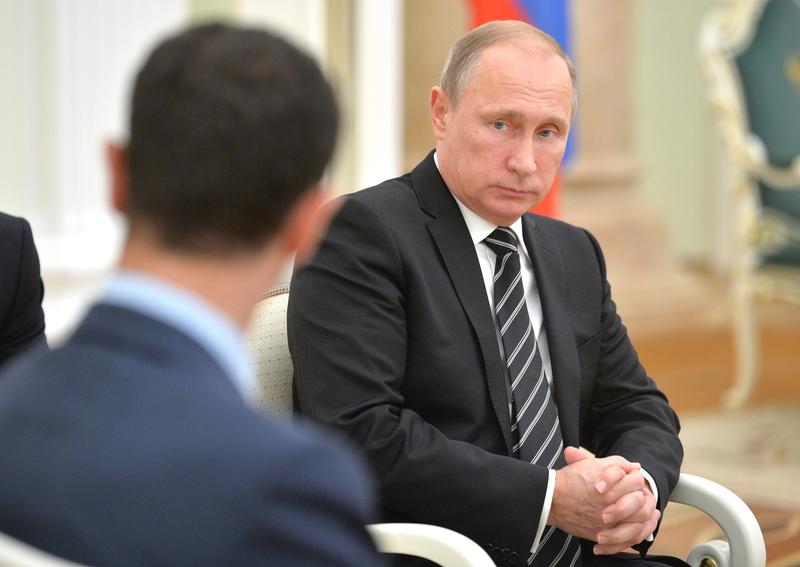

Russian President Vladimir Putin is feeling confident amid Russia's quick entry into the Syrian civil war and the continuing ground operations by the Russian air force. Speaking recently in Moscow during the celebration of the 2000th anniversary of the city of Derbent in Dagestan, Russia's southern republic in the Caucasus that has seen its share of Islamist-inspired anti-Russian violence, Putin said that "no one has ever been successful so far in scaring the Russian - and Dagestani - people. Trying to do so is absolutely hopeless."
Putin further elaborated that "our goal in Syria, and wherever it may be, is the fight against terrorism. We are ready to cooperate with all forces that are fighting against terrorism, regardless of religious affiliation. As for our internal affairs, much still has to be done for the development of our country. We have, I would say, a unique case, a unique setting for this development - life is such that even those who wanted to interfere with our plans are now helping us because we are forced to focus on our own internal development. What we yesterday easily bought with so-called petrodollars, today we are thinking of how to produce on our own. That would require attention to fundamental and applied sciences, as well as the high-tech industry."
Judging by recent developments in his military forces, Putin may have good reason to feel confident. The Russian Defense Ministry's National Control Center recently held a telephone conference under the leadership of the Russian Defense Minister, Army Gen. Sergei Shoigu. The defense minister reported on the completion of military training exercises and on specific developments concerning Russian military branches. The impressive list of achievements started with the results of Oct. 30 training on management of the armed forces - training that involved troops of the Southern Military District, the forces of the Northern and Pacific Fleets, the Caspian Flotilla, and the Strategic Missile Forces Command, as well as long-range aircraft. The exercise tested the reliability of communications across the entire chain of command - from the National Control Center to command-and-control centers at field units throughout the country.
Shoigu further elaborated that all components of the Russian nuclear forces carried out ballistic and cruise missiles launches, such as the launch of Topol intercontinental ballistic missiles from Plesetsk range by Strategic Missile Forces. He further highlighted the strikes against ground targets by Tu-160 strategic bombers at the Pemba and Kura training sites in Russia. Other components of Russia's Strategic Forces also carried out their training - submarines including the Northern Fleet's Bryansk and the Pacific Fleet's Podolsk fired ballistic missiles from submerged positions in the Barents and Okhotsk seas. Shoigu said all designated targets were hit with precision.
According to the report, special attention was given to the use of high-precision long-range weapons during this training. According to the Russian Defense Ministry, long-range precision-guided weapons have already shown their combat capabilities during recent attacks on the infrastructure of Islamic State militants in Syria, although several Russian missiles failed to hit their targets.
Shoigu added that in July of this year, the Defense Ministry decided to develop federal target programs aimed at developing the infrastructure of the Arctic zone and bolstering the security of nuclear weapons, as well as improving the airfield network of the armed forces. The implementation of these programs will improve the combat readiness of the Russian army and will strengthen the defense capabilities of the Russian state.
(AP photo)
