February 19, 2010
October 8, 2009
With a Little Help from My...Prime Minister?
Canadian PM Stephen Harper—presumably sending this dedication out to all of us here in the States—does a surprisingly good rendition of The Beatles' With a Little Help from My Friends; with, of course, a little help from world renowned cellist Yo-Yo Ma:
(h/t TPM)
September 14, 2009
Canada's Tories Go “All-in”
The odds of an early election in Canada have increased sharply over the last few weeks. Now, it seems that the minority Conservative government lead by PM Stephen Harper could be defeated on a vote of confidence as soon as Friday, thus plunging Canada into election turmoil.
The Liberal leader, Michael Ignatieff, announced weeks ago that he would no longer support the government in the House of Commons. The other opposition parties, the Bloc Québécois and the New Democrats (NDP), are unlikely to support or assist the Tories in any way. In fact, a so-called secret recording of one of Mr. Harper’s speeches (no media were allowed in the room) has just been released. Harper's adjusted message is rather clear: the fire breathing reformist is back in business. In a particularly intense show of passion, Stephen Harper urges his supporters to help him win a majority, or else Canada would be left at the hands of a Liberal government supported by separatists (Bloc) and socialists (NDP) that would nominate left-wing ideologues to critical federal institutions. The tone has been set.
Clearly, Mr. Harper - who has been serving as Prime Minister ever since the beginning of 2006, but has never been able to secure a majority in the House - has decided to use every last tool in the box. If he were playing poker, he would be going “all-in”.
At the beginning of the last campaign, the Tories were riding high against a weak Liberal leader, Stéphane Dion, and a Bloc Québécois that appeared on the defensive. In the end, they did clobber the Grits, but their approval ratings sank dramatically in Quebec after some separatist-bashing comments were made, thus paving the way for (yet another) Bloc landslide which effectively prevented them from obtaining a majority. But this time around, Mr. Harper has decided to focus his energy where he can actually win seats: Ontario (108 seats), as opposed to Quebec where 45 to 50 of the 75 ridings remain solid Bloc territory. Not much room to grow for the Tories there; Le Devoir reported last week that an internal report from the Conservative party analyzed that at least 6 of its 10 Quebec MP’s were in danger. Not because of a surge in Bloc support, mind you, but because of a stronger showing of the Grits in the province -- which might split the federalist vote, thus allowing the Bloc to consolidate its nationalist base and win key battleground constituencies.
Right now, democraticSPACE’s poll of polls gives us this picture of the relative strength of parties in Canada (155 seats required for a majority):
Tories: 35.2% (136 seats)
Grits: 30.7% (94 seats)
Bloc: 9.4% (38.4% in Quebec, 45 seats)
NDP: 15.2% (33 seats)
If voters were called to the polls today, the Canadian House of Commons would look much as it is today. With the Bloc’s solid grip on most of Quebec’s ridings, a majority is pretty much out of the question, unless one the two main federalist parties sweeps Ontario as the Liberals under Jean Chrétien did in the 90’s. But right now, the Grits and the Tories are locked in dead heat in Canada’s most seat-rich province.
Once more, Ontario will determine who gets the keys to 24 Sussex Drive.
August 10, 2009
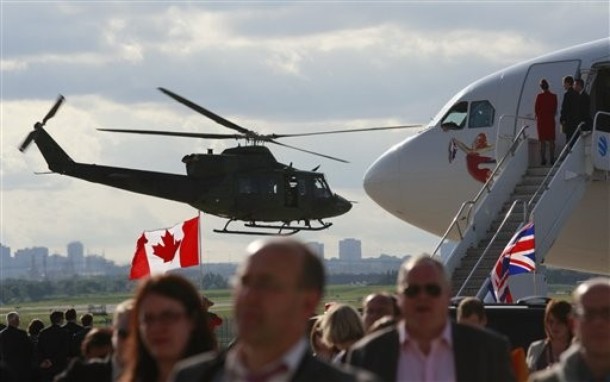
Canada: Great Power or Smart Power

If you haven't already done so, you should read this piece in the Globe and Mail from J.L. Granastein that ran on the home page this morning. It tackles the question of why Canada is not a great power:
That matters because great powers see themselves as mission-oriented. Sometimes, they play imperialist as Britain and France did. Sometimes, they seek global domination as Germany and the Soviet Union did. Sometimes, they aim to spread their capitalist/democratic vision of the world, as Washington does. But they all had or have a vision of the world they want. Canadians can't even agree on the kind of nation – or deux nations – that they desire. It's difficult to tell the world how to act in such circumstances, and Canadian moralizing that “the world needs more Canada” can only be a poor substitute.I think the notion the Washington assumed "great power" status for the purpose of spreading democracy and capitalism obscures an important reality. America acquired great power from a variety of sources, not least was that it avoided the steep costs of having two World Wars fought on its soil. When WWII ended, we understood that the gains from that war would be lost if the Soviet Union swallowed up the weak but pivotal states in its wake. We then undertook a massive military and diplomatic program to check the Soviet Union, which in turn propelled the U.S. into the great power we see before us.
But the point is that America took on this role for largely defensive reasons. The missionary zeal for capitalism and democracy was always latent, as champions of that zeal have argued, but it became a central rationale only when the defensive one (the Soviet Union) collapsed. This, I think, explains why America's post Cold War foreign policy looks both rudderless and reckless.
The purpose of a country's foreign policy is to ensure an international environment conducive to the security and prosperity of its people. Powers that take on missions beyond that scope - or define their security needs so broadly as to constantly put them in conflict with other nations - burn out. Literally. Look at the great powers listed by Granastein: all fell from their perch after extraordinary violence (the Soviet Union "collapsed" peacefully but only after six decades of constant conflict, and bloodshed, with the West).
It's important to have "great power" insofar as it affords you security and prosperity. But it is very difficult to acquire great power and not fall prey to the hubris and over-extension that traditionally accompanies, and ultimately undermines, that power. I can understand why a Canadian would look at the trajectory of great powers and say, "thanks, but no thanks." After all, as Granastein goes on to note of Canada: "We are now what we will continue to be – a developed democratic nation-state with a high standard of living, and that is no mean estate."
Far from it.
-----
Photo credit: AP Photos
January 18, 2009
Canada: Coalition and Equalization
The French World Beat is taking a break this week, as news are pretty slow on the other side of the Atlantic, aside from the Gaza crisis, that is. But some interesting issues have come from up north. Less than two full months after two elections (federal and provincial in Quebec), let's discuss the forces involved in Canadian and Quebecer politics for 2009.
Ten seats short of a majority in the House of Commons, Mr. Harper's government was almost overthrown by what Don Martin from the National Post describes as a "hodge-podge coalition led by the Liberals" just before the Christmas holidays. Drawing his last card of 2008, the Prime Minister suspended Parliament for a month in order to buy time and hoped for divisions within the Liberal Party over Mr. Dion's leadership to soar and disrupt plans for a coalition. Now, Mr. Harper's plan at least partially worked, as prospects for a coalition government overthrowing the Tories in the House are slimmer now than they were a month ago. How is that?
First, the Liberals have themselves a new leader in the person of Michael Ignatieff. It was widely known that while Mr. Dion, still the leader of the party, signed the coalition deal with the NDP and the Bloc, Mr. Ignatieff was the least enthusiastic of liberal heavyweights regarding this situation. Second, the liberal MPs, especially Ontarians, can read polling numbers: The idea of a Liberal-NDP coalition supported by the Bloc might get some traction in Quebec and liberal Toronto, but the majority of Canadians remain opposed to the idea. And who could blame them? In the ROC (Rest Of Canada, outside Quebec), electors favored the Tories over the Liberals or the NDP by a significant margin. Especially for Westerners, the idea of handing over the government to a Liberal-NDP coalition is tantamount to a coup d'etat. Third, Mr. Harper modified the initial budget propositions that started the fire. He backed down on cutting public financing for political parties and he is now promoting a stimulus package to jump start the economy in 2009.
Regarding this latest issue, it is interesting to note that Mr. Harper's right-wing ideological zeal, prominent at the end of 2008, has paved way to a more pragmatist approach. Indeed, Mr. Harper, instead of cutting a budget deal with the opposition, launched a series of discussion with the country's 10 provincial PMs. His guess was, and still is, that if he can satisfy the demands of most provinces with his budget, Ignatieff will have no choice but to back down and and vote with the government.
How did the provinces answer to Mr. Harper's economic stimulus package and plans to reorganize equalization* payments? Most did so positively, as PMs from British Columbia and Ontario labeled the discussions as productive and very constructive.
But, yet again, when you read the Quebec media, you get a whole different story.
"Charest hits a wall," titles Le Devoir. After the first few rounds of discussion, it became quite clear that Mr. Harper's equalization program changes did not cut it for PM Jean Charest's government, leading him to qualify the Tories' brand of federalism as "not so open" to traditional Quebec nationalist demands. Coming from a PM whose defense of federalism and Canadian unity in front of sovereigntists came in the form of enchantment by Mr. Harper's apparent "open federalism" just two years ago, this would be funny if it were not so sad.
Quebec will probably lose hundreds of millions of dollars every year in equalization payments with the new formula, which amounts for at least two preliminary conclusions:
First, after suffering a crippling defeat at the hands of the sovereigntist Bloc Québécois in Quebec in the latest federal elections, the Tories have mostly given up on Quebec. They bet that the 10 ridings they lack to form a majority government could be won in Ontario, B.C. and the Maritimes, but not in Quebec. The "open federalism" concept (an updated version of the "renewed federalism" from the '90s), praised by Tories and Quebec federalists just a few years ago, seems long gone.
Second, Quebec federalists, and especially Mr. Charest and his Liberal Party, have lost one of their main argument against sovereigntists. This amounts to the desert of ideas that is now crossing the federalist option in Quebec. While sovereignty as a political option is not showing upward or downward signs, federalism definitely lost the initiative in the last few months.
With a newly reinvigorated Parti Québécois and its 51 MPs in Quebec, sovereigntism and nationalism could be headed for a comeback in the coming months and years.
*Note : Equalization is a constitutional obligation of the federal government to redistribute revenue from wealthier provinces to poorer ones.
December 15, 2008
Liberals Couldn't Win It All in Quebec
Just a week ago, on December 8, Quebecers were called to the polls. They reelected PM Jean Charest, from the Liberal Party, for a third term. But what do these results mean? Let's take a look (63 seats are needed for a majority):
Liberals (centrist federalist): 66 seats (42.05%)
PQ (centre-left sovereigntist): 51 seats (35.15%)
ADQ (centre-right federalist): 7 seats (16.35%)
QS (far-left sovereigntist): 1 seat (3.79%)
At first glance, one could conclude that Mr. Charest won his bet. He was able to boost his party's popularity by 9% compared to the 2007 results. These numbers got him almost 20 new seats and of course, a majority government. Plain and simple: Mr. Charest won't have to barter for the support of either the PQ or the ADQ for the survival of his government, as was the case in the former minority government.
Anywhere else in the world, this would be called a victory. ... But here again, this is Quebec.
If you had been sitting in the ballroom where Liberals gathered to celebrate the results, you would have been able to hear mosquitoes fly (never mind the fact that mosquitoes are all dead come December). Up until the last moment, Mr. Charest's top operatives had hopes for 75 to 80 seats. They wanted not only a majority government, but a strong one to top it all off. The polls that came out in the last week of the campaign mostly suggested such a scenario. However, nobody in the Liberal Party saw the surge in support for the PQ in the last few days of the campaign. And it almost cost them their majority.
So despite having suffered a defeat, PQ officials read into the 2008 results some encouraging signs, even calling the defeat a "moral victory." Indeed, had you been sitting in the ballroom where PQ militants gathered to celebrate the results, you truly would have believed yourself to be sitting in the winning party's room. Some have called this enthusiasm a little bit hubristic, but none could deny that the PQ effectively stopped the slide in public support that it had been suffering since 1998.
That year, the PQ got 42.87% of public support, in 2003 it went down to 33.24% and it got to an historical low of 28.35% just last year, in 2007. At 35%, the PQ is back in business and it can certainly hope for a government mandate in 4 years. PQ militants did have reasons to celebrate last Monday.
But the main narrative of these results isn't the slim victory of the Liberals or the moral victory for the PQ; it is the hellish downward spiral in which the ADQ is plunged right now. At 16.35% in public support with 7 seats, the ADQ is in the exact opposite situation that the PQ is in. In 2007, the ADQ, under the leadership of Mario Dumont, got to an historical high of 31% of support, winning them 41 seats. Last Monday, the ADQ got only half of what it had in 2007. And Mr. Dumont, who was the most popular politician in Quebec a little bit less than 2 years ago, resigned in the face of these grim results.
What happened in just 18 months?
First, the image of a "one-man-show" stuck to the ADQ. The weakness of the ADQ team strongly contrasted with Mr. Dumont's apparent strength, therefore reinforcing the idea that as good as Mr. Dumont was, he was the sole player on his team. Second, Mr. Dumont's ability to channel public anger towards the government did not compute this time around. In 2007, the public rage over "reasonable accommodations" awarded to ethnic groups translated into growing popularity for Mr. Dumont and his party. This time around, voters did not have a ballot issue on which the ADQ was able to play.
Third, the issues that Mr. Dumont put forward in 2007 such as families and the defense of the Quebecer identity are now strongly attached to the PLQ and the PQ's electoral programs. Indeed, even Mr. Charest, the former leader of the Progressive-Conservative Party of Canada, was able to reinvent himself as a nationalist. Between a PQ that advocates for independence and a PLQ that is now playing the nationalist card, there simply was not that much room left for Mr. Dumont's grassroots nationalism.
Overall though, the ADQ's demise was caused more by ADQ supporters who stayed home last Monday than by the PQ or the PLQ stealing them away. Among those who voted for the ADQ in 2007 who did not repeat their gesture, about half chose the PLQ and half chose the PQ. My guess is, these nationalist voters who were hesitating between the PQ and the ADQ were mobilized to vote for the PQ as a nationalist response to the "separatist-bashing" and "Quebec-bashing" that unleashed its fury in western Canada in the last few weeks.
Mr. Harper will never acknowledge this, of course, but he may have been the PQ's strongest ally on December 8 by stirring up anti-Quebec feelings in the ROC (Rest of Canada).
December 2, 2008
Harper Reaps What He Sows
Canada is, well, in political turmoil, again. Not because of the Quebec general election, mind you, but because the conservative government that was elected just a little more than a month ago is about to be overthrown by an uneasy coalition formed by the Liberal Party (centre-left federalist), the New Democratic Party (leftist federalist) and the Bloc Québécois (centre-left sovereingtist).
How did we get here? First, keep in mind the results in terms of seats from the election last October (155 needed for a majority):
Tories: 143
Liberals: 77
Bloc: 49
NDP: 37
The Tories won, but they fell short of a majority, mostly because of the Bloc's strength in Quebec. After the election and during his inaugural address, Mr. Harper pledged that he would govern for all Canadians, regardless of their party affiliation. But last week, in his economic address, he did the exact opposite: he antagonized all three opposition parties by trying to cut off public funding for political parties, eliminating the right to strike for government employees and announcing a total of zero measures to meet the current economic crisis. At the moment he uttered these words, all three opposition parties made clear that they would never vote for such an economic plan, therefore vowing to overthrow the government.
How could Mr. Harper, known for his strategic sense, not have realized that all three opposition parties would league against him? My only guess is that Mr. Harper's arrogance made him overreach. He tried to push the opposition too hard, and the chickens came home to roost. Within a few hours, the Tories backed off on the most controversial part of their plan, the one regarding public financing for parties. But it was too little, too late.
The Liberals and the NDP leaders, Stéphane Dion and Jack Layton, quickly met and put on paper an agreement to form a coalition in the event that the Harper government would be overthrown by a vote of no-confidence. Now that this vote, which is going to take place on December 8 (the same date as the Quebec elections), will almost surely be lost by the conservatives, we know for sure that the days of the Harper government are numbered.
But in order for this deal to be sealed, Dion and Layton negotiated for the support of the Bloc Québécois and its leader Gilles Duceppe, who has pledged not to vote against the coalition government for a period of 8 months. The Bloc, a sovereigntist party, wants no part in the coalition but is willing to cut a deal in order to make gains for Quebec. Effectively, Mr. Duceppe will hold the balance of power in the Canadian House of Commons.
This has led to mass hysteria in some parts of Canada, as in the most conservative newspapers such as the National Post. Some have called this coalition a "Deal with the Separatist (Bloc) and Socialist (NDP) Devils".
But whatever grievances western reactionaries may have against the Bloc or the NDP, they cannot get around the fact that their champion, Mr. Harper, made his worst mistake ever by pushing the opposition too hard. They say that the Bloc should have no say in the government of Canada because they advocate for an independent Quebec.
Let me just remind them that this author's vote went to the Bloc last October and that my vote is just as good as their vote. As long as Quebecers pay taxes in Ottawa, we will have our say in the affairs of Canada. The Tories tried pandering to Quebec soft nationalist voters and it got them absolutely nowhere - they did not make any gains in Quebec. The Bloc got the vote of almost 40% of Quebecers and 50% of the votes of Quebec Francophones.
My word to the Tories who lash out at us evil separatists is: we cast our vote, we wanted the Bloc to represent us in a minority government. Deal with it.
Obviously, the reactionary ideologues who seem to have taken over the Conservative Party do not understand what a minority government means: it means the government must cut deals with the opposition in order to survive. Mr. Harper remarkably failed at this job, and for that he will be shown the door by the majority of the House of Commons. This is very good news for the 62% of Canadians (that includes 78% of Quebecers) who did not vote for Mr. Harper's right-wing agenda.
As an observer of American politics, you know what this situation reminds me of? I believe Mr. Harper overreached in the same way that Newt Gingrich did when he tried to have President Clinton impeached. It hurt the GOP brand just like Mr. Harper is now hurting the Tory brand in Canada.
November 20, 2008
Quebec Sovereigntists Mounting Comeback
As most of our readers are aware, there are about 9 millions North Americans who share French as a first language. Among them, 6.5 millions of them live in Quebec, a Canadian province which came very close to gaining its independence in 1995 (the NO got 50.4% and the YES got 49.6%).
Since then, the sovereigntist movement has suffered from diminishing enthusiasm, not to mention two electoral defeats for the Parti Québécois (PQ), leader of the movement. In fact, in the last Quebec general election, the PQ got 29% of the vote and 36 seats in the National Assembly (out of 125), its worst showing in 40 years.
However, the party that represents the sovereigntist movement on the federal level, the Bloc Québécois, has won landslide majorities both in terms of popular vote and seats in the latest federal elections. Will the PQ be able to pull itself up in Quebec City the way the Bloc did in Ottawa?
For now, it does not seem likely. The Quebec campaign, already halfway through, has garnered very little enthusiasm from Quebecers. And who could blame them? Before the Assembly was dissolved by Quebec PM Jean Charest (Liberal Party), a poll showed that 75% of Quebecers opposed elections. But this does not seem to have translated into a tangible anti-Liberal feeling among the population, since today's Léger Marketing poll shows Mr. Charest gaining traction among some voters:
Liberals : 44%
PQ : 33%
ADQ : 15%
However, the remaining half of the campaign might have a few surprises up its sleeve. For starters, the PQ is still ahead by a 2-point margin among Francophones, the ultimate key constituency that must be won for any party that wants to form a majority government. Indeed, 80 of Quebec's 125 seats are occupied by overwhelming Francophone majorities. That is why, even with an 11-point lead among Quebecers overall, the Liberal party might still fall short of a majority (63 seats). democraticSPACE's latest seat projection did give them a majority, but by such a slight margin that a minority government remains likely:
Liberals : 65 seats
PQ : 50 seats
ADQ : 10 seats
Looking at these numbers, some may conclude that the sovereingtist movement is on the decline. But what is interesting though is that independence remains popular among Francophones (close to 50% of them remain in favor of it), even more popular than sovereingtist parties themselves. Therefore, it seems that it is the PQ that's pulling independence downward, and not the other way around. With renewed leadership and upcoming tough fights between Quebec City and Ottawa, who knows what could happen? In 1994, independence was at 38% in the polls. A year later, the referendum got 49.6% support.
Conclusion: You can't kill a people's aspiration for independence.
As Jacques Parizeau, former Quebec PM and leader of the PQ during the 1995 referendum, once famously said : "Let us never underestimate the capability of the federal government to disappoint us."
November 12, 2008
What Should We Remember?
Today is Remembrance Day. So let me just start by honoring all soldiers who died defending their country during war, be them Quebecers, Canadians, Americans, Frenchmen, Japanese or Russians. On a more personal note, I would like to honor my two great grandfathers who served in the Canadian army during the First and Second World War. I am honored by their sacrifice and will forever cherish the freedom that they fought to protect.
But this day is also a good day to reflect upon the apparent changes in Canadian foreign policy since the coming-to-power of the Harper government in 2006. I'm writing this because many progressive Canadians and Quebecers believe that what used to be a peacekeeping Canadian army has, under Harper's leadership, turned into an Americanized, ruthless killing machine. In fact, I think this assertion is wrong: Aside from a surge in spending, there are not that many differences between the way things are right now and what they supposedly were in the "golden age of Canadian peacekeeping."
First of all, a lot of this perception has to do with the Canadian army's presence on Afghan soil. May I remind our readers that it was in 2001, under Jean Chrétien's Liberal government, that Canadian soldiers were sent to Kabul? It was only weeks after the tragedy of 9/11, and most Canadians were at that time eager to serve along their American allies and friends in capturing or killing those responsible for the death of 3,000 innocents. I would also keep in mind that during the last general election campaign that took place just a month ago, the differences between Harper and Stephan Dion on Afghan policy were almost nonexistent. Both agreed on a 2011 withdrawal from combat missions, both draped themselves in Lester B. Pearson's legacy of a peacekeeping and democracy-protecting Canadian army.
Second, under any Canadian government, the Arctic Sea would have been militarized. Paul Martin's government gave such signals in 2004 and 2005, and Harper effectively captured the issue during the 2008 campaign. So here again, not much difference.
Third, does anyone believe that after stretching our army into Afghanistan and suffering a toll of more than 100 casualties, Canadians wold be ready to embark upon dangerous peacekeeping missions in Darfur or Congo? I think not!
I'll just conclude with these words from an op-ed piece in the National Post this morning:
For too long, our politicians, academics and educators have tried to bury or even deny our true military history, insisting we have never been a warrior nation. And while it is true that we have never as a culture glorified war, neither have we backed away.
Lest we forget.
November 5, 2008
NAFTA, Canada and Obama
It is now official. Barack Obama will become the 44th US President in January. Up north, this was largely expected and hoped for. When reading newspapers across the board (from left to right, sovereigntist to federalist) this morning, one could not come across anything remotely resembling bitterness over McCain's defeat.
Of course, we all know that if it were the free world that elected its leaders, only Democrats would sit in the White House. The same is true in Canada and Quebec. For instance, the political arch-enemies that are Parti Québécois (sovereigntist) and the Québec Liberal Party (federalist) would definitely be on the same side - the Democrats' side - were they involved in US politics.
Le Devoir, a Quebec sovereigntist newspaper, reports that "A Democratic Wind Has Swept the United States," while the National Post (right-wing federalist) reports that "Obama's Victory is a Proud Day for America."
One thing is obvious: Canada would have overwhelmingly supported Obama. With the expectations very high, let's just hope that the 44th President will not impose a renegotiation of NAFTA, as he has promised, as this would deliver a crippling blow to his popularity in Canada.
It was probably good news for most Canadians to learn that the GOP was able to retain four seats in the Senate. This could prevent Mr. Obama from applying his protectionist policies; potentially halted by a coalition of free-trade Democrats and Republicans in the Senate.
But for now, enough about politics; for now, let's congratulate Mr. Obama on his incredible campaign and for the historic moment we all witnessed last night. Hats off!
October 30, 2008
Quebec Votes 2008
A few days ago, there definitely was en election 'buzz' in Quebec. Today, this 'buzz' morphed into an utmost certainty.
As is the case in all Westminster-style democracies, the Quebec legislature's fate lies in the hands of its Prime Minister Jean Charest. Many signs show that Mr. Charest has already made his decision, and that Quebec voters will go to the polls on December 8.
Why should international readers bother on what happens in federalized sub-states elections? First of all, because no election is completley uninteresting. Second, the results of Quebec elections will give us an idea of the relative strength of the sovereingtist movement (whose goal is Quebec's independence from Canada) versus its federalist adversaries (whose goal is constitutional status quo).
Let's take a look at the makeup of the present National Assembly (Quebec's sole legislative body), which holds 125 seats total:
Liberals (centrist federalist): 48
ADQ (centre-right federalist): 39
PQ (centre-left sovereigntist): 36
Independents: 2
The current minority government is formed by the Liberal Party and lead by PM Jean Charest.
Mr. Charest's main argument to dissolve the Assembly goes as follows: "During an economic crisis, Quebecers need a strong majority government." The main problem is, federal elections just took place ywo weeks ago and some liberals fear that forcing elections will encounter a backlash of voters who have grown election-fatigued. Of course, the only reasons why Mr. Charest wants to go to the polls is that he believes the actual polling numbers are good enough to allow him to form a majority government.
What about the polls? The latest from CROP gives this picture:
Liberals: 38%
PQ: 32%
ADQ: 17%
These numbers may seem favorable for the Liberals at first glance, but when broken down regionaly and by linguistic groups, the story becomes a bit different. Liberals owe their lead to their popularity in urban centres, mainly Montreal and Quebec City. However, among Quebec's Francophones (which make up to 83% of the population), the PQ is ahead with 38% as the Liberals trail at 30%. With these kinds of numbers, many rural ridings that went for ADQ in 2007 could swing back to the PQ, therefore effectively blocking a Liberal majority government. Depending upon the campaign, the PQ has a good shot at winning this election, or at least to come back as the official opposition after the historic beating it took back in 2007.
As far as Mr. Dumont's ADQ is concerned, 17% is a nightmare number that throws the ADQ into the back seats of the National Assembly. In a first-past-the-post electoral system, 17% means not more than five or six ridings. This would be a major setback for Mr. Dumont and his party.
Now, the campaign buses are rented, the candidates' official photos are taken ... Nothing can stop the electoral train when it starts. Of course, Mr. Charest could back off at the last minute. But his recent declarations suggest nothing of the sort. Quebecers, get ready, because we're going to vote on December 8 - for the fourth time in two years.
October 28, 2008
Canadian Liberals: Who's Next?
The Liberal Party of Canada, a once formidable money-raising, power-grabbing machine, suffered its heaviest seat loss since 1984 (40 seats under John Turner's leadership). At 77 seats, Mr. Stephan Dion was able to save a few strongholds but this is mainly due to Canada's first-past-the-post electoral system, as the Liberal Party's performance in 2008 (26%) is even worse than it was in 1984 (28%).
After such a crippling defeat, it was inevitable that Mr. Dion's leadership would be questioned. Six days after the election, under intense pressure, he announced that he would step down as party leader, thus launching a leadership race. For now, all we can do is offer a brief survey of the top contenders since the election date and the finance rules are to be announced later on by party officials. I have separated them in categories, because the list is getting longer everyday.
Leftovers from the last leadership race, in 2006
- Michael Ignatieff: Both a leftover from the last race AND party heavyweight, Mr. Ignatieff is one of the most respected members of the House of Commons. This is somehow exceptional because Mr. Ignatieff has been in politics for only three years now. A former international law academic, he does have the credibility and the ideas usually found in acclaimed intellectuals. As opposed to Mr. Dion, who also was a respected intellectual figure, Mr. Ignatieff also has political instinct and charisma. He will definitely be one of the top contenders.
- Bob Rae: Mr. Rae also is both a leftover from the latest race AND party heavyweight. He has a few advantages over Mr. Ignatieff, but mostly experience. Indeed, Mr. Rae is a former NDP PM from Ontario, which makes him one the contenders with the most executive experience. However, Mr. Rae's years as Ontario PM are remembered by Ontarians as years of plunging deficits and economic crisis. His adversaries will pound him relentlessly on this issue.
- Gerard Kennedy: Mr. Kennedy finished 4th in the first round of the liberal leadership race in 2006. By aligning himself with Mr. Dion, who finished 3rd, he effectively made a king-maker out of himself. He still hasn't stated his intentions for 2008, but I would be very surprised not to see him enter the race.
Party heavyweights
- Frank McKenna: Mr. McKenna is a 10-year former PM of New Brunswick, former ambassador to the US and a successful businessman. Although he chose not to enter the race in 2006, pundits believe he might want to make the jump in 2008. Although his résumé is very interesting, he would start behind his opponents when it comes to his mastery of the French language: Mr. Mckenna is an unilingual anglophone, and that pretty much disqualifies him from winning anymore than 10 seats in Quebec. He pledged to learn French if he were to enter the race, but this factor will definitely play against him, especially when compared to anglophones such as Michael Ignatieff or Bob Rae who speak good French.
- John Manley: Former foreign affairs and finance minister under the Chrétien government, Mr. Manley is part of the party establishment. I would not count too much on his candidacy though, as his lack of charisma and warmth have not allowed him to connect with base party members or voters.
New comers
- Dominic LeBlanc: A Liberal MP from New Brunswick, Mr. LeBlanc is the first officially declared candidate for party leader. He stated that he would run as a centrist, effectively attacking Mr. Dion's green shift that he perceived as a move too far to the left. For those seeking alternatives to Ignatieff, Rae, Mckenna and Co., he might be an interesting voice in the race. He also is fluently bilingual, which makes him a potentially competitive contender.
- Justin Trudeau: A political newbie, Justin Trudeau is the son of former Canadian PM Pierre-Elliot Trudeau. His last name is synonymous with multiculturalism, thus making him very popular among ethnic and religious communities and with the traditionaly liberal party base. But that which is seen as good in Ontario and in ethnic communities is not necessarily seen as good elsewhere: In Quebec, he is mostly perceived as arrogant and careless about Quebeckers as a national minority. Many in his party fear that his election would be tantamount to handing back Quebec to the sovereigntist movement.
If I had to rate these candidacies, from best to worse (in the perspective of a Liberal who wants to win a majority in the next federal election):
1. Ignatieff
2. McKenna
3. Rae
4. LeBlanc
5. Kennedy
6. Manley
7. Trudeau
October 19, 2008
Sarkozy Chooses His Side in Canada
French President Sarkozy arrived at Camp David yesterday to met with US President Bush on the topic of the financial crisis. He did, however, make a quick stop in Quebec City in which he changed two fundamental aspects of the Quebec-Canada-France love triangle.
First, let's remember why Sarkozy actually came to Quebec City. Celebrating the 400th anniversary of its founding, Quebec City is this year's host for the annual summit of the Organisation Internationale de la Francophonie (International Organization of Francophone States). Given the very nature of this institution committed to building bridges between French-speaking states, the French President has always been seen as its natural leader. However, ever since Mr. Sarkozy took office, the French government's interest in the institution and the promotion of the French language worldwide have waned.
Among the first policy review that it conducted, the new French government sent all Francophonie files from foreign affairs to international cooperation (a much less well funded department). Also, Mr. Sarkozy, in an apparent bipartisan gesture, took Bernard Kouchner, founder of Doctors without Borders, as his foreign affairs minister. This is the same Kouchner who said a few years ago that English would be the new language of work in the Francophonie.
Persisting up to this year, the low interest shown towards the Francophonie by this French government took a new step forward this last week. As foreign leaders gathered in Quebec City, Mr. Sarkozy, who at first insisted that he would be there, then changed his mind, then changed it again, finally settled for a quick stop before he would go see President Bush. The very fact that he only passed by shows how little he cares about the Francophonie. Also, his speech never mentioned the future of the French language; it only spoke on the ongoing financial crisis. To say that Mr. Sarkozy does not care about the Francophonie would be an understatement.
Second, in a press conference along side Canadian PM Stephen Harper, Mr. Sarkozy made a plea for Canadian unity, saying that "the world does not need more divisions", a clear reference to Quebec's sovereigntist movement. Of course, this was music to Mr. Harper's ears, but as much as it delighted the federalist side, this quotation spurred some outrage on the nationalist side.
Former Quebec PM Jacques Parizeau reacted by asking Mr. Sarkozy if unity was the goal, why did France abandon its colonial empire? Does Mr. Sarkozy believe that in the name of unity Algeria and Haiti should give up on their independence? He also pointed out that France recently recognized Kosovo's independence. Personally, I would have liked to ask the French President how he would feel if nationalist leaders from Quebec went to France and called on Corsicans to separate from France?
In this way, President Sarkozy changed yet another aspect of France's foreign relations. Ever since the 70s, France's position towards Quebec had always been one of support, regardless of the party in power or of the popularity of either political option. Now Mr. Sarkozy changed that by throwing all his support behind the federalists who are now in power in Ottawa and Quebec City.
Waning support for the Francophonie, important changes in the Quebec-France-Canada love triangle, all that in the few hours that he spent in Quebec City this weekend. It seems that to Mr. Sarkozy, restoring relations with the US ally is much, much more important than keeping good relations with its French-speaking cousins in Quebec, Central America, Africa and Europe.
My guess is, Mr. Sarkozy knows not one thing about what it means to be a national minority whose language is constantly threatened by the growing popularity of English.
October 15, 2008
Canadian Election Results
Canada's election results are in, and Conservatives have secured a minority government:
Tories : 143 seats
Liberals : 76 seats
Bloc : 50 seats
NDP : 37 seats
2 independents
Overall, the Tories came 12 seats short of a majority. Harper delivered Ontario (51 out of 108) and British Columbia (22 seats out of 36), but the Bloc effectively stopped the Tory tide in Quebec. With 10 seats in Quebec (75 seats), this was the province in which the Conservatives thought they could make the most gains. Without Quebec’s support, they could not form a majority government. Had there been no Bloc, Harper would be the PM of a majority government today. Yesterday clearly was a vote of confidence for Mr. Duceppe, as the Bloc sailed to a victory by a very large margin. But still, if you leave Quebec aside, yesterday was a victory for Mr. Harper.
Mr. Dion, on the other hand, lost almost everything. Liberal strategists, knowing they were heading for a defeat, had put the bar at 95 seats. Dion only delivered 76. It's the worst Liberal showing since 1988, when John Turner only got 40 seats for his party. You can expect Mr. Dion to hold on to his job as the leader of the Liberal Party; there are signs, however, that other Liberal heavyweights might want to force him out. No sooner than last night, after receiving news of the crushing defeat suffered by his party, deputy leader Michael Ignatieff made clear that leadership would be an issue to discuss in the coming months. The message is clear: Dion’s worst enemies are now within his own party, and the leadership struggle has already begun.
Will the conservatives prevail in the U.S. election as well? All signs point to the contrary, but what Mr. Harper’s victory showed yesterday is that in spite of polls, right-wing parties always tend to do a better job of motivating their base to go out and vote, as the results indicate that the Tories got more support than polls suggested. Add this to the so-called “Bradley effect” affecting black candidates in America, and McCain could still win in November despite polls giving Obama a 7 percent lead.
Only time will tell.
October 9, 2008
Majority Out of Reach for Harper
The Canadian election recently entered its last phase, as likely voters' intentions measured by polls now slowly but surely become reliable votes for Oct. 14.
A lot of movement in public opinion since last week's debates: The French debate seems to have solidified the Bloc's base in Quebec, making them the most likely winner in the province on Oct. 14. After a hard campaign start on the defensive, Mr. Duceppe's troops can now think of actually winning more seats than in the 2006 election. They are targeting key swing ridings in Quebec City and Lac-St-Jean, where the Tories made gains in 2006.
democraticSPACE's seat projection for Quebec (75 total) :
Bloc at 49 seats (38.8%)
Liberals at 14 seats (22.9%)
Tories at 10 seats (19.2%)
NDP at 1 seat (12.2%)
1 independent
A similar movement in public opinion has followed the English debate too. Mr. Dion's Liberal Party has made big gains in recent polls. In fact, the trend now suggests that the Tories and the Liberals are locked up in dead heat in Ontario. As I have stated before, Ontario will most definitely be the battleground province that will decide the color of our next federal government. Up to very recently, everybody conceded that the choice facing voters was between a majority and a minority for Mr. Harper. But now, talks of a Dion government are being taken with much more seriousness.
democraticSPACE's seat projection for Ontario (108 total) :
Tories at 44 seats (33.4%)
Liberals at 44 seats (32.2%)
NDP at 18 seats (20.9%)
2 ridings are real toss-ups
All added up, the numbers make for a seat projection for the whole of Canada (308 total):
Tories at 130 seats (33.8%)
Liberals at 92 seats (26.2%)
Bloc at 49 seats (9.6%)
NDP at 35 seats (19.4%)
2 independents
So we're still looking at a Conservative minority government, but Mr. Dion's shot at becoming PM have increased steadily over last week. Will he be able to turn the tide completely in his favor in just 5 days? Only time will tell.
What is sure though, is that the surge in support for Mr. Dion's party hurts both the Tories and the NDP in Ontario. In Quebec, higher support for the Liberals could mean that a few ridings that switched to the Bloc in the last election could come back in the Liberals' column. However, it also means that in some ridings the federalist vote will be split up between the Tories and the Liberals, therefore enabling Bloc candidates to squeeze by.
Only 5 days left, and the race is still open ...
October 2, 2008
French Debate: Harper Plays Defense
Wednesday evening, the first of two debates featuring all four of the main parties on the federal level (plus Elizabeth May from the Green Party) took place. As usual, one of the two debates is in French and the other in English. For those less familiar with Canadian politics, the French debate is essentially geared toward Quebec, where 85% of the population speaks French as a first language. I'll first start with a general impression and then will evaluate all five leaders individually.
For our American readers, I would compare yesterday's debate with the debates that you saw in the primaries in both American parties: Cloudy and lacking clear direction. In my opinion, there's just no way that voters can get to know the candidates and their policies better in a forum where there can be almost no dialogue between front runners.
Quite frankly, I really don't understand what Elizabeth May was doing there. There has never been an elected Green MP in the House as her party polls below 10%. And on top of all that, her French is terrible, terrible. So terrible in fact, that a vast majority of Francophones with whom I watched the debate could not understand what she was saying. All she did was slow down the debate when it, at times, became interesting.
Now let's take a look at how the leaders performed, from best to worst:
- Gilles Duceppe, leader of the Bloc Québécois: In my opinion, Mr. Duceppe came out on top. And it seems that this opinion is shared by most Quebecers, as a CROP poll released this morning shows that 54% of Quebecers rate Mr. Duceppe's performance as "excellent" or "very good," compared with Mr. Harper's 18%. He put Mr. Harper on the defensive on cultural funding, the environment and on personal-attack tactics used by the Tories. He clearly was the most experienced of all debaters (this was his 12th federal debate!).
Two negatives for Mr. Duceppe though: first, his attack on youth judiciary reform fell flat as Mr. Harper defended himself well. Second, he did not directly speak in favor of Quebec's independence, which he should have done to energize his base for the last two weeks of the campaign. 8.5/10
- Stéphane Dion, leader of the Liberal Party: With the Liberal polling at its worst for many years in Quebec, expectations were low for Mr. Dion. He actually exceeded them by far; I would say he was the most impressive of all five leaders expectations-wise. Of course, as is the case for Mr. Duceppe, the fact that the debate took place in French gave him an edge on Mr. Harper and Mr. Layton. He put Mr. Harper on the defensive on gun control, the environment and the economy. He probably did not convince Bloc or Tory voters in Quebec, but he made sure that core Liberal constituencies in Quebec would go out to vote on October 14. 8/10
- Stephen Harper, leader of the Conservative party and incumbent Prime Minister : Mr. Harper clearly was the man to beat yesterday (and most likely will be tonight in the English debate) as the four other leaders pounded him relentlessly on cultural funding, the environment and the economy. He managed to remain calm and fended off most of these attacks with some success. He was at his best when defending himself from Mr. Duceppe's attack on youth judiciary reform, but he clearly was off track when responding to the Bloc leader's attack on the dirty politics played by the Tories in Quebec. The fire-breathing reformist that he was in the '90s clearly stayed home yesterday, as Mr. Harper projected the image of a moderate, center-right leader, although his adversaries did not hesitate to remind voters that Mr. Harper would have gone to Iraq with the Americans had he been PM in 2003. 7/10
- Jack Layton, leader of the New Democratic Party: Mr. Layton continued playing the Mr. Nice Guy card yesterday evening. A recent poll showed that he is considered to be the most "sexy" of all leaders, and yesterday's debate confirmed it. He wanted to present himself as the alternative to Mr. Harper, a point he did make in the first half of the debate. On the second half though, he was directly attacked by Mr. Dion many times over, who portrayed him as an irresponsible socialist. I don't believe Mr. Layton fended off these attacks well. Verdict: by going it all-out against Mr. Harper, he opened himself to attacks from Mr. Dion and it hurt him. 5/10
- Elizabeth May, leader of the Green Party: Hats off for just succeeding in showing up. But her performance was bad - she did not show any clear understanding of issues other than the environment, especially regarding health care and Quebec-Canada relations. Most of her attacks fell flat as nobody wanted to debate with her. Also, she loses most of her points because French-speaking voters, the ones who were listening yesterday, did not understand most of what she was saying. Mr. Harper and Mr. Layton are not completely fluent in French, but at least they are understandable. Ms. May was not. 2/10
Tune in for tonight's English debate at 9 p.m., if the Palin-Biden faceoff happens to be boring.
September 30, 2008
Tories Still Ahead; Bloc Fighting Back in Quebec
As the Canadian election campaign enters its last two weeks, polls show that support for Mr. Harper's Conservative Party is still strong. The latest Harris-Decima poll came out today :
Canada-wide: Tories at 36%, Liberals at 26%, NDP at 19%, Greens at 9%;
Quebec: Bloc at 35%, Tories at 26%, Liberals at 21%, NDP at 13%, Greens at 5%.
In Quebec, the three latest Harris-Decima polls gave the Bloc between 35% and 39%. Also, a new Léger Marketing Quebec poll also released today reported Bloc support at 33%, with the Tories second at 26%. Finally, a survey of 7 competitive ridings shows that the Bloc could actually retake 2 Tory seats that it lost in 2006.
Seeing how poll numbers have been moving in the last few day, democraticSPACE updated its seat projection today:
Tories at 140 seats
Liberals at 82 seats
Bloc at 49 seats
NDP at 35 seats
Wednesday night will be a big night for party leaders as they face off in the French debate (English debate will follow Thursday night). For Liberal leader Stéphane Dion, this may be the last opportunity to turn around his floundering campaign.
As support for the Tories recede in Quebec, the battleground that will decide whether or not Mr. Harper's party is worthy of a majority government will be Ontario.
September 22, 2008
Canadian Contest: The Rhetoric Heats Up
It was a quiet weekend in the Canadian polling world. Only one poll was released over the weekend, from Harris-Decima. It shows the Tories at 39%, the Liberals at 23% and the NDP at 17%. In Quebec, the new poll shows that the Bloc remains ahead with support from 31% of likely voters. Followed behind them are the Tories at 25%. For the first time in years, the NDP is now the third party in Quebec, as it's 17% level of approval was just higher than the flunking Liberals.
democraticSPACE also updated its seat projections:
Tories at 144 seats (37,3%)
Liberals at 89 seats (25,6%)
Bloc at 41 seats (8,0%)
NDP at 33 seats (17,8%)
In Quebec:
Bloc at 41 seats (32,2%
Tories at 16 seats (26,0%)
Liberals at 16 seats (20,4%)
NDP at 1 seat (13,5%)
Yesterday, the campaign's rhetoric was turned up a notch. An unwritten rule of Canadian politics is that the parties do not (usually) campaign in the riding where the leader of another party is running. On Sunday, the Tories unleashed a full-scale assault in Gilles Duceppe's riding of Laurier-Sainte-Marie (Montreal) by campaigning on a publicity truck accusing the Bloc of having costed $350 million in salaries since it's founding in 1990.
Most pundits and editorials in Quebec agree that this move could heavily backfire for the Conservatives, as this kind of aggressive, negative campaigning is not really what citizens are used to here. How does Mr. Harper's team come up with $350 million? Simple--They added up the House of Common salaries that Bloc MPs have received in income since 1990. Of course, the attack does not mention that this $350 nillion in salaries would have been paid regardless of the party affiliation of Quebec's MPs.
It remains to be seen if this hubristic behavior coming from the Tories will damage their Quebec campaign or not.
September 18, 2008
Updated Seat Projections in Canada
Here are the latest seat projections from democraticSPACE:
Tories at 150 seats (38,9%)
Liberals at 86 seats (25,5%)
Bloc at 40 seats (8%)
NDP at 30 seats (16,9%)
2 independents
155 seats are needed to form a majority in Canada's 308 seats House of Commons.
In Quebec (75 seats total):
Bloc at 40 (32,7%)
Tories at 17 (27,3%)
Liberals at 16 (19,7%)
NDP at 1 (12,5%)
1 independent
Lots of new polling numbers came out in the last few days.
Harris-Decima: Tories at 38%, Liberals at 28%, NDP at 15%, Greens at 10%. In Quebec, Bloc is at 33%, Tories at 25%, Liberals at 22%, NDP at 11%.
Léger Marketing in Quebec: Tories at 34%, Bloc at 32%, Liberals at 20%, NDP at 9%
Strategic Counsel poll of key swing ridings:
Quebec: Bloc at 31%, Tories at 26%, Liberals at 23%, NDP at 13%
Ontario: Tories at 35%, Liberals at 35%, NDP at 18%
As you can see, some of these numbers are contradictory. For the first time, a poll shows the Bloc actually trailing the Tories in Quebec. However, most polls, especially those targeting key swing ridings, show that Tory support is sagging in Quebec and Ontario. Stay tuned as more numbers will start coming in the next few days.
September 17, 2008
Press Shows True Colors in Contradicting Polls
The race is definitely heating up in Canada. Flaming rants have come to pass from the leaders of the four major parties last week. Gilles Duceppe, from the Bloc Québécois, the Liberals' Stéphane Dion and Jack Layton of the New Democratic Party, have all campaigned hard to define PM Stephen Harper as a clone of American president George W. Bush, while Mr. Harper has attacked Mr. Dion by portraying him as a weak leader.
In Quebec, the Bloc insists that the recent Conservative cuts in cultural funding shows that Mr. Harper does not care about Quebec culture, although he has recently recognized, for the first time in Canadian history, that Quebec is a nation. Quebec artists groups, which have been known in the past for supporting Quebec's bid for independence, are now mostly campaigning for the Bloc (a minority is campaigning for the Liberals).
As far as polls are concerned, well, they are quite contradictory, depending on which press groups release them. On Tuesday, a Strategic Counsel poll released in the Globe & Mail showed that the Tories' lead has shrunk in targeted swing ridings in Ontario and Quebec. Keep in mind that the Globe & Mail is known for its support for the Liberal Party.
Today, a new Segma Unimarketing poll was released in the very federalist La Presse, a French-language newspaper in Quebec. It shows that the Tories are consolidating their lead everywhere in Canada, and most specifically in Ontario and Quebec. Keep in mind that La Presse is actively campaigning for the Tories in Quebec; some of its earlier polling numbers showed, as is true of this new one, higher Tory support than in other polls.
According to this poll, the numbers go as follows: Conservatives at 42%, Liberals at 23%, NDP at 16%. In Quebec, the Bloc's lead shrinks to 33%, followed closely by the Tories at 31%. The Liberals are long gone at 16%. These numbers would mean that the Tories could pick up as many as 10 seats from the Bloc in francophone ridings in Quebec, and up to as many as 20 seats from the Liberals in suburban Ontario.
So Segma Unimarketing projects that the Tories will get 173 seats, the Liberals 68, the Bloc 41 and the NDP 25. However, Segma's projection model does not include other regional polls, which are crucial for making accurate seat projections.
Specific regional polls are set to be released in both Quebec and Ontario this week. These will give us a much better idea of where the race is currently headed.
September 14, 2008
Canada : New Poll Predicts Conservative Majority
A new Canadian Press-Harris-Decima poll released Friday shows that the Tories are consolidating their support in most regions of Canada. According to this survey, the Conservative Party has a 41% support among likely voters, followed by the Liberal Party at 26% and the NDP at 14%. This is definitely a majority-forming support that Mr. Harper's party is seeking.
But most of the Tories' gains came out of the Liberal collapse in Ontario, as Bloc Québécois remains solidly ahead in Quebec with support from 35% of likely voters, followed by the Tories at 28%. The Liberals are most certainly out of the picture in Quebec, sagging at 17%.
With limited backing in Quebec, it's unlikely that Mr. Harper's majority would be handed to him by Quebec voters. If the Bloc is able to maintain its nationalist base, Ontario will most likely be the province that decides whether Mr. Harper's Tories are worthy of forming a majority government.
September 13, 2008
New Seat Projections in Canada
Greg Morrow's projection model, located at democraticSPACE.com, published a new seat projection based on the latest polls broken down regionally. The model used in these projections gave a pretty accurate prediction for the 2006 Canadian election. It did not do nearly as well in the Quebec 2007 election, however.
So democraticSPACE projects a Conservative minority government :
Conservative Party at 146; Liberal Party at 92; Bloc Québécois at 38; New Democratic Party at 30; Green Party at 0 (155 seats are required to form a majority).
New polling data should be available Monday. Stay tuned.
September 11, 2008
Tories Aim for Majority; Quebec Race Competitive
New polling data came out Wednesday in Canada. Let's take a look at what these numbers mean.
First, the Globe and Mail released its "poll of polls." According to this average of national polls, the Conservative Party is ahead at 37%, followed by the Liberal Party at 26% and the NDP at 18%. These numbers should bode well for Mr. Harper, as most analysts agree that 37% of the popular vote means that a majority government is within reach for the Conservatives. To get a majority government, the Tories would need to win at least 155 of the 308 seats in the House.
In addition, according to Ekos' polling data, the Conservatives are also within reach of a majority government with 37% of likely voters' support, followed by Mr. Dion's Liberals at 26%. Ekos projects that the Tories will get one more seat than necessary - 156 - for absolute majority in parliament.
But Ekos's projection model has weaknesses, especially when it's broken down regionally. In Quebec, Ekos reports that the Bloc remains ahead with 27%, followed by the Tories at 25% and the Liberal Party at 22%. It projects that out of Quebec's 75 seats, the Bloc would retain 33 seats while the Conservatives and Liberals would get 20 and 21 seats, respectively.
But I really have trouble believing that the Liberals would get more seats than the Tories in Quebec. It just makes no sense: Mr. Dion is widely unpopular among Quebec's francophones who make up 80% of the population. Also, the Liberal Party's support is below its 2006 level, so I really don't see how they could win 10 new seats in Quebec.
Before the House was dissolved, the Bloc had an overwhelming majority of Quebec's seats (50), followed by the Liberals and the Tories at 12 each. There are only two ridings in which the Liberal Party could make gains in Quebec: Outremont (a historical Liberal stronghold now represented by Quebec's only NDP MP, Thomas Mulcair) and Papineau, a riding in which the incumbent Bloc MP is being challenged by the Liberals' Justin Trudeau, the son of former prime minister Pierre-Elliot Trudeau.
The Tories remain out of the picture in Montreal, where the contest is really between the Bloc and the Liberals. Outside Montreal, though, the struggle is between the Bloc and the Tories. Even if he would never dare say it publicly, Bloc leader Gilles Duceppe hopes that the Liberal vote will not entirely collapse in Quebec.
Bloc strategists privately argue that if the Liberals remain around 20%, it will split the federalist vote between the Tories and the Liberals and therefor allow the Bloc to remain ahead. In any event, the race in Quebec remains higly competitive.
September 10, 2008
A Dirty, Dirty Campaign Starts in Canada
Canada's 39th legislature was dissolved by Governor General Michaëlle Jean (who is, under Canada's parliamentary monarchy, the representative of the Crown of England and therefor the head of state) just three days ago, but vicious, personal attacks have already come to pass. As Michel Auger, a senior political correspondent for Radio-Canada (the French CBC) stated Tuesday, it seems that this campaign will not be won on issues, but by a confrontation of very different personalities. Henceforth, personal attacks are bound to become a central part of the campaign.
Every party plays, to a certain extent, dirty politics. However, if a gold medal for personal attacks were to be awarded, Prime Minister Stephen Harper and his Conservative Party would definitely deserve it. With a treasure chest far exceeding that of his Liberal nemesis Stéphane Dion, Mr. Harper outspent his opponent for a full year now by running ads that portray Mr. Dion as a weak, undecided leader who will raise taxes.
However, on Tuesday, Mr. Harper's attacks came home to roost. The Conservative Party produced a website in which we could see an animated bird dropping excrement on Mr. Dion's shoulder. This trashy attack gave Mr. Dion some momentum, and his indignation played well for the media; portraying Mr. Harper as a take-no-prisoners, blood-thirsty general.
This is exactly the kind of gaffe that the Conservative Party fears. In a campaign where the Liberals (federalist centrist), the NDP (federalist left-wing) and the Bloc (nationalist center-left) are all working hard to portray Mr. Harper as a clone of American president George W. Bush, this latest attack could certainly hurt the Conservatives in some crucial constituencies. Among them are Canada's urban women, who typically abhor such dirty politics.
Of course, it is much too early in the campaign to start making predictions on the effect of this hardball Conservative initiative. Mr. Harper's hubris has given his opponent, Mr. Dion, more ammunition to portray the prime minister as a cold-blooded, power-hungry man. Even the conservative-leaning National Post, a natural media ally for Mr. Harper, acknowledged that these kinds of attacks have gone too far.
Mr. Harper did act swiftly to remove the ad from the web site and offered his excuses (which Mr. Dion accepted), but for a party that has been running negative ads for about a year now, it may be too little, too late.