Main

August 22, 2013

America's "Meritocracy" Looks Just Like China's Crony Capitalism

jpmorgan.jpg

JPMorgan is currently under investigation by the U.S. government for hiring the children of powerful Chinese officials in an effort to win business there. According to Andrew Ross Sorkin, if JPMorgan's Chinese hiring practices are found to have run afoul of the Foreign Corrupt Practices act, it will send "shudders" through Wall Street:

Virtually every firm has sought to hire the best-connected executives in China and, more often than not, they are the “princelings,” the offspring of the ruling elite.

But hey, that's China, where corruption is how business gets done, right? Not quite. Here's Sorkin again:

But hiring the sons and daughters of powerful executives and politicians is hardly just the province of banks doing business in China: it has been a time-tested practice here in the United States.

Sorkin goes on to extol the virtues of letting America's own "princelings" staff the ranks of powerful institutions because they're just so super-smart and well-connected. What the U.S. would prosecute as corruption in another country, Sorkin suggests, is actually good business in America.

What's ironic is that we've also learned this week that China is concerned with the possibility that Western ideas will penetrate their society and undermine faith in one party rule. From the looks of Sorkin's apologia, China's already got the hang of American meritocracy.

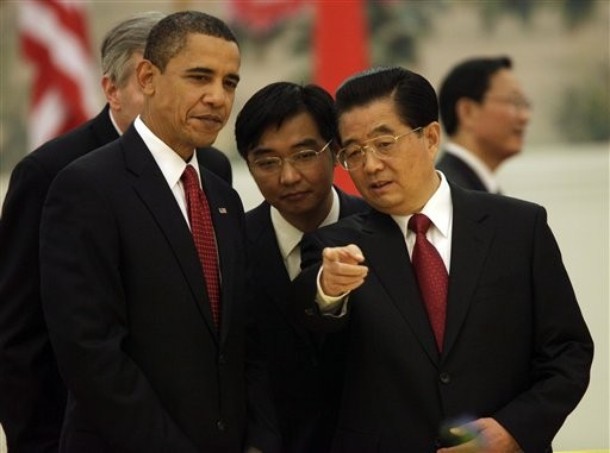
(AP Photo)

July 30, 2013

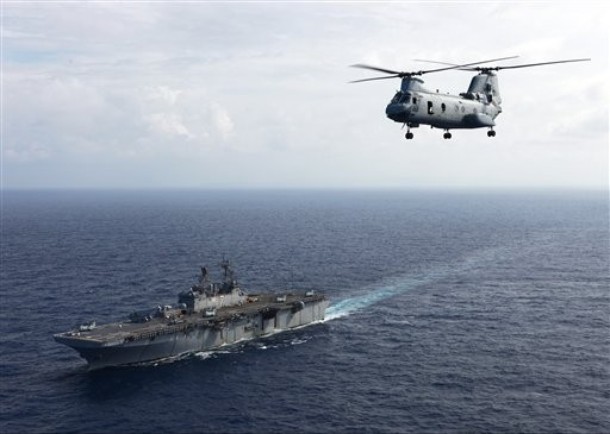
The Obama Administration Encircles China

uscircleschina.jpg

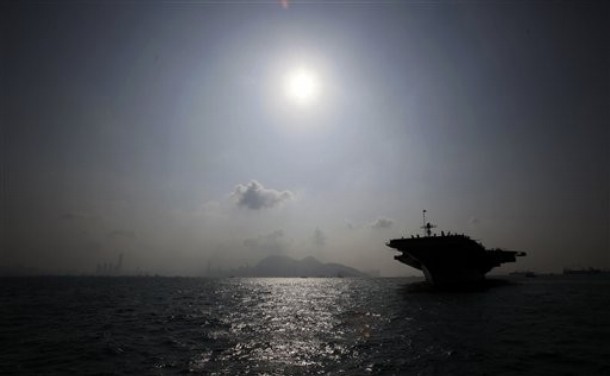
President Obama's "pivot" to Asia has been overshadowed by events in the Middle East, but as John Reed reports, that hasn't stopped the administration from implementing a policy of military encirclement around China:

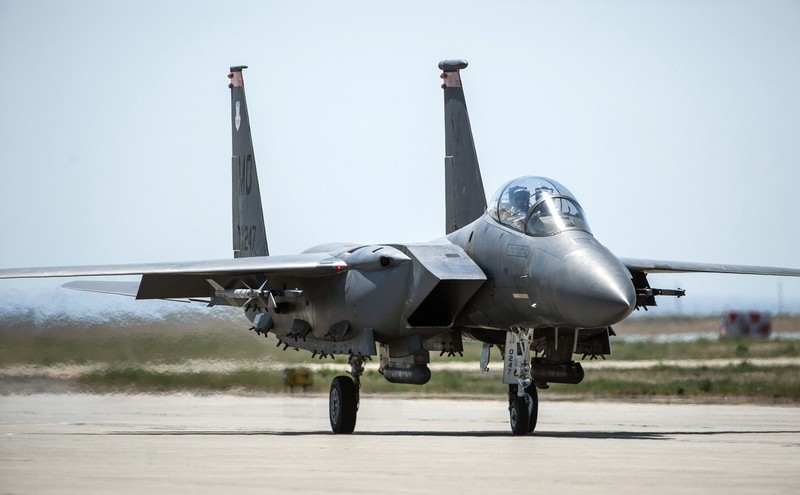
The United States Air Force will dramatically expand its military presence across the Pacific this year, sending jets to Thailand, India, Singapore, and Australia, according to the service's top general in the region.

For a major chunk of America's military community, the so-called "pivot to Asia" might seem like nothing more than an empty catchphrase, especially with the Middle East once again in flames. But for the Air Force at least, the shift is very real. And the idea behind its pivot is simple: ring China with U.S. and allied forces, just like the West did to the Soviet Union, back in the Cold War.


What kind of reaction will this encirclement provoke in China?

One way to answer this is to flip the question: If China began using bases in Central America to station offensive air power, would the U.S. sit idly by?

The administration seems to be banking on a deterrent effect -- that the Chinese will see the constellation of forces arrayed against them and relent on some of their territorial claims and acquiesce, however begrudgingly, to American military dominance in their backyard. This is a high-risk roll of the dice, to say the least.

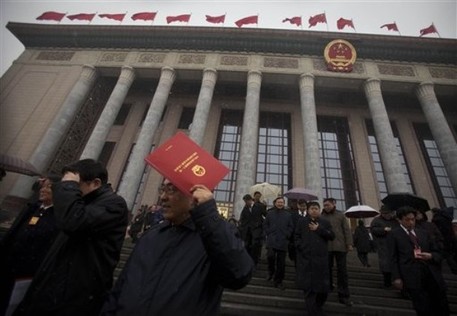
(AP Photo)

July 15, 2013

Which Imperial Power Was the Most Brutal?

Inca-Spanish_confrontation.JPG

Michael Rubin makes what I think is a rather bold claim here:

At its root, China is an imperialist power, one more brutal than Europe’s formerly colonialist powers who, to this day, continue to beat themselves up over their nineteenth and early twentieth century pasts. The Tibetans have been victims, Taiwan—whose unique identity is apparent to any visitor—might become a victim, and the Uighur Muslims are victims, as are any group who are not Han Chinese.

I'll admit up front that I know more about Europe's colonial past than I do about China's, but still, the above struck me as off the mark. Is China's current treatment of Tibetans really worse than what the Spanish did to the Incas or what the British did in Kenya? I could be convinced otherwise, but I doubt.

So, dear reader, I ask: over the sweep of history, has China's imperial rule been more violent and brutal than Europe's?

(Photo: Wiki Commons)

May 31, 2013

Who Doesn't Trust Banks? Europeans

europehatesbank.jpg

Europeans are more likely to distrust banks than anyone else around the world, according to a new survey from Gallup:

Confidence in financial institutions was regionally weakest in the EU; among the 27 EU member states, a median 37% of residents said they have confidence in their country's banks, while 55% did not. However, the trust level in the U.S. was exactly as low as the EU median, in line with the record-low levels Gallup found three years after the recession officially ended in the U.S.

In sharp contrast to Europe and the U.S., many Asian countries have weathered the global financial crisis well and emerged with considerable economic momentum. This momentum helps explain why confidence in financial institutions was highest in Asia last year -- particularly among emerging markets in Southeast and South Asia, where median trust was 77% and 75%, respectively. In Sri Lanka, Thailand, Cambodia, and Malaysia, almost nine in 10 residents expressed confidence in the financial institutions in their countries.

Confidence in East Asia did not lag far behind its southern neighbors. Median trust in the region was 66%; in China, that figure was slightly higher at 72%.

None of this is terribly surprising, given the financial sector's role in plunging the U.S. and then Europe into a sustained crisis. But China may not be content with their financial institutions for very long. As the Economist has observed, China's banks are saddled with bad local government debt and "souring" property loans thanks to its recent "infrastructure binge."

(AP Photo)

May 15, 2013

Why China Wants In on the Arctic

arctcicchina.jpg

China isn't the first country you typically think of when discussing Arctic matters, but they've just been admitted to the Arctic Council on an observer basis and will now have a seat at the table when Canada, the U.S., Russia and the Nordic countries set about wrangling over Arctic policy.

According to Gwynn Guilford, China wants in on Arctic issues less because of the region's reputed storehouse of hydrocarbons (an estimated 13 percent of the world's undiscovered oil reserves and 30 percent of undiscovered gas deposits) but because of its fisheries:

The ”new fishing grounds” will become “the world’s largest storehouse of biological protein,” wrote Tang Guoqiang, China’s former ambassador to Norway, in a recent paper.

As we recently discussed, fishing is a big business for China, so much so that it’s raiding the territorial waters of other countries. Arctic nations are currently mulling an accord to prevent fishing in the open water above the Bering Strait until scientists can assess fish stocks. The objective would be to manage commercial fishing, not to protect the fish habitat, noted the New York Times.


But China isn't alone. India, Italy, Japan, Singapore and South Korea were also admitted as observers into the Arctic Council. The Council itself has only limited powers -- they're able to issue non-binding protocols on member states. Still, as Arctic ice recedes, the Council is viewed as a key vehicle for hashing out the not-inconsiderable strategic stakes.

May 10, 2013

Sexual Abuse Is Rampant in China, Asia-Pacific Alleges Study

chinarape.jpg

A new survey from the UN has found that over 50 percent of Chinese men have abused their partners in the past.

The results are equally shocking looking at the Asia-Pacific region, where six countries (China, Cambodia, Indonesia, Papua New Guinea, Sri Lanka and Bangladesh) were surveyed. One-in-four respondents admitted to having raped a woman, and one in 25 said they had taken part in a gang rape.

James Griffiths has more:

Speaking at a UN symposium on Gender-based Violence and Research in Beijing, James Lang, program coordinator of Partners for Prevention, called the preliminary findings "shocking".

"Violence is a complex phenomenon. Much of the research has been focused on women, but when we try to come up with solutions to reduce violence, we have to include men. That's the whole motivation behind the study," he said.

Researches in China interviewed more than 2,000 men. Over half of respondents confessed to physically or sexually abusing their wives or girlfriends. More shockingly, 25 percent of respondents said they had raped a woman, and one in 25 admitted to taking part in a gang rape.

In this context, monkey-mauling bear bicycle races seem downright enlightened.

May 9, 2013

This Is What Passes for Entertainment in China

In the Shanghai Wild Animal park, they race black bears and monkeys on bicycles (for some reason). It doesn't end well for the monkey.

April 29, 2013

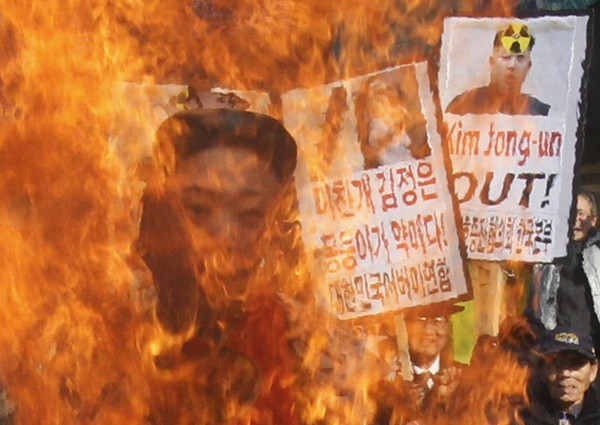
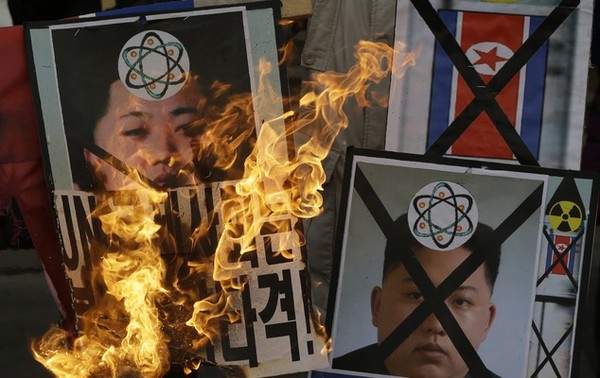
China Shouldn't Let the Korean Crisis Go to Waste

kimjongnumberun.jpg

Rahm Emanuel once said, "You never want a serious crisis to go to waste." The Chinese government should take heed of that advice.

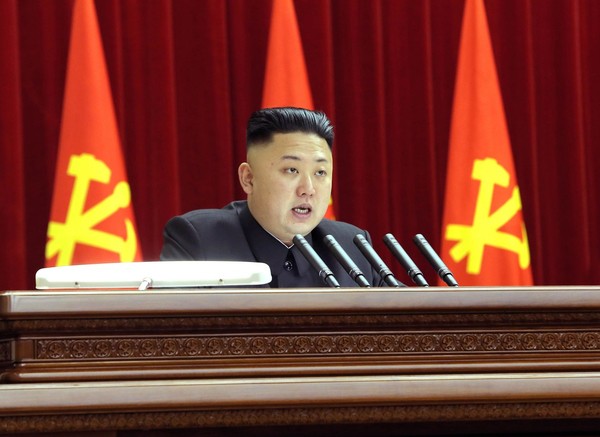
Tensions on the Korean peninsula are getting worse every day. North Korea's apparent plan to conduct a large-scale military drill is just the latest in a series of bizarre provocations by the regime of Kim Jong-un. Because it helps finance the regime, the only country with any real influence over them is China.

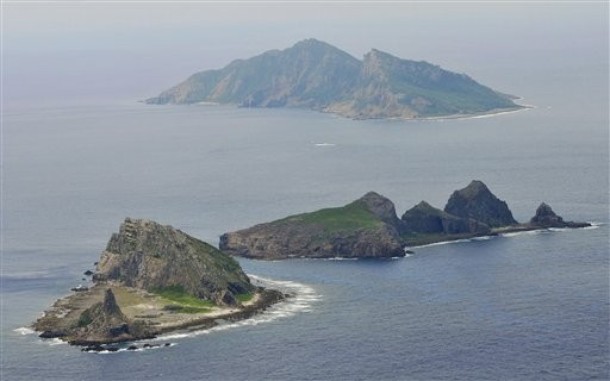
China, deservedly, has a poor reputation in America and in much of the world. A list of grievances would include: human rights abuses, brazenly stealing intellectual property, conducting cyberattacks, selling missiles to Iran, a willingness to escalate tensions over the Japanese-controlled Senkaku Islands, and manipulating their currency to create an uneven playing field in the global marketplace (though many other countries also manipulate their currencies). In general, China acts less like a responsible actor on the world stage and more like a greedy, regional bully with global ambitions.

Is there something they could do to start repairing their reputation? Yes. Endorse regime change in North Korea. But, would they do that? Probably not.

While China has issued vague warnings about regional "troublemakers" and has shown signs of changing sentiments, it has taken no substantive action toward reigning in the pariah in its backyard. In fact, Deng Yuwen, who edits a prominent Communist Party journal, was suspended from his job for writing an opinion piece in which he suggested that China should abandon the North and support Korean unification.

Why is China maintaining allegiance to the North? As Andrei Lankov explains in the New York Times, there are two main reasons: (1) Regime change could result in chaos, meaning thousands or millions of refugees swarming into China, not to mention the possibility of the North's weapons getting into the wrong hands; and (2) A unified Korea would be a U.S. ally. China doesn't like either of those outcomes, so it prefers to maintain the status quo. Lankov concludes:

China faces a choice between two evils: a nuclear North Korea or a collapsing North Korea. And a collapsing North Korea clearly represents a greater evil.

Still, China should recognize that a unified Korea is in its long-term interests. A richer and more stable Korea would be a boon to the regional economy. And perhaps best of all, China would earn admiration around the globe for doing the right thing.

The unfolding drama on the Korean peninsula has given China a golden opportunity to demonstrate to the rest of the world that it can act like a responsible power. Let's hope they don't let this crisis go to waste.

April 18, 2013

In China, You Can Be Paid to Surf the Web for Porn

chinawebjobs.jpg

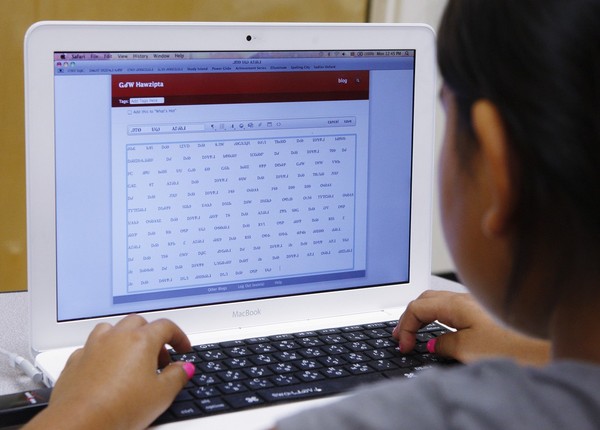
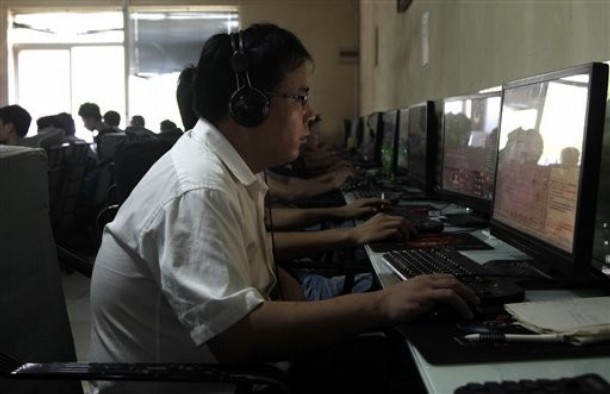
China is infamous for its "Great Firewall" and extensive cyber-censorship, but a new NGO called the "Safety Alliance" isn't concerned with political speech. It's looking to hire workers to surf the web in search of porn (not exactly a needle-in-a-haystack assignment).

Lest you think this is some kind of joke, it's not (or at least, it doesn't appear to be). As you can see from the translated job requirements, you'll need a college degree to perform the required tasks of the Chief Porn Identification Officer:

1. Research and study pornographic videos and images, formulate criteria for determining obscenity.
2. Deploy courseware on the standards of obscenity determination, and study materials such as educational videos on pornography.
3. Manage and rate pornographic resources (including BT seeds, images, and online videos).

Job Requirements:
1. Familiarity with the different standards of determination of pornographic content of different countries;
2. Familiarity with the standards of determination and express regulations concerning pornography in China’s law;
3. Familiarity with the standards of pornography identification used by CNNIC (China Internet Network Information Center) and various major internet providers;
4. A bachelor’s degree or above; age between 20-35; all genders;
5. Possesses good teamwork skills, and a strong sense of responsibility.

The job pays about (U.S.) $32,000, although virtue is its own reward.

(AP Photo)

March 26, 2013

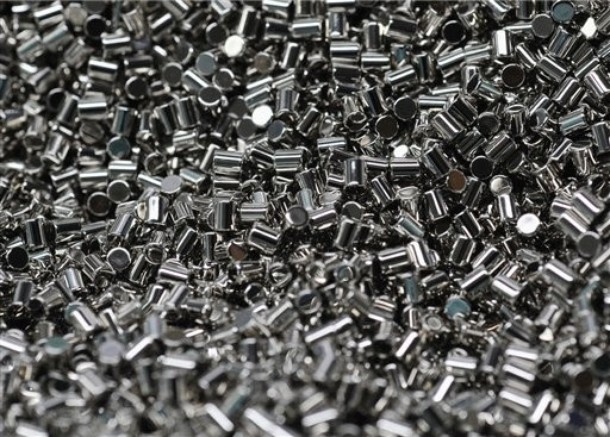
China Now Has Even Less Leverage Over Japan

RareEarthMine-615x400.jpg

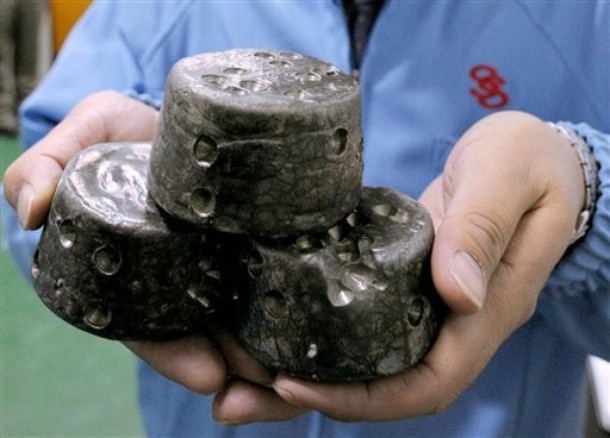
Ever since China imposed an export ban on critical rare earth minerals to Japan (minerals Japan's high-tech industry feeds on for products such as GPS chips and solar panels), China has seen its resource weapon lose considerable potency. Even after lifting the ban in 2010, China has not recouped its lost shipments. In 2012, Japanese imports of Chinese rare earths fell to their lowest level in 10 years thanks to Japan's efforts to diversify sources, recycle more aggressively and use alternatives.

Now things are about to get worse for China.

According to Reuters, Japanese researchers have found "astronomically high levels" of rare earths in the ground near an island Southeast of Tokyo. (The thing with "rare" earths, as RCW contributor Daniel McGroarty has explained, is that they aren't rare at all.)

Of course, these resources aren't immediately exploitable, but they do bolster Japan's ability to insulate itself from resource-bullying. It also underscores just how foolish it is for states to wield resource weapons in the first place. The importers, like Japan, suffer in the short-term but over the long-term, it's the producing states that wind up hurting the most as alternative measures are implemented.

(AP Photo)

March 22, 2013

China Is Returning North Korean Defectors

northkoreaescape.jpg

China reportedly captured and returned 12 North Korean troops who had defected after shooting their senior officer.

According to Korean media reports, there have been a series of defections among North Korean soldiers due to food shortages. North Korean border troops have been forced to cultivate their own corn and potatoes to survive and several groups have decided to roll the dice on escaping, only to be caught by Chinese border patrols.

It's not just North Korean soldiers who are having trouble escaping. In January, the New York Times reported that it was becoming "increasingly difficult" to smuggle refugees out of North Korea thanks to a crack down by China's border control.

Meanwhile, the United Nations has formally approved a probe into North Korea's human rights abuses.

(AP Photo)

March 20, 2013

Japan Moves Closer to Revising Critical Piece of Constitution to Permit "Self Defense"

abe.jpg

According to Japanese press reports, three political parties, comprising 76 percent of the seats in the lower house, have called for a change in Japan's Constitution. Specifically, they wish to revise "Article 9" which enshrines Japan's post-World War II pacifism.

The move to revise Article 9 is being led by the Liberal Democratic Party, whose leader, Shinzo Abe, is currently Japan's prime minister.

Most of the proposed revisions would assert Japan's right to "collective defense" and bestow official recognition on the country's Self-Defense Forces. The move is seen as a necessary first step for Japan to bolster its combat capabilities in light of its increasingly contentious standoff with China.

There is still some ways to go before Article 9 can be amended. A two-thirds majority in favor of the amendment must be achieved in both houses of congress. Elections for Japan's upper-house are due this summer.

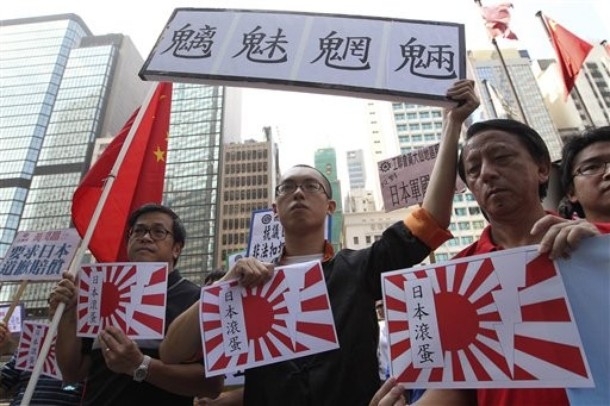
That hasn't stopped Chinese media from firing a shot across the bow. Writing in the China Daily, Cai Hong claimed that the Abe government was ditching "Japan's commitment to world peace," which combined with his government's refusal to apologize for "Japan's aggression during World War II, the revision of Japan's constitution and easing of Japan's weapons exports is cause for concern for the rest of the world."

(AP Photo)

March 19, 2013

Syrian Jihadists May Have a Chinese Recruit

In a YouTube clip reportedly from a Syrian jihadi group called the "Mujahideen Brigade Front," a Chinese convert to Islam who claims to have fought in Libya and is now battling the Assad regime in Syria, apologizes to Syria on behalf of the Chinese for his government's support of the Assad regime.

He also threatens China with "economic sanctions" once the rebels prevail.

Foreign Policy has the translation.

March 16, 2013

China Said to Have Aborted 336 Million Babies in 40 Years

chinaold.jpg

Official statistics from China's health ministry indicate that the country's doctors have performed 336 million abortions since 1971 in support of the government's "one-child" policy.

In addition to the hundreds of millions of abortions, China has also sterilized 196 million men and women since 1971.

China's leaders have credited the one-child policy, which is often brutally enforced, with preventing overpopulation and spurring economic growth. Yet it is also leading to a serious demographic crunch as China ages, a dynamic which could imperil China's future growth.

The incoming government has pledged to "reform" its family planning policies, although it does not plan to eliminate the one-child policy.

(AP Photo)

China's New Leader: Good for America?

The NewsHour conducted an interesting debate this between Kenneth Lieberthal of the Brookings Institution and Gordon Chang of Forbes about the Rise of Xi Jinping and the future of U.S.-China relations.

March 11, 2013

Asia's Other Economic Miracle

australihighflying.jpg

We're used to hearing about China's amazing 30 year run of blistering GDP growth. But there's another Asian country that has enjoyed 21 straight years of economic growth: Australia.

That's right, it's been 21 years since Australia has had a recession. That is the longest "for any nation at any time," according to Chris Richardson of Deloitte Access Economics.

What's the secret? China.

Australia has profited immensely from China's rise. Its mining industry serves as a key source of raw materials to fuel China's manufacturing industries. Australia's growth has also earned it the distinction of being the fastest growing rich nation in the world, according to Deloitte.

Yet with exports surging, Australia, like China, is trying to "rebalance" its economy to boost domestic consumption, an effort that has yet to yield much success.

And while Australia's economy is closely linked to China, the relationship is still marked by unease. Just today, Australia's central bank reported that it was attacked by hackers possibly operating in China. Australia recently agreed to station U.S. Marines at a base in Darwin and the country's strategic community has been engaged in a passionate debate (encapsulated well by Hugh White's The China Choice and the invaluable blog The Interpreteter) about the role it should play between China and the U.S.

(AP Photo)

March 8, 2013

Why China's Military Spending May Not Be That Impressive

chinamilitary.jpg

This week China announced it would up its defense tab by 10 percent. While this may have been music to ears of America's military-industrial complex, the reality is more complicated and considerably less menacing.

First, as a report in the China Quarterly notes, inflation has eaten away at the real-world impacts of China's big defense spending increases, making them much lower than current figures suggest. The military is also receiving a declining percentage of Chinese government spending -- "it does not come close to dominating national priorities," the study's authors write.

Indeed, as Lily Kuo observed, China is actually spending more money on domestic, internal security than it is on its external defense forces. The Communist Party has 1.3 billion people to keep an eye on -- a "near enemy" that's considerably more dangerous to their rule than America's Pacific fleet.

China also faces significant demographic and economic pressures over the longer-term which could put a crimp in their defense outlays.

(AP Photo)

March 1, 2013

China Uses a "Stealth Navy" to Ratchet Up Sea Tensions

chinamarine.jpg

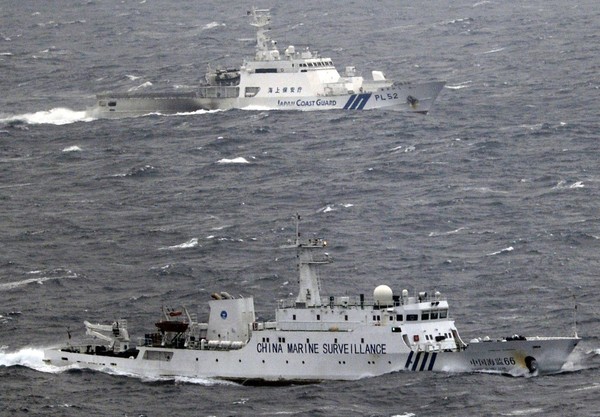
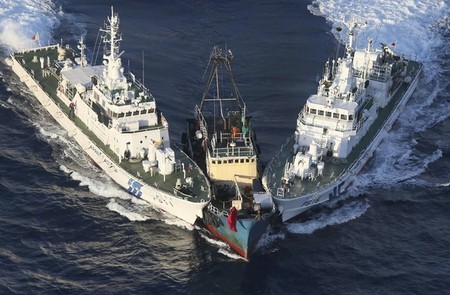
With no formal Coast Guard but plenty of coastal waterways in dispute, China has been cultivating its State Oceanic Administration into a "stealth navy" to "challenge existing maritime demarcations," writes Miles Yu.

Yu writes that the Marine Surveillance division of the Oceanic Administration has blossomed into robust fleet consisting of 13 ships, including several 4,000 tonners, and plans to launch 36 more vessels in the coming year. This ostensibly civilian service has 400 vessels, 10 aircraft and a transport plane, Yu notes.

According to a U.S. Navy official quoted by Yu, this fleet's sole purpose is harass other states' boats as it seeks to stake its claim in contested waters. Just last week, Japan claimed three ships from the Marine Surveillance division entered its territorial waters.

(AP Photo)

February 26, 2013

China's Officials Are Killing Themselves -- And the Chinese Are Laughing About It

chinasuicide.jpg

According to the Economic Observer, in the past two months three local Communist officials have killed themselves, joining a "growing number of high-ranking officials" who have committed suicide.

Published reports in China's state-run media typically attributed the deaths to depression but the public's reaction has been anything but sympathetic. The Observer noted that Internet users have taken to ridiculing the dead in part because the official reaction to these suicides has been so ham-fisted, with vague and elusive statements regarding the cause of death.

In some cases, such statements are clearly untenable. In 2011, Xie Yexin, an anti-corruption official, was found dead in his office with eleven stab wounds. After a "meticulous investigation," the authorities declared that Xie killed himself.

(AP Photo)

February 23, 2013

Understanding the Sources of Japan-China Tensions

Watch China Looms as Main Concern in Obama and Abe Meeting on PBS. See more from PBS NewsHour.

Mike Mochizuki, associate dean of the Elliott School of International Affairs at George Washington University, was on the NewsHour yesterday and gave an interesting overview of the rising tensions between China and Japan.

February 20, 2013

How China Killed One Billion Japanese Last Year

japanese-flag_2341797k.jpg

They've done it at the movies:

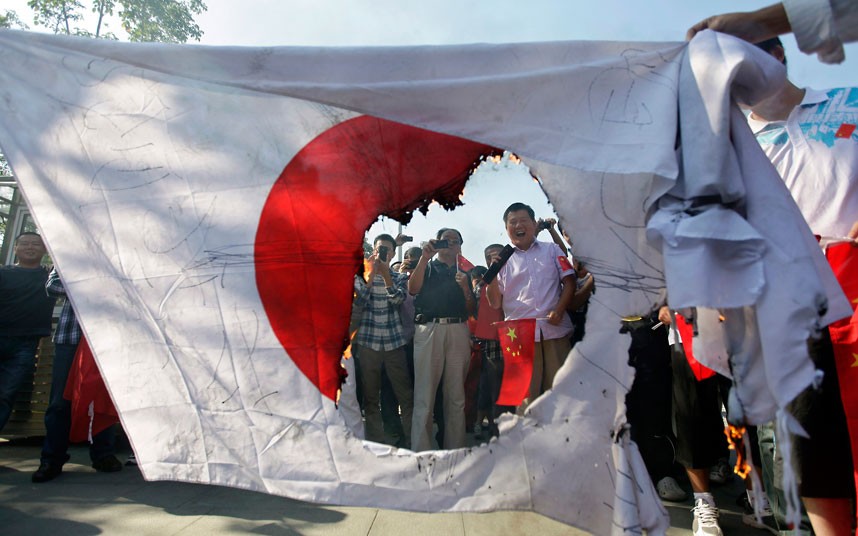
Nearly one billion Japanese soldiers or enemies were killed off in TV productions filmed last year at Hengdian World Studios, the studio facilities known as the Hollywood of China, the Guangdong-based Yangcheng Evening News reports, suggesting that Chinese TV audiences like to achieve some degree of catharsis for their anti-Japanese sentiment with a high body count of enemy combatants in historical dramas.

As this figure breaks down as 2.7 million deaths per day for 365 days — a rate of over 30 per second — it seems reasonable to assume that most of these "deaths" occurred off-screen — or that this represents the cumulative total of every death in every series broadcast on myriad domestic networks. Put it this way: somewhere on Chinese television right now, Japanese people are being killed. And probably in large numbers.

In 2012, out of the more than 200 TV series broadcast on national networks, more than 70 of them had a wartime or anti-Japanese theme, more than any other "genre." The trend is definitely set to continue this year, said the newspaper.

The Yangcheng Evening News looks a bit like China's equivalent of the UK's Sun paper, so we shouldn't take these figures as authoritative.

(Photo: Reuters)

February 18, 2013

Five Things Americans Fear the Most

nkoreatopthreat.jpg

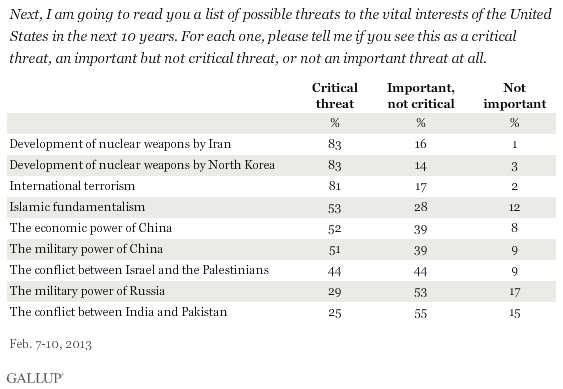
What do Americans fear most? When it comes to America's international security interests, the North Korean and Iranian nuclear programs are deemed most threatening, according to a new survey from Gallup. Americans were giving a list of nine developments and asked to rank them from more to less critical. Here are the top five threats Americans say are most critical:

1. The nuclear programs of Iran and North Korea (tied for first)
2. International terrorism
3. Islamic fundamentalism
4. The economic power of China
5. The military power of China

The poll was conducted before North Korea's most recent nuclear test.

Other issues that had previously ranked higher -- such as the Israeli-Palestinian conflict and tensions between India-Pakistan -- have declined.

Here's a look at the full list of Gallup's results:

gallupthreats.gif

(AP Photo)

February 15, 2013

Is China Cooking the Books?

chinacooking.jpg

Outside observers have long complained about the quality of official economic statistics from China but according to Asia Sentinel, the disconnect between what multinational corporations are reporting from China and what the Communist party is touting is growing sharper:

The assembled date, Walker says, indicate that 2012 was significantly weaker than either 2008 or 2009, even though the official GDP numbers show only a marginal tapering off.

"Demand in the real economy was as weak as the picture painted by our PMI and electricity production indicators," Walker writes. "Tax receipts and corporate earnings, not to mention what we know of cash flows in the first half of last year, also indicate the slowest economy in the last half decade, and not by a marginal amount."

Most of these figures show that the boom most China Bulls discovered in the second half of 2012, and the fourth quarter in particular, isn't there.

The Walker quoted above is Dr. John Walker of Asianomics. He has pegged China's real growth rate for 2013 at between zero and four percent. Official Chinese estimates are closer to eight percent.

(AP Photo)

February 13, 2013

How Will Obama's Nuclear Cuts Play in Asia?

During his State of the Union address, President Obama pledged to further cut America's nuclear arsenal. The exact figure wasn't specified, but it's been reported that the goal is to reduce the force from the current 1,700 "deployed weapons" down to 1,000, provided some kind of deal can be reached with Russia.

While China's nuclear arsenal is tiny in comparison, it has been undergoing a process of modernization and C. Raja Mohan argues that China will continue to stand aloft from any disarmament talks for the time being:

This approach leaves Beijing much leeway in responding to Obama's latest nuclear initiative. It allows Beijing to hold the high diplomatic ground on supporting the long-term goal of global zero, promising to join multilateral talks on nuclear reductions when it is convenient, and leaving room for its nuclear weapon modernisation in the interim.

Mohan argues that while most of America's close allies in Asia may be worried that America's "extended deterrence" would be weaker with a smaller arsenal, one major player is likely to be heartened by Obama's reductions:

In contrast to some in East Asia, India has every reason to welcome Obama's plans to negotiate deeper nuclear cuts with Russia. Like China, India has seen deep cuts in the US and Russian arsenals as an important first step on the road towards nuclear disarmament.

February 12, 2013

'Fatty Kim the Third' or How China's Web Users Are Reacting to North Korea's Nuclear 'Earthquake'

fattykimthe%20third.jpg

China has long propped up the North Korean regime as a buffer state between it and U.S. ally South Korea. But China's patience with North Korea is reportedly running thin and this latest nuclear test may be the atom that broke the camel's back, at least if China's web users had their say (which, of course, they don't).

Liz Carter of Tea Leaf Nation took the pulse of Weibo (China's version of Twitter) and found the response decidedly hostile to North Korea. One commentator described China's policy of propping up the Hermit Kingdom as "raising a mad dog to protect your house."

Josh Kim is also surveying China's online reaction, where several commentators have had harsh words for "Fatty Kim the Third." Lian Peng, anewspaper columnist, complained that the "bitterest loser" of North Korea's antics is China. Another, Yao Bo, argued that if "China continues to tolerate this thug nation, we will lose big."

The official Chinese reaction is more restrained, with the Foreign Ministry claiming to be "strongly opposed" to North Korea's nuclear experimentation.

(AP Photo)

February 7, 2013

China Will Also Focus on "Nation Building at Home"

cinareacitve.jpg

It's a favorite saying of the Obama administration, but it's equally valid for China's rulers, according to a new report from the Lowy Institute's Linda Jakobson. Where many in the U.S. and the world see a rising China, most of China's elite (from businessmen to politicians) are instead "deeply worried" about the trajectory of their country and whether China can overcome "daunting" domestic problems, Jakobson writes.

The upshot is that foreign policy won't be a top priority for China's leaders and their policy will continue to be "reactive," Jakobson notes. Nevertheless, the contours of future trouble are evident in Jakobson's report. Among China's key foreign policy aims, she writes, the top priority is the stability of the regime -- a stability which could be endangered if China is seen as being humiliated by foreigners in China's growing web of territorial disputes.

The potential for conflict with Washington is also prevalent. The biggest flash point, according to Jakobson, is U.S. intelligence gathering in China's "exclusive economic zone." The U.S. believes UN laws permit such activity, while China disputes that and both have military assets in the zone to monitor and (in China's case) intercept reconnaissance flights.

(AP Photo)

February 6, 2013

The Sources of China's Naval Conduct

Tensions have been steadily rising in the Pacific as China and her neighbors butt heads over disputed territories in the South and East China Sea. While the U.S. has tried to dampen tensions, Captain James Fanell, a top intelligence adviser to the U.S. Pacific Fleet, used what the Lowry Institute's Sam Roggeveen described as "bracing" language when describing China's naval ambitions at a recent conference. According to Fanell:

"...China is knowingly, operationally and incrementally seizing maritime rights of its neighbours under the rubric of a maritime history that is not only contested in the international community but has largely been fabricated by Chinese government propaganda bureaus in order to 'educate' the populous about China's rich maritime history, clearly as a tool to sustain the Party's control."

James Goldrick, a retired Rear Admiral in the Royal Australian Navy explains China's approach:

The danger is that a combination of China's self-image as the Middle Kingdom and continentalist ideas of strategy may manifest themselves in efforts to create what can only be described as an ever extending 'Great Wall over the Sea'. This is why the territorial concepts which are sometimes mentioned in relation to the South China Sea (in particular the 'nine dashed line') should be of such concern, as should some of the recent ideas about the way in which offshore oil platforms might be employed as instruments of sovereignty.

Basically, Goldrick argues that China views the seas as "blue territory" and not a "commons" accessible to all.

January 29, 2013

Woman in China Dies, Wakes Up in Coffin

chinacoffin.jpg

A 101-year old woman in China "woke up" after being declared dead and being unconscious for 16 hours. The best part: she was already in the funeral home, in a shroud and was being laid in the coffin when she opened her eyes and protested that she wasn't dead. No word on how rattled the funeral home workers were...

The woman was, according to reports, in "very good spirits." The assembled mourners than pivoted to party mode.

(AP Photo)

The World's Leading Wind Power Generators

windpower1.jpg

According to a recent survey from the World Wide Wind Energy Association, China is the world's leading producing of wind power. They boast a total of 67.8 gigawatts of wind power capacity. The U.S. is a fairly close second, with 60 gigawatts of wind power generation. Germany, Spain and India round out the top five.

Personally, I think the U.S. could probably vault to the top spot if it harnessed the abundant flow of hot air emanating from its capital.

(AP Photo)

January 25, 2013

The Underside of China's Economic Miracle: Child Labor

chinafactory1.jpg


Last year, Apple came into some fierce criticism for poor conditions at its suppliers' factories in China. Today, Apple gave the boot to a supplier for using child labor:

Apple has terminated a contract with Chinese circuit board manufacturer PZ after discovering 74 under-age workers were working there.

The workers, who were all under 16, had been supplied by a regional recruitment company who gave them fake identity papers, the tech giant said.

They have since been returned to their families.


Why are Chinese factories turning to underage labor? The New York Times reports today that many college graduates are shunning factory jobs. There is a huge mismatch in the types of jobs China is producing and the kind of work its college educated young are hoping to do.

In the short term, this mismatch is going to do damage to China's attractiveness as a destination for low-cost manufacturing, but longer-term it's going to put immense strain on white collar work around the world. Consider what happened to U.S. manufacturing as rural Chinese flooded into urban factories over the past three decades. Now imagine what happens to higher-skilled work as the children of those factory workers graduate from college with advanced degrees and compete on a globalized market. Those jobs may not be as susceptible to out-sourcing as factory jobs were (although that's a point of debate), but it would be naive not to think the ramifications are potentially just as significant.

(AP Photo)

January 22, 2013

Is China Blowing Another Huge Bubble?

chinabubble.jpg


Bubble, bubble:

China’s central bank, the People’s Bank of China, just okayed 3 trillion yuan ($482.6 billion) in new lending for 2013. It’s not much more than what it allowed in 2012—but still a considerable sum for a country struggling with overcapacity.

That’s merely worrisome though. What is actually stomach-churning, though, is the 679% year-on-year increase in “trust loans” disbursed in December, hitting 264 billion yuan. And, yes, that’s 679%, not a typo. (We recently explained in detail why these super-shady investment vehicles—which allow banks to finance off-the-books loans to companies and local governments by offering them to their retail customers as investments—should unnerve everyone, but the key words here are “Ponzi” and “scheme.”) The central bank also noted today that it expects a 16% year-on-year increase in “total social financing,” a hefty portion of which is trust loans.

Meanwhile, Kate Mackenzie worries that this is proof that China has failed to "rebalance" its economy away from state investment and toward a consumption based economy. Matthew Yglesias is less concerned:

To MacKenzie (or her headline writer) that means China "still has the same old problems." I would say the other way to look at that is that China still doesn't have the same old problem of having settled into a slow-growth, low-resources-utilization equilibrium that we see in much of the developed world.

One thing we learned from the U.S. financial crisis is that there's no gentle unwinding of bad debt when it's this pervasive. China, fortunately, is not as intertwined into the global financial machinery as U.S. and European banks are, but we'd be fooling ourselves to think that a financial crisis leading to a recession or sharply curtailed growth in China wouldn't have ripple effects on the global economy.

Still, before that financial Armageddon arrives we'll be able to enjoy an influx of Chinese gadgets:

China's industry ministry Tuesday set an aggressive goal of forging global giants in the electronics sector within the next two years through mergers and alliances and reiterated a long-standing push for Chinese companies to explore overseas acquisitions.


(AP Photo)

January 21, 2013

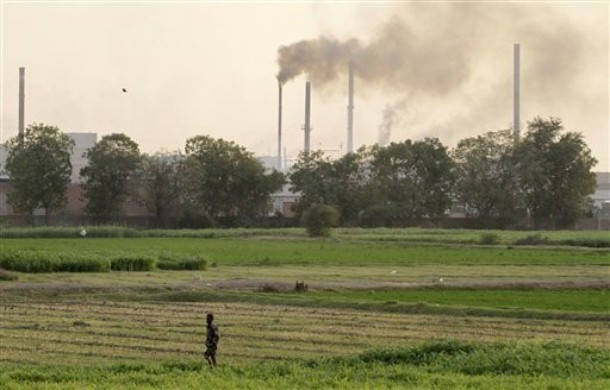
How Bad Is China's Air Pollution?

So bad that a factory fire raged for three hours before anyone noticed it through the smog.

January 18, 2013

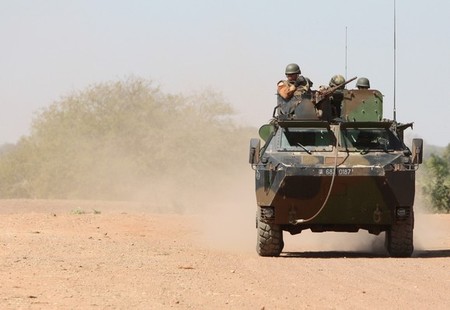
War in Mali: The China Angle

chinamaliangle.jpg

Joe Glenton argues that Western policymakers may be crying "jihadi" in Mali, but they're secretly worried about China too:

Mali and the other former French colonies which surround it have had extensive dealings with China. The country, one of the poorest in the world, has received substantial Chinese money for development. In 2011 China made good on a package of hundreds of millions, partially as a “gift” to improve the “living standards of Malian people”.

Some argue that China will sit back and let the French do its work for it by handling the crisis and restoring some kind of stability, with China perhaps moving back in later. Contrary to that view, it is worth considering that the intervention may be at least partially informed by a need to counter the Chinese, certainly on the part of the US and also on the part of major European countries.

For what it's worth, I don't doubt that prior U.S. and Western investment in Mali and other African nations had at least half an eye on China's rising influence there (China is said to have 2,000 citizens and roughly 20 firms operating in Mali), but that would hardly be a sufficient condition to motivate such a hasty intervention.

Moreover, I honestly cannot imagine Western policymakers would be so naive -- and historically ignorant -- to believe that a military campaign would foreclose the possibility of restored Chinese influence in Mali after the war. It didn't happen in Iraq or Afghanistan, where China was able to swoop in and scoop up resource contracts when the dust had partially settled. It's more likely that the West is acting against a perceived urgent threat and that the longer-term strategic implications with respect to China are pretty far on the back-burner.

(AP Photo)

January 16, 2013

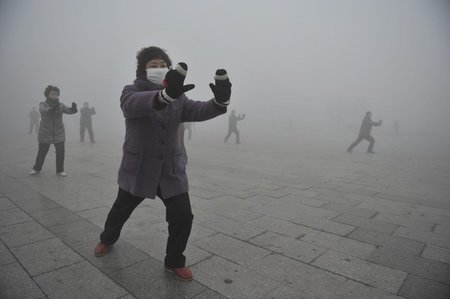
500,000 Breathing Masks Sold in China

rsz_china011613.jpg

...in two days. ABC's Kaijing Xiao has the story:

According to the figures released by Taobao and Tmall, China’s two biggest shopping websites, 500,000 masks were sold in two days. That number was three times more than the previous week.

The air quality index, or “AQI,” is how both the U.S. Embassy and Chinese government computes air quality. As set by the Environmental Protection Agency (China uses its own environmental agency) the AQI measures five different pollution components. PM2.5, or particles smaller than 2.5 microns, are considered the most harmful to your health because they get deeper into the lungs and can be absorbed directly into the bloodstream. Short-term effects of air pollution commonly include coughing, shortness of breath, eye irritation, headaches, nausea and dizziness.

It has been three days since I got back to Beijing, I haven’t seen the shape of the sun yet, and my chest has been feeling a consistent pain. Because Beijing sits in a basin, once the bad air gets in only a strong wind can push it out. Winds are expected in the coming days, and they can’t get here soon enough.

And it only appears to be getting worse, according to James Fallows:

The readings in the past few days have been in the previously unimaginable 700s-and-above range, reported as "beyond index" by @BeijingAir. The worst I have personally seen in Beijing was in the high 400s, and that day I did not understand how life could proceed any further in such circumstances. The conditions this weekend have been much worse

The Benefits of Globalization: Man Outsources Own Job to China

The last several presidential campaigns have seen increasing angst over the outsourcing of American jobs to lower-wage locales such as China and Southeast Asia. One enterprising software coder, however, took advantage of this new era of liberal labor rules by outsourcing his own job to China:

A security audit of a US critical infrastructure company last year revealed that its star developer had outsourced his own job to a Chinese subcontractor and was spending all his work time playing around on the internet....

After getting permission to study Bob's computer habits, Verizon investigators found that he had hired a software consultancy in Shenyang to do his programming work for him, and had FedExed them his two-factor authentication token so they could log into his account. He was paying them a fifth of his six-figure salary to do the work and spent the rest of his time on other activities.

The analysis of his workstation found hundreds of PDF invoices from the Chinese contractors and determined that Bob's typical work day consisted of:

9:00 a.m. – Arrive and surf Reddit for a couple of hours. Watch cat videos

11:30 a.m. – Take lunch

1:00 p.m. – Ebay time

2:00-ish p.m – Facebook updates, LinkedIn

4:30 p.m. – End-of-day update e-mail to management

5:00 p.m. – Go home

Not only did "Bob" outsource his own job -- he took jobs at other firms and outsourced them as well. He is now out of a job. Truly, globalization giveth and globalization taketh away.

January 3, 2013

A War in Asia Is Worse than Islamic Terrorism

Clifford May argues that Stratfor's Robert Kaplan is wrong to worry about Asia's brewing nationalism:

Similarly, in Asia, Kaplan sees China, Japan, and other nations “rediscovering nationalism,” undermining the notion that “we live in a post-national age.” He adds: “The disputes in Asia are not about ideology or any uplifting moral philosophy; they are about who gets to control space on the map.” True, but is the revival of such nationalistic sentiment really a crisis or even a major problem? Meanwhile, much more significant, Islamists are offering an alternative to both the old nationalist and the newer post-nationalist models.

It seems self-evident to me that Asia's disputes are considerably more worrisome. Islamists may be offering alternative models to discredited pan-Arab movements, but it doesn't mean the countries they lead (or could lead, if they take power) have much in the way of power or influence on a global scale. We know that when militant Islamist groups take power, the country in question tends to fail (see Afghanistan, Iran, etc.). Egypt's Brotherhood may offer an alternative to Taliban-style militancy, but then it will be stripped of the elements that make it dangerous to Western interests. Islamist governments of the kind May fears produce dysfunction, not global power.

The principle threat Islamism poses to the West is sporadic terrorism. There are some worst-case scenarios which could see sweeping upheaval across the Mideast that deposes the Saudi monarchy and plunges the global energy market into a major crisis. There's also the possibility that terror networks in Syria and Iraq could disrupt regional energy resources. That's clearly a danger, but one that carries the seeds of its own solution -- i.e., the more terrorism disrupts Middle East energy supplies, the faster the globe will transition away from Middle East energy. (A smart political class would be trying to head this off now, by reducing the use of oil -- not just producing more of it domestically -- but that's an argument for another day.)

Switching to Asia, the dynamics are just as combustible but the players far more important. It touches on two U.S. treaty allies, South Korea and Japan. It implicates three of the largest economies in the world (China, Japan, and the United States) as well as major maritime trade routes. The potential for conflict is rife, since unlike the Middle East where every country knows who owns what oil field (for the most part), Asia's untapped resources lie in contested waters. There's just as much history and bad blood among the major players in Asia as there is among the Mideast's various rivals (if not more), but unlike the Mideast, Asian states have advanced militaries.

So I think Kaplan has it right: we should be more concerned with Asia's brewing conflicts than Islamism.

December 28, 2012

The Wages of Chinese Economic Growth: 80 Percent of China's Coral Reefs Destroyed

coral_reef_1.jpg

China's torrid economic growth is one of the most spectacular tales of human improvement in recent memory, with literally millions of people being lifted from poverty into higher standards of living. Yet it's come at a cost -- environmental devastation on a truly large scale, as a new study from the Australian Research Council makes clear. To wit: China's coastlines have lost 80 percent of their coral reefs due to pollution, over-fishing and development.

To make the matter more challenging, some of the devastated coral is located in parts of the South China Sea with multiple claimants. Whoever assumes control over these waterways will not only inherit resource rights, but a serious ecological problem to boot.

(Photo: California Academy of Sciences)

December 21, 2012

China's Self-Containment Strategy

More evidence that China's assertiveness over its territorial disputes is backfiring:

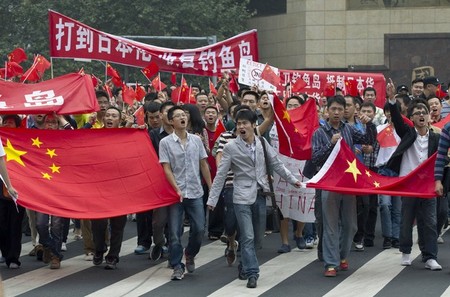
Anti-Japan riots in Beijing, Shanghai and elsewhere in China in September triggered by Japan's nationalization of the disputed Senkaku Islands brought vandalism and violence to Japanese restaurants, stores and car dealers and a boycott of Japanese products.

The disturbances prompted Japanese companies to worry that they have been too dependent on China for their sales and production and thus should consider diversifying their global exposure.

The "China-plus-one" concept, in which firms look to establish footholds elsewhere in Asia, was fostered several years ago but since September has gained greater traction.

Many Japanese firms are now looking to other emerging Asian markets to spread their risks.

James Clad and Robert Manning dubbed this "China's self-containment" and it appears to be unfolding before our very eyes. It does not appear that Asian states will meekly drop into Beijing's orbit as compliant satellites. Instead, it looks like they will push back against pressure from China, heightening the risks of a conflict -- one that would almost certainly implicate the U.S.

December 18, 2012

China's Looming Water Crisis

Brian Dumaine reads the latest global trends report from the National Intelligence Council and concludes that China could hit a rough patch:

One theme in particular that stands out this year is the coming food and water crisis in China. According to the report, climate change coupled with China's move toward urbanization and middle class lifestyles will create huge water demand and therefore crop shortages by 2030. As the report states: "Water may become a more significant source of contention than energy or minerals out to 2030."

Globally, demand for food is estimated to increase by more than 35% by 2030 and that means the world will need more water. After all, agriculture and livestock account for 70% of our water use. According to a major international study, global water requirements—mostly to sustain agriculture and livestock—will rise to 40% above our current sustainable water supplies.

China is particularly vulnerable to this trend. The report points out, for example, that cereal production in China faces significant challenges from environmental stresses relating to water scarcity—the melting Himalayan glaciers aren't helping—soil depletion, and pressures on land availability from urbanization. China is a major wheat producer and the second-largest producer and consumer of corn after the US.


December 13, 2012

How Will China React to North Korea's Missile Test?

By all accounts, the North Korean missile test was a significant technical milestone in the advancement of the country's arsenal. Jonathan Pollack wonders whether the test will strain the Hermit Kingdom's ties to China:

The bigger risks for Pyongyang concern its relations with China. The US, Japan, and South Korea have already called for an emergency meeting of the UN Security Council, since the North’s test are in direct violation of Resolutions 1718 and 1874, which prohibit North Korea from undertaking any rocket tests “using ballistic missile technology.” Since North Korea announced on December 1 that it would attempt another satellite launch, there have been persistent reports that the Obama Administration would seek to impose even harsher sanctions, even though North Korea is probably already the world’s most heavily sanctioned state. The US thus seems very likely to put great pressure on China to agree to additional sanctions. In recent weeks, the Chinese have openly cautioned the North Koreans from undertaking another test, without signaling what China would do should Pyongyang decide to test. Beijing’s first comments on the test had an ominous tone: “all parties concerned should stay cool headed and refrain from stoking the flames so as to prevent the situation from spiraling out of control.” How China chooses to respond will be the first foreign policy challenge for the newly installed Party General Secretary Xi Jinping.
Just a guess, but chances are the response will be in keeping with previous episodes. There will be a pro-forma denunciation from the United States and allied powers, a bland reproach from China and then everyone will quickly look the other way until the next provocation.

December 12, 2012

China's History of Humiliation

chinesenationalism.jpg

Zheng Wang explores China's historical memory and how it impacts present day attitudes:

The English translation of the Chinese phrase "Wuwang Guochi" is "Never forget national humiliation." It is the title of the book that I have just published. In this book, I refer to it as the "national phrase" of China. The Chinese characters associated with this motto are engraved on monuments and painted on walls all over China. For the Chinese, historical consciousness has been powerfully influenced by the so-called "century of humiliation" from the First Opium War (1839-1842) through the end of the Sino-Japanese War in 1945. The Chinese remember this period as a time when their nation was attacked, bullied, and torn asunder by imperialists.

As the research in this book has identified, China's unique national experiences, most significantly pride over its civilization as well as a collective memory resulting from the "century of humiliation" vis-à-vis Western powers, have played a crucial role in shaping the Chinese national identity.

Wang notes that China's educational system was revamped in the 1990's away from the class struggle narrative and toward a "victimization narrative" with the West as the principle architect of said victimization. If China were to move to a a multi-party democracy, Wang writes, these narratives could easily be seized on by nationalist leaders to mobilize support.

This is something many policymakers in the U.S. need to be mindful of. There's a thread that runs through some hawkish commentary on China that until the country democratizes to Western standards, the U.S. can never have a good relationship with Beijing. This stance not only overlooks the nationalist dangers that democratization could provoke, it also reinforces the idea in China that the West is intent on dominating their domestic politics. And as Wang notes, that is a potent historical grievance -- one the U.S. should be mindful of.

(AP Photo)

December 6, 2012

Who Owns America? Not China

Daniel Gross dives into the figures:

Over the past few years, our dependence on China as a lender has declined in both absolute terms and in relative terms. For all those who say the U.S. doesn’t make anything the world wants, look no further than the Treasury’s monthly statement of the public debt, which can be seen here (PDF). We manufacture government debt. And the world buys it. In the recently concluded fiscal year, the deficit was about $1.1 trillion. Between September 2011 and September 2012, the grand total of marketable debt held by foreigners rose from $4.9 trillion to $5.455 trillion, or about $555 billion.

So, yes, the amount of debt owned by foreigners has risen in the past year. But the portion of the debt owned by foreigners has stayed about the same—at about 51 percent—and the portion owned by China has fallen sharply. China’s total holdings of U.S. debt are about where they were in the middle of 2010, when the volume of total U.S. debt was much smaller.

November 19, 2012

The Rationale for a U.S. Presence in the Gulf

As the U.S. produces more and more of its own energy, the rationale for sustaining a large forward military presence in the Persian Gulf starts to weaken. But it's not like Middle Eastern energy won't find willing consumers. Instead, Gulf oil will flow to Asian markets, which puts major Asian oil consumers like China in something of a bind, as John Mitchell explains:

The United States military and naval presence contributes to stability in the Middle East and protects oil shipping through the Straits of Hormuz. This oil now goes east, not west, and the US security of oil supply no longer depends on it. Under these circumstances, how far will the US go to defend sea lanes that mainly benefit Asian markets?

The flip-side to this subsidy is that U.S. "defense" of Gulf sea lanes is another form of leverage over rivals like China. Any military force strong enough to keep the Gulf open could, in theory, close the Gulf down in a time of crisis (albeit at enormous costs to the global economy). That, in turn, will surely weigh on the minds of any Chinese strategist if (or when) the security competition between the U.S. and China really heats up.

On the other hand, the job of keeping the Gulf sea lanes open comes with a host of costs, like terrorism and military interventions, that the Chinese are probably happy not to bear.

November 14, 2012

Does China Really Have More Nuclear Warheads Than Previously Believed?

One Russian analyst thinks the Chinese have a lot more warheads than the U.S. assumes:


China has nearly 750 theater and tactical nuclear warheads in addition to more than 200 strategic missile warheads, a stockpile far larger than U.S. estimates, according to a retired Russian general who once led Moscow’s strategic forces.

New details of China’s strategic and tactical nuclear warheads levels were disclosed by retired Col. Gen. Viktor Yesin, former commander of Russia’s Strategic Rocket Forces, during a conference several months ago. A copy of Yesin’s paper was translated last month by the Georgetown University Asian Arms Control Project and obtained by the Washington Free Beacon.


However, according to Jeffrey Lewis, Yesin's essay is "full of errors" including referencing Chinese nuclear weapons facilities that Lewis himself visited and verified were moth-balled.

Either way, the "consensus" appears to be that China has about 240 nuclear weapons (give or take a hundred).

November 8, 2012

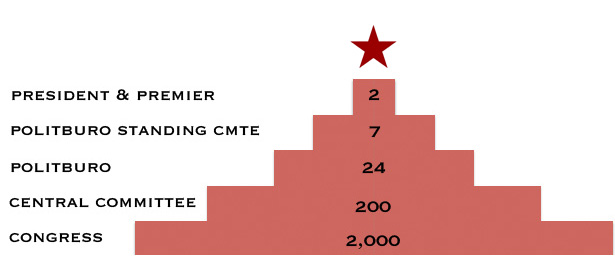
China's Leadership Structure Explained in One Chart

china-leadership-chart-3.jpg

Brian Fung explains:

Here's how it works: the National People's Congress brings together some 2,000 delegates. Those representatives are responsible for choosing between 200 and 300 members of what's called the Central Committee of the Communist Party. Out of those, 24 ascend to the ultra-powerful Politburo, which in the past has been responsible for many of China's major decisions. But it doesn't end there. Above the politburo sits the country's highest decision-making body, the Politburo Standing Committee (PSC). It's effectively a seven-member inner cabinet staffed by China's most powerful individuals, who themselves are drawn from the 24-member politburo.

November 7, 2012

China's Construction Boom as Seen Through Cement

Screen%20shot%202012-11-07%20at%209.44.27%20AM.png

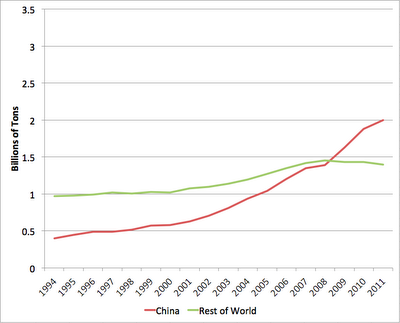
This chart, via Stuart Staniford, shows cement production. As Staniford notes, cement is a good proxy for construction activity and the chart shows how China kept surging while the rest of the world began a downward trend.

October 18, 2012

Is China Like a Fat Runner on Crystal Meth?

That's the evocative imagery used by Michael Pettis to describe China's stimulus-induced growth strategy:

It is as if you saw a middle-aged man in terrible physical shape running a marathon, and you predicted that after five or six miles he would be forced to quit. If however he took out a syringe and shot himself up with crystal meth, he would be able to continue running a few more miles, but this doesn’t mean that your analysis and prediction were wrong. It means that in a few more miles he will be worse off than ever (or will have to take an even bigger dose of crystal meth).

That's via Naomi Rovnick who offers some bullish takes on China:

The Beijing government has not announced a major economic stimulus project, as it did in 2009-10. But since the summer, central and local planners have begun propping up GDP with lavish spending on new projects. Industrial production rose 9.2% in September, year on year, after touching a 39-month low in August. So it is likely Chinese manufacturers are seeing the horrific conditions they have been laboring under start to ease.

I would say there are about as many people worried about a crashing (but not collapsing) China as there are about a rising one.

October 16, 2012

When a Talking Point Implodes: Chinese Lending Edition

China is about to be replaced as America's biggest creditor by Japan:

China is poised to lose its place as the U.S.’s biggest creditor for the first time since the height of the financial crisis, blunting one of Mitt Romney’s favored attacks in the presidential campaign.

Chinese holdings of Treasuries rose 0.1 percent this year through August to $1.15 trillion, Treasury Department data on international capital flows released today show. Japan, a stronger ally of the U.S., raised its stake by 6 percent to $1.12 trillion, on pace to top the list of foreign creditors by January.

Getting tough on Japan just doesn't have the same ring to it.

October 2, 2012

Preparing for China's Collapse

China's been something of a 2012 campaign punching bag, but Tyler Roylance wonders if the candidates are missing an important angle when it comes to the rising power:

Like generals preparing for the last war instead of the next one, President Barack Obama and Mitt Romney, his Republican challenger, have built their China-related campaign rhetoric around the notion that the Chinese are out to steal American jobs by manipulating exchange rates and heavily subsidizing their booming export industries. But this story of rapid, state-led economic growth is increasingly a thing of the past. As China's economy slows, the real concern for the next U.S. administration should be the potential fallout from a hard landing, including social unrest and political ferment.

Indeed. It's probably not good form to muse openly about a U.S. response to a Chinese "hard landing" - particularly one that unseats the Communist party - but hopefully it's something everyone is thinking carefully about.

September 25, 2012

Is Japan Really Cutting Defense Spending?

We've heard a bit in recent days about how Japan's security establishment is drifting to the right - becoming more assertive over its claims to disputed Islands also claimed by Russia and China.

But as Justin Logan points out, nationalist bluster aside, Japan is actually cutting its defense spending. Moreover, in response to the U.S. pivot, China is upping its own defense budget. These are two trend lines moving in the wrong direction.

Of course, the U.S. taxpayer is on the hook, as Logan notes:

So if Japan’s leaders are getting increasingly concerned about security, why are they cutting defense spending? Simple: They believe that they have a defense commitment from the United States that can serve as their deterrent against China.

So when you hear members of Congress rending their garments about sequestration, remember what they are worried about: the prospect that the transfer payments from American taxpayers to taxpayers in places such as Japan may be trimmed.

September 20, 2012

Parsing China's Claims at Sea

The crisis between China and her neighbors over a series of contested islands has been steadily ratcheting up. Duong Huy does a deep dive into the legal basis for China's broad claim and finds it wanting.

September 6, 2012

Solving the South China Sea Crisis ala Teddy Roosevelt

James Clad and Robert Manning make the case for deft diplomacy in the South China Sea:

Of course, we can keep relying on America's countervailing actions, knowing that China doesn’t play well in a multilateral space. But this game is prone to miscalculations by all sides. Nor does there seem much to gain from spending more time on “confidence building measures” or on a “multilateral security architecture” of regional groupings heavy on acronyms and light on results.

To find something new, we might try looking backwards – to a type of split-the-difference US diplomacy last deployed after Russia and Japan had fought a war in 1905. The next year, Theodore Roosevelt brokered a peace that lasted three decades, allowing China, Europe and the US to adjust to Japan’s rise as a major power.

To achieve something similar today would mean finding ways to facilitate commercial exploitation of the South China Sea. Privately, some chief executives of Chinese energy companies have spoken recently of their desire to form offshore joint ventures with western companies. Such joint exploitation could proceed by means of agreements resting expressly on a “without prejudice” basis – where companies, and the states in which they are domiciled, would make clear that mutual oil and gas exploration and production would occur “without prejudice” to their parent country’s sovereign claims. The competing claimant countries could agree among themselves as to which companies might participate in extraction in the areas in dispute.

Who knows if this would work, but it sounds like an idea worth pursuing.

August 27, 2012

How to Contain China: Romney Campaign Edition

containchina.jpg

In the most recent issue of Foreign Affairs, Aaron Friedberg, a China expert and adviser to the Romney campaign, published a long piece arguing that it was time for the U.S. to get tougher with China. Friedberg begins by describing America's current strategy:

Although U.S. policymakers have grown more circumspect in recent years, they have long hoped that trade and dialogue would help eventually transform China into a liberal democracy. The other half of Washington's China strategy, the balancing half, has looked to maintain stability and deter aggression or attempts at coercion while engagement works its magic.

But this isn't working, he writes:

The CCP's determination to maintain control informs the regime's threat perceptions, goals, and policies. Anxious about their legitimacy, China's rulers are eager to portray themselves as defenders of the national honor. Although they believe China is on track to become a world power on par with the United States, they remain deeply fearful of encirclement and ideological subversion. And despite Washington's attempts to reassure them of its benign intentions, Chinese leaders are convinced that the United States aims to block China's rise and, ultimately, undermine its one-party system of government.

What's odd here is that Friedberg is essentially arguing that China's leaders have it right: they have correctly understood American strategy (as stated by Friedberg in the first graf). Whatever Washington is doing to reassure them, it's clear (from the Communist Party's standpoint) that America's intentions are not benign. Friedberg's advice largely hinges on making the Communist Party feel even less secure - on the grounds that if a little insecurity and sense of besiegement have not produced Washington's desired outcome, doubling down on the strategy will do the trick.

An alternative (better?) strategy might be to disaggregate America's concerns for how China is governed - an issue that is not properly Washington's business anyway - with how China behaves abroad. Many insist on drawing linkages between the two - and undoubtedly some do exist - but it's hard to see how a democratic China becomes less interested in natural resources in the South China Sea or less immune to the nationalist urge to make expansive and aggressive claims on other nation's territorial waters. By objecting not just to China's behavior, but to the legitimacy of its very system of government, the U.S. takes an already difficult problem and makes it infinitely harder to manage.

Friedberg also offers some suggestions for how to right the military balance in Asia. Much of it makes sense - the U.S. should harden its facilities in range of China's increasingly sophisticated missiles and develop new capabilities that are less vulnerable to Chinese attack. But the advice is anchored in what I'd argue is a very questionable assumption:

Failing to respond adequately to Beijing's buildup could undermine the credibility of the security guarantees that Washington extends to its Asian allies. In the absence of strong signals of continuing commitment and resolve from the United States, its friends may grow fearful of abandonment, perhaps eventually losing heart and succumbing to the temptations of appeasement. To prevent them from doing so, Washington will have to do more than talk. Together, the United States and its allies have more than sufficient resources with which to balance China. But if Washington wants its allies to increase their own defense efforts, it will have to seriously respond to China's growing capabilities itself.

Won't this have precisely the opposite effect - i.e. the more America does, the less its allies will do? Haven't we already seen the script play out already in Europe? Why yes we have.

In fact, Asian militaries have been bulking up since before the Obama administration made its famous "pivot" to Asia. There is every reason to believe that Asian states will continue to invest in their defenses and that American moves to beef up their own defenses, particularly the kind of lavish, Cold War-style commitment Friedberg advocates, would take the pressure off. At a time when the U.S. is up to its eyeballs in red ink, this hardly makes much sense.

Friedberg's reasoning flies in the face not just of the very recent and relevant history of European defense spending, but in the face of his party's own orthodoxy when it comes to how incentives work. To understand how discordant this is, imagine Mitt Romney saying that the best way to get people to work is to give them lavish unemployment benefits and promise to support them no matter what they do.

However Friedberg is right to note that the trajectory of the U.S.-China relationship appears rocky and that some form of security competition is already underway. Anyone seeking some ideas of how a prospective Romney administration might approach this competition would do well to grapple with his arguments.

(AP Photo)

August 21, 2012

The Paranoia of the Hegemon

David Frum argues that the U.S. must remain the world's top dog:

The prospect of the U.S. as number 2 is a threat and challenge. So long as China remains a repressive authoritarian oligarchy, the prospect of a world reordered to meet Chinese imperatives is an ugly one.

The U.S. has only been the undisputed leading global power for about 30 years, meaning that for most of American history we have had to contend with either equal or stronger global powers, some of whom did not share our values and had conflicting interests.

Additionally, China has not proven that it can reorder its own backyard (although it clearly wants to) and they have never evinced any sign of having the kind of global ambition that so regularly infects America's Wilsonians and neoconservatives. And even in the event China overtakes the United States and suddenly decides it wants to exert its benevolent hegemony over the world, it would be opposed by a coalition that would likely include - at a minimum - the EU, Japan, India, Australia, the UK and the United States. Almost every major power, that is, except Russia and Brazil. China might find it rather lonely at the top.

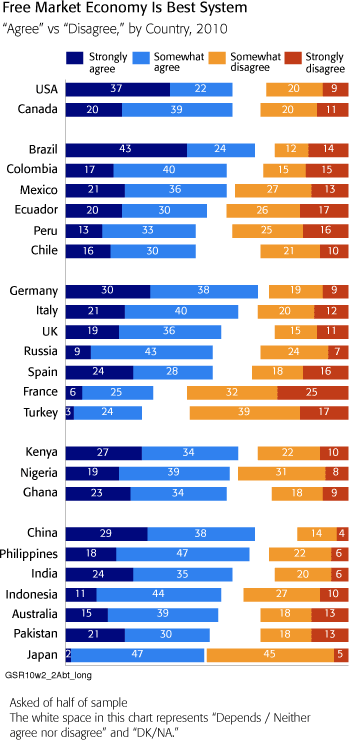
A world with a more powerful China will not pose any ideological threat to the United States or the idea that free-market capitalism is the best way to organize a society. The biggest threat to that idea are the free-market capitalist societies themselves, which are busy imploding or staggering along with sub-par growth. Righting that ship has very little to do with the relative position of China - and would be the right thing to do with or without the prospect of a rising China. And China has already embraced the market (albeit with a heavy dose of state interference). Moreover, the lack of freedom in China's one-party state is not something that they have expressed much interest in exporting to other countries.

By all means the U.S. should take China seriously - more seriously than it has to date. As far as potential challenges to global stability goes, the territorial disputes in Asia are arguably more dangerous than an Iranian nuclear weapon. But we're not facing a Cold War style contest for global supremacy. Acting otherwise is not conducive to clear-headed thinking about what the U.S. does next.

Senator Webb Issues Warning About China

Senator James Webb is concerned about China:

While America's attention is distracted by the presidential campaign, all of East Asia is watching what the U.S. will do about Chinese actions in the South China Sea. They know a test when they see one. They are waiting to see whether America will live up to its uncomfortable but necessary role as the true guarantor of stability in East Asia, or whether the region will again be dominated by belligerence and intimidation.

The Chinese of 1931 understood this threat and lived through the consequences of an international community's failure to address it. The question is whether the China of 2012 truly wishes to resolve issues through acceptable international standards, and whether the America of 2012 has the will and the capacity to insist that this approach is the only path toward stability.

We're likely to hear more of this type of rhetoric as Asia's territorial drama heats up. Unfortunately this is where Webb ends his op-ed. It would have been more profitable to spell out more concretely just what he thinks the U.S. should do vis-a-vis China's claims. Vague invocations of will really aren't sufficient. Current U.S. policy - that these disputes be settled diplomatically - sounds reasonable, but what else should the U.S. be prepared to do if China (or other Asian claimants like Vietnam) assert broad claims? If this is a "test" - what constitutes passing?

August 3, 2012

China's Solar Boondoggles

Bill Powell says that after pinning its hopes on solar, Chinese firms are finding it to be a "capital destruction" machine:

These are epic, historic collapses in market valuation, made all the more stunning by the assumption, so prevalent just four years ago, that "clean" energy's time had come. How ironic it is that Barack Obama's insistence that the United States invest government money into the creation of so called "green jobs" -- which led to the debacle of Solyndra and other wasted investments -- was predicated on the fact that if the U.S. didn't do so, the industry of the future would be Made in China. A credulous political press, egged on by the environmental lobby, swallowed the reasoning wholesale.

Powell argues that solar's ability to reach "grid parity" - where it is price competitive with other fuel sources - has been dealt a big blow by the collapse in U.S. natural gas prices, but may yet still happen in China, where gas is still expensive. That is, until they start fracking.

July 24, 2012

Who Understands the Iran Threat Better: America or China?

chinairan.jpg

The news that China imported more oil from Iran in June than it did on average the previous year brought to mind an interesting series of questions.

The Chinese, we're told, are masters of realpolitik - coldly weighing their strategic interests. They're certainly not shy about protecting what they view as core interests, as evidenced by the dust-up over the South China Sea. So why are they not concerned about the potential for a nuclear Iran to "dominate" the Middle East, as so many American strategists are? Do the Chinese have a better read on the consequences than their American counterparts? Are they naive or is Washington alarmist?

A few possible answers come to mind. The first is that China isn't in much of a position to contest Iran's pursuit of a nuclear weapon (or some form of nuclear capability) outside the generally ineffective mechanisms of sanctions and lecturing, and so they're simply prepared to deal with whatever environment arises when/if Iran eventually goes nuclear. The second possibility is that they believe that the Iran threat is inflated and that an Iran with a nuclear weapon won't ultimately act to endanger the flow of energy through the Mideast. A third possibility is that they think a nuclear Iran would, in effect, balance against U.S. power in the region. In this view, China would apply the same principle to the region that the U.S. does - that no one power should dominate - only directed against America's actual dominance and not Iran's latent potential.

It's not clear which of these possibilities is the operable concept. In all likelihood, it's a delicate balance among several competing priorities. As Richard Weitz noted, China ultimately does not want to see a nuclear-armed Iran, but neither does it want regime change or another war in the Middle East.

(AP Photo)

July 18, 2012

The World's Worst Currency Manipulators

China's getting beaten up in the U.S. presidential campaign for its practice of currency manipulation, but according to the Peterson Institute's Joseph Gagnon, most of the world's worst currency manipulators are close U.S. allies. Here's the ranking of the worst of the worst:

China
Japan
Saudi Arabia
Russia
Taiwan
Korea
Hong Kong
Switzerland

Hit the link for the full list.

July 13, 2012

China-Japan War Game Stokes Ire

A new game - Defend the Diaoyu Islands - recently popped up on Apple's app store. According to the Register, the game had players defending islands in the East China Sea from a Japanese invasion. From the game's description:

Defend the Diaoyu Islands, for they are the inalienable territory of China! Recently, the Japanese government has been sabre-rattling, making attempts to seize the Diaoyu Islands and even arresting our fishermen compatriots while selling off fish from the islands. Today, you can vent your anger by trying this game demo, working together to eradicate all Japanese devils landing on the island and turning them back towards their own lands. Defend the Diaoyu Islands!

Given the inflammatory nature of the app, Apple pulled the game from its store. The Diaoyu Islands are known as the Senkaku Islands in Japan.

July 9, 2012

China Still Importing Policy Ideas

According to the BBC's Mukul Devichand, China's policy battles owe much to Western ideas:

For mainland Chinese intellectuals, the journey to the West - and then back to Communist China - is now a well-trodden path.

In fact, the main schools of intellectual thought in China have one thing in common - their leading thinkers have often spent time in Western universities.

That means that for Westerners, who may struggle with China's very different language or food, Chinese policy debates are split along strikingly familiar lines.


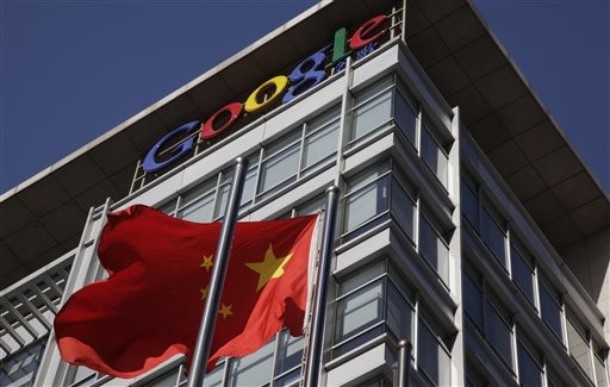
Google's Schmidt Predicts Fall of China's Great Firewall

googlechinafirewall.jpg

In an interview with Josh Rogin, Google Chairman Eric Schmidt decried China's web censorship:


"I believe that ultimately censorship fails," said Schmidt, when asked about whether the Chinese government's censorship of the Internet can be sustained. "China's the only government that's engaged in active, dynamic censorship. They're not shy about it."

When the Chinese Internet censorship regime fails, the penetration of information throughout China will also cause political and social liberalization that will fundamentally change the nature of the Chinese government's relationship to its citizenry, Schmidt believes.

"I personally believe that you cannot build a modern knowledge society with that kind of behavior, that is my opinion," he said. "I think most people at Google would agree with that. The natural next question is when [will China change], and no one knows the answer to that question. [But] in a long enough time period, do I think that this kind of regime approach will end? I think absolutely."

Interestingly, in March Reuters reported that China's innovation sector was surging:

International filings for patent protection, a key indicator of technological innovation in major economies, hit an all-time record last year driven by growth in China and other middle- income countries, a United Nations agency said on Monday.

The World Intellectual Property Organization, which administers the global patent pact, reported that 2011 saw a 10 percent rise in applications to a total of 181,900...

WIPO figures showed the United States, Japan and Germany, the long-time leaders in total applications, accounted between them for 58 per cent of total filings, but China, with a rise of 33.4 per cent on the previous year, was pushing them hard.

Patents in and of themselves don't tell you all there is to know about the long-term dynamism of a country's tech sector. But in 2012, the lack of freedom doesn't appear to be slowing China's technological edge (although given the rampant intellectual property theft it's difficult to judge just how much indigenous innovation is actually occurring).

(AP Photo)

China's Silt Wave

chinariver.jpg

Every year, China removes silt from the Yellow River in an operation that moves an amazing amount of water through a specialized dam. The Daily Mail has more photos.

(AP Photo)

July 6, 2012

Cuba's New Inspiration

chinacuba.jpg

According to Sarah Rainsford, it's China:

Cuba has begun introducing measures intended to kick-start its inefficient, unproductive planned economy.

It is a tentative start: The word "reform" is never used, nor "private enterprise" - instead, Cuba says it is "updating" its economic model.

Like China and Vietnam before it, the island's aim is to protect and prolong its socialist political system by introducing elements of market economics.

So it seems Raul Castro is in Asia looking for inspiration.

(AP Photo)

July 3, 2012

Advice Governor Romney Should Not Heed

Victor Davis Hanson offers some advice to Governor Romney when it comes to attacking President Obama's foreign policy. Daniel Larison picks apart some of the weaker points here, but I wanted to draw attention to this charge:

The addition of $5 trillion in national debt was disastrous in terms of U.S. foreign policy. It lost us what leverage we had over China. It destroyed any credibility in advising the European Union about its own financial meltdown.

When, I wonder, did the United States have leverage over China? Was it when the prior administration bestowed America with two enormous tax cuts, two large land wars, one huge (debt-funded) expansion of federal entitlements and a housing bubble? Indeed, if I were the Romney campaign (stocked, as it is, with members of the prior administration) I would be very leery about making this charge for several reasons. First, if the Obama administration's huge debt increase was a foreign policy "disaster" then Bush's debt increase was at least as bad

Here's a handy debt chart that allows you to rank changes in gross U.S. federal debt (starting at WWII). It shows that while the Obama administration is no piker when it comes to larding it on (ranking third), it's outdone by its predecessor (ranked second and seventh). The Obama administration has been no slouch in the debt department, exceeding the Bush administration's total spend, but they can't (yet) hold a candle to the rapid pace at which the debt soared when President Bush and the GOP controlled the nation's purse strings.

Either way, it's patently absurd to argue that with this record, the Romney camp would have any credibility when it comes to lecturing Europe about how to handle national finances.

Second, the Bush era is noted as one of relative calm in Sino-U.S. ties precisely because the administration was in no position to challenge Beijing because it was preoccupied with the high strategic task of policing Baghdad and begging an elderly Shiite cleric to say nice things about democracy. It was the Bush administration's spendthrift ways, disastrous handling of the Iraq war and the calamitous financial crisis which unfolded on its watch that led many Chinese analysts to believe the U.S. was in a period of decline. It's not clear if the current administration has actually increased U.S. leverage over China, but it's not like they squandered some terrific inheritance.

July 2, 2012

China Closing the Space Gap: Reason to Worry?

chinaspace.jpg

China has made a lot of space-related news of late. They put their first female astronaut into orbit and recently completed their first space-docking mission.

Morris Jones writes that while China still trails America in space, the world should not dismiss their achievements:

There is a condescending tone to much of the international reportage on China's recent space docking and expedition to its first space laboratory, Tiangong 1. Commentators applaud China's progress in space exploration but claim they are decades behind the US and Russia, who achieved similar feats in the 1970s.

These reports fail to account for the 'leapfrog' effect of technological advances, and the benefit of experience from other nations. Such effects are propelling much of Africa from being disconnected from telecommunications to enjoying broadband wireless services in just a few years. The effects are just as significant for China's space missions.

Morris concludes that the "US will probably only restore vitality to its space program when it realises that China has achieved near-parity with its own activities."

I think it's just as likely that China will advance a bit more before realizing, like the U.S., that a very expensive manned space program has little practical utility. The U.S. has not abandoned space exploration or the strategic exploitation of space for defense purposes. China will certainly continue to improve its space-related technologies, but I don't think the U.S. should fear a Sputnik 2.0. The Chinese economy won't grow at 8 percent forever.

(AP Photo)

June 25, 2012

The Sources of China's Strategic Behavior

chinabehavoir.jpg

In part two of my very infrequent series of posts on Aaron Friedburg's A Contest for Supremacy, Friedburg makes the following assertion regarding the sources of China's quest for regional hegemony:

To sum up: China’s current rulers do not seek preponderance solely because they are the leaders of a rising great power or simply because they are Chinese. Their desire for dominance and control is in large measure a by-product of the type of political system over which they preside. A liberal democratic China would certainly seek a leading role in its region, and perhaps an effective veto over developments that it saw as inimical to its interests. But it would also be less fearful of internal instability, less threatened by the presence of strong democratic neighbors, and less prone to seek validation at home through the domination and subordination of others.
While I think it's true that a democratic China would be less concerned about the presence of democracies on its borders, the other two factors don't ring true. It's not clear why a democratic China would suddenly become less fearful of internal instability. Don't all countries fear internal instability? A democratic China may provide more productive avenues for domestic grievances to be aired, but it's not as if the end of single party rule would make subsequent regimes comfortable with massive internal instability (see: India). Second, the idea that a liberal democratic China would be "less prone to seek validation at home through the domination and subordination of others" is belied by, among other thing, America's post Cold War foreign policy record.

The real question Friedburg is dancing around (and may address later in the book) is whether a democratic China would be a more pliant one with respect to U.S. hegemony in Asia. There is every reason to believe this will not be the case. The demands of national pride and strategic common sense would seem to dictate that a more powerful China will take a more forward-leaning role in policing the sea lanes it depends on for trade and natural resources.

Update: Larison adds another comparison:

The record of late 19th-century Britain or Meiji-era Japan ought to disabuse everyone of the notion that having a liberalizing and democratizing political system precludes the pursuit of an aggressive foreign policy. Rather than looking at America’s post-Cold War policies around the world, a more useful comparison might be with America’s early republican history as an expansionist power in North America. Early republican America was the most liberal and democratic country in the world by the start of the nineteenth century, but that hardly prevented it from using force or dominating other peoples. Increasingly democratic politics included expansionist goals that shaped U.S. relations with the rest of the continent. A democratizing China might or might not become more aggressive toward its neighbors than the current regime, but the assumption that a democratic China would be less aggressive in its dealings with other states in the region is a shaky one.

Just so. The makeup of China's government is not immaterial to these questions, but we shouldn't simply assume that a democratic China is going to relinquish longstanding territorial claims or strategic interests because it's a democracy.
(AP Photo)

June 19, 2012

The U.S. Isn't Handing Off the Mideast to China

Niall Ferguson, long a proponent of an imperial role for the U.S., makes this rather shocking (for him) suggestion:

In terms of geopolitics, China today is the world’s supreme free rider. China’s oil consumption has doubled in the past 10 years, while America’s has actually declined. As economist Zhang Jian pointed out in a paper for the Brookings Institution last year, China relies on foreign imports for more than 50 percent of the oil it consumes, and half of this imported oil is from the Middle East. (China’s own reserves account for just 1.2 percent of the global total.)

Moreover, China’s dependence on Middle Eastern oil is set to increase. The International Energy Authority estimates that by 2015 foreign imports will account for between 60 and 70 percent of its total consumption. Most of that imported energy comes through a handful of vital marine bottlenecks: principally, the straits of Hormuz and Malacca and the Suez Canal.

Yet China contributes almost nothing to stability in the oil-producing heartland of the Arabian deserts and barely anything to the free movement of goods through the world’s strategic sea lanes.

Imagine, for a moment, if the Chinese said they would be building naval bases in the Persian Gulf to help stabilize the region and protect their vital sea lanes. Would the U.S. reaction be to celebrate the burden-sharing and use the move as an opportunity to downsize its own commitments? Or would Washington have a collective freak-out about Chinese "assertiveness" and the dangers of being locked out of the Middle East forever?

I'm going with the second option.

Indeed, the reason the U.S. is "pivoting" to Asia is partly because China is beginning to shore up its own sea lane defenses in its immediate neighborhood. The U.S. response hasn't been to celebrate China's assumption of greater responsibility but to complain that China is "destabilizing" the region with its arms buildup and "assertive" foreign policy. If China can't take steps to protect what it views as vital interests in its own neighborhood without provoking howls of protest from the U.S., why do we think they'd be welcome in the Middle East?

If anything, the arguments for a redoubled U.S. commitment to the Middle East are going to grow in direct proportion to China's strategic rise. If China is dependent on Mideast oil and the U.S. is holding the most leverage in the Middle East, we are de-facto arbiters of China's energy security. That's not a position the U.S. is likely to relinquish if a Cold War-style standoff with China starts to take shape.

The flip side to this, and the argument I'm more sympathetic too, is that fobbing off the troublesome region on China (or anyone) would be a very good idea. It's just interesting that Ferguson, of all people, would be advancing it.

May 16, 2012

South China Sea: A Big Deal

On Monday I linked to a Brendan Taylor analysis that argued that the South China Sea wasn't much of a flashpoint. Kirk Spitzer reports on an opposing view:

A shooting war with China may not be inevitable, but a dangerous arms escalation seems a dead certainty. That’s the take from a rare public discussion here this week among naval experts from Japan, the U.S. and China.

“Eighty percent of the population wants us to use the military,” says Yang Yi, former director of the Institute for Strategic Studies at the National Defense University in Beijing. “They’re asking, ‘Why are we so weak? Why are we wasting money on our Navy if we are not going to use it?’ Outsiders really do not appreciate what is going on inside China.”

Feng seconds Yang's impression of Chinese public opinion on the matter.

It's ironic that one potential bulwark against Chinese escalation in the South China Sea is the fact that its government is not accountable to the will of its people. Of course, democracies are no stranger to ignoring their own citizen's desires, but Yang's account should give us pause the next time someone claims that the only way the U.S. can live peacefully with China is if it democratizes.


May 14, 2012

South China Sea: No Big Deal?

Brendan Taylor thinks that, contrary to the emerging conventional wisdom, the South China Sea isn't all that important:

I should start by saying that my scepticism regarding the strategic significance of the South China Sea is largely a reaction to the flurry of recent op-eds and essays identifying this area as a potential trigger for great power conflict. I doubt that such a trigger really exists, certainly not one with the potential to impact upon Asia's larger strategic order.

The reasons for my scepticism become clear when we compare the South China Sea with Asia's two most widely accepted flashpoints, Taiwan and the Korean Peninsula. Richard Bush and Michael O'Hanlon have argued that the problem of Taiwan could spark a nuclear war involving 1.5 billion people and produce a fundamental change in the international order. Similar estimates suggest that a Korean conflict would cost somewhere in the vicinity of US$ 1trillion and 500,000 lives during its first 90 days.

It's difficult to envisage a scenario where a skirmish in the South China Sea could erupt into a conflict of that magnitude. For this reason, I just don't think it's a real flashpoint.

April 30, 2012

America's Political Campaign Won't Scare China

Jacob Stokes comments on China's role in the U.S. presidential race:

Ultimately, the 2012 U.S. presidential election will have a long-term effect on Sino-American relations to the degree that it increases or decreases strategic mistrust between the two countries. The Chinese leadership understands that the rough and tumble of U.S. politics is often more smoke than fire—that most heated rhetoric gets moderated when it runs up against the demands of real-world policy making.

But a political discussion that frames the relationship between the two countries as an exclusively zero-sum competition, one that mirrors the ideological and strategic dimensions of the Cold War--instead of a process of managing differences and identifying common interests--risks creating an atmosphere of strategic distrust that will do long-lasting damage in relations with China. While it’s essential for the U.S. leaders to stand firmly in support of American interests and values, candidates should be wary of letting political point-scoring damage the world’s most important bilateral relationship.

I think the atmosphere of strategic mistrust predates the presidential campaign and that, as Stokes notes, the Chinese almost certainly discount everything they hear from the candidates until election season is over. That's probably a good strategy for the rest of us, too.

April 25, 2012

The Future's Uncertain and the End Is Always Near

The pivot, we tell the Chinese, is not about them. But then Manila and Tokyo ask: "What do you mean the pivot isn't about China. The Chinese are unwelcome visitors into our waters at least once a week!"

Oh, and we have new battle plan called "Air Sea Battle" that again is not about China. However, it is meant to operate in "anti-access" environments -- those in which enemies have many missiles, submarines, and cyber warfare capabilities. Sounds like China. We will be able to operate again in those environments once the plan is executed, but we will not execute it because we are cutting the defense budget, so China should worry a bit but not too much. Our allies should have just a little dose of reassurance to go along with their fears. - Dan Blumenthal

I wonder if "uncertainty" is actually the problem. What Blumenthal highlights is not really "uncertainty" but the administration's mealy-mouthedness (my word) with respect to what's it's doing in Asia. As Blumenthall notes, it's putting in place a semi-militarized containment strategy with the pivot, but is also taking great pains not to call it that lest it damage relations with China, which are rather important.

So what's the problem with this? There is nothing "uncertain" about establishing military bases in Australia and holding naval exercises with countries at China's perimeter. Does Blumenthal think U.S. allies in Asia would be more reassured if the administration actually took a sharper tone with China or explicitly framed its "pivot" in terms of Chinese containment?

He also writes:

Here is another part of the uncertainty doctrine that must leave Europeans and Middle Easterners scratching their heads: The United States is pivoting to Asia (under fiscal constraint) but not abandoning its allies in Europe or the Middle East.

I agree this is silly. If we're prioritizing Asia then it means we must correspondingly de-emphasize other regions. So imagine if President Obama said: "the U.S. is under fiscal strain and has to prioritize resources accordingly. That means we must shift our attention from a Europe that is peaceful and secure to Asia, where our interests will require more attentive monitoring."

Would Blumenthal hail this as providing clarity or would he condemn Obama for betraying U.S. leadership? The president's current rhetoric is designed to shield him from just such an accusation because Washington is unable to have an adult conversation about this stuff.

April 23, 2012

Obama's Solar Trade War

The Obama administration decided last month to slap tariffs on Chinese-made solar panels because, they claim, Chinese subsidies undercut U.S. manufacturers. It's an odd industry for the administration to target - all those Chinese subsidies have made solar roughly price-competitive as an energy source for the first time, something the supposedly environmentally-minded administration would approve of. Now the administration wants to make it more expensive.

Yet as DigiTimes notes, Chinese suppliers may be able to skirt the costs:

China-based solar firms, however, have been finding ways to avoid paying the tariff such as transfering solar cell orders to Taiwan. Taiwan-based solar cell makers have been experiencing rising capacity utilization rates but indicated that orders from China-based firms often have unprofitably low quotes. China does not want to give up on the US market because it is one of the fastest growing solar markets in the world.

Beyond that, it's very odd that the Obama administration would go to such great lengths over Iran, including, potentially, using military force but won't countenance cheap solar panels from China. One policy potentially threatens the lives of American service personnel and runs the risk of a near-term recession if a brief war in the Gulf causes oil prices to soar (among a host of other potentially negative outcomes). Letting cheap Chinese solar panels into the U.S. market, however, hurts the employment prospects of a small industry (unless these panels are somehow dangerous - a case I've not yet heard).

Obviously these two events are not tightly correlated, but they are related. Solar power isn't going to ween the U.S. off of oil as a transport fuel in the short-term (as I understand it, the solar roof experiment on the Prius was a bit of a flop), but the more alternative energy sources go online, the more the overall energy mix will tilt away from oil and the greater the chance that Washington can finally stop obsessing about the Mideast.

April 20, 2012

China-India Media War

Chinese media has reportedly mocked India's recently-tested Angi V long-range missile as a "dwarf." The Hindustan Times takes on the story with its own provocative headline. I guess it's still better to jaw, jaw...

April 5, 2012

Explaining the China Exception

Freedom House's Arch Puddington thinks the world is giving China a free pass when it comes to human rights abuses:

More than anything else, it is this calibrated economic integration, and the opportunities it represents, that has allowed China’s government to evade international opprobrium for its acts of repression. To be sure, the regime’s crimes are not entirely ignored. Human rights organizations regularly denounce the jailing of dissidents, the mistreatment of minorities, and the lack of anything resembling the rule of law. Occasionally, foreign governments are compelled to speak out, as when Beijing launched a campaign against the Nobel committee after jailed democracy advocate Liu Xiaobo was given the peace prize. But in an age when Hungary, Ukraine, and Turkey are rightly chastised for breaches of democratic standards, China usually gets a pass for policies that have brought pain and misery to millions. The separate category that China has carved out for itself goes beyond the usual double standard that has historically been applied to “progressive” dictatorships—to Cuba, or Nicaragua under the Sandinistas, for example. Instead there is a kind of stand-alone China Exception, under which repression and autocracy are quietly acknowledged but actual objections are seldom voiced.
This is no mystery: China is a powerful country and countries have to tread more carefully when criticizing it than they do with smaller, less powerful states. It's also not clear that publicly scolding China will accomplish anything because, again, China has gotten itself into a position where it doesn't really need to listen to anyone.

Puddington will have none of it:

The one-child policy and the persecution of the Uighurs are but two in a long roster of odious practices that, taken together with the world’s indifference, make up the China Exception. This indifference is a choice, often by people who hope for economic gain, or fear economic losses.

The fear of economic loss might strike Puddington as no reason to tread cautiously with respect to China's internal governance, but it's a perfectly legitimate concern. Any government has a primary obligation to the welfare of their own citizens. Putting that welfare at risk to deliver moral lectures to China about how China behaves internally would be an abdication of that responsibility.

And it's unlikely to even work. When some (democratic, human rights-abiding) European capitals objected to the U.S. push for a war with Iraq, the American response wasn't measured self-reflection and changed behavior but adolescent petulance and "Freedom Fries." Is China really going to behave differently?

March 29, 2012

Urine Eggs in China

I think I'll be amending my philosophy of trying any food once.

March 28, 2012

Who Is America's #1 Geopolitical Foe?

We know Mitt Romney thinks it's Russia and now the White House is on record giving al-Qaeda the dubious honor, but neither of these answers seems all that satisfying. Romney's answer, redolent of the Cold War, at least has the benefit of anointing a bona-fide geopolitical heavyweight. The White House's response has the benefit of identifying a group that is actually implacably hostile to the U.S., even if its power is negligible.

So who should get the top spot? China, like Russia, has geopolitical clout but isn't hostile to the U.S. across the board in the manner of an al-Qaeda. Beyond China, countries like Iran or North Korea (or even Pakistan) could earn a nod for their hostility to U.S. regional aims, but again, not for their power or geopolitical weight.

Even conducting this thought experiment usefully illustrates the fact that the U.S. is actually in a pretty nice geopolitical position in 2012: it has very few implacable enemies and none that are very powerful. There are very powerful states that, on certain issues, play a spoiler role, but the era of straight-up great power antagonism is gone. As James Joyner pointed out, the entire notion of the U.S. having a "number one geopolitical foe" is an "outmoded concept."

At least for now.

March 8, 2012

"Peace Through Strength" - Except for China

Ironically, China's best efforts to increase its security by developing powerful military capabilities and asserting its interests more vigorously may only render its leaders more insecure. Other Asian countries are moving closer to the United States, and each other, to balance growing Chinese power. President Barack Obama is reorienting the United States' military posture away from Europe and the Middle East in ways that reinforce, rather than diminish, the U.S. leadership role in Asia. - Daniel Twining

It's an interesting observation because it's also one that, if reversed, would be rejected by a broad swath of the U.S. defense and foreign policy establishment (to say nothing of the political establishment). The idea that building up one's military strength and forcefully interjecting oneself in the affairs of others is destabilizing and ultimately results in greater insecurity is a concept that really doesn't have a lot of traction in American policy-making circles. Instead, there is the belief (not unfounded) that American security lies in an overwhelming preponderance of power and a coalition of allies to maintain favorable regional balances around the world.

We shouldn't be all that surprised to see China mimic this strategy as its own power grows.

A more interesting question to ponder is whether Twining is right about the sources of Chinese insecurity and, if he is, what lessons that poses for U.S. strategy.

February 29, 2012

China's Other Bear Market

There are bull markets. There are bear markets. But in China, there's also a bear bile market. Yum.

February 27, 2012

A Crack in the Great Firewall

President Obama's Google Plus account is making news:

Chinese Internet users taking advantage of temporary access to Google's social networking site, Google+, have flooded U.S. President Barack Obama's page on the site with calls for greater freedom in the world's most populous country.

"Oppose censorship, oppose the Great Firewall of China!" one user posted, one of hundreds of comments in Chinese or by people with Chinese names that dominated the site over the weekend.

Beijing's blocking of websites and censoring of search results for politically sensitive terms is known colloquially as the "Great Firewall of China." With sites such as Facebook and Twitter blocked, self-censoring homegrown equivalents like Sina Corp's microblogging platform, Weibo, fill the void.

It was unclear why Google+ was accessible for some users in China for part of the past week. A Google spokesman said the company had not done anything differently that would have led to the access. One Google executive told Reuters that the company had noticed the opening early last week.

February 16, 2012

China No Cyber Superpower

Adam Segal argues that the popular perception of China as a cyber superpower is overwraught:

Two recent studies of national cyber power have placed China near the bottom of the table. China is number 13 on the EUI-Booz Allen Hamilton Cyber Power Index, behind Argentina, Mexico, and Brazil but better off than Russia, Turkey, South Africa, and India (the United Kingdom, United States, and Australia are the top three). The Brussels-based Security & Defence Agenda groups China with Italy, Russia, and Poland in the fifth tier (the U.S. and the UK are in the third tier, below Finland, Sweden, and Israel; the top group is empty).

These are very subjective studies based on interviews, surveys, and vague metrics. Still, they cut against the grain of popular perceptions. If you were just paying attention to the almost weekly reporting in the Western press about alleged Chinese cyber espionage, you could be forgiven for thinking that China ruled the cyber waves. Yet recent writings in the Chinese press have more of a “China is vulnerable” flavor and suggest that analysts, if not characterizing the country’s cyber strategy as weak, think there is a great deal of work that remains to be done.

Romney on China

A nation that represses its own people cannot ultimately be a trusted partner in an international system based on economic and political freedom. While it is obvious that any lasting democratic reform in China cannot be imposed from the outside, it is equally obvious that the Chinese people currently do not yet enjoy the requisite civil and political rights to turn internal dissent into effective reform.

I will never flinch from ensuring that our country is secure. And security in the Pacific means a world in which our economic and military power is second to none. It also means a world in which American values—the values of liberty and opportunity—continue to prevail over those of oppression and authoritarianism. - Mitt Romney

So American values can't be imposed on China, but we mustn't let that realization get in the way of brow beating them about all their internal failings anyway and surrounding them with U.S. military power.

And then President Romney will ask the Chinese - pretty please - to borrow their money.

February 15, 2012

Made in China, But Not So Cheap

Stan Grant says the era of "cheap China" is over:

The Chinese factory floor ain't what it used to be. Heavy industry machines now sit idle, where once hundreds of workers would have crammed into Dickensian sweat shops, slaving away for little pay.

China's army of migrant workers are smarter than ever, demanding higher pay and better conditions, armed with tough government labor laws.


February 7, 2012

India Riskier Than China?

Stephen Roach thinks so:

Yet fears of hard landings for both economies are overblown, especially regarding China. Yes, China is paying a price for aggressive economic stimulus undertaken in the depths of the subprime crisis. The banking system funded the bulk of the additional spending, and thus is exposed to any deterioration in credit quality that may have arisen from such efforts. There are also concerns about frothy property markets and mounting inflation.

While none of these problems should be minimized, they are unlikely to trigger a hard landing. Long fixated on stability, Chinese policymakers have been quick to take preemptive action....

India is more problematic. As the only economy in Asia with a current-account deficit, its external funding problems can hardly be taken lightly. Like China, India’s economic-growth momentum is ebbing. But unlike China, the downshift is more pronounced – GDP growth fell through the 7% threshold in the third calendar-year quarter of 2011, and annual industrial output actually fell by 5.1% in October.

But the real problem is that, in contrast to China, Indian authorities have far less policy leeway. For starters, the rupee is in near free-fall. That means that the Reserve Bank of India – which has hiked its benchmark policy rate 13 times since the start of 2010 to deal with a still-serious inflation problem – can ill afford to ease monetary policy. Moreover, an outsize consolidated government budget deficit of around 9% of GDP limits India’s fiscal-policy discretion.

February 4, 2012

Would a Democratic China Be a Peaceful China?

I've gotten underway on Aaron Friedberg's new book: A Contest for Supremacy: China, America and the Struggle for Mastery in Asia. One thesis of the book that has surfaced in reviews is that a democratic China would cede the contest for supremacy to the United States. A democratic China, he argues:

would certainly seek a leading role in its region…. But it would be less fearful of internal instability, less threatened by the presence of strong democratic neighbors, and less prone to seek validation at home through the domination and subordination of others.

I personally doubt this, but will keep an open mind until I finish the book. What's interesting is that Friedberg notes approvingly at the outset of Contest that U.S. strategy has long sought to deny the emergence of a dominant power in Eurasia - which makes the U.S., if not a "dominant" power there than at least a decisive one in Eurasia. In other words, the U.S. - a democracy - can have a strategy of exercising robust military power far from its shores to protect its interests. It's not clear to me why a democratic China would forego the same opportunity.

January 23, 2012

What Makes China an Economic Success?

Ma Guangyuan argues that it's not the "China model" that many in the West ascribe to:

Those viewing China’s model often point to the powerful Chinese government and its centralized authority as the key in propelling the development of the Chinese economy. They argue that centralization of forces makes it possible to launch major undertakings and minimize internal frictions.

However, this conclusion does not hold water when examined from a historical point of view. When the, Chinese government controlled everything at the start of the reform and opening-up drive in China, China did not prosper. On the contrary, China’s national economy fell to the brink of collapse during this period due to extreme political and economic leftism. It is obvious, therefore, that policy stability and the exercise of government power are not the key to economic transformation. In fact, the biggest hurdle blocking China’s course of development has been its stagnation in political reform and the transformation of government, as well as the government’s control over resources. Because its political reform has lagged, the Chinese government has become too involved in economic affairs and its officials have received unfettered powers over the distribution of land, capital and other economic resources. By getting directly involved in project examination and approval, licensing standards for market access, price control, and the execution of other types of administrative measures, the government not only frequently interferes with micro economic operations, but also commits many types of malpractices such as rent seeking to throttle market economic vitality.

January 19, 2012

Will the Middle East Be China's Problem?

NightWatch sees China's partnership with the UAE as filling a void left by the U.S. :

China has maintained a strategic relationship with Saudi Arabia since before the first Gulf War. The closer relationship with the UAE signifies that China intends to be consequential in both Sunni Arab states as well as Shiite Iran.

A recent analysis concluded that Arab states friendly to the US now perceive that the will to use US influence in the Middle East is waning and thus have begun looking for other partners to help ensure their long term security. China is the obvious candidate and is showing that it is prepared to fill any power vacuum the US choses to leave.

Omri Ceren sees this as some kind of problem, but I'd argue it's a positive development. China is more dependent on Gulf oil than the U.S. (the short-sighted killing of the Keystone pipeline notwithstanding) and should therefore take on a larger share of the Gulf's security headaches.

December 21, 2011

Obama Beefs Up Firepower of U.S. Allies in Asia

According to John Bennett, the Obama administration is flooding Asia with advanced fighter aircraft:

The culmination of this work will leave Washington with nearly 150 F-35s in the Asia-Pacific region and more than 100 F-16s.

That means about 250 of the world's most advanced warplanes are on their way to the region, even as China is building its own sophisticated jets and anti-aircraft systems.

The U.S. Air Force also has its super-stealthy F-22 fighter stationed in the region, bringing even more firepower as a check on possible Chinese aggression.

What’s more, Japan’s decision to buy 42 F-35s ... "increased the likelihood that South Korea will follow suit, enabling the U.S. to maintain a coalition of friendly forces in the region that operate compatible combat systems,” defense insider Loren Thompson of the Lexington Institute wrote in a column on Forbes.com Tuesday.

It's better for the U.S. to sell allies the tech required for self-defense than promise to do it for them, so all-in-all this is a positive development. It also proves, once again, that there is little chance that China's rise is going to create a cascade of states falling into its orbit. Most countries in the region are reacting in just the opposite fashion, which means the U.S. has more leeway to remain the "balancer of last resort."

December 20, 2011

The U.S.-China Solar War

solarwar.jpg

Martin Green documents it:

On October 18, the U.S. government was asked to impose tariffs on imports of Chinese solar cells and modules, based on the argument that China-based producers have been heavily subsidized and are selling solar products at unfairly low prices. Perhaps not surprisingly, some Chinese companies have now asked the Chinese government to impose tariffs on imports of American solar products, arguing that U.S.-based producers have been heavily subsidized, too. And just like that, the production of affordable and competitive solar products has become a political liability in the world's two largest producers and consumers of energy.
Green notes a tragic irony - at a moment when, in some parts of the world, solar energy has finally become economically viable, the trade dispute threatens to cripple the industry.

(AP Photo)

December 12, 2011

Mapping a Pacific President

chinampa.jpg

President Obama has called himself America's "first Pacific president." Tom Lasseter created the map above to highlight visits from key Obama administration officials:

It strikes me that the map's message is in the eye of the beholder. If you throw in Obama's trip to China in 2009, it suggests the blanket approach that the Americans have claimed. And there are, of course, many non-China reasons for trips to places like Pakistan and Russia.

But if you don't trust the United States and see its increased engagement in Asia as a way of hemming in China's rise, well, it might suggest that too.


I think a fair reading is that it's a bit of both.

December 9, 2011

How Many Nukes Does China Have?

A recent study from Georgetown suggested that China had 3,000 nuclear weapons. Hans Kristensen isn't so sure:

Although we don’t know exactly how many nuclear weapons China has, we are pretty sure that it doesn’t have 3,000. In fact, the Georgetown University estimate appears to be off by an order of magnitude.

In fact, he thinks the number is actually ... 100.

December 2, 2011

Does the GOP Have a Plan for Asia?

The foreign policy debate in the GOP primary has been something of a non-event, but Galrahn raises some important issues:

The Republican candidates, one of which is likely to replace Barack Obama unless the President can learn economics in the next 12 months, are almost certain to adopt the Obama doctrine for Asia that centers on US primacy. All evidence suggests that US political leaders cannot take any political stand except one that focuses on US primacy in Asia now and forever. This is a fools gold, but no one ever said politics wasn't foolish.

So we are left to search for other leaders, whether civilian or military, who are ready to promote visions of Americas future foreign policy in Asia and around the world that is congruent with the very real possibility that China may indeed have the largest economy in the world by 2025 - just 15 years from now. If China becomes the worlds largest economy, would that disrupt American primacy in Asia? President Obama's policy record isn't very good, indeed he isn't running a reelection campaign based on his record in case you haven't noticed, so there is certainly no evidence this new Obama Doctrine for Asia will be successful. There is also little evidence that anyone is thinking about a Plan B.

As China builds up military resources and capabilities commensurable with their economic growth, how should the US respond? Whose strategic vision of the future includes US prosperity and security regardless of whether China is the largest economy in the world or not?


December 1, 2011

Can America Learn Anything From China?

chinaamerica.jpg

Writing in the Wall Street Journal (of all places) Andy Stern argues that China's model of single party authoritarianism and state-directed capitalism is superior to America's economic model. I think Stern is wrong - but his piece does raise two very important questions: 1. At what point does Stern's diagnosis become correct? 2. Would the United States possess the capacity to recognize that its system was failing and change course?

Usually when talk turns to China's performance and fears about America's future, we're reassured by knowledgeable experts that Churchill's maxim applies: "democracy is the worst form of government except for the all the others." We're also reminded of China's very deep social and economic problems - problems which even three decades of torrid economic growth have not fully solved (and in some cases may be exacerbating). I also find this analysis very persuasive - I'd be more willing to bet that the U.S. looks a lot stronger in 10 or 20 years than China does. I don't believe history vindicates the kind of strong central planning role that Stern lauds in his piece (to say nothing about the many abuses that abound in China's single-party system).

But what if China makes it work? What if over the next 20 years, China continues to experience strong economic performance with ever larger numbers of people rising from unemployment or subsistence wages and the U.S. creaks along with stagnant growth, very high unemployment and very high levels of income inequality? What if China makes the leap from a manufacturing-based economy to an innovations-based economy? What would defenders of the American status quo say then? At what point does China's economic performance, and America's lack thereof, speak to something more systemic? Something ideological?

The second question is even more intriquing - would the United States and its political leaders even be willing to acknowledge it had fallen behind and look abroad for solutions? We know that several Asian countries were able to do this kind of rigorous self-assessment and adopt growth-boosting reforms. At the end of the 19th century and the beginning of the 20th, Japan realized their society was lagging behind the West and embarked on a crash modernization that saw Japanese power grow enormously before World War II. China has done much the same thing in the economic arena. Could America?

(AP Photo)

November 28, 2011

Sorry Interpretative Dance Majors

China's not interested:

Much like the U.S., China is aiming to address a problematic demographic that has recently emerged: a generation of jobless graduates. China’s solution to that problem, however, has some in the country scratching their heads.

China’s Ministry of Education announced this week plans to phase out majors producing unemployable graduates, according to state-run media Xinhua. The government will soon start evaluating college majors by their employment rates, downsizing or cutting those studies in which the employment rate for graduates falls below 60% for two consecutive years.

The move is meant to solve a problem that has surfaced as the number of China’s university educated have jumped to 8,930 people per every 100,000 in the year 2010, up nearly 150% from 2000, according to China’s 2010 Census. The surge of collge grads, while an accomplishment for the country, has contributed to an overflow of workers whose skill-sets don’t match with the needs of the export-led, manufacturing-based economy.

How China Curbed Drunk Driving

Denstu11-520x366.jpg

According to Jon Russell, a video campaign from the authorities coupled with stricter policing have cut drunk driving accidents in China by a third. Above, an image from the campaign that reads: "Driving after drinking is deadly."

November 10, 2011

How China Handles Corruption

I bet Bernie Madoff's happy he doesn't live in China:

Chinese official dubbed the "land granny" was executed after amassing 145 million yuan ($23 million) in bribes and illicit wealth, media reported on Thursday, offering a glimpse into the country's underground economy in land deals.

Luo Yaping was head of a land sub-bureau in a district of Fushun, a city in northeast China -- not an especially high position -- and yet she was able to use her power over land development and compensation to accumulate a fortune in bribes and embezzled compensation, the China News Service reported.

Luo, 50, was executed on Wednesday, the report said.

October 21, 2011

Will China Conquer the Moon?

Robert Bigelow thinks they will by 2025:

At the International Symposium for Personal and Commercial Spaceflight, Bigelow laid out a timeline of a wild-west-style Chinese takeover of the moon, calling China "the new gunslinger in Dodge." Bigelow's timeline notes China's increasing success in space projects, up to and including last month's launch of the Tiangong Space Station module. He further declares that the moon's abundance in helium-3, a possible future fuel, but more importantly that "claiming" the moon would be a major glory moment for China. The timeline suggests that China will complete surveys of the moon, withdraw from the Outer Space Treaty of 1967 and formally claim the moon as part of China. Bigelow even suggested diverting 10 percent of the defense budget--some $60 billion--to preventing this moon theft.
I think there's a better chance that China's Communist Party could implode by 2025, but you never know.

October 18, 2011

New Polls on Trade, China Currency

The National Journal took the measure of U.S. sentiment of both the recently concluded free trade pacts with South Korea, Colombia and Panama, as well as Senate action on China's currency manipulation:

When asked if they supported or opposed the congressionally approved agreements with South Korea, Colombia, and Panama, voters were just about evenly divided, with 38 percent supporting the accords and 41 percent opposing them. A full 21 percent of voters didn’t know enough to answer or refused to say.

While the overall number of voters was divided fairly evenly, the differences among subgroups were stark. Men favored the agreements 46 percent to 38 percent; women opposed them 44 percent to 30 percent. Although Republicans are sometimes thought of as being more pro-trade, 41 percent of GOP rank-and-file voters polled opposed the agreements. The number was slightly higher for Democrats: 45 percent of them opposed the treaties. When it comes to education, 44 percent of college graduates supported the agreements and 31 percent opposed them. Among those with some college or less education, 45 percent opposed the trade pacts and 35 percent supported them—perhaps reflecting views on the loss of manufacturing jobs to foreign competition.

Voters were similarly divided about a proposed measure that would slap tariffs on Chinese goods if Beijing is found to be manipulating its currency. Overall, voters were evenly divided on the measure, with 44 percent supporting it and 41 percent opposing it. College graduates supported the sanctions measure, 57 percent to 30 percent. When party affiliation was factored in among college grads, Republicans were the most supportive of the measure: 62 percent of them backed the bill and only 24 percent opposed it despite the widespread opposition to higher taxes in the Republican Party. Among Democrats and independents, the support for the measure was a bit lower. There was less enthusiasm for the punitive sanctions among voters who were not college-educated, although Republicans once again led the way; 44 percent of GOP voters with no college degree backed the bill, compared with 37 percent for Democrats and 40 percent for independents.

Interesting partisan split on the China question.

October 5, 2011

China Is Not America's Banker

Speaking of busting China myths, Arthur Kroeber does a nice job with one persistent meme:

China is not in any practical sense “America’s banker.” China holds just 8% of outstanding US Treasury debt; American individuals and institutions hold 69%. China holds just 1% of all US financial assets (including corporate bonds and equities); US investors hold 87%. Chinese commercial banks lend almost nothing to American firms and consumers – the large majority of that finance comes from American banks. America’s banker is America, not China.

It is more apt to think of China as a depositor at the “Bank of the United States:” its treasury bond holdings are super-safe, liquid holdings that can be easily redeemed at short notice, just like bank deposits. Far from holding the United States hostage, China is a hostage of the United States, since it has little ability to move those deposits elsewhere (no other bank in the world is big enough).

China Does Not Have a Successful Engagement Policy

In recounting the ten myths of America's China policy, Dan Blumenthal cites as a myth the fact that the U.S. is engaging with China:

This is a surprising policy unicorn. After all, we do have an engagement policy with China. But we are only engaging a small slice of China: the Chinese Communist Party (CCP). The party may be large--the largest in the world (it could have some 70 million members). We do need to engage party leaders on matters of high politics and high finance, but China has at least one billion other people. Many are decidedly not part of the CCP. They are lawyers, activists, religious leaders, artists, intellectuals, and entrepreneurs. Most would rather the CCP go quietly into the night. We do not engage them. Our presidents tend to avoid making their Chinese counterparts uncomfortable by insisting on speaking to a real cross section of Chinese society. Engagement seen through the prism of government-to-government relations keeps us from engaging with the broader Chinese public. Chinese officials come to the United States and meet with whomever they want (usually in carefully controlled settings, and often with groups who are critical of the U.S. government and very friendly to the Chinese government). U.S. leaders are far more cautious in choosing with whom to meet in China. We do not demand reciprocity in meeting with real civil society--underground church leaders, political reformers and so on. China has a successful engagement policy. We do not.

What an odd thing to say. As I understand Blumenthal, the point of engaging Chinese lawyers, activists, religious leaders, etc., inside China is to put pressure on the Communist Party and get them to change their policies. As Blumenthal notes, when Chinese officials come to the states, they meet with people "who are critical of U.S. policy" toward China, but has that changed anything about how the U.S. governs itself or behaves toward China? Blumenthal cites no evidence to suggest it has, so this can hardly be called a "successful" engagement on China's part, can it?

September 28, 2011

Getting Tough on China

Instead of more tough talk and increased defense spending, the United States and its allies in Asia need to grasp the malleable nature of China’s strategic intentions and shape a “mixed” regional approach focused more on creating incentives to cooperate than on neutralizing every possible Chinese military capability of concern to U.S. defense analysts. In particular, there is a need for a more far-reaching U.S.-China strategic dialogue that focuses on long-term interests and intentions and on what steps each country could take to avert growing security competition.

This is not pie-in-the-sky utopian thinking. It is rooted in the realities of America’s changing economic position in the world, China’s own internal problems and debates, and Asia’s increasing openness to cooperative multilateral security approaches. - Michael Swaine

This sounds reasonable and it would certainly be helpful if U.S. defense planners put themselves in the shoes of their Chinese counterparts when thinking about the U.S. posture in Asia. To wit: the very act of bulking up U.S. power in the region is almost certainly going to cause China to accelerate their own defense build-up - which is the thing we find so objectionable in the first place. But that said, I think at this point China's defense build up is baked in - they're a growing economy and even if they enter into a recession, it's not unreasonable to expect that they'll rebound and resume building up their military power. I think Swaine is right to caution that China's strategic intent is still unclear, but as the U.S. demonstrates, the stronger you get, the more prone you are to define your interests in an expansive manner.

On a more mundane point, the U.S. doesn't need to raise its defense spending to compete with China. The U.S. is already well ahead of China in terms of defense spending and even in more austere times can remain a superior military force vis-a-vis the Chinese for decades to come, provided it prioritizes that outcome and jettisons the idea that the entire world is an arena of "vital" U.S. interest.

September 19, 2011

Chinese TV Reveals Internet Propaganda Efforts

Another oops:

A Chinese TV news report unwittingly revealed how the communist regime’s Propaganda Department trains its army of paid Internet commentators, notoriously known as “50-cent-party,” to shape public opinion on the Internet.

On Sept. 8, Xishui TV, a local station in Hubei Province, reported a training conducted by the Xishui County Propaganda Department for spokespersons from various work units and all Internet commentators in the county. The purpose of the training, according to the report, was to continuously improve the skills of spokespersons and Internet commentators and to enable them to respond to a public crisis as well as guide public opinion in a “constructive way.”


Ah, the things you can afford when you're running a budget surplus.

August 30, 2011

Chimerica

John Copper makes a good, though somewhat narrow, case for Taiwan's strategic importance to the U.S., but hangs it around a rather odd analogy:

In December 1890, the United States Army won a battle against American Indians at Wounded Knee in South Dakota. This battle marked the end of the Indian Wars and meant that the United States could focus on external matters since it had finally consolidated its territory in the west.

Within ten years of Wounded Knee, the United States was on the way to becoming a world power. In 1898, the U.S. Navy won the Spanish American War. It acquired the Philippines and Guam as a result. The same year, the U.S. incorporated Hawaii and signed a tripartite agreement on Samoa....

China’s reunification of Taiwan will be its Wounded Knee. It will no longer need to focus on territorial matters and will doubtless look to realize power ambitions further from its shores.

So we must defend Taiwan lest China ... act like the United States.

In any event, I'm not sure this analogy is all that accurate since China is surrounded by much stronger powers (Russia, India, Japan, South Korea) than the United States was when it "broke out."

August 24, 2011

Cooling the China Hype

Ronald Bailey pours some cold water over fears that China is poised to eclipse America:

China’s total GDP is around $6 trillion today. Assuming 10 percent GDP growth for the next 20 years, China’s GDP would rise to $40 trillion. If the U.S. economy grew at say, 3 percent per year, total GDP would be $27 trillion. Back in 2007, before the financial crisis, the investment bank Goldman Sachs issued a report [PDF] that projected that Chinese GDP would be $26 trillion in 2030 compared to $23 trillion for the U.S. It bears noting that current Chinese purchasing power parity per capita is about $6,000 compared to $46,000 for Americans.

But it is unlikely that China’s economy can sustain 10 percent economic growth for two more decades. Economic history suggests that once countries catch up with leading economies in terms of technologies and business management, growth slows down. In which case, China’s growth might slow down to a mere 5 percent. Assuming sustained respective 5 percent and 3 percent growth rates for China and the U.S. for two decades, China’s total GDP would reach $16 trillion, not $34 trillion. In 30 years, it would grow to $26 trillion, by which time U.S. GDP would be $36 trillion. In 40 years, China’s GDP would $42 trillion and U.S. GDP would be $49 trillion. In 50 years, China’s GDP would finally surpass that of the U.S. reaching $69 trillion compared to $66 trillion.

August 12, 2011

Russia, China Shower Venezuela With Cash

Russia grants Venezuela $4 billion for military spending while China is lending Venezuela an additional $4 billion:

Venezuela is finalizing agreements for two separate credit lines of $4 billion each with Russia and China, with a portion of the financing earmarked for military equipment for the South American nation, according to Venezuelan state media.

With the world's largest oil reserves, Venezuela needs a well equipped military to defend itself from foreign aggression, President Hugo Chavez said during a broadcast phone call reported by the Venezuelan News Agency.

Chavez had to call in the news from Havana, where he is undergoing chemotherapy.

Readers of this blog may recall that Russia has financed over $6 billion worth of military equipment from 2005-2010.

On the other hand, Venezuela is borrowing at least $24 billion from China:

last year, Venezuela received a $20 billion credit line from the China Development Bank for housing

The housing construction has not started, but Hugo's betting on oil futures, so to speak, in a very big way.

August 10, 2011

Hyping China's Military Threat

china%20military%20power.jpg

As China's first aircraft carrier sets sail, Paul Dibb examines Chinese military power and finds it wanting:

China has 68 tactical submarines (28 of which are obsolete) whereas the USSR had 280 at the height of its military power. China has 78 principal surface combatants in its navy compared with 264 for the former Soviet Union. The Pentagon classifies only 25 per cent of China’s naval surface combatants (and fighter aircraft) as modern.

Many of China’s most advanced weapons are still based heavily on foreign designs (mostly Russian) copied through reverse engineering. This highlights a persistent weakness in China’s capability for innovation and a reliance on foreign suppliers for some propulsion units, fire control systems, cruise missiles, torpedoes, sensors and advanced electronics.

By all means we need to keep a close eye on the development of China’s military forces. China is undoubtedly an ambitious power seeking to claim its historical place in the sun. But let’s not succumb to the fatal assumption that China’s rise will be a simple straight-line extrapolation.

Sam Roggeveen isn't so sure:

Dibb's description of Chinese conventional military weaknesses is more telling, but China doesn't have to be America's global equal or even to match the US in the Pacific. To change the regional strategic status quo, all it needs is the ability to challenge US control of the sea, and it is well on the way to doing that.

(AP Photo)

August 8, 2011

Decline of the American Empire?

china%20modern.jpg

Stephen Walt wonders when it was the U.S. empire started to decline. His answer: the first Gulf War. Here's the rationale:

Unfortunately, the smashing victory in the first Gulf War also set in train an unfortunate series of subsequent events. For starters, Saddam Hussein was now firmly identified as the World's Worst Human Being, even though the United States had been happy to back him during the Iran-Iraq War in the 1980s. More importantly, the war left the United States committed to enforcing "no-fly zones" in northern and southern Iraq.

But even worse, the Clinton administration entered office in 1993 and proceeded to adopt a strategy of "dual containment." Until that moment, the United States had acted as an "offshore balancer" in the Persian Gulf, and we had carefully refrained from deploying large air or ground force units there on a permanent basis.

I think if we're going to pin the blame for a deepening U.S. role in the Middle East on anything it wouldn't be the Gulf War but the Carter Doctrine - that was what put the U.S. on the path toward an interventionist posture in the region. The Gulf War and the dual containment that followed were in many ways the logical heir to that doctrine.

But I'm not convinced that the Gulf War is really responsible, per se, for U.S. decline, mostly because "decline" is more of a relative phenomena (although we certainly haven't helped ourselves of late). That being the case, I'd argue that Deng Xiaoping's market-oriented reforms in China, which kicked off three decades of economic growth, have probably played a much more significant role in the narrowing of the power gap than America's post-Gulf War blunders.

(AP Photo)

August 4, 2011

U.S. Role in a Tense Asia

south%20china%20sea.jpg

Michael Auslin takes the measure of an increasingly contentious Asia:

Due to its military alliances, the United States will be further drawn into the conflicting webs of distrust and engagement that characterize Asian relations. Asserting its intent to forge closer ties with countries that seek to uphold regional stability and promote the adoption of effective norms of behavior is perhaps America’s best hope of retaining influence and relevance in a rapidly evolving region.

The question is - what happens if smaller Asian states use the presumption of U.S. defense to push maximalist claims against China? That would be just as destabilizing.

Indeed, in recent months we've seen quite clearly that Chinese "assertiveness" hasn't led to the "Finlandization" of her neighbors. Just the opposite: it has sparked outcries, protests and even military moves from the Philippines and Vietnam. For the U.S., this is an ideal recipe for off-shore balancing.

(AP Photo)

July 29, 2011

China, Singapore and the One Child Policy

The Economist reports on a rather surprising event in China: the public criticism of the long-running family planning policy of the state by an official in the nation's most populous province. According to their report, Zhang Feng, director of Guangdong’s Population and Family Planning Commission, has proposed a rather modest reform of the current system, which would allow families where one parent is an only child to have more than one child. He may be sensing the political benefit of speaking out against a policy which is decidedly unpopular, but the incident of such a public challenge is still notable:

Whatever lies behind it, Mr Zhang’s demand is significant both because it is an implied public criticism of the one-child policy and because Guangdong was always likely to be in the forefront of any campaign for change. The province suffers many of the worst problems attributable to China’s population control, notably a grossly skewed gender imbalance among newborns. The combination of a strong cultural preference for boys and prenatal ultrasound imaging has led to couples identifying and aborting female fetuses so that their sole permitted child is male. This is a nationwide problem, but Guangdong has consistently had some of the worst sex ratios. Normally, 105 boys are born for every 100 girls. In 2010, Guangdong had 119 male babies for every 100 girls. Ten years earlier, the ratio was a shocking 130.

The province also has big worries about the balance between its working-age population and their dependants in the decades to come. Guangdong’s boom has sucked in huge numbers of young migrants from elsewhere (children and elderly migrants are deterred from moving by the household-registration system, or hukou). But as economic growth spreads to new areas, potential migrants may opt to stay at home, leaving Guangdong’s labour-intensive export industries vulnerable to labour shortages. This is a microcosm of China’s broader worries about ageing and the coming rise in the number of dependants for each working-age adult.

Zheng Zizhen, a demographer at the Guangdong Academy of Social Sciences (GASS), says even a modest change would help. “Every couple, in Guangdong and all over China, should be able to have two children. But before we take a second step or a third step in that direction, we need to at least take a first step like this one.”

Jonathan Last has written extensively about this problem, and I interviewed him about the challenges facing societies at similar points a few months ago. He noted the example of Singapore as one that illustrates the difficulty of shifting from population restriction to population encouragement:

Singapore began modernizing late, in the mid '60s. And they embarked on a China style one child policy, because China had a policy to stop people from having kids because they thought fertility was what was keeping them poor and they wanted to get industrialized and rich really quickly. So, they did a really eugenic program - forced sterilizations, increased taxes on people who had more than one kid - that sort of thing. And their program was fantastically effectively.

Within seven years their fertility rate was down by 60% and they realized dear God, we’ve made a huge mistake. They saw their fertility rates collapsing so quickly that they threw all the machinery into reverse and for now coming on 20 years they have been trying desperately to get people to have more kids. They hand out a full year of paid maternity leave. They give you a $10,000 bonus just for having the baby, each time you have the baby. They have what is essentially a 401k plan for kids where you put away money for your kid’s expenses every year and the government matches it for you. So, it’s a combination of like a 401k plus flex spending. In Singapore the government controls all housing allocation. And so if you have kids you get access to better housing. And in fact if you have more than a couple kids they will make sure that your grandparents get to live near you so that you have, you know, convenience and free child care...

But the scary thing is that they’ve done all this for 20 years, and all that’s happened is that their fertility rates has continued to drop further, and further, and further, and further. And it stands right now at about 1.3 which is about as low as any country has ever recorded a fertility rate in the history of the world... in societies, once it becomes common for people to not have kids, for people to be child free and they get to see what that really means to their lifestyle, it becomes very hard to convince them to take the enormous hit and actually go around, get around to having kids.

This brief rightly notes that "China now has too few young people, not too many. It has around eight people of working age for every person over 65. By 2050 it will have only 2.2." This is a demographic nightmare, an unsustainable economic picture and one that - if Singapore's example proves accurate - is almost impossible for alter via shifts in public policy.

July 12, 2011

China and the Law of Sea

mullen%20in%20china.jpg

Much of the brewing tension in the South China Sea hinges on how various claimants view existing international law. Patrick Cronin analyzes:

Similarly, China and the United States have fundamentally different interpretations of the United Nations Convention on the Law of the Sea (UNCLOS). One major difference is over whether and which type of military activities are permitted within the 200-nautical mile exclusive economic zone (EEZ) of a nation. China’s national interests and growing confidence lead to an expansive view of its EEZ and a narrow view of which military activities are permissible for a foreign nation to undertake within an EEZ. Such activities must be peaceful, and Chinese nationalists don’t consider intelligence gathering even by non-warships to be peaceful. The United States, on the other hand, not only contends that such information gathering is entirely within international law, but also that the United States has an obligation to periodically test the premise in order to maintain what it considers the global public good of freedom of the seas.

Lyle Goldstein doesn't seem to buy it:

Washington's focus on "freedom of navigation," which has inexplicably become the main pillar of current U.S. policy in the region, is actually rather absurd. China, the world's largest maritime trading nation by almost any measure, is very unlikely to threaten navigational freedoms -- its own economy is almost wholly reliant on those very freedoms. The claim that China's opposition to regular U.S. military surveillance activities in the South China Sea threatens "freedom of navigation" is likewise disingenuous and represents an unfortunate tendency to reach for the clever sound bite. In fact, such U.S. surveillance activities all along China's coasts are excessive to the point of seriously disrupting the bilateral relationship and should thus be decreased, especially if linked to concrete progress on Chinese military transparency.

This piece also dives into the legal issues surrounding U.S.-China tensions.

[Hat tip: Larison]

(AP Photo)

June 29, 2011

China's Ideology

Daniel Larison continues the discussion about ideology and the rise of China:

I agree that ideology is an instrument of state power, and ideology as such wouldn’t exist except for the desire to acquire and exercise power, but this is what still leaves me puzzled. It doesn’t help the U.S. gain much of anything to stoke hostility towards China, and it isn’t clear to me that it is all that useful to the U.S. to try to encourage regime change in China. America won’t benefit from conflict with China, and it won’t benefit from prolonged instability in China and East Asia. If deploying liberal democratic ideology were actually being used to advance some concrete U.S. interest, that would be one thing, but instead it seems to have become an end in itself that requires the U.S. to put its interests at risk for the sake of prior ideological commitment.

I don't think the Obama administration (or the Bush administration for that matter) has ever been so bold as to declare that regime change is the end-goal of American policy toward China. That may be the implication of some of the ideologically-tinged rhetoric surrounding U.S. policy, but I don't know if either administration has come right out and said so. The further you get from the executive branch, however, the more overt the calls for changing China's regime tend to become.

It's true, I think, that ideological universalism has become an end of U.S. foreign policy in its own right - not just a means to other ends. Larison contends that such universalism won't help the U.S. advance its interests with respect to China:

Other nations don’t have to want to live under a Chinese-style system to accept Chinese investment and influence, and they don’t. In practice, democrats around the world are going to be interested in pursuing their respective national interests, and insofar as China supports or does not interfere with those there is nothing about China’s domestic regime that obviously limits the influence it can have. After all, it isn’t as if China’s neighbors would be less alarmed by its moves in the South China Sea if it were a democratic state. It is fundamentally what China does, not its reigning ideology or its internal repression, that makes its neighbors wary of its intentions.

I agree, although according to the Friedburg article we both cited, the manner in which China has pursued (and to some extent defined) its interests in the South China Sea is an expression of its ideology. I'm not sure about this - partly because I'm not intimately familiar with pre-Communist Chinese history and strategic policy, and partly because this same argument was trotted out about the Soviet Union and Russia and hasn't held up all that well. (Even a "democratic" Russia under Yeltsin complained vociferously about NATO expansion in the 1990s and attempted to exert influence over her neighbors - it was just too economically weak and internally disordered to be effective.)

Bottom line: I think that between China's actions and Washington's ideological commitments, there is ample cause to believe that a Cold War-style standoff is imminent, if not already underway.

June 28, 2011

Ideology and Power

Aaron Friedberg has a good piece in the latest issue of the National Interest on why conflict between the U.S. and China is inevitable:

Deep-seated patterns of power politics are thus driving the United States and China toward mistrust and competition, if not necessarily toward open conflict. But this is not all there is to the story. In contrast to what some realists claim, ideology matters at least as much as power in determining the course of relations among nations. The fact that America is a liberal democracy while China remains under authoritarian rule is a significant additional impetus for rivalry, an obstacle to stable, cooperative relations, and a source of mutual hostility and mistrust in its own right.

To which Larison responds:

If there is an “additional impetus for rivalry” between America and China on account of ideology, whence does this impetus come? Does it not come mainly from the American push for political change inside other countries? In other words, as Andrew Nathan says in his response:
As long as the West wants to change the Chinese political system, Beijing’s rulers will, as Friedberg says, quite rationally “believe that they are engaged in an ideological struggle, albeit one in which, until very recently, they have been almost entirely on the defensive.”

The question that comes to mind is this: why does the U.S. insist on waging such an ideological struggle, when it is likely to intensify any rivalry with China? There’s no question that ideology matters as much as power, but what remains puzzling is why states permit themselves to be held hostage to the dictates of ideology when these promise to fuel dangerous rivalries with other major powers.

There are, I think, two inter-related explanations for this. The first is that ideology is a form of power and states wield it when they think it helps them advance more mundane geo-strategic interests. To take the U.S.-China example - America's liberal democratic ideology is still fairly attractive globally, whereas not many people want to live in a single party communist autocracy that jails artists and Nobel Prize winners. Throwing this in China's face puts them on the defensive in the eyes of global public opinion and, by extension, makes it harder for China to plead its case on other issues of strategic importance. This is why many people who want to take a "harder line" with China over its growing "assertiveness" in Asia usually begin by urging American politicians to call out Beijing's human rights abuses.

The second explanation is that ideological parries are easy and demagogic. It's difficult, time consuming and complicated to suss out which states have legitimate claims to various pieces of aquatic territory and then to rally people around those issues. It's quite easy, by contrast, to call China (or any other state) "evil" and leave it at that.

June 20, 2011

Resource Boom vs. Doctor Doom

Nick Trevethan says that investors aren't buying Nouriel Roubini's China pessimism:

Famed market bear Nouriel Roubini may be talking down China, but resource firms are betting billions that rapid urbanization and economic growth will soak up the country's massive infrastructure investment and prevent a hard landing.

They are buying up competitors, investing in new capacity and speeding expansion projects to feed breakneck growth in raw materials demand in the world's top consumer of commodities.

June 17, 2011

Kissinger on China

KissingerDR.jpg

“I brought this picture out for you, Henry,” Donald Rumsfeld says to Henry Kissinger, proffering a framed black and white photo of a line of men sitting across from each other at a diplomatic gathering. “It was right after Vladivostok.”

“When you went to China with me?” Kissinger asks, perking up.

“I took you into China and introduced you to Zhou Enlai,” Rumsfeld says, with a smile and a slight chuckle. “No, no, that’s not how it worked.”

“No, but he was still alive, actually,” Kissinger says.

“Yes, you met with him,” Rumsfeld says. He has one hand in the pocket of his trademark fleece vest. “But here’s Deng Xiaoping, your friends Habib, and Winston Lord, and George Herbert Walker Bush, and Phil…”

“I remember that meeting,” Kissinger says, peering through his spectacles at the shadowy photo. “With Deng.”

The two veterans of a thousand policy arguments and diplomatic quarrels are quiet for a moment, looking into the past, at two lines of men divided by ideas and the sea, individuals who would shape the world for half a century and more.

Rumsfeld was hosting Kissinger - who inscribed a book to the two-time Defense Secretary as an “occasional adversary and permanent friend” - to promote the oracular diplomat’s new book, On China. It is a broad collection of his thoughts and anecdotes, with some reminiscing and a few policy prescriptions gained both from his more prominent diplomatic visits, conversations with Chinese leaders, and the over fifty times he’s been in the nation since. As the original, popular proponent of the long arc theory in respect to China, the former Secretary of State and National Security Advisor is now putting forward a recommendation for complementary growth and what he hopes to be a path to avoiding adversarial confrontation, written in longhand and released the same week as his eighty-eighth birthday.

Continue reading "Kissinger on China" »

June 14, 2011

The Prerogatives of Power

vietnam%20island.jpg

Michael Auslin keys in on what I think will be one of the larger problems confronting the U.S.-China relationship if China's rise continues unabated. To wit: China will start to act like the United States:

While Beijing claims that Hanoi and Manila broke agreements on joint exploration, the world should be worried that China feels no qualms about using its growing military power to resolve disputes to its satisfaction.

Where would they get such a crazy idea?

Hypocrisy aside, I think Auslin raises the key challenge confronting the U.S. in Asia. Asian states don't want to be pushed around by China (a good thing) but they don't want to be seen as "balancing against" China for the sake of good regional relations, which are critical for continued economic development. Threading this needle really depends on how "expansive" China views the prerogatives of her growing military power. If the Beijing equivalent of "benevolent global hegemony" emerges - watch out.

(AP Photo)

June 12, 2011

Hello Time Bomb

Matthew Good - whose Underdogs and Beautiful Midnight albums served as the soundtrack to the teenage years of suburban Toronto youth who spent the late-90s shoulder-tapping outside The Beer Store and shotgunning beer in dorm bathrooms - oddly enough popped back onto the radar this week in an unexpected way.

Borrowing from The Atlantic Wire:

China is at work on its first aircraft carrier which, Canadian musician and Guardian contributor Matthew Good notes, "has some defence analysts concerned, but they'd be the sort that view any alteration in the current global status quo discomforting." Not only is "a single U.S. carrier strike group, at present, the most powerful military asset in the world," but we have 11 of them. That's "two more active carriers than the rest of the world combined." The power a single one of these holds, Good explains, "could--if fully unleashed--devastate most nations on earth." Still, he acknowledges, the Chinese do have at least one sub "capable of launching nuclear weapons" and suspected to be working on two more. But this artillery hardly holds a candle to the U.S.'s "288 nuclear warheads per boat, each possessing a maximum yield of 475 kilotonnes." Good muses, "What an amazing technological age we live in. We can't feed the world, but by God we can blow it up."

What struck me first, judging from his picture byline, was that I'm not the only one who's put on a few pounds since the summer of '99. Sipping wine would come later in life, but in retrospect many of us ought to have at least been chugging lite beer while Mr. Good's rock anthems cranked from the five-disc CD stereo.

But on to the substance of the article which, if nothing else, is very informative. It's full of dry facts about how both China and the U.S. can destroy the world a couple times over. Apparently a deft touch in songwriting doesn't necessarily translate to op-ed pieces.

Good appears confounded by concerns over China's naval development, when, in his view, we should actually be worried about America's already formidable forces and how the resources to build and maintain such deadly arsenals could be put to more humanitarian purposes.

In my younger days, Good could do no wrong in my eyes. But, today, I must disagree with the erstwhile Canadian rocker.

China's rise is indeed inevitable. On track to be the world's largest economy, it's understandable that, in an age of Somali pirates and other rogue actors with out-sized abilities, China's national security interests would extend in lockstep with it's economic reach around the world. The Middle Kingdom must protect the trade routes and supply of raw material that have become absolutely vital to the Politburo as it seeks to maintain social harmony at home.

The concern of defense analysts, however, stems from the opaque nature of the People's Liberation Army (PLA). Even to the closest Asia-watchers, it remains unclear if China intends for its ascension to be one of benevolent and enlightened self-interest or aggressive and rancorous nationalism. Just last week Vietnam accused China of destroying a seismic survey boat in the South China Sea, while China said that Vietnam had "gravely violated" its sovereignty and warned its neighbor to stop looking for oil in the ocean without Chinese permission, said CFR.org.

Until it's clear which path the Chinese have embarked on, the U.S. along with China's increasingly insecure neighbors will have no choice but to brace for the worst while being mindful not to push the PLA into a corner and onto the defensive.

Otherwise the world could have a real time bomb on its hands. Hit it, Matt!

Alim

June 9, 2011

If China Catches a Cold...

Alex Frangos examines which economies will take a hit if China's growth slows:

The first set of economies affected would be big commodity producers that sell to China or rely on China’s demand indirectly. Top of that list would include Australia (coal, iron ore, natural gas), South Africa and Brazil (industrial metals) and Chile (copper). Southeast Asian countries such as Thailand and Vietnam supply rubber, and Indonesia provides a lot of coal.

Those countries’ currencies, such as the Australian dollar, Brazilian real and Chilean peso, which are at record or multiyear highs, would pull back.

Another impact of a China hard landing would be oversupplies in China of steel, machinery and other basic-material items, says Mr. Anderson. During a brief economic slowdown last decade, China reduced a glut by exporting those items at very low prices, which triggered a global drop in steel prices and political standoffs with the U.S. and Europe, where steel industries have bristled in the past over Chinese steel’s flooding global markets.

China’s neighbors South Korea, Taiwan and Japan, which supply heavy machinery for construction and manufacturing, would also get hit.

Higher on the value chain would be countries that produce the high-tech goods needed for China’s burgeoning manufacturing industry, especially Germany, which relies heavily on exports to drive its economy.

June 1, 2011

Cyber War and Real War

According to a new Pentagon doctrine, the U.S. will consider cyber-attacks acts of war:

The Pentagon's first formal cyber strategy, unclassified portions of which are expected to become public next month, represents an early attempt to grapple with a changing world in which a hacker could pose as significant a threat to U.S. nuclear reactors, subways or pipelines as a hostile country's military.

In part, the Pentagon intends its plan as a warning to potential adversaries of the consequences of attacking the U.S. in this way. "If you shut down our power grid, maybe we will put a missile down one of your smokestacks," said a military official.

So does this mean that, according to the Pentagon, Iran would be justified in launching a missile or two at an Israeli or American power plant in response to Stuxnet? It sure sounds that way.

Thomas Barnett sees this aimed squarely not at Iran but China:

This is an destabilizing step sideways in our security relationship with China: Beijing is being warned that its current and ongoing behavior can - at any time - be loosely interpreted as an act of war. Whatever situations or crises ensue, that handy rationale is now always sitting in the Pentagon's back pocket, because I guarantee you, whenever big-war enthusiasts want to play that card, the Defense Department will be able to muster - at a moment's notice - a long list of Chinese hacking attacks over the previous X hours/days/weeks/months. So when the President asks, "Do we have evidence that the Chinese are targeting us at this time for cyber-sabotage?" The answer will always be yes.

Are you fearful of a "Guns of August" scenario erupting with the Chinese? You should be now. "Archduke Ferdinand" currently lives inside virtually any US cyber network you care to cite.

I have a hard time believing that the U.S. would be eager to respond to Chinese hacking with an overt act of military retaliation, which could invite a much larger military confrontation between two nuclear-armed states. I do think this paves the way for the U.S. to respond "in kind" to China - although I have to think (and hope) that when it comes to hacking and cyber espionage, we're giving just as good, if not better, than we're getting.

May 24, 2011

China's Pakistan Base

The news yesterday that China may build a naval base in Pakistan has raised some eyebrows. Gideon Rachman observes:

The story has come out of Pakistan, following the visit of the Pakistani prime minister to China last week. It may simply reflect Pakistani fury with the US, following the Bin Laden killing – rather than any genuine Chinese decision to go for an overseas naval base. Some western policymakers reckon that the Chinese will actually be wincing at the appearance of this story in the western press, since it will heighten the perception that China is overplaying its hand in the Pacific – an idea that has helped America to strengthen its military alliances across the region.

I don't think it's a Pakistan snub to the U.S., after all there are good strategic reasons for Pakistan and China to partner. And, as Rediff reports, they have been steadily expanding ties for some time:

A free trade area is in place from 2006, raw materials exploitation is in full swing in different parts of Pakistan, while China is building (often without international competitive bidding) infrastructure projects such as widening Karakoram highway, railway projects (closer to Abbottabad), port facilities at Gwadar and Karachi, hydro-electric projects in Pakistan-occupied Kashmir, etc. Also, Pakistan procured 50 new fighter aircraft from China during Gilani's visit.

China had in the recent past substantially increased military supplies to Pakistan -- including JF-17 fighters, four frigates, six submarines, early warning aircraft and other ground forces equipment. More such projects are committed during this visit. Some Chinese retired naval officers and others have also demanded recently that China should set up military "facilities" in Pakistan. After the Chinese assistance to the Chashma III and IV nuclear power plants were cleared by the International Atomic Energy Agency in March this year (as a counter to the US-India 123 agreement), and as moves towards the Fissile Material Cut-off Treaty are being made, the recent news about substantial increases in Pakistan's capability to produce nuclear warheads, is not surprising.

May 2, 2011

After bin Laden

rsz_china5211.jpg

In an effort to organize my own thoughts on the killing of Osama bin Laden, I find myself returning over and over again to Peter Beinart's take on the terror mastermind's demise:

President Obama now has his best chance since taking office to acknowledge some simple, long-overdue truths. Terrorism does not represent the greatest threat to American security; debt does, and our anti-terror efforts are exacerbating the problem. We do not face, as we did in the 1930s, a totalitarian foe with global ideological appeal. We face competitors who, in varying ways, have imported aspects of our democratic capitalist ideology, and are beating us at our own game.

Bin Laden was a monster and a distraction. It is good that he is dead, partly because the bereaved deserve justice, but also because his shadow kept us from seeing clearly the larger challenges we face. The war on terror is over; Al Qaeda lost. Now for the really hard stuff; let’s hope we haven’t deferred it too long.

The competitor Beinart alludes to, I'm assuming, is China, and I can't help but wonder if bin Laden's death marks the end of an epoch in American foreign policy. Terrorism obviously isn't going anywhere; it existed prior to 9/11, and it will continue to exist long after. The so-called Global War on Terrorism was less a global understanding than a kind of framework for How The World Works According to Washington. The American military has been and will for the foreseeable future remain the preeminent power on earth, but to justify and rationalize that hegemony there must be rules; a kind of flowchart or S.O.P. to help the Beltway make sense of American power.

The War on Terrorism provided Washington's pundits and policymakers with a handy paradigm, much as the Cold War did throughout the latter half of the 20th Century. Will this change? Will a symbolic death lead to a more substantive reappraisal of American policy? Keep in mind that bin Laden's arguably symbolic termination precedes an actual drawdown of American troops from Afghanistan later this year. So while the generals - and the bloggers, and the pundits, and the pols and the wonks - continue to fight and feud over the last war - will we employ 'COIN' or 'Offshore Balancing' in our next indefinite military campaign? - I can't help but think that the American public has already moved on.

And who can possibly blame them? My own gripe with the War on Terrorism, specifically the Afghan mission, was the apparent indefiniteness of the mission. In a decade full of 'surges' and small accomplishments, rarely has there been as decisive and certain an action as bin Laden's killing. This man attacked us, and now he's dead. Seems simple enough.

That's why I can understand last night's displays of revelry and pure emotion in Washington, New York and elsewhere. After nearly ten years of color codes, TSA molestations and frequent condescension from the intelligentsia, the American people finally got a cut and dry result - a mission truly accomplished.

But where to from here for American foreign policy? For all the shortcomings and confusion that came with the GWOT, it was, at the very least, a doctrine premised on national defense. But if, getting back to Beinart's point, the War on Terror is to be replaced by a doctrine of counter-declinism, deficit hawkishness and Chinese containment, then I fear we may be headed toward an even uglier foreign policy paradigm.

China has gradually crept onto the American radar screen, and Beijing, for its own part, has been a busy bee.

With bin Laden now dead, and U.S. withdrawal (kind of) underway in the Near East, is China the next in line to consume America's imagination and energy? And will Washington follow? What happens, in other words, when one distracted giant finally opens its eyes, only to find another right in front of it?

Update: Evan Osnos gives a rather appropriate take on Chinese reactions to bin Laden's killing.

(AP Photo)

April 21, 2011

The World's Beer Consumption

voluyme%20of%20booze.jpg
It's rising, according to a new paper. (pdf) However, most of the rise is being driven by China and Russia. In some of the richer nations, such as the U.S., consumption is leveling off or even falling (despite my best efforts):

consmption%20%281%29.jpg

[Hat tip: Felix Samon]

April 19, 2011

China's Aggression

china%20aggression.jpg

Daniel Blumenthal argues that China is experiencing a "resurgence" of "foreign policy aggression." Here is his indictment:

* China "declared" the South China sea a core interest.
* China did not "condemn" North Korea.
* China "demanded" the release of a fishing boat captain detained by Japan.
* China halted the sale of rare earth minerals to Japan.
* China "reneged" on an agreement to air President Obama's speech on state television without censorship.
* China "moved" some short range missles around.
* China "displayed" a new stealth fighter.

Scary stuff. Now, in the same period of time, what has the U.S. done? Let's review:

* Sent additional soldiers to fight a war in Afghanistan.
* Ramped up a bombing campaign against Pakistan's tribal region.
* Provided covert military assistance for military strikes in Yemen.
* Agreed to sell $60 billion in advanced military hardware to Saudi Arabia.
* Cooperated with Israel to conduct sabotage operations against Iran's nuclear facilities
* Sent its secretary of defense into Iraq to request permission to station troops in the country past an agreed upon deadline.
* Bombed Libya.

(AP Photo)

April 7, 2011

Which Countries Love Capitalism

globescan%20capitalism.gif

According to a new poll from GlobeScan, public support for a free market economy is lower in the U.S. than it is in... China.

April 6, 2011

China's Coming Slowdown

china%20slowdown.jpg

Several analysts have been arguing that China has, if not feet of clay, been overvalued. Via Ryan Avent, a new paper on China's economic growth makes the case that China is due for an economic slowdown. Avent analyzes:

The story this suggests is one that's quite at odds with the prevailing view in much of the world—that China's relentless growth will continue until it dominates the global economy. Another possibility arises. Within a few years, we may be reading "What's the matter with China?" stories. A growth slowdown and demographic difficulties will challenge the policy status quo and could potentially expose serious weaknesses in the growth model (as Warren Buffet says, when the tide goes out, one sees who's been swimming naked). India, on the other hand, will be ascendent.

UPDATE: Avent isn't alone. None other than Doctor Doom himself thinks China's headed for a crash:

I’m writing on the heels of two trips to China….My meetings deepened my own impression and RGE’s long-standing house view of a potentially destabilizing contradiction between short- and medium-term economic performance: The economy is overheating here and now, but I’m convinced that in the medium term China’s overinvestment will prove deflationary both domestically and globally. Once increasing fixed investment becomes impossible—most likely after 2013—China is poised for a sharp slowdown. Continuing down the investment-led growth path will exacerbate the visible glut of capacity in manufacturing, real estate and infrastructure. I think this dichotomy between the high-growth/inflation pressures of the next couple of years and growth hitting a brick wall in the second half of the quinquennium is far more important than the current focus on a “soft landing” amid double-digit growth.


(AP Photo)

March 10, 2011

Is China Building a String of Pearls?

Is China building out a series of naval bases in friendly states on its perimeter, the so-called "string of pearls?" Billy Tea thinks not:

First and foremost, China does have some involvement in the identified ports. But with the exception of Sri Lanka's Hambantota and perhaps Myanmar's Sittwe, they are used not only by China and there are currently no signs whatsoever of any developments for future military purposes.

Second, while there is no denying that China has an interest in building relations with strategically located countries, it is important to understand the great power context these countries face. To openly side with China over other regional powers, including India and the United States, would be extremely risky diplomacy for these smaller countries.

Indeed, in today's globalized world, choosing one great power's side over another's unnecessarily limits countries' economic and political options. That's especially true for less-developed countries like Myanmar, Pakistan, Bangladesh, and Sri Lanka - all of which are reliant on foreign trade, aid and investment and for development purposes need all they can get. In the current geopolitical context, countries stand to gain the most by subtly playing great power off one another, rather than committing to one in particular.

Third, government officials in the respective "pearl" countries have openly repudiated reports they have given China any preferential treatment and that Beijing is quietly building and/or planning to build military bases in their sovereign territories.

Ultimately, the first and second rationales seems more persuasive than the third. Countries lie all the time about strategic matters, and it wouldn't surprise anyone if China's neighbors were engaged in some misdirection about their own commitments.

March 7, 2011

China, Iran & Smart Power

clintonchina.jpg

Via Daniel Drezner, it looks like Secretary Clinton is rethinking that whole "smart power" thing:

As Clinton railed against cuts sought by Republican to the U.S. foreign aid program, she told senators, "We are a competition for influence with China. Let's put aside the humanitarian, do-good side of what we believe in. Let's just talk straight realpolitik. We are in competition with China."

She noted a "huge energy find" in Papua New Guinea by U.S. company Exxon Mobil Corp., which has begun drilling for natural gas there. Clinton said China was jockeying for influence in the region and seeing how it could "come in behind us and come in under us."...

She said foreign assistance was important on humanitarian and moral grounds, but also strategically essential for America's global influence.

"I mean, if anybody thinks that our retreating on these issues is somehow going to be irrelevant to the maintenance of our leadership in a world where we are competing with China, where we are competing with Iran, that is a mistaken notion," Clinton said.

Grouping China and Iran into the same category is wrong for a number of reasons, not least because the nature of the relationships are fundamentally different. China and the U.S. may not be fast friends, but the relationship is considerably better than it is between the U.S. and Iran. Having America's top diplomat lump the two nations together doesn't seem particularly helpful.

Moreover, if the best the administration can do in defense of foreign aid is complain that Exxon Mobile might get the short end of a few Asia Pacific oil deals, they're going to have to up their game.

(AP Photo)

March 2, 2011

China, Ignored

china%20ignored.jpg

Max Bergmann explains why no one cares what China has to say about unrest in the Middle East:

China doesn’t have an international system it is pushing, it has China. And it is pretty hard to develop a new alternative international order in an age of nationalism, liberalism, and democracy whose sole function is to benefit the mothership power. China is developing and expanding its relations with other countries and building somewhat of a network of associates. But these are largely transactional relationships. A vivid example of the nature of China’s priorities was evident in the evacuation of Chinese oil workers from Libya. China was in Libya because it could get oil, but in Egypt, where resources are scarce, China was relatively absent. For the US the situation was reversed. We had close ties with Egypt and paid it billions, despite it being resource poor, because Egypt is critical to regional stability and peace.

I think this is largely correct, and clearly the fact that the U.S. has a large network of allies is an American strength. That said, having a more "transactional" relationship with the Middle East specifically doesn't sound like a bad thing. The world may not care what China has to say about the mess in the Middle East, but neither do they expect China to clean it up.

(AP Photo)

February 28, 2011

China's Nuclear Ambitions

Philip Dorling reports that China has its eyes on bulking up its nuclear forces:

Top Chinese officials have declared that there can be no limit to the expansion of Beijing's nuclear arsenal amid growing regional fears that it will eventually equal that of the United States with profound consequences for the strategic balance in Asia.

Records of secret US-China defence consultations, leaked to WikiLeaks and provided to Asia Sentinel, have revealed that US diplomats have repeatedly failed to persuade the rising Asian superpower to be more transparent about its nuclear forces and Chinese officials have privately acknowledged a desire for military advantage underpins continuing secrecy.

The basic argument under-pinning the Obama administration's push to eliminate nuclear weapons is that unless the U.S. takes the lead in delegitimizing them by slashing its own arsenal, other states will naturally seek to build up their own forces. Well, the U.S. has committed to cut its nuclear arsenal and both China and Pakistan have recently indicated that their nuclear arsenals will expand.

That's not to say that the U.S. can't afford to trim its nuclear arsenal, it can. But the idea that doing so and showing "leadership" on this issue is having a demonstration effect on problem states seems unfounded. In fact, especially with respect to China's nuclear forces, the only way to prevent further nuclear weapons states from appearing is for the U.S. to reaffirm its commitment to use nuclear weapons to defend her allies in Asia.

February 16, 2011

Russia & Japan Tensions

Demis-kurils-russian_names.png

In the last few months, Russia and Japan have been trading barbs over the Kuril Islands. This follows heightened tension between Japan and China over the Senkaku Island chain. These territorial dust-ups leads J.E. Dyer to issue the following warning:

Keeping our foreign-policy thinking on autopilot leaves our spokesmen giving narrowly conceived, legalistic responses that are inadequate to a changing situation. America’s core ally in the Far East is under real territorial pressure from both Russia and China — and the reflexive assumption that any given situation will stabilize itself, with little or no inconvenience to the U.S., is increasingly outdated.

If we're speaking about 'reflexive assumptions,' lets discuss Dyer's. I'll state up front that my knowledge of both the Kuril and Senkaku disputes is pretty topical and I couldn't weigh in definitely on which country has the stronger claim (hit the links above for the Wiki-versions of both disputes). But Dyer isn't litigating the cases either, just simply assuming that the U.S. must stand with Japan. Clearly the U.S. is obligated to defend Japan, but that does not mean that the U.S. should defend Japanese claims that have no merit.

(Photo of Kuril Islands via Wikipedia Commons)

February 14, 2011

Americans Erroneous View of China's Economy

Today, the big news out of Asia is that China has overtaken Japan as the world's second largest economy. But polls have indicated that Americans have believed, erroneously, that China has been the world's largest economy for a while now.

The most recent figures come from Gallup:

china%20economy%20gallup.gif

Rasmussen found that 45 percent of Americans polled knew their country's economy was the biggest. In January, Pew Research reported that 47 percent of Americans thought China was the world's largest economy, while only 31 percent correctly noted that the U.S. was still the world's largest.

Needless to say, it's difficult for policymakers to address issues surrounding China if so many people don't understand the actual dynamics of the relationship.

February 7, 2011

Russia Builds Up Pacific Navy

One of the biggest impediments to China's rise to great power status is the fact that China is surrounded by powerful neighbors. This, for instance, is how Russia is handling it:

The Kremlin’s choice of stimulus package is a bit of a throwback, though—among other things, a new fleet of warships to challenge China. Last week Prime Minister Vladimir Putin announced a whopping $678 billion package of new defense spending for the next decade, with a quarter of the money going to revamp Russia’s Pacific fleet. On the Kremlin’s shopping list: 20 new ships, including a new class of attack submarines, plus new missile subs, frigates, and an aircraft carrier.

February 5, 2011

Understanding the Rise of China


If you need a respite from Egypt, here's Martin Jacques on China's rise.

January 31, 2011

China's State Broadcasters Use Top Gun Footage


We pause from Egypt-blogging to bring you this important news:

China's state broadcaster used footage that appears to have been taken from a Hollywood film in one of its news reports - but not for the first time.

A China Central Television story about the country's air force showed an explosion that was identical to a scene from the 1986 film Top Gun.

The broadcaster often uses film clips in its news reports.

A person familiar with the company said it was currently trying to set up a system to contain this situation.

Look for the explosion at 1:11.

[Hat tip: The Gulf Blog]

January 25, 2011

Inside China's Student Spy Network

According to a report from the C.I.A., college students in China frequently spy on peers and professors:

Established in 1989 after the Tienanmen Square protests, “the principal objective of the Student Informant System [SIS] is to ensure campus stability and to control the debate and discussion of politically sensitive issues,” the CIA report said. “Students have had their scholarships revoked and their academic records penalized because of information provided by student informants that is sometimes highly subjective, such as facial expressions.”

This is not without controversy, as the report notes that some Chinese students are posting the names of student informants online.

U.S. Media Coverage of China

chart_builder2.php.gif


Pew Research analyzes U.S. media coverage of China:

In general, larger economic issues involving trade and economic policy with China tend to be overshadowed by different issues -- including tainted imports and disasters. And in any given week, ongoing economic issues are even less visible in the news.

January 24, 2011

China & Sovereignty

hu%20jintao.jpg

Nina Hachigian says that American neoconservatives are undermining U.S. policy toward China by viewing international institutions skeptically:

So while China invokes a 19th-century ideal of sovereignty to justify decisions that harm U.S. interests, some neoconservatives are championing the same antiquated notions — legitimizing China’s rejection of international standards and rules.

Yet the United States has benefited enormously from adopting a more modern view of sovereignty. Agreeing to a common set of trade rules means, for example, that Americans profit from exporting farm machinery and eat bananas year round.

The likelihood of a nuclear accident or terrorist incident has gone down — thanks to the Nuclear Nonproliferation Treaty, which requires the United States and the other 190-odd signatories to allow inspectors from the International Atomic Energy Agency at their nuclear facilities. Funding the International Monetary Fund pays dividends in a more stable financial system; and complying with World Health Organization requests has meant less vulnerability to deadly viruses.

It is unclear whether conservatives think these are not important benefits or that the U.S. can somehow enjoy them without, in turn, meeting its international obligations. Either way, it is a dangerous message for a rising China.

I don't agree with everything in the piece (specifically I don't think the view Hachigian decries is really 'neoconservative'), but it is worth noting that seeing as the U.S. had a major, if not decisive, role to play in shaping and creating the norms and institutions of the post World War II international order, it's definitively more favorable to the United States to have China move in that direction than to have the U.S. embrace China's view of how the world should work.

That said, China's "19th century worldview" hasn't lead the country to embark in multiple, costly military interventions around the globe, or burn its finite resources trying to "police" the globe - so maybe there's more to recommend it than Hachigian lets on.

China, America & the Middle East

Yiyi Chen, a professor at the Shanghai Jiaotong University and an adviser on Middle East affairs to the Beijing government, told The Media Line that Beijing in no hurry to significantly increase its role in the region. Right now, its focus is on studying the region and its problems carefully before deepening its involvement.

“The Western way isn’t the only way. The U.S. way has its value, but apparently it hasn’t solved the crises and conflicts of the region,” Chen said. “China has experienced the problem of foreign cultures and foreign value systems trying to impose their views on others ...We don’t have a view that we want to impose on the countries of the region.”

China’s growing economic and political clout hasn’t yet made itself felt in the Middle East, even as it has become the largest importer of the region’s oil, buying just over a tenth of the Gulf’s output and a quarter of Iran’s. But Beijing is starting to exercise unprecedented influence on critical issues, most notably by objecting efforts by the West to impose tougher sanctions on Iran. - David Rosenberg

From an American perspective, there's two ways to look at this. First, one can be enraged (or bemused) at how China is free-riding on America's provision of Persian Gulf security. While the American taxpayer and U.S. military bear the costs of keeping the region (relatively) stable, China bears none of those costs but enjoys all the benefits. The second way to view this is that the U.S. has China by the proverbial short hairs should relations deteriorate between the two great powers. With so much U.S. military power in the Gulf, it would be easy to disrupt energy shipments to China, but hard for China to inflict such a blow on the U.S.

What's interesting is Chinese thinking on the matter - insofar as Chen is a representative example. For the moment at least it looks like China is happy playing an "off-shore" role, which means the first interpretation mentioned above (free-rider) is perhaps a more accurate description of what's going on. Of course, China could very well want to play a more overt role in the region and simply lack the capacity or opportunity.

January 21, 2011

U.S. Views on Obama & Allies

Rasmussen has a new survey out gaging people's perception of the Obama administration's approach to alliance management:

The latest Rasmussen Reports national telephone survey shows that a plurality of Likely Voters (41%) says Obama believes America’s allies should do what the United States wants most often. But 23% think Obama believes America should do what its allies want more often, while 27% think neither scenario applies.

By contrast, 55% of all U.S. voters say our allies should do what the United States wants more often, and just nine percent (9%) think America should do want its allies want instead. Thirty-one percent (31%) agree with neither course....

Republicans are more likely than Democrats and voters not affiliated with either major political party to believe Obama thinks the United States should do what its allies want most often. While most Republicans hold the opposite belief themselves, roughly half of Democrats agree. Unaffiliated voters are more prone to choose neither option.

One of the things that's somewhat interesting about this finding is how it relates to the just concluded summit with China's President Hu Jintao. Before and during the summit, there was a lot of talk about how important it was for President Obama to publicly excoriate and shame China about its poor human rights record. The basic idea, I guess, is that this scolding would produce better behavior from China.

But consider the Rasmussen finding above - many Americans aren't particularly interested in doing what their allies want them to do, much less a country that's a quasi-adversary. Now, put yourself in the place of the Chinese - not exactly fast-friends with the U.S. - and ask whether they're going to be moved to make reforms at the behest of hectoring from American politicians.

January 20, 2011

China's Sputnik Moment?

china%20j20.jpg

Arthur Herman sees China's test of the J-20 stealth fighter as a "Sputnik" moment:

Compare this to the moment the Soviet Union tested its first atomic bomb in 1949. The face of modern warfare has changed--and America's military superiority hangs in the balance.

Air Power Australia, a highly respected defense-analysis outfit, has pronounced the J-20 "a techno-strategic coup." The US Navy's F/A 18, the mainstay of our naval-air fleet, is "outclassed in every respect." So is the plane the Pentagon is counting on to form the next generation of supersonic fighter, the F-35, and so are our integrated air-defense systems. Right now, only our Stealth B-2 bombers and F-22 Raptors stand between us and aviation obsolescence, but President Obama has axed the Raptor program.

There is a long and well-document tendency in U.S. foreign policy circles to vastly over-state the capabilities of American adversaries. From the non-existent "missile gap" decried by President Kennedy to Saddam Hussein's supposed nuclear weapons and WMD. China's military modernization might produce a force capable of imposing greater harm on the United States should the two countries come to blows in the Pacific, but that's a far cry from the force the Soviet Union fielded. (And the J-20, like much of China's military, is completely unproven and untested in combat.)

The analogy to Sputnik is overwrought for more than just technological reasons. Does Herman really believe that China aims to ignite global revolutions to impose Beijing-lead communist governments around the world?

(AP Photo)

January 19, 2011

Joint Press Conference Double Speak

rsz_hu_obama.jpg

Because of the disjointed setup with respective language translators, President Obama's joint press conference with Chinese President Hu Jintao was often interrupted for translations of remarks and questions into both English and Chinese. But it also allowed an opportunity for bilingual speakers to pick up nuances from the original remarks.

Hu, true to form, came well prepared, particularly with numbers and statistics, as befitting a former engineer. He handled all queries comfortably, even though as the head of a one-party dictatorship, he's never obliged to face a blistering free press at home.

On one occasion, Hu did flash noticeable annoyance, even a slight temper, when asked why congressional leaders are snubbing him at the state dinner tonight. He tersely concluded his remarks with "that's a question for him," and pointed to President Obama. It was a moment reminiscent of John McCain's contempt during a debate in the 2008 presidential election when he pointed to Obama and barked "that one."

Hu did not say "President Obama" as the English translator did, and he was not at all amused, even offended by such a snub. And at least partially he blamed Obama because he must have believed that Obama should have held sway to prevent an incident that would be viewed as a colossal "loss of face" for him at home.

Obama, on the other hand, kept his composure and handled the questions deftly, with skillful dancing on the inevitable and contentious issue of China's human rights record. His one light-hearted moment, though, was also lost in translation.

When asked of a potential challenge from Amb. Jon Huntsman for the presidency in 2012, Obama quipped that the fact that he and Huntsman (a former Republican governor of Utah) work so well together has to help Huntsman in the GOP primary. But the Chinese translator did not get the joke and spoke as if Obama meant it sincerely.

The technological problems have to be seen as somewhat of an embarrassment for the White House. With the leaders of the two most powerful countries meeting in a summit, the U.S. appeared ill-prepared for something as simple as a press conference. The quality of the translators (both for English and Mandarin) is also questionable, as both spoke with a slight accent.

Maybe it's time to boost the ranks of fluent Chinese speakers in the U.S. diplomatic corps. These summits with China's leaders will only increase in frequency for the foreseeable future.

(AP Photo)

The Balance of U.S.-China Power

us_china_trade_slide01v2_464.gif

The BBC has a series of slides detailing the balance of economic and military power between the U.S. and China. Check it out.

January 18, 2011

Containing China

contain%20china.jpg

The Foreign Policy Initiative calls for a rethink of U.S. policy toward China. Among their recommendations is to ramp up arms sales to China's neighbors and harangue China "in every available forum at every available opportunity" about its human rights record. Then they suggest:

Seek solutions to major international issues without China. Though the P5+1 and Six Party Talks were, conceptually, an innovative method to deal with Iran and North Korea; in practice, they have served as another mechanism by which Russia and China continue to resist efforts to compel their client states. Instead, the United States, in concert with its democratic allies, should seek other avenues to impair these regimes’ capabilities.

This is something I'd love to see fleshed out more. How, exactly, does the U.S. find a "solution" to North Korea that does not involve China? According to my map, the two countries share a border and China is North Korea's major trading partner.

(AP Photo)

January 17, 2011

Chinese Views of the U.S.

Last week, Pew Research published findings from a survey of U.S. attitudes on China. Now a poll conducted by Horizon Research and published in China Daily reports on Chinese attitudes about the United States:

The number of Chinese people who view Beijing's ties with Washington as "very important" has doubled in the past year, while most people believe relations will remain stable or improve despite recent turbulence, a survey reveals ahead of President Hu Jintao's upcoming visit to the United State...

Nearly seven in 10 (69.9%) believe that in commercial affairs the world's two largest economies are both competitors and partners.

Most people consider that China made a greater contribution than the US in handling the financial crisis and trying to combat climate change, the survey showed.

Asked to value Beijing's ties with Washington, more than half (54.3%) of respondents said they regard Sino-US ties as "very important", more than double the 26 percent in 2009.

An overwhelming nine in 10 (90.9%) viewed the relationship as "important".

However, more than half of the respondents believed that ties had deteriorated in 2010, and nearly four in 10 (the report did not give the specific number) said current relations are "in a bad situation".

Eighty percent said the US was to blame.

As to future ties, six in 10 (no specific figure available) said the relationship will generally remain stable, while about one quarter were more positive, saying it will get better.

People under 30 are more optimistic than those in other age groups.

[Hat tip: China Real Time]

January 13, 2011

The Meaning of China's Stealth Jet Test

china%20gates%20gedg.jpg

Galrahn at Information Dissemination is worried about the implications of China's test of its J-20 stealth jet:

It isn't China's military technology I am concerned about, at least not today or anytime in the near future. It is how difficult it is to build a relationship on trust with China when you are given every impression that the President of China is probably being dishonest, or disingenuous at best, to your face in a discussion where you sit across from one another. Know your history - this is what the Japanese were like in the 1930s.

Meanwhile, Bill Bishop runs down various interpretations of the test flight and of reports that Chinese President Hu Jianto did not know the test was about to go down:

1. Hu did not know. This is the terrifying scenario, as it means that in spite of his role as head of the CMC and his promotion of many top generals, the PLA is at risk of major rupture with the Party and civilian leadership. In this scenario we can expect the jockeying for 2012 succession to be especially brutal and potentially spill outside China’s borders;

2. The senior defense official simply misunderstood the Chinese reaction and/or was misunderstood by the reporters. While it is probable that many of the Chinese government officials (aka civilians) did not know, Hu as head of CMC did know (UPDATE: Victor Shih suggested that Hu likely approved the flight but left the timing up to the PLA). Perhaps there is some ambiguity around the quote “it was clear the civilian leadership was uninformed” that led to the conclusion that Hu was unaware of the flight, as people assume he is a “civilian” and not also military given his role as Chairman of the CMC;

3. The senior defense official has a bias towards believing in a civilian-military split, and/or has an agenda to push said “split”. “Evidence” that the PLA has “gone rogue” would be a boon to the Pentagon and defense contractors;

4. The Chinese put on an elaborate charade designed to lead US officials to believe in a military-civilian split. Why would they do this? Perhaps they think that if the US believes that Hu is weakened and in a power struggle with the “hardliners” then the US will go easy on him to avoid “undermining” him and upsetting a “delicate balance”. If you think this suggestion is crazy you are behind in your reading of Chinese military classics like “Art of War”, “Three Kingdoms” and others.

I lean toward #2, but am not really sure at this point.

(AP Photo)

U.S. Views on China

1855-4.png

Pew Research has released a new survey on U.S. views of China that contains many interesting findings:

Nearly half (47%) say Asia is most important, compared with just 37% who say Europe, home to many of America's closest traditional allies....

The latest national survey by the Pew Research Center for the People & the Press, conducted January 5-9 among 1,503 adults finds that by two-to-one (60% to 27%) Americans see China's economic strength as a greater threat than its military strength. And as Obama goes into talks with the Chinese president, a 53% majority say it is very important for the U.S. to get tougher with China on trade and economic issues.

Yet while Americans may see China as a problem, relatively few describe it as an adversary, and a 58% majority say it is very important to build a stronger relationship between the U.S. and China. By comparison, promoting human rights and better environmental policies and practices are important, but lower priorities.

It's interesting to note the divergence between where the U.S. public expresses concern with China - along the economic dimension - and where most of the "strategic class" of analysts find alarm - China's military build-up.

January 12, 2011

Are China's Neocons Harming China's Interests?

Jacob Heilbrunn thinks they might be:

But the temptation to use North Korea as a weapon to torment Washington may be too much for Beijing's hawkish types to resist. If they cooperated, America would have less incentive to bulk up, or maintain, its forces in the region. Instead, China is, from its own standpoint, perversely encouraging America to remain. But that's what happens when the civilian diplomats get shunted aside by the hawkish military neocons. And for now, it looks as though China's neocons have the upper hand. Like the neocons who wrecked American foreign policy, they may be poised to follow policies that are actually inimical to China's true interests, while arguing that they are pursuing its true ones.

January 11, 2011

China's Stealth Jet

The Wall Street Journal assess the implications of the testing of a stealth jet during Defense Secretary Gates' visit to China:

China's first test flight of its stealth fighter Tuesday overshadowed a mission to China by U.S. Defense Secretary Robert Gates to repair frayed military relations, and prompted concern about whether President Hu Jintao and the civilian leadership are fully in control of the increasingly powerful armed forces.

U.S. officials said that President Hu appeared to be taken by surprise when Mr. Gates asked him about the test flight during a meeting, hours after pictures and accounts of it began appearing online.

David Axe says not to worry:

First, for all its apparent design strengths as a bomber or a fighter, the J-20 seems to rely on imported Russian engines — just as many other Chinese jets do. That gives Russia effective veto power over the J-20’s use in combat. All Moscow has to do is shut down the supply and support of engines to ground the J-20 and indeed most of the PLAAF.

Secondly, there are lots of ways to shoot down or otherwise disable Chinese fighters. Counting just American forces, there are: Air Force F-15s, F-16s, F-22s and (soon) F-35s; Navy and Marine F/A-18s and F-35s; Navy Aegis destroyers and cruisers; and Army surface-to-air missiles. But in a major shooting war, the Navy and Air Force wouldn’t wait for J-20s or other Chinese fighters to even take off. Cruise-missile-armed submarines and bombers would pound Chinese airfields; the Air Forces would take down Chinese satellites and thus blind PLAAF planners; American cyberattackers could disable Beijing’s command networks.

The Great Green Race: China vs. India

china%20factory.jpg

Alex Frangos reports that in a contest between Chinese and Indian consumers and businesses over who cares more about the environment, China wins:

Among consumers, 94% of Chinese say they will pay more for products that are certified as green, meaning they have some sort of energy or health and safety benefit. In India, it’s 72%, as it is in Singapore as well.

Businesses in China seem more attuned to marketing green products. Three out of five Chinese businesses think their customers will pay more for green products, while in India and Singapore, that percentage is 35%. Among Chinese food and beverage companies, 67% claim they trade or produce green products, compared to 16% in India. Clothing and footwear makers and sellers, it’s 41% versus 30% in India.

(AP Photo)

Treating China Like Russia

china%20gates%20gedg.jpg

Richard Weitz argues in the Diplomat that the Obama administration's approach to China is much like the Clinton administration's approach to Russia:

Yet these policies should be seen less as an effort to contain China and more as a return to the kind of shaping and hedging policies that the Bill Clinton administration pursued on many security issues, especially relations with Russia. The principle behind this approach is that it will help shape the targeted actor’s choices so that it will pursue policies helpful to the United States and its allies. In the case of China, these policies would include not threatening to use force against other countries, moderating its trade and climate polices and generally embracing and supporting the existing international institutions and the global status quo. On the flip side, if these shaping policies fail, then the United States aims to be in a good position, thanks to its strategic hedging, to resist disruptive Chinese policies until China abandons them.

I don't think the two circumstances are really analogous. Clinton was able to "shape" Russia's choices regarding its immediate security environment because Russia was very weak and consumed with internal problems and the U.S. was not. And the end result of American policy toward Russia through the Clinton administration and into the Bush era was a sharp deterioration in relations between the two countries (a deterioration for which both nations share blame) and a war between Russia and her neighbor - not exactly an ideal we should be shooting for with China.

Furthermore, Weitz argues that the U.S. should try to shape China's choices to avoid a "destabilizing" arms race in Asia. But it's too late - arms purchases in Asia are on the rise and probably won't decline for some time. So has it destabilized Asia? Not yet and when you consider the environment, would Weitz prefer that all of China's neighbors were poorly armed and unable to defend themselves? It seems to me that that's an environment ripe for destabilization and Chinese adventurism. An Asia that's armed to the teeth is one in which China is not invading anyone.

(AP Photo)

January 10, 2011

China Wants to Kill Americans?

gates%20in%20china.jpg

Gordon Chang thinks the Chinese military is suicidal:

Why be concerned with WikiLeaks when the secretary of defense is rushing to give sensitive information to the only great power preparing to kill Americans? The justification for doing so is that the Chinese will reciprocate. Yet they have in fact not responded in kind after years of essentially one-way transfers of information and know-how from the United States to China, and Gates on this trip will not see any military facility not previously opened to U.S. officials....

The Chinese interpret Gates’s offers of cooperation as signs of weakness. He is, in their view, the representative of a power in terminal decline, a country that will soon be so weak it will not be able to resist Chinese advances in the region. Comments early last year to the effect that Beijing can use its holding of American debt to punish the United States reveal the mentality of senior PLA officers.

China’s generals and admirals are wrong in every respect, but the important point is that we are oblivious to what they are thinking. Gates needs to recognize that Beijing is configuring its military to fight the United States, that its senior officers do not fear war, and that they think they can win one. To not recognize facts is reckless—and something that has led to every great tragedy involving Americans.

You have to assume that China's generals also think about the enormous stockpile of American nuclear weapons, long range bombers, submarines and inter-continental ballistic missiles - weapons that, collectively, could obliterate large swathes of their country.

No one should ever discount the possibility that nations can embrace a suicidal irrationality from time to time, but nothing in China's recent behavior suggests that the country wants to fight a war with the United States.

(AP Photo)

January 3, 2011

China's Views About Power

According to a recent poll, only 12 percent of respondents in China said their country was a world superpower:


Looking at relations with Japan, over half of the participants said the ties were unlikely to deteriorate in 2011.

Over 80 % of the participants also expressed concerns about Western intentions to contain China's development, with about 40 % calling for countermeasures to be taken against threats to China.

Among the issues of greatest concern, US intentions to strategically contain China placed ahead of trade disputes as the most important bilateral issue in 2010.

Ties with Washington were deemed as the most significant bilateral relationship for China for the fifth consecutive year.

December 29, 2010

Human Rights & Rising Economies

A new report on human rights from the risk consulting firm Maplecroft finds backsliding in China:

Most significantly for business, given it plays a major role in supply chains, China has fallen two places in the ranking from last year to 10th. China joins DR Congo (1), Somalia (2), Pakistan (3), Sudan (4), Myanmar (5), Chad (6), Afghanistan (7), Zimbabwe (8), and North Korea (9) as the countries with the worst human rights records.

Russia (14), Colombia (15), Bangladesh (16), Nigeria (17) India (21), Philippines (25) and Mexico (26) have also seen their scores worsen and are featured in the ‘extreme risk’ category.

Interestingly, the report also singles out India for criticism:

India, which is important to the ICT, manufacturing and agriculture sectors, performs particularly badly in the area of labour rights protections. It is ranked joint first for child labour, forced labour and discrimination and 7th for trafficking, which includes the use of girls in bonded labour and sexual exploitation. Estimates of the number of child labourers varied widely. The government's 2004 national survey estimated the number of working children from aged 5-14 at 16.4 million. NGOs, however, claimed the number of child labourers was closer to 55 million.

The Scramble for Rare Earth Minerals

China announced yesterday that it would cut its rare earth mineral export quota in 2011, following steep reductions in 2010. While the move is sure to deliver some short-term pain to industries in Asia, Europe and the U.S., it has been a boon for Australia:

Australia's emerging rare earths producers and explorers are enjoying a year-end surge in value thanks to China's latest move to limit supplies from its dominant industry to the rest of the world....

According to the US Geological Survey, rare earths are relatively common within Earth's crust but, because of their geochemical properties, are not often found in economically exploitable concentrations. It said new mines in Australia, the resumption of a big mine in the US, and the possible development of other deposits there and in Canada ''could help meet increasing demand''.

As Ian MacKinnon reports, the international scramble to shore up new sources of supply is creating some uncomfortable bedfellows - such as a tie-up between South Korea and Burma.


December 27, 2010

Is China a Paper Tiger?

They just might be, if this report from John Pomfret is any indication:

After years of trying, Chinese engineers still can't make a reliable engine for a military plane.

The country's demands for weapons systems go much further. Chinese officials last month told Russian Defense Minister Anatoly E. Serdyukov that they may resume buying major Russian weapons systems after a several-year break. On their wish list are the Su-35 fighter, for a planned Chinese aircraft carrier; IL-476 military transport planes; IL-478 air refueling tankers and the S-400 air defense system, according to Russian news reports and weapons experts.

This persistent dependence on Russian arms suppliers demonstrates a central truth about the Chinese military: The bluster about the emergence of a superpower is undermined by national defense industries that can't produce what China needs. Although the United States is making changes in response to China's growing military power, experts and officials believe it will be years, if not decades, before China will be able to produce a much-feared ballistic missile capable of striking a warship or overcome weaknesses that keep it from projecting power far from its shores.

The report also pours some serious cold water on China's vaunted "anti-ship" missile:

But the challenge for China is that an anti-ship ballistic missile is extremely hard to make. The Russians worked on one for decades and failed. The United States never tried, preferring to rely on cruise missiles and attack submarines to do the job of threatening an opposing navy.

U.S. satellites would detect an ASBM as soon as it was launched, providing a carrier enough warning to move several miles before the missile could reach its target. To hit a moving carrier, a U.S. government weapons specialist said, China's targeting systems would have to be "better than world-class."


December 24, 2010

Balancing China

One argument made by proponents of the U.S. foreign policy status quo is that absent a strong American presence in key regions of the world, democratic allies will wilt under the oppressive influence of autocratic powers. But if we have learned anything in 2010 is that precisely the opposite happens, at least in Asia. China's "assertive" behavior hasn't precipitated a bout of regional appeasement but has instead catalyzed regional states to bulk up their defenses. As Barbara Demick reports:

Chinese behavior in the South China Sea has reversed the alliances of the Vietnam War, with Hanoi now edging toward the United States as it seeks protection. Vietnam is investing in submarines and long-range combat aircraft because of dozens of incidents over the last year in which Chinese vessels have harassed its fishing and oil ships. China's territorial claim to 1 million square miles of the sea has also unnerved Malaysia, Indonesia and Singapore, pushing them closer to the U.S.

Japan, too, recently announced that its new defense strategy will not entail becoming a satellite state of communist China but instead will be revamped to reflect China's emergence. Arms purchases in Asia are on the rise.

None of this is to suggest that the U.S. should "disengage" from Asia. But it is a telling reminder that if the U.S. were to disengage from, say, Europe, the result wouldn't be the collapse of Western Civilization.

December 23, 2010

Distrust of China

A new poll finds that a majority of Japanese and Americans do not trust China:

The Gallup poll published Wednesday by the Yomiuri Shimbun was conducted among 1022 Japanese and 1002 Americans and showed that 87 percent of Japanese and 65 percent of Americans do not trust China....

The poll found that Japanese people feel relations between Japan and the U.S. have been worsening due to the planned relocation of U.S. base in Okinawa. Some 40 percent of Japanese respondents said bilateral relations deteriorated, up from 26 percent last year. In contrast, the proportion of those who thought the two countries are on good terms fell from 48 percent last year to 33 percent this year.

Asked about the reasons, 79 percent of Japanese cited complications caused by the relocation plan.

December 22, 2010

U.S. Bombing Plans for China


Thomas Barnett reposts maps produced by the Center for Strategic and Budgetary Assessment detailing all the areas inside China that the U.S. would want to bomb in the event of hostilities over Taiwan. Barnett:

If somebody publishes maps of the U.S. delineating all the places they'd want to bomb on the first day of the war . . . I'd take that kinda personally. No, I'm not naive enough to believe the Chinese don't have theirs. But it takes a certain chutzpah to publish yours so openly while decrying Chinese "provocations" and "throwing their weight around." China hasn't waged war in a very long time. The U.S. does so regularly. Whose maps should we take more seriously?

This gets to the nub of one of the odder complaints the Pentagon makes about China's military build-up - its "lack of transparency." Would we feel better about China if they came out and said, ala the U.S., that they're developing their military capability so that they can blow up our carrier battle groups?

December 20, 2010

How to Handle China

The U.S. faces a series of tough choices with respect to handling a rising China. For decades, American strategy has been predicated on the belief that no one power (besides itself) can be in a position to dominate a strategic region of the world. This principle is challenged by China, which has enjoyed booming economic growth and is slowly but steadily building a military that can defend a range of interests further from its territory. China's continued economic growth is not inevitable, but if it does continue to clip along at a healthy pace, it will be harder and harder for a strapped U.S. to sustain its dominance in Asia - especially if it is expected to maintain supremacy elsewhere in the world.

So what to do? One suggestion comes in the form of a new report from the American Enterprise Institute titled Security in the Indo-Pacific Commons. In it, author Michael Auslin argues for boosting America's forward deployment of military forces, followed by an effort to improve cooperation with China's neighbors.

It's a long report and well worth a read, and a blog isn't the best forum to grapple with it in its entirety, but I would like to raise a few questions: if we find China's military modernization troublesome and the impetus to enhance American forces in the region along with creating 'concentric triangles' of allies around the country, why wouldn't China view America's triangular, militarized containment as equally troubling, and equally worthy of response? Why would an aspiring great power trust a putative rival to keep open the 'commons' it traverses for its own trade, particularly when that rival embarks on a strategy to sustain overt dominance of said commons? The U.S. would not be similarly trusting.

I think we can all agree on the need to sustain a favorable balance of power in Asia. The question centers on how to best manage that. To that end there's less focus in the report on China's strategic aims and interests, outside of noting China's desire to build a military capable of offsetting America's strengths. It's important to monitor China's military, but isn't it equally important to understand what China's perceived interests are and whether or not the U.S. can live in a world where China takes on a greater role 'policing the commons'?

It may be impossible to strike an adequate balance between America's legitimate interest in sustaining an open Indo-Pacific region and China's legitimate interest not to be militarily hemmed in and reliant on an outside power to protect its own vital sea lanes, but it seems incumbent upon us to try and find one.

The Other China-Japan Dispute

It's over a giant robot statue:

Sotsu Co. is investigating whether a Chinese amusement park copied the design of a large statue of the Gundam robot, first built in Japan last year to resemble the huge fighting machines in the legendary Japanese anime series “Mobile Suit Gundam.”

The Tokyo-based company, which manages the copyrights to the comic series, said it started looking into the matter after an outsider alerted the company about the statue last week. The company hasn’t been in direct contact with Floraland, the Chengdu-based amusement park in question, according to a company spokeswoman.

You can view photos of the robot in question here.

Japan Sours on China

According to a report in the Asahi Shimbum:

A record 77.8 percent of respondents to a government survey at the end of October, at the height of the fallout from the Senkaku Islands dispute, said they did not "feel close" to Japan's giant neighbor.

That marked a sharp 19.3 percentage points increase over a year earlier and was the worst figure since 1978, when the Cabinet Office survey began.

The number of Japanese who did not feel the bilateral relationship was good rose 33.4 points to 88.6 percent.

The survey results mark a new high in negative feelings toward China over the last two decades. Throughout most of the 1980s, about 70 percent of Japanese respondents to the survey said they felt close to China.


December 17, 2010

China, in Perspective

Elizabeth Economy wants to dial back the "China dominance" rhetoric:

The United States is in an economic mess, and it is tempting to see China behind every door. This is a mistake on two fronts. First, as China’s economy and military grow, its policies will certainly matter to the United States more and more; but let’s take our time to understand precisely how and why before we raise alarm bells on every front. Second, and even more important, seeing China everywhere enables us to avoid looking in the mirror — which is where we really ought to be focused in order to fix our problems.

Unfortunately, I think Economy's going to be disappointed. There is a time-honored tendency in politics (and not just American politics) to locate the source of blame for a nation's ills beyond its borders. Why on Earth would a politician blame his or her constituents for something when a more convenient scapegoat lies within reach? China makes an attractive target (and often a legitimate one) for American complaints.

There is also a very strong belief in U.S. national security circles that America must maintain hegemony in Asia, a belief that puts the U.S. on a collision course with a rising China. The alarm bells that Economy fears are drowning out rational discussion are only going to get louder the more China does things like announce it's building an aircraft carrier.

December 1, 2010

WikiLeaks: Why Not Target China?

wikileaks.jpg

Thomas Friedman asks what it would look like if WikiLeaks poached China's secrets. He does it to set up a faux cable highlighting America's domestic shortcoming, but it's a question I had been asking myself after reading Glenn Greenwald's defense of the organization:

Ultimately, WikiLeaks' real goal appears to me to be anti-authoritarian at its core: to prevent the world's most powerful factions from operating in the dark.

So has WikiLeaks targeted authoritarian powers like China or Russia? The WikiLeaks Wikipedia page says that one of its founders was a Chinese dissident so it's possible they've been poaching secrets from China, Russia and other authoritarian powers, but clearly not with the intensity that they've gone after the U.S. Or maybe they just have not had the good fortune (in their view) to hook up with the Chinese or Russian equivalent of a Bradley Manning, the alleged source of their U.S. material. But this just belies Greenwald's assertion about the organization's "anti-authoritarian" posture - real authoritarian states don't cough up their secrets that easily and truly "anti-authoritarian" organizations just don't scoop up the low-hanging fruit from flawed democracies and call it a day.

Then again, it's not clear that Greenwald has an accurate sense of international media freedom. He writes in a different post on WikiLeaks:

Simply put, there are few countries in the world with citizenries and especially media outlets more devoted to serving, protecting and venerating government authorities than the U.S.

Obviously this is just hyperbole. But still:

Of the 196 countries and territories assessed during calendar year 2009, 69 (35 percent) were rated Free, 64 (33 percent) were rated Partly Free, and 63 (32 percent) were rated Not Free. This represents a move toward the center compared with the survey covering 2008, which featured 70 Free, 61 Partly Free, and 64 Not Free countries and territories.

The survey found that only 16 percent of the world’s inhabitants live in countries with a Free press, while 44 percent have a Partly Free press and 40 percent live in Not Free environments.

The U.S. media can be servile, corrupt and biased but the idea that there are few other countries in the world whose media is more subservient to government power than America ignores a rather huge swath of world media that is actually run by the state.

(AP Photo)

November 29, 2010

WikiLeaks: China and North Korea

china%20-%20noko.jpg

There's been a good deal of "nothing to see here" world weariness among commentators assessing the WikiLeaks document dump. But this seems rather significant to me:

Senior Chinese officials have said the Korean peninsula should be reunified under Seoul's control, according to leaked classified US diplomatic cables.

They are said to have told an ex-South Korean minister China placed little value on the North as a buffer state....

Mr Chun said the Chinese officials "were ready to 'face the new reality' that the DPRK [Democratic People's Republic of Korea] now had little value to China as a buffer state - a view that since North Korea's 2006 nuclear test had reportedly gained traction among senior PRC [People's Republic of China] leaders."

"Chun argued that in the event of a North Korean collapse, China would clearly 'not welcome' any US military presence north of the DMZ [Demilitarised Zone]," the ambassador's message said.

"The PRC would be comfortable with a reunified Korea controlled by Seoul and anchored to the United States in a 'benign alliance' - as long as Korea was not hostile towards China," it added.


If true, that seems to be an important shift and holds open the possibility of U.S.-China cooperation toward reunification, something I didn't think was all that probable, especially if it entailed a U.S. military presence remaining on the peninsula. Obviously we don't yet know the full story, nor is it clear whether enough of the Chinese leadership feels strongly enough about dumping North Korea as a buffer to actually effect change in North Korea. But still, it holds out an encouraging hope that South Korea, the U.S. and China can reach a modus-vivendi in the event the North collapses.

This is also a pretty interesting case for the utility of secrecy: is it better, or worse, from a U.S. standpoint, that the North Koreans hear about this?

Update: Drezner says not so fast:


I don't doubt that Chinese officials said everything reported in the documents. I do doubt that those statements mean that China is willing to walk away from North Korea. It means that Chinese diplomats are... er.... diplomatic. They will tell U.S. and South Korean officials some of what they want to hear. I'm sure that they will say somewhat different things to their North Korean counterparts.

The key is to determine whether China's actions reflect their words. And over the past six months, China has not acted in a manner consistent with Tisdall's claims.

Fair point, although I do think that China's tipping of the hat that they would be OK with a reunified peninsula still bound to the U.S. military is a significant move - although it's obviously unclear how widely that view is shared within China.

November 24, 2010

Brzezinski on Korea

obamanorthkorea.jpg

Writing in the Financial Times Zbigniew Brzezinski offers some advice to President Obama:

The president has to take the initiative. Provocation of this kind cannot be dismissed lightly or left in the hands of diplomats. He should call President Lee Myung-bak of South Korea to reassure him personally and directly of US support. Then he should call President Hu Jintao of China and express serious concern. He should call Prime Minister Naoto Kan of Japan, as America’s prime ally in the Pacific and given its proximity to the Korean conundrum. He should also call President Dmitry Medvedev of Russia. Hillary Clinton, US secretary of state, should then follow up on these calls and set in motion convening the United Nations Security Council.

Reaching out to China and the relevant players here is a good idea, but there's a danger in taking "presidential ownership" of a problem of this kind. Like the Israeli-Palestinian conflict, which the president is currently struggling with, it is unsolvable.

(AP Photo)

November 23, 2010

China's Influence on North Korea

Not so much:

China’s influence is rising steadily around the world. But the problem of how to manage its Communist neighbor and one-time ally appears to befuddle China’s leaders, who stumble from indulging the North to sending occasional signals of pique, all without making the country adopt a path toward greater openness or stability.

“At the moment China has limited influence,” Cai Jian, a professor of Korean studies at Fudan University, said in a telephone interview. “On one hand it’s unhappy with North Korean actions and its provocative behavior, but on the other hand it still has to support North Korea.”

It's possible for China to really pressure the North by cutting off aid, but, as Jian notes, fears of a refugee flood and the prospect of an American military presence directly on their border has thus far stayed China's hand.

November 19, 2010

China's 'Crazy Bad' Air

The language of environmental diplomacy:

Air pollution in Beijing was so bad Friday that the U.S. Embassy, which has been independently monitoring air quality, ran out of conventional adjectives to describe it, at one point saying it was "crazy bad."

The embassy later deleted the phrase, saying it was an "incorrect" description and adding that it was working to revise the language to use when the air quality index goes above its highest point of 500, which means the air is considered hazardous for all people by U.S. standards.

November 18, 2010

Hard Labor for a Tweet

Be careful what you tweet in China:

Amnesty International today urged the Chinese authorities to release a woman sentenced to a year in a labour camp for retweeting a supposedly anti-Japanese message.

Chinese online activist Cheng Jianping was sentenced to one year of ‘Re-education Through Labour’ on Monday for “disturbing social order”, having retweeted a satirical suggestion on October 17 that the Japanese Pavilion at the Shanghai Expo be attacked.


November 16, 2010

China in the Middle East

In the LA Times, David Schenker & Chirstina Lin argue that we should be concerned about China's relationships in the Middle East:

Given China's extensive presence throughout the world — attributable at least in part to the fact that its foreign policy is devoid of moral concerns — it is unrealistic to expect that Washington could have somehow excluded Beijing from the Middle East. Indeed, the very absence of considerations other than national interest makes China an appealing partner to states in a region where authoritarianism is rife. Some Mideast states also likely view China as useful counterbalance against the West.

That first sentence is odd, no? If China's growing global role is at least partly attributable to a lack of "moral concerns" what do the authors think about the considerably larger U.S. global role? They continue:

What is of concern, however, is that the rapid rate of Chinese progress occurs amid a growing regional perception that the United States is withdrawing from the Middle East.

Although China holds a significant portion of U.S. debt, and trade relations are strong, at the end of the day the two nations are competitors — both strategic and economic — with profoundly differing worldviews. It may be that this great game will end with Washington and Beijing as allies. More likely, though, a modus vivendi will emerge between the two powers. Until then, Washington should work to strengthen its remaining regional allies and reestablish a presence in the region.

Unfortunately the piece ends there, so it's not clear what's entailed by "reestablishing" a presence (add more military bases, reoccupy Iraq?). It's also a bit ironic, given how the authors castigate China for being "devoid of moral concerns" in its foreign policy to then urge the U.S. to reinforce ties with "regional allies" in the Middle East. Those allies, with the exception of Israel, are uniformly autocratic, when they're not tyrannical. Of course, we can't boost ties with democratic Turkey because the authors spend the beginning of the piece bashing "Islamist" Turkey for partnering with China.

The more important question is why, exactly, we should worry about what China's doing in the Middle East. The authors advance the idea that the U.S. and China are competitors, so presumably we would guard our position in the Middle East to exercise some kind of leverage over China. But in reality, it doesn't work that way. We're the ones begging Beijing to sign onto our sanctions against countries in the region. If push came to shove, the U.S. could halt or massively disrupt oil shipments from the Middle East - but that would not only hurt China but every oil-importing country in Asia and beyond.

It seems to me that China has a logical strategy with respect to the Middle East - let the U.S. pick up the cost of stationing forces in the region and exhaust itself waging various wars and hatching clever "containment" schemes to manage this or that political actor it disapproves of while China makes deals and gets access to needed energy resources.

China's State Capitalism

chinacapital.jpg

The Wall Street Journal takes an in depth look at how "state capitalism" works in China:

Central to China's approach are policies that champion state-owned firms and other so-called national champions, seek aggressively to obtain advanced technology, and manage its exchange rate to benefit exporters. It leverages state control of the financial system to channel low-cost capital to domestic industries—and to resource-rich foreign nations whose oil and minerals China needs to maintain rapid growth.

China's policies are partly a product of its unique status: a developing country that is also a rising superpower. Its leaders don't assume the market is preeminent. Rather, they see state power as essential to maintaining stability and growth, and thereby ensuring continued Communist Party rule.

The article notes that Japan pursued a similar strategy during its economic ascendancy, so it's too soon to worry that the sky is falling. If Chinese growth stalls (and you have to imagine at some point it will), they may be forced to rethink some elements of "state capitalism."

(AP Photo)

November 11, 2010

How the Pentagon Will Fight China

usnavy%20missile.jpg

David Axe gives us a glimpse of the AirSea Battle concept:

It seems AirSea Battle mostly involves better communications and command procedures for integrating ships and planes into the same task forces. But there’s at least one new piece of hardware: a new, more deadly anti-ship missile. On Wednesday, the Defense Advanced Research Projects Agency awarded Lockheed Martin a 3-year, $160 million contract to develop the Long-Range Anti-Ship Missile. The goal is for LRASM to give Navy ships “the ability to attack important enemy ships outside the ranges of the enemy’s ability to respond with anti-ship missiles of their own.”

LRASM must fit into the Navy’s existing vertical-launch cells and should rely less on “off-board” targeting — drones, planes, satellites — than current weapons. In other words, the LRASM must have its own, smart sensors. That would allow even isolated or electronically-jammed American ships to sink enemy vessels.

It's good to see the Department of Defense finding inspiration in old Atari games. More, in a serious vein, here.

(AP Photo)

China's Growth

yuan.jpg


The Conference Board's Global Economic Outlook claims that the "emerging markets" are going to be the drivers of global economic growth through 2010. At such time, the Board says that China may have a larger GDP than the U.S. in terms of purchasing power parity (PPP) by 2020.

Through 2015, the Conference Board expects U.S. GDP to putter along at 1.8 percent growth while China hums along at 9.2 and India follows behind at 8.3. The Board sees China's growth rates cooling a bit on the back-end of the forecast: down to 8.6, while both the U.S. and India make growth gains. Meanwhile, in Europe

In short, the Board argues that "we are seeing unprecedented shifts in the distribution of global output."

Derek Scissors says we should be skeptical of these numbers because the price of goods in China is likely to increase, which would impact the PPP comparisons considerably.

(AP Photo)

November 10, 2010

Chinese Views on Island Disputes

chinapoll.jpg

A new poll finds that about a third of Chinese think China should use force to back up its territorial claims in Asia:

The Global Times newspaper said more than 90 percent of the Chinese responding to the poll are concerned about territorial disputes between China and Japan and Southeast Asian countries but do not view the issue as a national priority.

A vast majority of the respondents, 76.3 percent, reject the idea of the United States acting as a mediator in China's territorial disputes and 40 percent suspect Washington is instigating an "anti-China alliance" over the territorial issues....

The poll results show that 39.8 percent of the respondents believe China should fight for its territorial claims, while 35.3 percent favor "putting disputes aside and developing (the islands) jointly while insisting on our sovereignty," the newspaper said.

The Global Times is affiliated with the official Communist party newspaper, the People's Daily so caveat emptor on the poll results.

(AP Photo)

November 9, 2010

China and the U.S. Navy

usnavychina.jpg

Alvin Felzenberg and Alexander Gray make the case for bolstering the U.S. Navy to contain China:

Actions such as these suggest that the people formulating current U.S. military posture may have forgotten a vital lesson of the Cold War: that perception can often be just as important as reality. It was America’s unprecedented investments in rebuilding and protecting Western Europe through the Marshall Plan and deterring an outside threat against it through NATO that demonstrated to the Soviet Union America’s commitment to defending the West against aggression. But for the perception that the U.S. was willing to go to war to protect democratic countries on that continent, the history of the last half-century would have been the story of either the loss of freedom through accommodation to Soviet aggression, or war.

The trouble with this version of Cold War history is that it leaves out a rather important fact: the U.S. fought two massive wars - at a cost of over 100,000 lives - to sustain the "perception" that we were willing to stand up to Soviet Communism. Are the authors suggesting that the U.S. embark on similar endeavors to impress upon the Chinese leadership our seriousness?

They continue:

Absent an overwhelming superiority in naval strength to back up trade and other negotiated agreements, President Obama’s efforts to re-engage in Asia will be worthless. China respects power and will adjust its foreign policy to the realization that the interests of America and its allies are both immutable and capable of being defended. That is the true path to an enduring peace.

I think it's correct for the U.S. to sustain a good deal of military power in Asia, of which the Navy plays a huge role. But this kind of advice really, really falls apart without a clear definition as to the American interests that are supposed to be "immutable." It's particularly important to spell out which of our allies' interests we are expected to treat as immutable and worthy of dying for.

(AP Photo)

November 7, 2010

Some Sunday Fun with Maps

1) Go to Google Maps.

2) Click on 'get directions.'

3) Type in 'Japan' as the start location.

4) Type in 'China' as the end location.

5) Go to direction #43.

6) Laugh, dammit!

November 4, 2010

The Most Powerful People on Earth

hu%20jintao.jpg
Forbes has a list of their choices for the Most Powerful People on Earth. The list is capped at the top 68. Coming in at number one is China's President Hu Jintao (Obama is number two). Coming in at 68, Julian Assange, the creator of WikiLeaks.

(AP Photo)

November 1, 2010

Criticizing China

After linking to a rather gruesome story of Chinese human rights violations, Jay Nordlinger writes:

Meanwhile, remember that the policy of the entire world — with the exception of the Norwegian Nobel Committee, oddly — is never, ever, ever to cause the dictatorship in Beijing the slightest discomfort, ever.

Obviously, this is hyperbole, but it's wrong nonetheless. Nations may be wary about wading into China's domestic politics, but they're not interested in making the world an overly comfortable place for Beijing.

Hillary Clinton Heads to Malaysia

rsz_clinton110110.jpg

While her husband and many of her administration colleagues are out on the campaign trail, Secretary of State Hillary Clinton is on the other side of the world on Monday, beginning a three day visit to Malaysia - the first bilateral visit to the nation in fifteen years.

A number of issues will be on the table during her time there - not the least of which, of course, is China and America's interests in the region in the wake of the ASEAN summit. Clinton has specifically denied to the local press that the U.S. seeks to "contain" China, but it never hurts to reach certain understandings.

Besides the normal security discussions, economic interests will also be a prominent concern. As the Wall Street Journal recently noted, the rebounding export market and domestic consumption have outpaced expectations, and the key now is to reinvigorate private investment - which Malaysia can probably attract via continued transparency reforms, anti-corruption efforts and moving the oft-cited affirmative action policies toward a merit-based solution. Attracting more private investment doesn't require these steps, but they'd grease the skids.

Yet Clinton's visit also brings up a broader signal as well as a need for engagement in the context of more long-term interests. Robert Kaplan raised a similar issue in a Los Angeles Times piece last week concerning the effects on Islam of market globalization:

Yet this new, postmodern Islam with a hard Middle Eastern edge is ramming up against another import: the glitzy materialism that in Malaysia and Indonesia is associated with nominally communist China. This is the real "clash of civilizations" going on. Americans thought they owned the face of global capitalism after the collapse of the Berlin Wall; it turns out that in Islamic East Asia, the Chinese do. Ethnic Chinese own many of the spanking new malls packed with Louis Vuitton, Versace and other designer stores, the places to observe women in the most fashionable silk jilbabs and the most revealing, sophisticated dress. In Muslim Southeast Asia, modesty often stops at the neck.

Malaysia's path as a developing nation is one that seems all the more important in the context of the continued clash around the world concerning our views on radical Muslims and the pursuit of true moderates. The recent arrest of the would-be Metro bomber in Northern Virginia, the UPS plane bomb threat and other incidents are all present in the minds of many American voters this week. That is, sad to say, the face of Islam for many Americans.

If U.S. engagement with moderate Islam is to have a future, that future may well be in Malaysia and other pockets of the Muslim world that have turned to embrace global capitalism. And if the face of Islam in America is going to become more moderate and approachable, then I suspect it will take more than just bilateral talks once every decade and a half.

(AP Photo)

October 28, 2010

A U.S.-China Space Race

Not only has China now built the world's fastest supercomputer, surpassing a U.S.-built machine, they're also looking to surpass the U.S. in space:

It's too early to call it a race, says Henry Hertzfeld, research professor of space policy and international affairs in the Space Policy Institute at George Washington University. But China's Martian orbiter may indicate a second destination for the country's space program.... Hertzfeld nevertheless cautioned that the differences between the 1960s and the 21st century make for a very different competitive landscape. There are more countries now with space capabilities and access to space; there is much more cooperation among nations; and the costs are astronomical.

"I think it's too early to tell if we will engage in a true 'race' to Mars as we did with the USSR to the moon," he said.
But the official messages from governments seem to tell a different story, with the U.S., India, China, and Russia all declaring that they hope to reach Mars at around the same time.

I would be really surprised if we get a replay of the Cold War-era space race. As America's own space program demonstrated, there's a real difference between space exploration as a bauble of Great Power status (the moon landings) and any kind of strategic, long-term space program. Landing people on Mars just to prove you can do it is a ridiculous waste of money absent a serious strategic vision.

October 21, 2010

Who Killed the Monroe Doctrine? America

chavez%20medvedev.jpg

Investors Business Daily is outraged that Russia is helping Venezuela develop nuclear technology, demanding that someone remind Russia of the Monroe Doctrine.

Unfortunately, the U.S. doesn't have any leg to stand on with respect to the Monroe Doctrine given how it's become a bi-partisan staple of foreign policy establishment dogma that the U.S. does not recognize "spheres of influence." It would be self-evidently absurd for the U.S. to protest Russia's dalliances in Venezuela (a little under 2,000 miles from the U.S. border) when the U.S. is pushing to admit countries that border Russia into NATO.

That said, should we be dusting off the concept of 'spheres of influence' in an era of emerging great powers? Ted Galen Carpenter argues that we should:

Russia needs to find a graceful way out of its increasingly cozy relationship with Chavez, and the United States needs to stop talking about deploying missile defenses or expanding NATO eastward. Washington and Moscow must acknowledge that the concept of spheres of influence is alive and well, and that gratuitous violations of that concept will negate any prospect for a reset in relations.

U.S. leaders must also comprehend that cordial relations with China require a willingness to accept that East Asia’s rapidly rising great power will seek to establish a sphere of influence in its neighborhood. Beijing’s expansive territorial claims in the South China Sea and the recent spat with Japan over disputed islets in another body of water are signs of that process. China’s growing power and assertiveness means that the United States will need to tread softly regarding such territorial disputes, as well as the even more sensitive Taiwan issue, if Washington wants to avoid nasty confrontations with Beijing.

While I think avoiding nasty confrontations should be a key goal, I'm not sure how affording China a 'sphere of influence' would work in practice. China's prospective 'sphere' encompasses major economic powerhouses like Japan, Taiwan and South Korea, and some weaker Southeast Asian states. Unlike, say, Russia, where the U.S. ties to countries like Georgia or even Ukraine were historically relatively weak and economically negligible, American ties to Japan and South Korea are anything but.

(AP Photo)

October 20, 2010

China Widens Rare Earth Ban

rare%20earths.jpg

An interesting development on the China rare earths front (who ever thought that geology could be so exciting). The New York Times is reporting that China is now blocking rare earth shipments to the U.S. and Europe:

“The embargo is expanding” beyond Japan, said one of the three rare earth industry officials, all of whom insisted on anonymity for fear of business retaliation by Chinese authorities.

They said Chinese customs officials imposed the broader restrictions on Monday morning, hours after a top Chinese official summoned international news media Sunday night to denounce United States trade actions.

This is ultimately going to prove self-defeating for China, but it will prove very lucrative for anyone in the U.S. mining industry. Relatedly, I wonder what this action does to the "responsible stakeholder" view of a rising China.

(AP Photo)

October 19, 2010

Global Broadband

internet.jpg

According to the Broadband Forum, there are just shy of 500 million broadband subscribers worldwide:

China, the powerhouse of global broadband in the 21st century so far, was responsible for 43 percent of all net broadband lines added in Q2 and performed far better than the same quarter in 2009 (China includes Mainland China, Hong Kong & Macau). In Western Europe, many markets did better than the equivalent 2009 quarter. Germany, the UK, Italy, Spain, the Netherlands, Poland and Turkey, amongst others, all reported strong numbers. Central and South American markets have cooled to an extent, but many are still reporting good quarterly growth (of 5-7 percent). However, the US and in particular Canada, broadband growth has significantly slowed, affected by the end of housing stimulus packages. In Canada's case, the market slowed to levels not seen for a decade.


Asia now accounts for 41 percent of broadband subscriptions, followed by Europe with 30 and the Americas with 26 percent. China alone accounts for 120.59 million or over 24 percent of the 500 million broadband subs worldwide. Check out the Gallup/RCW list of the Most Wired Countries for more on global connectivity.

(AP Photo)

October 18, 2010

The Great Game 2.0

I'm not going to pretend to be an expert on the foreign policy of Imperial Britain in the 19th and early 20th centuries, but what little I know of it makes me dubious of this argument from Thomas Barnett and, by extension, Robert Kaplan:

Where do Afghanistan and Pakistan fit into this "new Great Game," as Kaplan dubs it? They stand between, on the one hand, India and China and, on the other, all the energy that pair of rising behemoths needs to access in the Persian Gulf and Central Asia. So the current effort in Afghanistan is not a case of America imposing globalization's connectivity on places where it was never meant to go. Instead, it represents -- like in Iraq -- another situation where the U.S. is making dangerous places just safe enough for Asian powers to access much-needed energy and mineral resources.

As I understood it, Britain waged its "Great Game" against Russia for influence in Central Asia and the outskirts of the Ottaman Empire because Britain wanted to protect the trade routes it had between England and India. In other words, there was a clear strategic rationale for why Britain played the Great Game and the aim was to benefit Britain. Barnett argues that the U.S. should continue nation building in Afghanistan on behalf of India and China. But what's in it for the United States?

Barnett argues that we'd be a "stabilizer" between two rising powers, but one has to wonder how much of a role Western troops fighting and dying in Afghanistan should really play in that balancing effort.

October 14, 2010

China, the Middle East and Resource Weapons

610x%20%281%29.jpg


There's an interesting experiment playing out now with China and its rare earth mineral monopoly that holds lessons for the U.S. in the Middle East. Three weeks ago, China began withholding shipments of rare earth minerals to Japan in response to Japan's detention of a Chinese fishing crew operating in disputed waters. This mineral embargo strikes a direct blow at many of the electronic industries in Japan that rely on these minerals for products such as batteries in hybrid cars.

Japan finally relented and released the sailors, and later their captain, in what looked like a capitulation in the face of China's "resource weapon." Whether this is the case or not, I think over the long term China's actions have actually undercut this gambit. It will almost certainly spur other nations with their own rare earths resources (which, according to the Times, aren't actually that rare) to begin, or in the case of the U.S., resume, mining operations to break China's near monopoly.

The lesson here for the Middle East is obvious. For years there's been a fear of an "oil weapon" or worries that a hegemonic power (first Iraq, now Iran) could "take over the world's oil supply" and wield it to our detriment. But there's a reason that the Arab world has only used the so-called "oil weapon" once - it doesn't work. No matter how painful the initial blow, the effect is short-term. Over the long term, the consuming states devise alternatives. But in the case of producing states, there is no alternative. Unlike China, most of the oil-producing states in the Gulf don't have a diversified industrial base. If they can't export oil, they can't eat.

(AP Photo)

October 13, 2010

Getting in China's Grill

gates%20in%20nam.jpg

In Vietnam, Defense Secretary Robert Gates stated the administration's position on Asia:

On Tuesday, Gates echoed recent statements by Secretary of State Hillary Rodham Clinton that the United States would not take sides on competing Asian territorial claims but would insist on open access to international waters and shipping lanes.

"The United States has always exercised our rights and supported the rights of others to transit through, and operate in, international waters," Gates said. "This will not change."

Washington's stance has irked Beijing, and Chinese leaders have told the Obama administration to butt out of what it sees as local disputes.

On the one hand, I think the U.S. position is the correct one with respect to navigating international waters, particularly given the amount of commerce that passes through Asia. On the other, it's worth remembering that with defense partnerships with Japan and budding relationships with other Asian states like Vietnam, we're taking defacto positions on these territorial disputes - against China.

It's also odd to hear the U.S. lecture China on what it can and cannot declare as a core interest. The U.S. takes a much more expansive view of its "core interests" than any other country on the planet, including China, so it's little wonder that our insistences with respect to the South China Sea grate on the ears of the Chinese military.

(AP Photo)

Spheres of Naval Influence

southchinasea.jpg

Nic Maclellan shows how France's colonial holdings give it the third largest exclusive economic zone (defined as water out to 200 nautical miles from the coast over which a country has special rights over the exploitation of natural resources) in the world.

This in response to a very pertinent question:


Does any other country successfully claim an expanse of blue ocean so distant from its land mass? Are there any such precedents, or is China pushing totally unrecognized definitions here?

Let's start with some easy examples, where a body of water is nearly enclosed by a territory (a 'lake' if you will). Doesn't the US virtually control the Gulf of Mexico? If there's an oil rig more than 200km from the US coast, is that in international waters? If so, who, if anyone, agrees on the oilfield's boundaries and the terms of the lease?

(AP Photo)

October 12, 2010

Why China's Mad at the U.S.

Thomas Barnett waxes incredulous:

This is the state of our discussion: the world's biggest and by-far strongest military regularly getting up into the grill of the second-biggest economy on the planet and letting it know--in no uncertain terms--that it will not countenance China exercising military power in its own region! Why? Despite being intensely overdrawn militarily around the planet and facing military resource shortages in the very same regions where Chinese economic interests are skyrocketing, it's in our best interest to deny China's rise with all our might. Safely buttressed by the vast security resources of our NATO allies, it's clear that we don't need any new friends and--instead--must do everything possible to deny their emergence, because more Chinese security means less U.S. security; it is a completely zero-sum game.

Brilliant stuff. I can't imagine why the Chinese look upon us as anything but the best of friends. I am flabbergasted at our naivete in hoping for something better to emerge.

The U.S. position toward China does seem to swerve between patronizing platitudes (they'll be a "stakeholder") and wary hedging.

Was Stuxnet a Chinese Attack on India?

Stuxnet, the computer virus that wrecked havoc with Iran's nuclear facilities, may have been a Chinese virus cooked up to attack India:


The deadly Stuxnet internet worm, which was thought to be targeting Iran's nuclear programme, might actually have been aimed at India by none other than China.

Providing a fresh twist in the tale, well-known American cyber warfare expert Jeffrey Carr, who specialises in investigations of cyber attacks against government, told TOI that China, more than any other country, was likely to have written the worm which has terrorised the world since June.

While Chinese hackers are known to target Indian government websites, the scale and sophistication of Stuxnet suggests that only a government no less than that of countries like US, Israel or China could have done it. "I think it's more likely that China is behind Stuxnet than any other country," Carr told TOI, adding that he would provide more details at the upcoming NASSCOM DSCI Security Conclave in Chennai in December.

This is the first I've heard of such accusations and there doesn't appear to be any other experts making similar claims. But still, an intriguing twist.

October 6, 2010

Ethan Epstein on North Korea

Ethan Epstein, a talented young writer, has a series of pieces this week at Slate concerning how the Chinese look at North Korea, in an odd sort of voyeurism:

North Korea fascinates even Chinese people living under nominally Communist rule. All the tourists on the boat clutching binoculars and pointing out sights on the North Korean side of the river are Chinese. The tourists at the Dandong International Hotel peering out into Sinuiju over breakfast were also Chinese.

Chenyin Jin, a Chinese academic, speculates that "Chinese people like to see North Korea because it reminds them of what life was like under Mao. There's an almost nostalgic appeal." Given how much China has changed in the last 30 years, looking at North Korea is like looking back in time for a lot of Chinese people. It is hardly surprising that the great majority of the 16,000 or so tourists who visit North Korea annually on stage-managed propaganda tours are Chinese. (Only a little more than 1,000 hail from Western countries.)

But there's something ghoulish about all this. Like "ghetto bus tours" of Compton or Harlem church tours, it can be argued that all this staring at North Korea amounts to little more than rubbernecking on a grand scale. Sure, North Korea is a country closed to the outside world, so it's easy to understand why people would be curious about how life is lived there. Yet as our boat slows down and we look through our binoculars at the skinny and woefully abused people on the riverbanks, I can't help but feel that this whole "industry" is a little disgusting.

I'll be curious to read his entries, and hope you will too.

Rare Earths, Getting Rarer?

The Financial Times reports on China's move to shore up its hold on the rare earth mineral market:

China produced 97 per cent of the world’s rare earths last year, and global concerns about that monopoly have peaked in recent weeks, after Japanese traders reported their rare earth shipments were halted during a diplomatic dispute between their country and China.

Thomas Barnett explains why China's gotten a strangle hold on the market:

The world has simply allowed China to achieve its dominant production position by abandoning their own mining efforts. Why? Very expensive and very environmentally damaging.

It's likely impossible, and self-defeating, to become "self sufficient" in rare earths (just as it is impossible to become "energy independent"). That said, 97 percent is a pretty alarming number. But I suspect that the more China thinks of its rare earths market position as a strategic cudgel, the faster it's going to lose that market share as alarmed nations reinvest in extraction of their own resources.

October 5, 2010

About that Chinese Navy ...

Sam Roggeveen assess China's recent efforts at bulking up its naval strength:

In surface ships, the PLA Navy is still substantially smaller and less capable than the Japanese maritime force, never mind the US Navy. But here, the story is growth and modernisation. China has increased its destroyer and frigate fleet while retiring obsolete ships and introducing advanced new types.

In both surface ships and submarines, Callick's description of 'steady' growth applies. Although there have been major acquisitions of Russian ships and subs, the emphasis has been on small-scale domestic production. After a handful of units, there's a lull while the PLA Navy accumulates operational experience, which leads to new designs. From the outside, at least, it all looks very methodical — even the headline-grabbing purchase of a derelict Russian aircraft carrier has been followed by a painfully slow refurbishment effort.

Given its economic growth, China's naval modernisation over the last decade could have been much more spectacular.

October 4, 2010

Japan Pile-On

First it was a flair-up with China over disputed islands to its south. Now Japan and Russia are locking horns over the Kuril Islands to Japan's north.

This is certainly the kind of dynamic that could force a reappraisal inside the ruling DPJ about the merit of U.S. defense ties.

October 1, 2010

Silence Is Golden

silence%20is%20golden.jpg

The Obama administration's decision to insist on an Israeli settlement freeze is, as some predicted, turning out to be a mistake, at least from the standpoint of rejuvenating the peace process. And it's pretty obvious why: the administration drew a line in the sand that they could not enforce. Leave aside whether they should have drawn this particular line so firmly, the fact is they let their rhetoric get out ahead of what they were actually willing or able to do to apply pressure to defend their line.

This is, unfortunately, a common practice in Washington. It was evident during the Bush years, when numerous stern warnings to the likes of Iran and North Korea went unheeded by their intended recipients with no serious consequences. The Obama administration has picked up the torch not only with the peace process, but with Iran as well.

The point here is not that the U.S. should follow through on every foolish pronouncement it makes, but that its public officials should stop using the language of "red lines" unless they actually and sincerely mean to enforce them. Either offer some mealy-mouthed equivocation or keep a reserved silence. Is that so hard?

China, too, has arguably made a similar blunder by recently declaring the South China Sea a "core national interest" - language it previously reserved for discussing Tibet and Taiwan. This proclamation set off an immediate, and overwhelmingly negative response from China's neighbors and the U.S. Whether this was a gaffe or not, it's now a marker in the sand that China is going to have to either defend (which would be costly and potentially calamitous) or claw back (which would be embarrassing). Either way, it's suggests that China is beginning to "talk the talk" of a superpower. They may rue the results.

(AP Photo)

India Rising

The Economist has a good piece on why India will over-take China, putting them at odds with the recent swooning over China's efficient authoritarian/capitalist model. They write that India's demography is more favorable to long-term growth than China's, which has been stunted by its "One Child" policy. The second driver of Indian growth, they argue, is its democracy:

The notion that democracy retards development in poor countries has gained currency in recent years. Certainly, it has its disadvantages. Elected governments bow to the demands of selfish factions and interest groups. Even the most urgent decisions are endlessly debated and delayed.

China does not have this problem. When its technocrats decide to dam a river, build a road or move a village, the dam goes up, the road goes down and the village disappears. The displaced villagers may be compensated, but they are not allowed to stand in the way of progress. China’s leaders make rational decisions that balance the needs of all citizens over the long term. This has led to rapid, sustained growth that has lifted hundreds of millions of people out of poverty. Small wonder that authoritarians everywhere cite China as their best excuse not to allow democracy just yet.

No doubt a strong central government would have given India a less chaotic Commonwealth games, but there is more to life than badminton and rhythmic gymnastics. India’s state may be weak, but its private companies are strong. Indian capitalism is driven by millions of entrepreneurs all furiously doing their own thing. Since the early 1990s, when India dismantled the “licence raj” and opened up to foreign trade, Indian business has boomed. The country now boasts legions of thriving small businesses and a fair number of world-class ones whose English-speaking bosses network confidently with the global elite. They are less dependent on state patronage than Chinese firms, and often more innovative: they have pioneered the $2,000 car, the ultra-cheap heart operation and some novel ways to make management more responsive to customers. Ideas flow easily around India, since it lacks China’s culture of secrecy and censorship. That, plus China’s rampant piracy, is why knowledge-based industries such as software love India but shun the Middle Kingdom.

September 30, 2010

Chinese-Australia Naval Exercises

Michael Auslin isn't sure why they were conducted:

China has claimed the South China Sea as a core national interest, as we’ve repeatedly heard about lately, and is increasing its naval activities, including aerial exercises, in the East China Sea. All the while it refuses repeated requests that it settle territorial disputes in Southeast Asia in an established, transparent, multilateral manner. It would be a shame for one of America’s closest allies, Australia, to now decide to go down the path of paying respect to China’s maritime ambitions in the hopes of influencing its behavior. What the Australians get out of these exercises is difficult to discern. What the Chinese get is clear, as is the message smaller nations in the region receive.

Rory Medcalf offers an explanation:

Any suggestion that practical navy-to-navy cooperation and dialogue means that Australia is somehow slipping into China's strategic orbit and placing less importance on the alliance with the US – or on promising partnerships with Japan, South Korea and India — is wrong. Indeed, HMAS Warramunga's tour of North Asia included a re-enactment of the Incheon landing, a sign of Australian solidarity with South Korea and the US in these tense times on the Korean Peninsula.

The bottom line is that there are shared security benefits to be derived from navies getting to know each other better: improved channels of communication, understanding of each other's command systems and ways of operating, even basic awareness of the level of seamanship each side is capable of, all of which can help to calibrate decisions and liaison in a crisis. This applies at least as much to nations that might have clashes of interests at sea as it does to those who see their objectives as generally in harmony. That is why China's reluctance to resume military links with the US has been so self-defeating, and needs to end soon, for everybody's sake.

September 29, 2010

U.S. Views on China

obmachina.jpg

Rasmussen Reports:

Speaking at a dinner of American and Chinese businessmen in New York last week, Chinese Premier Wen Jiabao said the China-U.S. relationship “enjoys a bright future because common interests between our two countries far outweigh our differences.” But just 32% of Americans agree.

A new Rasmussen Reports telephone survey finds that 30% of Adults do not share the premier's view of common interests, and 38% are not sure. (To see survey question wording, click here.)

Most Americans agree, however, that U.S. relations with China are important. Eighty-three percent (83%) think the relation between the two nations is at least somewhat important, including 53% who think it is Very Important. Just nine percent (9%) think relations between the two are not important. This remains unchanged from nearly a year ago.

Still, an overwhelming majority of Americans (87%) are concerned about the level of U.S. debt now owned by China, including 61% who are Very Concerned. Just nine percent (9%) are not very or not at all concerned.

(AP Photo)

The False Security of the Electric Car

china%20electric.jpg

Walter Russell Mead does a nice job shooting down Thomas Friedman's contention that electric cars are the key to rejuvenating American manufacturing and the middle class. To just add a bit to Mead's case, the idea that electric cars will transition America off of "foreign sources" of energy and help us compete with China is simply not true. As frequent RCW contributor Daniel McGroarty has tireslessly pointed out, the batteries we'd be inserting into those electric cars rely on Rare Earth minerals to function. And guess who has the bulk of those minerals?

China.

(AP Photo)

China Cultivating North Korea

china%20north%20korea.jpg

China has long been recognized as the key player in the effort to isolate and pressure North Korea to give up its nuclear program. But it appears that Beijing is more interested in "investing" in the Hermit Kingdom than denuclearizing it:

China has launched a major push to boost economic engagement with North Korea and persuade Pyongyang to adopt reforms, experts say.

Analysts suggest Beijing believes development will improve regional stability by encouraging its impoverished neighbour to act more cautiously.

China also hopes to benefit from port access, mineral rights and increased trade.

But some believe the economic drive undercuts the impact of sanctions imposed in the hope of forcing North Korea to denuclearise.

From China's perspective, stability at the border and a buffer between it and U.S.-aligned South Korea matter more than whether the country has a few crude nuclear weapons or periodically engages in bouts of international blackmail. Until Washington can devise a way to change that calculus, we're going to be stuck with the Kim clan for a while longer.

(AP Photo)

September 28, 2010

China Rising, China Ageing

Elizabeth Economy argues that China isn't just rising, but ageing:

Chinese officials appear most concerned about the ageing of the population. They face two separate challenges here. First, by 2050, China will have more than 438 million people over the age of 60, roughly 25 percent of the country’s total population. China’s leaders are desperately concerned about maintaining a strong and active labor force to ensure continued economic growth. Of course, people over 60 can continue to lead productive lives, working well into their seventies or even eighties, but China will need to improve its health care system to ensure their health care needs are met in the process.

Second, the skewed age demographic has brought about the “Four-two-one” problem, in which one child is responsible for caring for two parents and four grandparents, has been actively discussed for well over a decade. With a dearth of facilities to help care for the elderly, there is no doubt that the burden will be great on these only children, and recent polls suggest that many do not feel prepared to shoulder such a burden—even simply to take care of their parents, much less their grandparents.

Meanwhile, the Telegraph marks the 30th anniversary of China's "one child" policy:

But today, the one-child policy remains firmly in place and government officials cannot shake the idea that it has played an important role in China's economic miracle.

With only one child to care for, parents have been able to save more money, enabling banks to make the loans that have funded China's huge investments in infrastructure.

Meanwhile, officials claim the policy has conserved food and energy and allowed each child better education and healthcare.

"We will continue the one-child policy until at least 2015," said the National Family Planning Commission earlier this year.

September 27, 2010

Japan Gets Tough

japan%20gets%20tough.jpg

Yoree Koh says that the Japanese government has come out swinging today against China by demanding payment for damage done to their vessels by a Chinese fishing boat in addition to ordering more Chinese fishing patrol boats away from the contested Senkaku islands and summoning the Chinese ambassador for a talking to.

If you're interested in what the fuss is all about, Global Security.org has a good primer on the actual islands in contention.

(AP Photo)

September 22, 2010

Tom Friedman Is Right About China (and U.S.)

It's not everyday that I agree with what Tom Friedman says about China. Typically, he goes there, gets starry eyed, and starts extolling all the virtues of the Chinese Communist Party.

His column today wasn't quite that. And he was 100 percent correct on why China gets things done whereas the U.S. no longer does.

This was right on the money:

Studying China’s ability to invest for the future doesn’t make me feel we have the wrong system. It makes me feel that we are abusing our right system. There is absolutely no reason our democracy should not be able to generate the kind of focus, legitimacy, unity and stick-to-it-iveness to do big things — democratically — that China does autocratically. We’ve done it before. But we’re not doing it now because too many of our poll-driven, toxically partisan, cable-TV-addicted, money-corrupted political class are more interested in what keeps them in power than what would again make America powerful, more interested in defeating each other than saving the country.

Once upon a time the U.S. did build Interstate freeways that traversed the entire continent. Dams that regulated water flow and generated power. Skyscrapers that were the envy of the world. And all that was done in a free society and under democratic governance.

(Just the other day a friend and I joked about the L.A.-to-San Francisco bullet train, something that's been "in the works" for more than 20 years and yet not a single rail has been laid. We concluded that our grandchildren will still be talking about it 50 years from now.)

Nothing gets built anymore in the U.S. - other than sports stadiums. Too much red tape. Too many lawyers. Special interest groups. Unions. By the time an environmental impact study was done, a new one has to be commissioned. In the meantime, China just finished adding another thousand miles of high-speed railway.

Another valid point Friedman made about China is its leadership. The top of the CCP leadership chain is frighteningly competent. To rise to the pinnacle in China these days, you can't do it with catchy slogans or being the son of a former president.

Hu Jintao is an engineer by trade. Wen Jiabao a geologist. The fifth-generation CCP leaders have even more diverse backgrounds after a generation dominated by engineers. Many have PhDs and a great number of them are now foreign-educated.

But Friedman does miss a point (perhaps on purpose). With a near-homogeneous population (91 percent Han Chinese), China doesn't have diversity issues; and its benevolence toward minorities is purely lip service.

In the Chinese view, somewhat tinged with racism, the U.S. and the west are being dragged down by their minority populations and racial strife. But the reality is that it's not the blacks and Latinos that are impeding progress in the U.S., as the Chinese are wont to believe (a same attitude held by the Japanese, especially when it was booming in the '80s), it's the diversity-driven politics that are long on sensitivity but short on competitiveness.

That's part of the recipe for the hamburger that may ultimately do the U.S. in.

September 21, 2010

Contain or Accommodate China? Ctd.

china%20military.jpg

Hugh White's essay on the emerging great power competition between the U.S. and China and what role Australia should play is making quite an impact in wonkish Australian circles. It's been little remarked on in the U.S. as far as I can tell, no doubt thanks to the preoccupation with Afghanistan and Iran, but it's a debate worth following closely. It's a foreshadow of the more urgent strategic debate slowing gaining ground in the United States - to wit: whether to "accommodate" China or attempt to contain and contest her rise.

Australia's position is unique, obviously. They cannot choose containment if no one else does, but Australia could undermine any potential American containment regime by unilaterally choosing accommodation. Australia, as White documents, is in a tough spot and has been ill-served by leaders who have refused to wrestle with the strategic implications of a rising China and the potential for a U.S.-China clash.

Crispin Rovere provides a good overview of the strategic debate in Australia:

It is good to remind ourselves of what the underlying beliefs were when the 'hedging' strategy was formed. These have underpinned it to the present day. The prevailing assumption being that, as China became richer, several things would occur: (a) An educated middle class would emerge, free from subsistence concerns, demanding greater political freedom and precipitate liberal democratic reforms; (b) China, after realising the benefits of export-driven growth, would see little reason to rock the boat, and gratefully integrate itself into the American led international order, just as Japan did after its post-war reconstruction; and (c) eventually one-party rule would cause stagnation in the Chinese economy, just as it had done in the Soviet Union. Ultimately the Chinese elite would see the Washington Consensus as the only viable model for a successful capitalist system, with the government removing itself from the affairs of the private sector.

As of 2010, none of these things have happened. On the contrary, as the Chinese are becoming richer they are becoming more nationalistic, and the Chinese Communist Party's legitimacy is now reliant upon, rather than subverted by, sustained economic growth. China is integrating into the US-led order only in as much as it serves its perceived interest, but is taking an increasingly assertive line as their power grows. [emphasis mine]

I wonder if China's reliance on economic growth isn't much the same thing as being subverted by it. In an important sense, the Communist Party's legitimacy is now tied to the economic prosperity of its people in a way that it simply wasn't before. To the extent that China needs good relations with America and its Asian trading partners to sustain its economic growth, wouldn't the Communist leadership remain wary about upsetting the applecart?

The question, and worry, is what happens if China's economic growth unexpectedly sputters. Will the Communist party seek legitimacy in nationalism and external conflicts? Or will it dabble with political liberalization in the hopes of reviving its economic fortunes and staving off internal unrest?

(AP Photo)

September 17, 2010

Documenting Mao's Crimes

mao%20crime.jpg

Arifa Akbar reports:

Mao Zedong, founder of the People's Republic of China, qualifies as the greatest mass murderer in world history, an expert who had unprecedented access to official Communist Party archives said yesterday.

Speaking at The Independent Woodstock Literary Festival, Frank Dikötter, a Hong Kong-based historian, said he found that during the time that Mao was enforcing the Great Leap Forward in 1958, in an effort to catch up with the economy of the Western world, he was responsible for overseeing "one of the worst catastrophes the world has ever known".

Mr Dikötter, who has been studying Chinese rural history from 1958 to 1962, when the nation was facing a famine, compared the systematic torture, brutality, starvation and killing of Chinese peasants to the Second World War in its magnitude. At least 45 million people were worked, starved or beaten to death in China over these four years; the worldwide death toll of the Second World War was 55 million.

A staggering, incomprehensible sum.

(AP Photo)

September 13, 2010

China Fears

Thomas Barnett isn't buying Andrew Krepinevich's concerns about China:

I mean, I'd love to read the scenario whereby China's "dazzles" a few US satellites and launches some surprise cyber attacks and blows up a couple of US warships with missiles and voila! Suddenly everybody in SE Asia is China's cowed minions willing to do whatever it says. Oh, and the rest of the world just accepts this fait accompli, offering no response. Doesn't that fantastic logic strike you as mirror-imaging the same sort of net-centric "shock and awe" that we've never been able to pull off on anyone to any lasting effect? So how come China, with its completely inexperienced military, is going to make that happen with such ease and such obvious and permanent gain (i.e., "finlandization)?

It's amazing to me: we supposedly learn the harsh reality of war in the 21st century in Iraq and Afghanistan (i.e., that the high-tech most certainly does not rule--much less guarantee victory), but now we're supposed to freak out and go all Cold War over China because it's able--on a zero-experience base--to do everything we weren't able to do with net-centric warfare and they'll be so good at it that we'll never see it coming and we'll lose everything before we even know what hit us.


September 9, 2010

A Second Great White Fleet

Christopher Albon and Craig Hooper write in favor of an application of naval soft power:

On August 31st, little noticed outside naval analyst circles, China’s first purpose-built hospital ship left port on her inaugural mission. The 10,000 ton vessel, called Peace Ark, and her crew of over 400 military and medical personnel will spend the next 87 days providing health care to foreign militaries in the Gulf of Aden and humanitarian assistance to civilians in Djibouti, Kenya, Tanzania, the Seychelles, and Bangladesh. More than that, Peace Ark’s deployment marks the start of a new phase of Chinese soft power: medical assistance to win hearts and minds.

U.S. Navy ships, including hospital ships, routinely conduct similar humanitarian assistance and disaster relief operations. The U.S.N.S. Mercy is currently returning from such a mission in the Pacific. However, in almost all cases these deployments are completed by one or two vessels, whose work often achieves only minor local media coverage. If we are serious about improving global perceptions of the U.S., we must think bigger.

One hundred and two years ago, sixteen United States Navy battleships steamed out of Hampton Roads, Virginia. For the next two years, this fleet circumnavigated the globe, making port calls on six continents. The armada, sporting freshly painted white hulls, became known as the “Great White Fleet,” and by doing everything but fight introduced a new and invigorated America to the world.

We need a second Great White Fleet.

One of the interesting questions under the current administration is whether there is a willingness to deploy soft power for use in situations that clash, even indirectly, with the interests of China. Much as I have agreed with the steps of Robert Gates as Secretary of Defense, his attitude toward the use of the Navy toward these kind of ends is perhaps a bit too negative. In any case, an interesting proposition.

Benjamin Domenech, a former speechwriter for Tommy Thompson and Sen. John Cornyn, is editor of The New Ledger and a research fellow with The Heartland Institute. He writes on defense and security issues for The Compass.

An Overblown Oil Shock?

Vaclav Smith says we shouldn't worry about oil supplies running out:

Appraisals of the oil future tend to focus on dwindling supply and assume that demand will inexorably grow. But this is not the case. Rising oil prices and economic downturns exert clear downward pressure on demand, and we can reinforce this pressure through more efficient fuel conversions, by promoting sensible alternatives, and, above all, by turning to natural gas. This abundant fuel can do everything oil can, and is already the most important fuel for heating houses and the second most important fuel for generating electricity. The United States already has natural gas reserves sufficient for nearly a century at the current rate of consumption.

Extraction of any mineral resource must decline and eventually cease, but oil will continue to be a major contributor to the world energy supply in the coming decades. Whenever it comes, news of a peak in global oil production should be greeted with calm. Energy transitions throughout history—from biomass to coal, from coal to oil and gas, and from direct use of fuels to electricity—have always resulted in more productive and richer economies. Modern society will not collapse simply because we face yet another of these grand transformations.

The Council on Foreign Relations' Geo-Graphics blog isn't so upbeat:

South Korea, which consumes 3% of world oil output, is too small to disrupt oil markets. China is too big not to disrupt them. Were China’s per capita oil consumption to be brought up to South Korea’s, its share of global consumption would increase from today’s 10% to over 70%. In order to cap China’s share at 22%, which is the U.S. share today, global oil output would have to increase by a massive 13% per annum over ten years – well beyond the 1% growth averaged since 1975. This rate of growth is inconceivable, even if vastly more expensive sources of supply, such as the Canadian oil sands, were developed at breakneck speed.

(AP Photo)

September 8, 2010

State Capitalism & Resource Scarcity

natural%20resources.jpg

One of the reassuring messages in Ian Bremmer's The End of the Free Market is that the world's autocratic capitalist states (China, Russia, Saudi Arabia, etc.) did not have a zero-sum view of economic growth, like many nations did in the early half of the 20th century. So while their state champions and sovereign wealth funds can distort global markets, the world can escape the beggar-thy-neighbor cycle of economic destruction that marked the Great Depression.

Reading Vivian Fritschi's analysis on a coming era of resource constraints, I'm no longer sure we can be so sanguine about state capitalism. Economic growth is fundamentally anchored in the exploitation of resources, many of them finite in nature. From food, to water, to key minerals, many of these resources are under strain and the state firms of China in particular are keen to shore up privileged access to these supplies. While they may take a more liberalized view on the prospects of shared economic growth, these autocratic states seem to take a more 20th century view of the resource base this growth is built upon.

(AP Photo)

September 7, 2010

India's Singh on China

singh.jpg

India's Prime Minister Manmohan Singh chatted up the editors of the Times of India:

"China would like to have a foothold in South Asia and we have to reflect on this reality. We have to be aware of this," he said. He, however, also said that it was his firm belief that the world was large enough for India and China to "cooperate and compete" at the same time.

After his meetings with the Chinese leadership, including with President Hu Jintao and Prime Minister Wen Jiabao, Singh said he was of the feeling that Beijing wanted to sort out the outstanding issues with India. "However, this leadership will change in two years. There is a new assertiveness among the Chinese. It is difficult to tell which way it will go. So, it's important to be prepared."

One reason we shouldn't treat a U.S.-China Cold War as inevitable is that China's geostrategic environment is a lot more constrained than the Soviet Union's was.

(AP Photo)

September 3, 2010

China's Four Day Traffic Jam

china%20traffic.jpg
Ouch:

Thousands of coal trucks and other vehicles were backed up for miles on a highway in northern China on Friday, the latest in a series of monster traffic jams that have plagued the overloaded road since construction began on a parallel route earlier this summer... State television broadcaster CCTV reported that about 10,000 trucks were stuck in the jam. The exact length of the gridlock was not clear, but one of the worst stretches was a 75-mile (120-kilometer) span of highway between Inner Mongolia's Zhouzi and Xinghe counties, media reports said.

The BBC has the video.

(AP Photo)

September 2, 2010

The Iraq War As Seen from China

Evan Osnos observes:


Real or contrived, the Oval Office curtain call on the war in Iraq has drawn ardent interest from the Chinese government and press, which have greeted the occasion with a reaction that veers between mournful and self-righteous. But the most important subtext in the Chinese response, albeit implicit, is a fact that says more about the changes of the last seven years than it does about the war itself: when the war began, America was stronger—and China was far weaker—than either side is now.

China was never fond of the war for both practical and philosophical reasons. It was one of five countries—the others were Russia, Indonesia, India, and Vietnam—that had oil deals in place with Saddam Hussein when the U.S. invaded. It has since recovered its position, and far more, emerging, as the A.P. put it in June, “as one of the biggest economic beneficiaries of the war, snagging five lucrative deals.” While Western oil companies responded coolly to Iraq’s recent oil auctions, Chinese companies shrugged off “the security risks and the country’s political instability for the promise of oil.”

[Hat tip: Patrick Appel]

Resource Wars

mineral%20wars.jpg

Two news items amplify Daniel McGroarty's piece running on the front page today regarding the potential for heightened resource competition around the world.

The first is Andreas Landwehr's report in the China Post on China's voracious appetite for minerals:

Never before has China invested so many billions of dollars to ensure that the demands of its manufacturers and consumers are met, but in their buying sprees around the world, state-owned Chinese businesses are also meeting with resistance.

China already uses twice as much steel as the United States, Europe and Japan combined, and the sheer scale and speed of the country's economic growth will see its demand for resources rise for decades to come.

The other, and perhaps more significant, warning is being raised by the Bundeswehr Transformation Center (a think tank affiliated with the German army) regarding oil shortages. The study, which was leaked to Der Spiegel, paints a fairly stark picture of a future market collapse and the rise of importance of oil exporting countries.

The West needs to return to strong economic growth, but such a rebound would set in train the competition for finite resources sketched above.

(AP Photo)

September 1, 2010

Rising China (Internet Edition)

china%20internet.jpg

Stacey Higganbotham reports:

The number of internet users in China rose by 9.4 percent from the beginning of the year to the midpoint, and is now at 420 million, according to China Internet Network Information Center (CNNIC), and reported by TeleGeography. Many of those users are connecting from wired connections, but China has a huge population of mobile phone users who are hopping online as 3G is rolled out across the country.

Of the total Internet users, 363.8 million (or 86.6 percent) accessed the web through wired broadband, while 276.8 million (65.9 percent) used mobile handsets. The numbers don’t add up because some people have multiple connections. Telegeography reports that the average time spend surfing the web was 19.8 hours per week in China. In contrast, Americans spend an average of 13 hours online a week, according to a Harris Interactive poll from December.

(AP Photo)

August 31, 2010

The Two Sides of China

china%20two%20faces.jpg

Evan Feigenbaum observes that while China's military leaders are feeling confident, its economic leaders are not so blustery:

For some in China’s strategic class, the crisis reinforced breathtaking conclusions about China’s “rise” and American “decline.” It fed sweeping (and exaggerated) conclusions about shifts in the balance of power. But for China’s economic managers, this crisis has been deeply unsettling: Domestic and household consumption are up; but they aren’t rising fast enough to replace global demand as a source of new economic growth. China is exiting its $586 billion stimulus. Planners worry about asset bubbles in the property market. And, despite efforts to “rebalance” the Chinese economy, China ended July with a $29 billion trade surplus. China’s strategic class may preen, then. But those who focus on China’s economy, society, and politics increasingly emphasize difficult challenges and tough questions: Where will sustained and robust growth come from if global demand remains slack? Can China manage the political implications of slower growth? Can China continue to protect its exporters in the face of growing international pressure on the value of its currency?

This is a useful reminder that while concerns about an emerging security competition in Asia are valid, it's not the only lens through which to view the rise of China. If concerns about growth and development continue to trump expanding regional ambitions, I suspect China will be far more hesitant to challenge the status quo.

(AP Photo)

August 18, 2010

Japan: Losing That 'Hungry Spirit'

china%20economy%20number%202.jpg

Yoree Koh reports that the Japanese couldn't care less that the Chinese have vaulted ahead of them as the world's second largest economy:

Japan is taking the demotion with a shrug.

“It can’t be helped,” said Koichi Matsubara, 36, who works in real estate. “Business has been drifting overseas, our population is shrinking. We’re a small island, and given the size of our country, we were perhaps at the top longer than expected. I think we will continue to lose ground.”

But the fall is more often attributed to Japan’s lack of fighting power compared to the days of post-World War II yore when it was chasing after its more developed European rivals.

“Japan lost its momentum,” said Kazuyoshi Ono, a 58-year-old former banker. “The thinking in the past was, ‘If I work hard, the harder I work the more likely I’ll succeed,’ but we’ve lost that hungry spirit.”

China's Nuclear Weapons

Analyzing the Pentagon's latest report on Chinese military power, the Strategic Security Blog sees some setbacks in China's nuclear weapons programs.

August 16, 2010

Japan & China: Still Wary

japan%20china.jpg

A new survey shows that negative impressions between Japan and China run deep in both countries:

About 70 percent of Japanese and 60 percent of Chinese have negative impressions of each others' countries on food safety, historical differences and a bilateral dispute over resource development, according to the results of a poll released Saturday....

The annual survey found that while the ratio of Japanese who view China negatively was nearly unchanged from the previous year, the proportion of Chinese with negative feelings toward Japan fell by more than 10 points, apparently reflecting more positive coverage of Japan through the Chinese media.

(AP Photo)

The Defining Challenge of the 21st Century?

obmachina.jpg

John Mearsheimer has an interesting lecture (pdf) on the emerging competition between the U.S. and China:

I expect China to act the way the United States has acted over its long history. Specifically, I believe that China will try to dominate the Asia-Pacific region much as the United States dominates the Western Hemisphere. For good strategic reasons, China will seek to maximize the power gap between itself and potentially dangerous neighbors like India, Japan and Russia. China will want to make sure that it is so powerful that no state in Asia has the wherewithal to threaten it. It is unlikely that China will pursue military superiority so that it can go on the warpath and conquer other countries in the region, although that is always a possibility. Instead, it is more likely that Beijing will want to dictate the boundaries of acceptable behavior to neighboring countries, much the way the United States makes it clear to other states in the Americas that it is the boss. Gaining regional hegemony, I might add, is probably the only way that China will get Taiwan back.

A much more powerful China can also be expected to try to push the United States out of the Pacific-Asia region, much the way the United States pushed the European great powers out of the Western Hemisphere in the nineteenth century. We should expect China to come up with its own version of the Monroe Doctrine, as Imperial Japan did in the 1930s....

And what is the likely American response if China attempts to dominate Asia? It is crystal clear from the historical record that the United States does not tolerate peer competitors. As it demonstrated over the course of the twentieth century, it is determined to remain the world’s only regional hegemon. Therefore, the United States can be expected to go to great lengths to contain China and ultimately weaken it to the point where it is no longer a threat to rule the roost in Asia. In essence, the United States is likely to act toward China similar to the way it behaved toward the Soviet Union during the Cold War.

I think there's a lot to this analysis, particularly the inevitability of some kind of Cold War-style standoff, albeit one that's less intense than the conflict with the Soviet Union. But unlike the Cold War, there's much less of an ideological component to U.S.-China security competition. And if China can't be portrayed as revolutionary power bent on global domination, it will be a lot harder for Washington to justify the costs and risks of an Asian containment scheme.

[Hat tip: Stephen Walt]

(AP Photo)

China, Space Polluter

space%20junk.jpg

China has reportedly skipped ahead of Japan as the world's second largest economy, but according to a study produced by the Russian space agency Roscosmos the country has already claimed the top spot in a somewhat less prestigious indicator:

Who’s the biggest space polluter on the planet? Why that would be China, a relative newcomer to the space age, which now tops the list of countries contributing to space debris, according to a study by the Russian space agency, Roscosmos.

China accounts for 40 percent of the space debris, followed by the United States, which produces 27.5 percent and Russia, with 25.5 percent, the study showed.

(AP Photo)

August 12, 2010

The View From China

The U.S. is building an "Asian NATO" to encircle China, according to Dai Xu, a Chinese military strategist.

August 11, 2010

Finding a New China Strategy

chinanokowen.jpg

Thomas Wright suggests that the Obama administration start thinking about what it can salvage from the decline and fall of Pax Americana:

The Obama administration should continue to engage emerging powers, but it now needs a new strategy of preservation to ensure the current international order can withstand external pressures and function effectively, even if a major power, such as China, decides to undermine it. To do this the US needs to build new geopolitical partnerships and alliances; Indonesia and India are good candidates. It must seek European support for core principles of openness, including freedom of the seas, space and cyberspace, to be upheld even if China and others encroach upon them. It should give more influence to nations willing to take on greater responsibilities in tackling shared problems – including South Korea, and on certain issues Vietnam and Turkey – and pressure those who do not.

If the administration wants to preserve an international environment that values "openness" it will need more than new alliances with emerging Asian powers - it will need an economic and trade agenda to match.

(AP Photo)

China Beats U.S. in Mobile Internet Use

chinamobile.jpg


A larger proportion of Chinese mobile phone users are accessing the Internet via their phone than their counterparts in the U.S. The Nielsen Company reports:

In a short amount of time, mobile consumers in China have surpassed their American counterparts when it comes to using the devices to access the Internet (38% of Chinese mobile subscribers compared to 27% of American mobile subscribers), despite less advanced networks. Whether it’s kids in Beijing downloading games or adults in Shanghai requiring real-time information about the stock market and the ability to act on it on the go, the mobile Web is becoming an integral part of Chinese life....

Today, there are 755 million cell phone subscribers in China – more than half of the population. That makes China the world’s largest mobile device market....

In China, the vast majority of mobile consumers (87%) use pre-paid plans. In the U.S., less than 20% of mobile consumers use them, as most Americans prefer subscribing to post-paid plans. Even though Chinese have less 3G network coverage and own fewer smartphones, they tend to use their mobile phones to access the Internet while on the go more than Americans (38% vs. 27%). Chinese also texted (86% vs. 64%), and instant messaged (23% vs. 16%) more often. Meanwhile, Americans used their mobile devices more than Chinese for e-mail (25% vs. 8%) and picture messaging (37% vs. 22%).

You can find a list of the most wired countries in the world here.

[Hat tip: ICT Newslog]

August 10, 2010

Democratic Capitalism

Dani Rodrik pushes back against the argument that autocratic systems make for good capitalism:

Democracies not only out-perform dictatorships when it comes to long-term economic growth, but also outdo them in several other important respects. They provide much greater economic stability, measured by the ups and downs of the business cycle. They are better at adjusting to external economic shocks (such as terms-of-trade declines or sudden stops in capital inflows). They generate more investment in human capital – health and education. And they produce more equitable societies.

Authoritarian regimes, by contrast, ultimately produce economies that are as fragile as their political systems. Their economic potency, when it exists, rests on the strength of individual leaders, or on favorable but temporary circumstances. They cannot aspire to continued economic innovation or to global economic leadership.

At first sight, China seems to be an exception. Since the late 1970’s, following the end of Mao’s disastrous experiments, China has done extremely well, experiencing unparalleled rates of economic growth. Even though it has democratized some of its local decision-making, the Chinese Communist Party maintains a tight grip on national politics and the human-rights picture is marred by frequent abuses.

But China also remains a comparatively poor country. Its future economic progress depends in no small part on whether it manages to open its political system to competition, in much the same way that it has opened up its economy. Without this transformation, the lack of institutionalized mechanisms for voicing and organizing dissent will eventually produce conflicts that will overwhelm the capacity of the regime to suppress. Political stability and economic growth will both suffer.

This is the basic message of Ian Bremmer's book, the somewhat erroneously titled The End of the Free Market. Bremmer argues that despite the threat posed by autocratic capitalist systems, they'll ultimately be undone by their own shortcomings. It might be hard to imagine after the recent debacles of democratic capitalism, but I suspect it's true.

[Hat tip: Nick Schulz]

August 2, 2010

Suckers at the Great Game

This double game goes back to 9/11. That terrorist attack was basically planned, executed and funded by radical Pakistanis and Saudis. And we responded by invading Iraq and Afghanistan. Why? The short answer is because Pakistan has nukes that we fear and Saudi Arabia has oil that we crave....

Is there another a way? Yes. If we can’t just walk away, we should at least reduce our bets. We should limit our presence and goals in Afghanistan to the bare minimum required to make sure that turmoil there doesn’t spill over into Pakistan or allow Al Qaeda to return. And we should diminish our dependence on oil so we are less impacted by what happens in Saudi Arabia, so we shrink the funds going to people who hate us and we make economic and political reform a necessity for them, not a hobby.

Alas, we don’t have the money, manpower or time required to fully transform the most troubled states of this region. It will only happen when they want it to. We do, though, have the technology, necessity and innovators to protect ourselves from them — and to increase the pressure on them to want to change — by developing alternatives to oil. It is time we started that surge. - Thomas Friedman

Here's a question: are the Chinese offering security guarantees to the various countries they buy oil or natural resources from? Yes, they sometime run interference for states like Sudan or Iran at the UN, but is China as heavily invested in the security of any foreign regime from which it has energy deals as the U.S. is in the Gulf? Why not take a page out of their play book?

July 28, 2010

Japan to Add Submarines

japsubs.jpg

According to a report in the Japanese press:

Japan is to increase its submarine fleet for the first time in 36 years, the Sankei Shimbun reported Sunday. The plan apparently aims to counter China's naval build-up by partially filling the void created by the U.S. reduction of submarines in the Pacific area.

The paper said the Japanese government plans to increase the number of submarines from the current 18 including two trainer submarines to more than 20 when it revises its Defense Program Guidelines by year's end.

Michael Auslin sees this development as reflecting "uncertainty" about Japan's ties to the U.S. It could be. But this uncertainty isn't necessarily a bad thing if it catalyzes an arms race in Asia: front line states should be the ones that assume the lion's share of the burden and cost of their own defense.

I think the role of the U.S. as a balancer of last resort should be maintained, but we should certainly not be discouraging countries like Japan or South Korea if they want to make a more substantial investment in their own defenses. If the Obama administration is creating some uncertainty in the minds of America's Asian allies about the U.S. commitment, and that uncertainty is catalyzing greater defense expenditures on the part of our allies, is this really a bad thing?

Notice also that instead of "bandwagoning" with China, key Asian states are asserting their own interests. As the Lowy Institute's Graeme Dobell writes, China's handling of North Korea has definitely pushed the South Koreans closer to the U.S. when the conventional held that South Korea was primed to fall into China's "orbit."

(AP Photo)

July 23, 2010

South China Sea

During her stop in Vietnam, Secretary Clinton offered to mediate competing territorial claims in the South China Sea:

Secretary of State Hillary Rodham Clinton, speaking at a meeting of the Association of Southeast Asian Nation, or Aseans, in Vietnam, said, “The United States has a national interest in freedom of navigation, open access to Asia’s maritime commons, and respect for international law in the South China Sea.”

The United States, she said, was prepared to facilitate multilateral negotiations to settle competing claims over the islands — something sought by Vietnam, which has had deadly clashes with China over them. In 1988, warships from China and Vietnam traded fire in the Spratly Islands, sinking several Vietnamese boats and killing dozens of sailors.

China maritime ambitions have expanded along with its military and economic muscle. It has long laid claim to islands in the South China Sea because they are rich in oil and natural gas deposits. And it has put American officials on notice that it will not brook foreign interference in the waters off its southeastern coast, which it views as a “core interest” of sovereignty.

As Ishaan Tharoor notes, China's rise is sparking a low key regional arms race:

In the past year, regional powers such as India, Vietnam, Australia and even countries with U.S. bases such as Japan and South Korea have all taken significant measures to upgrade their navies; an Asia-Pacific arms race is on the cards. While the U.S. remains the pre-eminent force in the Pacific, Chinese officials are able to plan half a century down the line. "If it was up to the Navy, I don't think the U.S. would see any sense in conceding its hegemony in the future," says Roy of the East-West Center. "That would be the result only of a political decision." But, with American politics hobbled by recession, unemployment and wars in West Asia, it's no surprise that governments elsewhere may not be counting entirely on Washington's supremacy.

Incidentally, this is a pretty good resource delineating the competing territorial claims in the South China Sea.

July 22, 2010

Containing China

usnavy.jpg

Daniel Blumenthal:

The Obama administration appears to have gotten the message. They did sell a much needed package of arms to Taiwan. Secretary Gates did not mince words in talking about U.S. and allied interests in the South China Sea and the administration appears to be going forward with joint anti-submarine warfare exercises with the South Koreans despite howls of protests from China.

Washington still has a strong hand to play. China is growing stronger, but, for all of its chest thumping, it pales in strength compared with the United States and its allies in Asia. And none of our Asian allies want a dominant China. Indeed, one of the untold stories in Asia is the region's military modernization. Almost all of our allies are buying advanced tactical aircraft (mostly the F-35), maritime surveillance capabilities, and diesel submarines -- to deal with a rising China. The atmosphere is ripe for us to begin creating an informal network of alliances operating more closely together, particularly since much of what our allies are buying is American equipment. Washington should start to build the institutions today that will allow the allies to train together on their fifth-generation aircraft, patrol the South China Seas, and hunt for submarines. How about announcing the creation of a fifth generation aircraft "center for excellence" in Singapore, where all allies can train?

The point is that there is still a chance to present China with a choice: act like a responsible power or face a great wall of resistance.

I think the basic contours of this sound right: China is not going to expand into a vacuum. Whereas the Soviet Union was able to march into militarily defeated territory during and after World War II to grow its power base, China has no such luxury. This puts the U.S. on rather solid footing with respect to the balance of power in Asia, but it still requires some investment and attention on our part (which is why starting a third war in the Middle East would be a significant mistake).

But as an aside, I don't quite understand Blumenthal's point about "acting like a responsible power." China has interests. Those interests may or may not conflict with America's. There is nothing inherently "irresponsible" about a country pursuing its interests, even if they conflict with ours. I imagine, were the shoe on the other foot, Blumenthal would find this kind of language from officials in Beijing rather tedious.

(AP Photo)

July 21, 2010

China: World's Largest Energy Consumer

chine%20energy%20use.jpg

That's according to the International Energy Agency:

Back in June 2007 China earned the dubious distinction of surpassing the U.S. to become the world's top emitter of greenhouse gases. Now approximately three years later, the highly populated country has become the world's largest consumer of energy.

The news that China may now be the world biggest energy customer comes based on analysis by the International Energy Agency (IEA). According to the IEA, China overtook the U.S. in energy consumption sometime last year.

Despite having over 1.3 billion people, versus about 307 million in the U.S., China's new title may be primarily driven by the inefficient way it uses energy. While the U.S. has improved its energy efficiency by 2.5 percent per year from 2000 to 2010, China only improved 1.7 percent.

Interestingly, the Chinese have disputed the IEA's findings, claiming that America is still top dog in this category. Either way, the Chinese know how much energy the use and how much they need. The question is, will their search for resources bring greater stability or instability to the world?

China and the Internet

xqqayuicdku95m2pgh54hw.gif

The Beijing-Google row notwithstanding, Gallup notes that internet usage has surged in China:

The rise in Internet access in Chinese homes -- whether via computers or mobile devices -- may continue to accelerate not only because of increasing consumer confidence, but also because of the "network effects" of information technology. As more Chinese begin to use online communication, the value of access increases for everyone, driving demand among those who don't have it.

The potential effects are far-reaching: Chinese consumers will likely demand more digital products and content services as Internet use grows, and international corporations will have new opportunities to reach millions of consumers in rural China.

July 20, 2010

Wary of China's Growth

china%20yuan.jpg

Matthew Yglesias sees the upside of Chinese economic growth:

What’s more, beyond those narrow economic considerations, growth in China is strongly positive-sum in a number of other domains. A richer China will, for its own selfish reasons, be host to increased quantities of scientific and technical research that will increase the overall stock of human knowledge in a generally beneficial way. A richer China will also produce additional works of culture that will enrich our lives over and above whatever economic value they might have. Economic growth in China and other large poor countries is one of the most promising phenomena of our times and it’s a very big problem that people don’t generally understand it that way.
From the standpoint of human welfare alone the "rise" of Asia has been hugely beneficial. However, I don't think it's a "very big problem" to be wary about the prospects of an increasingly wealthy China. Yglesias cites numbers from Pew Research's study on global attitudes and what the study shows is that a lot of countries around China - India, Japan, South Korea, etc. - are similarly concerned about its rise (conversely there are Asian countries such as Pakistan and Indonesia that are less concerned). I don't think a zero-sum attitude about China's growth is warranted, but neither is faith that the positive-sum elements are so evident as to make serious conflict unthinkable.

(AP Photo)

July 19, 2010

It Depends on the Meaning of Leadership

china%20rising%20in%20power%20frum.jpg

Subbing in at Andrew Sullivan's blog, David Frum gets some push-back on the notion that American world leadership be a defining characteristic of conservative politics. Frum responds:

Plaintively in some cases, ferociously in others, people asked: why should American world leadership be a goal of any kind of conservative politics?

My answer: consider the alternatives. For 60 years, the democratic countries have known ever-rising levels of affluence and security. This benign system of collective security and free trade has extended outward to encompass more and more countries: beyond western Europe to include central and eastern Europe, beyond Japan to reach the small countries of the Pacific Rim. We have not done so well in Latin America and the Middle East, but Chile at least has joined the system and Brazil likely soon will.

This construct is the work of no one country, but it ultimately rests upon the reassuring fact of American power. As Murray Kempton said of Dwight Eisenhower, it is the great tortoise on whose broad shell the world sat in sublime disregard of the source of its peace and security.

Just as even the most self-equilibriating markets need a lender of last resort, so even the most stable international system needs a security guarantor of last resort. Some describe the post-1945 system as a "democratic peace." But democracy alone did not suffice to keep the peace after 1918. It's an American-sustained peace, and should the day come when America loses the power or will to sustain it, the international system that will follow will be not only more dangerous but also less hospitable to liberal values in the broadest sense of the word liberal.

The question I'd pose is not about America's "will" but America's power. America is losing power, in part because of policies that Frum himself championed (see: Iraq, invasion of) and as a result of the economic development of China, which the U.S. has encouraged and profited from.

What does American "leadership" consist of in a world where China continues to close the power gap? A politics, conservative or otherwise, that can cogently address that question without resorting to banalities about American exceptionalism or reassuring myths about how globalization will make everyone play nice, is sorely needed.

(AP Photo)

July 13, 2010

Soft Power and Espionage

Martin Regg Cohn has an interesting column in today's Toronto Star on the fine line between espionage and soft power in Canada:

Forget the stagecraft of spy novels, or the make-believe machinations of those captured Russian sleeper agents. China targets Canadians with more mundane tactics ranging from sumptuous free lunches to package tours of China. Last month, a so-called “opinion leader” told me excitedly that he’d been invited on a tour of China. MPs go all the time. So do freelance journalists. All on China’s dime.

Call it soft power. But spying can be a deadly serious business when it tars entire communities. The canard of “dual loyalties” has dogged Canadians of Chinese, Japanese, Italian and Jewish descent over the years — with many innocent citizens unjustly detained in wartime.

It’s a mistake to single out diasporas. While the Chinese and other governments shamelessly target émigré groups to aid the motherland, they spend at least as much time and money trying to win over the “landed gentry” — the white folks who make up the Canadian establishment going back generations.

Read the whole thing here.

Chinese Labor Unrest: Will Politics Follow?

china%20labor%20unrest.jpg

Andrew Jacobs has a good piece in the New York Times detailing how labor unrest in China is leading to higher wages and better working conditions for Chinese workers. The question the piece raises in my mind is whether this is a middle stage toward eventual pressure on China's communist leadership for political reform. As the Chinese win ever greater concessions and benefits from their bosses, will they then turn on their political bosses with similar demands? Or is it the opposite - high employment and rising wages will lead to a sense of contentment with the system?

(AP Photo)

July 10, 2010

Contain or Accommodate China?

This is a bit old, but nevertheless still relevant. It's historian Niall Ferguson discussing the shift of economic power toward the East (you can watch the full interview here). At the eight minute mark he raises a good point. The U.S. is facing, in Ferguson's words, "a genuine superpower, a real economic rival" in China, and yet we're so distracted by our "colonial wars" (his words) in Iraq and Afghanistan that we're not seriously grappling with the implications of this.

He goes on to say that there is a clear dilemma facing the U.S. - should we treat China as the British treated the rise of the United States as a world power, by accommodating it. Or do we try to balance against China, as the British balanced against the rise of Germany, through a series of alliances in Asia.

It's a good question, but I don't think the choices are that stark. I think there is a clear danger in embarking decisively down either path, in part because it's not clear what kind of "great power" the Chinese are going to be. Military power is a lot less useful to the Chinese in the 21st century than it was to the Germans in the 20th. Nevertheless, if we are overly accommodating, we could wake up to find the world a much less hospitable place for the U.S. and our economic interests. On the other hand, if we're consumed with checking Chinese power, we put ourselves on a potentially destructive collision course.

I think this is why U.S. policy towards China has been something of a muddle - some parts balancing (such as the effort to forge closer ties to India), some parts accommodation (see the relatively muted executive branch response to China's currency manipulations). I think as China becomes more powerful and more assertive, it will be increasingly harder for Washington to strike this balance, in part because there is an influential swath of opinion in U.S. foreign policy circles that views any potential strategic challenger as an inherent and intolerable security threat.

July 6, 2010

If the BP Spill Happened in China

Gady Epstein takes us through China's rapid response.

July 1, 2010

SinoNN?

China launches a 24-hour English news network.

June 22, 2010

Does Global Popularity Mean Anything?

Mona Charon doesn't think so:

Americans, one suspects, pay far more attention to these global popularity contests than other nations. Can you imagine Vladimir Putin or Hu Jintao poring over these results? Ah, 50 percent of Germans have a favorable view of Russia compared with only 38 percent of Brazilians! Fifty-eight percent of Indonesians like the Chinese, but only 39 percent of Mexicans feel the same! Summon our image-makers!

I can't speak to Putin, but according to John Lee, Charon's suspicions are wrong about China. In the American Interest, Lee detailed how the Chinese do indeed spend a lot of time thinking about their global image and pay particular attention to how the U.S. is able to cultivate its "soft power" and global goodwill - all so that the Chinese rise to power will be viewed as a benign event.

June 21, 2010

China's Currency Move & the G-20

Arvind Subramanian hails the decision by China's leaders to allow a gradual rise in the renminbi as a victory for the G-20:

But it is the fact of the G-20 that allowed Secretary Geithner to convert the China currency issue from a bilateral US-China matter (on which little progress had been made for many years) to one in which a broader set of countries had a stake. The public pronouncements by Brazil and India earlier this year re-inforced this “multilateralization” of China’s currency undervaluation. This multilateralization had two positive effects. It forced China to take more seriously the international consequences of its currency policy. And it also made the politics of changing policy easier because China is seen not as caving to bilateral pressure but as responding to the wider international community. Regardless of what happens at the G-20 Summit in Toronto over this week-end, the G-20 can already count the change in China’s currency policy as its victory.

The second implication is this: with China having made its contribution to global re-balancing, it is time to demand the same of Germany, which is the other large surplus country in the world economy, and which has just received a steroidal boost of competitiveness with the decline of the euro.


June 17, 2010

Working with China on North Korea

chinanokowen.jpg


William Tobey writes about engaging China on North Korea:

Beijing fears instability, and rightly so. Military confrontations, refugee flows, and political turmoil are all to be avoided. But it is time China made a choice between a failed and cruel regime, and a modern, peaceful, and prosperous Korean Peninsula. The United States can stipulate that democratic reunification of Korea would diminish the need for U.S. ground forces -- and certainly not motivate any movement of U.S. troops toward China's border with Korea. It would also lessen imperatives for regional missile defenses and closer U.S. alliances with South Korea and Japan -- providing strategic reassurance to Beijing. Advance planning and coordination on refugee flows, economic dislocations, nuclear proliferation, and security issues would mitigate the dangers of instability.

On the other hand, if China continues abet North Korea, if it refuses to use its influence in productive ways, it should expect no further help in the form of international ransom payments to Pyongyang. If Beijing seeks to block effective action by other nations -- as it can do by wielding its veto as a permanent member of the United Nations Security Council -- responding to North Korea's demands should become Beijing's problem exclusively.


It would certainly make sense - though it would enrage the North - to coordinate planning for the collapse of the Kim Jong-Il (or Jong-un) regime between China, South Korea and the United States. It would have to be done quietly, of course, but the lack of such planning constitutes a clear and serious risk to all three countries.

(AP Photo)

June 15, 2010

Understanding China's Labor Unrest

chinalabor.jpg

Mark Thirlwell says that China has encountered a "Lewisian turning point" -

The idea of a 'Lewisian turning point' derives from a classic 1954 paper by Arthur Lewis called 'Economic Development with Unlimited Supplies of Labour'. That paper is 'widely regarded as the single most influential contribution to the establishment of development economics as an academic discipline'. It also won Lewis the Nobel Prize in economics.

In it, Lewis developed a dual economy model to explain economic take-off in developing economies. In his model, developing economies comprise a capitalist sector and a subsistence sector, and economic development involves the transfer of labour from the latter to the former. Key to the model is the argument that 'an unlimited supply of labour may be said to exist in those countries where population is so large relatively to capital and natural resources, that there are large sectors of the economy where the marginal productivity of labour is negligible, zero, or even negative.'

Under these circumstances, the capitalist sector can tap this supply of under-employed (or surplus) labour from the subsistence sector, and moreover can do so at a constant wage. This allows a rising share of profits in national income. These profits are then re-invested in the capitalist sector, and the large supply of surplus labour means that this increased rate of profit and investment can be sustained, powering the transformation of the economy.

Eventually, a turning point arrives when the supply of surplus labour is exhausted, at which point wages start to rise, the rate of profit falls, and the rate of investment slows.

And what this means for China:

Some of the commentary to date has tended to focus on the potential implications for international supply chains and on the relocation of footloose manufacturing to economies where labour costs are lower. Other pieces have asked whether it could signal an end to cheap Chinese imports and a rise in the China Price (although some China analysts argue that the share of labour costs for many of China's exports is so low that any impact of even quite large pay rises will be very modest).

A more general point is that higher wage growth – and any consequent shift towards a higher wage share in China's national income – would be an important step forward both for China's own development and for the much-discussed objective of global re-balancing.

A China that earns more is going to be a China that spends more, which is in the long-run what everyone seems to want.

(AP Photo)

The World's Worst Human Rights Abusers

Freedom House has the "worst of the worst" list here. Four countries on the "worst of the worst" list - China, Cuba, Libya and Saudi Arabia - also sit on the UN Human Rights Council.

June 8, 2010

U.S.-China Tensions

uschina%20ties.jpg

John Pomfret's article in the Washington Post about a Chinese general's "outburst" during the recently concluded bilateral talks serves as pretty good reminder of why the next decade or two are going to require some deft diplomacy:

On May 24 in a vast meeting room inside the grounds of the state guesthouse at Diaoyutai in Beijing, Rear Adm. Guan Youfei of the People's Liberation Army rose to speak.

Known among U.S. officials as a senior "barbarian handler," which means that his job is to deal with foreigners, not lead troops, Guan faced about 65 American officials, part of the biggest delegation the U.S. government has ever sent to China.

Everything, Guan said, that is going right in U.S. relations with China is because of China. Everything, he continued, that is going wrong is the fault of the United States. Guan accused the United States of being a "hegemon" and of plotting to encircle China with strategic alliances. The official saved the bulk of his bile for U.S. arms sales to China's nemesis, Taiwan -- Guan said these prove that the United States views China as an enemy.

U.S. officials have since depicted Guan's three-minute jeremiad as an anomaly. A senior U.S. official traveling on Secretary of State Hillary Rodham Clinton's plane back to the United States dismissed it, saying it was "out of step" with the rest of the two-day Strategic and Economic Dialogue. And last week in Singapore, Defense Secretary Robert M. Gates sought to portray not just Guan, but the whole of the People's Liberation Army, as an outlier intent on blocking better ties with Washington while the rest of China's government moves ahead.

The funny thing is that Guan is not wrong - at least, not about American strategy. While the Bush and Obama administrations have talked about (and often honestly worked toward) a constructive partnership with China, there is also a clear policy of hedging against China's rise. The U.S. fought hard to keep a military base in Japan and the Pentagon routinely invokes the People's Liberation Army as a threat (or "challenge") to which we must prepare for. Indeed, open any recent issue of a major foreign policy journal and you'll read about how China's military modernization is a threat to the U.S. Visit any conservative think tank and you'll hear how it is incumbent upon the U.S. to bolster our military in Asia to prevent Chinese military superiority from threatening our hegemony in the region.

In other words, Guan knows exactly what's going on. There is a natural and increasingly inevitable rivalry that is going to occur in Asia between two powers that insist that hegemony in the region is their right. It's a struggle that will almost certainly define the next two decades and, I'd argue, is significantly more important to American security and international peace than Iran's nuclear program.

(AP Photo)

U.S.-China Tensions

uschina%20ties.jpg

John Pomfret's article in the Washington Post about a Chinese general's "outburst" during the recently concluded bilateral talks serves as pretty good reminder of why the next decade or two are going to require some deft diplomacy:

On May 24 in a vast meeting room inside the grounds of the state guesthouse at Diaoyutai in Beijing, Rear Adm. Guan Youfei of the People's Liberation Army rose to speak.

Known among U.S. officials as a senior "barbarian handler," which means that his job is to deal with foreigners, not lead troops, Guan faced about 65 American officials, part of the biggest delegation the U.S. government has ever sent to China.

Everything, Guan said, that is going right in U.S. relations with China is because of China. Everything, he continued, that is going wrong is the fault of the United States. Guan accused the United States of being a "hegemon" and of plotting to encircle China with strategic alliances. The official saved the bulk of his bile for U.S. arms sales to China's nemesis, Taiwan -- Guan said these prove that the United States views China as an enemy.

U.S. officials have since depicted Guan's three-minute jeremiad as an anomaly. A senior U.S. official traveling on Secretary of State Hillary Rodham Clinton's plane back to the United States dismissed it, saying it was "out of step" with the rest of the two-day Strategic and Economic Dialogue. And last week in Singapore, Defense Secretary Robert M. Gates sought to portray not just Guan, but the whole of the People's Liberation Army, as an outlier intent on blocking better ties with Washington while the rest of China's government moves ahead.

The funny thing is that Guan is not wrong - at least, not about American strategy. While the Bush and Obama administrations have talked about (and often honestly worked toward) a constructive partnership with China, there is also a clear policy of hedging against China's rise. The U.S. fought hard to keep a military base in Japan and the Pentagon routinely invokes the People's Liberation Army as a threat (or "challenge") to which we must prepare for. Indeed, open any recent issue of a major foreign policy journal and you'll read about how China's military modernization is a threat to the U.S. Visit any conservative think tank and you'll hear how it is incumbent upon the U.S. to bolster our military in Asia to prevent Chinese military superiority from threatening our hegemony in the region.

In other words, Guan knows exactly what's going on. There is a natural and increasingly inevitable rivalry that is going to occur in Asia between two powers that insist that hegemony in the region is their right. It's a struggle that will almost certainly define the next two decades and, I'd argue, is significantly more important to American security and international peace than Iran's nuclear program.

(AP Photo)

June 5, 2010

Let the Eagle Choose

Looking back on the anniversary of President Obama's Cairo speech, Michael Rubin is troubled by the administration's freedom agenda - or lack thereof:

On this, the one-year anniversary of Obama’s Cairo speech, the silence of the Obama administration in the face of backsliding on rights, freedom, and liberty in Kurdistan, Turkey, and Arab states such as Egypt and Yemen, is deafening. In recent weeks, independent journalists in Kurdistan have begun to receive cell phone death threats (as Sardasht did before his murder). When they have gone to security to lodge complaints, the journalists are harassed. It is now only a matter of time until more journalists are whacked. The victims are not insurgents nor violent Islamists, but rather liberals and the best of the new generation. Obama’s inaction is dangerous because, when administration officials like assistant secretary of state Jeffrey Feltman or U.S. congressmen on a junket take their photos with Barzani, cynicism grows about perceived U.S. endorsement dictators; this in turn encourages anti-Americanism.

Many visitors describe their experiences in Iraqi Kurdistan as positive; my twenty-plus trips were. Certainly, Kurdistan shines compared to Baghdad if not, increasingly, Basra. The problem is that, on human rights, stability, and liberty, the trajectory in Iraqi Kurdistan is backwards. [Emphasis my own - KS]

To which Matt Duss retorts:

I don’t disagree with Michael here on the Obama administration’s lack of follow-through on the promise of the Cairo speech, which I’ve found deeply disappointing, or with his concern about the increasing oppression in Iraqi Kurdistan. Nor do I disagree that cuddling up to dictators encourages cynicism and anti-Americanism (though isn’t it interesting how conservatives can make such claims without being accused of “blaming America”?) As you can see from the photo at right (Bush shaking hands with Barzani), Bush himself knew quite a bit about cuddling up to dictators.

I do disagree, however, with his use of “backsliding” here, as if George W. Bush left the region on a pro-democracy trajectory, which he most certainly didn’t.

How about we cut both presidents some slack, and accept the fact that American officials are going to do the occasional photo-op with thugs, dictators and generally bad people? This strikes me as yet another example of American interests and rhetoric being in conflict. The potential to look foolish and hypocritical will always exist so long as the United States is in the business of everyone else's business.

The United States decided back in 2003 that the overall stability of Iraq was a long-term strategic interest in the War on Terrorism, and we've lost thousands of lives and billions of dollars in securing that supposed interest. Indeed, the very idea behind the strategic recalibration known as "The Surge" was to give all of Iraq the breathing room it required in order to become more like Kurdistan.

Can Washington rightfully turn around then and demand that Iraqi Kurdistan be freer-er? Is that consistent with the overall, long-term investment the United States has made in Iraq?

Even setting aside the freedom agenda, at what point must the United States decide that the business of global trade and commerce permits only a limited amount of rhetoric regarding freedom and democracy? Were all of the world's resources conveniently positioned under the world's democracies this wouldn't be so difficult. Sadly, this isn't the case. (Setting aside China's economic growth as compared to our more democratic allies in Europe.)

Take a step back and look at what, where and who the United States is in bed with around the globe, and then tell me that it's the American president's job to prevent journalists from receiving death threats in Iraqi Kurdistan. This is of course a terrible situation, but doesn't our executive have more pressing matters to attend to?

Dictatorships and otherwise isolated regimes have the luxury of rhetorical rigidity. America does not. Interests and rhetoric are colliding, and one may eventually have to give. So which will it be?

UPDATE: Evan Feigenbaum points out how China has its own problems in this area.

May 28, 2010

China Is Low on "Threat Priority" List

chinaus.jpg


In the past couple of weeks, two important documents have been released by NATO and the U.S. government. Insofar as China is concerned, these strategic reports make it clear that the "China threat" is, in fact, not perceived as such a threat by those currently in power in the U.S. and Europe.

First, a NATO short piece called "NATO 2020: Assured Security; Dynamic Engagement", which is supposed to be a major redefinition of NATO strategy for the coming decade. China is unequivocally viewed as having strong interests in a stable regional and global order. Some key quotes:

"Emerging global powers such as China, India and Brazil are asserting their rising influence in a peaceful manner."
"In the Asia-Pacific, the major powers, which include Japan, the Republic of Korea, China, India, and Australia, all view regional stability as in their interests and are generally supportive of international norms."

Moreover, the report goes on to say that working with China does not require a formal alliance or organization in which to have dialogue and cooperation -- the anti-piracy action is cited as an example.

A week later, the White House released its National Security Strategy (PDF). China is first mentioned as an increasingly influential actor in international politics with whom the U.S. should be "building deeper and more effective partnerships." Indeed, in every context in which China is mentioned, the tone and verbiage stress cooperation and engagement, particularly in areas of mutual interest.

The report only goes on at length about China for a single paragraph, which is instructive:

"We will monitor China’s military modernization program and prepare accordingly to ensure that U.S. interests and allies, regionally and globally, are not negatively affected. More broadly, we will encourage China to make choices that contribute to peace, security, and prosperity as its influence rises. We are using our newly established Strategic and Economic Dialogue to address a broader range of issues, and improve communication between our militaries in order to reduce mistrust. We will encourage continued reduction in tension between the People’s Republic of China and Taiwan. We will not agree on every issue, and we will be candid on our human rights concerns and areas where we differ. But disagreements should not prevent cooperation on issues of mutual interest, because a pragmatic and effective relationship between the United States and China is essential to address the major challenges of the 21st century."

This doesn't sound like an American government that is particularly worried about China. It actually sounds very much like the Obama campaign's original position on China. The last line, in particular, makes clear that any disagreements should take a back seat to a positive relationship. So, despite the various issues of contention that have popped up in the past 16 months, the White House seems to have kept the "China threat" at a minimal level of anxiety. This suggests that actors within the U.S. government who might paint the picture otherwise -- like some Pentagon officials or Congressmen -- have not gained the upper hand in Administration deliberations.

Taken together, do these two reports mean that the next five to ten year will undoubtedly be free of conflict (armed or otherwise) between the U.S. and China? Not necessarily. A flash point could arise over Taiwan or Korea or some other unforeseen issue. But what these two documents clearly suggest is that, at least in the West, there is very little desire to ramp up security dilemmas, real or otherwise, with China.

Instead, China's continuous rise is viewed as an opportunity for economic growth, like Obama's goal to double exports for 2014. And unless you're really aching for a quick way to waste money and political capital on a hegemonic conflict, this perception should be (at least somewhat) comforting.

(AP Photo)

Kevin Slaten was a junior fellow in the China Program at the Carnegie Endowment for International Peace. Now, he lives in Taiwan on a Fulbright Grant. His opinions in no way reflect the views of the State Department or Foundation for Scholarly Exchange. He blogs at http://www.kevinslaten.blogspot.com/.

May 27, 2010

How China Feels About North Korea

kimgjoncrazy.jpg

It's widely acknowledged that if any country has the leverage to talk North Korea off the ledge, it's China. The Wall Street Journal spoke to U.S. officials recently back from meetings with the Chinese to give us a flavor of what the Chinese really think of their unruly neighbor:

China's official views on North Korea have appeared divided, say the U.S. officials, who said they spent "hours" during their visit trying to gain China's insights into North Korea's recent actions and the mindset of its ailing leader, Kim Jong Il. "The Chinese seem frustrated" with Mr. Kim, said a senior U.S. official who took part in the talks.

Many Chinese analysts say they believe leaders in Beijing have grown exasperated with Mr. Kim, who embarrasses them with his nuclear theatrics and has shown little inclination to copy Chinese market-led overhauls, though Beijing has tried to dazzle him with tours of showcase cities and development zones.

Beijing's differing views on the North appear to be based both upon the age of Chinese officials and their place in government. One U.S. official said older Chinese officials who dealt with Mr. Kim's father, Kim Il Sung, remember him as largely predictable and responsive to Chinese influence. "He was more pliant," the official said they were told. Kim Jong Il, in contrast, appears to the Chinese as unpredictable and elusive.

Two great qualities to have in a leader of a nuclear-armed garrison state.

(AP Photo)

May 26, 2010

China's Suicide Factory

Austin Ramzy reports on the underside of China's economic boom:

The massive Foxconn factory in the southern Chinese city of Shenzhen is known for assembling famous electronic goods like Apple's iPhone and iPad. But in recent months it has gained a darker image, as a place where distraught workers regularly throw themselves to their deaths. The latest fatality came on Tuesday morning, when a 19-year-old employee died in a fall in the company's Shenzhen compound, according to the state-run Xinhua news service. He was the ninth worker this year to have died in a fall from factory buildings on Foxconn's properties in Shenzhen; two have survived suicide attempts, according to state-media reports. Another teenager, who the company revealed this month died after jumping from a company building in Hebei province in January, brings the total employee death toll from falls to 10 this year.

This is something you occasionally read about with respect to higher-level management in some Asian companies, but as Ramzy notes, the suicidal urge has struck lower-level factory workers, not the hyper-stressed upper management.

In other Chinese economic news, the Chinese steel firm Anshan is looking to invest in several U.S. facilities. Thomas Barnett thinks the Chinese are finally learning to play the game like the Japanese did:

I've told this story on China for a couple years now in the brief: Japanese cars used to be keyed in Indiana parking lots years ago. Why? This is Big 3 production territory. It doesn't happen today. Why? Toyota and Honda have IN plants now.

May 21, 2010

Peripheral Foreign Policy

rsz_iran052110.jpg

Roger Cohen is frustrated by the Obama administration's reaction to the Turkish-Brazilian nuclear fuel deal with Iran:

Brazil and Turkey represent the emergent post-Western world. It will continue to emerge; Secretary of State Hillary Clinton should therefore be less trigger-happy in killing with faint praise the “sincere efforts” of Brasilia and Ankara.

The West’s ability to impose solutions to global issues like Iran’s nuclear program has unraveled. America, engaged in two inconclusive wars in Muslim countries, cannot afford a third. The first decade of the 21st century has delineated the limits of U.S. power: It is great but no longer determinative.

Lots of Americans, including the Tea Party diehards busy baying at wolves, are angry about this. They will learn that facts are facts.

This strikes me as somewhat contradictory. Cohen laments the Obama administration's rejection of the fuel swap deal - which he concedes is an insufficient deal that fails to meet the Western demands put forth last year - because 1. You don't want to hurt feelings in Ankara and Brasilia, because they are emerging powers whom you might need down the road, and 2. this deal, while well short of the October arrangement, may have served as a "tenuous bridge between "mendacious" Iranians and “bullying” Americans."

First, the latter point: Spinning a deal for the sake of public perception and reaching a substantive deal are obviously two different things. Cohen asserts that this deal would've been a huge P.R. victory which, I suppose, it could have been. But if the administration is serious about nonproliferation it was necessary to knock this deal down right out the gate - which it apparently did.

And spin spins both ways. While Washington and the West certainly could have spun this deal to their advantage, so too could have the Iranians - as they already have. The whole point of this deal was not only to build trust between Tehran and Washington, but to assuage Western and regional concerns about Iranian enrichment. This week's trilateral deal fails to do that, and thus it fails to actually take time off the so-called Doomsday Clock.

In other words, accept this deal and you basically gave Iran seven months to set the terms of negotiation while rebuffing your own immediate concerns. Clenched fist, check.

As for Brazil and Turkey, what exactly was Obama to do? Accept the deal, and you accept the Turkish-Iranian argument that the deal represents the death knell of sanctions, which the U.S. never agreed to and never will. Cohen may view this deal as a beginning, but Tehran and Ankara are spinning it differently. And as Greg noted yesterday, China and Russia simply matter more than Brazil and Turkey do, especially on the matter of Iranian proliferation.

Will this hurt U.S. efforts down the road when, at some unforeseen moment, Washington needs Ankara or Brasilia? Perhaps. But that's the point: A multi-polar world doesn't guarantee a less divisive one where everyone gets along and hugs out their problems. Quite the contrary.

For much of the 20th century - and the first few years of the 21st - American power was rather easy: Either you're with us, or you're with the evildoer behind door #1. Make your choice. There was a kind of cold clarity in this arrangement, and in some ways the U.S. excelled at it. But as other powers emerge, they also come to the table with years - decades, even - of experience at playing a weaker hand inside global institutions like the UN. They know how to check the maneuverings and desires of other states, just as they too have been checked.

Washington isn't very good at this game, and it's going to take some time for the United States to rebuild capital and use its still preponderantly stronger military and economy to its advantage. This may require a more prudent, interests-based foreign policy designed to keep larger powers in your corner - which, in turn, will mean less peripheral meddling in said powers' backyards.

So will Ankara and Brasilia remember this? Probably. Welcome to the new world order.

UPDATE: Larison offers his thoughts on the matter.

(AP Photo)

May 20, 2010

China Continues Aiding Iran

Washington may hype having gained China’s support for a fourth round of United Nations Security Council sanctions on Iran, but Beijing’s leaders still seem to be working with their counterparts in Tehran to make existing and future attempts at tightening Iran’s access to global finances meaningless.

A report (in Persian) by the Fars News Agency confirms fears that China continues playing both sides of diplomatic and economic fences between the United States and Iran. While publicly appearing to go along with the much watered-down draft of sanctions, China has also agreed to "finance U.S. $1 billion for municipal and civic construction in the city of Tehran."

Essentially, the standoff between the West and Iran continues to play into Beijing’s hands. What if anything the United States and its allies can do remains unclear and possibly hopeless.

With friends like China, it is not surprising that Ahmadinejad and his cohorts dismiss the proposed set of sanctions as having "no legitimacy at all," even if adopted by the Security Council.

These developments highlight, yet again, that it is unrealistic to expect other nations to view multinational issues in the same light as the United States does. Attempts at resolving ongoing tensions with Iran in America’s favor, alas, continue demonstrating the escalating limits of Washington’s influence on a world stage where many nations are jousting for power.

Did the U.S. Rush Iran Sanctions?

clintiransanctions.jpg

Just as Copenhagen was a visible demonstration of the rising clout of China, the recent nuclear diplomacy by Turkey and Brazil was still more evidence that the leadership role so coveted by the U.S. is being undermined by the rise of economic powers with divergent security interests. Unlike in Copenhagen, though, it looks as though the U.S. was able to rebuff this "rogue" diplomacy. Matt Duss, for one, is unhappy:


It’s clear that Iran saw the announcement of the deal as a way to head off international pressure. But that doesn’t mean that its acceptance of the terms isn’t significant — it is. In my view, it would have been smarter for Obama to acknowledge the deal as a potentially positive step, but make clear that more is needed, similar to how he pocketed Netanyahu’s sort-of-but-not-really acceptance of a Palestinian state last year. As it is, by scrambling to get the UN sanctions resolution finalized in the shadow of the Brazil-Turkey intervention, that resolution now looks much more like an end in themselves, rather than a means to arriving at a mutually acceptable agreement.

But that's the problem: there is no mutually acceptable agreement here.

It will be more interesting to watch how China and Russia move. The Brazil/Turkey gambit has given both China and Russia clear cover now to balk at sanctions, even watered-down ones. If they don't, it means the Obama administration has gone a long way in winning them over (invalidating Duss' fear of diplomatic blow-back). Not that it will do much good. But you take the victories where you can get them, and I think China and Russia matter more to Iran than Brazil and Turkey.

(AP Photo)

May 18, 2010

Tensions in Korea

skoreaship.jpg

The South Koreans will formally announce that North Korea was behind the sinking of the Cheonan.

The Washington Post reports:

South Korea will request that the U.N. Security Council take up the issue and is looking to tighten sanctions on North Korea, the officials said. The United States has indicated it would support such an action, U.S. officials said. Japanese Foreign Minister Katsuya Okada told his South Korean counterpart on Monday that Japan would do the same, the Japanese press reported Tuesday.

Another consequence of the report, experts predicted, is that Lee will request that the United States delay for several years a plan to pass operational control of all forces in South Korea from the United States to the South Korean military. Approximately 28,500 U.S. forces are stationed in South Korea.

South Korea's conclusion that North Korea was responsible for the sinking of the Cheonan also means it is unlikely that talks will resume anytime soon over North Korea's nuclear weapons program. North Korea has twice tested what is believed to be a nuclear weapon. China has pushed for an early resumption of those talks, but South Korean officials said they will return to the table only after there is a full accounting for the attack against the Cheonan and a policy response.

Scott Snyder analyzes South Korea's response:

Finally, the Lee administration made an early bet that internationalizing the Cheonan response would be the most effective South Korean course of action. Involving international investigators shields the South from accusations that the investigation is biased, but thus far it appears to have yielded little political influence with China, who has applauded South Korea’s decision to undertake a “scientific and objective investigation.” Furthermore, China’s decision to host Kim Jong Il less than a week following Lee Myung-bak’s visit was taken very poorly in Seoul, potentially revealing the limits of South Korea’s internationalization strategy. China is unlikely to accept condemnation of North Korea at the UN Security Council without a “smoking gun” that directly links North Korea to the Cheonan incident.

South Korea’s international approach casts China as the enabler of North Korean provocations. South Korea’s approach attempts to impose potential costs on China as a proxy for South Korean inability to impose costs directly on North Korea. In this approach, China’s failure to rein in North Korea will have costs to China’s interests on the Korean peninsula (as enumerated in my recent CSIS report with Bonnie Glaser on the need for Sino-U.S.-ROK dialogue to plan for instability in North Korea) in the form of increased South Korean public hostility toward China, increased regional tensions on China’s periphery, and by making China North Korea’s guardian at the UN. It remains to be seen whether South Korea’s post-Cheonan diplomacy will influence China’s approach to the peninsula.

Much has been made of China's "soft power" push in Asia, but alienating Japan and South Korea to curry favor with North Korea doesn't seem like a sustainable strategy to me.

(AP Photo)

April 30, 2010

The Coming Cold War with China

chinacontain.jpg


Dan Blumethal has a thorough post examining the implications of China's growing naval strength and what America's response should be:

Taiwan's importance is the same as the importance of our Japanese, South Korean, and Philippine allies -- more geopolitical than geostrategic. These countries have embraced the international system that the United States created and defended after World War II. They are democratic states with free market economies that all want to be part of what used to be called the "West," the worldwide club of modern, advanced industrial democracies. Washington's interests are better served when economically vibrant democracies are free from the control of other great powers - this better ensures that the international system remains hospitable to us.

In my opinion, for geopolitical as well as geostrategic reasons, the United States military should maintain a (more defendable) presence on the territory of as many U.S. Asian allies as welcome it, at least until all can be assured that China will be a responsible and democratic great power, uninterested in creating its own exclusive economic or military spheres. That means we need to work harder to help our allies build capabilities that help frustrate China's military plans rather than pulling back and relying mostly on offshore bases.

To rephrase this, Blumenthal thinks we should engage in a massive Asian arms race until:

*China is "responsible"
*China is "democratic"
*China does not want "exclusive economic or military spheres"

Of all these conditions only one - a closed economic sphere - strikes me as something worth attempting to stop. I have no idea what being "responsible" means in this context but if it's a proxy for "doing what Washington says to do" then good luck with that. As for democratic, that's irrelevant. If China doesn't want to wage war on her neighbors or carve out exclusive economic zones in which we can't participate it, that should be enough for American policy.

As for a "military sphere" this is another way of saying that America must be the strongest military power in Asia (i.e. that it remains an "American sphere"). Such a strategy is plausible if we're counting the aggregate power of our allies and, crucially, we're not trying to sustain a similar posture everywhere else. Otherwise we're just going to accelerate our own bankruptcy and decline.

Finally, there is the idea that China will want to create a "closed" economic zone - precisely where and how this would occur and what material impact it would have on the U.S. isn't really specified, but isn't this rather important to spell out? It's been noted before but China is only growing powerful because it is participating in the open international economy (including trade with the U.S.).

Still, I think it's only proper to look 20 years down the road and hedge against the possibility that China, having grown strong off the system, would seek to fundamentally upend it. But it would be nice if advocates of a "preemptive containment" of China could state the case a bit more concretely.

(AP Photo)

April 27, 2010

The Coming U.S.-China Clash?

obama%20china.jpg

There have been a spat of stories detailing the growing power and assertiveness of China's navy and the natural question of whether this portends a kind of great power clash with the U.S. in the not-so-distant future.

Abe Denmark writes in Wired about the modernization and "aggression" of the Chinese navy in the South China Sea. At the Federation of American Scientists' blog, Hans M. Kristensen discovers a new Chinese naval demagnetization facility for its submarine fleet, proof of the country's growing capability. Meanwhile, Stephen Walt draws a comparison between China's increasing regional assertive and the Monroe Doctrine. As a growing China pursues the natural course for a budding great power in expanding its influence, Walt argues, security competition with the U.S. is inevitable.

I'd say that sounds right, but Hugh de Santis reminds us that China's neighborhood is far less accommodating to a great power rise than the Western Hemisphere was to the U.S.:

Although China’s neighbors have prospered from its economic rise, they are having second thoughts about its intentions. As Asian production networks become more integrated, members of ASEAN (the Association of Southeast Asian Nations) that warmed to the idea of the China-ASEAN Free Trade Agreement when it was proposed in 2001 are beginning to worry that they will be reduced to economic appendages of Beijing.

This is especially true of Thailand and Malaysia, whose exports must compete with similar and often cheaper goods from China. But even countries rich in commodities that China covets are voicing concerns, including those in mainland Southeast Asia. Chinese plans to mine bauxite in Vietnam have provoked considerable domestic criticism. Cambodia too is wary that Beijing will eventually acquire their land and water rights. Though it relies on China for money and arms, the military junta in Burma is also hedging its bets by increasing contacts with India and the United States. And Indonesia, a major beneficiary of Beijing’s ravenous demand for raw materials, has gone so far as to delay implementation of the FTA because it fears that it may put pay to its steel and textile industries.

More than its economic penetration of the region, it is China’s growing self-confidence and muscle-flexing that has aroused fears in its neighbors that its ultimate objective may be hegemony rather than harmony.

I ultimately think China's neighborhood will act as the best check on any "hegemonic" ambitions the country might harbor.

(AP Photo)

April 26, 2010

Video of the Day

In international institutions, China scored big diplomatic points this weekend.

Interestingly enough, while this is ostensibly a move motivated by economics, Robert Zoellick uses words more closely associated with power politics, like "polarity," than with political economy.

For more videos on topics from around the world, check out the Real Clear World videos page.

April 22, 2010

The U.S. & China: Heading for a Cold War?

chinaus.jpg

The Lowy Institute's Michael Wesley pours some cold water on the idea:

Today's US and China are not the same as America and the Soviet Union during the Cold War. The US and the USSR were superpowers, a word that's used so much these days that many have forgotten its original meaning: a power so much larger than all other types of state that collectively they would be no match for it. With this sort of power lead, any sudden change in relations between Washington and Moscow – for better or worse – had a decisive effect on world politics.

America and China do not possess that kind of power gap with other classes of states. Unlike just after the Second World War, today the rest of the world is much richer and much better armed.

Furthermore, the Cold War was driven by ideology as much as by power. Today, America and China do not represent powerful, universalist ideologies that speak to the development and doctrinal issues that confront many of the world's societies. Neither state can meaningfully be said to have ideological followers that see the other state and the doctrine it represents as an existential threat to their way of life.

I'd say that many politicians and analysts in America would vigorously contest that last point. America, they would argue, does represent a universalist ideology. Indeed, many of the strongest proponents of that notion believe we cannot live securely in a world populated with political systems that do not share our views and thus have a positive obligation to go forth and spread the revolution. Granted, this idea does not seem to have many takers in the current administration - but administrations change.

We also can't predict how China will ultimately behave as (if?) it continues to close the power gap with the United States.

(AP Photo)

April 17, 2010

India Debunks the Currency Hawks

Perhaps the most common refrain from the folks in Congress and the punditocracy who are demanding a drastic appreciation in China's currency (the RMB) is that the revaluation is absolutely necessary to reduce the "dangerous" US-China trade deficit.  These currency hawks' underlying reasoning is simple: China's allegedly undervalued currency makes Chinese imports to the US cheaper and American exports to China more expensive, thus creating a woefully-distorted bilateral trade imbalance as compared to a situation in which both the RMB and USD "floated" based on market conditions.  (See here and here for examples of this rhetoric.)

Assuming for a moment that the RMB is significantly undervalued, and that the bilateral trade deficit (or any trade deficit) is a problem for the US economy, there remains a very serious question of whether any sort of RMB appreciation, based on market factors or otherwise, will actually affect the US-China trade balance.  The currency hawks certainly think so (it's their raison d'etre), but many scholars (and your humble correspondent) disagree, pointing to the recent history of the RMB and the US trade deficit, the past experiences of Japan's currency appreciation versus the dollar, and, of course, lots of economic analysis and modeling of structural factors in both the US and China - all of which strongly argue against the theory that RMB appreciation is some sort of "silver bullet" for the bilateral trade deficit.  Indeed, a very interesting new study released by the Centre for Economic Policy Research provides even more such evidence (and a lot of other good stuff).

Unsurprisingly, currency hawks like Paul Krugman have brushed these sound criticisms aside, arguing that they fail to capture current market realities (or something).  A story in Thursday's Wall Street Journal, however, provides very strong support for the currency skeptics' arguments about the disconnect between nations' currency policies and their bilateral trade balances - this time from what is arguably China's largest competitor, India. 

Continue reading "India Debunks the Currency Hawks" »

Flyin' High with Evo

rsz_morales041710.jpg

Bolivian President Evo Morales is holding a star-studded climate change soiree in Cochabamba, which he claims:

will give a voice to the poorest people of the world and encourage governments to be far more ambitious following the failure of the Copenhagen summit.

So concerned is Evo with the plight of the poor that he's buying himself a jet built for the Manchester United team:

Bolivia's Treasury Minister Luis Arce says the government is negotiating to buy a French Falcon 900 jet built for the needs of Britain's Manchester United. The price: $38.7 million.

The British soccer team declined to purchase the jet after it was finished, so Morales rushed to buy it, according to Agence France Presse, which also reports that Morales will have another jet, a $40 million Antonov BJ financed through a military credit from Russia.

Morales has been busy this month. While tightening his grip over the country following local elections earlier this month, Morales had recently accepted the third donation of military equipment from China.

Perhaps Evo will fly his Chinese friends and his celebrity friends to the inauguration of the Bolivian Space Agency's new satellite: China and Bolivia are working on a $300 million joint satellite project:

According to Bolivian Public Works Minister Walter Delgadillo, the satellite has a maximum capacity of the DFH-4 model that will enable it to cover not only Bolivia but also the whole Latin America.

China had previously helped Venezuela launch a satellite in 2008.

(AP Photo)

April 15, 2010

The China Jobs Question

Is China destroying, or creating, American jobs? Two piece from the Internets today make opposing claims.

C. Fred Bergsten says destroying:

If China eliminated its currency misalignment and thus cut its global surplus to 3 to 4 percent of its GDP, that would reduce the U.S. global current account deficit $100 billion to $150 billion. Every $1 billion of exports supports about 6,000 to 8,000 (mainly high-paying manufacturing) jobs in the United States. Hence, such a trade correction would generate an additional 600,000 to 1.2 million jobs. Correcting the Asian currency alignment is by far the most important component of U.S. President Barack Obama's new National Export Initiative. Its budget cost is zero, which also makes it by far the most cost-effective possible step to reduce the unemployment rate and help speed economic recovery.

Such exchange-rate realignment is not without precedent. In 2005, Beijing announced a new "market-oriented" exchange-rate policy and let its currency appreciate 20 to 25 percent. In mid-2008, however, China repegged to the dollar, and the renminbi has ridden it down, taking back about half the previous rise. China has doubled the scale of its currency intervention since 2005, now spending $30 billion to $40 billion a month to prevent the renminbi from rising; on this metric, its currency policy is about one-half as "market-oriented" as when it announced such a strategy five years ago.

Daniel Griswold says China is a large market for U.S. exports:

Regardless of its currency regime, China has been the hottest major export market for U.S. companies in the last decade.

Since China began to gradually appreciate its currency in 2005, U.S. exports to the Asian giant have shot up by 69%, according to the U.S. Commerce Department. That compares to a much more sluggish 19% increase in exports to the rest of the world.

Export of U.S.-manufactured products was up 47% during that same period, compared with an anemic 7% increase to the rest of the world. China alone accounted for half of the dollar-value increase in durable goods exports, led by civil aircraft, semiconductors and industrial machinery.

U.S. farmers have enjoyed great success in China's market. Since 2005, U.S. agricultural exports to China have more than doubled, from $5.7 billion to $13.8 billion. Farm exports to China have been growing three times faster than farm exports to other countries. China now buys more than half of U.S. soybean exports.

If American exports of goods and services had enjoyed the same rate of growth in the rest of the world as they have in China since 2005, U.S. exports would have increased by an additional $600 billion during that period.

April 12, 2010

Shanghai's Future Concrete Graveyard

01-china-pavilion-shanghai-expo-2010.jpg

As we read about the upcoming Shanghai Expo, we're constantly amazed by the seemingly unreal scale of construction. The city has spent $45 billion U.S. to prepare for scores of pavilions to be spread out over 1,300 acres and welcome some 70 million visitors over six months. And many of the pavilions are massive works of architecture in and of themselves, costing some countries well over a hundred million dollars, like Japan's "Purple Silkworm", which has a price tag of $133 million U.S.

Many compare this massive investment to Beijing's preparations for the 2008 Summer Olympics. But what many fail to ask is, like Beijing's ghost stadiums today, what happens to all of these concrete mammoths when the Expo is over? Some will be reduced to whence they came, like the UK's pavilion, which will be distributed in pieces to UK and Chinese schools.

Others, though, are built permanently. The hope is that it will bring people to Shanghai for years to come, hoping to glance at the legacy of the the largest World Expo in history. But empty buildings will only retain their energy for so long, and the initial wonder will die off as Oct. 31 fades into the past.

One hopes that city officials in Shanghai, compared to their Beijing counterpart, have a better long-term transition plan for their two-square mile concrete graveyard.

Kevin Slaten was a junior fellow in the China Program at the Carnegie Endowment for International Peace. Now, he lives in Taiwan on a Fulbright Grant. His opinions in no way reflect the views of the State Department or Foundation for Scholarly Exchange. He blogs at http://www.kevinslaten.blogspot.com/

April 10, 2010

China’s March Trade Deficit — What Does It Mean?

By Patrick Chovanec

The news that China ran a $7.2 billion trade deficit for the month of March (its first in six years) must strike people as surprising, given all they’ve heard about China running chronic trade surpluses. But you need to put it in context. China’s exports every year are highly seasonal — they peak in the fall, when Christmas orders are being shipped, and drop in the spring. So China’s trade surplus usually declines in the spring, and it’s not unprecedented for it to run a one-month deficit even in a year when it ends up running a sizeable trade surplus. The last deficit took place in April 2004, a year in which China went on to rack up a then-record $32 billion surplus.

What tipped this month’s figure from a marginal surplus to a deficit was a surge in imports, up 66% from last year. But it going to be important to drill down and take a closer look at exactly what’s making up those imports. If they are finished consumer goods, then it could be a sign of rising consumption in China and a shift towards more balanced trade. But if they consist mainly of raw materials, as many economists suspect, it could indicate that Chinese manufacturers are gearing up for a surge in exports later this year (a phenomenon compounded by rising commodity prices for inputs like iron ore and crude oil, in part due to rising Chinese demand).

The key question is, is this a trend or a cycle? Is it a trend towards higher domestic consumption and more balanced trade, or part of a production cycle that leads right back to where we started? I’m not convinced yet this is a trend.

There’s a lot of speculation that China may use news of this month’s trade deficit to fend off US pressure to strengthen the RMB, arguing that it is making progress in restructuring its economy and boosting domestic demand. But if this is part of a cycle, as many suspect, and China goes right back to running trade surpluses in a month or so, that argument’s not going to have much staying power. That’s probably why even Chen Deming, China’s Minister of Commerce (who has been very vocal these past few weeks about the damage a stronger RMB could do to exporters) is being careful not to overplay the news, describing the March trade deficit as “a blip on the radar screen” that may soon be reversed.

The key thing to watch, regarding China’s willingness to strengthen the RMB, is the recovery of China’s exports. They’re up just over 20% from last year, but that’s just barely back to the level they were at before the global financial crisis struck. With Chinese exporters already struggling, China’s leaders have been reluctant to hit them with a “double whammy” in the form of a less competitive currency. If exports continue their recovery, though, that will give the Chinese a lot more comfort in moving towards a more flexible exchange rate.

----
Patrick Chovanec is a professor at Tsinghua University's School of Economics and Management in Beijing, China. He blogs at http://chovanec.wordpress.com/

April 6, 2010

The Beijing Consensus

Ben Simpfendorfer sees evidence that the Middle East is looking approvingly at the "China model" of development:


To be fair, China has fewer ethnic problems relative to the Middle East. Ninety-two percent of its population is Han Chinese. Its largest minority, the Zhuang Chinese, account for a little over one percent. That makes it easier to delay questions of political identity than it would be for either Iraq or Syria.

Nonetheless, China illustrates that it is possible to leave the tough questions until later. I raised just this point at the Arab Thought Foundation’s conference noting that Taiwanese investors have built factories on the mainland not far from the Chinese missile silos pointing back at Taiwan.

It might that some countries are already learning. Syria, for instance, has pushed ahead with economic reform even if political reform remains stagnant. President Assad has talked of the “China Experiment”, and Syrian officials have made study trips to China to learn more about its success.

The Chinese are also bringing their pragmatism to the Middle East. Haixin, for instance, is an air-conditioning company that has recently built a factory near Cairo. I remain hopeful that others will follow, ignoring the region’s complex political problems that are more likely to deter Western companies.

It would be wrong to only praise China. Its pragmatism could equally be labeled mercantilism. As an Arab observer, based in China, recently wrote in Al Sharq Al Awsat, “a mentality of profit rules over Chinese officials”, and that for all China’s talk of increasing its imports from the Middle East, little has been achieved.

Peak Everything

mining.jpg

Writing in the Oil Drum, Chris Clugston makes the case that our supply of "non-renewable natural resources" (NNR) are increasingly scarce, posing a huge risk to the 1-billion plus people around the world living high on the industrial lifestyle. It sounds intuitive enough: there is only so much Earth and only so many extractable resources. The situation in the U.S. looks particularly grim:

A US NNR Scarcity Analysis was conducted to assess the incidence of NNR scarcity associated with fifty eight (58) NNRs in the United States.17 The salient findings:

* Annual US production levels associated with 50 of the 58 analyzed NNRs have reached their geological US peak production levels;
* Twenty five (25) of the 58 analyzed NNRs are no longer being produced in the US at all;
* The US currently imports some quantity of 46 of the 58 analyzed NNRs; and
* For 18 of the 58 analyzed NNRs, the US imports 100% of its current annual utilization level.

America has been able to supplement its continuously decreasing domestic NNR production levels—thereby forestalling fatal NNR supply shortfalls—by:

* Importing ever-increasing quantities of NNRs from foreign nations;
* Outsourcing US manufacturing operations to foreign offshore locations, thereby utilizing foreign NNRs; and
* Becoming a net importer of foreign goods and services, thereby utilizing foreign NNRs throughout the product/service production and provisioning processes.

Clugston also notes:


The salient findings associated with the assessment: 50 of the 57 analyzed NNRs (88%) experienced global scarcity during the 2000-2008 period; 23 of the 26 analyzed NNRs (88%) will likely experience permanent global supply shortfalls by the year 2030.

At the end of the day, we are not about to “run out” of any NNR; we are about to run “critically short” of many. This reality will have a devastating impact on our industrial lifestyle paradigm.

If that is indeed the case, it would also put huge strains on our foreign policy, particularly with the one nation that's been aggressively shoring up its access to raw materials. But that's not to say everything is peachy in China either. Elizabeth Economy notes that China is enduring a major drought right now:

While China often confronts serious seasonal droughts—last year northern China experienced the worst winter drought in 50 years, costing the region 50 percent of its agricultural output—this year’s drought has hit even the typically water-rich southern provinces. According to one report, 600 rivers in southern China have simply dried up.

(AP Photo)

April 5, 2010

China, Realist State Ctd.

obmachina.jpg

Reflecting on the watered down sanctions that will likely be issued by the United Nations over Iran's nuclear program, Will Marshall writes:

All this suggests we’re in for protracted haggling in the Security Council over language that, in the end, probably won’t induce the Islamic Republic to stop enriching uranium in defiance of UN strictures. The fundamental problem is not that China is indifferent to nuclear proliferation or intent on “protecting” a valuable trading partner. The fundamental problem is that China doesn’t seem ready yet to assume the responsibilities of global leadership, as we would define them.

From Sudan to Iran, China puts the amoral pursuit of its own interests – in these cases, assuring access to the energy it needs to fuel its rapid growth – ahead of larger conceptions of international cooperation and order, or even its own undoubted interest in stemming nuclear proliferation. The idea of “enlightened self-interest” that underpins U.S. internationalism has an unnatural and vaguely sinister ring to officials in the Middle Kingdom. For now at least, it’s hard to imagine the historically self-contained and inward-looking Middle Kingdom spending trillions of renminbi, say, to support a Pacific analogue to NATO, or an architecture of international institutions dedicated to collective problem-solving. [Emphasis mine.]

I often wonder what American commentators would be saying if the shoe were on the other foot and the U.S. was the rising power and China the dominant one. Would we argue that, for all its faults, the Chinese-led international order was the best for America's interests and that, when America's commercial interests conflicted with Chinese priorities, the U.S. should subsume her interests to further China's agenda.

I suspect no American politician would touch that rhetorical framework with a hundred foot poll and yet we expect the Chinese to essentially swallow that line.

(AP Photo)

Is China "Hollowing Out" America's Economy?

Last week I highlight a Michael Lind piece which argued as much. Philip Levy cites a study that argues just the opposite. Cato's Daniel Ikenson also dove into the issue:

Although the Chinese currency appears to be undervalued, the evidence suggests that appreciation will not reduce the bilateral trade deficit. Between July 2005 and July 2008 the renminbi rose 21% against the dollar, to $.1464 from $.1208, where it had been pegged since 1997. But the trade deficit, according to the trade statistics compiled by the U.S. Census Bureau, nevertheless increased to $268 billion from $202 billion over that period.

Textbooks say that the Chinese should increase purchases of American products when the renminbi's value increases against the dollar — and indeed they did by $28.4 billion. But exports to China were already increasing rapidly before the currency began to appreciate, rising by $19 billion between 2002 and 2005, according to the Census Bureau.

Textbooks also predict that Americans will reduce their purchases of Chinese products in response to an appreciating renminbi. But U.S. imports from China between 2005 and 2008 actually increased by a whopping $94.3 billion, or 39%.

America's Global Retreat?

AEI's Michael Auslin had an article on Fox News arguing that Japan's unwillingness to host a marine base in Okinawa, Britain's skeptical take on the "special relationship" and the recently passed healthcare legislation spell trouble for global security:

The upshot of these three trends will likely be a series of decisions to slowly, but irrevocably reduce America's overseas global military presence and limit our capacity to uphold peace and intervene around the globe. And, as we hollow out our capabilities, China will be fielding ever more accurate anti-ship ballistic missiles, advanced fighter aircraft, and stealthy submarines; Russia will continue to expand its influence over its "near abroad" while modernizing its nuclear arsenal; and Iran will develop nuclear weapons, leading to an arms race or preemptive attacks in the Middle East.

Under such conditions, global trade flows will be stressed, the free flow of capital will be constrained, and foreign governments will expand their regulatory and confiscatory powers against their domestic economies in order to fund their own military expansions.

For the past six decades, global stability was assured in large part by an expensive US commitment to maintain credible forces abroad, forge tight alliances with key strategic countries, and devote a significant, though not onerous, part of national treasure to sustaining a military second to none. Rarely in history has a country shouldered such burdens for so long, but the succeeding decades of growth and avoidance of systemic war proved the wisdom of the course.

Are these three strikes the writing on the wall, the blueprint for how American power will decline in the world, with a whimper and an empty purse? The choice to reverse these trends will grow increasingly difficult in coming years, until we reach a point of no return, as did Great Britain and Rome.

The result, unhappily, will not be a replay of the 20th century, when Washington stepped up after London's decline. It will almost certainly be the inauguration of decades, if not centuries, of global instability, increased conflict, and depressed economic growth and innovation. Such is the result of short-sighted policies that reflect political expedience, moral weakness, and a romantic belief in global fraternity.


So who is guilty of moral weakness and short-sightedness: the Japanese, the British, or the Americans? All of the above?

It's one thing to worry if the U.S. was unilaterally unplugging itself from alliances over the objections of its partners, but at least in the cases Auslin cites, that's not the issue. The U.S. is harranging Japan to keep the base deal on track, while a democratically elected government, responding to the desire of its people, is objecting. In Britain, neither the current Labour government nor David Cameron's Tories are talking about seriously undermining strategic ties with the United States.

Auslin sites the success of a 60 year American strategy to keep the peace globally, but isn't this the fruits of such peace? Independent-yet-friendly democracies seeking a little more freedom of movement seems to me a far cry from countries seeking "non-aligned" status or worse, becoming clients of a competitive power.

Furthermore, I'm not sure why Auslin would suggest that "foreign governments will expand their regulatory and confiscatory powers against their domestic economies in order to fund their own military expansions." As Auslin notes, the U.S. is able to fund a globe-spanning military without undue burden, surely these other large economies can fund militaries sufficient to meet their (less grandiose) security needs.

I do agree with Auslin that we're looking at a potentially less stable international environment, but that's mostly due to the rise of China and more powerful states in Asia. And China is rising regardless of the percentage of GDP we allot to defense and entitlements. If defense analysts think this is going to overturn the peaceful workings of global trade, then it seems to me they should spend more of their time arguing against nation building in the hinterlands of land-locked Afghanistan than on health-care. The former pulls resources directly away from the mission of militarily containing China (unless providing security so that Chinese mining concerns in Afghanistan can reap billions in profit is a super-sophisticated form of stealth containment), while the later exterts a longer-term budget strain which may or may not impact defense outlays.

And while those who believe in "global fraternity" are surely romantics, I would argue that those who believe in a durable global hegemony are equally starry eyed.

What Time Magazine Thought of China in 1958

Hindsight is a useful tool in foreign policy - it allows for the assessment of past events and trends in order to - hopefully - chart the correct future course for nations and states. This December 1958 article from Time Magazine analyzed China's "Great Leap Forward" policy and attempted to predict what Beijing's global position would be in the decades to come. Some items worth noting:

- China's population was projected to grow to a billion people by 1980, and to be at over 2 billion by the turn of the 21st century. That is actually close to the truth - China's one-child-per-family rule, instituted in 1980, resulted in approximately 400 million people not born over the past 30 years. In the absence of this policy, China's population today would be around 1.8 billion people.

- The article quotes British Socialist MP Richard Grossman writing that Chinese Communism is "far the biggest and far the most formidable mass movement in human history - a movement which 'within the next decade' may transfer the center of the world to Peking." The British politician may have been off considerably, but current events are shaping up much in Beijing's favor, as modern China already holds a formidable global power status.

- "As recently as World War II, Winston Churchill could impatiently dismiss as 'unrealistic' U.S. insistence that China have big-power status. Yet today, barely 15 years later, Red China is universally acknowledged as the most formidable military power in Asia. Within the Communist bloc, when China speaks, Khrushchev listens." Back In 1958, Soviet leadership was much more confident of Soviet Union's position vis-a-vis China, but few can deny today that when Hu Jintao speaks, both Medvedev and Putin are listening carefully. Even President Obama listens attentively to what his counterpart is saying in China. And Beijing''s growing military power pushes existing relationships and commitments across Asia to the limit.

- "What the Russians have to fear from Mao's China is not that it will desert to the West or 'pull a Tito,' but that it will one day seize leadership of the Communist world." Well, China does lead the Communist world - or what is left of it - but Beijing did better than "pulling a Tito" (a reference to a Yugoslavian economic and foreign policy that was largely independent of the USSR). Today, China is on track to become the second largest economy in the world, with current Russian economy far behind its vast Asian neighbor.

- "When Britain's Sam Watson forecast to Khrushchev that the Chinese would one day flood either north into Siberia or south into Australia, Khrushchev's reply was: "I'm all in favor of Australia." Today's Chinese economic expansion is utilizing Russia's eastern economic resources, and many in the Russian political and economic establishment are concerned that their country is becoming a raw material annex to Beijing, while many in Moscow worry that largely empty lands east of the Ural Mountains are slowly being colonized by the ever-increasing numbers of Chinese immigrants.

April 2, 2010

A Better Deal

chinafactory.jpg

Michael Lind had an interesting article in Salon earlier in the week arguing that America's Cold War strategy of "markets for bases" has hollowed out the U.S. economy:

During and after the Korean War, the U.S. rebuilt its military and stationed troops along "tripwires" from Central Europe to East Asia. The U.S. encouraged the formation of the European Common Market (now the European Union) in part to provide the West Germans with markets. In Asia, Mao Zedong's victory in China cut off Japan's China market, so the U.S. offered the American market to Japanese exporters, which initially were not considered a threat to American businesses.

Thus began the Grand Bargain at the heart of U.S. Cold War strategy toward West Germany and Japan, the "markets-for-bases" swap. In return for giving up an independent foreign policy to their protector, the United States, the West Germans and Japanese would be granted access to American markets (and, in the case of the Germans, access to Western European markets)....

A version of the markets-for-bases deal was extended to China, which, it was hoped, would acquiesce in U.S. military hegemony in its own neighborhood, in return for unlimited access to American consumers.

George W. Bush made the deal explicit in his 2002 West Point address: "America has, and intends to keep, military strengths beyond challenge -- thereby making the destabilizing arms races of other eras pointless and limiting rivalries to trade other pursuits of peace." U.S. to other great powers: We make wars, you make cars.

I don't think we should short-change the success in turning Japan and Germany into very prosperous, friendly nations. The U.S. not only helped them rev up their shattered economic engines, but directed their economic output toward peaceful goods. In contrast to the first World War, the U.S. and allied strategy was a lot more far-sighted, even if it has now run aground.

The current Washington consensus is that a similar gambit will work with China - they grow rich from American consumers and thus become "stake holders" in a system of our design, subordinate to our geopolitical priorities. Lind doesn't think it will work. I'm on the fence.

I think it's obvious that the military aspect of this strategy - we build a huge conventional force and you spend your money on consumer goods - is not applicable to China. But where are the other incentives to keep China more or less in harmony with American objectives?

Fundamentally the gambit with Germany and Japan worked because we had to keep them "on side" during the Cold War. There's no such dynamic at work today. China has every incentive (for now) to keep taking advantage of U.S. markets without playing ball when it comes to U.S. strategic priorities. It remains to be seen whether the reported "thaw" in U.S.-China relations is significant or not. Gideon Rachman, for one, thinks its all for show - a way for China to escape the charge of currency manipulation.

Either way, is the U.S. - deeply in debt (to China!), overseeing two wars, groping around the world for a handful of jihadists, trying to stave off a nuclear Iran and bring peace to the Holy Land (and Kashmir) - well poised to throw them a brush back pitch?

(AP Photo)

April 1, 2010

The False Allure of Energy Independence

One of the subtexts of the Obama administration's decision yesterday to open up parts of U.S. coastal waters to oil and gas exploration is the idea that greater American energy production will deliver us to the nirvana of energy independence. This idea is, of course, bunk. Yet energy independence is a bi-partisan fixation. Conservatives have their drills, liberals, their windmills. But as Daniel McGroarty wrote in these virtual pages earlier in the week, a green energy revolution would leave the United States heavily dependent on China:


The wind turbines, solar panels and next-gen batteries that are at the core of the Green Energy movement. And there's a devilish dynamic at work: The more one set of researchers strives to decrease the amount of rare earths we need for a given function - the more another bunch thinks up new inventions that become viable with smaller traces of rare earths. Multiply those new uses across tens and hundreds of millions of cell phones, PDAs and whatever new device is destined to come off the drawing boards, and you get the picture. The world is going to need a lot more rare earth compounds than we're producing right now.

Where will we get them?


And the answer:

Today, 95 percent of all rare earths produced worldwide come from a single country: China.

In short, the idea that America is going to find defense in self-sufficiency is alluring but false. Even the Hermit Kingdom needs support from the outside world.

March 26, 2010

Poll: China, Iran Top U.S. Threat List

Rasmussen Reports:

A new Rasmussen Reports national telephone survey finds that 25% of voters now rate China as a bigger threat to U.S. national security than five other key nations. That’s second only to Iran, which is viewed as the number one threat by 30%....

Fifteen percent (15%) of voters now view North Korea as a bigger threat to U.S. national security than any of the other nations on the list regularly tracked by Rasmussen Reports. Rounding out the list are Pakistan (9%), Afghanistan (4%), Iraq (4%) and Russia (2%).

Chinese Censorship in Action

We often read or hear about the oversight and restrictions imposed by the Chinese Communist Party on Internet content in China. But amidst the fallout from the recent Google announcement to forward its Chinese searches to Hong Kong, China Digital Times translated orders that were transmitted on March 23 directly from the CCP State Council to various news outlets and websites:

All chief editors and managers:

Google has officially announced its withdrawal from the China market. This is a high-impact incident. It has triggered netizens’ discussions which are not limited to a commercial level. Therefore please pay strict attention to the following content requirements during this period:

A. News Section

1. Only use Central Government main media (website) content; do not use content from other sources
2. Reposting must not change title
3. News recommendations should refer to Central government main media websites
4. Do not produce relevant topic pages; do not set discussion sessions; do not conduct related investigative reporting;
5. Online programs with experts and scholars on this matter must apply for permission ahead of time. This type of self-initiated program production is strictly forbidden.
6. Carefully manage the commentary posts under news items.

B. Forums, blogs and other interactive media sections:

1. It is not permitted to hold discussions or investigations on the Google topic
2. Interactive sections do not recommend this topic, do not place this topic and related comments at the top
3. All websites please clean up text, images and sound and videos which attack the Party, State, government agencies, Internet policies with the excuse of this event.
4. All websites please clean up text, images and sound and videos which support Google, dedicate flowers to Google, ask Google to stay, cheer for Google and others have a different tune from government policy
5. On topics related to Google, carefully manage the information in exchanges, comments and other interactive sessions
6. Chief managers in different regions please assign specific manpower to monitor Google-related information; if there is information about mass incidents, please report it in a timely manner.

We ask the Monitoring and Control Group to immediately follow up monitoring and control actions along the above directions; once any problems are discovered, please communicate with respected sessions in a timely manner.

Addition guidelines:

- Do not participate in and report Google’s information/press releases
- Do not report about Google exerting pressure on our country via people or events
- Related reports need to put [our story/perspective/information] in the center, do not provide materials for Google to attack relavent policies of our country
- Use talking points about Google withdrawing from China published by relevant departments

This is not going to help the Chinese government's public image in the international media war over the Google spat.

Kevin Slaten was a junior fellow in the China Program at the Carnegie Endowment for International Peace. Now, he lives in Taiwan on a Fulbright Grant. His opinions in no way reflect the views of the State Department or Foundation for Scholarly Exchange. He blogs at http://www.kevinslaten.blogspot.com/.

March 24, 2010

China, Google and Rights

The differing views on the Google-China row around the world are quite striking. Most interesting is the different conception of rights, which no one seems to state, but are worth pointing out here.

In the Daily Telegraph, Shane Richmond writes:

Google has come to the right decision in pulling out of China. However, its reason for doing so seems trivial compared to the human rights abuses it ignored to be there in the first place. It leaves me wondering whether there is more to this decision than we know.

In contrast, an editorial in China Daily contends:

As we all know, each country has its own rules. There is no such a thing as absolute freedom. This Internet company, with its operation in many countries for many years, should have more than enough knowledge that there can't be absolute freedom on the Internet, either. There is also no freedom for an Internet company to upload novels without notifying the writers and paying them.

Does Google have such freedom in the United States? It certainly doesn't. Then why does this company want to have its own way in China? There is no reason for the Chinese government to allow Google to do whatever it wants to do simply because it is an American company.

Implicit in each of these viewpoints is a fundamental conflict on property rights. In the western conception, as typified by the Telegraph, property rights are a function of individuals. Information should be publicly available, and the government should not have any say in it. Also implicit is the right of a creator of information to publicize his or her creation, and the responsibility of the government to protect their rights to remuneration and creative control over that creation.

However, a striking contrast comes in the Chinese editorial, where rights are primarily vested in the state. In this conception, any restriction is a function of the state, so copyright law and censorship are both justified. It's therefore not a conflict to say that the state protecting copyright law is the same as censorship, because from the state's perspective, they are both powers of the state.

March 23, 2010

A Coming Backlash Against China?

Evan Feigenbaum points to the signs:

First, there’s China’s sheer weight in the world, which has now grown to the point that Beijing has acquired the capacity to push back at American policies as never before. China has said “no” plenty of times in the past. But what’s new is the combination of interdependence and a more weighty China. So while the administration has met some of this pushback with American counterpressure, China’s government seems lately to be probing and testing, exploring the possibilities and limits of Beijing’s strengthened capacity to say “no” to the United States.

Second, there’s the ongoing debate in China spawned by the recent financial crisis. This has been a theme at meetings I’ve held in recent months with Chinese colleagues. Some have reached sweeping (but, I think, badly exaggerated) conclusions about shifts in the balance of power, China’s “rise,” and America’s “decline.” But at minimum, this sort of sentiment will feed domestic pressures in China. Many, both in and out of China’s government, want to test what Beijing’s growing weight might yield. They are confident of China’s growing strength. They relish the opportunity to, at minimum, make Washington work harder for Chinese support of ostensibly shared objectives. In some cases, they want to see if Washington will accommodate a wider array of Chinese interests.

Third, the domestic politics of U.S.-China relations seem to be changing. This is true on the Chinese side: Chinese exporters, for instance, are resisting calls for exchange rate revaluation, arguing that many companies will go under and China will suffer massive job losses. But it is especially true on the American side, where the old political and business coalition may be fracturing. Some of my old colleagues, I fear, may not appreciate the degree to which the politics of China policy might get away from this president and his administration.

I do think this last point is something worth watching. A number of polls show serious American concern with China (see here and here for instance). What's more, a recent Pew Research poll of elite vs. public attitudes shows a divergence of opinion, with elites less worried about the rise of China than the public at large. There's considerable room, I think, for demagogic politicians to make hay at China's expense.

March 22, 2010

Google vs. China, Round 2

googlechina.jpg

The Google-China row took a fresh twist today with Google announcing on its blog a change to its China policy:

So earlier today we stopped censoring our search services—Google Search, Google News, and Google Images—on Google.cn. Users visiting Google.cn are now being redirected to Google.com.hk, where we are offering uncensored search in simplified Chinese, specifically designed for users in mainland China and delivered via our servers in Hong Kong. Users in Hong Kong will continue to receive their existing uncensored, traditional Chinese service, also from Google.com.hk....

...In terms of Google's wider business operations, we intend to continue R&D work in China and also to maintain a sales presence there, though the size of the sales team will obviously be partially dependent on the ability of mainland Chinese users to access Google.com.hk.

The NY Times interviews co-founder Sergey Brin who says that negotiating with the Chinese didn't produce much clarity. In a related Times news story, the Miguel Helft and David Barboza write:

The stunning move represents a powerful slap at Beijing regulators but also a risky ploy in which Google — one of the world’s technology powerhouses — will essentially turn its back on the world’s largest Internet market, with nearly 400 million Web users and growing quickly.

It remains to be seen how China will react, but Evgeny Morozov notes that while Google is backing away from China, Chinese tech firms are quietly going global.

(AP Photo)

China, U.S. Power, and Cyber-warfare

The New York Times is reporting today that two Chinese academics wrote a paper on a major vulnerability of the U.S. power grid. Some people did not like that much:

Larry M. Wortzel, a military strategist and China specialist, told the House Foreign Affairs Committee on March 10 that it should be concerned because “Chinese researchers at the Institute of Systems Engineering of Dalian University of Technology published a paper on how to attack a small U.S. power grid sub-network in a way that would cause a cascading failure of the entire U.S.”

I would raise two major points of caution. The first is my normal point on Chinese academics, specifically that they really are not powerful in China. Moreover, many academics from around the world like to write papers on topics dealing with the U.S. because it is easy to get information. Pretty much everything about the U.S. that you could want to know as a scholar is online, documented, and cross-referenced, so it is easy to study. This make U.S. systems a natural workshop for scholars interested in almost anything, and offers the side benefit that pretty much every smart person in the world will look at what is happening in the U.S. and give some feedback.

Secondly, however, while it is disconcerting that the Chinese are aware of a hacking vulnerability, cascade failure of a power grid could happen naturally. Moreover, if they were really planning on attacking us that way, they probably would not publish it. It sure would have been nice if in 1939 a professor and grad student at the University of Tokyo had written a paper on the vulnerabilities of the U.S. Pacific fleet at Pearl Harbor, including how to fix the problem, but they did not.

March 21, 2010

Is Obama Neglecting Asia?

The second problem is related to his first: the same commitment to a leftist agenda creates obstacles to an effective Asia policy. Even if he had made it to Indonesia and Australia, he would not have had much to offer. Obama cannot move an inch on the foreign policy agenda items that matter most to Asians: trade and security. Either he is uninterested in these issues or his party will not let him act on them. On trade, even so much as a mention of the South Korea free trade agreement resulted in severe resistance from his party. If Obama cannot ratify agreements already negotiated, how can he possibly offer a free trade, open investment vision to compete with China's more mercantilist one?

On security, Asians already know Obama will not invest in the military resources necessary to assure the region of American staying power. That too would obstruct his domestic spending agenda. This is a president who essentially asked every Department except for the Defense Department to figure out ways to spend more as part of his fiscal stimulus. He did so while America is fighting two wars and dealing with the menace of China's growing military. Some friends get the picture: Australians are already embarked on a military strategy that hedges against American withdrawal from the Asia-Pacific. - Daniel Blumenthal

I think the first point is one of the more powerful critiques you could lodge against "smart power." Expanding free trade and economic integration seems to be an essential plank in any engagement strategy and yet, as Blumenthal notes, this isn't something the Obama administration has been able to offer as part of the "smart power" portfolio. But without deepening economic ties, what else does "smart power" have to offer?

But I'm not sure about the second half of Blumenthal's argument. First, there is not going to be an American withdrawal from the Asia-Pacific and I'm surprised Blumenthal could even suggest as much given the very public brew-ha-ha over the Futenma airbase in Japan. To recap: the Obama administration wants to keep to a 2006 agreement in place to relocate a Marine airfield inside Japan while the Japanese government, responding to domestic protests, is trying to block the move. That doesn't quite square with an administration pulling away from Asia.

Second, the defense budget is increasing. We currently - and absurdly - spend more money on defense than at anytime since World War II. The real problem is that the mix of investments is shifting toward, in Defense Secretary Gates' words, "winning the wars we're in now" and not doubling down on the conventional platforms necessary to deter a rising China. If you want the U.S. to focus more on Asia (which I agree we should) the real enemy is the misguided effort to transform the U.S. military into a constabulary force to bring democracy to the Greater Middle East.

But we also need to better define the terms of our engagement. As I understand the current Washington consensus, a successful "engagement" strategy means reinforcing the Cold War-era pattern of dependencies, whereby the U.S. taxpayer foots the bill for the defense of most of Asia's major economies. This is why Blumenthal is seemingly aghast that Australia is "hedging" (read: spending more of their own money on their defense) against an American withdrawal. But notice what Australia is not doing - they're not resigning themselves to becoming a Chinese client state. Surely this dynamic, whereby our allies remain our allies while doing more to bolster their defenses against a rising China is something we should be encouraging.

March 20, 2010

China Gets Ready to Invade America

If you haven't heard yet, in November 2010, a remake of the film Red Dawn will hit theaters. In 1984, this film depicted the Soviet Union invading the U.S. This time, of course, it will be the Chinese.

I recently wrote a short piece on the ignorance imbued in a poke at Chinese history at the end of Alice in Wonderland, which was released a few weeks back. But this pales in comparison to the approaching epic compilation of substantive deficit that is Red Dawn.

RedDawnTeaserPoster.jpg

You might respond: But you haven't even seen the movie yet.

True. But the premise -- a major Chinese invasion of the United States -- is so defunct of military and diplomatic reality that I really don't have to see the movie to know its factual failure.

Moreover, how does the director, Dan Bradley, and his crew feel about the potential damage this could do to civil society? A sea of American and Chinese people are already woefully ignorant about each other. Many Americans think that Chinese are brainwashed and repressed, while many Chinese think Americans are war-mongers. This movie plays squarely into this ignorance.

And although it is unlikely to set off any wars, given the sensitive balance of U.S.-China relations, this film will be, at least, unhelpful in the matter of public nationalism (or xenophobia) toward the other country.

Kevin Slaten was a junior fellow in the China Program at the Carnegie Endowment for International Peace. Now, he lives in Taiwan on a Fulbright Grant. His opinions in no way reflect the views of the State Department or Foundation for Scholarly Exchange. He blogs at http://www.kevinslaten.blogspot.com/.

March 19, 2010

China, the Realist State

chinarealist.jpg

Daniel Blumenthal has a good post up on Foreign Policy on what's behind the seeming shift in elite Western opinion regarding China. He then writes:

All of these pieces were published during a time of demonstrably heightened Sino-American tension. But unlike past periods of Sino-American tension, when opinion-makers blamed America as much as China for bad relations, all of these writers put the blame for tense relations squarely at China's feet. They just disagree on whether China's arrogance is based on strength or weakness. Perhaps it took the departure of Bush-Cheney, so unpopular with elites, for these writers to begin to see China for what the American people know it to be: a growing threat to the United States.

So the answer to the first question is that for a variety of reasons -- including the end of the Bush presidency, the financial crisis, and aggressive Chinese behavior -- there seems to be a trend in elite opinion towards viewing China as a problem.

But what about the second question? Why is China a problem?


I think there's an even more important question: what is the nature of the "China problem?"

Right now, China's behavior is troublesome but in a fairly non-ideological manner: they're trying to maximize their advantage, sometimes at our expense. This is felt most acutely in the economic realm, which is why many liberals (like Paul Krugman) are crying foul. In the military/security realm there's concern about China's military build-up, but mostly in the context of how that impacts America's heretofore unfettered freedom of access, not in the context of an imminent campaign of armed conquest throughout Asia.

In other words, China is behaving how many realists would expect a powerful state to behave. This doesn't preclude conflict (obviously it potentially heightens the chances of conflict) but it does present something of a rub for the United States, especially for our politicians and our foreign policy punditry. We love ideological enemies. Revolutionary regimes - be they in Moscow or Tehran - excite us in a way that grubby, material-interest seeking states do not. This, I think, explains the rather flaccid attempts to date to dress up China's fusion of authoritarianism and capitalism into some kind of looming ideological challenge to the U.S. Otherwise, China's deal cutting with third world tyrants, its military investments, its economic agenda, just doesn't pack that dramatic punch.

The U.S. itself takes a fairly ideological view toward foreign policy, if only rhetorically and inconsistently. The same officials who cannot balance a budget will frequently proclaim that they have unlocked God-given and universal truths about how humanity should order its affairs and - in the heights of excess - affirm that we have a positive obligation to further the Lord's work on Earth.

Obviously, there's very little room in such a worldview for another country to make similarly sweeping claims and China, to the extent that I am aware, has not (and if they're smart, they'll continue to stay mum). This complicates U.S. strategy, at least at the thematic level. When you strip away the rhetoric, the U.S. is no stranger to realpolitik - and that's not a bad thing! But crying "no fair" when China scoops up a good resource deal from a third world tyranny is not as morally edifying as decrying the advance of Evil Empire 2.0.

(AP Photo)

March 15, 2010

Paul Krugman: Neocon?

Dan Drezner makes the case.

A Troubling Turn in China?

Obama%20China.jpg

John Pomfret in the Washington Post sounds the alarm on China:

China's government has embraced an increasingly anti-Western tone in recent months and is adopting policies across a wide spectrum that reflect a heightened fear of foreign influence.

The shift has accelerated as China has emerged stronger from the global financial meltdown, with a world-beating economic expansion rate and a growing nationalist movement. China has long felt bullied by the West, and its stronger stance is challenging the long-held assumption shared among Western and Chinese businessmen, academics and government officials that a more powerful and prosperous China would be more positively inclined toward Western values and systems.

While the lede sounds ominous, there's nothing in the piece to substantiate that level of alarmism. What's more, in an article purporting to show China rebuffing the West across "a wide spectrum," there's no mention of China's military or Taiwan. That seems like a pretty significant omission.

And I think it shows that U.S. policy, in a perverse way, may have thus far succeeded with China. The U.S-China competition, as noted by the piece, is purely economic. That doesn't mean the competition doesn't carry damaging consequences. The uptick in complaints about currency manipulation suggests it does. But given that some form of competition with a rising China is inevitable, wouldn't it be preferable that it occur along the economic spectrum, and not a showdown over Taiwan or another security-related issue?

Stepping back, two administrations have now premised their engagement with China along the "responsible stakeholder" paradigm. As China developed, we would afford them a greater say in the international system so long as they accepted that system as the basis for world order. But with China failing to tow the Western line on climate change and Iran (and taking a number of other countries, including democratic ones, with them) and evidence emerging that they're gaming the international economic system to their advantage, this position seems less tenable. And while the U.S. still acts as if trading off against a hierarchy of interests flies in the face of all that is good and proper, it may be the future of stable relations with China (and other emerging powers) depends on it.

(AP Photo)

March 14, 2010

China's Democratic Reforms

Today, the Associated Press reported on the wrap-up of China's National People's Congress. A largely rubber-stamp legislative body of 3,000 delegates, this year's Congress passed the Communist Party government's annual report with 97.5 percent approval.

rsz_china031410.jpg

Although not a central part of the story, the article goes on to state the following:

"Delegates, who include hundreds of army officers, themselves are carefully vetted by Communist Party officials and selected in a perfunctory election by lower-level committees." [Emphasis added]

It's true that most of these delegates are predetermined in the high-level politics of China, yet the abundance of reporting out of the West on the "perfunctory" processes in Chinese politics understandably skews the perception of its audiences. As much as those in America or elsewhere buy into the common narrative that China is a near-totalitarian regime, it has been experimenting seriously with inner-party democratic reform in lower level elections for over 14 years.

According to one report (PDF) by Joseph Fewsmith in the China Leadership Monitor , in 2001-02, about 5,000 of 16,000 official positions were chosen through elections, some more democratic than others. In some places, there have even been direct, competitive elections for a position, called a “public recommendation, direct election” (公推直选).

And aside from the institutionalized democratic processes, like elections, there are all types of democratic negotiating in China via social movements -- a field which I research. For example, workers might protest over nonpayment in China's southern sunbelt region and, wanting not to risk larger instability, local governments appease their demands. Democracy is more than punching a ballot.

Is China a one-party state? Yes. Is it more repressive than most states in the West? Yes.

But these facts are beside the point. Westerners, and particularly Western media and newswires, have to start seeing some of the complexity in the gigantic world of Chinese politics. As much as it confuses our worldview, we might have to decide that China is not Big Brother.

Kevin Slaten was a junior fellow in the China Program at the Carnegie Endowment for International Peace. Now, he lives in Taiwan on a Fulbright Grant. His opinions in no way reflect the views of the State Department or Foundation for Scholarly Exchange. He blogs at http://www.kevinslaten.blogspot.com/.

(AP Photo)

Seeing Things Our Way

Evan Feigenbaum at Asia Unbound wonders why it's so "hard to turn common interests with China into complementary policies." His answer:

First, Beijing rarely shares American threat assessments. And China’s leaders, even when they do sense a challenge to “stability,” are far more relaxed than are Americans about the scope and nature of those threats.

This is certainly true of Pakistan, where Beijing trusts the military’s instincts and senses little threat to the Pakistani state. It’s true of Iran. And it’s true of North Korea, which few Chinese believe will collapse and where a managed transition toward Chinese-style reform is the medium-term outcome China seeks to achieve.

Second, even when Beijing shares America’s sense of threat, countervailing interests still obstruct cooperation.

In Afghanistan, for example, China certainly shares America’s core interest: a stable Afghan state that does not harbor, nurture, or export terrorism. But Chinese decision-makers become uncomfortable when told that the path to victory might require a long-term NATO presence on China’s western border, U.S. bases or other military arrangements in Central Asia, and enhanced U.S. and NATO strategic coordination with neighbors that have had difficult relations with China.

Likewise on North Korea and Iran. It may well be that China doesn’t wish for a nuclear North Korea. But its emphasis on stability over and above every other objective puts it at odds with Washington and with the present government, at least, in Seoul about how to rank that objective relative to all others.

Feigenbaum later lauds the U.S. provision of "public goods" for the international system but of course the proffering of those goods is precisely why the U.S. feels threatened by things that most countries aren't nearly as concerned with. In such an environment, why would we expect other countries to put their economic interests aside to help us?

March 11, 2010

Worst.Year.Ever.

rsz_obamabiden031110.jpg

Danielle Pletka laments the end of American civilization as we know it:

Consider that the president’s own staff can’t gin up a single special relationship with a foreign leader and that the once “special relationship” with the United Kingdom is in tatters (note the latest contretemps over Secretary of State Hillary Clinton’s bizarre intervention on the Falkland Islands); that neither China nor Russia will back the United States’s push for sanctions against Iran; that Iran, it seems, doesn’t want to “sit down” with the Obama administration and chat; that the “peace process” the president was determined to revive is limping pathetically, in no small amount due to missteps by the United States; that one of the key new relationships of the 21st century (advanced by the hated George W. Bush)—with India—is a total mess; that the hope kindled in the Arab world after Obama’s famous Cairo speech has dimmed; that hostility to America’s AfPak special envoy Richard Holbrooke is the only point of agreement between Delhi, Islamabad, and Kabul; that there isn’t a foreign ministry in Europe with a good word to say about working with the Obama White House; that there is a narrative afoot that began with the Obama apologia tour last year and will not go away: America is in decline.

Too many of these problems can be sourced back to the arrogance of the president and his top advisers. Many of Obama’s foreign policy soldiers are serious, keen, and experienced, but even they are afraid to speak to foreigners, to meet with Congress, or to trespass on the policy making politburo in the White House’s West Wing. Our allies are afraid of American retreat and our enemies are encouraged by that fear. George Bush was excoriated for suggesting that the nations of the world are either with us or against us. But there is something worse than that Manichean simplicity. Barack Obama doesn’t care whether they’re with us or against us.

And that's in just one year! Imagine how much he'll have ruined by 2012!

Needless to say, I find all of this to be a bit exaggerated, and even a bit disingenuous. Keep in mind that many once thought it cute or tough to alienate and insult allies; designating them as 'old' and 'new' Europe, for instance. When the Bush administration ruffled feathers it was decisive leadership; when Obama does it it's the collapse of Western society as we know it. Pick your hyperbole, I suppose.

After eight years in office, did President Bush actually leave us with a clear policy on ever-emerging China? How about the so-called road map for peace? How'd that work out? Did President Bush manage to halt Iranian nuclear enrichment, or did he simply leave Iran in a stronger geopolitical position vis-à-vis Iraq and Afghanistan?

Pletka attributes many of these perceived failings to "arrogance." But it has been well documented that the previous administration was also stubborn, resistant to consultation and set in its ways. How then, if Ms. Pletka is indeed correct, has this changed with administrations?

Pletka scoffs at the president's insistence that policy is "really hard," but he's right - as was George W. Bush when he said it. Perhaps, just perhaps, the problem isn't what our presidents have failed to do, but what we expect them to do in an increasingly multipolar, or even nonpolar world?

(AP Photo)

A Multipolar Mess?

Nikolas Gvosdev writes:

Two years ago, Washington was abuzz once again with the prospects for a “League of Democracies” that would support U.S. global leadership. But in the aftermath of Cyclone Nargis, which devastated Burma/Myanmar, a very clear rift opened up between the democracies of the advanced north and west, which advocated an intervention on humanitarian grounds, and the democracies of the south and east, which proved to be far more receptive to China’s call for defending state sovereignty. In the Doha round of trade talks and in the ongoing climate change negotiations, the leading democracies of the south and east—Brazil, Mexico, South Africa, India and Indonesia among them—have tended to line up with Beijing instead of joining Washington’s banner.

The entire National Interest piece is worth a read, but regarding this snippet I would argue that if it's a "League of Pliancy" Washington had hoped for, then perhaps it should start viewing the world the way Vladimir Putin does. A key tenet of President Bush's so-called freedom agenda was that a more democratic world meant a safer world. I'm sure that's true. But it also means a more pluralistic world; one with many voices, and many interests.

This world could be a great place to live, if there were actually an international system to help guide and support emerging democracies alongside the already ensconced ones. But this is one of the freedom agenda's key failings: more democracy means more interests, which of course makes it harder for countries, such as the United States, that are used to dealing with more pliant actors.

Interests and emerging democrats will continue to overlap and conflict in the coming years, which is why it's imperative that our public officials learn how to lead in an increasingly multipolar tug of war around the globe. From what we've seen so far, I wouldn't hold your breath for such nuanced understanding in 2010 or 2012.

UPDATE:

Larison adds his own thoughts to the multipolarity vs. exceptionalism debate, and calls a bluff on Obama's neoconservative critics:

To take their criticism seriously, we would have to believe that his critics accept the reality and inevitability of multipolarity, and we would have to believe that they also accept the relative decline in American power that this entails. Of course, they don’t really accept either of these things. For the most part, they do not acknowledge the structural political reasons for resistance to Obama’s initiatives, and they recoil from any suggestion that America needs to adjust to a changing world. They locate the fault for any American decline entirely with Obama, because he fails to be sufficiently strong in championing U.S. interests. “Decline is a choice,” Krauthammer says, and he accuses Obama of having chosen it.

March 10, 2010

U.S. More Concerned with China Debt Than Terrorism

Zogby has a new poll out:

More than twice as many U.S. adults (58%) say that debt owed to China is a more serious threat to the long-term security and well-being of the U.S than is terrorism from radical Islamic terrorists (27%).

Interestingly there was little variation by party identification with a majority of Democrats, Republicans and independents all agreeing that the debt owed by the United States to China poses the greater threat. Opinion was consistent across all other major demographic and political sub-groups.

While I don't think terrorism is the most serious long-term threat we face, I don't think the debt issue vis-a-vis China is a huge problem either (in fact, it could potentially stabilize the relationship in what some have dubbed a "financial balance of terror"). The problem is the debt itself, not who we owe the money to.

March 8, 2010

China's Slowing Defense Expenditure

china%20military.jpg

Austin Ramzey reports for Time that China has dialed back its defense outlays and seeks to explain why:

Amid those economic demands, another double-digit increase in military spending might be seen as excessive. But perhaps the most compelling reason for the slowdown in spending is that Chinese officials have become more cautious of the way the development of the People's Liberation Army is perceived abroad. Last year China marked the 60th anniversary of the founding of the People's Republic with an Oct. 1 military parade in front of Tiananmen Square. While generally a cause for celebration in China, the parade of soldiers, tanks and missile carriers was seen as intimidating by many foreign observers.
There has definitely been an uptick in commentary surrounding China's military rise and some nervous reaction, particularly from India, about the potential for a more militarily assertive China. Nevertheless, the fact that China is sensitive to this tells us one of two things: either they're cleverly pulling the wool over our collective eyes until they're fully capable of seizing a hegemonic role for themselves or China is genuinely not interested in a Cold War-style stand off with the U.S. Which is it?

(AP Photo)

March 4, 2010

The Earthquake Index

KAOHSIUNG, Taiwan -- Two months ago, Haiti lost over 200,000 people to a magnitude 7.0 earthquake. Last week, Chile saw about 800 casualties and extensive from an 8.8 rumble. As I drank my coffee this morning, my apartment in Kaohsiung City, along with the rest of Taiwan, was shaken by a 6.4 quake. As of now, there are 13 people injured as a result.

PHO-10Jan12-198344.jpg
Damage in Haiti (Washington Post).

The earthquake's epicenter was in Kaohsiung County, so the city was particularly susceptible. Yet students stayed in school and most businesses operated in their normal fashion -- although President Ma Ying-jeou canceled his day's schedule to respond to the quake's damage.

Despite similar seismic conditions, Taiwan fared tremendously better than Haiti. (Sure, a 6.4 is six times less powerful than a 7.0, but how many times must you multiply 0 casualties to get 212,000?) In fact, Kaohsiung even has three times the population as Port-au-Prince.

The obvious factor in the disparate outcomes is economic development, where Taiwan has had a far greater capability to prepare for such quakes -- though the enforcement of building codes has been questioned by some. Even Chile, suffering such a strong seismic event, saw relatively few deaths in the context of Haiti. To the Chileans' credit, they have also invested extensively in preparedness. Yet it is also notable that inequality in Chile is about five times greater than in Taiwan, so there are more vulnerable people in Chile during a quake.

Earthquake deaths seem to be rough, natural indicators of equitable development -- or lack thereof. You can even look at a similar region over time: compare the deaths in undeveloped California during a 1906 quake of 7.8 and a 1992 quake of 7.3. The former, in San Francisco, took 3,000 lives, while the latter, near Los Angeles, killed exactly two people.

What doesn't change with development, though, is the instant feeling of uncertainty one experiences as Earth swings your apartment building around you.

Kevin Slaten was a junior fellow in the China Program at the Carnegie Endowment for International Peace. He now lives in Taiwan on a Fulbright Grant. His opinions in no way reflect the views of the State Department or Foundation for Scholarly Exchange. He blogs at www.kevinslaten.blogspot.com.

March 2, 2010

China in the Mideast

Dan Drezner chimes in:

1) China is cozying up to a powerful country on the periphery of the Middle East;

2) Because of its religion and periodically bellicose foreign policy, that country that is viewed as an outsider by the Arab Middle East;

3) This country is pursuing internal security policies that would generously be described as "controversial" by the rest of the world;

4) It's Middle East policy can have pronounced effects on China's own domestic politics;

5) All the while, Chinese energy dependence on the region is increasing rapidly.

Welcome to the Middle East, China!!

Indeed, although thus far that growing presence has been done on the cheap.

March 1, 2010

China's Mideast Security Detail

rsz_iraqchinaoil030110.jpg

Tom Barnett explains how China could reap the long-term benefits of the Iraq War:

Will the Chinese begin to assume the same kind of security role that the U.S. has historically played in the region anytime soon? Hardly. And yet China's increasing presence throughout the region already alters the correlation of forces. China's national oil company, Sinopec, is the only foreign firm to date to win oil access in both Iraq's Kurdish region and the south. Given Baghdad's ambition and Beijing's unquenchable thirst, the two are a match made in Big Oil heaven -- with Washington's blessing.

And more importantly, with Washington's security. China gets another energy source, minus the nasty byproducts and backlash that come with regional hegemony. Meanwhile, we will have spent approximately $2 Trillion to give China more markets in which they will attempt to supplant the dollar.

(AP Photo)

Cue China Freakout

No doubt there are some who will take a report via Reuters that a 'senior' Chinese military officer wants to challenge the U.S. militarily as a bad sign:

The call for China to abandon modesty about its global goals and "sprint to become world number one" comes from a People's Liberation Army (PLA) Senior Colonel, Liu Mingfu, who warns that his nation's ascent will alarm Washington, risking war despite Beijing's hopes for a "peaceful rise."

While this quote and other points may seem ominous, this is far from a clarion call, nor a shift in China's policy. First of all, this is not a new theory, and is best outlined in John Mearsheimer's The Tragedy of Great Power Politics and a position which he has taken several times since. Secondly, this is not a policy paper, but a privately published book which the author admits is his own opinion, and is probably hyperbolized to generate sales. Finally, the author is a senior colonel, which sounds impressive, and is certainly not a junior rank, but is also not in a position of any real power either. In the end, the context does not really inspire awe.

February 28, 2010

Americans See China as Long-Term Threat

Rasmussen Reports notes that the public views China as a "long-term threat" to America:

Half the nation’s voters (50%) view China as a long-term threat to the United States, according to a new Rasmussen Reports national telephone survey. Fueling this sentiment is concern over how much U.S. debt China now owns and the expectation that China will use that debt against the United States at a later point in time.

Just 21% do not believe China is a long-term threat, but another 29% are undecided.

Eighty six percent (86%) of voters are at least somewhat concerned about the level of U.S. debt now owned by China, including 62% who are very concerned. Just 11% voters are not very or not at all concerned about how much U.S. debt China now owns.

Seventy-three percent (73%) believe it is at least somewhat likely China will use this debt against the United States in some fashion within the next five years. That number includes 45% who believe it is very likely. Only 16% say China is unlikely to use the debt against America, but that finding includes just two percent (2%) who say it's not at all likely. Twelve percent (12%) are undecided.

February 25, 2010

Americans See Chinese Century

A new Washington Post/ABC News poll takes stock of American attitudes on China:


Asked whether this century would be more of an "American Century" or more of a "Chinese Century," Americans divide evenly in terms of the economy (41 percent say Chinese, 40 percent American) and tilt toward the Chinese in terms of world affairs (43 percent say Chinese, 38 percent American). A slim majority say the United States will play a diminished role in the world's economy this century, and nearly half see the country's position shrinking in world affairs more generally.

The poll also found an America more or less resigned to playing a more reduced role in world affairs. 40% said it was neither good nor bad that the U.S. would play a smaller role in the world economy (vs. 15% who said it was good and 43% who said it was bad). The same 40% expressed ambivalence about the U.S. playing less a role in world affairs.

February 18, 2010

Has Obama's Engagement Flipped China?

obmachina.jpg

David Shorr at Democracy Arsenal thinks I'm preemptively stealing the Obama administration's thunder by crediting Saudi arm twisting for getting China to sign onto Iran sanctions (if they do):

I can understand the argument that the Saudis get credit for pushing the sanctions across the finish line, but this analysis applies a pretty steep discount to all the earlier diplomatic work.

A fair point and I should clarify that if we define "engagement" to mean realigning the material incentives that confront the nations considering sanctions against Iran, then yes, the administration will deserve credit for effective diplomacy if China signs onto tough sanctions.

But if we define engagement to mean what I took the administration and its supporters to mean, that President Obama's efforts to improve America's image abroad have made cooperation on Iran sanctions more probable, than I'm not convinced. First, it posits a relationship between global public opinion and the decisions of leaders of autocratic states that I do not believe exists. Second, it holds that all that was missing on the part of the U.S. was a "good faith" effort to engage the Iranians to show China and Russia that Iran was truly intransigent.

But were China and Russia really holding off on sanctions because they felt the U.S. was insufficiently sincere in its efforts to reach a negotiated settlement? Or did they take a look at what they stood to gain and lose and decided they had more to lose through sanctions and then used whatever excuse was handy to gum up the works?

Shorr believes that the Saudis are dragging China across the finish line, as if this is a final nudge before getting them on board. I don't think that's right. Dennis Ross, who is the White House point man on Iran, laid out his plan in Myth, Illusions and Peace for how to leverage the Saudis against China. Here's what Ross wrote:

China may seem to be a difficult case because it does receive about 13 percent of its oil from Iran. But make no mistake, if the Chinese had to choose between Iran and Saudi Arabia, they would choose the Saudis. They have massive new investments in Saudi petro-chemicals and are jointly financing new oil refineries, and the Saudis have agreed to fill a strategic petroleum reserve for China. Business is business, and the Chinese have a higher stake in Saudi Arabia than in Iran.

If Saudi Arabia is indeed cooperating with the U.S. in threatening China's economic interests in the Kingdom, and China relents, that is carrying them a considerable distance. And it has zero to do with how many people love America around the world or how sincere we were in dealing with Iran's clerical rulers.

But Shorr also holds out a more intriguing message that the U.S. should deliver to China - it is their responsibility to help the U.S. hem in Iran's nuclear ambitions in the name of regional stability:

The United States' strategy should be for all major powers to be status quo powers -- influential nations that share the responsibility for essential stability and a basically functioning world, as opposed to a more chaotic one.

I generally agree with this position but I worry about how it looks the more the relative balance of power shifts, as it is expected to do. We want China to be a "status quo" power because the present status quo is overwhelmingly favorable to us - it is one that we have shaped and led. Makes sense for us, but why is this a compelling message to China? And how much can we make it "worth their while" without starting to surrender important parts of that system?

As I understand it, the present status quo posits that the U.S. has a right to establish a worldwide constellation of military bases in the name of securing the global commons. As China's military capabilities improve, would we afford it room to do some of this policing, or view these moves as threatening our interests?

The U.S. has a right to travel halfway around the world to knock off a leader it objects to, without UN Security Council approval. Does China? The U.S. has the right to declare the Non Proliferation Treaty sacrosanct with respect to Iran, but not India. Does China get to carve out exceptions too? We can sell arms to autocrats in the Persian Gulf, who torture, decapitate, lash and crucify people, but China is being "irresponsible" in dealing with Africa's thuggish leaders. We can proclaim loudly and repeatedly that we have devised the best system of government and will see to it that it is spread everywhere - for the sake of our very security. China, presumably, enjoys no such missionary mandate.

Having China enhance the world's stability means that they'll embrace Washington's policy goals, something they appear less inclined to do by the day. And while I think the "responsible stakeholder" rhetoric is a wise tact for the U.S., it's important to acknowledge that the idea of "international responsibility" - where responsibility is defined as signing onto the U.S. or Western agenda - is a conceit. We need to ask why, as she grows ever more powerful, would China want to lock in an arrangement where they are the junior partner in Washington's world order? If the shoe were on the other foot, would we be so satisfied?

(AP Photo)

February 15, 2010

U.S. Public Supports Dalai Lama Meeting

dalai%20lama.jpg

Angus Reid finds that despite Chinese protests, most Americans support President Obama's decision to meet with the Dalai Lama:

In the online survey of a representative national sample of 1,004 American adults, 64 per cent of respondents agree with President Obama meeting the Dalai Lama in the U.S. Clear majorities of Democrats (65%), Republicans (59%) and Independents (63%) are in favour of this meeting....

Almost three-in-five Americans (57%) believe the U.S. should provide an official welcome to the Dalai Lama similar to the welcome offered to other religious leaders.

Full results here (pdf).

(AP Photo)

Leverage, What Is it Good For?

To pick up on Kevin's point below, one of the rationales for sustaining American predominance in the Persian Gulf is to preemptively thwart a similar bid from China. If we are the arbiters of oil security, the theory goes, the Chinese will be reliant on the U.S. as she becomes ever more dependent on the stuff for her economy.

With Secretary Clinton's swing through the Middle East, we're calling in those chips:

Secretary of State Hillary Clinton flew to the Gulf on Sunday to seek oil-rich Saudi Arabia’s help in pressing China to join the US drive for sanctions against Iran, aides said. The US chief diplomat’s three-day trip to Qatar and Saudi Arabia is also aimed at enlisting broader regional support, including Turkey’s, in a drive to stop Iran’s sensitive nuclear work, her aides told reporters.

Note that we're not using our leverage over the region's oil producers to actually weaken China. Instead, we're cashing in our leverage in the Middle East in a desperate bid to.... maintain our leverage in the Middle East. We are, in effect, asking China to support an American policy designed, at least in some measure, to keep China in a state of strategic dependency vis-a-vis the United States. I guess we're about to see whether the Chinese value the emergence of another power in the Middle East or whether they like seeing America bogged down "policing" the place.

Mo Hegemony, Mo Problems

Blake Hounshell writes:

First, let's get one thing straight: There will be no tough sanctions. As FP's Colum Lynch has reported, China doesn't even have a go-to Iran hand right now, and has shown little interest in damaging relations with a country that supplies 11 percent of its oil imports. Beijing will see to it that whatever sanctions do pass the U.N. Security Council are toothless, as the Chinese have done on all previous occasions. They'll give just enough to allow the Obama administration to say it passed something, while wringing concessions out of Washington that we may never know about.

Hounshell makes a fair point, although I'd imagine Washington's sales pitch will go something as follows: OK, that's where you get 11 percent of your oil, but where's the other 89 percent coming from these days? While Beijing worries about easy access to 11 to 14 percent of its oil, the West could attempt to make getting the other 80 to 90 percent more difficult. Faced with that option, perhaps China yields. Who knows. China has done a lot of prospecting and signed a lot of dotted lines in Iran, but questions remain - mostly due to preexisting sanctions - over whether or not heavier long-term investment in Iran will go smoothly. China is sitting on all these oil and gas exploratory contracts, fully aware that they lack the full tech and know-how to actually extract it all.

But there's another argument to be made, and I believe we're now hearing it from Secretary Clinton, who recently said:

"China will be under a lot of pressure to recognize the destabilizing impact that a nuclear-armed Iran would have in the Gulf, from which they receive a significant percentage of their oil supply."

Hint, hint: the more you invest in the Middle East, the more you have to invest in keeping the region safe and secure. Or, in short, the Biggie Smalls Doctrine. See U.S. foreign policy (1980 - present). Does Beijing wish to embed itself in the region as the United States has? Does China want its consumption costs tied to that instability? Washington, in making a kind of anti-hegemonic appeal, might be hoping the trouble is more than China's willing to endure.

February 12, 2010

The Ivory Tower and Policy: China Edition

Harsh Pant in the Japan Times gets hyperbolic about China's building of bases overseas, and claims that this is a sign that Beijing is going to pursue an aggressive foreign policy:

Now, however, one of the most prominent foreign policy thinkers in China is suggesting that establishing bases overseas is a Chinese right that the government cannot ignore. Shen Dingli, a professor at Fudan University in Shanghai, asserts that "it is wrong for us [China] to believe that we have no rights to set up bases abroad."

Dingli argues that it is not terrorism or piracy that poses the greatest threat to China's interests, but rather the potential of other states to block China's trade routes. To prevent this from happening, China, according to Dingli, needs not only a blue-water navy but also "overseas military bases to cut the supply costs."

There are plenty of reasons to believe that China is not a benign actor within the system, anyone who doubts this needs look only at the reaction China had to the Google 'incident.' Nevertheless, pointing to an article by a professor at a university only serves to muddy the waters. While Fudan University (复旦大学) is one of the top schools in the country, there is no reason to believe that Prof. Shen has any additional influence in government than any other professor. Moreover, part of the academic job description is to propose and debate ideas, whether they are realistic or not.

In the end, governments do what they want to further their interests as they see fit. While China did mull the idea, it was already ruled out before Prof. Shen published his paper. When looking at policy, we should do well to remember that academics' direct influence on foreign policy is generally low. After all, many of the top 'foreign policy thinkers' in the United States, of all political stripes and ideological persuasions took out an ad opposing the Iraq War, and we all know how that turned out.

Video of the Day

Sometimes people forget that China remains an authoritarian regime, but unfortunately, they cannot go long without reminding us:

It is strange to me that Liu Xiaobo has not received the attention that other causes celebres do. If there is any modern analog to Ghandi, or Martin Luther King, it is probably Liu Xiaobo. Poignantly, he is only accused of signing the Charter 2008.

For more news on issues from around the world check out the Real Clear World videos page.

February 11, 2010

China's Preparing for Oil Scarcity, But Is America?

The economic recession is now out of its most acute phase, but the systemic damage and slow recovery will be felt for years in many Western countries, particularly the U.S. Conversely, China grew at about 8% last year and a top Chinese think tank has predicted 10% growth in 2010. As China roars into its year of the Tiger, America will be dealing with high unemployment and low single-digit growth for half a decade or more.

If we were to deem 2010 as a starting point for evaluating future economic prospects, China obviously has a leg up over the U.S. from the get-go, in terms of growth potential.

But which country is better positioning itself for long-term growth? Two decades from now, the gears of national economies will be churning without the last century's most popular lubricant: oil. In a future of oil scarcity, will the U.S. or China be more prepared?

Continue reading "China's Preparing for Oil Scarcity, But Is America?" »

Understanding Iran's Bomb

usnavy.jpg


Writing in the New Republic, Matthew Kroenig offers one of the sharper takes I've read on the strategic implications of an Iranian bomb and why those implications mitigate against Chinese and Russian cooperation with the U.S.:

The United States’ global power-projection capability provides Washington with a significant strategic advantage: It can protect, or threaten, Iran and any other country on the planet. An Iranian nuclear weapon, however, would greatly reduce the latitude of its armed forces in the Middle East. If the United States planned a military operation in the region, for example, and a nuclear-armed Iran objected that the operation threatened its vital interests, any U.S. president would be forced to rethink his decision....

Some analysts argue that we shouldn’t worry about proliferation in Iran because nuclear deterrence will work, much like it worked during the Cold War. But from Washington’s point of view, this is precisely the problem; it is more often than not the United States that will be deterred. Although Washington might not have immediate plans to use force in the Middle East, it would like to keep the option open.

This is, in a nutshell, the threat from Iran. Few people seriously believe Iran is going to use a nuclear weapon, but it is very reasonable to think that the strategic fallout from an Iranian bomb would be less American freedom of action in the Middle East. But is that conventional wisdom correct? Consider Pakistan. They have nuclear weapons and we nonetheless threatened them after 9/11 and invaded a neighboring country to depose a government Pakistan was allied with. Russia and China have nuclear weapons, but that has not stopped the U.S. from moving into Central Asia.

A nuclear weapon is certainly invaluable for saving your own skin (see North Korea), but it's not worth much to other countries unless you're willing to explicitly extend them the benefits of your nuclear deterrent, like the U.S. has done with some of its allies. Looking at the Middle East, there aren't too many likely recipients for an Iranian nuclear umbrella (and developing the capabilities to credibly offer one is extremely expensive). So about the best a nuclear bomb would do for Iran is prevent U.S. military action directly against them. (And consider too that the first Gulf War against Iraq saw the U.S. attack a country with WMD.)

In other words, it's likely that the U.S. would still be able to project power in the Middle East with an Iranian bomb. In fact, a nuclear Iran would almost certainly see a sharp increase in American power in the region (as we have already seen) as the U.S. moves to contain Iran.

But this just underscores the difficulty in enticing China and Russia to help: we can't tell them that a nuclear Iran is a threat to them, because it isn't. We can't say that a nuclear Iran would prevent their freedom of movement in the Middle East, because that's not something we want either. We can't tell them a nuclear Iran increases the prospect for regional instability, because from Russia's perspective, anything that puts pressure on oil prices is a good thing. We can't threaten military force because from Russia and China's perspective, the more we're bogged down policing the Mideast, the less we're paying attention to them.

February 9, 2010

Chinese Military Destroying Chinese Economy?

China and the U.S. have a very special relationship based around the tremendous debt that the Chinese hold from the United States. Apparently, the PLA believes that gives them leverage. Reuters reports:

Senior Chinese military officers have proposed that their country boost defense spending, adjust PLA deployments, and possibly sell some US bonds to punish Washington for its latest round of arms sales to Taiwan.

The calls for broad retaliation over the planned US weapons sales to the disputed island came from officers at China's National Defence University and Academy of Military Sciences, interviewed by Outlook Weekly, a Chinese-language magazine published by the official Xinhua news agency.

This would definitely be bad for China. Much of the Chinese economy is based upon a low labor price which allows export prices to remain artificially low vis-á-vis the U.S. If the Chinese were to sell off a large portion of American debt, they would put pressure on their own currency. Moreover, while the sudden increase in U.S. securities on the market might make securing new US debt expensive, ultimately the change in the currency rates might encourage a re-balancing of the trade balance, which ultimately benefits the United States.

All this might be immaterial, insofar as the Chinese seem to realize this, even if the PLA doesn't.

February 8, 2010

Does Mating Competition Drive China's Savings Rate?

By Patrick Chovanec

Here’s a thought for Valentine’s Day:

Wei Shangjin, a professor at Columbia Business School, proposes an intriguing new theory in Forbes to account for why the Chinese save so much. Conventional explanations of China’s high savings rate focus on high out-of-pocket expenses for health care and education, the absence of a social safety net, and an undervalued currency that makes exports cheap and imports expensive. But in Wei’s view, it all boils down to sex — the gender ratio, that is, and the competition it causes in the marriage market.

In China today, he notes, there are 122 baby boys born for every 100 girls. Given China’s one-child policy, most Chinese parents, especially in low-income rural areas, have a strong preference for having a boy to carry on the family line (in my own observation, residents of high-income cities like Beijing, in contrast, seem to actually prefer girls). Even though it’s technically illegal under Chinese law to tell an expecting couple the sex of a fetus (for precisely this reason), many find out anyway and will abort a girl in order to try again for a boy. The result is a lopsided demographic with a lot more boys than girls.

China’s one-child policy was instituted in 1979, so that means there’s been plenty of time for those baby boys and girls to grow up and start looking for mates. And when they pair off, there aren’t enough girls to go around. According to the numbers, one out of every five young men will be unable to find a partner. Which means, if you don’t want to end up the lonely heart, you better have a plan to impress the ladies. For families with boys, Wei believes, that means saving up to buy housing and other accoutrements of wealth that will help attract a mate (in fact, in some parts of China, bachelors and their parents have resorted to forking over a cash “bride price” that can go as high as US$5,000, a payment that represents several years’ income for a farming family. The lucrative practice has given rise to organized scams involving “runaway brides” who take the money and disappear. For a rather eye-opening read on this topic, check out this recent Wall Street Journal article).

Wei’s theory, that mating competition drives high savings rates in China, is an interesting notion, one he tries to back up with hard data. He reports:

In our study we compared savings data across regions and in households with sons versus those with daughters. We found that not only did households with sons save more than households with daughters on average but also that households with sons tend to raise their savings rate if they happen to live in a region with a more skewed sex ratio.

Even those not competing in the marriage market must compete to buy housing and make other significant purchases, pushing up the savings rate for all households.

The effect is significant. The household savings rate in China rose from about 16% of disposable income in 1990 to over 30% today, which is much higher than most countries. (The comparable rate in the U.S. was about 3% before the crisis, and 6% in recent months.) About half of the increase in the savings rate of the last 25 years can be attributed to the rise in the sex ratio imbalance.

When I read Wei’s article, it immediately called to mind a joke one of my Chinese students told me. My wife and I had just had our first child — a boy — this past October, and he was quick to congratulate me on this, for most Chinese, highly enviable outcome. I remarked, though, that my wife’s parents would actually have preferred a girl. He said that this was a common attitude in Beijing, unlike the rest of the country. A boy, he said, is like China Construction Bank. You must save and save in order to afford and buy a house. A girl, on the other hand, is like CITIC (China’s first financial institution set up to raise foreign investment) because she will bring in money from outside. It’s a very Chinese analogy — I didn’t quite get it at first — but it captures an outlook that would seem to back up Wei’s theory.

Demographics certainly have a big impact on saving and spending patterns, but the usual focus is on age, not sex. I don’t know whether Wei’s theory is correct — I still think saving to pay for out-of-pocket health care is a key factor — but it certainly presents food for thought. If it is true, even in part, it suggests that the Chinese preference to save rather than spend may go far deeper, and prove far less tractable, than many economists believe.

(In any event, China has certainly come a long way from 1973, when Mao allegedly made Kissinger a bizarre offer to send 10 million “excess” Chinese women to the United States. Don’t take my word for it, check out the BBC and AFP).

-------------
Patrick Chovanec is a professor at Tsinghua University's School of Economics and Management in Beijing, China. He blogs at http://chovanec.wordpress.com/
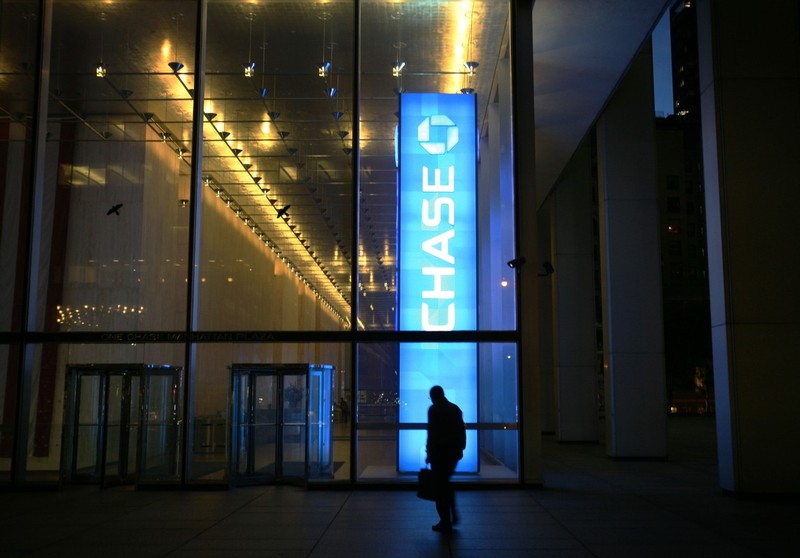
What Matters with China?

lama.jpg

The subject of U.S.-China ties is hot now and no wonder, with so many divisive issues on the agenda. The question is, which issues should matter to the U.S. and which ones should we let slide? Max Boot offers his cheat-sheet:


That doesn’t mean we should engage in needless and self-destructive confrontations with China over global warming and currency, but that also doesn’t mean we should mindlessly kowtow to China’s every whim. As I argued in this Weekly Standard article in 2005, we should pursue a balanced approach to China, tough on security and human-rights issues but accommodating on trade and currency policy.

The interesting thing to note about Boot's preferences is that his points of emphasis (human rights and security) are the matters that don't actually impact American lives, while the things he wants to let slide (especially currency) are Chinese policies that do have a good deal of impact on the lives of Americans. China's human rights record is an internal matter, whereas her currency valuation is an international matter of fairly large significance for the U.S. economy. Why, I wonder, does one trump the other?

(AP Photo)

February 3, 2010

Video of the Day

Gordon Chang is extremely well known for being bearish on China, and so represents only one side of the scholarly debate on China and Chinese policy. Nevertheless, he points out something that is very interesting, and is often overlooked when dealing with U.S. and Chinese relations. Often people seem to think that the U.S. needs China because China has a huge market, but the trade balance shows that really it is China which needs the U.S. market. The only thing China buys in large quantities is U.S. debt, which I think most Americans would happily quit exporting.

For more videos on world events, check out the Real Clear World Video page.

February 2, 2010

Video of the Day

Relations continue to sour between the United States and China:

This could be an interesting natural experiment on the power, or lack thereof, of sanctions. While it is possible that a wobbly company might be hurt by sanctions, it seems unlikely that the economic titans that are U.S. defense contracting companies are among them. If this squabble heightens, this may finally spell the end of "Chimerica."

For more videos on the events of the world, look at the Real Clear World Videos page.

Understanding Gates' Pentagon

secretary%20Gates.jpg


Secretary Gates is often described as a pragmatist. That's not a bad thing, of course, but when it comes to the business of trying to set the U.S. on solid strategic footing for the 21st century, pragmatism can be a liability, since it won't look at the underlying issues but instead tries to manage the present situation as best it can. The key to understanding Secretary Gates' strategic thinking, I think, came in a speech he gave at the National Defense University in September 2008. Gates said:

Think of where our forces have been sent and have been engaged over the last 40-plus years: Vietnam, Lebanon, Grenada, Panama, Somalia, Haiti, Bosnia, Kosovo, Afghanistan, Iraq, the Horn of Africa, and more.
What's missing from this litany is obvious: any engagement with the question of whether these interventions were vital for the security of the United States. Surely Secretary Gates doesn't think American security would be intolerably threatened had we not intervened in Lebanon, Grenada, Panama, Somalia, Haiti, Bosnia, and Kosovo? Or do we really believe that the military had no other choice?

Unfortunately, rather than wrestle with these questions, it's simply taken as a given that this is what America must do as a global power and so it's off we go to China to borrow the money to pay for it all. That is, in a nutshell, what the current defense strategy promises. We will "rebalance" the force, cutting into the conventional platforms that give America true security to pay for the nation building/counter-insurgency in the mostly irrelevant litany that Gates highlighted.

(AP Photo)

February 1, 2010

Did Russia Try to Sabatoge the U.S. Economy?

Via Blake Hounshell, an interesting tidbit has emerged from former Treasury Secretary Hank Paulson's forthcoming memoir:

Russia urged China to dump its Fannie Mae and Freddie Mac bonds in 2008 in a bid to force a bailout of the largest U.S. mortgage-finance companies, former Treasury Secretary Henry Paulson said.

China rejected the idea, but some are still calling it an alarming case of "economic warfare" considering the Russian gambit was reportedly hatched during (or just before) the war with Georgia. Daniel Drezner cautions about reading too much into it before all the facts are out.

January 26, 2010

The Scott Heard 'Round the World?

rsz_scottbrown012610.jpg

Over on Real Clear Politics, there has been plenty of speculation on the effect Scott Brown's election has had on domestic politics. However The Hindu reports that shock waves may be felt as far away as India. Both India and China are allegedly rethinking their decision to sign the Copenhagen Accord:

Prime Minister Manmohan Singh has written to UN Secretary General Ban Ki-moon seeking a number of clarifications on the implications of the accord that India -- with five other countries -- had negotiated in the last moments of the Copenhagen climate summit in December, the officials said, speaking on condition of anonymity.
“That letter, and the defeat of the Democrats in the Massachusetts bypoll, has forced the UN to postpone the deadline indefinitely,” an official said. “With the Democrats losing in one of their strongholds, the chances of the climate bill going through the US senate have receded dramatically.
“So if the US is not going to reduce its greenhouse gas emissions by 17 percent, which was a very weak target anyway, why should we make any commitment even if it does not have any legal teeth?” the official said.

I'm a treaty skeptic, especially of ones as difficult to enforce as carbon emissions. It seems highly probable that the Massachusetts Republican's victory is just an excuse for India and China to withdraw and blame it on a faction in the United States. Oddly, this could be a sign that China and India at least take these treaties seriously, since they are unwilling to sign if it would actually put them at a relative disadvantage to the United States.

(AP Photo)

January 25, 2010

Video of the Day

That China and Google are still in the news tells you that this story is more significant than perhaps originally thought:

Part of the reason this story may have such long legs could be the fact that Google is such a powerful corporation. However, more tellingly, instead of backing off and denying everything, the Chinese Communist Party has decided to double down on their control of the internet. This is potentially significant for two reasons: 1. the party views its control of the internet as critical to its survival, meaning that China may not be as stable as many currently perceive, or 2. China now believes that its power vis-à-vis the United States is great enough that it can forge its own path in the international community,meaning that China's heretofore peaceful rise may have been ephemeral.

For more videos on international subjects check out the RCW Videos page.

On China, U.S. Values Rights Over Economy

chinapoor.jpg

An interesting finding from Angus Reid:

People in the United States want their government to take human rights and minority rights into account when it deals with China, according to a poll by Angus Reid Public Opinion. 51 per cent of respondents feel this way, while 21 per cent would prefer to focus on the trading relationship.

The full poll on China is available here. (pdf) Among its other notable findings:


Half of Americans (50%) think their country should do less business with China; 28 per cent say it should maintain the current amount of business, and only one-in-ten people (10%) say it should increase trade ties with the Asian country....

The implications of doing less business with China would almost certainly mean more poverty in China. And that wouldn't exactly help much in the human rights department.

(AP Photo)

January 23, 2010

Could the WTO Tear Down China's Great Firewall?

Reuters reports that the United States Trade Representative (USTR) is "mulling" (great word!) a challenge to China's internet restrictions - the humorously-named-but-not-actually-funny-at-all "Great Firewall of China":


U.S. trade officials have asked for more information as they weigh whether to pursue a case against Chinese Internet restrictions that impede Google and other companies, an attorney for a U.S. free speech group said on Friday.

"They've asked us for more detail about it. We are trying to put that together right now," said Gilbert Kaplan, a partner at King and Spalding, which represents the First Amendment Coalition, a nonprofit advocacy group...

The U.S. free speech group, known then as the California First Amendment Coalition, first approached the U.S. Trade Representative's office in late 2007 with the idea of challenging China's barriers to Internet access at the World Trade Organization.

It gave the trade office, run at the time by the Republican administration of former President George W. Bush, "a very extensive white paper, or memo, describing the WTO violations that the 'Great Firewall' caused, and that were actionable in our view under the WTO, and a request that USTR begin a WTO case against China regarding the Firewall," Kaplan said.

Although no case was filed, Kaplan said U.S. trade officials never ruled out that possibility.

"We're continuing to request that they start that case. That dialogue is continuing," Kaplan said.

A spokeswoman for the U.S. trade representative's office had no immediate comment.

A study by the Brussels-based think tank ECIPE in November called government censorship the biggest trade barrier that Internet companies face.

Many countries censor the Internet for political or moral reasons. China has developed one of the most pervasive methods. In Cuba, all unauthorized surfing is illegal, while many Western countries limit access to child porn sites.

A WTO case could help "clarify the circumstances in which different forms of censorship are WTO-consistent," ECIPE said....

China agreed as part of its commitments to join the WTO in 2001 that U.S. service companies would have the same access in China as their own companies.

"We believe that applies to the Internet and Internet companies," Kaplan said.

China's web restrictions in effect force U.S. Internet companies to "put servers and hardware in China, rather than doing what they do everywhere else in the world, which is use their U.S. base," Kaplan said.

"If we try to serve the Chinese market from the U.S. or anywhere outside the Great Firewall, our Internet access is so slow that no one will use our sites," he said.

WTO rules also require countries to follow transparent and understandable procedures, he said.

Instead, China "is very randomly stopping our Internet companies and our Internet access with no prior notice and no set of regulations," Kaplan said.


The free speech group's 2007 white paper is here, and they state that China's internet restrictions violate a whole host of WTO rules, including GATT Article III (national treatment), China's services commitments under the GATS and China's WTO Accession Protocol. 

Continue reading "Could the WTO Tear Down China's Great Firewall?" »

January 19, 2010

Russia in the Far East

The daily Nezavisimoye Voyenno Obozreniye - Independent Military Review - published a scathing assessment on the state of Russian Army preparedness in the strategically-important Far East.

The data is crucial for several reasons: 1. The Russian military establishment views "eastern direction" as a source of potential threat (read, China, but don't say it aloud, as is the current modus operandi in Moscow); 2. Russia just inaugurated a major oil pipeline to feed much-needed energy for China's ever-increasing demand. Defense of energy networks that now criss-cross Eastern Siberia and the Far East are key to Russian economic security; 3. the criticism of the Russian military preparedness are becoming more and more public across the Russian Federation.

"Last week the MOD Commission checked the status of combat training in the Far East. The preliminary results are disappointing. According to the First Deputy Defense Minister of the Russian Army General Nikolai Makarov, the combat training of troops in the Far Eastern Region (DVO) and the Pacific Fleet (TOF) is assessed as unsatisfactory. Meanwhile, Far East and the Pacific Fleet in combat power and the number of troops make up almost 40% of the capacity of the Russian Army and Navy. General Makarov said that the final conclusions on the audit readiness of troops in the region will be made by the end of January. However, he said that during this test, "the high demand placed on a new image of the troops and their leaders do not allow individual military units and commanders to deliver a positive evaluation."

Continue reading "Russia in the Far East" »

January 18, 2010

Chinese Bombs and Chinese Aid

ALeqM5iyneY8gN8CT-49YBQSwDoZWsJAIQ.jpg
(AFP Photos)

The past week's headlines are significant for highlighting the two potential manifestations of China's growing global clout. First, China announced that it had successfully tested anti-missile technology. Four days later, after Haiti was devastated by a magnitude-7.0 earthquake, China announced that it would provide $4.4 million worth of aid to support the global effort.

China watchers, for at least a decade now, have been arguing over the path that China will ultimately traverse in international relations. Will it develop into a responsible member of the international community, or will it eventually decide to take on U.S. military dominance in hopes of controlling the international system?

The events of the last seven days suggest an ambiguous answer to that question.

On the one hand, the PRC sent significant aid -- the amount noted above plus another $1 million via the government-controlled Red Cross Society of China -- and personnel to assist one of only 23 countries that still recognize Taiwan as an independent nation. In the past, China established the pattern of not dealing with or assisting nations that recognized Taiwan. And if the Chinese tried to sign an agreement with one of these states, then it usually stipulated a breaking of diplomatic ties with Taipei. Therefore, China's quick response to Haiti's disaster without any strings attached, despite Haitian recognition of Taiwan, signifies a PRC that is more concerned with playing its part and building confidence with the international community.

On the other hand, on Jan. 11, China publicly announced the success of a missile test in which it shot down another missile in mid-flight while it was in space. This is something that, until now, only the U.S. has successfully achieved, making it a significant step in military development. Moreover, this is evidence that China's pumping increasingly more money into the military -- particularly its maritime, space, and electronic -- capabilities is paying off in quality, not just quantity. Certainly, if it were planning on a purely cooperative future, China wouldn't need such capabilities, defensive or not.

These two futures are not mutually exclusive, of course. Conceivably, the PRC could be showing the world that it wants to be constructive while simultaneously hedging its bets on a world that, largely, does not trust its military intentions. But how much does such a strategy reinforce doubts amongst some in the international community?

Yet, it is not a Catch-22. What China needs to do is to use -- and please excuse the cynicism -- crises, such as Haiti, as opportunities for much more significant confidence building. With all of its foreign reserves and new military wherewithal, China could be playing a much more significant role in international humanitarian efforts, particularly during disasters, in which politics can usually be evaded. Imagine if China were to have sent $50 million and 1,000 aid workers to a country with which it didn't even have diplomatic relations. This would have been a clear sign that China is here to play a positive role in the world.

As it uses its newfound power to make more significant contributions, the PRC doesn't necessarily have to stop developing defensive capabilities. (America certainly does both.) But without matching the growing might of its military arsenal with diplomatic and humanitarian might, to many around the world, China's intentions will remain in doubt.

Kevin Slaten was a junior fellow in the China Program at the Carnegie Endowment for International Peace. Now, he lives in Taiwan on a Fulbright Grant. His opinions in no way reflect the views of the State Department or Foundation for Scholarly Exchange. He blogs at www.kevinslaten.blogspot.com.

January 15, 2010

Why Did China Spy on Google?

googlechina.jpg

The New York Times' David Sanger and John Markoff report that the U.S. is keeping mum on the Google/China dust-up in part because of the severity of the cyber-intrusion that sparked Google's decision:

Last month, when Google engineers at their sprawling campus in Silicon Valley began to suspect that Chinese intruders were breaking into private Gmail accounts, the company began a secret counteroffensive.

It managed to gain access to a computer in Taiwan that it suspected of being the source of the attacks. Peering inside that machine, company engineers actually saw evidence of the aftermath of the attacks, not only at Google, but also at at least 33 other companies, including Adobe Systems, Northrop Grumman and Juniper Networks, according to a government consultant who has spoken with the investigators....

...Besides being unable to firmly establish the source of the attacks, Google investigators have been unable to determine the goal: to gain commercial advantage; insert spyware; break into the Gmail accounts of Chinese dissidents and American experts on China who frequently exchange e-mail messages with administration officials; or all three. In fact, at least one prominent Washington research organization with close ties to administration officials was among those hacked, according to one person familiar with the episode.

There is growing body of argument (see Jordan Calinoff in FP today) that the Google contretemps is the culmination of a Chinese policy to make the country less hospitable to foreign corporations. That may indeed be the case, but this particular incident sounds more like run-of-the-mill spying to me, not industrial policy.

(AP Photos)

January 13, 2010

Google Threatens China Pull-Out

googlechina.jpg

By Patrick Chovanec

An important news story is unfolding today in China. In the wee hours of this morning (Beijing time), David Drummond, Google’s Senior Vice President for Corporate Development and Chief Legal Officer, posted a statement on his blog. The gist of that statement is a business bombshell: Google, faced with what it sees as an intolerable level of censorship and harassment, has effectively decided to pull the plug on its China operations.

Drummond begins by describing the incident that immediately sparked this decision:

In mid-December, we detected a highly sophisticated and targeted attack on our corporate infrastructure originating from China that resulted in the theft of intellectual property from Google. However, it soon became clear that what at first appeared to be solely a security incident … was something quite different … we have evidence to suggest that a primary goal of the attackers was accessing the Gmail accounts of Chinese human rights activists.

Although Drummond does not explictly point the finger at the Chinese government as the perpetrator, it’s hard to read his words as implying anything else.

He goes on to note that when Google entered the Chinese market in 2006, it believed that the potential benefits outweighed some of the uncomfortable compromises it was forced to make. If this proved mistaken, the company pledged, it would reconsider its strategy. The recent cyberattacks, Drummond concludes, combined with China’s tightening controls over Internet access, have tipped the balance. As a result:


We have decided we are no longer willing to continue censoring our results on Google.cn, and so over the next few weeks we will be discussing with the Chinese government the basis on which we could operate an unfiltered search engine within the law, if at all. We recognize that this may well mean having to shut down Google.cn, and potentially our offices in China.

I hear from reliable sources that, as of this morning, Google.cn has unilaterally lifted all of its censorship blocks and is running unfiltered in China. (A more recent report says that the famous “tank man” photo can be accessed, a major no-no as far as Chinese censors are concerned).

Tellingly, Drummond notes that Google’s decision was made in the U.S. “without the knowledge or involvement of our employees in China” — an effort, no doubt, to shield them from retaliation. In light of China’s arrest of four Rio Tinto employees last year on espionage charges following a series of commercial disagreements, Google’s concern is certainly understandable.

Although its statement is couched in diplomatic and open-ended language, make no mistake: Google has crossed the Rubicon. In the U.S., a statement like this might be just a tough-talk negotiating tactic, to see if the other side will blink. But in China, nobody issues an ultimatum — especially not to the government — unless they are fully expecting a final and irreconcilable break. As long as you have some hope of a favorable outcome, you bite your tongue. That’s precisely why Facebook, YouTube, and Twitter have uttered not a word of complaint, even as a six-month ban on accessing those sites has left their Chinese market share in ruins. Google’s decision to publicly throw down the gauntlet — a move sure to be seen by the Chinese government as a virtual declaration of war — is a sign the company has already written off China and is ready to pack its bags.

Some observers wonder whether Google is just using “human rights” as an excuse to fold a failing business, noting that its main Chinese competitor, Baidu, has built up a 75% market share, leaving Google with just 18%. It’s certainly true that striking such a pose would win the company kudos from Congress, which was sharply critical of Yahoo when it handed over information to Chinese police that resulted in the arrest of a journalist.

Still, a company with Google’s resources doesn’t just abandon a huge market like China — even if it ranks a distant #2 — without good reason. There’s widespread feeling among foreign companies in China that the issues Google is complaining about are real, and serious. A senior person with a leading global tech company here in Beijing who I talked to described Google’s announcement as “unprecedented,” and said it will make everyone rethink the way they do business in China. A diplomatic contact told me that the privacy and security issues raised were so serious that “the U.S. government’s response, or lack of response, will send a profound message” not just to China, but the entire world. Already, U.S. Secretary of State Hillary Clinton is demanding an explanation from China for the alleged cyberattacks.

If it does leave, to my knowledge Google will be the first major U.S. company to quit China explicitly for reasons of political interference — and that marks a very significant development. China has always operated on the assumption that, no matter how they might grumble, foreign investors will ultimately accept whatever strictures China dishes out because nobody, in the end, is willing to walk away from the Chinese market. Google’s decision seriously undermines that assumption. There is a breaking point.

Update: The latest news I'm hearing over Twitter is that

1. Google is alternatively denying that you can access "tank man" photos through its Chinese site, or saying you always could, while some are reporting it has turned its censoring filters back on again
2. China has had a remarkably cautious initial response, saying it needs "to study" the Google allegations. I can confirm that, at this moment, Google.cn and Gmail.com are still accessible from China, which really surprises me.

These developments raise two possibilities I did not previously entertain. The first is that Google has the unique size, visibility, and prestige to really play hardball with China, and that turning its censorship filters off and on again was a way to send a message to China that it is willing to hit the "nuclear" button, but is open to talking. The second is that the Chinese government is not completely unified on this issue, that the elements that (allegedly) attacked Google have created an unwelcome mess for other elements concerned that China's business reputation would be damaged if Google picks up its toys and goes home. It is quite possible that both scenarios are true, or neither. The story unfolds ... and is well worth monitoring closely. How it plays out will shape business-government relations in China in significant ways.

(AP Photos)
------------
Patrick Chovanec is a professor at Tsinghua University's School of Economics and Management in Beijing, China. He blogs at http://chovanec.wordpress.com/

Reaction to the China/Google Dust-up

googlechina1.jpg

The Atlantic's James Fallows, who has spent I believe the last three years living in and reporting on China, offers his thoughts on the news:

But there are also reasons to think that a difficult and unpleasant stage of China-U.S. and China-world relations lies ahead. This is so on the economic front, as warned about here nearly a year ago with later evidence here. It may prove to be so on the environmental front -- that is what the argument over China's role in Copenhagen is about. It is increasingly so on the political-liberties front, as witness Vaclav Havel's denunciation of the recent 11-year prison sentence for the man who is in many ways his Chinese counterpart, Liu Xiaobo. And if a major U.S. company -- indeed, Google has been ranked the #1 brand in the world -- has concluded that, in effect, it must break diplomatic relations with China because its policies are too repressive and intrusive to make peace with, that is a significant judgment.
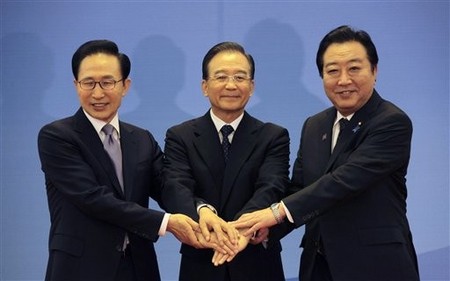
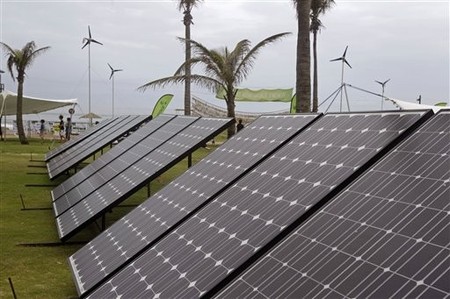
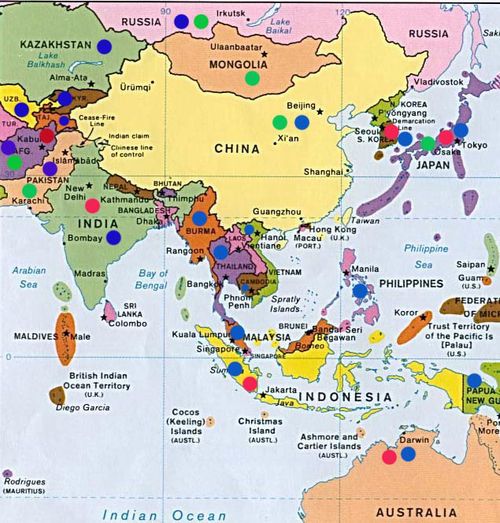
Ryan Tate, however, smells something fishy:

The timing of Google's aversion to censorship is telling. As admitted in Drummond's post, Google has bowed to the censorious demands of the Chinese regime for years, reasoning (conveniently) that the Chinese people were better off with Google than without it; Google even allowed its own censors to be profiled in the New York Times.
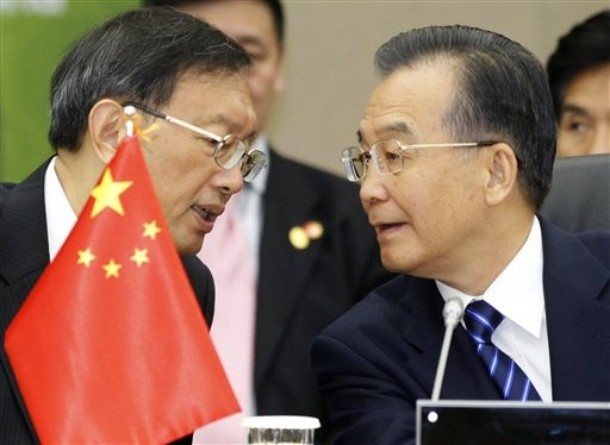
Only now, amid executive turnover at Google China and a continued failure to best their state-sponsored competitor there, and after Chinese hackers have endangered the company's interests globally, does Google get firm on the issue of human rights. It's a clever way to dress up a security breach — and an embarrassing attempt to partner with China's authoritarian leaders — as an act of nobility and courage.

It would be grievous indeed if Google is trying to turn an act of corporate CYA into an international rebuke of China. Even Hillary Clinton is weighing in on this now.

Meanwhile, the Daily Telegraph's Peter Foster reports from Beijing that many Chinese bloggers would be upset at the loss of Google.

(AP Photos)

December 31, 2009

The Luxury of Nuclear Weapons

Andrew Sullivan writes:

The obvious aim, it seems to me, of the Revolutionary Guards is not to nuke al-Aqsa, but to use a nuclear capacity to immunize their terrorism in the region, to balance Israel's nuclear monopoly, to scare the crap out of the Saudis and Egyptians, and to shore up their control at home. I see this as an inevitable coming-of-age of Iran as a regional power, and although there is an obvious and acute danger that nuclearization could entrench some of the worst elements of the regime (and they don't get much worse than Ahmadinejad), the brutal truth is: we do not have the tools to stop it. One day, a nuclear Iran, if led by men and women legitimately elected by the people of Iran, could be our friend, not enemy - and a much more reliable and stable friend than the Sunni Arab autocracies we are currently shoring up. I believe, in short, that in my lifetime we will see a democratic Iran, led by the generation that took to the streets this year. And I believe vigilant containment is the only realistic way at this point to get there.

Why is it that no one talks extensively about human rights in North Korea, or China or Russia? Why does it make sense that Burma's military junta would pursue a nuclear weapons program?

The answer is rather simple: security. As Andrew points out, the likelihood of Iran actually using one of these weapons should they even attain the capability is slim. The problem is that the very possession of these weapons allows Iran into an unspoken club of hush, hush humanitarianism. Sure, we all know bad things go on in the aforementioned countries, but what can we actually do about it?

If Iran acquires a nuclear weapon the regional dynamic, as Sullivan concedes, would immediately change. In order to offset a regional arms race, the United States would essentially need to cover the entire Middle East in its so-called nuclear umbrella. Strategy would shift from engagement to containment. And this is the important point: when you seek to simply contain, you are accepting losses within already compromised boundaries. In this instance, that lost territory is the Islamic Republic of Iran.

I hope--and pray--to see a free and democratic Iran in my lifetime, just as Andrew does. But the chances of that happening should this awful and rotten regime get a nuclear weapon would be rather slim. If the casual observer thinks this government is oppressive now, just wait until it is intoxicated with the impunity of the nuclear womb.

Moreover, any hopes of resurrecting nuclear nonproliferation can get kissed goodbye. As I wrote earlier this month, what Obama is trying to do here is admirable--that being, restore some semblance of international order and process for dealing with rogue states that seek nuclear weapons. If the policy toward nuclear Iran is mere containment, then Iran has already won.

What then will be the strategy for the next nuclear aspirant? Containment? War? Something else? The fact that there's no viable answer to those questions is the problem, and it will only get worse if Tehran gets the bomb.

Removing All Options from the Table

rsz_obama_iran.jpg

Ray Takeyh writes:

The modest demands of establishment figures such as Ali Akbar Hashemi Rafsanjani, including for the release of political prisoners and restoring popular trust (via measures such as respecting the rule of law and opening up the media), was dismissed by an arrogant regime confident of its power.

Disillusioned elites and protesters who had taken to the streets could have been unified, or their resentment assuaged, by a pledge by Supreme Leader Ayatollah Ali Khamenei for the next election to be free and fair, for government to become more inclusive or for limits to be imposed on President Mahmoud Ahmadinejad's prerogatives. Today, such concessions would be seen as a sign of weakness and would embolden the opposition. The regime no longer has a political path out of its predicament.

I believe Takeyh is mostly right here. The problem however is that the Green Movement has lacked a political option from the get-go--hence the demonstrations and the unrest. Both sides have the option of violence, but that's a leap I don't think the Green Movement is prepared to take. As Takeyh notes, the regime has been mostly reserved and cautious in how it has handled the demonstrations, leaving it in a kind of uncertain limbo: it won't fully crackdown, nor will it capitulate.

He goes on to say:

The Obama administration should take a cue from Ronald Reagan and persistently challenge the legitimacy of the theocratic state and highlight its human rights abuses. The notion that harsh language militates against a nuclear accord is false. At this juncture, the only reason Tehran may be receptive to an agreement on the nuclear issue is to mitigate international pressures while it deals with its internal insurrection. Even if the regime accommodates international concerns about its nuclear program, the United States must stand firm in its support for human rights and economic pressure against the Revolutionary Guards and other organs of repression.

Let's keep in mind that Tehran, to date, has balked at even the most modest of uranium transfer arrangements, all the while withstanding demonstrations and internal unrest. These are men who cut their teeth during the war with Iraq, while at the same time fighting violent insurgents at home. None of this is new to them.

And "standing firm" requires a key commodity: leverage. Reagan had the leverage to simultaneously talk and talk tough because he had a stockpile of nuclear weapons and missiles to back up that talk. Were Obama to follow Takeyh's advice, and premise nuclear negotiations on human rights violations in Iran, then he'd essentially be removing all options but one from the proverbial table: attack.

Russia and China will not back a negotiating strategy intended to support the Green Movement. Thus, the United States will be left--once again--unilaterally lecturing a regime, and with only one remaining option to make good on that lecturing.

So are we prepared in 2010 to take that leap? Do we toss multilateral pressure on the scrapheap and ready for another war? This is the inevitable path if we lose sight of how fragile the international coalition is on Iran.

UPDATE: It's also, I would add, important to take note of the folks who are embracing Takeyh's suggestion. Some are what I would call the usual suspects, and they dragged us into one war based on false pretenses and then attempted to re-package it as a humanitarian endeavor. We know where they fall on the attack or talk question, but where then do their unlikely bedfellows reside?

(AP Photo)

December 19, 2009

China's Desperate Homeowners


By Patrick Chovanec

I’ve come to learn that when something is banned in China, it’s probably well worth checking out. That's proven to be the case with a new hit TV series called woju 蜗居, which goes by the English name “Dwelling Narrowness”. The series, which aired on Beijing and Shanghai TV, focuses on the difficulties facing average Chinese people in an environment of spiraling apartment prices and official corruption. One blog calls it “without question one of the most influential television series to have aired in China,” and it must have touched some raw nerves, because it was yanked from the airwaves and ordered back to the edit room to be “recensored.” If anything, its abrupt cancellation has generated even more interest among Chinese viewers, who can still download it illicitly online.

The main story revolves around the two Guo sisters, who live in Shanghai. The elder, Haiping, and her husband are graduates of Fudan University, and together live on a typical “local” combined salary of RMB 9,000 (US$1,300) per month. In order to scrimp and save every penny, they rent an cheap one-room apartment and live apart from their young daughter, who is being raised by Haiping’s parents. Frustrated by their earlier decision not to purchase an apartment when prices were far cheaper, they are obsessed with buying one as soon as possible, even though they can barely afford it. They end up buying a place with a mortage of RMB 6,000 per month, 2/3 their income.

The younger sister, Haizou, is a pretty and naive girl who lives with her kind and loyal boyfriend, Xiao Bei. She works for a somewhat slimey property developer who relies on her to help entertain important contacts, one of whom is Secretary Song, an official in the city government who passes along valuable advice and information. Song is facing a bit of a midlife crisis, and is attracted to Haizao’s youth and innocence. Pressed by her elder sister to provide some of the cash she needs to buy an apartment, Haizao grows closer to Secretary Song, eventually becoming his mistress.

Continue reading "China's Desperate Homeowners" »

December 14, 2009

China in Russia's Near Abroad

chinagas.jpg


There's been a lot of focus on U.S. foreign policy in Russia's "near abroad." Well, move over America:

With one flick of a switch today, Russia's long-standing dominance and near monopoly over Central Asian natural-gas exports officially came to an end.

The massive Turkmenistan-China pipeline, which will carry natural gas from eastern Turkmenistan through Uzbekistan and Kazakhstan into China's northwestern Xinjiang region, went on line today during an inauguration ceremony attended by regional leaders. It marks the first time in more than a decade that a pipeline has been constructed to pump gas out of the region, and the biggest-ever effort to export Central Asian gas without using Russian routes...

...Observers see RWE's activities as the first steps in securing Turkmen gas for Nabucco. And for Nabucco shareholders and supporters, the example of the new Turkmenistan-China going online demonstrates with certainty that it is possible to build a high-volume pipeline that avoids Russia.

The great game is on.

(AP Photos)

December 11, 2009

View China Currency Dogma with Skepticism

The blogosphere has been rumbling over two recent op-eds in the Financial Times - a generally free market publication - arguing against China's currency policies and warning of these policies' economic harms.

The first, and more hysterical, op-ed came from University of Chicago(!) economist Robert Aliber who argues that drastic protectionism is needed to force China to appreciate its currency (the RMB) and thus correct the "unsustainable US-China trade imbalance." This is pretty startling coming from an economist from the free market U.Chicago. Fortunately, Cato's Dan Ikenson gives Aliber's op-ed a proper fisking, so all I need to do there is point you to Dan's great blogpost.

Martin Wolf's op-ed is more thoughtful, but no less alarming. He sees four serious problems with China's currency regime:

First, whatever the Chinese may feel, the degree of protectionism directed at their exports has been astonishingly small, given the depth of the recession. Second, the policy of keeping the exchange rate down is equivalent to an export subsidy and tariff, at a uniform rate – in other words, to protectionism. Third, having accumulated $2,273bn in foreign currency reserves by September, China has kept its exchange rate down, to a degree unmatched in world economic history. Finally, China has, as a result, distorted its own economy and that of the rest of the world. Its real exchange rate is, for example, no higher than in early 1998 and has depreciated by 12 per cent over the past seven months, even though China has the world’s fastest-growing economy and largest current account surplus.

Wolf is a smart, reasonable guy and expresses a view held by a lot of smart, reasonable guys: China's currency is very undervalued; it's distorting global trade balances; and something needs to be done to stop it (and thus end these imbalances). I've expressed skepticism about these views, as have other people far smarter than me (linked throughout my aforementioned posts).  But I thought that a direct response to Wolf - printed in today's FT - also warranted notice.  Here's Jim O'Neill, chief economist at Goldman Sachs:
Like many others, I often, all so easily, fall into the camp that the Chinese exchange MUST still be undervalued, and cite the reserves fact and its growth as evidence, but I am not so sure when I really analyse it. We have a model for estimating fair values for many currencies, our so called GSDEER, and it did used to suggest that the CNY was undervalued. However as a result of the approximate 20pct appreciation of the past 4 years, and higher prices than many other countries, our model suggests it is no longer so clear. Now FX models are FX models, and having spent so much of my career on them, I know only too well that it is subject to even more risks for somewhere like China. But when I see our own- objective -model saying things like this, observe surveys showing that Mexico is now back to being the no 1 place to produce heavy industrial goods, and China’s imports rising much more sharply than exports, I stop to question my underlying tendency. On top of this, and Martin, as many others, never seems to address this, China’s current account surplus this year is going to be close to about half what it was a year ago amidst lots of evidence that domestic demand, especially consumption, is roaring away. Yesterday, we got news that in November, Chinese auto sales rose by 92pt year on year. They are so strong, that they are now importing some directly from overseas. You see similar evidence when you look at LCD TV sales and almost anything else. As some Chinese policymakers point out, this is almost definitely more important than the exchange rate issue that so many are still rather perhaps excessively focused on.

O'Neil's response is reprinted here not to trumpet a big, silly "see, I told you so; look how smart I am" (really!).  Instead, I fully admit that I don't know whether China's currency is undervalued or overvalued, or whether a revaluation will affect bilateral trade flows between China and the US or other countries. (Although I do know that history argues against it, and I'd prefer letting the free market decide.)  But I hope that my posts, and O'Neil's very well-researched and modeled response, make clear that there's a lot of good debate among honest and smart people about China's currency policies and global trade.  There's also a lot of idiotic demagoguery, and we should be very, very suspicious of economists (*cough*PaulKrugman*cough*) and politicians who loudly proclaim with steadfast confidence that (i) China's currency is harming the US economy, and (ii) RMB appreciation will be a magic cure for "unsustainable" global trade imbalances.

It just ain't that easy.

Scott Lincicome is an international trade lawyer in Washington, DC. He blogs at http://lincicome.blogspot.com/.

November 16, 2009

U.S. & China: Exchange Rates Aren't the Problem

By Patrick Chovanec

When President Obama arrives in Shanghai tonight, one of the hottest issues on the table will be the exchange rate between the U.S. Dollar and China’s Renminbi. In the past few weeks, commentators like New York Times columnist Paul Krugman have argued that Obama’s top priority should be to pressure China into strengthening its currency, in order to “rebalance” the global economy. I disagree. A more flexible exchange rate – and the stronger Renminbi that would likely result – would be a step in the right direction. But it’s not a silver bullet, and would have little effect in the absence of more substantive economic reforms. In my view, the focus on currency is a huge distraction from far more pressing issues.

Krugman is correct that a rebalancing needs to take place. The current situation, in which China runs larger and larger trade surpluses, and lends the proceeds back to fuel ever-rising consumption in the United States, is not sustainable indefinitely, especially as the Chinese economy grows to rival America’s in size.

According to conventional economic theory, flexible exchange rates play a vital role in correcting such imbalances. When a Chinese exporter sells a product to the U.S., it receives dollars in return. Those dollars don’t just disappear; they stay in China until someone wants them to buy products from America or invest in American assets. For quite some time now, China sells more than it buys from the U.S., and brings in more capital than it invests abroad, which means that there aren’t enough people who want to use all the dollars that keep flowing in. Just like any other market, when the supply of something – in this case dollars – outstrips demand, its price should drop. The dollar depreciates, making U.S. goods cheaper and more attractive to Chinese consumers, while the Renminbi appreciates, making Chinese goods more expensive in America, eventually closing the gap in trade.

The Chinese government, though, isn’t letting that happen. Instead of letting those excess dollars sell for a lower price in Renminbi, it steps in and buys them at the current exchange rate, and holds them as reserves. By keeping the Renminbi artificially cheap, Krugman and other critics contend, China gains an unfair trade advantage. If only the Chinese would stop interfering, and allow the dollar to find its true level, American products would become more competitive and this dangerous imbalance would correct itself.

Sounds good, but the problem is we’ve been here before. In the early 1980s, Japan was running a chronic trade surplus with the United States, and accumulating dollar reserves on a massive scale. Economists argued that an undervalued Yen was to blame. So in September 1985, the central banks of the U.S., Japan, Britain, France, and West Germany agreed on what became known as the Plaza Accord. Over the course of the next two years, they intervened heavily in global currency markets to bring the value of the dollar down by over 50% against the Yen, from around 250 JPY/USD to 125.

The outcome baffled and frustrated economists. While the cheaper dollar had a significant effect in reducing America’s trade deficit with Europe, Japans’ trade surplus with the U.S. barely budged – in fact, it grew. How could this be? Why didn’t the new exchange

Continue reading "U.S. & China: Exchange Rates Aren't the Problem" »

October 5, 2009

China’s Angry Artist Throws Down the Gauntlet

Chinaartist.jpg


By Patrick Chovanec

To my mind, the most underreported story of China’s October 1st “National Day” anniversary was the emergence of Ai Weiwei as the most outspoken critic of China’s ruling regime.

For those who are not familiar, Ai Weiwei was the designer of the “Bird’s Nest” stadium that served as the main venue for the 2008 Beijing Olympics. A big bear of a man with a grizzly beard, he is known for his gruff and eccentric manners and his avant garde antics as a performance artist (his most notorious work was the F*** Off” exhibit, which featured photos of Ai giving the finger to the White House and Tiananmen Square, and smashing real — and priceless — Ming vases).

Ai_WeiweiAi, whose father was a poet exiled to Xinjiang to clean toilets during the Cultural Revolution, has never been shy in expressing his contempt for China’s Communist Party leadership, usually in the form of blunt and quotable asides. Authorities have long seen him as a “disruptive element”. But recently, Ai has really stepped it up a notch. He has played an active role in organizing investigation petitions by parents in Sichuan whose children were killed when many schools collapsed in late year’s earthquake, allegedly due to substandard materials and construction attributable to official corruption. On a recent trip to Sichuan, to witness the trial of one of his fellow activists charged with “inciting subversion of state power,” police broke into Ai’s hotel and walloped him over the head, causing cranial injuries that later required emergency brain surgery in Germany.

But it was his public statements on and around October 1st which have truly propelled him into untested and potentially dangerous territory. He published a prominent op-ed in TIME Magazine calling for democratic accountability and describing the 60th Anniversary celebrations as “the final hurrah of a dying system.” In an interview with Al Jazeera, he violated one of the country’s most sensitive political taboos by saying “China would be much better off” if Mao’s Communists had lost to Chiang Kai-shek in 1949. Elsewhere, he openly compared China’s ruling Party to a Mafia crime family (something he has done before, but without quite the same global audience to hear it). None of these comments would seem that shocking coming from pundits or activists outside of China. But coming from a Chinese citizen, on the incredibly sensitive occasion of an anniversary marking the Communist Party’s 60-year hold on power, China’s leaders are likely to view them as virtual treason.

Obviously Ai Weiwei is making a conscious bid for the role of China’s dissident-in-chief. The interesting question is how China’s authorities will respond as he grows more and more provocative. True, Ai does not have a large public following — most people in China know him for the Bird’s Nest and know nothing of his politics. I personally find some of his countercultural antics a bit childish. But his TIME article, in particular, was a measured and eloquent expression of precisely the social trends and political ideas that the Party fears most. Ai’s gutsy words will be seen as both an affront and a threat.

------
Patrick Chovanec is an associate professor at Tsinghua University’s School of Economics and Management in Beijing, China, where he teaches in the school’s International MBA Program. He blogs at http://chovanec.wordpress.com/

(AP Photos)

September 12, 2009

Chen Shui-bian Gets His Just Desserts

081112-Chen-Shui-bian-hmed-1p.hmedium.jpg

There was a time when Chen Shui-bian was a rising political star of Asia. He was a masterful campaigner, an astute politician and viewed by some as the champion of the oppressed.

Twice, he won the presidency of the Republic of China, against the better-funded, more-organized Kuomintang (KMT) despite long odds. In 2000, he led the upstart Democratic Progressive Party (DPP) into power in the island's second democratic election, taking advantage of an internal split in the KMT. Four years later, he won by a razor-thin margin aided by a mysterious assassination attempt just two days before the election.

While president, Chen also proved to be incredibly corrupt.

On Friday, Chen was sentenced to life in prison for embezzling $15 million U.S. during his presidency. He had an elaborate setup where he involved family members, including his wife, with a money laundering scheme that'd make the mob proud.

During his second term as president, Chen was busy putting money away while Taiwan's economy went into the tank. His party was routed in the 2008 legislative election, becoming a marginal minority party with fewer than a quarter of the seats. As Chen was barred by the constitution to run for a third term, his successor was beaten soundly by the KMT's Ma Ying-jeou in last year's presidential election.

In his final years in office, as he was trying to cover up the paper trail, Chen unleashed a series of political maneuvers designed to shift the attention of the public: Flogging the corpse of Chiang Kai-shek and stirring up conflict between the islanders and mainlanders; provoking China with frequent rhetoric of Taiwan "independence"; advocating Taiwan's re-admission into the U.N. by holding referendums, all the while knowing it was a purely political stunt.

Chen was dragged out of the office, kicking and screaming. He still has die-hard supporters, who insist on his innocence not because of any shred of evidence but because of their loyalty to a charismatic chameleon, who sold out his principles in exchange for a lucrative retirement. Had Taiwan's judicial authority not detained him swiftly, he surely would've fled, never to return.

The South China Morning Post calls it a tragedy for Taiwan:

The verdict marks the fall of the man once hailed as "Son of Taiwan", the child of a poor farmer who rose to the top, but now dubbed the "shame of Taiwan". As Taiwan's second democratically elected president, he came to power as a leader of some stature, a man seen to embody the hopes of Taiwanese with strong feelings of local identity. Indeed, it was on the back of their support that he became president. He projected the image of an incorruptible champion of Taiwanese nationalism and independence, whose anti-mainland rhetoric froze relations with Beijing.

He is now seen to have betrayed their faith by using his position for personal gain. The question now is how much damage his fall from grace has inflicted on the opposition Democratic Progressive Party and the independence movement in Taiwan. There was already a lot of disillusionment with the DPP over its performance in office after it came to power in 2000. Its reign was marked by internal bickering, administrative incompetence and corruption. Because Taiwan had experienced the dictatorship of the Kuomintang regime for so long, many people were prepared to give the DPP the benefit of the doubt. This fund of goodwill was depleted, however, as the party struggled to come to grips with the responsibilities of office.

This is the ultimate tragedy of Chen's conviction. In order to have a viable and vibrant democracy there needs to be a viable opposition capable of credibly contesting power and testing the government. Chen's disgrace of the island's highest office and his party will make it much more difficult for the DPP to recapture power.

(AP Photos)

September 5, 2009

Chickens Coming Home to Roost

By Patrick Chovanec

China Daily, the Chinese government’s official English-language newspaper, had an interesting report yesterday. Apparently the Chinese chicken industry is getting creamed by U.S. import competition, and is begging the government for protection. This is sort of a “man bites dog” story, in that normally all you hear about is Chinese imports wiping out higher-cost U.S. industries. In this case, imports from America actually seem to be beating domestic Chinese chickens on price, of all things:

From 2006 to 2008, the broiler imports from the US accounted for 68, 66 and 73 percent of the total Chinese broiler imports. The figure jumped to 89 percent during the first half of this year.

According to an investigation by the animal agriculture association into six major Chinese broiler companies whose output volume made up for 20 percent of the total, the ratio of output to capacity was 79 percent from 2006 to 2008. It dropped to 66 percent during the first half of this year.

“Price is the key reason behind the shift, as consumers have become more sensitive to it during the financial crisis,” said Ma.

In 2008, China’s broiler meat was priced at an average of 10,482 yuan per ton. It was 9,823 yuan per ton for the US product over the same period, 659 yuan lower.

Of course, nothing appears in China Daily without some point to it. The story draws an implicit but clear link between the Chinese government’s pending decision on protecting domestic chicken producers and President Obama’s upcoming decision whether or not to impose special tariffs on Chinese-made tires. China has vowed to retaliate if Obama goes ahead with the tariffs, and it’s not hard to guess what they might have in mind.

Okay, it’s a terrible pun, but if President Obama signs onto sanctions against Chinese tires, the chickens may literally come home to roost.

----
Patrick Chovanec is an associate professor at Tsinghua University’s School of Economics and Management in Beijing, China, where he teaches in the school’s International MBA Program. He blogs at http://chovanec.wordpress.com/ where this post first appeared.

September 2, 2009

When Will China Learn to Grow Up?

When in doubt, throw a temper tantrum.

It matters not that China has the world's third largest economy, perhaps the second-most powerful military and is the only potential global rival to the hegemon that is the United States. You can still count on China acting like a third-rate despot with all the delicacies of a bull in a, well, china shop.

So the Dalai Lama decided to visit Taiwan, in an oh-so transparent political maneuver designed to poke and get a rise out of China. Did China take the bait?

At first, Beijing acted only irritated, which was a good move and showed considerable restraint. It absolved Taiwan's beleaguered President Ma Ying-jeou and laid the blame entirely on the opposition and independence-minded Democratic Progressive Party (DPP).

That would've been fine. It'd be better had China just acted like the Dalai Lama didn't exist and ignored the visit entirely. Why give the Tibetan spiritual leader and the DPP the satisfaction?

But after thinking it over, Communist China's mandarins couldn't help themselves. They sunk their teeth in it. Hook, line and sinker.

Never mind that Ma's Kuomintang (KMT) had just sent a kowtow party to Beijing last week to explain themselves. Ostensibly, they told the Chinese that given Ma's weakened political state, they couldn't afford another big brouhaha.

Brushing the KMT aside,

China has canceled or postponed at least two planned visits to Taiwan, and nixed ceremonies meant to mark the expansion of direct air service, said KMT spokeswoman Chen Shu-rong. China had already said its delegation would not join Saturday's opening ceremony for the Deaf Olympics in Taipei.

That last move was so classically clever, it sure would resolve to win over the hearts and minds of the skeptical Taiwanese. In a rare opportunity to host an international athletic event, Taiwan now will get snubbed by its cross-Strait brethren. These deaf Chinese athletes, instead of being celebrated as goodwill emissaries for vastly improving relations between the mainland and Taiwan, are now mere ventilators in the latest Chinese temper tantrum.

But what did you expect from a regime, despite its power and size, that has the diplomatic maturity of a 3-year-old?

August 19, 2009

Chinese City Makes 2018 Olympic Bid

By Patrick Chovanec

Reuters reports that the Chinese city of Harbin wants to host the 2018 Winter Olympic Games. Its request to put in a bid must first be approved by China’s cabinet, the State Council. Even if permission is granted, China’s sports minister says that winning the bid would be “difficult” given stiff competition from better-known contenders like Geneva and Munich.

Nevertheless, I’m thrilled, and hope China’s leaders give Harbin the go ahead. It’s a fantastic city and would benefit immensely from hosting the Winter Olympics.

Harbin is located in the far northeast of China, near the border with Siberia. Founded by the Russians in 1898 as an important junction on the Trans-Siberian Railroad, Harbin is famous for old colonial architecture, bitterly cold weather, and 150-proof grain alcohol. It hosts an incredible festival every winter featuring huge snow and ice sculptures, including life-size castles and churches. It’s also home to a Siberian tiger reserve where the ”entertainment” includes feeding live chickens to the tigers.

When cities like Paris, New York, or London bid to host the Olympics, I have to wonder what they are thinking. Those cities already possess the attractions and facilities they need to bring in visitors, and the Olympics add nothing but security headaches and costly over-investment. The 2008 Beijing Games served as a big coming-out party for China, a focus for national pride–but for the city itself they were pretty much a bust. Beijing actually ended up attracting fewer visitors than normal last summer, and most of the venues now lie empty.

For Harbin, on the other hand, the Olympics would be a golden opportunity. The northeast, where the city is located, has run up on hard times. The region was home to many of China’s state-owned industries that collapsed in the 1990s, throwing millions of people out of work. It has struggled to develop replacement sources of income, such as winter tourism. The area’s ski resorts are promising but primitive, and poorly known even within China. Construction of new world-class recreation facilities, and the massive positive exposure that hosting the Olympics would bring, are just what Harbin needs to jump-start its future–and maybe even give those poor tigers and chickens a break. The benefits would endure long after the Games.

It’s true that Harbin may need help in preparing its bid. It lost previous bids to host next February’s 2010 Winter Olympics (to Vancouver) and the 2012 Winter Youth Olympic Games (to Innsbruck), probably due to inexperience. But if China’s central government put its weight behind the effort, there’s no doubt in my mind that Harbin could put together a more persuasive case.

The Olympics can be an excessive indulgence for already world-famous cities, or they can be a chance to introduce new and exciting places onto the world stage, and give struggling cities a shot at rejuvenation. Harbin is a great place to start.

--------
Patrick Chovanec is an associate professor at Tsinghua University’s School of Economics and Management in Beijing, China, where he teaches in the school’s International MBA Program. He blogs at http://chovanec.wordpress.com/ where this post first appeared.

July 6, 2009

China's Other Powder Keg Erupts

The ethnic riots in China's Xinjiang Autonomous Region has so far claimed 140 lives with 800-plus injured, according to official figures. In reality, those numbers could be much higher.

The majority Uighurs in the Xinjiang region, in China's far-flung northwest corner, have resented the hardline rule of the Chinese Communists and the growing influx of ethnic Han Chinese since the People's Liberation Army entered the area in 1949. The latest incident began as a group of Uighur students protested Chinese discrimination against ethnic minorities.

According to the South China Morning Post, the leading English-language newspaper in Hong Kong, the origins of the events that led to the protest may have been fanned by an internet hoax:

Provincial police yesterday detained a man accused of spreading false rumours of rape over the internet that sparked a deadly ethnic brawl at a Hong Kong-owned toy factory in the northern Guangdong city of Shaoguan at the weekend.

Xinhua reported that the former worker posted a message on a local website claiming, "Six Xinjiang boys raped two innocent girls" at the factory, which is owned by Early Light International (Holdings).

Police said the unfounded claim was behind the massive brawl on Friday night between a group of Han and Uygur workers from the northwestern Xinjiang region who had been recruited to the factory. Some 800 migrant workers were employed from Shufu county, under the jurisdiction of Kashgar.

The Xinjiang region may be even more volatile than Tibet, which has given authorities fits intermittently since Communist Chinese occupation began in 1951. But Chinese leadership won't hesitate to unleash a harsh reprisal in Xinjiang, as there is little international support for the Uighurs' plight. A number of central Asian nations, and Russia, view the Uighur Muslims as potential troublemakers in the region and an Islamic terrorist threat.

Recently, when the Obama administration released a handful of Uighur detainees from the Guantanamo Bay detention facility, it had a difficult time placing them because repatriating them back to China would have resulted in harsh treatment (if not death) for these individuals, considered separatist terrorists by Beijing.

The riot in Xinjiang may be short-lived, as Chinese authorities will have no qualms about shutting down media access and springing a bloody crackdown. Alim Seytoff, head of the Uighur American Association, told the Chinese-language World Journal that the authorities responded with 1,000-plus riot police as soon as the protest emerged and "we've been told, they began randomly shooting into the crowd. ... We don't know how many people actually died, but at least hundreds were injured."

He went on to refute the Chinese government's assertion that the riot was premeditated by expatriate Uighur organizations, calling it a "smokescreen."

June 2, 2009

Chimerica: Owning The Bank That Owns Us

An old axiom points to the perverse nature of high debt: When you owe the bank a million dollars, the bank owns you. But when you owe the bank a billion dollars, you own the bank.

At this point, the United States debt to China is approaching a trillion dollars, with no end in sight. And U.S. Treasury Secretary Timothy Geitner is in China now attempting to calm restlessness over seemingly out-of-control fiscal deficits while wheedling reforms out of the Chinese economy at the same time.

The biggest concern, of course, is that China will begin to scale back its purchase of U.S. government debt or, in a scenario feared by many conservatives, use the threat to "dump" U.S. securities as leverage over the United States. Either scenario could be economically devastating to the U.S., as decreased demand for U.S. debt would increase the costs of borrowing by driving interest rates upward while at the same time causing strong inflationary pressures as the Federal Reserve "monetized" the deficit by in essence creating new money with which to buy U.S. debt from itself.

But while these concerns over the impact of creating more U.S. debt than the global market can absorb are valid, the scenario of China as the Potter-esque banker foreclosing on U.S. government debt are probably overblown. China simply cannot credibly threaten to undermine the value of U.S. securities without destroying its own economy. The following comment by a Chinese finance official is revealing: "We hate you. We hate you. But we will buy your bonds."

Continue reading "Chimerica: Owning The Bank That Owns Us" »

May 3, 2009

Chinese Sphere: Obama's First 100 Days

Views of President Obama’s first 100 days in office have been positive overall in the Chinese-language media. The Global Times, a subsidiary of the Chinese government’s official newspaper, People’s Daily, published the comments below from Wu Xinbo, Associate Dean of Fudan University’s International Relations and Public Affairs Institute:

Upon Obama’s assumption of office, Sino-U.S. relations underwent a stable transition and embarked on a new development track. This never happened in the past. At the outset of the Clinton and Bush presidencies, Sino-U.S. relations experienced great turmoil. However, it is different with Obama. This is primarily because the Obama administration sees China as part of the solution to the problem rather than as part of the problem itself. This is a positive sign.

An editorial in the Sing Tao Daily, Hong Kong’s second largest newspaper, has this to say about Obama’s foreign policy:

Obama’s “smart power” diplomacy has shattered Bush’s militaristic unilateralism. This has been regarded favorably worldwide. He laid out a clear timetable for troop withdrawal from Iraq and even drew a clear line between himself and some of the Bush administration’s policies that violated human rights and ethics. This included closing down the Guantanamo detention center in Cuba and publicizing information about prisoner abuse.”

Singapore’s largest Chinese-language newspaper, Lianhe Zaobao, feels that Obama’s “rock-star quality” is a valuable political resource for the U.S.:

Wherever he goes he is like a rock star: people go crazy and the media swoon for him. … For Obama, no matter how opposing one’s ideological stance may be, people generally admit that he is a sincere person. This kind of packaging practically speaking is a very valuable political resource. No matter whether domestic or international, the public feels that he is a rare leader and is willing to give him a chance. Especially in light of the mess that Bush left behind, people are even more willing to sympathize with the new president.

April 26, 2009

Chinese Sphere: Jackie Chan and Freedom

Jackie%20Chan%20Boao%202009.jpg
Jackie Chan speaks at the "Creative Asia" panel discussion in the Boao Forum (Source: Xinhua)

Action movie star Jackie Chan caused a stir in the Chinese-speaking world with his remarks at the China-hosted Boao Forum last week. During the “Creative Asia” panel discussion, Chan was asked a question related to the Chinese government’s restrictions on filmmaking. He responded with the following (a video of a portion of his remarks can be found here):

Recently I’ve felt that in these 10 years since Hong Kong returned [to China] – I grew up in Hong Kong, and from its return until today, I’ve slowly come to see – I don’t know whether it is good to have freedom, or is it good to not have freedom? I am really confused now. Too much freedom will create a situation like the way Hong Kong is today – very chaotic. Furthermore, it will create a situation like Taiwan – also very chaotic. I’ve slowly come to realize that we Chinese need to be controlled after all. [laughter and applause from the audience] Once control is gone and there is an opening up, we will end up doing whatever we want without restraint.

The foreign media has focused on the outrage sparked by Chan’s remarks in China, Hong Kong, and Taiwan. Although the public mood in Hong Kong and Taiwan generally seems to be one of resentment and anger, there are also voices that are more sympathetic towards the actor. The nature of responses in the Chinese-language media seems to track how favorable an outlet is towards a greater Chinese identity in general and the Beijing government in particular.

Continue reading "Chinese Sphere: Jackie Chan and Freedom" »

April 21, 2009

What May Eventually End 'Big Three' Dominance

This slide show has the ominous feel to it - the pictures are form the recent auto show in Shanghai. China's domestic car makers were in full force, showcasing their latest models - from compact to small-sized sedans to luxury brands. Looking at the pictures, the apparent similarity of Chinese models to Toyota, Honda - even Bentley - is all too clear.

Bottom line is that these cars were made at a fraction of the cost of their American competitors. And they look just like what the market demands - small, sleek, compact sedans and cross-overs. The big question is when these cars are going to be sold in the United States. Once that happens, the car market here is going to go from cut-throat to down-right thermonuclear. The American consumer would win, of course, but at what price? That remains to be seen.

April 14, 2009

China's Military Prowess Making Russia Nervous

There is an old Russian proverb - "Vsyo volka ne kormi, a on na les smotrit"- "No matter how much you would feed the wolf, he still looks at the forest." This applies to the existing and evolving Russian relationship with China - no matter how many public statements are made about the strength and mutual benefit of a Moscow-Beijing alliance, China is inching further and further ahead of Russia on all criteria that signify a great power - economy, high-tech development, international reputation. And military strength.

The last item already makes Moscow nervous, even if outwardly it shows no signs of concerns. This entry at a popular daily online magazine Lenta.ru discusses China's recent development of a ballistic missile, based on its Dong-Feng 21 rocket (possibly nuclear-tipped) that can sink a large moving target (presumably a US aircraft carrier): "It is easy to assume against whom, and for what purpose, this new Chinese weapon is fielded. First, the modern aircraft carrier is the only target that a given country would not mind using a nuclear weapon on. ... Secondly, only the U.S. military fleet has so many aircraft carriers that justify a creation of new types of ballistic missiles. And third, the American ships of this class are a deterrent to China, a country that does not conceal its aggressive intentions against, for example, neighboring Taiwan."

The analysis further brings up evidence that USSR has been developing a similar missile in the 1960s and 1970s - whose purpose was to presumably sink American carriers - but ended up not fielding the actual missile due to a variety of domestic and international factors. "In any case, Russia has abandoned the development of such weapons for the last several decades, and the U.S. did not seriously expect that ballistic missiles capable of striking major moving maritime targets may be fielded by a likely opponent. In short, while the two superpowers were flexing their muscles, a third power - while only gaining momentum - was looking far into the future."

Russia sold China mass amounts of modern military technology in the 1990s and even recently - everything from small arms to the modern Su-27 jet fighter to submarines and naval vessels. Given China's determination to develop and field its own modern military, these purchases from Russia went into further developing and modernizing one of the largest militaries in the world.

Given Russia's emphasis on its nuclear deterrent, Moscow so far avoided a "What If?" discussion about the time when China's military could eventually surpass its Russian counterpart. However, a sobering and realistic assessment is already necessary: "We cannot say with confidence if this weapon (anti-ship ballistic missile) was indigenously developed in China. Most likely Beijing has once again carried out a competent and quiet "information leak" with the purpose of demonstrating the potential of China's military power and its future development. But if this Chinese rocket is not pure propaganda, then it's not just the United States that would soon have to develop technology that can neutralize such a weapon."

April 12, 2009

China: Healthcare Reform

The big news in China last week was the unveiling of the government's healthcare reform plan that would seek to provide "safe, effective, convenient, and affordable" health services to the entire population by 2020. The government is planning to spend 850 billion yuan (US$124 billion) towards building new rural hospitals and clinics and will regulate the prices of "essential" medicines. Different tiers of health insurance will be set up to cover citizens according to their employment status and whether they are urban or rural.

This is significant because affordable healthcare is not in the reach of the vast majority of Chinese citizens. As a result, families tend to save more in case a health emergency should occur. American economists who complain about Chinese currency manipulation have long called for the Chinese Communist Party (CCP) government to implement measures to lower the national savings rate and stimulate domestic consumption (see this Senate hearing testimony from the Peterson Institute for Intenational Economics for an example). This healthcare reform plan seems to be an answer to their wishes.

In the Southern Metropolis Daily, one of China's leading commercial newspapers, Beijing-based economist Chen Qinglan writes that this plan is a step in the wrong direction:

True healthcare reform must have a clear direction, and that should be to stimulate the supply of healthcare services and products. This is the path towards truly solving the healthcare system's problems. Specifically, we should: 1. Cancel restrictions on the inflow of private and foreign capital and open up the market. Encourage private capital to purchase stock and buy up public hospitals. Completely open up the healthcare market no matter whether it is for non-profit or for-profit hospitals. Allow private capital and public interest organizations to freely participate; 2. Cancel regulation of drug prices and let the market determine the prices of medicine and healthcare services. This would rationalize the allocation of healthcare resources; 3. Break the monpolistic and privileged position of public hospitals. The tasks of managing and supervising public hospitals by government health departments should be separated; 4. Open up the health insurance market; 5. Open up the establishment of privately-run medical schools and training organizations to stimulate the cultivation and supply of healthcare professionals.

By marching out under the banner of "public interest" and denying marketization, the government is comprehensively intervening in public healthcare services and returning to the planned model of the past. We will definitely be beset by inadequate supply of healthcare services, subpar service quality, non-proactive doctors, slowdown of technical innovation, and other old problems, once again falling into a vicious cycle. Once this model fails, it will be the people who pick up the bill.

Chen's criticism is timely in light of the fact that last month, Chang Gung, a hospital group founded by late-Taiwanese entrepreneur Wang Yung-ching, was forced to scale back its plans to expand into two more Chinese cities because its flagship hospital in Xiamen was having trouble hiring sufficient doctors and nurses and running at a profit. The Chinese government does not allow Chang Gung to register as a non-profit entity, so it does not enjoy the tax breaks and subsidies that are available to local public hospitals. The CCP's healthcare reform proposal does not seem to address this problem.

March 29, 2009

Chinese Sphere: Tibetan Serfdom

xin_222030628023095331501.jpg
Chinese President Hu Jintao visits an exhibition marking the 50th Anniversary of Democratic Reform in Tibet, at the Cultural Palace of Nationalities in Beijing. (Xinhua)

This year marks the 50th anniversary of the Tibetan uprising against Chinese Communist rule in the region. Throughout this month, the Chinese government has been imposing a lockdown in areas with large Tibetan populations and banning foreign journalists from those areas. Yesterday, seemingly in an attempt to negate the anniversary of the uprising and further solidify Chinese Communist party (CCP) rule over Tibet, the government designated March 28 to be Serfs’ Emancipation Day to commemorate the freeing of Tibetans from serfdom under the Dalai Lama. Here is the official view from China Daily:

More than 1 million serfs were freed in Tibet in 1959, eight years into the region's peaceful liberation and shortly after a failed uprising of its feudalistic upper class.

Earlier, about 95 percent of Tibet's 1.14 million population were serfs, owning no more than 5 percent of the social resources. The local upper class, comprising only 5 percent of the region's population, ran a brutal, theocratic rule.

In January, Tibet's 382 legislators, mostly with a serf background, unanimously endorsed a bill, declaring March 28 as Serfs' Emancipation Day during the local people's congress' annual session in Lhasa.

A People’s Daily editorial calls this a triumph of “democratic reform:”

Democratic reform is yet another great contribution that the new China has made to the work of global human rights. The darkness and cruelty of the old Tibet was heartless and ruthless towards humanity and human dignity. The carving out of eyeballs, breaking of joints, cutting off of feet, and other cruel punishments inflicted upon serfs and slaves were absolutely horrifying. Democratic reform shattered the system which divided people into castes. It abolished the old Tibet’s laws and barbaric punishments. It liberated a million serfs and slaves from inhuman oppression. Through the national constitution and laws, it provided guarantees of dignity and rights accorded to citizens. From this time forth, a people’s democratic political system was established. The shackles that obstructed the democratic political development were utterly broken.

An editorial in Sing Tao Daily, the second largest newspaper in Hong Kong, does not see any hope for any forward movement in relations between the CCP and the Dalai Lama:

Beijing and the Dalai Lama’s representatives have not been able to make progress in talks. The root problem is that though the Dalai Lama does not insist upon Tibetan independence, his proposal for a high level of autonomy for a greater Tibetan region is difficult for Beijing to accept. The Dalai was born in Qinghai, and many of his protectors who fled with him are from Tibetan regions in Sichuan. The government-in-exile cannot ignore their interests. This greater Tibetan region encompasses a quarter of China’s territory. It is impractical to demand that Beijing make such a concession.

In an op-ed in the Apple Daily, one of the largest newspapers in Taiwan, former deputy secretary-general of Taiwan’s National Security Council Antonio Chiang sees the Chinese government’s handling of Tibet as ultimately harming the national interest:

The CCP’s hostility towards the Dalai Lama has deepened. Hope for reconciliation between the two sides has shattered. The situation has deteriorated and each side has become further radicalized. This is in no way beneficial for China’s peace and stability.

There is an abundance of talent in the ranks of overseas Tibetans. Their experience in exile has trained them extremely well, especially in the areas of diplomacy, public relations, lobbying, and international organizations. They have also cultivated much talent in the political, cultural, and educational fields…

The Dalai Lama will not remain cooped up for the long-term in India’s northern mountainous regions. His habit of traveling around the world will not change. Wherever he goes, that country and China will experience very unpleasant tensions. This is an acute irony in China’s desire to cultivate the image of a great nation.

To the CCP, the Tibet issue is inextricably tied up with its notion of Chinese sovereignty. Practically speaking, if Tibetans were granted the autonomy that is called for by the Dalai Lama, how seriously would that compromise China’s national security? It is hard to imagine that India would seek to exploit Tibetan autonomy in order to advance territorial claims.

However, in the same way that the CCP has framed the issue of Taiwan and Xinjiang, they have all become part of a “national myth” of Chinese sovereignty and identity, and the CCP has staked its legitimacy upon nothing less than the maximalist goal of establishing its unchallenged rule over these areas. It is a high stakes zero-sum game, and anyone who deals with Beijing in these sensitive issues must be cognizant of this and plot his strategy accordingly.

March 26, 2009

China's Rising Car Production

If you haven't read Harold James' article on the front page - "Is China the New America?" - it's well worth your time.

Read it, then ponder this:


China in 2008 surpassed the United States to become the world’s second largest auto-making nation, and in 2009 is set to displace Japan as the planet’s largest car producer, according to iSuppli Corp.

China in 2008 manufactured 9.3 million cars, while the United States built 8.7 million. In 2009, China will build 8.7 million autos, compared to 7.6 million for Japan.


March 22, 2009

China: Government Blocks Coca-Cola

Last week China’s Ministry of Commerce announced its decision to block Coca-Cola’s acquisition of Huiyuan Group, China’s largest privately-owned beverage company. The proposed buyout raised alarm that not only would Coke gain a monopolistic position in China’s beverage market, but also that a well-known domestic brand would be eliminated by a foreign company. This was the first such case that was decided according to China’s two year-old Anti-Monopoly Law.

The Commerce Ministry’s official announcement states:

Upon investigation, the Commerce Ministry has determined that this consolidation would have a negative influence on competition. The Coca-Cola Company would possibly use its dominant position in the carbonated beverage market to tie up fruit juice sales or implement other business conditions of an exclusionary nature to consolidate and limit competition in the juice beverage market. This would lead to consumers being forced to pay higher prices for fewer selections. Concurrently, due to the effect of current brands restricting market entry, it would be difficult for potential competition to eliminate these competitive restrictions. Also, consolidation would also squeeze the survival space of domestic small and medium-sized beverage companies. This would have an adverse influence on the competitive state of the Chinese juice beverage market.

In a commentary in the Southern Metropolis Daily, one of China’s leading commercial newspapers, lawyer and economist Ma Guangyuan asserts that 80% of Chinese netizens were opposed to the deal. It is unclear how he came up with that figure, but it cannot be denied that the case was controversial. As a result, the Commerce Ministry’s decision was not made solely according to the merits of the case:

In my estimation, the [reasons] provided by the Commerce Ministry lack direct evidence for how a marriage between Coca-Cola and Huiyuan would influence other people’s livelihoods. Instead, their reasoning is based on indirect judgments. This is probably the hidden danger that will cast doubt on this decision for days to come. The ministry’s official announcement revealed a detail that supports this point: the Commerce Ministry … requested that Coca-Cola provide a proposal for a possible solution, but Coca-Cola’s preliminary and revised proposals failed to obtain the ministry’s approval.

Because the announcement did not give any specifics, we do not know anything about the recommendations given by the ministry. We also do not know anything about the alternate proposals provided by Coca-Cola. However, according to external sources, the Commerce Ministry wanted Coca-Cola to give up the Huiyuan trademark after the acquisition. If that is true, than it implies that the merger would not have set up any competitive obstacles or restrictions. The problem still seems to be wrapped up with the preservation of national brands and other non-legal issues.

March 20, 2009

Keeping the Peace

aircraft%20carrier.jpg

Guy Sorman at City Journal gives us the Navy's view on why it's necessary to patrol the Pacific:

How dangerous and unstable would Asia become without the Seventh Fleet? The Navy points to two different threats. The first is China, which has territorial claims against most of its neighbors. Taiwan comes immediately to mind, of course, but the Chinese government is also disputing ownership of the oil-rich Spratly Islands with Vietnam and the Philippines. If North Korea were to collapse, moreover, the Chinese Army could take over its territory before South Korea or the U.S. had time to intervene. China is building a very large deepwater fleet—the first in its history. (South Korea and Japan are similarly increasing their naval power.) Thus far, this Chinese fleet seldom moves far from China’s territorial waters, something that surprises the Seventh Fleet leadership. The lack of a high-seas tradition, perhaps?

The other peril comes from Islamic terrorism: a loose network of al-Qaida affiliates operating in East Java, northern Sumatra, the southern Philippines, and southern Thailand.

One of the conversations we're going to need to start having as China becomes more powerful is whether we're defending Pacific sea lanes for China or from China. Right now, it sounds like the latter. That's clearly going to become untenable as China's power grows.

Territorial disputes notwithstanding, China also benefits from global trade, and particularly trade with Japan and Taiwan. They have a strong interest in the free flow of goods through the Pacific, so the ideal situation is to have the U.S. Navy make room for a China that recognizes itself as a stakeholder in the current international system, and not as the vanguard of a new one. This would not only improve Pacific security, but defray its costs, which today are born exclusively by the U.S. taxpayer.

Of course, the Chinese may not be interested in a shared responsibility and may view Asia as an exclusive sphere. They may view U.S. policing efforts as containment measures - which will, in turn, invest their territorial disputes with new found geopolitical meaning. Then we're going to have to decide which of China's territorial claims are worth opposing with American blood and treasure.


--
Photo via SqueakyMarmot under a Creative Commons license.

March 15, 2009

Chinese Sphere: Rubber Stamp and Baseball

The Chinese government wrapped up its annual dual legislative sessions last week with 97.4% of the 2,898 representatives voting their approval for Premier Wen Jiabao’s work report that set an economic growth rate for 2009 of 8%. Although largely seen as rubber stamp parliaments, the Chinese Communist Party (CCP) has in recent years tried to play up their credentials as the voices of the people in response to citizens’ desires to have a greater say in public affairs. In the Southern Metropolis Daily, one of China’s leading commercial newspapers, an op-ed written by a professor at the China University of Political Science and Law criticizes the sub-optimal quality of the briefings given by government leaders. From these criticisms, one can get an idea of what these legislative sessions can be like:

Continue reading "Chinese Sphere: Rubber Stamp and Baseball" »

March 14, 2009

A Financial Balance of Terror?

money.jpg


Chinese Premier Wen Jiabao is worried about the U.S. economy. That makes two of us. Still, his worries carry a tad more weight considering the $1 trillion in U.S. debt Jiabao's government owns. That figuring is staggering, the largest debt holding in the world, according to the Times, and many smart minds are trying to wrap themselves around the geopolitical implications of it.

Is this a matter of what some could rightly call America's domestic irresponsibility (spending immensely more than we earn) having serious foreign policy implications? Our debt fueled spending spree placing us in a position of weakness vis-a-vis a potential rival? Or is it a useful dynamic that will solidify a peaceful (if occasionally tense) relationship between the U.S. and China?

I lean toward the latter. The U.S. and China are locked in what Larry Summers has dubbed "a financial balance of terror." As with the nuclear balance of terror, both sides would suffer immense losses if direct hostilities broke out. This balance gives both nations a strong interest in not upsetting the applecart through, among other things, a shooting war. (The Taiwanese just announced an end to military conscription, so perhaps they buy into the theory too.)

That's not to say that the U.S. should sink deeper into debt to advance world peace. Just that America's substantial debt to China might not be so detrimental to U.S. security interests as it initially appears.

Of course, Norman Angell said as much of Britain and the Germany in 1913, and if memory serves, that didn't work out so well.

Photo via Yonanimus under a Creative Commons License.

March 11, 2009

High Stakes on the High Seas

The recent near-violent confrontation on the South China Sea between the Chinese navy and a U.S. navy reconnaissance ship brought back memories of the 2001 showdown over the crash landing of an American recon plane on Hainan Island. History has a funny way of repeating itself.

The Chinese intention is pretty clear - it wants to test a new American president who is even more of a rookie at international affairs than George W. Bush was in April 2001. But more important, the Chinese really would want to know how its navy stacks up against the world's premier sea power.

China's adventure into the Horn of Africa region last year was but a thinly disguised attempt to flex its new naval muscles. A land power throughout its history, China in recent years has made a concerted effort to bolster its maritime capabilities. It needs a stronger navy to provide safe passage for its growing number of freight and merchant ships - the backbone of the world's second-largest exporter.

But there is another aim at work. China may not be spoiling for a fight with the U.S. Navy, but it wants to make sure it won't be totally overwhelmed if a confrontation becomes inevitable. Of course, much of this has to do with Taiwan - China knows if it must take the island by force, a thousand missiles and a hundred divisions of the PLA won't get the job done if they can't get across the Taiwan Strait.

And there's the matter of the South China Sea, which has long been considered a "lake" by the Chinese, who claims ownership of all of the potentially oil-rich (on par with Kuwait by one estimate) Spratly Islands. Hainan Island serves as the hub of China's budding submarine fleet, a force that has undergone rapid modernization and is quickly becoming the second-strongest in the world.

So when an American ship crept nearby, it became a golden opportunity for China to fire a shot across the bow of USS Barack Obama. The new president's reaction, or the absence of, will give China important clues it's looking for.

March 8, 2009

China: Careful Steps Toward E-government

Last week the Chinese government held its annual meetings of what, on paper, are its highest consultative and legislative bodies, the Chinese People’s Political Consultative Conference (CPPCC) and the National People’s Congress (NPC). They are largely viewed as rubber stamp parliaments by foreigners. However, the central government in recent years has tried to play up their credentials as representatives of the people. The People’s Daily, the government’s official newspaper, launched the “E-Two Sessions” website last week where netizens can submit, discuss, and vote on proposals for new laws. An editorial uses some pretty lofty rhetoric in describing the website as a major step forward in participatory government:

This is a witness to the ever-increasing maturity of Chinese netizens. Using their mouse clicks to express their wishes for the motherland, using their keyboards to type out their hopes for the revival of the people, our netizens have become more mature. Their outlooks have become broader. Their attitudes have become more rational. They offer advice for the nation through their writings. They consciously assert their identities as citizens and incorporate social justice and national affairs into their outlooks. This reflects their passion for bearing the responsibility for the nation and participating in the political process. The popularity of the “E-Two Sessions” website is the best witness to netizens’ growing sense of civic consciousness and increasing rationality in expressing their opinions.

And what are the top five proposals with the most votes? As of this writing, they are:
1. Government and party officials of county-level and lower should not have their own special drivers.
2. Cancel requirements for private businesses to apply for licenses in order to increase employment.
3. Distribute subsidies for senior citizens.
4. Crack down heavily on corruption.
5. Enable those who have lost their jobs through reform of state-owned enterprises to also enjoy the benefits of economic reform.

Note that those are just the titles of the proposals. All of them link to separate web pages which contain comprehensive descriptions as well as sections for leaving comments and voting. How much this website will actually affect the proceedings of the Two Sessions is uncertain. And with the Internet in China, one should always approach whatever content, especially that coming from government channels, with a measure of skepticism.

March 1, 2009

Chinese Sphere: Searching for Transparency in Government

One of the Chinese Communist Party’s (CCP) key challenges in preserving its ruling position and maintaining domestic stability is carrying out political reform to correct for the excesses and imbalances of the past 30 years of economic growth. The CCP has ruled out Western-style democracy, so it must search for other ways to fight corruption, improve efficiency, and strengthen local governance capacities. A few weeks ago, a People’s Daily editorial called for government officials to be willing to withstand scrutiny by the country’s 300 million netizens. Last week, a National People’s Congress delegate from Guangzhou called for video feeds of the city government’s meetings to be accessible by the Internet (article in Chinese here). An editorial in the Yangcheng Evening News, one of China’s largest circulating newspapers, voiced its approval:

In practice, televising the government’s decision-making process on the TV or Internet would better protect the public’s right of knowledge, participation, expression, and monitoring. It would contribute to reducing policymaking mistakes and decrease the costs associated with policymaking and implementation. … TV or Internet video feeds of the decisionmaking process for policies affecting people’s livelihoods demonstrate the government’s openness, democratic nature, and resolve to eliminate conflict of interests.

These calls for using the Internet to foster an open government do not sound much different from what some citizens in the U.S. have been advocating. It will be interesting to see how significant a role the CCP allows the Internet to play in making politicians more transparent and accountable.

Controversy over the possibility of Taiwan signing a Comprehensive Economic Cooperation Agreement (CECA) with China intensified last week with opposition parties threatening to launch an impeachment effort against the president if it goes through. Government officials have described it as a free trade agreement that Taiwan needs to sign in order to remain competitive after China, Japan, and South Korea enter into free trade agreements with ASEAN over the next few years. However, none of the agreement’s details have been made available to the public, and the government will only submit it to the legislature for review after it has been signed. The Apple Daily, one of the leading newspapers in Taiwan, weighs in on this situation:

[President Ma] has indicated that the CECA would immediately take effect after signing and would then be sent to the legislature for review. This drew the immediate criticism from both the KMT and DPP. In terms of democratization, this is without a doubt a step backwards. The Constitution grants the president the authority to enter into agreements with foreign countries. However, it also grants the legislature the authority to review the signing of agreements. It is the norm in democracies for the parliament to perform an ante hoc review rather than a post hoc ratification – only the rubber-stamp National People’s Congress of China “enjoys” the right of post hoc ratification. Is Taiwan’s legislature a local branch of the National People’s Congress?

What President Ma is exercising is somewhat equivalent to the Fast Track negotiating authority that U.S. presidents used to enjoy before it expired in 2007. The root problem, however, is not really over procedure, but the fact that he is signing a CECA with China. It also does not help that the CECA name sounds similar to CEPA, the Closer Economic Partnership Agreement signed between Hong Kong and China. Now, if the Ma administration was about to enter into an FTA with the U.S., there would not be nearly as much suspicion and controversy.

February 22, 2009

Chinese Sphere: Russia Sinks Chinese Ship

While Secretary of State Clinton’s visit to China has grabbed the headlines of the mainstream media, Chinese netizens on the free-for-all discussion forums like Tianya have been abuzz with talk over the sinking of a Chinese cargo ship by the Russian Coast Guard near Vladivostok. About half of the crew of 16 are missing at sea. Russia claims the cargo vessel was smuggling items and refused to stop after Coast Guard ships fired warning shots. China’s foreign ministry has lodged protests with the Russian government and demanded an investigation.

The sinking has generated thousands of messages on the international relations section of the Tianya discussion forums. Most of them, understandably, seethe with rage, like this post which has been viewed over 15,000 times and received over 360 responses:

One can see the Russian frigate firing upon the Chinese cargo vessel from the video footage. At the moment when the ship was struck and causing shards to fly through the air, sounds of mocking laughter can be heard. One can see from the camera angle that the video was taken by a soldier on the Russian frigate. In another shot, besides the cameraman one can also see two other Russian frigates sailing in the waters. In other words, three armed Russian frigates had surrounded the cargo vessel. There was no way a cargo vessel could have broken their net and escaped, but the Russian frigates still fired 500 rounds – and the Russians even got a good laugh out of it. If this is not unacceptable, than what is?

Other posts like this one call for calm:

In the face of the Russian sinking of our cargo vessel, the Chinese government has been consistent in maintaining a calm attitude. Everyone complains about how China shows weakness when encountering international conflicts, but it is exactly this “weakness” that has given us a stable lifestyle and enabled the Chinese economy to develop rapidly.

Meanwhile, last Wednesday the Taiwanese government announced that with an 8% fall in GDP during the fourth quarter of 2008, the nation was officially in a state of recession. This was the largest ever single-quarter decline in GDP in Taiwan’s history. This also gives Taiwan the dubious distinction as one of the worst-performing industrial economies in the world according to The Economist.

An editorial in the Liberty Times, a leading pro-Taiwan independence newspaper, writes:

Every country has been hit by the global financial crisis. However, The Economist states that out of the 55 countries it tracks Taiwan has been hurt the most. Why is this? The reason is Taiwan’s economy relies heavily upon exports, and these exports and investments rely heavily upon China. Once exports to China steeply decline, Taiwan’s economy will sink into contraction. Last December’s exports to China dropped nearly 54%, resulting in the shocking 8.36% drop in GDP in the fourth quarter. January exports to China dropped nearly 59%, so we should not be surprised to see more depressing economic figures for the first quarter. … Taiwan still suffers from a China-dependence blood disease that other countries do not have to worry about.

Taiwan president Ma Ying-jeou has been resolute in pressing ahead with signing a Comprehensive Economic Cooperation Agreement (CECA) with China, which would further liberalize trade and capital flows between the two sides of the Taiwan Strait. This has generated controversy in Taiwan due to fears that not only would it increase Taiwan’s dependence on the Chinese economy, but that it would also send a signal to the world that the agreement is paving the path for political integration.

February 15, 2009

China: Cooperation on Climate Change?

Hillary Clinton gave a speech at the Asia Foundation last Friday to set the stage for her upcoming visits to Japan, South Korea, Indonesia, and China. This will be her first overseas trip as Secretary of State, and it is notable that she has chosen Asia as her destination. In her remarks, Clinton brought up climate change as one of the potential areas of cooperation between the U.S. and China:

We will work hard with the Chinese to create partnerships that promote cleaner energy sources, greater energy efficiency, technology transfers that can benefit both countries, and other strategies that simultaneously protect the environment and promote economic growth. While in Beijing, I will visit a clean thermal power plant built with GE and Chinese technology. It serves as an example of the kind of job-creating, bilateral, public-private collaboration that we need so much more of.

A commentary in the Southern Metropolis Daily, one of China’s leading commercial newspapers, also thinks this is a good idea:

The U.S. led the way in two technological revolutions. The first was with the atomic bomb, which revolutionized warfare. The next was with computer networks which revolutionized telecommunications. Everyone has witnessed how these revolutions have fundamentally changed the face of the world. Would it be possible for China to play a part in a revolution in the much discussed area of energy technology? This will only take place if there is deep cooperation between China and the U.S.

With regards to bearing responsibility for reducing global emissions, China obviously has its own circumstances, interests, and positions. The importance of the “Roadmap for U.S.-China Cooperation on Energy and Climate Change” lies in the realistic path it provides for achieving a win-win result through dialogue and negotiations. The roadmap emphasizes that technological revolution in the areas of energy and the environment not only requires the cooperation of our two countries, but also for the government, private enterprise, and the general public to work together. This point is particularly interesting for China. … China can continue its path of development as well as become a model of a low-carbon economy for the world. This is a goal worth pursuing.

The Bush administration did not place a high priority in addressing the climate change issue. When it rejected the Kyoto Protocol in 2001, one of the main reasons cited was that developing nations like China were not required to make any reductions. Since then, the climate change community has been hoping that the largest emitters of the developed and developing world can work together to tackle the issue.

It appears that Secretary Clinton is taking the first step in this direction. She is bringing along special climate change envoy Todd Stern with her on this trip, so this may be her attempt to place her imprint on the U.S.-China relationship. Climate change would be a new front in this bilateral relationship that, up until recently, has largely revolved around trade, human rights, Taiwan, and North Korea. It will be interesting to see what effect adding climate change to the mix will have on the other issues.

February 8, 2009

Chinese Sphere: Wrinkles in Relations

The People’s Daily, the Chinese government’s official newspaper, published an interesting commentary titled, “Learn to Listen to Public Opinion from the Internet.” Penned by an associate professor at the Central Party School, the country’s premier institution for the training of future CCP cadres, it addresses the recent “human flesh search” phenomenon, how it has led to the downfall of certain government officials, and the attempts of one city to ban them:

The development of the Internet is not just an information revolution. It is also an essential part of the development process of political democracy. Through this important bridge to public opinion, the party and government can, with the help of the people, perfect the management mechanism of cadres, the disciplinary mechanism of party members, and the enforcement mechanisms of the judiciary.

Today, there are quite a few officials who are feeling more pressured, that it’s tough to be an official because there are countless eyeballs keeping close watch over them. If you are carrying out your duties responsibly, what do you have to be afraid of? Some people feel pressured because they cannot abuse their power and engage in under-the-table transactions any longer. Now there are many officials who have changed their behavior, become more disciplined, and do not dare to exceed their authority.

Is the Chinese government allowing the Internet to develop into a kind of civil society? Or is this an attempt by the central government to keep the local government in line?

While room for expression seems to be expanding in China, journalists in Hong Kong working beats in China are finding their activities coming under tighter restrictions. Ming Pao, the leading newspaper in Hong Kong, laments this recent development:

Today the Hong Kong and Macao Affairs Office of the State Council announced the “Regulations for Hong Kong and Macao Journalists Reporting in the Mainland.” The key portion of those regulations is that journalists in the Mainland must carry and be ready to produce at all times a press pass issued by the Liaison Office of the Central People’s Government on behalf of the All-China Journalists Association. This is a restrictive rule which only adds to the obstacles faced by Hong Kong and Macao reporters operating in China. This very clearly goes against the trend of the Mainland opening up. Also, there needs to be strengthened communication and increased understanding in order to speed up integration between the Mainland and Hong Kong and Macao. These new rules will most certainly hinder that vision from coming true.

The restrictions may be due to the Chinese government’s wariness over the abundance of sensitive political anniversaries this year, such as the 20th anniversary of the Tiananmen Square Incident.

The gloomy outlook for the Chinese economy has caused much worry in Taiwan where exports to China dropped nearly 40% last year. The Liberty Times, one of Taiwan’s leading newspapers, sounds an alarm over the island’s over-dependence upon its neighbor:

It can be said that in the face of the global financial tsunami, China is already drowning and is in no position to help others. This is not surprising. Recently China’s leader reiterated that China could only take care of itself and was not able to save the world. This statement clearly tells us that Taiwan’s economy cannot rely on China. It’s a dead end. Regretfully, President Ma, who continues to relax restrictions on investments in China, seems to be totally oblivious. ...

Wen Jiabao stated that it would be difficult for China to maintain an 8% GDP growth rate. Anyone who is sensitive towards the Chinese economy will easily detect the warning signs of deterioration in the Chinese economy from Wen’s remarks. At this present moment what the government should be doing is maintaining a safe distance from China.

Taiwan President Ma Ying-jeou has been expending a lot of political capital in efforts to reduce tensions with China through closer economic exchanges, which were largely supported, and scaling back efforts to increase Taiwan’s international space, which was much more controversial. Now that it appears that the economic links are not going to deliver the goods in the near term at least, the Ma administration has been trying to put a positive spin on its cross-strait policy. However, it will be hard-pressed to tout any accomplishments in enlarging Taiwan’s international space because there simply are none. Even when presented with an opportunity recently to re-establish diplomatic relations with Malawi, the Ma administration has chosen to decline out of unwillingness to displease China. With this kind of foreign policy, one wonders what occupies the time these days of Taiwan’s Ministry of Foreign Affairs?

February 1, 2009

China: Tough Economic Times Ahead

The Chinese world spent most of the past week celebrating the lunar new year and has started returning to the work of pushing the economy forward bit by bit. At the World Economic Forum in Davos, Chinese premier Wen Jiabao optimistically predicted that his nation's GDP growth would hit the magic 8% mark this year, popularly considered to be the rate China would need to reach in order to continue to provide employment for current and new workers.

Apart from doubts over the accuracy of officially reported statistics, there are indications that China's economy is being hit hard by the global financial crisis. Many Taiwanese businessmen originally posted to China have been recalled to Taiwan or laid off. Millions of migrant workers are also finding themselves without a job to return to after the new year.

Lan Weiwei, the deputy editor-in-chief of Southern Metropolis Weekly, shares on his widely read blog about his experience returning to his hometown for the new year:

This year's winter will probably be even longer than expected. Everybody wishes that it could be like previous years where after the fifth or sixth day of the Chinese new year they would be rushing back to the city to work. The situation this year is a lot different. Although the official day to start work this year has moved up a day earlier than previous years, it seems like people are not in such a hurry to get back to work. ... Before, there were people who were indispensable to the factories or companies they worked for. This year, they have become idle.

This is especially the case for my relatives and childhood friends who have been working in Guangdong. Most of them do not know whether they will have jobs this year. Some of them who worked at factories were told to return home and wait there until they received notification to go back to work. They realize, however, that the notification this year will arrive later than usual.

January 25, 2009

Chinese Sphere: Ringing in the New Year

For Chinese communities around the world, this week marks the beginning of a week-long holiday to mark Chinese New Year, or Spring Festival as it is usually called. The significance of the holiday is on the same level as Christmas for the Western world and also involves family reunions in one’s hometown. One of the phenomena associated with the Spring Festival is the massive outflow of people from the cities where they work back to their hometowns. Even in an island as small as Taiwan, every time Chinese New Year rolled around there would be massive traffic jams on the highways with hundreds of thousands of people leaving Taipei for their hometowns down south. The scale of the travel situation in China is even more mind-boggling where you have an estimated 188 million people making the journey home, and that is only for the railways.

A blog posting in China comparing the differences between how holiday travel is handled in the U.S. and China has struck a chord, receiving over 100,000 views and 1,100 comments. Popular novelist and former Atlantic Council senior fellow Yang Hengjun attributes China’s travel problems to two main factors: 1. The inability of regular citizens to change their official residence (known as hukou in Mandarin) which greatly limits the social services that migrant workers and their families can access outside of their hometown. This often ends up separating parents from their children who can only receive schooling in their hometowns. 2. Train and airplane tickets are snatched up by those with special connections to the government.

Yang writes, “Unlimited authority, abuse of power, an unfair system, monopolistic corporations, social inequality, and corruption has made the Chinese New Year travel rush not a transportation problem, but a social and political one. That is what causes so many people to get angry! … In the U.S., apart from a small minority of government officials who are traveling for business dealing with national interests, those who are traveling for personal reasons are all treated the same in the purchasing of tickets. Even if you were traveling on business for your company or the government, you need to go through the same process as an illegal immigrant worker in a Chinese restaurant: purchase tickets online or line up at the counter, first come first serve. … In China, one’s level in society basically determines whether you are able to get a ticket, and the highest level is, obviously, the ‘servants of the people.’ Have you ever heard any public servant or their family members complain about not being able to get tickets?”

For Taiwanese businessmen working on the other side of the Strait, the new year usually means either getting on a plane back home or flying one’s wife and kids out to China. However, the global financial crisis has changed this dynamic this year. An article in Commonwealth, the leading general affairs magazine in Taiwan, explains how economic difficulties in China have affected cross-strait travel: “The Fu-hsing Travel Agency pointed out that in the past there would always be tons of people flying to the mainland to visit relatives or go on tours, and demand for seats outstripped supply. This year that demand has decreased significantly. ‘There are already airline companies that are selling direct flights to Shenzhen for an extremely low price of NT$7,000 [approx. US$212], but this still hasn’t attracted any buyers,’ a representative from the travel agency said.

This year, China-based Taiwanese businessmen will have a particularly cold Spring Festival. Those who are unlucky have been laid off and sent back to Taiwan. Some are temporarily unable to reunite with their family.

Mr. Chen, who has been ‘recalled’ to Taiwan, said with a note of sarcasm, ‘This year it’s my turn to go back to Taiwan to see my family. During the past decade, whether Taiwanese businessmen spent their Chinese new year in Taiwan or China was an indicator of which location was more attractive. Mr. Chen plans to see how things go in Taiwan for the next year or two, and then make a decision once the economy recovers.

‘It’s hard to say whether I’ll return to the mainland. After this shuffling of the deck, I think new opportunities will appear on both sides,’ Chen said optimistically.”

January 22, 2009

China's Sagging Economy

flag%20of%20china.jpg

Some Q4 numbers from China:

China's GDP for the fourth quarter of 2008 plunged, in the latest indication that the impact of the global financial crisis on China has worsened, AP reported. Economic growth came in at 6.8% compared to a year earlier, according to data released today by the National Bureau of Statistics (NBS). This compares to 9% growth in the previous quarter and 10.6% in the first quarter. The economy grew by 9% for the full year, marking the slowest annual growth since 2001, and down significantly from the 13% growth seen in 2007. Exports fell by 2.8% in December, following a 2.2% drop in November.

So, will a declining economy spur domestic unrest? If China's leadership is unable to deliver economic gains commensurate with the past few years, will they go abroad in search of demons to slay?

Photo via Gene Zhang under a Creative Commons license.

January 18, 2009

China: The View of Bush Legacy

During President Bush’s final press conference last week, he was asked indirectly about his views of America’s damaged “moral standing.” Bush defended himself spiritedly saying, “I strongly disagree with the assessment that our moral standing has been damaged. It may be damaged amongst some of the elite, but people still understand America stands for freedom, that America is a country that provides such great hope.” He went on to name some parts of the world where the U.S. was still held in high regard, and China was one of those countries.

So how does China, or, more specifically, members of the Chinese media feel about Bush’s legacy? A commentary in the Southern Metropolis Daily, one of China’s leading commercial newspapers, mentions how Truman left office with very low approval ratings, but his legacy was later on vindicated. The writer pins Bush’s place in history squarely upon the Iraq war and comes up with a measured assessment: “People say that history often repeats itself, and it’s hard to say that it will not do the same for Bush in how his stature may be revised the same way that Truman’s was. However, the difference is that the emergence of Europe and Japan along with the end of the Cold War serve as the basis for Truman’s place in history. The basis for Bush’s legacy has yet to be determined.

"Moreover, what makes it even more uncertain is the promotion of his Middle East democracy strategy in Muslim countries where there lies a wide gap between them and Western ideals. If Iraq is able to continue moving forward in the development of its democracy and rule of law and go on to influence other Middle Eastern countries, there will be greater hope of a comprehensive realization of Bush’s Middle East democracy project. However, if Iraq goes backwards in democracy and its sects are unable to cooperate, leading to widespread chaos with global effects, than history will render a judgment that Bush will not like. But that is the impartial judgment that he has no choice but to accept.”

The People’s Daily, the official newspaper of the Chinese government, casts U.S.-China relations in a guardedly optimistic light in an editorial titled, “Sino-U.S. Cooperation Leads to World Peace.” Although Bush is not mentioned directly, his administration’s policy of encouraging China to become a “responsible stakeholder” is discussed. The timing and nature of the article also indicates that it was written in response to Bush’s oncoming departure.

“In recent years, amidst the efforts of the international community to resolve problems of a global nature, the fruits of the Sino-U.S. ‘global relationship’ are gradually being seen. Room for cooperation and opportunity has continuously growing larger, and mutual trust has also been increasingly strengthened. It can be said that the harder the global problem, the more it shows the necessity and importance of Sino-U.S. cooperation. … The Sino-U.S. relationship is made up of the world’s largest developing country and the largest developed country. They have the common responsibility for the peace and development of mankind.”

The absence of criticism and forward-looking nature of this editorial seems to indicate that the Chinese government has been pleased with how the Bush administration has conducted its dealings with them and hopes that they will see the same from the Obama administration.

December 28, 2008

China: 2008 in Review

In 2008, the world saw both impressive demonstrations of China’s rising power and capabilities as well as increasingly bolder and complex challenges to the Chinese Communist Party’s (CCP) control over the nation.

In May, a 7.9 magnitude earthquake hit the Sichuan Province that left over 87,000 people dead or missing. The central government went all out in its disaster response with Premier Wen Jiabao flying to the affected area to personally oversee relief efforts. Foreign observers praised the massive scale of the logistical operation and its overall effectiveness as well as the government’s openness in disseminating information and accepting foreign assistance.

The fact that one of the largest-scale Olympic games could still be held just three months after the earthquake struck further underlined the resilience and governance capabilities of the CCP. On August 8, the Beijing Olympics opened with a display of fireworks and choreographed performances whose mammoth scale took the breath of virtually the entire global audience. Combined with the eye-catching architectural designs of Olympic venues, the surprisingly successful effort to reduce air pollution in one of the most polluted cities in the world, and beating out the United States to capture the most gold medals while coming in a close second in the overall medal count, Chinese could hold their heads high and show the world that they had, indeed, arrived, and they were a force to be respected and reckoned with.

Continue reading "China: 2008 in Review" »

December 21, 2008

Chinese Sphere: Direct Connect Across the Strait

On December 15, Taiwan and China officially launched direct airline, shipping, and postal links between each side. Ever since 1949 when the Communists evicted the Nationalists from China, forcing them to set up a government-in-exile in Taiwan, the Taiwan Strait maintained a distinct bumpiness in a world that was going flat. Up until last Monday, all air and shipping activity between the two sides had to be routed through Hong Kong and Macau (air) or Okinawa (sea). The cutting out of the middleman, so to speak, will significantly reduce costs and travel times as a quick look at a map of the region would show.

Picture%200.png

The Southern Metropolis Daily, a commercial newspaper based in southern China, sees this as a positive development and looks forward to seeing the three links shorten not only the travel distance between the two sides of the Strait, but also the relational: “A change in the nature of economic activity will ultimately lead to a change in people’s hearts. Through closer interaction, there will be mutual understanding of each other’s thinking, a sharing of each other’s markets, and a sharing of common responsibilities. … Although differences still exist over politics, enhanced people-to-people contact can gradually temper the residual effects of ideology.”

In Taiwan, there is a guarded optimism. The Taiwan-based China Times writes, “Whether you are a cabinet official or industry titan, this is the time to think of the best way to make use of this rare historical opportunity and retool industrial competitive strategy. For example, government policymakers should think about how to take advantage of the mainland’s efforts to expand domestic consumption, how to attract Taiwanese businessmen to set up their operating headquarters in Taiwan, and how to develop Taiwan into an operational and logistics center. Now that the three links have been opened, strategies for addressing these issues should be developed without delay.”

Hong Kong stands to lose a significant amount of business from this further integration of China and Taiwan’s economies. Sing Tao, one of Hong Kong’s leading dailies, writes, “Hong Kong has already made plans early on for the opening of direct flights. Affected businesses have also prepared themselves to face this situation. However, the arrival of the financial crisis this year has made Hong Kong’s economic outlook even grimmer. During November, the peak pre-Christmas period for shipping companies, Chinese exports fell from their levels one year ago, the first drop in seven years. In addition to that, Hong Kong’s airport cargo shipping fell 18.7%. Passenger traffic fell 5.56%, the fourth consecutive declining month. Now that Taiwanese businessmen do not need to travel through Hong Kong with the three links in effect, the statistics for Hong Kong may get even worse.”

December 7, 2008

Chinese Sphere: Pondering Place in New World

Amidst reports of the ongoing back-and-forth arguments that took place in the U.S.-China Strategic Economic Dialogue over the strength of the Chinese currency, an interesting news item surfaced in the Southern Metropolis Daily, one of China's leading commercial newspapers. In remarks to the paper, Major General Jin Yi'nan, the head of the PLA National Defense University's Institute of Strategy, advocated dispatching the Chinese Navy over to the Gulf of Aden to take care of the Somali pirates. Just last month the pirates hijacked of a Chinese fishing boat and took 15 Chinese hostages.

While Jin was quick to dispel "China threat" concerns, he made clear that the overall message of such a mission went beyond a simple piracy fighting action: "If the Chinese Navy were to rescue hostages and protect the passage of commercial vessels, it would in no way be an economic issue. Rather, it would be an issue of national image. In fact, sending out a naval group is not just to target the Somali pirates. The Chinese Navy would sail from Hainan, through the Malacca Straits, enter the Indian Ocean, draw near to the Red Sea, and take position in the Gulf of Aden. This would be a sign to the world that China will be resolute, determined, and capable of mobilizing its Navy to protect its maritime interests, regional security, and the safety of shipping lanes and passages. That is the most important point."

In a Ming Pao op-ed, convener of Hong Kong's Executive Council CY Leung ponders how Hong Kong can maintain a position of importance in China and the world: "We need to integrate two primary demands: the first is for foreign financial organizations to develop their business in mainland China; the second demand is for mainland China to develop its own sustainable domestic financial industry with the help of Hong Kong. If we are unable to meet both of these demands, the financial center of Hong Kong will lose its 'international' nature and become just like Shanghai. We will also lose our 'Chinese' nature and become just like Singapore. ... If we can carry out this project, we can secure the position of the next generation of Hong Kong residents as well Hong Kong's place in the country."

The closer that Taiwan president Ma Ying-jeou tries to bring the country to China, the more his administration seems to take on facets of its authoritarian neighbor. Police treatment of protesters during the Chinese envoy's visit last month elicited notices from Freedom House, the International Federation for Human Rights (FIDH), and most recently Amnesty International, a dubious distinction that Taiwan has not had since the days when it was a martial law dictatorship. Now Ma has stated that it would not be in the "national interest" to welcome the Dalai Lama, who had expressed a desire to visit Taiwan in 2009. The Dalai Lama last visited Taiwan in 2001 when the current opposition Democratic Progressive Party was in power.

In an editorial, the Taiwan-based China Times writes, "Cross-Strait relations are, indeed, important to Taiwan, and everybody wishes for harmony between the two sides. However, cross-Strait relations should in no way be equated with the national interest. A free economy, democracy, human rights, and national stature are absolutely of greater importance. ... For a long time the message we have given to the international community was that Taiwan stood on the side of democracy, freedom, and human rights and faced suppression from Communist China. Every country, out of consideration for its 'national interest' and Chinese pressure, has sacrificed Taiwan.

"However, there are many international friends who are still concerned about Taiwan's plight. Now that we have rejected the Dalai Lama, have we not just shot ourselves in the foot? Moreover, if we ourselves are unable to withstand pressure from Communist China, how can we ask the international community to support Taiwan?"

November 30, 2008

Chinese Sphere: Reactions to Mumbai Attacks

The Mumbai terrorist attacks figured prominently in the international sections of Chinese language newspapers. In the Southern Metropolis Daily, one of China’s leading commercial newspapers, Zhuang Liwei asserts that while outside groups may have aided the attackers, their primary motivation should be attributed to longstanding discrimination against Muslims in India’s predominantly Hindu society: “Before this Mumbai attack occurred, incidents of Muslim villages being burned, Muslims being murdered, and Muslims being evicted from their homes were occurring on a regular basis. Although the Indian government had made efforts to restrain Hindu radicals, they were of only limited effect because of Hindu’s political influence.

"Overall, Muslim radicals who found themselves disadvantaged had no choice but to resort to a strategy of bloody attacks in order to carry out a balanced resistance. At the same time, the intervention of external Islamic forces also enabled the Indian Muslims to obtain support and resources to continue their hardened resistance against the Hindu camp.” Zhuang goes on to forecast a round of revenge attacks and counterattacks between India’s Hindus and Muslims.

In the Liberty Times, one of Taiwan’s leading dailies, Lee Cheng-hong believes that India’s attribution of the attacks to external forces is a way of covering up its internal contradictions: “India may choose to take the more attractive American path and call the Mumbai attacks India’s 9-11 and put the finger on Pakistan as the mastermind. Thus, India’s next step would be to raise tensions with Pakistan and perhaps even engage in armed conflict. The logic for this course of action is simple and it would work towards sidestepping internal political crises and shift the focus outwards.” Lee also sees this as President-elect Obama's first major foreign policy test.

An editorial in Lianhe Zaobao, Singapore’s leading Chinese-language daily, interestingly blames India’s democracy for the attacks: “Many things about India tell us that oftentimes this ‘world’s largest democratic country’ is confounded by democracy itself. Even today it has still been unable to transform the benefits of democratic theory into reality for managing the nation and improving people’s lives. Instead, certain political forces and special interest groups force the nation’s political machinery to a standstill in pursuing their own interests. This renders the government unable to enact or execute policy, and the natural result in the end is that interests of the majority and all of society are harmed.

"With regards to the Mumbai incident, people cannot assign the entire blame to the lack of efficiency in India’s political system, but there is one point that cannot be denied: if a nation’s policymaking and execution functions are weak and powerless, or are constantly paralyzed, than it would naturally become an easy ‘soft target’ for terrorist organizations or other evil forces to attack. For India, this should be a lesson. For other countries, should this also not be a warning?”

November 23, 2008

Chinese Sphere: Financial Crisis Hits Home

At the outset of the financial crisis, many China-based media commentators were exuding a sense of self-satisfaction toward the troubles the U.S. economy was going through and looking forward to a reconfigured international order with a weakened U.S. and stronger China. However, with recent news this past week of rising unemployment and factory closures in China, the media has dialed back its triumphal declarations and is, instead, calling for businesses to do the right thing and keep their workers on the dole.

In an editorial titled, “Committing to No Layoffs Is an Expression of Corporate Social Responsibility,” the Chinese government’s official Xinhua News Agency writes, “In the face of economic crises, corporations, especially privately-run businesses, can choose to layoff workers in order to reduce risk and costs and achieve the goal of self-preservation. This is a common approach taken by corporations in developed Western nations. However, a responsible corporation should look after the overall interests of the nation and society. It should tightly tie its own fate to that of the nation and the people. … The greater the crisis, the tougher will be the test of a corporation’s moral fiber and social responsibility.”

With Singapore now officially in a recession and one of its largest banks announcing layoffs, leading Chinese-language daily Lianhe Zaobao is also using similar language in pleading for businesses to go easy on the layoffs: “Corporations may pursue profit, but they must also be socially responsible. They should care for the welfare of their employees and their families. … In the midst of the rapidly deteriorating global economic situation, it would be unrealistic to expect companies not to engage in any layoffs at all. … However, we sincerely hope that during these difficult times company managers will be able to think carefully and long-term. Value and respect the labor-management-government tripartite negotiation channels and make use of its special advantages. Adopt a ‘tripartite’ approach in dealing with issues such as crisis response and employee lay-offs in order to set a good example of a manager.”

An economic policy consisting of entreaties to businesses to refrain from taking measures perfectly consistent with free market principles would be received with ridicule in Taiwan, so the government can only hope to use fiscal measures to soften the impact of the global economic downturn. However, President Ma Ying-jeou’s administration has resorted to a curious combination of both massive government spending and large tax cuts in hopes to stimulate the economy.

The Taiwan-based China Times writes, “Cutting taxes is like smoking opium. In some situations tax cuts may have a stimulatory effect, but they also have very obvious negative consequences: they decrease government revenue, worsen the nation’s financial state, add to the debt burden of future generations, seep away funds for infrastructure development, and weaken the investment environment. Overall, it causes long-term damage to economic fundamentals. Short-sighted political hacks get caught up in the applause over tax cuts, but they ignore the after-effects of shocks to government debt and infrastructure development. … When our government officials wish to adopt the most appealing policies of America’s Democratic and Republican parties by both increasing spending and cutting taxes, does President Ma not feel the least bit of discomfort? Is there such a thing as a free lunch?”

November 16, 2008

Chinese Sphere: World Order and Law and Order

On the heels of the announcement of the Chinese government’s massive stimulus plan, many domestic newspapers weighed in with commentary on the global financial crisis and its potential effect on the nation. The official government newspaper, People’s Daily, sees in the crisis an opportunity to test and strengthen Chinese business enterprises and government officials that survive this crisis. It also sees a vindication of China’s development path:

“Socialism with Chinese characteristics is unprecedented in the history of mankind. We acknowledge that our social structure is not perfect and contains all sorts of inadequacies and problems. However, it does not follow that we should question the path we have taken, nor should we automatically regard the Western model as superior. … We must get past the fallacious notion that ‘all that is Western is advanced,’ and face others with objectivity and rationality. We must be practical and sensible in taking stock of ourselves, forgo superstition, and not blindly follow the crowd.”

Singapore’s leading Chinese-language daily, Lianhe Zaobao, sees China advancing in international stature through this crisis: “In the midst of the bleak outlook surrounding the global economy, the unveiling of Beijing’s market bailout plan has shown that it marches to the beat of a different drummer. China perhaps feels that it needs to let the world know once more that not only is it able to take care of itself, but that the nation’s stability and development is its most concrete contribution to the world economy. Consequently, in the international economic order of the future, China has reason to occupy an important role.”

Meanwhile, Taiwanese society is reverberating from the aftershocks of protests surrounding the November 3rd visit of a Chinese official and last week’s detention of former president Chen Shui-bian on corruption charges. Chen joins seven other current and former government officials, all members of the opposition Democratic Progressive Party (DPP), who have either been arrested or detained during the past few months on separate charges, raising suspicions that government prosecutors have been solely targeting opposition figures.

In an editorial, the Apple Daily, a popular tabloid in Taiwan, writes, “It is a fact clearly witnessed by all that the judiciary has only been going after [opposition party members] and ignoring [ruling party members.] Consequently, the judiciary has gained for itself the unsavory reputation of a political hit man. This has seriously affected the independence and dignity of the law. When the law is unable to remain politically neutral, it will deepen social fissures, lead to further polarization, and betray its mission as society’s arbiter.”

While it may be a stretch to conclude that the judiciary is being controlled by the ruling Chinese Nationalist Party (KMT), it is even more difficult to attribute the one-sidedness of these recent prosecutions to mere coincidence.

November 9, 2008

Chinese Sphere: Trepidation over Obama

As with the rest of the world’s media, the Chinese-language press weighed in on what changes, if any, President-elect Obama would bring to US foreign policy. There seems to be an overall sense of appreciation for the historical significance of the election, but also some trepidation over whether an Obama administration would upset the relatively stable relationship that currently exists between the US and China, attested by the fact that the topic of these relations barely came up during the course of the campaign.

In Hong Kong’s Ming Pao, Dong Sheng writes, “In general, there is always bound to be a degree of uncertainty when the US changes presidents. Nevertheless, if the Sino-US relationship was able to emerge from the shadow of the (Yugoslavia) embassy bombing and spy plane incident and develop into what today appears, at least on the surface, to be one based primarily on cooperation, than in the near term there will be no dramatic changes in US-China relations.” The writer is still concerned, however, over how Obama will handle the financial crisis, especially with relation to his expectations of the Chinese government’s role.

Over in Singapore, leading Chinese language daily Lianhe Zaobao expresses concerns over Obama’s trade policies. “Traditionally, the US Democratic Party has a protectionist image, and in the midst of this financial and economic situation those protectionist feelings can be easily stirred up. Consequently, as the guardian of market economics, America needs to continue to speak out for free trade and attack protectionism.”

Taiwan is also nervous about the incoming Democratic administration because the party is seen to be more accommodating to China than the Republicans. The Taiwan-based China Times states, “Obama’s election win has given Taipei some cause for concern for the future development of US-Taiwan relations. This is completely understandable because Obama is a center-left liberal, and this will also be the ideology of his officials who will take over the handling of the US-China-Taiwan relationship. It is likely that in their consideration of US national interests that those of Taiwan's would be neglected.”

An op-ed column in the Chinese government’s official newspaper, People’s Daily, drips with scorn for Obama’s declaration of change. “Obama is a typical American political hack. There is no difference between his thinking and that of the members of the US Congress. If anyone thinks he will change America, he will probably be sorely disappointed.” One of the examples the writer gives is Obama’s conception of America’s role in foreign affairs. “America’s interference around the world will not change. Intervening in the Kashmir issue is part of Obama’s platform. His reasoning, unbelievably, is to enable Pakistan to focus its efforts on fighting terrorism. Americans are still making up reasons to reach their hands into all sorts of places. Sometimes there will not be any valid reason, so they will make something up to convince themselves and ignore what others think. Obama and Bush are the same. Democrats and Republicans are the same. They think America should be in charge of everything that goes on in this world.” The writer concludes, “In seeking out peaceful coexistence and prosperity for mankind, one should not place their hopes upon any country or even any particular leader. People need to work together so that a multipolar world can constrain rogue nations, and universal values can curb unilateral policies.”

November 2, 2008

Chinese Sphere: All Eyes on November 3

There has been a significant thawing of relations between China and Taiwan ever since Ma Ying-jeou assumed the presidency of Taiwan back in May. Formal channels of communication between the two sides, dormant for eight years during the administration of Ma's predecessor Chen Shui-bian, have suddenly been revived.

The key difference has been that Ma has hewn to his Chinese Nationalist Party's (KMT) traditional stance towards the status of Taiwan, which is that the island is a part of China, and the rightful ruler of China is the Republic of China (ROC) government. Disagreement over the "rightful ruler" part notwithstanding, this is good enough for the government of People's Republic of China, which prefers Ma's stance much more than Chen's past insistence on upholding Taiwan's sovereignty and independence.

The topic of cross-Strait relations has been a hot topic in the Chinese-language media this past week, especially in anticipation of Chen Yunlin's Monday visit to Taiwan. Chen is the chairman of the Association for Relations across the Taiwan Straits (ARATS), the body in charge of conducting relations with Taiwan. The visit will be of particular historical significance because he will be the highest-level Chinese official to set foot on the island. An agreement is expected to be signed that would clear the way for direct air, shipping, and postal links between the two sides as well as the creation of a food safety mechanism.

Singapore's leading Chinese-language daily, Lianhe Zaobao, is very upbeat on this meeting. An October 29th editorial states, "From an objective standpoint, this pragmatic cooperation will most certainly bring about tremendous and long-ranging benefits for the two sides of the Strait. It will especially inject vitality into Taiwan which has limited room for development. This kind of mutually beneficial win-win cooperation is also helpful for maintaining stability and peace in the Taiwan region."

However, not everyone in Taiwan is happy about the rapprochement with China. Taiwan's main opposition party, the Democratic Progressive Party (DPP), staged a protest on October 25th which generated a surprisingly large turnout of 600,000. In the October 30th edition of Apple Daily, one of Taiwan's largest circulating tabloids, Lee Wen-chung writes, "Over the course of 12 years of Lee Teng-hui and eight years of Chen Shui-bian's presidencies, Taiwan completed its transition to a democracy in the midst of hardship and formed a shared community. No matter whether your preference is for 'Taiwan' or 'Republic of China,' the names all refer to this land and its people; the dispute over the future of Taiwan can be handled through a democratic process. However, the Ma administration's disregard and concessions over national sovereignty has severely undermined the consensus over this community."

The "concessions" that the writer is referring to include Ma's referral to Taiwan as a "region" in an interview and his willingness to allow Chen Yunlin to address him as "Mr. Ma" instead of "President Ma." The October 30th editorial of the Taiwan-based China Times newspaper declares, "If the Chinese Communist authorities truly understood the Taiwanese people, they should know that there is nothing that can take the place of dignity. Furthermore, if Chen Yunlin is unable to address Ma Ying-jeou as 'president' when they meet, than there is no need, nor is it appropriate for the two men to meet. Ma Ying-jeou is the leader chosen by ballots cast by the people of Taiwan. He is a representative of our national sovereignty. If he is not able to be properly addressed in his own country and is even willing to be called 'Mr. Ma' or other substitute titles, than not only is that a personal insult, but it is also an insult to Taiwan's sovereignty."

The controversy over titles stems from the Chinese government's refusal to acknowledge Taiwan as an independent country. Therefore, Taiwan is always referred to as "the Taiwan region" and its president is referred to as the "leader" in the Chinese media. An op-ed column by Chien Han-sun in the overseas edition of the People's Daily, the Chinese government's official newspaper, gives an example of this: "Ever since Mr. Ma Ying-jeou assumed the leadership of the Taiwan region, cross-Strait relations have been developing in a positive direction."

Along the same vein as the Lianhe Zaobao editorial mentioned above, the writer plays up the economic benefits that closer economic integration will bring to the two sides. His conclusion, however, would not only worry independence supporters in Taiwan, but also the majority that just wishes to keep the status quo of the relationship between Taiwan and China: "I often hear that the 'status quo' should be maintained in the cross-Strait relationship. This simply does not make any logical sense because the 'status quo' changes with time. Yesterday's 'status quo' is different from today's, and todays 'status quo' will be different from tomorrow's. For every single day of the past eight years the DPP had tried every which way to shift Taiwan's 'status quo' closer towards 'Taiwan independence.' Now that the KMT is in power, I hope that every day they will pull the 'status quo' back upon the path of peaceful unification. It is only in this way that the 'status quo' will be meaningful. Otherwise, we will fall into the 'Taiwan independence' trap."

October 26, 2008

Chinese Sphere: Interested But Cautious

As is the case in Europe and many other parts of the world, the U.S. presidential election has attracted great interest in the Chinese-language media. Every major newspaper in China, Taiwan, Hong Kong, and Singapore provides daily updates of the race, virtually tracking and explaining whatever the American press is focusing on including poll numbers, campaign contribution hauls, and even Joe the Plumber. Xinhua and the People's Daily, the Chinese government's official news agency and newspaper, as well as Ming Pao, one of Hong Kong's leading dailies, have entire websites devoted to news and analysis of the presidential race.

As alluded to in Nicholas Kristof's latest column, the race element in this year's election is an area of fascination. Many Chinese have a perception of American society as fraught with racial tension. When I was working in Taiwan, one of the most common questions I would be asked was whether as an Asian-American I had ever encountered racial prejudice. In Lianhe Zaobao, Singapore's largest Chinese-language daily, Zhong Bu writes that in the remaining days of the election, three factors will determine the winner: turnout of new voters, how undecided voters cast their ballots, and the Bradley Effect. Zhong states, "American race relations will be tested by whether the Bradley Effect reappears." In the China Times, a pro-China paper in Taiwan, Kuo Chenlung is even more pessimistic, arguing, "The race factor that this election has inflamed will leave a deep scar in American political history. Even if Obama gets elected, it would not eliminate racial prejudice in white people once and for all. And if Obama loses, black people would certainly not accept the results quietly."

In China, the government-controlled media's views of the candidates and the overall democratic process are tepid at best. In the China Youth Daily, the official paper of the Communist Youth League, Li Hongwen complains about how a Reuters article stated that since the only experience Chinese people have with democracy is through a homegrown version of the American Idol singing contest, they do not understand American elections. Li responds, "The writer is the one who does not understand. Chinese people approach serious issues with a trivial attitude, and sometimes they have a serious attitude when handling trivial issues. ... It is not that Chinese people do not understand the American election, it is that they do not want to waste time on other people's affairs." Li concludes with, "Elections are not always about making the best choice. It's more often about making what appears to be the least worst choice. That is what this election is all about."

Earlier this month, the Chinese Communist Party's official biweekly magazine, China Comment, ran a piece written by Feng Ju, a Chinese national working in Silicon Valley. Feng gives a blistering critique of Western democracy with a focus on how it is done in the U.S. Some arguments could find themselves right at home in McCain or Obama talking points -- outsized influence of special interests, irresponsible fiscal policies, and the absence of gun control. However, the author reserves the sharpest criticism for the American judicial system: "The failure of the American judicial system stems from the flaws of American-style democracy: it overemphasizes process at the expense of results; it overemphasizes fairness for the criminal and neglects fairness for the victim; it overemphasizes the rights of the criminal and neglects the rights of victims and their family members. Radical U.S.-style democracy has only resulted in absolute inequality." The writer concludes, "Western democracy is not a silver bullet. Pick the system that works best for you."

It is telling that in this condemnation of the judicial system Feng uses the term "criminal" instead of "defendant" or "the accused."