Main

February 7, 2012

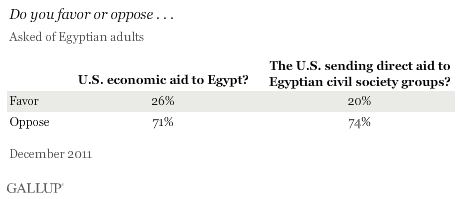
Egyptians Don't Want American Economic Aid

egytpaid.gif

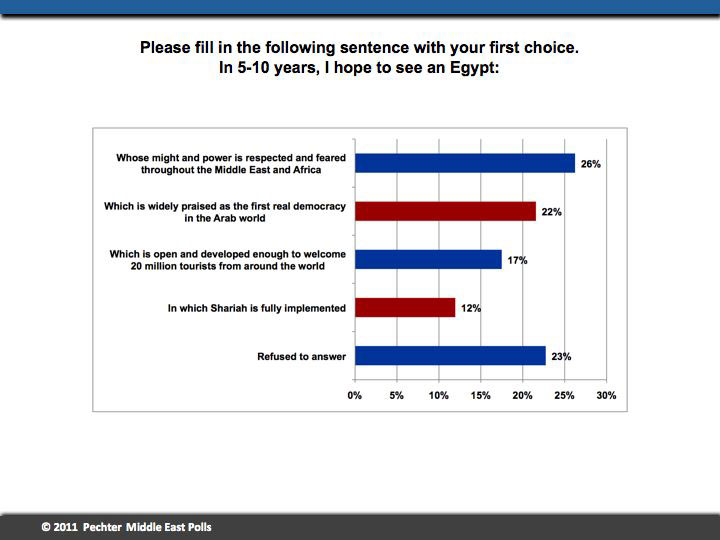
A new survey from Gallup shows that a broad majority of Egyptians do not want American economic aid.

If this NGO crisis continues they may get their wish.

January 5, 2012

The Coming Battle Over Egypt

As it becomes increasingly obvious that a democratic Egypt will mean an Islamist one, fissures are forming among neoconservative commentators about how to handle this. In one camp, we have those who are urging the Obama administration not to countenance an illiberal crackdown by Egypt's military (even advocating cutting off aid if the military does not allow democracy to progress). On the other hand, we hear voices urging the administration to back the military as it seeks to subvert Egypt's democracy and brutalizes its people - the better to keep the Islamists at bay.

What the Washington Post dubbed the "coming collision" between the Muslim Brotherhood and the Egyptian military will also highlight a debate in the U.S. about what its interests in Egypt actually are. For decades, the U.S. has viewed Egypt through the prism of the Cold War and Israeli security. Now that the Cold War is over and it doesn't matter whose "side" Egypt is on, sustaining the Camp David peace accords is the key "vital" interest the U.S. has in Egypt. In other words, U.S.-Egyptian relations are mediated mostly through Egyptian-Israeli relations.

If this remains the case, the Obama administration will either have to convince the Muslim Brotherhood that keeping the peace is in its own best interests (which it is likely already doing), or it will have to hold its tongue as the military subverts efforts at creating a true civilian democracy. It will be a challenge, to say the least, since the Brotherhood is already disavowing Camp David and even with U.S. support, the Egyptian military may not be able to hold the line. And even if the generals do succeed in subverting true civilian rule, the U.S. will then face the ire of the Egyptian people for being complicit in the Army's continued stranglehold on political life.

Good times ahead.

December 22, 2011

Maintaining Leverage Over Egypt

Andrew Exum argues that American leverage in the Middle East shouldn't be traded away so lightly:

The principle problem is one that has been in my head watching more violent crackdowns in Bahrain and Egypt: the very source of U.S. leverage against the regimes in Bahrain and Egypt is that which links the United States to the abuses of the regime in the first place. So if you want to take a "moral" stand against the abuses of the regime in Bahrain and remove the Fifth Fleet, congratulations! You can feel good about yourself for about 24 hours -- or until the time you realize that you have just lost the ability to schedule a same-day meeting with the Crown Prince to press him on the behavior of Bahrain's security forces. Your leverage, such as it was, has just evaporated. The same is true in Egypt. It would feel good, amidst these violent clashes between the Army and protesters, to cut aid to the Egyptian Army. But in doing so, you also reduce your own leverage over the behavior of the Army itself.

But all of this begs an important question - leverage for what? The idea is that the U.S. invests in places like Bahrain and Egypt because it needs or wants something in return. During the Cold War, it was keeping these states out of the Soviet orbit. In the 1990s and beyond, it was ensuring these states remained friendly with Israel and accommodative to U.S. military power in the region. Today, what? What is it that U.S. policy requires from Egypt and Bahrain that necessitates supporting these regimes during these brutal crack downs?

November 28, 2011

Egypt, Israel and U.S. Interests

Ever since tens of thousands of protesters converged on Tahrir Square in Cairo for the first Day of Revolution exactly 10 months ago, the Obama administration has struggled to strike the right balance between democracy and stability. In the early morning hours on Friday, President Obama came out on the side of the Arab street, issuing a call for the Egyptian military to quickly hand over power to a civilian, democratically elected government.

In so doing, the president opened up a litany of risks, exposing a fault line between the United States and the Egyptian military which, perhaps more than any other entity in the region, has for 30 years served as the bulwark protecting a critical American concern in the Middle East: the 1979 Camp David peace treaty between Egypt and Israel. - Helene Cooper

Ultimately, it's hard to see what choice the administration had. At the end of the day, it's not like the U.S. could hold back a democratic tide in Egypt if it wanted to, and why should Washington align itself with a military junta when it doesn't have to? To the extent any new civilian (or Islamist) regime in Egypt wants to abrogate its peace treaty with Israel, it will pay a lot higher price than the $1.5 billion in U.S. aid.

November 22, 2011

How Would the GOP Handle Egypt?

egyptround2.jpg

The escalating protests in Egypt have underscored the extent to which the removal of Hosni Mubarak - historic though it was - was a far cry from instituting a truly democratic government under civilian control. Egypt's military rulers appear to be back-peddling but it's unclear just how far they're willing to go to meet protester demands for full civilian control of the government.

All of this puts Washington in something of a bind. On the one hand, there remains a fear of what a truly democratic Egypt will produce (i.e. the empowerment of the Muslim Brotherhood). On the other, there are concerns that backing the military's attempt to crush democratic reforms will only fuel a dangerous long-term resentment among Egyptians.

The Obama administration hasn't really broken clearly in either direction, but it seems like there are three broad choices: 1. continue to send American tax dollars to Egypt's military, even (or perhaps, especially) if they maintain their grip over Egypt's political and economic institutions - the better to keep the Muslim Brotherhood out; 2. refuse to send American tax dollars to Egypt's military rulers until they release their grip on those institutions; 3. refuse to send American tax dollars to Egypt irrespective of what they do.

Tonight the GOP nominees are holding a debate on U.S. foreign policy and it will be interesting to see what position, if any, they'd endorse. I think you'd get a hardy endorsement of number three from Ron Paul but it's not clear to me how the others would break on the question. (And a shameless in-house plug, we'll be hosting a live blog tonight for the GOP debate with a number of foreign policy analysts and journalists. You can tune in here at 8pm EST.)

(AP Photo)

October 12, 2011

Israel Apologizes

Don't tell Mitt Romney:

Israel is to apologise to Cairo over the deaths of six Egyptian policeman, according to an announcement which coincided with news of an Egyptian-brokered deal for the release of Gilad Shalit.

The apology was expected to be formally extended on Wednesday.


Will the appeasement never cease?

September 27, 2011

Report: 100,000 Christians Left Egypt Since March

According to a new report from the Egyptian Union of Human Rights Organizations, nearly 100,000 Christians have emigrated from Egypt since March 2011:

The report, which was sent to the Egyptian cabinet and the Supreme Council of the Armed Forces (SCAF), warned that this emigration has been prompted by the escalating intimidation and attacks on Christians by Islamists.

"Copts are not emigrating abroad voluntarily," said Naguib Gabriell, the director EUHRO, "they are coerced into that by threats and intimidation of hard line Salafists, and the lack of protection they are getting from the Egyptian regime."

September 26, 2011

Religion in Egypt

A new survey takes the pulse:

A survey by the cabinet’s Information and Decision Support Center, published on Sunday, revealed that 58 percent of the sample said they would not vote for a president of a different religion than their own, while 36 percent said they would.

But the survey said that 60 percent said they would consider voting for candidates of a different religion in parliamentary elections, and 37 percent saying they would not.

It also said that 73 percent of Egyptians, Muslims and Christians, are religious and pray regularly.

August 22, 2011

The Middle East, Democracy and Israel

israel%20egypt.jpg

James Traub defends his enthusiasm for the Arab Spring against the pessimists:

There are, I suppose, two reasons to dump cold water on the Arab Spring. The first is that you think the enthusiasm is overblown, and you enjoying taunting the romantic spirit that sees reflections of America and its democratic values in every popular uprising across the globe. Go ahead and jeer; I would only note that even the grumpy and skeptical John Quincy Adams, who famously abjured crusades to destroy foreign "monsters," added that the American people are "well-wishers" to those everywhere who seek freedom.

The second reason is that you believe that while it may be good for them, it's bad for us. But in the long term, that cannot be so. Illegitimate government in the Arab world has been a disaster for the neighborhood, and for the world. Legitimate government provides the only narrative powerful enough to prevail over the appeal of extremism. We have every reason to be well-wishers.

The trouble with this formula is that, from Washington's perspective, the "us" is not simply the United States but Israel as well. After all, a key American interest in the Middle East has been creating a benign security environment for the state of Israel. Reconciling that interest with an interest in the flourishing of Middle East democracy is going to be difficult indeed. Take the recent news from the Egypt-Israeli border:

"Egyptian blood is not cheap and the government will not accept that Egyptian blood gets shed for nothing," state news agency MENA quoted a cabinet statement as saying.

Egypt's Information Minister Osama Heikal told state TV: "The assurance that Egypt is committed to the peace treaty with Israel ... should be reciprocated by an equivalent commitment and an adjustment of Israeli statements and behavior regarding various issues between both countries."

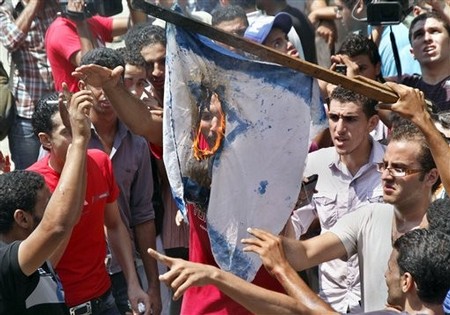
As crowds of Egyptians protested angrily at the Israeli embassy in Cairo through Saturday night, burning Israeli flags in scenes that would never be allowed during the Mubarak era, both countries were trying to defuse the diplomatic crisis.

But restraint was in short supply among the contenders to become Egypt's future leader in elections due by year-end.

"Israel must realize that the day when Egypt's sons are killed without an appropriate and strong reaction are over," wrote presidential hopeful Amr Moussa -- former secretary-general of the Arab League -- on his website.

Another contender for the leadership, Hamdeen Sabahy, hailed a protester who scrambled atop the Israel embassy in Cairo in the early hours of Saturday to remove and burn the Israeli flag as a "public hero."

The Obama administration is obviously going to work hard to paper over this immediate dispute and wield whatever leverage it has left in Egypt to kept the country at peace with Israel. It's also clear that, at least initially, the goal will be for the U.S. to have its cake (a secure Israel) and eat it too (a democratizing Middle East). But what if those two goals become, at least for a time, mutually exclusive?

(AP Photo)

August 2, 2011

The Middle East's Silent Majority

egypt%20silent.jpg

The Wall Street Journal reports on the latest twist in the Egyptian revolution:

Six months after young, liberal activists helped lead the popular movement that ousted President Hosni Mubarak, the hard core of these protesters was forcibly dispersed by the troops. Some Egyptians lined the street to applaud the army. Others ganged up on the activists as they retreated from the square that has come to symbolize the Arab Spring.

Squeezed between an assertive military and the country's resurgent Islamist movement, many Internet-savvy, pro-democracy activists are finding it increasingly hard to remain relevant in a post-revolutionary Egypt that is struggling to overcome an economic crisis and restore law and order.

"The liberal and leftist groups that were at the forefront of the revolution have lost touch with the Egyptian people," says Shadi Hamid, director of research at the Brookings Institution's Doha Center. "These protesters have alienated much of Egypt. For some time they've been deceiving themselves by saying that the silent majority is on their side—but all evidence points to the contrary, and Monday's events confirm that."

Now, if Ambassador Hill and Fouad Ajami are to be believed, President Obama could rectify this by giving better speeches and being more "supportive" of liberal elements in the region.

(AP Photo)

July 28, 2011

Ajami and Hill on the Arab Spring

Peter Robinson's interview with Charles Hill and Fouad Ajami on the latest edition of Uncommon Knowledge is worth your viewing for a number of reasons, but particularly for a line of argument on the Arab Spring interesting, particularly around the 5 minute mark:

Robinson: But what happens next?

Hill: It's going to hell. Because primarily, frankly, the United States has stepped back from its support of freedom and democracy... The speech of the president on the Arab Spring, that climaxed with the question of the Israeli-Palestinian situation, it turned the whole narrative back to 1975 when there's a new narrative that didn't say "Death to America" or "All that matters is the Palestinians", it was an entirely new freedom agenda that we have just stepped away from.

Hill's focus leads to a comment by Robinson on a missed opportunity for a genuine reset of relations with the Arab world. This is intriguing, and it will almost certainly be included in any general election campaign from the right as a criticism of Obama's response to the Arab Spring and the campaign in Libya. Whether it has any sticking power will likely depend on the continuation of world events in Egypt and the political success of the Muslim Brotherhood there.

June 6, 2011

Polling Egypt's Revolution

The International Republican Institute has conducted some fresh polling in Egypt. The Washington Post got a sneak peak:

A majority of Egyptians who supported this year’s revolution did so mainly because of their poor economic situation, not because they yearned for democracy, according to a U.S. government-funded poll released Sunday.

The survey also underlines Egyptians’ sky-high expectations for their next government. Eight in 10 respondents said they anticipated their economic situation would be better in the coming year. That presents a daunting challenge for whomever takes office, with a recent drop in tourism and foreign investment exacerbating the country’s already severe economic problems....

Only 15 percent said they support the Muslim Brotherhood, which favors a government guided by Islamic sharia law. Less than 1 percent of respondents favor an Iran-style Islamic theocracy.

And only 15 percent said their political opinions were strongly influenced by religious figures, with many more citing family members and military leaders....

The poll found that two-thirds of respondents wanted Egypt to be closer to the United States than to Iran. But that result does not reflect the ambiguity many Egyptians feel about the U.S. government, which was a strong backer of Mubarak.


March 15, 2011

Meanwhile, in Egypt

J. Scott Carpenter and Dina Guirguis report on Egypt's constitutional developments:

A principal cause for concern in Egypt is the hastily organized constitutional referendum scheduled for March 19 -- a little more than a month after Mubarak's departure and just four days following Secretary Clinton's arrival. In the referendum, the process behind which is largely unknown, Egyptians will vote on whether to amend Egypt's current constitution to create a framework under which parliamentary and presidential elections can be held in June and August, respectively.

The proposed constitutional amendments putatively address the most troublesome articles of the current (suspended) constitution by instituting presidential term limits and restoring full judicial supervision over elections. Despite these seemingly responsive amendments, Egyptians have voiced increasing concerns over both their substance and the process that has led to the referendum. Worries also center on the amendments' endorsement of the SMC's overall electoral timetable and transition plan -- and the implications of this endorsement.

The amendments themselves were drafted over a two-week period, in near secrecy, by a ten-person, all-male committee chosen opaquely by the SMC. Two members, including the committee chair, have Islamist orientations. The amendments essentially leave intact the presidential system and various articles that permit expanded executive power. Furthermore, they ban from the presidential contest any person holding dual nationality or whose spouse is non-Egyptian, a ban that would preclude well-respected public figures such as Egyptian-American Nobel laureate Ahmed Zuweil from the race.

The amendments presume the election of the parliament before the president by requiring that the president be sworn in by the nation's legislative bodies. With the exception of the Muslim Brotherhood (MB), Egyptian opposition and civil society groups are largely opposing the amendments and the time line because they do not result from a participatory, inclusive, and genuine dialogue with the Egyptian people.

Along with favoring the MB -- which, though lacking majority support, is organized and relatively disciplined -- the accelerated time line is believed by other opposition figures to boost former regime elements, which remain entrenched in local governments and could easily reconstitute either under the same or an alternative party banner.

The question becomes whether Egypt's military is deliberately engineering this transition so as to empower the Brotherhood - the better to spook the West.

March 7, 2011

Myths and the Muslim Brotherhood

rsz_egypt030711.jpg

With the first of Rep. Peter King's (R-NY) hearings on the radicalization of Islam scheduled to occur this week, on Sunday Lorenzo Vidino of the Rand Corporation took to the pages of the Washington Post to detail what he tabs as "five myths about the Muslim Brotherhood." Yet in reading the piece, it's hard to imagine this was the title Vidino chose - each "myth" is more of a "yes, but" contextual clarification; far short of factual inaccuracy.

Is it fair to say that the Brotherhood is a global organization? That just depends on what your definition of "organization" is - perhaps "alliance of like-minded collaborators who share money, information, and resources across more than eighty nation-states" is not your definition of a "global organization." How close and how recent do ties to al-Qaeda have to be to raise concerns? Portions like "This is not far-fetched, yet ..." and "Historically, yes. But ..." are a good sign that it's simply unfair to call items such as "The Brotherhood seeks to impose a draconian version of sharia law" myths - in Egypt, at least, that is simply a fact.

One myth which I'd suggest Vidino's piece persists in deploying is a typical view of the generational divide between old and new guard on questions of radical Islam. In reality, the differences are more complex, and the young voices for radicalism are often the most violent - a piece about Alexandria in the 1960s in this weekend's Wall Street Journal drives the point home:

Colette Frege Haggar remembers how, in the 1960s, she would slip on a bikini and walk down Alexandria's streets to join the other bikini-clad women at her local beach.

Now, women in this Egyptian city almost universally wear head coverings - and increasingly, Ms. Frege and others say, they wear niqabs, the black shroud-like garments with slits for the eyes. If women go to a public beach, they usually do so in head-to-toe dress.

Ms. Frege, a 56-year-old Catholic of Lebanese-Italian descent, has watched her city morph from the Middle East's most cosmopolitan city to one of its Islamist strongholds. The question is what comes next: a return to the more liberal polity of her youth or a fundamentalist entrenchment.

Continue reading "Myths and the Muslim Brotherhood" »

February 28, 2011

Which Democrats?

Niall Ferguson follows up on an earlier critique of President Obama's handling of the Middle East with his advice:

The correct strategy—which, incidentally, John McCain would have actively pursued had he been elected in 2008—was twofold. First, we should have tried to repeat the successes of the pre-1989 period, when we practiced what we preached in Central and Eastern Europe by actively supporting those individuals and movements who aspired to replace the communist puppet regimes with democracies.

Western support for the likes of Charter 77 in Czechoslovakia and Solidarity in Poland was real. And it was one of the reasons that, when the crisis of the Soviet empire came in 1989, there were genuine democrats ready and waiting to step into the vacuums created by Mikhail Gorbachev’s “Sinatra Doctrine” (whereby each Warsaw Pact country was allowed to do things “its way”).

No such effort has been made in the Arab world. On the contrary, efforts in that direction have been scaled down. The result is that we have absolutely no idea who is going to fill today’s vacuums of power. Only the hopelessly naive imagine that 30-something Google executives will emerge as the new leaders of the Arab world, aided by their social network of Facebook friends. The far more likely outcome—as in past revolutions—is that power will pass to the best organized, most radical, and most ruthless elements in the revolution, which in this case means Islamists like the Muslim Brotherhood.

The basic question here is how we know who the right local proxies are. If the 30-something Google executives don't cut it, who, exactly, would John McCain court? The Egyptian Ahmed Chalabi? And as John McCain is honing this well oiled machine of pro-Western, pro-Israel liberal democrats waiting in the wings, are the region's intelligence services providing us with more or less covert assistance?

Many commentators seem to be infatuated with the Cold War example of American aid to dissidents in Eastern Europe. But this seems completely inappropriate. During the Cold War, it's true, the U.S. supported Eastern European dissidents - but not their oppressors. In the Mideast, the U.S. has a long and very well document history of supporting the oppressors and offering half-hearted, on-again, off-again support for reforms.

I'm pretty confident that had John McCain been elected, he would not have radically overhauled America's alliance structure in the Middle East. But that's what you would have to do to repeat the success of the "pre-1989" policy.

Update: Larison has more:

If “the best organized, most radical, and most ruthless elements” will be able to exploit the situation in Egypt now, they would have been able to do so even if the U.S. had followed all of the democracy promotion advocates’ advice. Nostalgia for Cold War successes is badly misleading. Western support for eastern European dissidents was all very well, but it wasn’t what made the revolutions in 1989 a success, and it wasn’t what led to the mostly peaceful transitions to democratic government in the years that followed. Westerners very much want to take credit for 1989 and afterwards (we “won” the Cold War, after all), but the reality is that this was something that the peoples of eastern Europe and the former Soviet Union accomplished almost entirely on their own.

February 17, 2011

Sanctions and Wrong Lessons

rsz_iran021711.jpg

Benjamin Weinthal of the Foundation for Defense of Democracies writes:

Plainly said, the European Union ought to follow Washington's lead and place Iran's Revolutionary Guard Corps on the EU terror list. The guard corps helped crush Monday's demonstrations and controls Iran's military-industrial complex.

European partners like Germany must fall into line with U.S. sanction efforts and shut down Iran's main financial conduit in Europe - the Hamburg-based European-Iranian Trade Bank. A group of leading U.S. senators, including Joseph Lieberman (I-Conn.), Kirsten Gillibrand (D-N.Y.) and Frank Lautenberg (D-N.J.), issued a strongly worded letter in early February to German Foreign Minister Guido Westerwelle about Germany's ongoing failure to end the bank's worst practices, if not close it entirely.

In 2009, the Iranian people launched protests that shook the entire Islamic world, creating the first cracks in the dam that ultimately burst with the fall of Egyptian President Hosni Mubarak. Iranian democrats asked during the 2009 protests: "Obama: Are you with us or against us?"

I think, in his rush to link the two uprisings, Weinthal overlooks one key element of the Egyptian revolution: leverage.

What made the Egyptian revolution a success wasn't a speech, nor was it a summit in Washington. Egyptians succeeded where Iranians failed because the latter nation's military operates as a globally ostracized crime syndicate, whereas the former functions more like a beloved Fortune 500 company. Moreover, Egypt's military apparatus stood down, while Iran's opened fire.

American influence obviously shouldn't receive all of the credit for this, but it clearly factored into the Egyptian military's decision to comply with U.S. desires for a peaceful transition sans Mubarak.

This calls into question the efficacy of the Iran sanctions regime altogether. I'm not a fan of counterfactuals, but would the 2009 unrest in Iran have gone any differently had the U.S. more aggressively engaged Tehran in say 2001 or 2003? We'll obviously never know, but it's a question sanctions advocates (like yours truly) should probably take into consideration.

(AP Photo)

U.S. Sees Mubarak Ouster as Positive

mubarak%20zogby.jpg

According to a new poll from Zogby:

U.S. likely voters are more likely to say the ouster of Egyptian President Hosni Mubarak was positive rather than negative for the U.S., but 68% are either very or somewhat concerned that Islamic fundamentalists will have too much power in the new government.

The Feb. 14-16 Zogby Interactive poll also finds that 45% believe President Barack Obama's response to the situation in Egypt was "what it should have been." However, 21% say Obama should have been more supportive of "our ally" Mubarak and 15% say Obama should have been more supportive of the protestors.

Close to 50 percent of Americans thought Mubarak's ouster was a negative development for Israel vs. 28 percent who thought it was positive and 23 percent who weren't sure.

(AP Photo)

February 15, 2011

Doing bin Laden's Work?

egypt%20people.jpg

Michael Scheuer isn't enthused about the overthrow of Mubarak:

Bin Laden, his lieutenants, and their allies know that after the Western media returns to what it does best -- isn’t Lindsey Lohan due in court? -- Muslim Egyptians will be reaching for Allah’s rope, not Facebook’s self-deification. And the Islamists also will know the stout wall of U.S.-and-Israeli-supported Arab tyranny they have long attacked is cracking.

When the West sees pious Egyptians moving toward Islam, not secular democracy, bin Laden will have thanked God for His gifts to the mujahedin. Having designated Arab police states and Israel as Islam’s main enemies -- brain-dead America simply being in the way due to its money and guns -- bin Laden et. al. now see the ruins of the strongest Arab tyranny, as well as the most loyal, least demanding ally secured by Washington‘s relentless intervention in the Muslim world. They know whatever regime follows Mubarak will be weaker, more influenced by those demanding a form of Sharia law -- including General Clapper’s Kiwanis-in-waiting, the Muslim Brotherhood -- and, being a democracy, more representative of Egyptians’ deep, abiding hatred for Israel.

I think it's true that in the near-term, the goals of U.S. democracy promoters and bin Laden have overlapped. Both want the old Middle Eastern order swept away. Scheuer seems to think that in doing so, more of the Middle East will move in bin Laden's direction, but is that true? A Middle East that's less receptive to the U.S. and Israel is still a far cry from a Middle East that wages open war against the U.S. and Israel (which is presumably the bin Laden program).

The old order is what created bin Laden's jihad in the first place. If the Obama administration cheered on a Mubarak crack down, wouldn't that do wonders for al-Qaeda recruitment?

(AP Photo)

February 14, 2011

Voters Somewhat More Upbeat on Egypt

According to Rasmussen:

The latest Rasmussen Reports national telephone survey conducted the two nights following Mubarak’s announcement shows that 29% of Likely Voters believe the change in the government of Egypt will be good for the United States, up eight points from a week ago. (To see survey question wording, click here.) Two weeks ago, just five percent (5%) of all Adults thought it would be good for the United States if the government in Egypt was overthrown.

Twenty percent (20%) now say the change will have a negative impact on the United States, while another 16% say it will have no impact. But 35% aren’t sure what kind of impact, if any, the Egyptian change in government will have on the U.S.

Fifty-four percent (54%) of voters believe it is at least somewhat likely that Egypt will become a free, democratic and peaceful nation over the next few years. Thirty-one percent (31%) do not see this outcome as likely, while 15% are not sure. Those results include 16% who say it is Very Likely Egypt will reach this goal and eight percent (8%) who say that’s Not At All Likely to happen.

How's Obama Handling Egypt?

obama%20eygpt.jpg

Some recent polls on the president's handling of Egypt show the public mostly approves of how the administration has conducted itself. A Fox News poll showed 48 percent approval vs. 32 percent disapproval; Gallup had a 47 percent approval to 32 percent disapproval; Pew Research found that 57 percent of respondents said the administration was handling the protests "about right."

(AP Photo)

Did Obama Botch Egypt?

obama%20happy.jpg

Niall Ferguson isn't impressed with President Obama's handling of Egypt:

The president has alienated everybody: not only Mubarak’s cronies in the military, but also the youthful crowds in the streets of Cairo. Whoever ultimately wins, Obama loses. And the alienation doesn’t end there. America’s two closest friends in the region—Israel and Saudi Arabia—are both disgusted. The Saudis, who dread all manifestations of revolution, are appalled at Washington’s failure to resolutely prop up Mubarak. The Israelis, meanwhile, are dismayed by the administration’s apparent cluelessness.

Last week, while other commentators ran around Cairo’s Tahrir Square, hyperventilating about what they saw as an Arab 1989, I flew to Tel Aviv for the annual Herzliya security conference. The consensus among the assembled experts on the Middle East? A colossal failure of American foreign policy.

I'm not clear why Ferguson is citing Saudi Arabia and Israel here. Ferguson insists in the piece that Obama should have jumped into the Egyptian revolt on the side of the protesters and the democratic wave - which is the antithesis of what both the Israelis and the Saudis wanted.

I do agree with Ferguson that no matter who "wins" in Egypt, Obama is the ultimate "loser" since the basic presumption appears to be that the president of the United States is omniscient and omnipotent - and that any outcome in another country that fails to satisfy our desires is naturally his fault.

(AP Photo)

February 11, 2011

Wasted Youth

egypt%20protests.jpg

According to Gallup, young people in several Arab countries feel their leadership is not taking advantage of the country's human capital. During the 2010 survey, Gallup found that Egypt's youth experienced the largest declines:

Fewer than 3 in 10 15- to 29-year-olds say Egypt's leadership maximizes youth potential, down from almost 4 in 10 in 2009.
Other countries notching declines: Jordan, Sudan and Iraq.

(AP Photo)

February 10, 2011

The Secular Muslim Brotherhood?

Thursday was not a particularly good one for James Clapper, U.S. Director of National Intelligence. Speaking to a House Intelligence Committee hearing, he weighed in on his thoughts on Egypt’s Muslim Brotherhood, describing it as a "largely secular" organization.

Even with a near-immediate clarification release from his office, Clapper's statement prompted derision of both the restrained and the angry variety. NBC's Richard Engel called it a "head snap" moment. Perhaps the mildest response I could find was Jake Tapper's comments on ABC News, stating simply: "The Muslim Brotherhood is quite obviously not a secular organization."

What we've learned over the past several months is that there is a sizable portion of people who would like to claim otherwise. Tom Joscelyn did a fairly thorough job of debunking Bruce Reidel's claims about the Brotherhood, and the Op-Ed from Brotherhood member Abdel Moneim Abou el-Fotouh on Wednesday has mostly fallen on deaf ears.

Continue reading "The Secular Muslim Brotherhood?" »

Poll Shows Low Support for Brotherhood

egypt%20polling%20wash%20inst.jpg


The Washington Institute has released a poll (pdf) it conducted of Egyptians during the uprising. Some key findings:

This is not an Islamic uprising. The Muslim Brotherhood is approved by just 15 percent of Egyptians -- and its leaders get barely 1 percent of the vote in a presidential straw poll. Asked to pick national priorities, only 12 percent of Egyptians choose sharia (Islamic law) over Egypt's regional leadership, democracy, or economic development. And, when asked to explain the uprising, the issues of economic conditions, corruption, and unemployment (around 30 percent each) far outpace the concern that "the regime is not Islamic enough" (only 7 percent).

Surprisingly, when asked two different ways about the peace treaty with Israel, more support it (37 percent) than oppose it (27 percent) -- although around a third say they "don't know" or refuse to answer this question. Only 18 percent of Egyptians approve either Hamas or Iran. And a mere 5 percent say the uprising occurred because their government is "too pro-Israel."...

As for Egyptian views of America, a narrow plurality (36 percent vs. 27 percent) say Egypt should have good relations with the United States. And only a small minority (8 percent) say the current uprising is against a "too pro-American" regime. Nevertheless, half or more of the Egyptian public disapprove of how Washington has handled this crisis so far, saying that they do not trust the United States at all.

While the poll gives us reason to believe that a lot of the fear about "Tehran on the Nile" is likely overheated, there are foreign policy responses that are less encouraging (from Washington and Israel's perspective). When asked about Egyptian foreign policy, 19 said their first choice would be to maintain Egypt's relationship with the U.S. and 'moderate states' while 18 percent said Egypt should tear up its treaty with Israel and join the 'resistance front.' A further 16 percent said Egypt should distance itself from the U.S. and follow an independent line like Turkey, while 15 percent said better relations should be restored with Syria and Iran to help contribute to resistance against imperialism and colonialism.

Obama's Global Zero (Not So Much)

According to proliferation expert Henry Sokolski, the Obama administration is seeking nuclear deals with Jordan and Saudi Arabia that would eschew needed safeguards:

What is truly flabbergasting, though, is the fact that the Obama administration seems willing to accede to both Jordan’s and Saudi Arabia’s demands. At almost exactly the same time Egyptian protestors were filing into Tahrir Square on January 25, a highly respected arms control news service reported that the U.S. government was discussing nuclear deals with Jordan and Saudi Arabia which would not include the “gold standard” safeguards that the Obama administration has demanded from other countries, such as the United Arab Emirates (UAE), to ensure that nuclear cooperation is less likely to enable nuclear proliferation. In specific, these deals lacked any requirement that Saudi Arabia or Jordan forswear making nuclear fuel or ratify a new, tougher nuclear inspections regime known as the IAEA Additional Protocol.
It's early still in the Egyptian crisis, but it's not hard to see how a democratic Egypt could potentially develop a weapon of its own on the usual grounds that it lives in a rough neighborhood with one nuclear state near its border and Iran on the cusp. As Sokolski notes, Cairo has already "made several haphazard attempts to get a bomb." Good times.

February 9, 2011

U.S. Views on Egypt

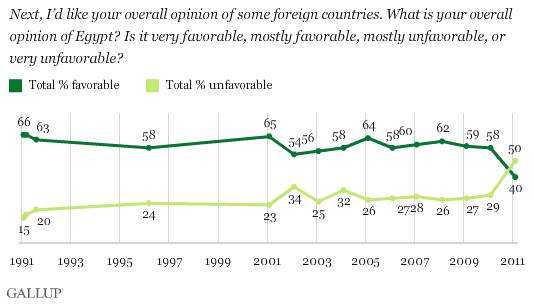
There have been several new polls gaging U.S. views on the unfolding unrest in Egypt. First, Gallup notes that more Americans now hold an unfavorable view of Egypt:

gallup%20egypt%20us%20views.gif

Meanwhile, Pew Research reported yesterday:

Americans do not have a clear point of view about how the massive anti-government protests in Egypt will affect the United States. More than half (58%) say the protests will not have much of an effect (36%), or offer no response or are noncommittal (22%). Of the minority that thinks the protests will have an effect on the U.S., nearly twice as many say their impact will be negative rather than positive (28% vs. 15%).

This lack of agreement notwithstanding, a majority (57%) says the Obama administration is handling the situation in Egypt about right, while much smaller numbers say the administration has shown too much support (12%) or too little support (12%) for the protestors.

Finally, Rasmussen Reports finds most Americans want to stay out of Egypt's affairs:

A new Rasmussen Reports national telephone survey shows that only 15% of Likely U.S. Voters believe the United States should get more directly involved in the Egyptian crisis. Sixty-eight percent (68%) say America should leave the situation alone. Seventeen percent (17%) are not sure which is the best course.

February 8, 2011

Obama's Egypt Policy

mubarak%20out.jpg

The New York Times writes about the Obama administration's strategy:

But, considering it lacks better options, the United States has strongly backed him [Omar Sulieman] to play the pivotal role in a still uncertain transition process in Egypt. In doing so, it is relying on the existing government to make changes that it has steadfastly resisted for years, and even now does not seem impatient to carry out.

It seems like the administration's gambit is to move as slow as possible while still pushing for some reform. Some observers, like Max Bergmann, are less patient:

The problem for the United States is that the regime’s survival in Egypt would reinforce the central gist of Al Qaeda’s central claim against the West: that change is impossible in the Middle East because the United States will prevent it. Therefore, Al Qaeda insists that to create change in the region they must strike first at the US and the West to get them to stop interfering in the Middle East. In other words, if we are seen as culpable in killing the protests, we are playing directly into Al Qaeda’s narrative.

Maybe the negative blowback of the regime’s survival will be minimal, but it seems foolish to assume that the current unstable status quo, will be less destabilizing than a prompt transition to “real democracy.”

I actually think it's quite possible that a "prompt" transition to real democracy would be considerably more destabilizing than the status quo, if the institutions that support democracy can't handle the rapid transition. I think Bergmann is right to warn of the consequences of standing by the Egyptian regime as it comes out on top of the protesters, which is why over the medium term, the U.S. should be rethinking the gobs of taxpayer dollars it showers on Egypt in the name of keeping a peace which is in Egypt's best interest to keep anyway.

(AP Photo)

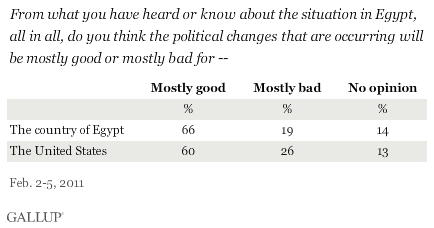
U.S. Optimistic About Egypt Protests

ht4qjeaaxueku6mbjtu5uw.gif

Americans have a mostly positive outlook about the prospects for change in Egypt, according to a new survey from Gallup.

In addition, an overwhelming majority of respondents (82 percent) said they were sympathetic to the protesters vs. 11 which said they were unsympathetic.

February 7, 2011

War Gaming Outcomes in Egypt

mubarak%20kick.jpg

Braver, and wiser, people than yours truly have been making predictions about how things will shake out in Egypt. Thomas Barnett & WikiStrat have been war-gaming the outcome in Egypt. Barnett seems pretty optimistic about how it will all shake out:

My hopes for Egypt are that, by 2020-2022, we're looking at a Turkey-like player with a broad and relatively happy middle class. It's got a military that's respected and still a very solid friend of the US and the US's friends in the region. It is Islamist in flavor, because that's the people's heritage and it must be respected, just like a Christian-Judeo one is in the US. But it's not unduly dominant or nasty to other faiths, because that's bad for globalization and business. It becomes a conduit for the Horn and North Africa and the PG - connecting in all directions.

And sooner than you think, it becomes the justification for similarly successful unrest elsewhere.

(AP Photo)

February 2, 2011

U.S. Views on Obama's Egypt Policy

Not too bad, according to Rasmussen:


A new Rasmussen Reports national telephone survey finds that 41% of Likely U.S. Voters rate the way the Obama administration has responded to the situation in Egypt as good or excellent. Twenty-two percent (22%) view the administration’s response so far as poor. ...

Most Americans expect the unrest in Egypt to spread to other Middle Eastern countries and think that will be bad for the United States. But a sizable majority also believe the United States should stay out of Egypt’s current problems.

Polling Egypt

vx6i9ez4nuocpmm6i4qcbg.gif

Gallup offers up some of their research findings on Egypt and the Middle East:

Egyptians' approval of U.S. leadership fell 18 percentage points from 2009 to 2010, more than in other countries in the Middle East and North Africa.

Gallup's global employment tracking finds 21% of residents of the Middle East and North Africa were underemployed from 2009-2010 and 10% were unemployed.

They also tracked wellbeing in Tunisia and Egypt:


Wellbeing in Egypt and Tunisia decreased significantly over the past few years, even as GDP increased. In Egypt, where demonstrations have prompted President Hosni Mubarak to give up power after elections this fall, the percentage of people "thriving" fell by 18 percentage points since 2005. In Tunisia, where mass protests toppled the country's government last month, the percentage of people Gallup classifies as thriving fell 10 points since 2008.

February 1, 2011

Security Trade Offs

egypt%20trade%20off.jpg

One of the uncomfortable questions being raised by the protests in Egypt is to what degree U.S. and Israeli interests justify consigning 80 million Egyptians to tyrannical rule. The basic "pro-Mubarak" argument articulated by Barry Rubin and Caroline Glick is that Israel's security (and America's interest in said security) are ample justification to get behind Mubarak or a fellow strongman. The writhing mass of "rioters" (in Glick's formulation) cannot be trusted to govern themselves because they endorse, or will fall prey to, totalitarian Islam.

And they might be right! After all, revolutions often lead to worse outcomes for both their population and the world at large.

America has every right (indeed, an obligation) to privilege her interests above the well-being of people in other states when common ground can't be reached, but to the extent that defending interests entails actively aiding the repression of an entire people, that should give us pause, particularly because we're simultaneously trying to squelch a global terrorist insurgency that feeds off of just such repression.

(AP Photo)

January 31, 2011

Egypt and the Muslim Brotherhood

rsz_muslim_brothers.jpg

Earlier this month I wrote about the Muslim Brotherhood and the challenges they present within Egypt. I asked a few questions of Shadi Hamid, director of research at The Brookings Institution's Doha Center, and he had this to say at the time:

"In recent years, the Egyptian regime has adopted a new, troubling character, moving from autocracy with a liberal veneer to full-blown autocracy. The most recent elections suggest the regime no longer has much interest in pretending," Hamid told me. "In the 2005 elections, the Brotherhood won 20 percent of the seats in what seemed a victory for Egyptian Islamism. Since then, the Brotherhood has experienced the worst period of anti-Islamist repression since the 1960s. This coincides with the rise of a new faction of neo-liberal, Western-educated technocrats in the ruling party, who, somewhat ironically, seem to have less tolerance for opposition than the regime's 'old guard.'"

Hamid maintains that the Brotherhood and other Islamist groups are in a state of increasing crisis in response to this repression.

"The Brotherhood has struggled to respond to the regime repression and failed to articulate a clear vision for change," Hamid told me. "The 2010 elections - quite possibly the most rigged in Egyptian history -- further showed a movement hedging its bets, unsure of where to go and how to get there. Their half-hearted participation -- they only ran about 130 candidates out of a possible 518 -- came after difficult internal debates over whether and how to participate in elections that they knew would be worse than anything in recent memory."

My own opinion after speaking to many experts is that the Brotherhood is an area of some concern, yes, but it's difficult to judge their real power or impact - and even with that being the case, the concerns are not so great as to be worth shoring up corrupt autocracies on their last legs.

A few weeks later, the answers to these questions of course carry far more weigh. Even as some now claim that the Brotherhood is nothing to worry about, there remains significant concerns about how much of a role they would play in any new Egyptian government. Hamid has now called the Obama administration's initial response to the Egyptian revolt "disappointing, but not surprising." That's certainly my reaction to today's uncomfortable Q&A at the White House, courtesy of ABC News' Jake Tapper, in the wake of Mohammed ElBaradei's defense of the Brotherhood:

TAPPER: ElBaradei told ABC News this weekend that the Muslim Brotherhood is no more extremist -- is not an extremist organization and is no different from Orthodox Jews in Israel or evangelical Christians in the United States. Does the Obama administration agree with that?

GIBBS: Well, let me -- without getting into a discussion about them, I think there are certain standards that we believe everybody should adhere to as being part of this process; one that is, to participate in this ongoing democratic process, one has to take part in it but not use it as a way of simply becoming -- simply becoming or taking over that process simply to put themselves in power. We believe that any group should strongly weigh in on the side of nonviolence and adherence to the law.

Meanwhile, a leader in the Muslim Brotherhood has apparently called for a war on Israel. I would expect a followup or two, Mr. Gibbs.

(AP Photo)

January 30, 2011

Elliott Abrams on Egypt and Class Revolution

I had the opportunity to interview Elliott Abrams this morning on the situation in Egypt. His take on this subject is fascinating to me for a number of reasons, particularly because of his outspoken defense of George W. Bush's approach to Middle East policy. On Egypt, he raised several points of note in the interview, including this one about the nature of class and revolution:

If you look at Egypt over the past ten years, there's been a tremendous amount of foreign investment, and the Egyptian stock market has been fabulous -- you would've been a lot better investing in it than in the New York Stock Exchange or the London Stock Exchange. But there's no trickle down -- the rich get richer. If you look at the Forbes list of billionaires, you'll see a number of Egyptians on it now. The rich in Egypt are very rich indeed -- their own planes, their own yachts, so there's a lot of money floating around -- but it's floating around at the top levels. The Egyptian office worker, the Egyptian farmer is still exceptionally poor. And what this has done is create a sense, in Tunisia and in much of Egypt, a sense that everything is being stolen, that there's nothing here for the common man, it's just all for the rich.

And that is exacerbated by a second thing: there's a ruling system here, there's a ruling party -- the National Democratic Party and the security forces -- and if you're plugged into those, you have ways of beating the system. If you're not plugged in -- if you don't have people who can look out for you inside the system, officials of the party -- then you're not going to see any money, you just work and work and work and get nothing for it.

You were born in a social and economic class. You die there. Your children will die there, too. There's no social mobility.

The podcast is here. I hope you'll listen to the whole thing.

Egypt and the Clash of Time Horizons

mubarak.jpg

Watching events unfold in Egypt, it seems the Obama administration is in much the same pickle that has bedeviled America's Middle East and counterterrorism policy since 9/11 - moves to improve American security in the short-run can potentially harm the U.S. position over the longer run.

In the long run, almost everyone agrees that America would be better served dealing with a government in Egypt with real democratic legitimacy. But to get there, the U.S. may well have to deal with an Egypt that turns against U.S. priorities and interests (and that's assuming the country can more or less peacefully transition to another government and not collapse into chaos). See Leslie Gelb's warning on the issue:

The other "devil," now being proclaimed as misunderstood Islamic democrats, is the Muslim Brotherhood, and they should give us great pause. Baloney and wishful thinking aside, the MB would be calamitous for U.S. security. What's more, their current defenders don't really argue that point, as much as they seem to dismiss it as not important or something we can live with. The MB supports Hamas and other terrorist groups, makes friendly noises to Iranian dictators and torturers, would be uncertain landlords of the critical Suez Canal, and opposes the Egyptian-Israeli agreement of 1979, widely regarded as the foundation of peace in the Mideast. Above all, the MB would endanger counterterrorism efforts in the region and worldwide. That is a very big deal.

The counter-argument is that standing behind Mubarak if he uses violence to crush the protesters isn't going to help America either, because it will create even more disaffection with the U.S. in the Mideast and ensure that when Mubarak does fall (or die), the leaders that take over will have even greater animosity toward the U.S. than they do now.

(AP Photo)

January 28, 2011

Biden Makes Up America's Mind?

Regarding my post from yesterday, based upon Joe Biden's conversation with Jim Lehrer, I would guess the administration has decided that it is better to support Mubarak than hope for a positive change in Egypt:

My takeaway: The U.S. is going to at least pretend that Mubarak is a democratically elected leader; that it would oppose his violent overthrow; and while it does think people have a right to protest, they should just hope the protests induce the government to change. Given Biden's history of speaking out of turn, or misspeaking, this may not be the actual position of the U.S. government. If it is, however, this would be a good example of the common accusation that the U.S. (as well as other Western governments) talks the liberal talk, but won't walk the liberal walk when it conflicts with its power-based interests.