Main

February 7, 2012

India Riskier Than China?

Stephen Roach thinks so:

Yet fears of hard landings for both economies are overblown, especially regarding China. Yes, China is paying a price for aggressive economic stimulus undertaken in the depths of the subprime crisis. The banking system funded the bulk of the additional spending, and thus is exposed to any deterioration in credit quality that may have arisen from such efforts. There are also concerns about frothy property markets and mounting inflation.

While none of these problems should be minimized, they are unlikely to trigger a hard landing. Long fixated on stability, Chinese policymakers have been quick to take preemptive action....

India is more problematic. As the only economy in Asia with a current-account deficit, its external funding problems can hardly be taken lightly. Like China, India’s economic-growth momentum is ebbing. But unlike China, the downshift is more pronounced – GDP growth fell through the 7% threshold in the third calendar-year quarter of 2011, and annual industrial output actually fell by 5.1% in October.

But the real problem is that, in contrast to China, Indian authorities have far less policy leeway. For starters, the rupee is in near free-fall. That means that the Reserve Bank of India – which has hiked its benchmark policy rate 13 times since the start of 2010 to deal with a still-serious inflation problem – can ill afford to ease monetary policy. Moreover, an outsize consolidated government budget deficit of around 9% of GDP limits India’s fiscal-policy discretion.

January 24, 2012

IMF to World: Gird Your Loins

The International Monetary Fund is out with its latest forecast and it expects the global recovery to stall. The above video does a nice job summarizing the findings, but the nickle version is that it's all Europe's fault. A chart showing the the latest IMF projections for most of the world's advanced economies is below the jump.

Continue reading "IMF to World: Gird Your Loins" »

A World In Debt: Who's Paying It Off

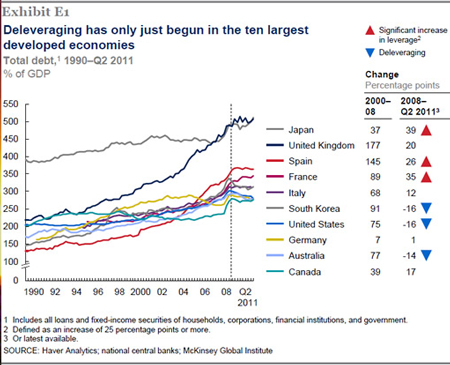
macdebt.jpg

Ever since the world ran face-first into the credit crisis, the phrase "de-leveraging" has been on a lot of people's lips. It's considered both a short-term curse (it reduces consumer and business demand) but the long-term cure (once our books our balanced we can head back to the mall).

A new study from McKinsey surveys a number of countries whacked by the financial crisis to see which consumers have done the best job paring back their debt loads. The answer, as you can see from the chart (click it for a larger image), is that the U.S. has done quite well in this regard but in other major economies, a lot of work still remains. There is some encouraging news, though, as McKinsey notes:

The deleveraging processes in Sweden and Finland in the 1990s offer relevant lessons today. Both endured credit bubbles and collapses, followed by recession, debt reduction, and eventually a return to robust economic growth. Their experiences and other historical examples show two distinct phases of deleveraging. In the first phase, lasting several years, households, corporations, and financial institutions reduce debt significantly. While this happens, economic growth is negative or minimal and government debt rises. In the second phase of deleveraging, GDP growth rebounds and then government debt is gradually reduced over many years.

McKinsey says the U.S. is "most closely following the Nordic path" which is comprised of six critical factors: a stable banking system, a credible plan for long-term fiscal sustainability, structural reforms already in place, rising exports, rising private investment, a stabilized housing market.

I'm not sure if the U.S. has yet reached a credible plan for long-term fiscal sustainability (just the opposite) but there it is.

[Hat tip: Drezner]

January 16, 2012

Who's Winning in the Global Economy

globalecon.gif

Via the Economist.

December 1, 2011

Mapping Cross-Border Investment Flows

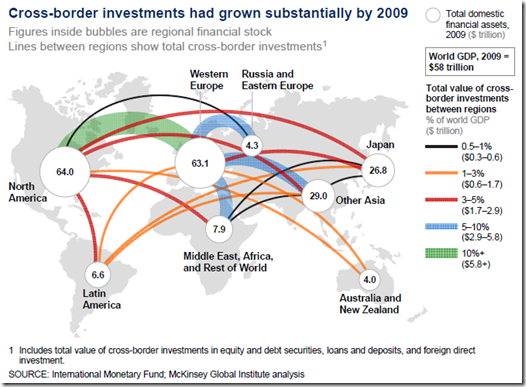
crossborder%20capital.png

Via the Big Picture, a look at how investment cash flows around the world.

November 30, 2011

Global Economy: Bad News Ahead


The above, courtesy of the OECD, provides a forecast for the global economy. To sum it up for the non-economists among us: it's bad.

Whistling Past World War III

I still cannot bring myself to believe that we are heading back to the 1930s. First, the very knowledge of what went wrong 80 years ago may help politicians to avoid the same mistakes this time around. China’s continued emphasis on the need for a "peaceful rise" owes something to a knowledge of the terrible errors of Imperial Japan.

Second, there is a plausible argument that the 66 years of peace between the major powers and developed nations since 1945 reflects the progress of civilisation, rather than a lucky cycle in world history.

Finally, the developed world is starting from a much higher level of affluence than it did in the 1930s. In an economic crash, people might still lose their savings, their jobs and their homes — but they are less likely to be reduced to utter destitution. - Gideon Rachman

I don't know about you, but losing my job, home and savings would be a fairly devastating experience. In fact, I suspect that were this unfortunate outcome to befall even more Americans and Europeans than it has already, it would indeed be very radicalizing, particularly when contrasted with the solicitousness shown large financial institutions. We see the contours of this already in the Tea Party and Occupy Wall Street movements but I think Rachman is being a bit too complacent here about the potential for more volatile social upheaval and political reaction if things do take a turn for the worse.

Does this mean World War III? If I had to bet my (meager) savings, I'd wager no, if only because nuclear weapons have foreclosed that option for many of the world's great powers, but I think the probability of a large scale military catastrophe grows the more people's expectations of a positive future are dashed.

November 22, 2011

State Capitalism: Good for Jobs?

Charlie Szrom thinks the Obama administration's foreign policy has failed to create jobs because, in part, the administration has not engaged in the same kind of state-capitalism that marks the economies of China and Russia:

The second policy set consists of those government actions that directly influence the sales, bids, and operations of American companies. In regions such as Central Asia, Africa, and Latin America, American companies often face steeper odds in winning new business than firms from countries whose governments provide more support.[Emphasis mine]

I'm confused. I thought conservatives believed that private enterprise would flourish if the government just got out of the way.

October 4, 2011

Which Countries Invest the Most in R&D?

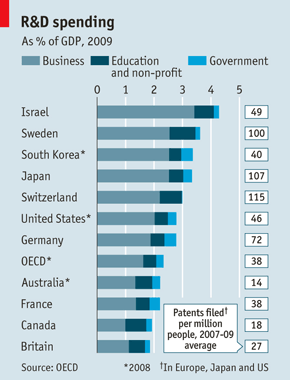
rd%20spend.gif

According to new figures from the OECD, Israel leads the way in investing in research and development, while Switzerland earns the most patents-per-percentage of GDP spent on research efforts.

April 7, 2011

Which Countries Love Capitalism

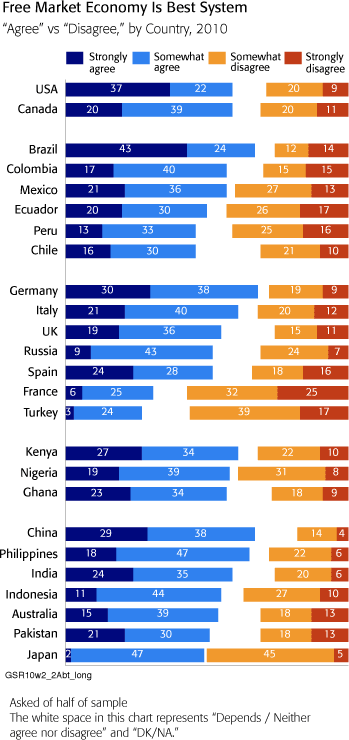
globescan%20capitalism.gif

According to a new poll from GlobeScan, public support for a free market economy is lower in the U.S. than it is in... China.

February 1, 2011

Food Prices & Stability

Screen-shot-2011-01-31-at-10.13.25-AM.png

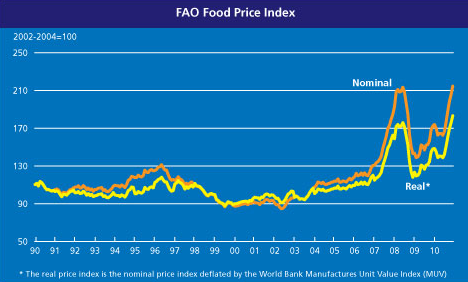
One trigger of the recent instability in the Middle East is the price of food, something the Food and Agriculture Organization said hit near record levels in January. Several months ago as part of our Gallup Global Top Fives, we identified the five most food insecure countries (Egypt and Tunisia did not make the list). If the trend line above continues upward, it's possible a few more regimes will come under intense pressure from their disgruntled citizenry.

[Hat tip: Mark Leon Goldberg]

January 26, 2011

World Economic Forum Live Stream

If you, like me, were not invited to this year's World Economic Forum, take heart: it's being live streamed below.

January 20, 2011

World Energy Use

570x_oil_map_major_oil_trade_movements.gif

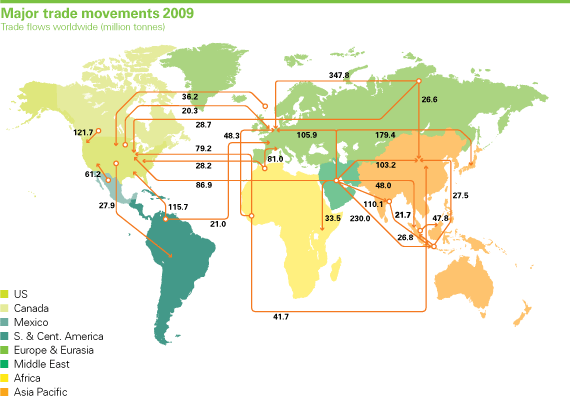
BP has released their annual Review of World Energy. The above chart highlights oil trade movements around the world. You can read the whole report here. Also check out a very cool interactive tool to find various statistics about world energy use.

January 10, 2011

Global Responsibilities vs. Bond Vigilantes

aircraft%20carrier%20daylife.jpg

James Joyner examines Secretary Gates' defense budget:

Again, this is hardly "austerity" in the sense the rest of the NATO Allies are experiencing. But that's a reflection of not only greater financial resources here but of the responsibilities that come with being a global superpower.

Further, let me again re-emphasize that Gates is not pretending that these are deep cuts. Or "cuts" at all. Rather, he's recognizing that the era of unlimited growth in the American defense budget are over, at least for a while, and acting accordingly.

I think this reality - taken together with an obvious unwillingness on the part of the political establishment to tackle entitlement spending - means that some form of bond market-provoked crash austerity program of the likes that is currently roiling Greece and Ireland has now become more likely for the U.S. over the medium term. But at least we'll have met our "global responsibilities."

(AP Photo)

January 4, 2011

Will Washington Embrace European Austerity?

The Washington Post writes that incoming Majority Leader John Boehner will preach the gospel of austerity, but his philosophy seems to leave out defense spending, a large chunk of the federal government's discretionary spending:

"The American people want a smaller, more accountable government. And starting Wednesday, the House of Representatives will be the American people's outpost in Washington, D.C.," Boehner said. "We are going to fight for their priorities: cutting spending, repealing the job-killing health care law and helping get our economy moving again."
Over in Europe - where real austerity programs are underway - defense budgets are squarely on the table, and the chopping block. Ironically, both liberals and conservatives are likely to look nervously at European austerity - liberals, for its negative impact on economic recovery and conservatives for its impact on transatlantic security.

December 29, 2010

The Scramble for Rare Earth Minerals

China announced yesterday that it would cut its rare earth mineral export quota in 2011, following steep reductions in 2010. While the move is sure to deliver some short-term pain to industries in Asia, Europe and the U.S., it has been a boon for Australia:

Australia's emerging rare earths producers and explorers are enjoying a year-end surge in value thanks to China's latest move to limit supplies from its dominant industry to the rest of the world....

According to the US Geological Survey, rare earths are relatively common within Earth's crust but, because of their geochemical properties, are not often found in economically exploitable concentrations. It said new mines in Australia, the resumption of a big mine in the US, and the possible development of other deposits there and in Canada ''could help meet increasing demand''.

As Ian MacKinnon reports, the international scramble to shore up new sources of supply is creating some uncomfortable bedfellows - such as a tie-up between South Korea and Burma.


December 14, 2010

2010: A Costly, Deadly Year

According to the reinsurer Swiss Re, 2010 saw a tripling of monetary losses around the world due to disasters both man-made and natural:

According to initial estimates from Swiss Re’s sigma team, worldwide economic losses from natural catastrophes and man-made disasters were USD 222 billion in 2010, more than triple the 2009 figure of USD 63 billion. The cost to the global insurance industry was USD 36 billion, an increase of 34% over the previous year. Approximately 260 000 people died in these events, the highest number since 1976.

In 2010, severe catastrophes claimed significantly more lives than the previous year: nearly 260,000 were killed, compared to 15,000 in 2009. The deadliest event in 2010 was the Haiti earthquake in January, claiming more than 222,000 lives. Approximately 15 000 people died during the summer heat wave in Russia. The summer floods in China and Pakistan also resulted in 6,225 deaths.

The German reinsurance firm Munich Re seconded this assessment, noting that 2010 had been an "exceptional" year for weather-related disasters.

Good times.

Continue reading "2010: A Costly, Deadly Year" »

November 9, 2010

Islamic Finance and Microfinance

My RCW colleague Kevin Sullivan sent along this interesting China Post article concerning the rise of Islamic finance:

Will Islamic finance be a serious challenge to traditional Wall Street finance? That is a question that deserves a good answer.

First of all, thanks to the good work of Bank Negara Malaysia and the Gulf central banks, the infrastructure for Islamic finance has been laid, with the establishment of the Accounting and Auditing Organization for Islamic Financial Institutions (AOFFI), the Islamic accounting standards authority, the Islamic Financial Services Board (IFSB), the international Islamic financial regulatory standard-setting organisation and the Institute for Education in Islamic Finance (INCEIF). The International Shari'ah Research Academy for Islamic Finance (ISRA) also provides an invaluable website that is increasingly the transparent source for shari'ah interpretations on what is considered acceptable under Islamic law.

For people unfamiliar with Islamic finance, the basic principle of Islamic banking is the sharing of profit and loss and the prohibition of usury. Simply put, interest is prohibited, but profit sharing is not. A cynic can say that with zero interest rate policies adopted by advanced country central banks today, they are also practicing Islamic banking.

I am a bit skeptical about these conclusions. As a general principle, Islamic finance is illiquid and overpriced, primarily because it's not a large market. The people who make use of this financial source tend to be those who have no alternate choice, for sociocultural reasons, and anybody who does have a choice doesn't bother with it. And while some European banks have gotten into Islamic finance on the sell side, they're only doing so because there's a profit opportunity.

This does, however, raise another finance item for consideration.

Continue reading "Islamic Finance and Microfinance" »

October 19, 2010

Global Broadband

internet.jpg

According to the Broadband Forum, there are just shy of 500 million broadband subscribers worldwide:

China, the powerhouse of global broadband in the 21st century so far, was responsible for 43 percent of all net broadband lines added in Q2 and performed far better than the same quarter in 2009 (China includes Mainland China, Hong Kong & Macau). In Western Europe, many markets did better than the equivalent 2009 quarter. Germany, the UK, Italy, Spain, the Netherlands, Poland and Turkey, amongst others, all reported strong numbers. Central and South American markets have cooled to an extent, but many are still reporting good quarterly growth (of 5-7 percent). However, the US and in particular Canada, broadband growth has significantly slowed, affected by the end of housing stimulus packages. In Canada's case, the market slowed to levels not seen for a decade.


Asia now accounts for 41 percent of broadband subscriptions, followed by Europe with 30 and the Americas with 26 percent. China alone accounts for 120.59 million or over 24 percent of the 500 million broadband subs worldwide. Check out the Gallup/RCW list of the Most Wired Countries for more on global connectivity.

(AP Photo)

October 13, 2010

The Global Gender Gap

The World Economic Forum has released its 2010 Global Gender Gap Report, which ranks countries by the level of gender equality. The top ten countries with the highest levels of gender equality:

1. Iceland 2. Norway 3. Finland 4. Sweden 5. N. Zealand 6. Ireland 7. Denmark 8. Lesotho 9. Philippines 10. Switzerland

You can read the full report here (pdf)

October 5, 2010

How Much Defense Spending Is Enough?

It is unrealistic to imagine a return to long-term prosperity if we face instability around the globe because of a hollowed-out U.S. military lacking the size and strength to defend American interests around the world.

Global prosperity requires commerce and trade, and this requires peace. But the peace does not keep itself. The Global Trends 2025 report, which reflects the consensus of the U.S. intelligence community, anticipates the rise of new powers—some hostile—and projects a demand for continued American military power. Meanwhile we face many nonstate threats such as terrorism, and piracy in sea lanes around the world. Strength, not weakness, brings the true peace dividend in a global economy.

We have not done enough to help our military preserve the peace and deter (and if necessary, defeat) our enemies. Americans have fought superbly in Iraq and Afghanistan, and have prevented any further terrorist attacks on the scale of 9/11. But faced with a nuclear Iran, or a Chinese People's Liberation Army that can deny access to U.S. ships or aircraft in the Asian-Pacific region, there are many missions ahead.

Yet we face those challenges with a baseline defense budget—defense spending minus the cost of the wars—that is 3.6% of GDP, significantly less than the Reagan-era peak of 6.2%. Our active-duty military is two-thirds its size in the 1980s. - Brooks, Deulner, & Kristol

Ben and Drezner have tackled this op-ed already but to add my own two cents, I think some perspective is in order:

Between June 2007 and November 2008, Americans lost an estimated average of more than a quarter of their collective net worth. By early November 2008, a broad U.S. stock index the S&P 500, was down 45% from its 2007 high. Housing prices had dropped 20% from their 2006 peak, with futures markets signaling a 30-35% potential drop. Total home equity in the United States, which was valued at $13 trillion at its peak in 2006, had dropped to $8.8 trillion by mid-2008 and was still falling in late 2008. Total retirement assets, Americans' second-largest household asset, dropped by 22%, from $10.3 trillion in 2006 to $8 trillion in mid-2008. During the same period, savings and investment assets (apart from retirement savings) lost $1.2 trillion and pension assets lost $1.3 trillion. Taken together, these losses total a staggering $8.3 trillion. Since peaking in the second quarter of 2007, household wealth is down $14 trillion.

So yes, Brooks, Kristol, et. al. are right, there are threats to global commerce. But they overwhelmingly stem from the world's parliaments, central banks, debt-strapped consumers, and financial markets. The People's Liberation Navy and Somali pirates? Not so much.

September 17, 2010

How the Greek Economy Will Recover

By selling novel souvenirs, of course:

Two U.S. tourists unknowingly bought six human skulls in Greece, which they learned when they were stopped at the airport in Athens.

The Americans carried the skulls in their hand luggage, which was scanned during a layover on their way back to the United States from the island of Mykonos.

September 8, 2010

State Capitalism & Resource Scarcity

natural%20resources.jpg

One of the reassuring messages in Ian Bremmer's The End of the Free Market is that the world's autocratic capitalist states (China, Russia, Saudi Arabia, etc.) did not have a zero-sum view of economic growth, like many nations did in the early half of the 20th century. So while their state champions and sovereign wealth funds can distort global markets, the world can escape the beggar-thy-neighbor cycle of economic destruction that marked the Great Depression.

Reading Vivian Fritschi's analysis on a coming era of resource constraints, I'm no longer sure we can be so sanguine about state capitalism. Economic growth is fundamentally anchored in the exploitation of resources, many of them finite in nature. From food, to water, to key minerals, many of these resources are under strain and the state firms of China in particular are keen to shore up privileged access to these supplies. While they may take a more liberalized view on the prospects of shared economic growth, these autocratic states seem to take a more 20th century view of the resource base this growth is built upon.

(AP Photo)

June 16, 2010

Capitalism vs. the State

David Brooks, riffing off of Ian Bremmer's new book The End of the Free Market, sees the emergence of a new ideological standoff:

The rivalry between democratic capitalism and state capitalism is not like the rivalry between capitalism and communism. It is an interdependent rivalry. State capitalist enterprises invest heavily in democratic capitalist enterprises (but they tend not to invest in each other). Both sides rely on each other in interlocking trade networks.

Nonetheless, there is rivalry. There is a rivalry over prestige. What system works better to produce security and growth? What system should emerging and struggling democratic nations aim for? There is also rivalry over what rules should govern the world order. Should countries like Russia be able to withhold gas from Western Europe to make a political point? Should governments be able to tilt the playing field to benefit well-connected national champions? Should authoritarian governments like Iran be allowed to nuclearize?


As I wrote in my own review of Bremmer's book, I think the answer to the first set of questions - which system works better and what system should emerging market states choose - will be answered by how well the U.S. and Europe handle their current economic challenges. If we can ensure our economic recovery chugs along, and if Europe can get its house in order (admittedly a tall order) than we will have made a plausible case for a free market system. Whether emerging countries buy-in is up to them, but all we can (and should) do is lead by example.

But I think it's mistaken to view the contest between "state capitalist" systems and free market democratic systems as a coherent rivalry. As Bremmer makes clear in the book, countries like China and Russia are out for their own, they're not interested in forming a coherent ideological challenge to democratic capitalism. We would do well not to stamp an overly ideological framework over what it is a very time-honored tradition of countries seeking to maximize their position in the global order.

May 21, 2010

(Not So) Deep Thought

As the anniversary of Iran's June 12 unrest rapidly approaches, I had a (not so) deep thought about this year's headlines as compared to last.

The top foreign policy story of 2009, I'd assume rather indisputably, was Iran. But barring some sort of cataclysmic event (knock on virtual-wood), the world news story of 2010 will likely be Greece and the greater Euro debt crisis.

So I ask: Which do you believe to be the more significant of the two? I think one's answer may reveal a lot about how they consider and approach foreign policy. (and yes, my answer is the Eurozone crisis.)

Please add your thoughts in the comments section and call me Neville Chamberlain.

May 20, 2010

China Continues Aiding Iran

Washington may hype having gained China’s support for a fourth round of United Nations Security Council sanctions on Iran, but Beijing’s leaders still seem to be working with their counterparts in Tehran to make existing and future attempts at tightening Iran’s access to global finances meaningless.

A report (in Persian) by the Fars News Agency confirms fears that China continues playing both sides of diplomatic and economic fences between the United States and Iran. While publicly appearing to go along with the much watered-down draft of sanctions, China has also agreed to "finance U.S. $1 billion for municipal and civic construction in the city of Tehran."

Essentially, the standoff between the West and Iran continues to play into Beijing’s hands. What if anything the United States and its allies can do remains unclear and possibly hopeless.

With friends like China, it is not surprising that Ahmadinejad and his cohorts dismiss the proposed set of sanctions as having "no legitimacy at all," even if adopted by the Security Council.

These developments highlight, yet again, that it is unrealistic to expect other nations to view multinational issues in the same light as the United States does. Attempts at resolving ongoing tensions with Iran in America’s favor, alas, continue demonstrating the escalating limits of Washington’s influence on a world stage where many nations are jousting for power.

April 26, 2010

Video of the Day

In international institutions, China scored big diplomatic points this weekend.

Interestingly enough, while this is ostensibly a move motivated by economics, Robert Zoellick uses words more closely associated with power politics, like "polarity," than with political economy.

For more videos on topics from around the world, check out the Real Clear World videos page.

April 17, 2010

India Debunks the Currency Hawks

Perhaps the most common refrain from the folks in Congress and the punditocracy who are demanding a drastic appreciation in China's currency (the RMB) is that the revaluation is absolutely necessary to reduce the "dangerous" US-China trade deficit.  These currency hawks' underlying reasoning is simple: China's allegedly undervalued currency makes Chinese imports to the US cheaper and American exports to China more expensive, thus creating a woefully-distorted bilateral trade imbalance as compared to a situation in which both the RMB and USD "floated" based on market conditions.  (See here and here for examples of this rhetoric.)

Assuming for a moment that the RMB is significantly undervalued, and that the bilateral trade deficit (or any trade deficit) is a problem for the US economy, there remains a very serious question of whether any sort of RMB appreciation, based on market factors or otherwise, will actually affect the US-China trade balance.  The currency hawks certainly think so (it's their raison d'etre), but many scholars (and your humble correspondent) disagree, pointing to the recent history of the RMB and the US trade deficit, the past experiences of Japan's currency appreciation versus the dollar, and, of course, lots of economic analysis and modeling of structural factors in both the US and China - all of which strongly argue against the theory that RMB appreciation is some sort of "silver bullet" for the bilateral trade deficit.  Indeed, a very interesting new study released by the Centre for Economic Policy Research provides even more such evidence (and a lot of other good stuff).

Unsurprisingly, currency hawks like Paul Krugman have brushed these sound criticisms aside, arguing that they fail to capture current market realities (or something).  A story in Thursday's Wall Street Journal, however, provides very strong support for the currency skeptics' arguments about the disconnect between nations' currency policies and their bilateral trade balances - this time from what is arguably China's largest competitor, India. 

Continue reading "India Debunks the Currency Hawks" »

March 30, 2010

Critics and Consistency

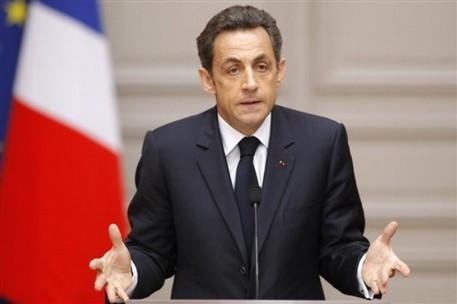
rsz_sarko033010.jpg

Responding to French President Nicolas Sarkozy's backhanded praise for American health care reform, Kevin Drum writes:

Sarkozy was something of a darling of the right when he was first elected, thanks to his support of laissez-faire economics and general embrace of American values. But the financial collapse of 2008 turned him into something of a regulatory hawk, and now there's this. I'll bet the American right doesn't think much of him anymore.

I'm not so sure. So long as he - or any leader of an allied country, for that matter - continues to criticize President Obama's performance abroad, I think the critics will continue to find praise, warranted or unwarranted, for Sarkozy.

I think this goes back to a point we've made repeatedly here on this blog, and that is that the president's critics have thus far demonstrated a serious lack of consistency when it comes to foreign policy. Neoconservatives in particular have been bemoaning the cultural and global decline of Europe for nearly a decade, but once administrations changed, so too did the tone.

This makes for some oddly inconsistent rhetoric, particularly from the right. So either Obama fails to meet the Sarkozy standard, or he leads a party too heavily influenced by the French. What does that even mean? Does it have to mean anything? Probably not; we're talking about the world of politics after all, where things needn't make sense in order to be repeated over and over again.

(AP Photo)

March 15, 2010

Paul Krugman: Neocon?

Dan Drezner makes the case.

February 28, 2010

Health Care and American Power, Ctd.

Last week, Kevin began to debunk two recent articles - one by the Times' Anatole Kaletsky and the other an article on recent statements by Sec. Hillary Clinton - which boldly argue that the death of current U.S. health care legislation will mean the inevitable death of America's influence around the world.

Clinton's argument is that ObamaCare's failure will signal to the rest of the world that American government is broken, and that this perception will adversely affect foreign countries' views on whether America still has the capacity to "move forward" and lead on international issues.  Money quote: "Their view does color whether the United States — not just the president, but our country — is in a position going forward to demonstrate the kind of unity and strength and effectiveness that I think we have to in this very complex and dangerous world."

Kaletsky takes an even harsher line and argues that the demise of ObamaCare will dismantle the American economy, and by extension, America's influence in the world.  He writes:

If nothing is done to change the US healthcare system, it can be stated with mathematical certainty that the US Government and many leading US companies will be driven into bankruptcy, a fate that befell General Motors and Chrysler largely because of their inability to meet retired workers’ contractually guaranteed medical costs....

Gridlock over healthcare would imply similar stalemates on taxes, public spending, the budget, macroeconomic stimulus and financial reform.  As a result, an active response to any future financial crisis might become impossible.  Even worse, any important action to control US government borrowing could be ruled out.

Alrighty then.  Kevin did a great job dismantling these arguments from the foreign policy angle by providing some excellent historical perspective on the issue, so I'm just going to weigh in from the international trade and economics angle.

My conclusion in short: Clinton's and Kaletsky's arguments are nonsense.

Continue reading "Health Care and American Power, Ctd." »

February 26, 2010

Health Care and American Power

In response to my post from yesterday, our friends over at the sans-green Daily Dish send along this Times piece by Anatole Kaletsky. In it, Kaletsky argues that the future of the American economy - and thus, American leadership around the world - rests on the results of yesterday's health care summit in Washington:

If nothing is done to change the US healthcare system, it can be stated with mathematical certainty that the US Government and many leading US companies will be driven into bankruptcy, a fate that befell General Motors and Chrysler largely because of their inability to meet retired workers’ contractually guaranteed medical costs.

Today’s summit represents Mr Obama’s last chance to find a way forward, either by shaming some Republicans into supporting him or by embarrassing his own perennially divided Democratic Party into uniting around a single plan. If he is unable to do this, he will have almost no chance of passing any significant legislation on any other issue—– not on energy, budgetary responsibility, macroeconomic management or even on such seemingly popular issues as bank regulation and jobs.

In short, Mr Obama has staked his entire presidency on today’s summit.

I don't know that this passes political or economic muster. I am no economist, so all I'll add here is that, to my knowledge, the largest economy in continental Europe, Germany, has been dealing with an aging and entitled work force for years. While economic discontent at home can of course impact all forms of policy - including foreign - I don't know that it has had any effect at all on Germany's role in Europe and around the world, respectively. On the contrary, Angela Merkel seems to have become more globally assertive in the face of Western financial crisis.

As for the politics, I believe the general consensus is that yesterday's summit moved no one and only further entrenched actors and voters in their respective camps.

Kaletsky goes on:

Gridlock over healthcare would imply similar stalemates on taxes, public spending, the budget, macroeconomic stimulus and financial reform. As a result, an active response to any future financial crisis might become impossible. Even worse, any important action to control US government borrowing could be ruled out. If the financial markets seriously reached this conclusion, all the debates about government debt and public spending in Britain, Greece and other countries would be a waste of breath. A genuine loss of confidence in America’s fiscal outlook would create a financial crisis so horrific that actions by the British or European governments would be swept away like beach huts in a tsunami.

[/hyperbole]

Did the United States not fight and win a world war in the face of economic depression and peril? Did economic ebb and flow affect the way in which the world perceived American leadership during the Cold War, or during the current War on Terrorism? Perhaps it did, which is why I open the floor up here to trade and economy wonks to fill in the gaps.

But I remain incredulous.

February 12, 2010

Goldman Sachs Hid Greek Debt

In the event you needed another reason to be angry at Goldman Sachs, Der Spiegel reports:

Goldman Sachs helped the Greek government to mask the true extent of its deficit with the help of a derivatives deal that legally circumvented the EU Maastricht deficit rules. At some point the so-called cross currency swaps will mature, and swell the country's already bloated deficit.

The "Lord's work" indeed.

February 10, 2010

Greece's Bailout Plea

Greece, as you likely know, is in some deep trouble financially. Now, they want a bailout from the EU:

“We feel humiliated and we understand that things cannot remain the same as they were before,” said Vasiliki Revithi, 56, a biochemist at the National Organization for Medicines, noting that a monthly cut of about $950 to her salary would mean no new car and cheaper makeup. “But we gave the world democracy, and we expect the European Union to support us.”

Certainly a creative pitch, if nothing else.

January 29, 2010

R2-D2 to Lead the Global Recovery?

ri-man.jpg

Former chief economist at the International Monetary Fund and current Professor of Economics and Public Policy at Harvard University Kenneth Rogoff made a fascinating declaration:

As the global economy limps out of the last decade and enters a new one in 2010, what will be the next big driver of global growth? Here’s betting that the “teens” is a decade in which artificial intelligence hits escape velocity, and starts to have an economic impact on par with the emergence of India and China….

In 50 years, computers might be doing everything from driving taxis to performing routine surgery. Sooner than that, artificial intelligence will transform higher learning, potentially making a world-class university education broadly affordable even in poor developing countries. And, of course, there are more mundane but crucial uses of artificial intelligence everywhere, from managing the electronics and lighting in our homes to populating “smart grids” for water and electricity, helping monitor these and other systems to reduce waste.

In short, I do not share the view of many that, after the Internet and the personal computer, it will be a long wait until the next paradigm-shifting innovation. Artificial intelligence will provide the boost that keeps the teens rolling. So, despite a rough start from the financial crisis (which will still slow global growth this year and next), there is no reason why the new decade has to be an economic flop.

For an image of what a future controlled by computers and robots might look like, look no further than Japan, which employs over a quarter of a million robot workers, envisions using robots to counter future economic and demographic challenges, and creates robot fashion-models.

January 23, 2010

Could the WTO Tear Down China's Great Firewall?

Reuters reports that the United States Trade Representative (USTR) is "mulling" (great word!) a challenge to China's internet restrictions - the humorously-named-but-not-actually-funny-at-all "Great Firewall of China":


U.S. trade officials have asked for more information as they weigh whether to pursue a case against Chinese Internet restrictions that impede Google and other companies, an attorney for a U.S. free speech group said on Friday.

"They've asked us for more detail about it. We are trying to put that together right now," said Gilbert Kaplan, a partner at King and Spalding, which represents the First Amendment Coalition, a nonprofit advocacy group...

The U.S. free speech group, known then as the California First Amendment Coalition, first approached the U.S. Trade Representative's office in late 2007 with the idea of challenging China's barriers to Internet access at the World Trade Organization.

It gave the trade office, run at the time by the Republican administration of former President George W. Bush, "a very extensive white paper, or memo, describing the WTO violations that the 'Great Firewall' caused, and that were actionable in our view under the WTO, and a request that USTR begin a WTO case against China regarding the Firewall," Kaplan said.

Although no case was filed, Kaplan said U.S. trade officials never ruled out that possibility.

"We're continuing to request that they start that case. That dialogue is continuing," Kaplan said.

A spokeswoman for the U.S. trade representative's office had no immediate comment.

A study by the Brussels-based think tank ECIPE in November called government censorship the biggest trade barrier that Internet companies face.

Many countries censor the Internet for political or moral reasons. China has developed one of the most pervasive methods. In Cuba, all unauthorized surfing is illegal, while many Western countries limit access to child porn sites.

A WTO case could help "clarify the circumstances in which different forms of censorship are WTO-consistent," ECIPE said....

China agreed as part of its commitments to join the WTO in 2001 that U.S. service companies would have the same access in China as their own companies.

"We believe that applies to the Internet and Internet companies," Kaplan said.

China's web restrictions in effect force U.S. Internet companies to "put servers and hardware in China, rather than doing what they do everywhere else in the world, which is use their U.S. base," Kaplan said.

"If we try to serve the Chinese market from the U.S. or anywhere outside the Great Firewall, our Internet access is so slow that no one will use our sites," he said.

WTO rules also require countries to follow transparent and understandable procedures, he said.

Instead, China "is very randomly stopping our Internet companies and our Internet access with no prior notice and no set of regulations," Kaplan said.


The free speech group's 2007 white paper is here, and they state that China's internet restrictions violate a whole host of WTO rules, including GATT Article III (national treatment), China's services commitments under the GATS and China's WTO Accession Protocol. 

Continue reading "Could the WTO Tear Down China's Great Firewall?" »

January 21, 2010

Video of the Day

On the RCW video page we will periodically host interviews and speeches. Today we have Joseph Stiglitz:

Regardless of how many Nobel's someone has, one should never accept what they say uncritically. Nevertheless, Joseph Stiglitz is probably the most important critic of unchecked free markets in the west today. In academic circles, one would likely describe him as an opponent of the Chicago School, however in popular parlance, both Stiglitz and the Chicago School often devolve to parodies of themselves. One can see in this interview that Stiglitz may favor a second stimulus, but he is also concerned about deficit spending.

How the Post-Communist Generation See Things

youngcommies.jpg

Pew Research's Juliana Menasce Horowitz sees positive signs in the attitudes of young people in post-Communist societies:

In every Eastern European country surveyed, the post-communist generation is much more supportive of the move away from a state-controlled economy than are those who lived as adults under communism. As is the case with opinions about the change to democracy, the generational divide is greatest in Russia; about six-in-ten (62%) Russians younger than age 40 say they approve of their country's change to capitalism, compared with just 40% of those in the older age group.

A double-digit gap also exists in Ukraine, Slovakia, Bulgaria, the Czech Republic and Poland, and a smaller gap is evident in Lithuania and Hungary. In Ukraine, where the overall level of support for the change to a market economy is lower than in any other country surveyed (36% approve of the change), nearly half (47%) of those younger than age 40 say they approve of the economic changes their country has undergone; just 28% of those 40 or older share that view.

The entire study is worth a read. Of note, Ukraine, which just concluded a first round of presidential voting, has the lowest approval when it comes to a country's move to multi-party elections.

(AP Photo)

January 20, 2010

The Index of Economic Freedom

The Heritage Foundation and the Wall Street Journal recently released their Index of Economic Freedom for 2010. In their own words:

Economic freedom is the fundamental right of every human to control his or her own labor and property. In an economically free society, individuals are free to work, produce, consume, and invest in any way they please, with that freedom both protected by the state and unconstrained by the state. In economically free societies, governments allow labor, capital and goods to move freely, and refrain from coercion or constraint of liberty beyond the extent necessary to protect and maintain liberty itself.

There is a lot of data there, and undoubtedly people will make of it what they will. Moreover, these indices are fairly subjective, based upon the criteria selected for the creation of the index. Nevertheless, these indices can be good measures of what certain groups think of certain things.

In other words, if you care about what the Wall Street Journal and the Heritage Foundation cares about, then this index tells you a lot. zdgs

November 10, 2009

Peak Oil Back on the Radar

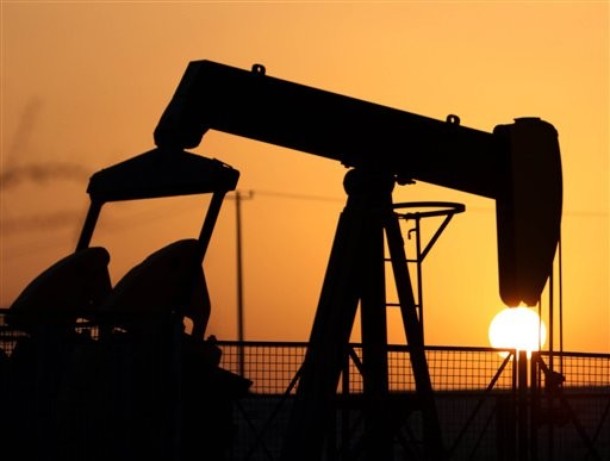
oil.jpg

The International Energy Agency is out with its new global forecast on oil and energy reserves (a short highlight is available here - pdf). Meanwhile, a whistle-blower at the IEA has gone to the Guardian to say the organization's estimates for global output are far too optimistic:

In particular they question the prediction in the last World Economic Outlook, believed to be repeated again this year, that oil production can be raised from its current level of 83m barrels a day to 105m barrels. External critics have frequently argued that this cannot be substantiated by firm evidence and say the world has already passed its peak in oil production.

Now the "peak oil" theory is gaining support at the heart of the global energy establishment. "The IEA in 2005 was predicting oil supplies could rise as high as 120m barrels a day by 2030 although it was forced to reduce this gradually to 116m and then 105m last year," said the IEA source, who was unwilling to be identified for fear of reprisals inside the industry. "The 120m figure always was nonsense but even today's number is much higher than can be justified and the IEA knows this.

Kevin Drum isn't so sure this anonymous source is really onto something significant.

(AP Photos)

October 1, 2009

In Support of a Global Transaction Tax

9902_1_.jpg

Last week, the G-20 formally agreed to become the new G-7, which theoretically will help put a little more "oomph" into policies designed to tackle the twin challenges of maintaining global economic growth while restructuring economies worldwide to fit low-carbon or even carbon-free economic growth models.

Piggybacking on the recent surge in international coordination, Germany's Minister of Finance Peer Steinbrück wrote recently on the case for a global financial-transaction tax:

A global financial-transaction tax (FTT), applied uniformly across the G-20 countries and covering all financial transactions at a very low rate, is the obvious instrument of choice to ensure that all financial-market participants contribute equally. Foreign Minister Steinmeier and I are suggesting that the G-20 take concrete steps toward implementing an FTT of 0.05% on all trades of financial products within their jurisdictions, regardless of whether these trades occur on an exchange. National governments could establish a personal allowance to exempt retail investors.

Based on calculations by the Austrian Institute of Economic Research, which studied the possible effects of general FTTs on behalf of the Austrian government, a global FTT of 0.05% could yield up to $690 billion per year, or about 1.4% of world GDP. Such a tax would not unduly burden financial-market participants, yet it would raise a significant amount of money to finance the costs of this crisis.

This makes a lot of sense. A small tax like this would help build a "rainy day fund" in preparation for whenever the global economy next takes a slight downturn, a policy that has proven highly successful in countries like Chile and Norway. The slight tax might also nudge investors toward buying and holding, which might also help deter against a major run on the dollar and other currencies. Maybe such a tax could also help the U.S. avoid eventual economic meltdown as the rising costs of social welfare programs cause public debt to explode in the near future.

Steinbrück's suggestion is a good one, and the G-20 would do well to consider it.

(Photo Credit: AP Photos)

September 30, 2009

U.S.-Colombia Free Trade Agreement: Rhetoric vs. Reality

By Scott Lincicome

Uh oh. Looks like someone forgot his Rahm-approved FTA talking points:

* WSJ: US Secy Locke: Colombia Trade Pact Not Likely Ratified In '09. "The U.S. Congress won't likely ratify a free trade agreement with Colombia this year as it's currently focusing on health care reform and energy-related legislation, U.S. Commerce Secretary Gary Locke said Tuesday."

* Miami Herald: U.S. Trade Representative: free trade agreements underway with Panama and Colombia. "Assistant U.S. Trade Representative for the Americas Everett Eissenstat told a crowd at the Americans Conference that work was progressing on free trade agreements with both Panama and Colombia, though 'less tangible' concerns about violence and impunity in Colombia have yet to be fully resolved."

What a debacle (and I don't mean the incongruous administration statements). The US-Colombia FTA was completed and signed on November 22, 2006. Since that time, American exporters have paid approximately $1.9 million per day in Colombian tariffs that they wouldn't have paid if the Democrat-controlled Congress had just passed the FTA back then and thus allowed it to enter into force. By my math, that means that Congress' and (now) the President's partisan stalling has resulted in a pointless tax on American businesses of almost $2 billion ($1.9798 billion = 1042 days times $1.9 million) and counting. Meanwhile, one of our closest allies in Latin America has bent over backwards to get the agreement passed, holding hundreds of public meetings, working hard to (successfully) reduce domestic labor union violence, and countering Hugo Chavez' viral influence in the region. Heck, the Colombians even sponsored a massive public art campaign here in Washington, DC in an attempt to improve public sentiment about their country.

And USTR's response to the billions in needless tariffs and the Colombians' humbling efforts? Ummmmm...

Speaking Thursday [Sept. 24, 2009] at the Congressional Black Caucus Annual Legislative Conference Town Hall on Capitol Hill, United States Trade Representative Ron Kirk stressed the importance of passing health insurance reform. Reforming the health care system is a trade priority - because American businesses and workers can't take full advantage of job-creating trade opportunities as long as our health care system drains their resources. Health reform will help to grow America's global economic competitiveness.

Oh, right. That makes perfect sense.

(Please note extreme sarcasm and disgust.)

-----------
In 2008, Scott Lincicome served as a senior trade policy adviser for Senator John McCain’s Presidential campaign. He blogs at http://lincicome.blogspot.com/

September 29, 2009

Has the American Anti-Globalization Movement Jumped the Shark?

g20.jpg

By Scott Lincicome

Last week's G20 meetings featured anti-globalization protest shenanigans that have become routine since the genre began in Seattle 10 years ago - anarchists, arrests, misguided vandalism against Starbucks and other alleged symbols of corporate global-greed, English majors unintentionally demonstrating why they're English (and not Economics) majors, etc etc. But lost in the routine media coverage of the anti-trade protests in Pittsburgh was their striking impotence relative to earlier iterations of the "movement."

According to the AFP, Pittsburgh police estimated that up to 4,500 "protesters on Friday flooded into city streets lined with police in full riot gear, still tense after violent anti-G20 protests in the eastern US city late Thursday." Those violent Thursday protests featured only about 400 hooligans and a few dozen arrests, the AFP also reported.

Sounds pretty big, huh? Well, it's actually pretty insignificant when you provide some perspective (instead of just focusing on the protesters' attention-grabbing violence and tomfoolery):

* The granddaddy of the modern anti-globalization movement - the 1999 protests against the World Trade Organization's Ministerial Meeting in Seattle - drew over 40,000 protesters, according to similar local police estimates. Those protests - featuring the strange bedfellows of US labor unions, anarchists, environmental "advocates," socialists, and "consumer groups" like Public Citizen - really flooded Seattle's streets and literally shut down both the city of Seattle and the WTO meetings themselves.

* The follow-up to Seattle - the April 2000 protests against the annual World Bank and IMF meetings in Washington, DC - featured at least 10,000 protesters, summoned about 1,500 additional cops, and shut down most of DC (although the official meetings still managed to happen). I was working in DC at the time and vividly remember how most people stayed home that day in fear of violence (or just really, really bad traffic).

Compared to these protests, the G20 ruckus was pretty tepid. Granted, the devolution of the American anti-globalization movement is not a brand new phenomenon: compared to last April's World Bank/IMF protests - which apparently drew only 150 protesters - the G20 protests were huge. Nevertheless, the G20 meetings were highly publicized, came in the midst of a global recession that's (unfairly) being blamed on "free market policies," and were located in a traditional "rust belt" city with large numbers of folks that are highly skeptical of free trade (Pittsburgh is the national headquarters of the United Steelworkers union, afterall). And the March 2009 G20 protests in London drew "tens of thousands" of protesters.

Continue reading "Has the American Anti-Globalization Movement Jumped the Shark?" »

September 20, 2009

A Global Debt Clock?

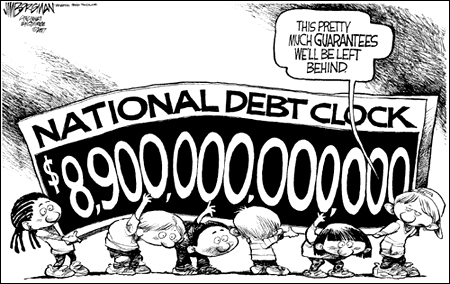
071010_p08_cartoon.jpg

Global debt is exploding, and Harvard economist Kenneth Rogoff thinks that a new debt crisis is bound to follow the latest financial one.

Indirectly supporting the above thesis is a well-crafted and fascinating "Global Debt Clock" now maintained by The Economist. But before you check out the clock, glance over a recent piece by Joseph Stiglitz that smartly warns about the alluring, dangerous, and ultimately deceptive "fetishism" the world has on statistics.

(Cartoon Credit: The Korea Times)