Main

January 19, 2012

Putin: Radio Pours Diarrhea On Me

Metaphorically, of course:

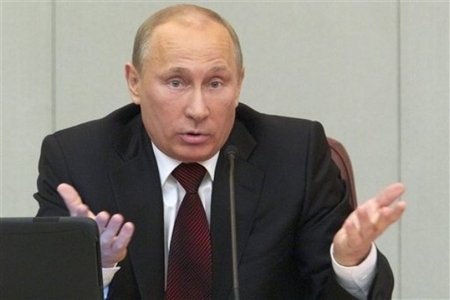
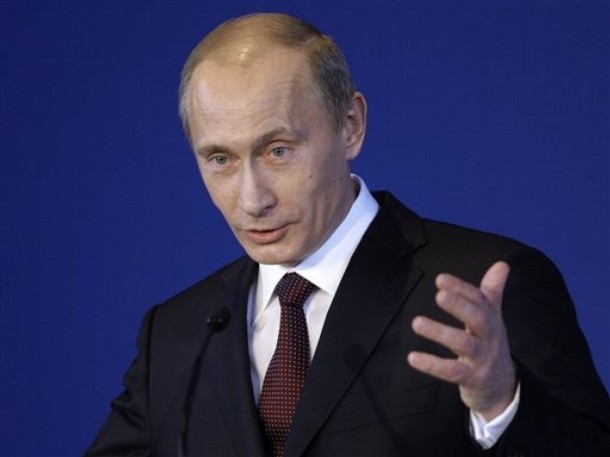
Russian Prime Minister Vladimir Putin has accused a leading liberal radio station of constantly disparaging him and serving foreign interests.

At a regular meeting with editors-in-chief of leading media, he told Moscow Echo radio's Alexei Venediktov: "You pour diarrhoea over me day and night."

He singled out a discussion of Russia's opposition to US missile defence plans in Europe as an example of Echo's bias.

December 1, 2011

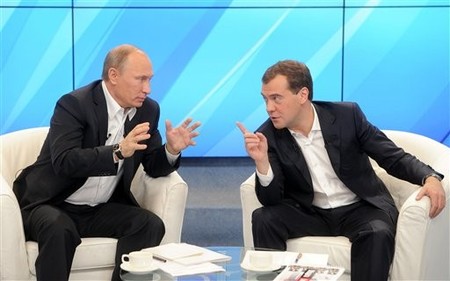
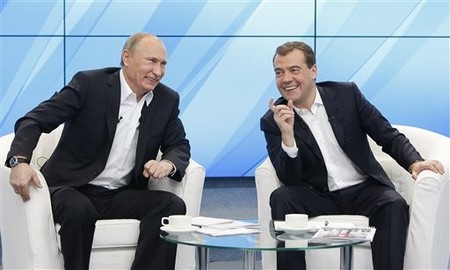
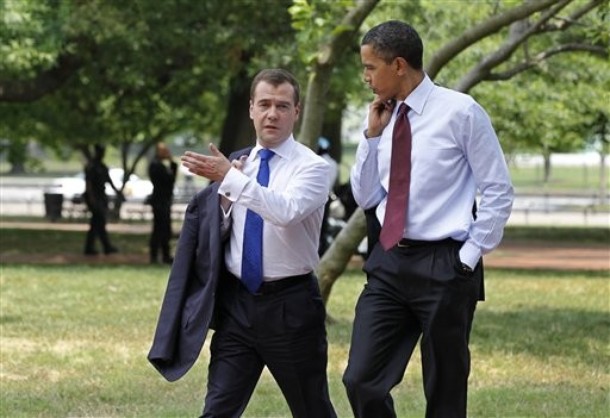
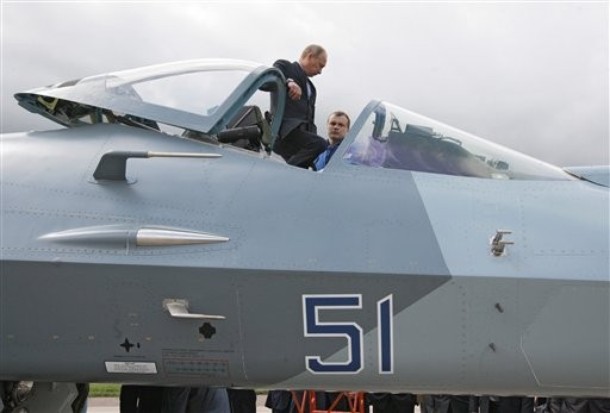
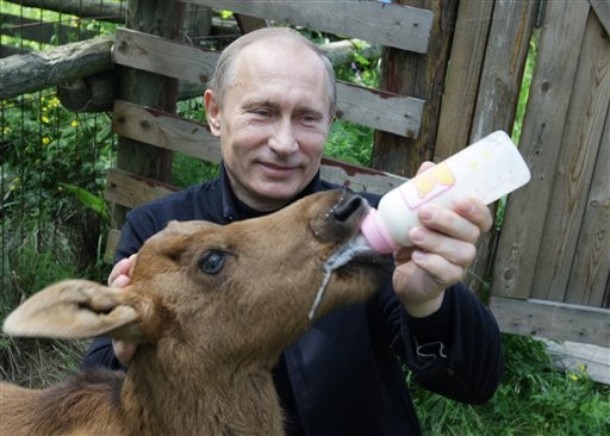
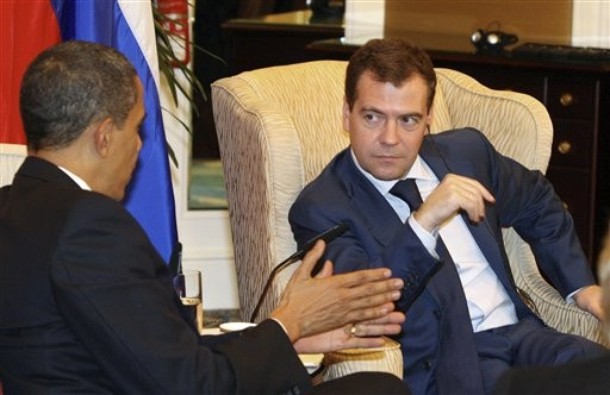
The Dynamic of Russia's Ruling Tandem

In two photos:

putin1.jpg

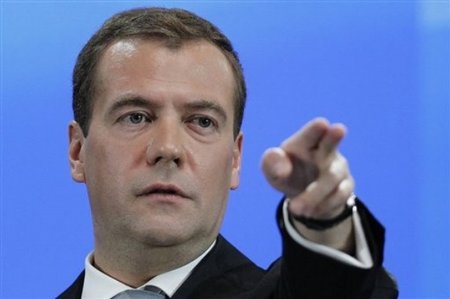
medvedev1.jpg

(AP Photo)

November 20, 2011

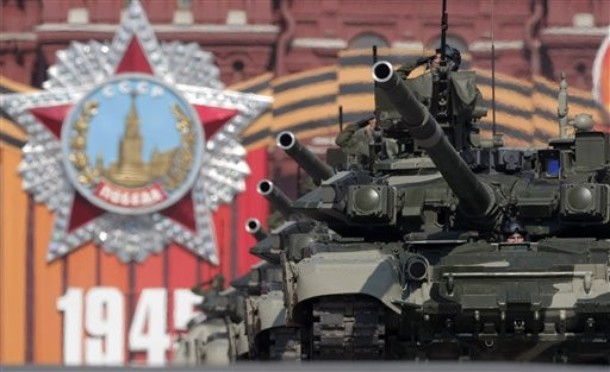
Azerbaijan Buys Chinese Planes, Russia Disses Own Tanks

Azerbaijan recently announced that it is purchasing Chinese-made JF-17 Thunder fighter jets. This is a bold move by China into what was, up until recently, a Russian-dominated military sales market, and the geopolitical space that Moscow considers its own and which Washington considers as vital to its interests both in the Middle East and Central Asia.

Given how sales of military equipment can solidify alliances between nations - such as between the U.S. and Taiwan, Saudi Arabia, Israel and many other states - this purchase has the potential to alter security dynamics in the Caucasus and beyond. On its own, Azerbaijan demonstrated that it can reject a wide variety of military aircraft - such as American F-16 and F/A18, EU's Eurofighter, French Rafael, Swedish Gripen, Russian Mig-29 and Su-27 - in favor of a plane that is untried and untested in military combat.

This purchase binds Baku to Beijing's military industry, since supply parts, service, maintenance and training would have to be done by China, at least initially. At this point, only Pakistan operates JF-17, which is close to combat performance than Russian-made Mig-29 or American F/A-18 fighter planes. However, Azerbaijan may have simply been buying smart - the cost of a each Chinese fighter jets is only $20 million.

Continue reading "Azerbaijan Buys Chinese Planes, Russia Disses Own Tanks" »

October 12, 2011

Russians Find Bigfoot

According to the Guardian:

The vast Siberian tundra holds untold mysteries, from once-secret nuclear installations to alleged UFO crash sites.

Now, a team of scientists say they are "95%" sure that Russia's wintry expanse is home to the mythical yeti, otherwise known as the abominable snowman.

More than a dozen scientists and yeti enthusiasts flew in from Canada, Estonia, Sweden and the US to exchange findings with their Russian counterparts at a day-long conference in the town of Tashtagol, some 2,000 miles east of Moscow in the Kemerovo region. Locals there have reported an increase in sightings of a creature in recent years.

A two-day expedition to the region's Azassky cave and Karatag peak over the weekend "collected irrefutable evidence" of the yeti's existence there, the Kemerovo government claimed in a statement. "In one of the detected tracks, Russian scientist Anatoly Fokin noted several hairs that might belong to the yeti," it added. Scientists also found footprints, a presumed bed and various other markers.

It's kind of reassuring to know that despite all the turbulence around the world, people still have time to be "Yeti enthusiasts."

October 11, 2011

Judging the Reset

Putin’s return should serve as a wakeup call for President Obama and his advisers. The “reset” policy profoundly misreads not only why U.S.-Russia relations chilled in the first place, but also what is truly required to improve them. The problem was not U.S. rhetoric or actions, but the nature of the Russian regime. U.S.-Russian relations will not be on a firm footing until Moscow changes its strategic outlook and the Russian people are truly free to choose their own leaders. [Emphasis mine] - Jamie Fly and Robert Zarate

The U.S. arguably accomplished something similar to this during the Cold War. That took six decades to accomplish and still produced a Russian polity that outrages American conservatives. Could it be that Russia's "strategic outlook" is less malleable than Washington strategists would prefer?

September 30, 2011

Isn't It Ironic?

John Walsh:

The death is announced of Wilson Greatbatch, 92, the American inventor of the cardiac pacemaker, a revolutionary device which has, since the 1960s, pumped life into millions of people. And there's some news about Mikhail Kalashnikov, also 92, inventor of the AK-47 assault rifle, a revolutionary device which has, since the 1950s, done the exact opposite. A Russian newspaper reports that, although the Russian army is no longer buying his weapon – the most effective killing machine in human history – the company has told its staff not to tell Mr Kalashnikov about it, in case the shock kills him.

September 29, 2011

Russia Boasts of Huge Oil Find

Putin may be feeling flush:

According to numerous Russian media reports, addressing a meeting of the sixth media forum of the United Russia Party on 25 September, Russian Natural Resources Minister Iury Trutnev said that the preliminary forecast is that resources in the Russian Arctic shelf are comparable to those in mainland Russia, adding, “Speaking of long-term planning, these reserves could last 100, may be 150 years, but longer is unlikely. Humanity will eventually have to look for new energy anyway. Recently, we completed 40-year talks with Norway, delineated the gray zone, and now obtained another 5 billion tons of fuel equivalent there.” Trutnev’s new Arctic reserve claims are buttressed by the United States Geological Survey (USGS) 2008 survey, which estimated that 90 billion barrels of undiscovered oil and 1.668 trillion cubic feet of undiscovered natural gas lie beneath the Arctic’s waters and ice, representing 13 percent of the world’s undiscovered oil. Strong oil prices, more advanced offshore equipment and receding sea ice are leading to a growing interest in the Arctic.

September 15, 2011

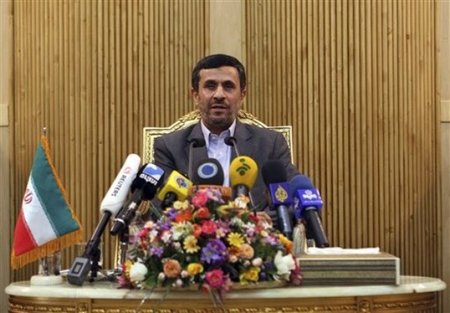
Don't Play Ahmadinejad's UN Game

rsz_iran91511.jpg

The 66th session of the United Nations General Assembly convened this week in New York City.

Libya’s ousted Brotherly Leader and Guide of the Revolution Muammar Gaddafi dare not show his face due to an International Criminal Court arrest warrant upon his head for crimes against humanity. Venezuela’s President Hugo Chavez cannot attend either because of ongoing chemotherapy. But Iran’s President Mahmoud Ahmadinejad intends to be there.

We will no longer be entertained and infuriated by scenes of Chavez sarcastically speaking about satanic sulfur in 2006 or Gaddafi disdainfully chucking the UN charter over his shoulder in 2009. Nonetheless, Ahmadinejad plans on yanking the West’s chain yet again. He will distribute a book on alleged atrocities committed against Iran and Iranians by American, British and Soviet forces during World War II, the semi-official Mehr News Agency reports:

Ahmadinejad will go to New York late this week, taking 1000 English copies of Documents on the Occupation of Iran during World War II. Iran’s occupation by the Allies during World War II is an international issue. This book contains many documents referring to the abuses inflicted by the Allies against the Iranian people.

The five-volume work is to be presented as evidence at the UN General Assembly, a parallel story in the Tehran Times notes:

to demand compensation from the Allies for violation of Iran’s neutrality during that world conflict.

So even though his comrades from the Mad Hatter’s Tea Party cannot be there, Iran’s chief executive will do his best to incite American, British and Russian emotions – and he is well accomplished at provoking negative responses. But unlike Alice, officials in Washington, London and Moscow should not respond in anger. Paying no attention to his theatrics will deny Iran’s president the pleasure he seeks.

Let’s not give Ahmadinejad a tale to spin for Chavez when he flys to Caracas after the New York visit.

(AP Photo)

August 31, 2011

Allies in Danger?

Potential presidential candidate John Bolton argues that U.S. allies are put in danger by President Obama's nuclear policies:

Within the administration, there are strong advocates for America pledging “no first use” of nuclear weapons. Although the nuclear posture review “only” expanded “negative security assurances” somewhat, there is little doubt that “no first use” is alive and well in internal administration councils. These self-imposed constraints on the use of nuclear weapons reinforce the allies’ concern that Mr. Obama has forgotten the central Cold War lesson about the U.S. nuclear deterrent. There was never any doubt that a Soviet attack through the Fulda Gap into Western Europe would have swept through NATO forces, possibly all the way to the English Channel. Thus, the threat of U.S. nuclear retaliation against such an attack - an unambiguous case of a U.S. first use of nuclear weapons - was precisely what was needed to keep Soviet forces on their side of the Iron Curtain.
How is this lesson applicable to today? What army is poised to sweep into Europe, overwhelming Western defenses and precipitating a nuclear first strike as a desperate gambit to keep the West free?

Bolton then proceeds to undermine his argument that America's allies are feeling "increasingly insecure" about America's nuclear posture:

Accordingly, Europeans should be very worried that they are increasingly on their own to face the re-emerging threat of Russian belligerence. Because the New START treaty does not limit tactical nuclear weapons, Europe, simply because of geographic proximity, is most vulnerable to Russia’s advantage in that category. It is thus highly ironic that some NATO countries have recently called for removing the last U.S. tactical nuclear weapons from Europe, which will simply enhance Russia’s existing lead. [emphasis mine]

In other words, Europe isn't all that afraid of the re-emerging threat of Russian belligerence. Granted, attitudes toward Russia vary significantly in Europe but most of Western Europe, the former core of NATO, is not gripped by the panic that apparently envelopes Mr. Bolton.

August 22, 2011

When a TV Commercial Is Not Just a Commercial

From time to time, we all get offended by what we see on TV.

Recently, Russian World War II veterans were deeply offended by a television commercial that advertised model German tank assembly kits. In particular, this commercial advertised German "Tigers," a famous tank designed to stop Soviet T-34 tanks and which made their debut at the massive Battle of Kursk in 1943.

The veterans' association considered such commercials as "propaganda for Nazi military weapons." When the vets turned to lawyers for advice, they were told that since the kits feature no German or Nazi insignia, such commercials were perfectly legal. It's notable that Austria prohibited similar advertisements on the country's television back in 2010.

August 12, 2011

Russia, China Shower Venezuela With Cash

Russia grants Venezuela $4 billion for military spending while China is lending Venezuela an additional $4 billion:

Venezuela is finalizing agreements for two separate credit lines of $4 billion each with Russia and China, with a portion of the financing earmarked for military equipment for the South American nation, according to Venezuelan state media.

With the world's largest oil reserves, Venezuela needs a well equipped military to defend itself from foreign aggression, President Hugo Chavez said during a broadcast phone call reported by the Venezuelan News Agency.

Chavez had to call in the news from Havana, where he is undergoing chemotherapy.

Readers of this blog may recall that Russia has financed over $6 billion worth of military equipment from 2005-2010.

On the other hand, Venezuela is borrowing at least $24 billion from China:

last year, Venezuela received a $20 billion credit line from the China Development Bank for housing

The housing construction has not started, but Hugo's betting on oil futures, so to speak, in a very big way.

August 9, 2011

Sanctions and Russian Human Rights

In the past, I've wondered just how U.S. sanctions could change Russia's internal behavior. So I was pleased to see the Washington Post editorial page tackle this head-on with a piece titled "Sanctions Can Promote Human Rights in Russia." After the Obama administration approved some travel bans, the Post argues, Russian behavior changed:

At first, Russian spokesmen issued vague, empty threats of retaliation. Then authorities announced that two prison doctors implicated in the death of the lawyer, Sergei Magnitsky, would be prosecuted. Finally, government prosecutors said last week that they had reopened the case brought against Mr. Magnitsky that led to his imprisonment, mistreatment and death in 2009.

Most likely, the new investigation represents another cynical maneuver by the Russian Interior Ministry, which has managed to protect the police officials responsible for Mr. Magnitsky’s death for two years despite public promises of justice by Mr. Medvedev.

In other words - even if the penalties work, they don't work because the Russians are going to respond with "cynical maneuvers." So what was the point again?

August 2, 2011

Putin Gets His Licks In

AFP reports:

Russian Prime Minister Vladimir Putin on Monday accused the United States of acting as a "parasite" on the world economy by accumulating massive debts that threaten the global financial system.

"The country is living in debt. It is not living within its means, shifting the weight of responsibility on other countries and in a way acting as a parasite," Putin told a group of pro-Kremlin youth in central Russia.

Meanwhile, Michael Schuman provides a more measured analysis of what impact the U.S. debt deal will have on the global economy.

August 1, 2011

Judging the U.S.-Russia Reset

The White House touts its "reset" policy toward Russia as one of its key diplomatic successes. But the Russian authorities were caught off-guard when Washington quietly barred some of their officials from traveling to the United States this week, a move that threatens to undo some of the gains Washington has made boosting ties with Moscow.

The State Department blacklist targets those connected to a scandal that's drawn widespread international condemnation: the death of Sergei Magnitsky, a Russian lawyer jailed in 2009 after accusing police of bilking the government of more than $200 million. A report commissioned by President Dmitry Medvedev himself concluded Magnitsky was denied medical care and probably severely beaten before he died. - Gregory Feifer

There seems to be a belief in some quarters that acts of Russian hostility abroad (i.e. toward Georgia) or internal violence somehow undermine the 'reset' - as if all that's needed to push Russia toward a true liberal democracy are more U.S. sanctions and hectoring. But the reset will stand or fall on how much cooperation the U.S. can get on important strategic matters. There are obviously people who are legitimately distressed about Russia's internal governance and their behavior toward Georgia, but ultimately the U.S. can only be the champion of her own interests.

July 1, 2011

Redeeming Russia

Ariel Cohen and Donald Jensen argue that the aim of U.S. policy toward Russia should be the latter's moral enlightenment:

When the Soviet Union fell in December 1991, Washington rushed to Boris Yeltsin’s assistance. The world expected that Russia would eventually grow to be more like the United States or Western Europe. By the late 1990s, however, Russia was rapidly regressing from Western political models. Beginning around 2000, the two sides returned to a relationship based on strategic security concerns resembling the old Cold War paradigm.

Moscow and Washington quickly exhausted this security agenda for U.S.–Russian rapprochement, however, and the pendulum swung back. During the rest of the decade, while Russia rejected American efforts to promote democracy in Georgia, Ukraine, Kyrgyzstan, Afghanistan, and Iraq, Washington grew alarmed at the increasing authoritarianism of Vladimir Putin. George W. Bush’s proclamation of America’s duty to press for democratic values around the globe further alienated the Kremlin.

Then they take aim at the Obama administration's reset:

While the gains from the “reset” relationship have been exaggerated, the cost in terms of the U.S. moral authority has been high. The Obama Administration has explicitly disavowed linkages within its Russia policy components, such as punishing Russian misbehavior in one area by withholding concessions in another.

There is good reason to believe, moreover, that Russian leaders do not take White House efforts at promoting human rights seriously. They know that the U.S. Administration is chained to the “reset” and will do little more than verbally object to the Kremlin’s abuses of human rights and the rule of law.

The authors then argue that the U.S. should once again make a play for changing Russia's internal governance. Leave aside the unsupported assertion that the reset delivered "exaggerated" gains (it's hard to tell if they're exaggerated if the authors won't deign to tell us what they are) and focus on the practicalities here. The authors admit that - despite Western efforts when Russia was weaker and in need of external help in the 1990s - the U.S. was unable to make Russia "grow to be more" like us. So why now, in 2011, are the prospects so much better?

One need not think that the "reset" was a major win for the U.S. to conclude that picking fights with Russia's leaders over how they rule (or misrule) their people is actually going to be productive - either at changing the behavior we disapprove of or securing cooperation on geo-political issues.

June 12, 2011

Ukrainian Tanks Again Beat Out Russian Competition

Ukrainian defense consortium Ukrspetsexport scored yet another victory in its global competition against the Russian military export machine - this time, it's Ethiopia that will purchase 200 Ukrainian-modified T-72E1 main battle tanks. This deal, worth about $100 million, is Ukrspetsexport's largest in the past eight years.

This is yet another instance when international buyers chose technology that was developed in the Soviet days, but is currently fielded by Russia's competitors like Ukraine. Such competition essentially offers technology that is identical to what Moscow offers, but at a cheaper price.

Earlier, RCW reported that Russia lost tank tenders in Malaysia and Thailand to Ukraine and Poland. This time, the Ethiopian purchase may have larger consequences, since the country sits in the unstable region of Africa where armed conflict may be inevitable - Ethiopia fought a war with Eritrea, invaded Somalia in a bid to bring stability to the lawless country, and is bordered by Sudan, which could erupt in a new round of civil war that may pull in neighboring states.

This could mean that Ethiopia may use its armed forces for military action, utilizing its tank corps and eventually needing more tanks, spare parts and expertise. For now, Ukraine has definitely established itself as a go-to place for heavy military machinery - a fact that is not lost on Russia.

Your move, Moscow ...

June 8, 2011

The Reset, RIP?

Stephen Cohen charts the deterioration of U.S.-Russian relations:

Still more, expanding NATO eastward has institutionalized a new and even larger geopolitical conflict with Russia. Moscow’s protests and countersteps against NATO encroachment, especially Medvedev’s statement in 2008 that Russia is entitled to a “sphere of strategic interests” in the former Soviet republics, have been indignantly denounced by American officials and commentators as “Russia’s determination to re-establish a sphere of influence in neighboring countries.” Thus, Biden stated in Moscow in March, “We will not recognize any state having a sphere of influence.”

But what is NATO’s eastward movement other than a vast expansion of America’s sphere of influence—military, political and economic—into what had previously been Russia’s? No US official or mainstream commentator will admit as much, but Saakashvili, the Georgian leader bent on joining the alliance, feels no such constraint. In 2010, he welcomed the growth of “NATO’s presence in the region” because it enables the United States and its allies to “expand their sphere of influence.” Of all the several double standards in US policy-making—“hypocrisy,” Moscow charges—none has done more to prevent an American-Russian partnership and to provoke a new cold war.

I think the lingering distrust on both sides explains why the initial bout of NATO expansion was (from Washington's point of view) necessary and inevitable and (from Russia's point of view) threatening. It was unrealistic to expect two countries that had been locked in a decades-long struggle to instantly shed their habits and cooperate in previously contested geopolitical space.

June 6, 2011

A New Russian-U.S. Arms Race?

Richard Lourie argues that the U.S. and Russia may be heading towards a new arms race:

On May 20, Russia’s top generals made what Time magazine called “a startling admission of weakness.” In their opinion, by 2015 the NATO missile defense system would neutralize both Russia’s ICBMs and its submarine-based ballistic missiles. That could be devastating for Russia because, as defense analyst Ruslan Pukhov points out, for “relatively little expense, Russia’s nuclear forces support the country’s status as a great power, provide a military deterrent to other major powers and enable it to maintain moderately sized conventional forces.”

But Pukhov also demonstrates that the generals are wrong about the 2015 date — or were just making noises as part of the bargaining process. Russia’s nuclear arsenal will not be significantly stymied by the system NATO wants to put in place. But once in place, that system could provide an excellent base for a more elaborate system that could indeed neutralize Russia as a nuclear power. Since Russia has no leverage over the United States and NATO, its only choice would be to upgrade its own heavy, ground-based multistage missiles. In other words, Russia and the United States, without in the least meaning to, may be backing into a new arms race.

May 25, 2011

Putin, Hero

6ABF580C-72C4-4E55-9A5D-007F91276730_w527_s.jpg
RFL reports:

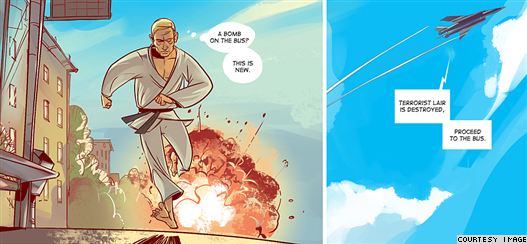
Russian Prime Minister Vladimir Putin, clad in a kimono, rushes to rescue a bus threatened by an Al-Qaeda bomb.

He narrowly manages to save the passengers with the help of his loyal, bear-costumed sidekick, President Dmitry Medvedev.

That's the plot of a new comic strip that has taken the Internet by storm.

"Superputin, A Man Like Any Other," has been viewed almost 3 million times since being posted last week on a specially created website, www.superputin.ru.

I'm more of a Silver Surfer guy myself.

May 18, 2011

Medvedev's Criticism and Putin's Czarist Vision

rsz_putin51811.jpg

Over at Shadow Government, former USAID honcho Paul Bonicelli writes on Putin's latest movements:

But there is that other reason Putin is calling for a popular front and a uniting of every civic and social force he can collect under his banner: it is the way to take Russia back to the age and politics he is most comfortable with, that of czarist Russia, albeit with a twist. Putin has demonstrated after ten years in power that what he is really comfortable with is a Russia that looks and acts a lot more like that of the czars who practiced political and philosophical absolutism. The czars established control over the domestic scene by subjecting all societal groupings and activities to the service of the divine right state. Putin is not a czar de jure but he can be one de facto. This is a minor detail for one so determined to rule as he sees fit. So by defining the nature of the electoral system in terms of who can run and who controls the economy, he's got the electoral problem essentially solved. And this assured control at home means it is much easier to control the "near abroad" and exert influence over world affairs.

I find this to be an interesting point considering this news on Medvedev's latest comments criticizing Putin's lackadaisical attitude toward modernization. He goes on to state that imprisoned energy tycoon Mikhail Khodorkovsky would pose "absolutely no danger" to society if he were pardoned or released, while also sharing rare public criticism directed at Putin's oil czar:

As for Deputy Prime Minister Igor Sechin, the country’s oil czar, Mr. Medvedev seemingly had him in mind when he lambasted the people involved in the failed Arctic exploration deal between BP PLC and OAO Rosneft.

“Those who prepared the deal should have paid more attention to the details of the shareholder agreements and other details,” Mr. Medvedev said at a televised press conference outside of Moscow. “They should have done a more subtle due diligence inside the government. They should have agreed in advance to have fewer problems.”

A thin-skinned leader might overreact to such criticism by reasserting the power he believes is his right. We shall see if there's a public response in short order.

(AP Photo)

Chechnya and Islam

I recently had the pleasure of interviewing former journalist and expert on Chechnya Thomas de Waal for Coffee and Markets. He made several interesting points about the region - here's an excerpt:

de Waal: This is a place where the Russian Government has poured a lot of money into and basically bought itself some time by building up this like war lord, the troops have come home casualty figures down. But in the long term basically Chechnya now, from people’s description, no longer looks like Russia any more. Most of the ethnic Russians have left.

So, Russia is building itself up a long term problem by creating this place which really has not much in common with the rest of Russia. And in the meantime other places in this very complex mountainous region around Chechnya, the North Caucasus is a place of literally dozens of nationalities living in the mountains of the North Caucasus, has become more unstable. There’s been more violence. There’s a kind of low level insurgency carrying on, which is actually getting worse. So, there are on many levels, Moscow is losing this region, even though it’s not very much in the headlines at the moment.

Domenech: I wonder if you could outline for us how that’s happening when it comes to the ethnic transition. You talked about the largest mosque. I’m very fascinated to see sort of how much more Islamic it’s become over the past several years. What are some of the examples of the effect that that’s having?

de Waal: Well, I think what’s happening is that you’ve got a younger generation of people in these places, Chechnya, Dagistan, Ingushetia who have grown up and their whole lives have been shaped by war, by instability, and by unemployment. The State really hasn’t offered them much. The local leaders tend to be very corrupt. If they go work in the rest of Russia they suffer ethnic discrimination. Last December we saw basically race riots in the center of Moscow with white nationalists, skin heads, trying to beat up people with brown skins and from the caucuses in Moscow.

So, it’s a pretty miserable existence for this younger generation. They don’t feel much connection with the rest of Russia. Some of them probably want to feel more connection with the rest of Russia. But for some of them, not all of them, but there’s obviously the attraction of Islam as a creed which promises purity, promises justice, promises equality, and is, you know, a way of fighting back against these corrupt regimes. It’s a narrative we see all over the world and it’s certainly happening in the south of Russia although many people aren’t really seeing it.

I hope you'll listen to or read the entire interview, which touches on several additional points of interest.

May 16, 2011

The Cult of Putin

putin%20bike.jpg

Why doesn't this surprise me all that much:


Members of the sect that has sprung up in a Russian village some 250 miles southeast of Moscow believe that the 58-year-old macho Russian politician is on a special mission from God.

"According to the Bible, Paul the Apostle was a military commander at first and an evil persecutor of Christians before he started spreading the Christian gospel," the sect's founder, who styles herself Mother Fotina, said.

"In his days in the KGB, Putin also did some rather unrighteous things. But once he became president, he was imbued with the Holy Spirit, and just like the apostle, he started wisely leading his flock. It is hard for him now but he is fulfilling his heroic deed as an apostle."

Reports from the sect's headquarters close to the town of Nizhny Novgorod say that its members are all women who dress like nuns and pray for Mr Putin's success in front of traditional Russian Orthodox Church icons that have been placed alongside a portrait of the Russian prime minister himself.

You can see our best Putin photos of 2010 here. And don't forget our list of some of the best Putinisms.

[Hat tip: Passport]

(AP Photo)

April 28, 2011

Russia's Election

Via Other Russia, this video (produced by Russia's Communist Party) lampooning Russia's ruling tandem is making the rounds.

April 21, 2011

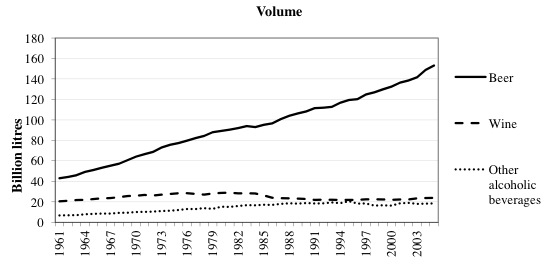
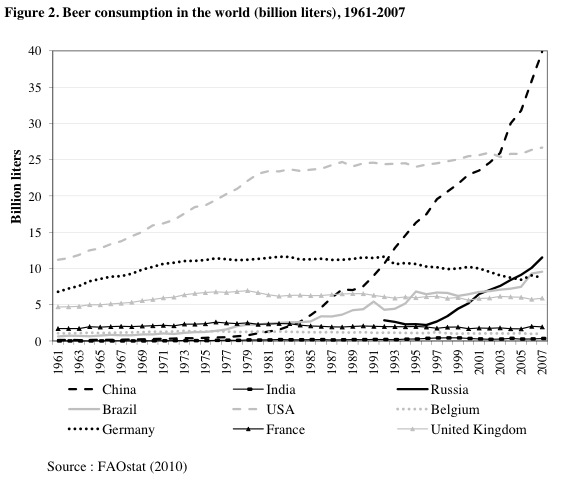
The World's Beer Consumption

voluyme%20of%20booze.jpg
It's rising, according to a new paper. (pdf) However, most of the rise is being driven by China and Russia. In some of the richer nations, such as the U.S., consumption is leveling off or even falling (despite my best efforts):

consmption%20%281%29.jpg

[Hat tip: Felix Samon]

Putin Calls Out Bernanke

Monetary policy gets testy:

“Look at their trade balance, their debt, and budget. They turn on the printing press and flood the entire dollar zone — in other words, the whole world — with government bonds. There is no way we will act this way anytime soon. We don’t have the luxury of such hooliganism,” he said.

Even as Putin blamed the U.S. for printing money — something for which Russia was criticized during periods of hyperinflation in the 1990s — other Russian officials said there is no alternative to the U.S. dollar and declined to discuss cutting the country’s dollar holdings.


Kindred Winecoff pushes back:

This isn't hooliganism. This is using monetary policy in textbook ways. As it happens, U.S. monetary policy has a great effect on external economies, which is why Putin calls the whole world the "dollar zone", but let's be clear: those countries want the U.S. to pursue less expansionary monetary policy so they can free-ride on it. It's fine for them to have that preference, and as I've argued before, I think the U.S. should allow some free-riding. But the U.S. government has citizens to satisfy as well, so those countries can't very well expect the U.S. to pursue a contractionary policies while the economy is so weak.

April 16, 2011

Russia Losing Tank Exports Battle

russia41711.jpg

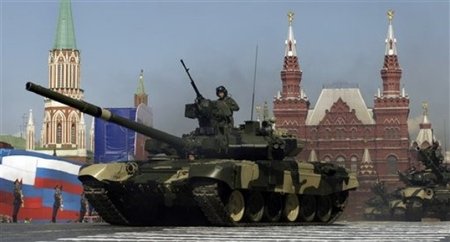
Heavy arms exports have been the mainstay of Soviet and now Russian military sales - for many decades, Russian tanks have competed successfully on the growing global market. Following the collapse of the USSR, Russia has maintained a leading position when it comes to heavy-duty military machinery. However, current trends point to Russia's potential decline in this lucrative market. According to Konstanin Makienko from the Center for Analysis of Strategies and Technologies, Russia is bound for weapons exporting decline unless it offers customers a wide range of modern and competitive products. On the one hand, Russia is the world leader in terms of sales of tank technology; on the other hand, over the past few years, Moscow has lost several tenders for the supply of tanks to foreign customers.

For the time being, India is the largest purchaser of Russian battle tanks - namely the T-90 model - purchasing hundreds of machines through 2019. But once this order runs out there may be no more customers willing to place such large orders, and the overall sales volume of MBTs may start to decline globally. What really irks Russia is the fact that it lost the Moroccan tender for 150 units to the Chinese VT1A main battle tank. The Chinese tank was based on the Russian T-72 MBT. Additionally, China is undercutting Russia on the tank market by offering more models to potential customers - from the cheaper Type-96 model, to more expensive Type-98 and Type-99. All these tanks were based on Soviet models, modernized by China over the course of the last few decades. This prompted Brigadier General Alexander Postnikov, Head of Russian Land Forces, to state that "today's military hardware produced by Russia, including heavy mechanized variants, are not compatible with NATO or even Chinese standards."

To add insult to injury, so to speak, was the selection several years ago by the Malaysian military - long a purchaser of Russian high-tech items like the Mig-29 fighter - of the Polish PT-91M battle tank, which is also based on the Soviet T-72 tank. And just a month ago, Russian T-90 MBT lost to its Ukrainian competitor T-84U during Thailand tender - Bangkok will purchase 200 Ukrainian main battle tanks, which, like the Polish and Chinese versions, is also based on the Soviet T-72 model.

Going forward, the picture mightn't be very bright for Russian exports of tank models and technology. Its mainstay customers in the Middle East - Libya, Egypt, Syria - are either embroiled in political upheavals and have more pressing matters to address, or, like Iraq, they are purchasing American and Western-made weapons. New customers like Venezuela, Azerbaijan and Uganda cannot make up for the drop-off in sales, and fierce competition from improving technology offered by China and other countries is further eroding Russia's once-dominant position. Add to that the growing trend of impending natural disasters, low-level insurgencies and the unlikely event of a large clash between state armies - and numerous countries may prioritize armored vehicles over heavy and expensive tanks if /when they decide to make that purchase. Russia may bounce back with modernized and high tech offerings, but it could only do so by closely following the emerging trends on the global arms market.

(AP Photo)

April 9, 2011

Russia Showcases Its Next-Generation Tank

TANK.jpg

Russian "Urlavagonozavod" tank production facility has showcased - although not publicly - its next generation T-95 main battle tank, also known as "Project 195." The new tank differs from the currently fielded T-90 by a low silhouette, remote-operated turret and a special armored compartment for the crew.

It is estimated that crew safety was increased with this new arrangement, which puts an additional armored plate between the turret and the men operating the tank. This also allowed the tank profile to be lower, which contributes to its low visibility on the battle field, an almost "stealth"-like characteristic.

So, take that, China or NATO! - and there is no word yet if this model will be offered for export.

March 13, 2011

Russia's Ministry of Emergency Situations will aid Japan

Russia' Ministry of Emergency Situations will send to Japan a squad of rescuers to conduct search and rescue operations in areas affected by the earthquake. According to RIA Novosti, Irina Andrianova, the head of MES, confirmed that Japan has already agreed to accept the Russian specialists who will work for two weeks in standalone mode.

Russia to Purchase French Armored Cars

In yet another sign that Russia is serious about modernizing its ground forces with foreign help, the French company Panhard is in talks with Moscow to supply VBL 500 armored combat vehicles for the Russian Border service. The actual delivery of the vehicle is far from certain, given how long Russia has been negotiating with France to purchase the "Mistral" amphibious assault ship.

Another plan to purchase ground vehicles is sure to ruffle the feathers of the domestic weapons manufacturers, who are balking at their government's decisions to acquire Western military equipment instead of buying domestic fare.

This decision follows last year's announcement that Russia will purchase Light Multirole Vehicles (LMVs) built by Italian Iveco after the Italian company formed a joint venture to assemble 2,500 of the armored vehicles in Russia.

February 16, 2011

Russia & Japan Tensions

Demis-kurils-russian_names.png

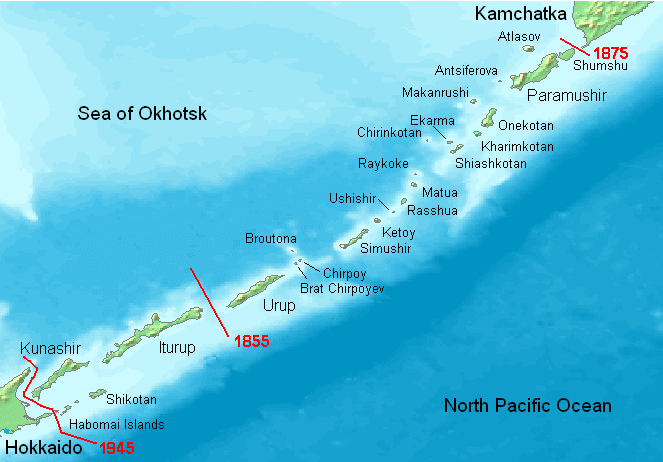
In the last few months, Russia and Japan have been trading barbs over the Kuril Islands. This follows heightened tension between Japan and China over the Senkaku Island chain. These territorial dust-ups leads J.E. Dyer to issue the following warning:

Keeping our foreign-policy thinking on autopilot leaves our spokesmen giving narrowly conceived, legalistic responses that are inadequate to a changing situation. America’s core ally in the Far East is under real territorial pressure from both Russia and China — and the reflexive assumption that any given situation will stabilize itself, with little or no inconvenience to the U.S., is increasingly outdated.

If we're speaking about 'reflexive assumptions,' lets discuss Dyer's. I'll state up front that my knowledge of both the Kuril and Senkaku disputes is pretty topical and I couldn't weigh in definitely on which country has the stronger claim (hit the links above for the Wiki-versions of both disputes). But Dyer isn't litigating the cases either, just simply assuming that the U.S. must stand with Japan. Clearly the U.S. is obligated to defend Japan, but that does not mean that the U.S. should defend Japanese claims that have no merit.

(Photo of Kuril Islands via Wikipedia Commons)

February 15, 2011

Russia's Unbelievable Alcoholism

Richard Weitz provides some hair-raising stats:

- Russians 16 and older drink the equivalent of roughly four gallons of pure alcohol per capita each year, almost twice the amount of their American counterparts.

- Russia currently has 2 million alcoholics.

- The number of Russian children aged 10-14 who drink alcohol exceeds 10 million.

- Roughly 500,000 Russians die annually from alcoholic-related accidents, crimes, and illnesses.

- Alcohol poisoning kills more than 23,000 Russians each year.

In addition to heavy overall drinking, Russians are prone to binge drinking. It is also not uncommon for Russians to consume potentially toxic substances containing high levels of alcohol -- including lighter fluid, cleaning solution and even the ethanol fuels used in vehicles -- for the simple reason that they contain greater concentrations of regular alcohol but are taxed at only one-third the rate. During the Soviet period, MiG-25 warplanes were a particularly popular source, since their de-icing tanks contained almost 5 gallons of pure alcohol.

February 7, 2011

Russia Builds Up Pacific Navy

One of the biggest impediments to China's rise to great power status is the fact that China is surrounded by powerful neighbors. This, for instance, is how Russia is handling it:

The Kremlin’s choice of stimulus package is a bit of a throwback, though—among other things, a new fleet of warships to challenge China. Last week Prime Minister Vladimir Putin announced a whopping $678 billion package of new defense spending for the next decade, with a quarter of the money going to revamp Russia’s Pacific fleet. On the Kremlin’s shopping list: 20 new ships, including a new class of attack submarines, plus new missile subs, frigates, and an aircraft carrier.

January 11, 2011

Treating China Like Russia

china%20gates%20gedg.jpg

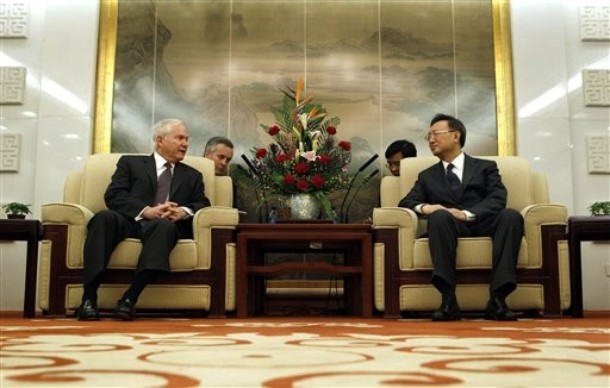
Richard Weitz argues in the Diplomat that the Obama administration's approach to China is much like the Clinton administration's approach to Russia:

Yet these policies should be seen less as an effort to contain China and more as a return to the kind of shaping and hedging policies that the Bill Clinton administration pursued on many security issues, especially relations with Russia. The principle behind this approach is that it will help shape the targeted actor’s choices so that it will pursue policies helpful to the United States and its allies. In the case of China, these policies would include not threatening to use force against other countries, moderating its trade and climate polices and generally embracing and supporting the existing international institutions and the global status quo. On the flip side, if these shaping policies fail, then the United States aims to be in a good position, thanks to its strategic hedging, to resist disruptive Chinese policies until China abandons them.

I don't think the two circumstances are really analogous. Clinton was able to "shape" Russia's choices regarding its immediate security environment because Russia was very weak and consumed with internal problems and the U.S. was not. And the end result of American policy toward Russia through the Clinton administration and into the Bush era was a sharp deterioration in relations between the two countries (a deterioration for which both nations share blame) and a war between Russia and her neighbor - not exactly an ideal we should be shooting for with China.
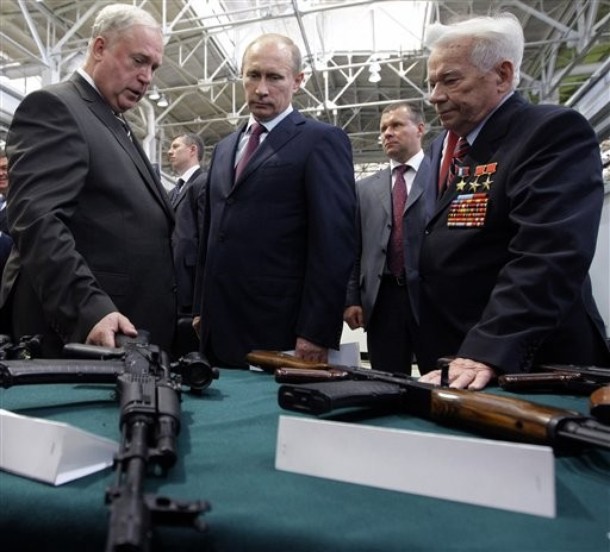
Furthermore, Weitz argues that the U.S. should try to shape China's choices to avoid a "destabilizing" arms race in Asia. But it's too late - arms purchases in Asia are on the rise and probably won't decline for some time. So has it destabilized Asia? Not yet and when you consider the environment, would Weitz prefer that all of China's neighbors were poorly armed and unable to defend themselves? It seems to me that that's an environment ripe for destabilization and Chinese adventurism. An Asia that's armed to the teeth is one in which China is not invading anyone.
(AP Photo)

December 28, 2010

U.S.-Russian Relations After START

Now that the New START debate is over, attention turns to what's next in U.S.-Russian relations. While it appears the Obama administration will work on limiting shorter-range arms, conservatives want to focus on how Russia is ruled. Here's Robert Kagan:

Relations with Moscow are about to grow more challenging. This is partly because some of the easy pickings - including this treaty - have already been harvested. The problems that lie ahead are going to be a tougher test of the reset: what to do about Russia's continued illegal occupation of Georgia; how to handle Russia's increasingly authoritarian domestic behavior, its brutal treatment of internal dissent and its squelching of all democratic institutions.

Jennifer Rubin thinks the conviction of oil tycoon Mikhail Khodorkovsky indicates the reset was "mostly spin."

I'm not sure why we're defining the "reset" as somehow hinging on whether the United States can successfully change the internal politics of Russia - as ugly as they unquestionably are. As I understood it, the goal was to improve U.S.-Russian relations and advance, to the extent possible, American interests in areas where Russia also wielded influence.

It's also not quite clear to me how the United States can go about changing Russia's political institutions (have public figures whine loudly about them?) or why such a complex and ill-defined effort should be the key priority going forward.

December 24, 2010

Voters Question Russian Honesty on New START

Via Rasmussen:

A new Rasmussen Reports national telephone survey finds that only 27% of Likely U.S. Voters trust Russia to honor the nuclear weapons agreement. Half (49%) do not trust the Russians, and another 25% are not sure. That level of trust is consistent with results found in July and March.

Still, 49% of voters wanted the Senate to confirm the nuclear weapons treaty. Thirty-seven percent (37%) think the treaty should have been rejected, while 15% are undecided.

December 22, 2010

Abandoning Belarus?

While everyone else is focused on the Korean peninsula these days, James Kirchick's reports from the Belarus election deserve attention. Kirchick previewed the election by asking why the West is cozying up to Alexander Lukashenko:

Earlier this decade, Lukashenko’s abuses led the United States and the European Union to impose a series of targeted sanctions on regime officials, which led the Belarusian government to reconsider a handful of its draconian actions. The sanctions were effective, in large part, because the U.S. and its European allies presented a united front. After all, unilateral sanctions don’t have the same bite as those implemented by several countries. (See the painstaking effort of the Obama administration to convince governments around the world to get on board with sanctions against Iran.) But, over the past year, that erstwhile front against Belarus has cracked. The EU has dropped many of its sanctions, and European leaders have even begun cozying up to Lukashenko. Meanwhile, the United States, while maintaining sanctions, has done little to press the Belarusian president on his abysmal human rights record.

Why has the West gone soft on Lukashenko? The answer, in fact, lies to the east: Belarus has increasingly become a pawn between Russia and Europe and the United States. And the winner of this geostrategic chess match has been the Belarusian dictator himself.

Last week, Lukashenko was re-elected to a five year term under controversial circumstances and a government crackdown on protests. Kirchick describes the scene:

A column of spetsnaz stormed past me, throwing an elderly man to the ground and beating people—all of them unarmed—mercilessly. Presidential candidate Vital Rymasheuski staggered past me assisted by supporters, his hands covering a bloody gash on his forehead. I witnessed one police officer repeatedly club a person who was trapped against a wall. The sound of truncheons slapping plastic shields was the clear signal that unrelenting violence was only a few seconds away—and that one should run.

Six opposition candidates were arrested by the authorities, and Lukashenko is now set to be the head of state for a full 21 years - essentially, president for life. Shouldn't the United States care about this? Should the U.S. remain silent simply as payback for the Belarus commitment to give up Uranium stores? Is this really worth any diplomatic utility gained by using him as a pawn against Russia?

December 13, 2010

Public Supports New START

According to Gallup:

If given the opportunity to vote on the matter, 51% of Americans would ratify the START nuclear arms agreement with Russia and 30% would vote against it, while 19% are undecided.
The partisan breakout is interesting because while Democrats are the leading proponents (56 would vote in favor vs. 28 voting against), Republicans weren't all that far behind: 49 percent would vote for ratification, 34 percent said they'd vote the treaty down.

The poll was conducted on December 3-6th.

December 11, 2010

Vladimir Putin: Piano Man

This kind of speaks for itself.

(Don't miss our Year in Putin photo slideshow.)

December 3, 2010

Russian Justice

It's not unusual for conservatives to lambaste Putin's Russia for its authoritarian backsliding. Just today, Jamie Fly excoriates the Obama administration's New START treaty on the grounds that, among other things, we really should be pressing Russia on human rights instead. So naturally, conservatives were horrified when authoritarian Russia made a not so subtle threat at WikiLeaks:

So far Russia has had no official response. But on Wednesday, an official at the Center for Information Security of the FSB, Russia’s secret police, gave a warning to WikiLeaks that showed none of the tact of the U.S. reply to the Iraq revelations. “It’s essential to remember that given the will and the relevant orders, [WikiLeaks] can be made inaccessible forever,” the anonymous official told the independent Russian news website LifeNews.

An outrage! Take it away, Charles Krauthammer:

We are at war - a hot war in Afghanistan where six Americans were killed just this past Monday, and a shadowy world war where enemies from Yemen to Portland, Ore., are planning holy terror. Franklin Roosevelt had German saboteurs tried by military tribunal and executed. Assange has done more damage to the United States than all six of those Germans combined. Putting U.S. secrets on the Internet, a medium of universal dissemination new in human history, requires a reconceptualization of sabotage and espionage - and the laws to punish and prevent them. Where is the Justice Department?

And where are the intelligence agencies on which we lavish $80 billion a year? Assange has gone missing. Well, he's no cave-dwelling jihadi ascetic. Find him. Start with every five-star hotel in England and work your way down.

Want to prevent this from happening again? Let the world see a man who can't sleep in the same bed on consecutive nights, who fears the long arm of American justice. I'm not advocating that we bring out of retirement the KGB proxy who, on a London street, killed a Bulgarian dissident with a poisoned umbrella tip. But it would be nice if people like Assange were made to worry every time they go out in the rain.

So is this what we mean by American exceptionalism: being a tad less ruthless than the KGB?

The Tangled Web

The United States will agree to a demand by Kyrgyz officials that their impoverished country be given a share of lucrative fuel contracts for a critical transit hub here for troops headed to Afghanistan, Secretary of State Hillary Rodham Clinton said Thursday.

Clinton's announcement, made during a five-hour visit to the fragile Central Asian democracy, appeared designed to assuage growing anger over Pentagon contracts that have been worth about $3 billion over eight years to Mina Corp. and Red Star Enterprises, a secretive business group registered in Gibraltar.

The new arrangement should also please Russia, which is expected to play a big - and profitable - role. Gazpromneft, part of Russia's state-controlled energy giant Gazprom, will probably supply much of the jet fuel.

Moscow has frequently used Gazprom to further its political and strategic goals, but the Obama administration is gambling that its efforts to "reset" relations with Russia - and the prospect of large profits for Gazprom - will help ensure that jet fuel keeps flowing to the U.S. air base in Kyrgyzstan, known as the Manas Transit Center. - Washington Post

Now the specifics of this seem rather pragmatic - if everyone gets to wet their whistle, no one complains. But it's worth pondering the contortions that U.S. policy must endure all so that we can stop under 100 al-Qaeda fighters from maybe someday crossing into Afghanistan.

December 2, 2010

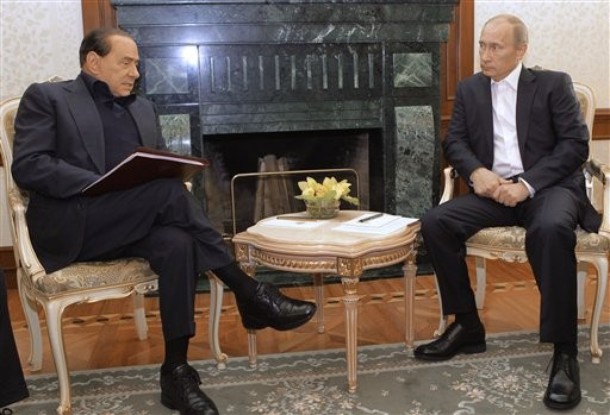
Berlusconi, Putin and Nukes

bromance.jpg

Arms Control Wonk Jeffrey Lewis digs around WikiLeaks and finds evidence that Italy, to his surprise, had pushed to have the U.S. remove tactical nuclear weapons from its territory:

As regular readers know, I have long supported the immediate consolidation of all US nuclear weapons in Europe to two US airbases — with Incirlik and Aviano being the obvious candidates. The surprise announcement that Italy wants the bombs gone too modestly complicates that proposal, although presumably Rome would welcome the withdrawal of nuclear weapons from Ghedi Torre.

Does anyone know why the Berlusconi government might have shifted its position on forward deployed US nuclear weapons? Is it a function of some inexplicable Italian coalition politics?

A possible answer, I think, comes from another revelation in the WikiLeaks trove:

The official report that Mr Berlusconi “and his cronies” have been enabled to make money on multi-million pound energy deals concluded between Italy and Russia. Aside from alleged financial deals, the two leaders’ close ties were founded on Mr Berlusconi’s admiration of “Putin’s macho, decisive and authoritarian governing style,” the then US ambassador to Rome, Ronald Spogli, wrote in Jan 2009.

December 1, 2010

WikiLeaks: Why Not Target China?

wikileaks.jpg

Thomas Friedman asks what it would look like if WikiLeaks poached China's secrets. He does it to set up a faux cable highlighting America's domestic shortcoming, but it's a question I had been asking myself after reading Glenn Greenwald's defense of the organization:

Ultimately, WikiLeaks' real goal appears to me to be anti-authoritarian at its core: to prevent the world's most powerful factions from operating in the dark.

So has WikiLeaks targeted authoritarian powers like China or Russia? The WikiLeaks Wikipedia page says that one of its founders was a Chinese dissident so it's possible they've been poaching secrets from China, Russia and other authoritarian powers, but clearly not with the intensity that they've gone after the U.S. Or maybe they just have not had the good fortune (in their view) to hook up with the Chinese or Russian equivalent of a Bradley Manning, the alleged source of their U.S. material. But this just belies Greenwald's assertion about the organization's "anti-authoritarian" posture - real authoritarian states don't cough up their secrets that easily and truly "anti-authoritarian" organizations just don't scoop up the low-hanging fruit from flawed democracies and call it a day.

Then again, it's not clear that Greenwald has an accurate sense of international media freedom. He writes in a different post on WikiLeaks:

Simply put, there are few countries in the world with citizenries and especially media outlets more devoted to serving, protecting and venerating government authorities than the U.S.

Obviously this is just hyperbole. But still:

Of the 196 countries and territories assessed during calendar year 2009, 69 (35 percent) were rated Free, 64 (33 percent) were rated Partly Free, and 63 (32 percent) were rated Not Free. This represents a move toward the center compared with the survey covering 2008, which featured 70 Free, 61 Partly Free, and 64 Not Free countries and territories.

The survey found that only 16 percent of the world’s inhabitants live in countries with a Free press, while 44 percent have a Partly Free press and 40 percent live in Not Free environments.

The U.S. media can be servile, corrupt and biased but the idea that there are few other countries in the world whose media is more subservient to government power than America ignores a rather huge swath of world media that is actually run by the state.

(AP Photo)

November 27, 2010

The Next WikiLeak

Via Mike Allen:

ADMINISTRATION PREPARES FOR WIKIDUMP OF STATE DEPT. CABLES, possibly Sunday – Could be seven times the October release – Jim Miklaszewski, on “NBC Nightly News”: “U.S. officials tell NBC News that the upcoming document release from the website WikiLeaks contains top secret information so damaging it could threaten Senate ratification of the START nuclear arms control treaty with the Russians. According to the officials, the information contained in classified State Department cables reveals secrets behind the START negotiations and embarrassing claims against Russian leadership – information that could provide ammunition to Republican opponents of the treaty on Capitol Hill. …. There’s also serious concern that some of the leaks could threaten U.S. counterterrorism operations on two fronts, Afghanistan and Yemen. In Afghanistan, where President Hamid Karzai has already come under fire for Afghan corruption and questions about his mental stability, U.S. officials say the secret cables reveal new and even more embarrassing claims about his personality and private life. Perhaps more troublesome, the leaks reportedly include top secret information about U.S. military and intelligence operations against al Qaeda in Yemen and some critical dispatches about Yemen’s President Saleh.”

November 18, 2010

Putin's Puppy

putinpuppy.jpg

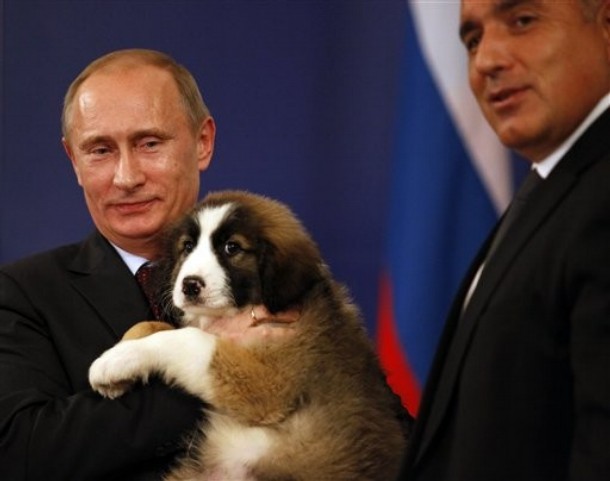
We're used to seeing Russian Prime Minister Vladimir Putin shooting whales, soothing polar bears or riding shirtless across Russian streams. But while in Bulgaria, Putin had a chance to show off his warm and fuzzy side when he was given a Bulgarian shepherd dog by Bulgaria's president (he also pocketed a gas deal). Now Putin is asking Russians to help name the pup. Given that Putin's other dog is named "Connie" it's not clear that the name has to be hyper-masculine, although it probably wouldn't hurt.

(AP Photo)

November 17, 2010

The Odd Death of New START

I have been trying to wrap my head around why such an anodyne arms control treaty is provoking such opposition from the GOP. When you have wall-to-wall support in the U.S. military for the treaty and massive public support (including majority support from self-indentified Republicans), it just doesn't seem to make sense. Daniel Larison draws a lesson:

The death of New START is a useful lesson in just how irrelevant public opinion is to the shaping of foreign policy and national security. Relatively small numbers of activists that are better organized, more engaged and more intense in their views can wield disproportionate influence on policy debates. When they are allied with the relevant interest groups and some members of Congress, a small number of dedicated activists can determine policy to a remarkable degree, especially when their opposition is disorganized and largely passive. The side of the debate that has greater intensity and organization will certainly prevail when their opponents simply trust that the inherent worthiness of the initiative or policy will somehow trump political calculation and influence.

November 14, 2010

Georgian-Russian Tensions Still High

rsz_russiageorgia111410.jpg

Modern weapons of war are becoming more and more commonplace in all conflict theaters around the world. Russian "Interfax" news agency reports that an Unmanned Aerial Vehicle flew over the break-away province of South Ossetia and retreated after the South Ossetians opened fire. The break-away province complained that there have been many such flights over its territory originating from Georgia. Another former Georgian province, Abkhazia, also faces repeated surveillance by the Georgian UAVs.

Meanwhile, the spy row between Georgia and Russia shows no signs of abating. Last week, the Georgian government announced the arrest of 13 "Russian spies," many of whom were Georgian citizens allegedly spying for Moscow. This week, Interior Minister Vano Merabishvili addressed the nation on television. "Operation "Enveri" is the first stage in a massive counter-intelligence operations. There are many spy groups in Georgia still," said the minister. "But it's not the only operation currently conducted by the Georgian Counterintelligence services. At least three Russian spy agencies operate on the territory of Georgia - FSB, SVR and GRU - and each has its own networks."

Merabishvili also offered his thoughts on why the official reaction in Moscow to "spy scandal" was rather muted. According to him, in 2006, when Georgian authorities arrested four Russian soldiers and dozens of Georgian citizens in a counter-intel sweep, "Moscow still thought we were its satellite . . . And Moscow was psychologically wounded that a state it considered as unimportant was actually taking some action. Since then, much time has passed, and Georgia's image has changed. So now Russia's reaction was adequate, similar to the one when its spies were discovered in Europe. When we will identify Russian spies for the third time, there may not be any reaction from Russia at all."

For its part, Moscow considers the latest Georgian spy operation as a provocation and a "political farce."

(AP Photo)

November 7, 2010

Russia Buying Indigenous UAVs

It looks like domestic pressure has finally gotten to the Russian military - recently, the Ministry of Defense tested 22 models of indigenous-produced UAVs and decided to purchase some of them for use in the armed forces. This does not impede Russia's earlier commitment to international UAV purchases, especially from Israel.

Meanwhile, Kazak firm Kazakhstan Engineering and French firm Sagem recently signed the memorandum of understanding to jointly produce UAVs.

October 30, 2010

Russia Creating Affordable 'People's Car'

Following India's recent unveiling of a design for a cheap, mass-produced "people's" vehicle that could be affordable to multitudes of new consumers, Russian "Onexim Group," headed by Mikhail Prokhorov (who also owns the NBA's New Jersey Nets) presented the first images of two hybrid cars on Oct. 12 - prototypes of urban hatchback and a compact crossover, created under the "City Car" project. The vehicles were designed in only 180 days without any foreign support or contribution. Three prototypes are to be tested this December.

It is expected that the "people's" cars will be equipped with 70-horsepower electric motor, lithium-ion batteries and a 0.6-liter engine that can operate on natural gas and will produce energy to recharge the batteries on the move. According to preliminary information, the cars will be able to go 400 kilometers (about 250 miles) without refueling, at the maximum speed of 120 kilometers (75 miles) per hour. The base cost of these cars is about $10,000, but could rise to as much as $15,000.

October 26, 2010

Losing Europe to Russia?

russia%20germany.jpg

John Vinocur wonders if the U.S. is "losing" Europe to Russia. The framing of the question is a bit odd, because it presupposes that Russia is strong enough to "win" Europe away from the United States. What's really at issue is Europe's willingness to chart a slightly more independent course:

Rather, Germany and France, meeting with Russia in Deauville, northern France, last week, signaled that they planned to make such three-cornered get-togethers on international foreign policy and security matters routine, and even extend them to inviting other “partners” — pointing, according to diplomats from two countries, to Turkey becoming a future participant....

As for the Obama administration stamping its foot, what it came down to was a senior U.S. official saying: “Since when, I wonder, is European security no longer an issue of American concern, but something for Europe and Russia to resolve? After being at the center of European security for 70 years, it’s strange to hear that it’s no longer a matter of U.S. concern.”

Needless to say that Washington does not believe in "spheres of influence" or the ability of a great power to have a say in another country's foreign policy decisions. No sir.

(AP Photo)

October 21, 2010

Who Killed the Monroe Doctrine? America

chavez%20medvedev.jpg

Investors Business Daily is outraged that Russia is helping Venezuela develop nuclear technology, demanding that someone remind Russia of the Monroe Doctrine.

Unfortunately, the U.S. doesn't have any leg to stand on with respect to the Monroe Doctrine given how it's become a bi-partisan staple of foreign policy establishment dogma that the U.S. does not recognize "spheres of influence." It would be self-evidently absurd for the U.S. to protest Russia's dalliances in Venezuela (a little under 2,000 miles from the U.S. border) when the U.S. is pushing to admit countries that border Russia into NATO.

That said, should we be dusting off the concept of 'spheres of influence' in an era of emerging great powers? Ted Galen Carpenter argues that we should:

Russia needs to find a graceful way out of its increasingly cozy relationship with Chavez, and the United States needs to stop talking about deploying missile defenses or expanding NATO eastward. Washington and Moscow must acknowledge that the concept of spheres of influence is alive and well, and that gratuitous violations of that concept will negate any prospect for a reset in relations.

U.S. leaders must also comprehend that cordial relations with China require a willingness to accept that East Asia’s rapidly rising great power will seek to establish a sphere of influence in its neighborhood. Beijing’s expansive territorial claims in the South China Sea and the recent spat with Japan over disputed islets in another body of water are signs of that process. China’s growing power and assertiveness means that the United States will need to tread softly regarding such territorial disputes, as well as the even more sensitive Taiwan issue, if Washington wants to avoid nasty confrontations with Beijing.

While I think avoiding nasty confrontations should be a key goal, I'm not sure how affording China a 'sphere of influence' would work in practice. China's prospective 'sphere' encompasses major economic powerhouses like Japan, Taiwan and South Korea, and some weaker Southeast Asian states. Unlike, say, Russia, where the U.S. ties to countries like Georgia or even Ukraine were historically relatively weak and economically negligible, American ties to Japan and South Korea are anything but.

(AP Photo)

October 20, 2010

Courting Eastern Europe

Helle Dale offers some suggestions for the Obama administration:

Reform the U.S. Visa Waiver program, which still means that Polish residents have to line up for visas to enter the United States, when travelers from other European countries do not;

Work with the countries of CEE on security cooperation and democracy promotion. Make U.S. officials visible and available to the publics of these countries and reestablish public diplomacy institutions, such as America houses, that have been allowed atrophy since the Cold War;

Reexamine U.S. decisions on international broadcasting into the former Soviet Union, where services have been cut even in the absence of local free media.

Support the exploration of gas shale, which Poland possesses in abundance, and which would provide an alternative to Russian gas as Sikorski suggested. There is currently only $2 billion in U.S. business investment in Poland. Gas shale could give Poland energy independence; perhaps even make it an energy exporter.

I think these are mostly sensible ideas in their own right, but Dale implies that this is all necessary to blunt malevolent Russian influence. But I don't think we should view - or treat - relations with Eastern and Central Europe as zero sum standoffs.

October 13, 2010

Russian Reset, UK Style

UK Foreign Secretary William Hague is looking to shore up relations with Russia:

Hague, part of a coalition government which took office in May, will meet Russian counterpart Sergei Lavrov and President Dmitry Medvedev during his 24-hour visit which began on Tuesday.

Relations between the previous British government and Russia deteriorated badly after the 2006 murder of Alexander Litvinenko in London with a rare radioactive isotope.

Meanwhile, Arnold Schwarzenegger's getting job offers from Medvedev.

September 22, 2010

The Wages of Appeasement

If all these policies were aimed to achieve an effective sanctions package against Iran with Russian support, then the "reset" policy failed. The sanctions, as advertised, will not be able to stop the Iranian race to gain nukes.

The reported US capitulation on S-300 is the latest in the long list of unilateral concessions to Russia, which endanger US friends and negatively affect US national security. - Ariel Cohen, "If the S-300 Sale is Allowed, Obama’s Russian “Reset” Policy Has Failed"

Russian President Dmitry Medvedev issued a decree Wednesday banning all sales of S-300 anti-aircraft missile systems to Iran. - AP

September 8, 2010

Israel's Military Deal with Russia

israel%20russia.jpg

Earlier in the year, France was poised to sell its Mistral amphibious assault ship to Russia (negotiations are still ongoing). The U.S. was not pleased. Secretary Gates voiced his concern about the deal. In the media, the reaction was more robust. Writing in the Weekly Standard, Reuben Johnson went so far as to declare the NATO alliance itself was a threat to peace:

If Europe is now only for Europeans -- and NATO is a threat rather than guarantor of peace -- then the U.S. needs to rethink how it handles its own military sales arrangements with those European nations who express these sentiments either by words or deeds. If these deal goes through, perhaps it might be time to reset the U.S. military relationship with France.

So maybe Johnson cares to comment about this:

Israel and Russia made history on Monday, signing for the first time a military agreement that will increase cooperation on combating terrorism and the proliferation of nuclear weapons, but also could lead to the sale of Israeli weaponry to the Russian military...

Russia is particularly interested in acquiring Israeli unmanned aerial vehicles (UAVs). In 2009, Russia bought 12 drones from Israel Aerospace Industries, following its war with Georgia, during which Georgian military forces used Israeli Elbit Systems Hermes 450 UAVs.

(AP Photo)

September 7, 2010

Brazil Eying Russian Competitor to Humvee

According to Russian media, in the next few days, Russian GAZ-2330 "Tiger" armored car will be transferred for testing by the Rio de Janeiro police, which will use the vehicles to patrol the city suburbs.

According to Oleg Strunin, official JSC Rosoboronexport representative to the Brazilian state arms export agency, several Brazilian states expressed an interest in the Russian armored vehicle. Negotiations are also taking place on assembling "Tigers" in Brazil. "We believe that 'Tigers' have very good prospects in Brazil, and hope to soon conclude a contract for delivery of such machines to the country," added Strunin.

Bottom line: "Tiger" was conceived, designed and tested as a competitor to the American Humvee armored car. And while the American vehicle served with distinction for the past three decades in huge numbers virtually everywhere around the world in numerous conflicts, saving countless lives, the "Tiger" on the other hand is a new vehicle which hasn't undergone the same rigorous battlefield testing. Even as Hummers are being phased out from Iraq and Afghanistan in favor of a new breed of vehicles, it certainly can hold its own as a police patrol car.

So why did Brazil choose the untried and untested Russian car? Good question ...

August 11, 2010

Putin's Katrina?

putin%20katrina.jpg

Simon Shuster thinks the wildfires crippling Moscow could spell political trouble for Vladmir Putin and Dmitri Medvedev:

According to opinion polls, however, the Russian public is not nearly so eager to pat its leaders on the back. In the last two weeks of July, state-run pollster VTsIOM reported that approval ratings for both Putin and Luzhkov had fallen to their lowest levels in more than four years, while Medvedev's numbers were at one of their lowest points since he took office in May 2008. At the same time, more Russians have started clamoring for the return of gubernatorial elections, which Putin canceled in 2004 when he handed the Kremlin the right to appoint regional leaders. In a survey released August 6 by the independent Levada Center, 59% of Russians now want to choose their own governors again, up by 5% since January.

But Michael Stott says that Russia's media manipulation will be able to overcome any short-term damage done:

Popular apathy, control over the media and a lack of potent opposition will ensure that Moscow's ruling duo do not suffer seriously from disastrous summer fires as president George W. Bush did from his administration's slow response to catastrophe.

Although a record-breaking summer heatwave found Russia's authorities ill-prepared to fight the fires and slow to react to the smoke pollution that has crippled Moscow, analysts said Prime Minister Vladimir Putin and President Dmitry Medvedev would ensure that others took the blame.

Sounds like business as usual for a politico.

Personally I think the most absurd vignette of the entire Moscow fire was undoubtedly this, from Shuster:

But perhaps the most blatant attempts to downplay the disaster have come from the mayor of Moscow, Yuri Luzhkov. As the fires around his city choked the skies with smoke last week, Luzhkov was away on holiday. "What's the problem? What, do we have some kind of emergency situation, some kind of crisis situation? What's the problem in Moscow?" the mayor's spokesman told the LifeNews agency on August 6. Three days later, LifeNews reported that Luzhkov, an avid beekeeper, had ordered his prize-winning hives to be evacuated away from the smog. All the while, he has refused to declare a state of emergency for Moscow's human inhabitants.
(AP Photo)

August 10, 2010

Democratic Capitalism

Dani Rodrik pushes back against the argument that autocratic systems make for good capitalism:

Democracies not only out-perform dictatorships when it comes to long-term economic growth, but also outdo them in several other important respects. They provide much greater economic stability, measured by the ups and downs of the business cycle. They are better at adjusting to external economic shocks (such as terms-of-trade declines or sudden stops in capital inflows). They generate more investment in human capital – health and education. And they produce more equitable societies.

Authoritarian regimes, by contrast, ultimately produce economies that are as fragile as their political systems. Their economic potency, when it exists, rests on the strength of individual leaders, or on favorable but temporary circumstances. They cannot aspire to continued economic innovation or to global economic leadership.

At first sight, China seems to be an exception. Since the late 1970’s, following the end of Mao’s disastrous experiments, China has done extremely well, experiencing unparalleled rates of economic growth. Even though it has democratized some of its local decision-making, the Chinese Communist Party maintains a tight grip on national politics and the human-rights picture is marred by frequent abuses.

But China also remains a comparatively poor country. Its future economic progress depends in no small part on whether it manages to open its political system to competition, in much the same way that it has opened up its economy. Without this transformation, the lack of institutionalized mechanisms for voicing and organizing dissent will eventually produce conflicts that will overwhelm the capacity of the regime to suppress. Political stability and economic growth will both suffer.

This is the basic message of Ian Bremmer's book, the somewhat erroneously titled The End of the Free Market. Bremmer argues that despite the threat posed by autocratic capitalist systems, they'll ultimately be undone by their own shortcomings. It might be hard to imagine after the recent debacles of democratic capitalism, but I suspect it's true.

[Hat tip: Nick Schulz]

July 27, 2010

Photo of the Day

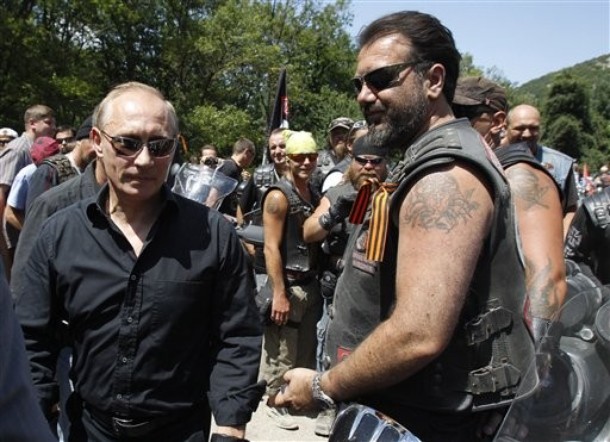
putin%20the%20biker.jpg

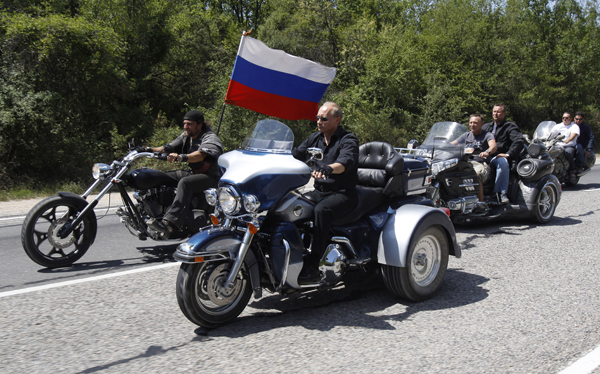
(Russia's Vladimir Putin attends an international bikers convention in Ukraine. AP Photo)

July 21, 2010

A Russian, Parasailing Donkey

No clever title necessary:

Police are apparently still looking for the donkey and its owner.

July 14, 2010

Americans Not Surprised By Russian Spying

An unsurprising poll from Angus Reid:

The revelation that there are Russian spies posing as American citizens in the United States did not shock many people in the North American country, according to a poll by Angus Reid Public Opinion. 77 per cent of respondents say they were not surprised about this situation.

The poll also found that:

Half of respondents (50%) think Russia should not be singled out for its espionage because many other countries keep active spies elsewhere. One-third of Americans (34%) disagree with this view, and believe Russia should be shamed for maintaining a Cold War mentality by keeping active spies in Western countries.

Two thirds of Americans (65%) think the Central Intelligence Agency (CIA) should continue to train and send American spies into other countries, while only 12 per cent believe this activity is no longer necessary.

Full results here. (pdf)

July 13, 2010

Soft Power and Espionage

Martin Regg Cohn has an interesting column in today's Toronto Star on the fine line between espionage and soft power in Canada:

Forget the stagecraft of spy novels, or the make-believe machinations of those captured Russian sleeper agents. China targets Canadians with more mundane tactics ranging from sumptuous free lunches to package tours of China. Last month, a so-called “opinion leader” told me excitedly that he’d been invited on a tour of China. MPs go all the time. So do freelance journalists. All on China’s dime.

Call it soft power. But spying can be a deadly serious business when it tars entire communities. The canard of “dual loyalties” has dogged Canadians of Chinese, Japanese, Italian and Jewish descent over the years — with many innocent citizens unjustly detained in wartime.

It’s a mistake to single out diasporas. While the Chinese and other governments shamelessly target émigré groups to aid the motherland, they spend at least as much time and money trying to win over the “landed gentry” — the white folks who make up the Canadian establishment going back generations.

Read the whole thing here.

July 12, 2010

Between the EU and a Hard Place

Can a regime survive without any friends? We may be about to find out in Belarus:

It’s not often that Brussels and Moscow see eye to eye on the politics of the former Soviet Union. But both want Belarussian president Alexander Lukashenko gone, preferably after elections slated for early 2011. The EU has long criticized Lukashenko for abusing opposition activists and censoring local media. Now he’s alienated his onetime great protector, Russia, as well. His unpaid gas bills to the tune of $200 million led Gazprom to briefly cut off supplies last month. He called Prime Minister Vladimir Putin “the main enemy of the Russian people,” and refused to recognize Russian-occupied Abkhazia and South Ossetia as independent states in defiance of Kremlin pressure. He also offered asylum to former Kyrgyz president Kurmanbek Bakiyev, whom Russia helped oust earlier this year.

Russians Would Vote Putin

putin%20votes.jpg

Via Angus Reid:

Russian prime minister Vladimir Putin could defeat president Dmitry Medvedev—the man who appointed him to his current job—in the next presidential election, according to a poll by the Yury Levada Analytical Center. 37 per cent of respondents would vote for Putin in the next ballot, up 10 points since April.

Medvedev is second with 17 per cent, followed by Communist Party (KPRF) leader Gennady Zyuganov with six per cent, Liberal Democratic Party (LDPR) leader Vladimir Zhirinovsky with four per cent, and Russian Federation Council speaker Sergei Mironov of A Just Russia with two per cent.

(AP Photo)

Spy vs. Spy

russia%20spy%20ring.jpg


Rasmussen Reports:

With the U.S.-Russia spy swap making headlines, 65% of voters say they are at least somewhat confident in the ability of the government to catch those from other countries who are spying on the United States.

A new Rasmussen Reports national telephone survey finds that just 30% of voters lack confidence in the government’s ability to catch foreign spies.

These findings include 19% who are Very Confident in the government’s counterespionage efforts and five percent (5%) who are Not At All Confident.

Seventy-two percent (72%) regard the threat of Russian spying in this country as at least somewhat serious, with 31% who view it as Very Serious. Only 22% say it’s not very or not at all serious.

But 20% say the United States spies more on other countries that they spy on us. Seventeen percent (17%) think it’s the other way around, that other countries spy on us more than we spy on them. A solid plurality (48%), however, think the level of spying is about the same among all countries.

(AP Photo)

Business As the Continuation of Politics by Other Means

russia%20gazprom.jpg

At least in Russia, as Gregory Feifer writes:


To conceal its designs, the Kremlin relies on a dizzying web of shell companies nominally owned and operated by Europeans but in reality controlled by Moscow to attack by stealth. Among them, a gas-trading company named Vemex has taken 12 percent of the Czech domestic market since its establishment in 2001 to sell Russian natural gas. Although there's nothing on Vemex's website to indicate it, the company is Czech in name only. It's actually controlled by Gazprom through a series of companies based in Switzerland, Germany, and Austria, including Centrex Europe Energy and Gas, which has helped spearhead the Russian drive to buy energy assets across Europe.

Centrex is registered in Austria and, according to Gazprom's website, founded by its own Gazprombank. But the company's real ownership is impossible to trace. According to the European Commission, Centrex is owned by Centrex Group Holding Ltd., registered in Cyprus, a company controlled by Gazprom's German subsidiary, and RN Privatsiftung, a Vienna foundation whose stockholders are unknown.

Why go to the trouble of hiding the real owners of companies either already known or believed to be controlled by Gazprom? Vemex is just one of a large number of enterprises Gazprom has set up in countries across Central and Eastern Europe to jockey for stakes in European energy utilities. By disguising the real owners, Gazprom makes its actions more palatable to Europeans wary of expanding Russian influence.

Investigative journalist Jaroslav Plesl points the finger at his own countrymen for enabling Moscow. Czechs are "willing to sell anything," he says of the staggering corruption in his country, something Russian companies have been able to exploit by taking advantage of nontransparent tenders. They also lobby to prevent the development of regulations that would prohibit those kinds of activities, with the effect of exporting the kind of corruption that dominates Russia.

My question: does this kind of activity stand on its head the vision of globalization as channeling the contests between nations into the more peaceful economic realm, or confirm it?

(AP Photo)

July 5, 2010

Russia Conducts Military Exercises in Far East

Here is something that should put China on notice - Russian military just tested the possibility of non-stop flight by jet fighters from the European part of Russia to the Far East. The test was conducted as part of the "Vostok-2010" (East 2010) exercises. According to Interfax news agency, Russian Chief of General Staff Nikolai Makarov reported on the flight at a meeting with Russian President Dmitry Medvedev.

According to Makarov, Su-24M and Su-34 fighter-bombers participated in the flight, with Su-24M needing three in-flight refuelings, while the Su-34 was refueled twice.

The "Vostok-2010" exercises, running from June 29 through July 8, are the biggest maneuvers of Russian armed forces in 2010, involving the Pacific Fleet and two military districts, bringing together 20,000 troops, more than 5,000 units of military equipment, over 40 ships and 75 airplanes and helicopters.

The exercises involve defense against massive missile and air strikes, as well as possible counter-insurgency operations. "Vostok-2010" also provides training for joint action with the FSB border forces for the protection of maritime borders, as well as anti-piracy and anti-poaching operations. President Medvedev followed the exercises from aboard Peter the Great heavy nuclear missile cruiser.

July 1, 2010

Anatomy of the Russian Spy Ring

Stratfor has a comprehensive review of what we know about the Russian spies.

June 30, 2010

Russia Hosts Military Exhibition Near Moscow

An international military exhibition has opened in Zhukovsky, near Moscow. "Technology in Mechanical Engineering 2010" forum will last until July 4, 2010. This forum will include the exhibitions "UVS-TECH", "International Salon of Weapons and Military Equipment", "Intermash" and "Aerospace 2010."

The exhibition involves 314 companies. Russian Defense Ministry will showcase 23 units of military equipment and 25 models provided by the military manufacturers, such as Ka-135 and "Vulture" drone mock-ups and a new "Wolf" armored car.

Visitors can also see other modern armaments, including T-90S tanks; BMP-3M infantry fighting vehicles; newest KAMAZ and URAL heavy trucks; "Tiger" armored cars; and many other interesting technologies.

Russian Experts: China (Again) Preparing to Attack

Russia's "Svobodnaya Pressa" (Free Press) publication reports that China's growing infrastructure projects parallel to the border with Russia are a sign that Beijing could use such extensive infrastructure for a successful military thrust into the Russian Far East.

In the Tszyain county, Heilongjiang Province, two highways are being constructed - 114-km long stretch of Heihe - Tszyain road and 103-kilometer long Suybin - Tszyainong highway, to be open in October 2010. Additional roads are also built on the border with Russia. Alexander Aladdin, "Svobodnaya Pressa" China expert, is sure that such infrastructure development is preparation for war. Earlier, Aladdin asked Russian Constitutional Court to review the agreement with China on the transfer of Russian Amur Islands to Beijing. He believes that such transfer could be a strategic threat to the safety of Khabarovsk, the Far East and Russia itself in the future: "China is already building wide concrete roads toward Russia that could withstand the stress of transporting heavy equipment and weaponry. With the commissioning of such infrastructure, China can easily transfer troops and equipment along the entire border with Russia, and to conduct offensive operations in strategically important areas."

Aladdin laments the state of the Russian military today: "After undergoing modernization, the army has nothing left except the 85 untrained brigade-level formations. The massive reduction of troops and officers in the army has left the Far East and Eastern Siberia without protection from the external enemy." He predicts China's easy victory under such circumstances: "The beginning of large-scale offensive operations along the land border and landing in northern Russia will conclude with a full, quick victory for China and the loss of the Russian territory to the Ural Mountains. After all the territory to the Urals are captured, Russian citizens will be deported or destroyed."

Alexander Khramchikhin, the head of the analytical department of the Institute of Political and Military Analysis, agrees with this possible scenario: "The construction of the road along the Russian-Chinese border is very specialized - this road runs parallel to the front lines. China has a strong interest in the invasion of our Far East - the fact is that China cannot survive without expanding its territory." According to Khramchikhin, "China will try to do so without conflict, but in case of a crisis, it will launch a war without a second thought. The plan to take over our territories is designed, I think, over the next several decades. The first main task for China is to solve the Taiwan issue. After that, the Chinese will take Russia seriously. They do not even hide their intentions."

What is interesting is that neither expert mentions that Russia would use nuclear weapons in its defense if attacked first - a policy that is enshrined in its Military Doctrine.

400 Russian Spies in U.S.

That's the word from a former KGB hand:

Oleg Gordiyevsky, a British-based former senior agent with the Russian Federal Security Service's (FSB) predecessor, told RFE/RL's Russian Service that he reckons Russia has hundreds of spies currently working in the United States.

A "conservative" estimate is that 400 or so spies are operating in the U.S. from embassies and other Russian governmental institutions, he said.

He put the number of deep-cover agents, or "illegals" like those in the recent case, at around 60.

Gordiyevsky estimated the number of U.S. spies in Moscow at 20-25, and said the British had two spies in the Russian capital.

He did not elaborate on how he arrived at such specific figures.

The U.S. side sounds a bit low, no?

June 29, 2010

Russian Spies

russianspies.jpg

The U.S. is obviously not the only target of Russian espionage. Last week, the Czech Republic's intelligence service released its annual report highlighting the extensive efforts made by the Russians to spy on their country. And as Robert Coalson notes, it makes for interesting reading:

The BIS spent all (yes, all) its counterintelligence effort against Russia. “In terms of coverage, intensity, aggressive nature and quantity of operations, the Russian intelligence services have no rivals in the territory of the Czech Republic.” (The BIS's 2008 report puts this thought even more amusingly: "As to activities of other intelligence services in our territory, the risks they posed for the Czech Republic in 2008 were negligible.")

Here’s more from this NATO member state's main security agency:

“There were continuing efforts of Russian companies to establish themselves in the Czech energy market, both through supplies of relevant products and through firms owned by companies having their seats in European countries. It is highly likely the complex ownership structure is aimed at camouflaging links to the Russian Federation.”

“There has been an increase of intelligence capacities and intensity of intelligence operations in the Czech Republic, particularly in the field of research and development and in [the] economy….”

“Russian intelligence services have in some cases smoothly picked up where their Soviet predecessors left off.”

The Russian spy ring story is certainly interesting, if not terribly surprising. My initial reaction was to shrug it off and hope that our moles are more effective at prying away Russia's secrets. Daniel Drezner, however, is confused, particularly by the timing of the U.S. announcement and the fact that the alleged spies weren't actually charged with espionage.

I'm curious to see how the news will be processed - will people view it as indicative of Russian perfidy or just the normal course of rough-and-tumble international power politics? I incline toward the second camp, on the assumption that we're giving as good as we're getting.

(AP Photo)

June 28, 2010

Russian Views of U.S. Improve

medvedevobamafriends.jpg

According to a new poll:


Russians like the U.S. government more than they have since before Boris Yeltsin ceded the presidency to Vladimir Putin, indicating Barack Obama’s “reset” is paying off, a poll published today shows.

Fifty-nine percent of Russians have a “good” or “very good” opinion of the U.S., up from 46 percent a year ago and 22 percent in September 2008, the month after Russia waged a five- day war with U.S. ally Georgia, the Moscow-based All-Russian Center for the Study of Public Opinion said in a statement.

The percentage of Russians who have a “bad” or “very bad” opinion of the U.S. fell to 27, less than half the 65 percent recorded in September 2008 and the lowest since 1998, according to VTsIOM, as the Moscow-based center is also called. The poll of 1,600 people was conducted May 1-2, before President Dmitry Medvedev’s state visit to California’s Silicon Valley and Washington, and had a margin of error of 3.4 percentage points.

(AP Photo)

June 21, 2010

Photo of the Day

putintopgun.jpg

Russian President Vladimir "Top Gun" Putin steps into the cockpit of a Sukhoi T-50. AP Photo

June 17, 2010

Russia's Sphere of Influence

Brian Whitmore says that Moscow is reluctant to exercise its influence in its near-abroad:

Like Russia's 2008 war with Georgia over the pro-Moscow separatist region of South Ossetia, the crisis in Kyrgyzstan is emerging as a watershed moment in Moscow's relations with its former Soviet vassals.

But while the war in Georgia sent a loud and clear message that Russia is prepared to unilaterally use force against its neighbors to achieve its objectives in the region, the Kyrgyz conflict appears to be demonstrating the limits of Moscow's power.

And while the invasion of Georgia had Cold War undertones, pitting a resurgent Russia against a close U.S. ally, the crisis in Kyrgyzstan is highlighting a new spirit of cooperation between Moscow and Washington -- both of which have military bases and vital interests in the small but strategically important Central Asian country.

Russia wants to prevent chaos in its backyard, analysts say, while the United States wants to assure that its mission in Afghanistan, which is supplied via the Manas military base in Kyrgyzstan, is not disrupted. Both have an interest in the situation stabilizing.

June 6, 2010

Photo of the Day

putin%20feeds%20deer.jpg

(Vladimir Putin reveals his soft side. AP Photos)

May 28, 2010

Poll: United Russia By a Mile

putinguns.jpg


Via Angus Reid, it looks like Putin's party enjoys quite a lead:

Most people in Russia would support the governing party in the next election to the State Duma, according to a poll by the All-Russian Public Opinion Research Center. 54 per cent of respondents would vote for United Russia (YR) in the next ballot, up two points since April.

The Communist Party (KPRF) is a distant second with eight per cent, followed by the Liberal Democratic Party (LDPR) with five per cent, and the opposition movement A Just Russia with four per cent.

(AP Photo)

May 21, 2010

Peripheral Foreign Policy

rsz_iran052110.jpg

Roger Cohen is frustrated by the Obama administration's reaction to the Turkish-Brazilian nuclear fuel deal with Iran:

Brazil and Turkey represent the emergent post-Western world. It will continue to emerge; Secretary of State Hillary Clinton should therefore be less trigger-happy in killing with faint praise the “sincere efforts” of Brasilia and Ankara.

The West’s ability to impose solutions to global issues like Iran’s nuclear program has unraveled. America, engaged in two inconclusive wars in Muslim countries, cannot afford a third. The first decade of the 21st century has delineated the limits of U.S. power: It is great but no longer determinative.

Lots of Americans, including the Tea Party diehards busy baying at wolves, are angry about this. They will learn that facts are facts.

This strikes me as somewhat contradictory. Cohen laments the Obama administration's rejection of the fuel swap deal - which he concedes is an insufficient deal that fails to meet the Western demands put forth last year - because 1. You don't want to hurt feelings in Ankara and Brasilia, because they are emerging powers whom you might need down the road, and 2. this deal, while well short of the October arrangement, may have served as a "tenuous bridge between "mendacious" Iranians and “bullying” Americans."

First, the latter point: Spinning a deal for the sake of public perception and reaching a substantive deal are obviously two different things. Cohen asserts that this deal would've been a huge P.R. victory which, I suppose, it could have been. But if the administration is serious about nonproliferation it was necessary to knock this deal down right out the gate - which it apparently did.

And spin spins both ways. While Washington and the West certainly could have spun this deal to their advantage, so too could have the Iranians - as they already have. The whole point of this deal was not only to build trust between Tehran and Washington, but to assuage Western and regional concerns about Iranian enrichment. This week's trilateral deal fails to do that, and thus it fails to actually take time off the so-called Doomsday Clock.

In other words, accept this deal and you basically gave Iran seven months to set the terms of negotiation while rebuffing your own immediate concerns. Clenched fist, check.

As for Brazil and Turkey, what exactly was Obama to do? Accept the deal, and you accept the Turkish-Iranian argument that the deal represents the death knell of sanctions, which the U.S. never agreed to and never will. Cohen may view this deal as a beginning, but Tehran and Ankara are spinning it differently. And as Greg noted yesterday, China and Russia simply matter more than Brazil and Turkey do, especially on the matter of Iranian proliferation.

Will this hurt U.S. efforts down the road when, at some unforeseen moment, Washington needs Ankara or Brasilia? Perhaps. But that's the point: A multi-polar world doesn't guarantee a less divisive one where everyone gets along and hugs out their problems. Quite the contrary.

For much of the 20th century - and the first few years of the 21st - American power was rather easy: Either you're with us, or you're with the evildoer behind door #1. Make your choice. There was a kind of cold clarity in this arrangement, and in some ways the U.S. excelled at it. But as other powers emerge, they also come to the table with years - decades, even - of experience at playing a weaker hand inside global institutions like the UN. They know how to check the maneuverings and desires of other states, just as they too have been checked.

Washington isn't very good at this game, and it's going to take some time for the United States to rebuild capital and use its still preponderantly stronger military and economy to its advantage. This may require a more prudent, interests-based foreign policy designed to keep larger powers in your corner - which, in turn, will mean less peripheral meddling in said powers' backyards.

So will Ankara and Brasilia remember this? Probably. Welcome to the new world order.

UPDATE: Larison offers his thoughts on the matter.

(AP Photo)

May 20, 2010

Did the U.S. Rush Iran Sanctions?

clintiransanctions.jpg

Just as Copenhagen was a visible demonstration of the rising clout of China, the recent nuclear diplomacy by Turkey and Brazil was still more evidence that the leadership role so coveted by the U.S. is being undermined by the rise of economic powers with divergent security interests. Unlike in Copenhagen, though, it looks as though the U.S. was able to rebuff this "rogue" diplomacy. Matt Duss, for one, is unhappy:


It’s clear that Iran saw the announcement of the deal as a way to head off international pressure. But that doesn’t mean that its acceptance of the terms isn’t significant — it is. In my view, it would have been smarter for Obama to acknowledge the deal as a potentially positive step, but make clear that more is needed, similar to how he pocketed Netanyahu’s sort-of-but-not-really acceptance of a Palestinian state last year. As it is, by scrambling to get the UN sanctions resolution finalized in the shadow of the Brazil-Turkey intervention, that resolution now looks much more like an end in themselves, rather than a means to arriving at a mutually acceptable agreement.

But that's the problem: there is no mutually acceptable agreement here.

It will be more interesting to watch how China and Russia move. The Brazil/Turkey gambit has given both China and Russia clear cover now to balk at sanctions, even watered-down ones. If they don't, it means the Obama administration has gone a long way in winning them over (invalidating Duss' fear of diplomatic blow-back). Not that it will do much good. But you take the victories where you can get them, and I think China and Russia matter more to Iran than Brazil and Turkey.

(AP Photo)

May 19, 2010

A Russian Thaw?

russiachina.jpg

Brian Whitmore reports:

According to a report in "Russian Newsweek," Moscow is planning to reorient its foreign policy in a more pragmatic and pro-Western direction. The story by journalists Konstantin Gaaze and Mikhail Zigar, which cites a recent Foreign Ministry policy paper, says the move is part of an effort to attract badly needed investment to modernize the country's crumbling infrastructure and diversify its economy to make it less dependent on energy exports:
The idea behind the document is that Russia intends -- not just in words but also in deeds -- to have a foreign policy in which there are not friends and enemies, but only interests. The country's economy needs to be modernized and foreign policy must also work to solve this problem. A senior official at the Foreign Ministry who participated in the drafting of the document confirmed that in place of a Cold War there will be Detente.

The policy paper's preamble, written by Foreign Minister Sergei Lavrov, calls for "the strengthening of relations of interdependence with the world's leading powers," with the most desirable partners being the United States and the European Union.

According to the "Russian Newsweek" story, the "triumphant optimism of Russian leaders in a time of record-high oil prices is a thing of the past. In the post-crisis world, Russia is forced to look for friends and start a useful economic ties." It cites an unidentified Foreign Ministry official as saying that "the crisis has shown that Russia cannot develop independently."

Whitmore thinks that any outreach is the result of a pragmatic consideration on the part of Russia's rulers as to what will best preserve the political status quo. He then writes:

But sooner or later, the Kremlin is going to run into the same political-economic conundrum that has accompanied every Russian attempt at modernization. Modernizing an economy implies diversifying and decentralizing. It implies respect for property rights. It implies greater transparency. It implies respect for the rule of law as opposed to the rule of the gun.

But does it? China has thus far modernized without any of those things. It may not be sustainable indefinitely, but for now, if Russian rulers are looking for a developmental model that secures their hold on power, why would they look to the West? It's in China where they can find a model that gives them economic development and authoritarian rule.

(AP Photo)

May 13, 2010

Poll: Corruption in Russia

Via Reuters:

Fifty-five percent of respondents to a Levada Center poll of 1,600 Russians said they believed that "bribes are given by everyone who comes across officials" in Russia....

...findings by the Levada Center showed that Russians still pay bribes to obtain better medical services, prefer to "buy" their driving licenses, bribe police when caught violating traffic rules, or pay to ensure that their child can dodge the draft or get a place at the right school.

Ten percent confessed they had even paid to arrange funerals for relatives or loved ones.

Only 10 percent of those polled believe that only "cheats and criminals" bribed officials and 30 percent said that those offering "cash in envelopes" are in fact "ordinary people who have no other way to solve their problems".

Should NATO Sell Arms to Russia?

russian%20military.jpg


Dmitry Gorenburg makes the case:

First of all, countless studies have shown that greater ties between states reduce the likelihood of conflict between them. If France or Germany sell military equipment to Russia, they not only establish closer ties between their militaries, but they also make the Russian military more dependent on NATO military equipment. Cold warriors seem to think that the dependency argument only runs in one direction — Western states who sell to Russia wouldn’t want to lose sales, so they’ll do whatever Russia wants. But the road of mutual dependence is a two way street. If Russia starts buying certain categories of military equipment from abroad, its domestic defense industry will likely lose whatever capability it still has to produce that category of equipment. Russia will then depend on NATO states for the procurement (and perhaps maintenance) of its military equipment. In that situation, Russian leaders will have to think twice before undertaking any actions towards NATO that are sufficiently hostile as to result in it being cut off from access to such equipment.

I'm usually of the mind that the advantage bestowed by Western military equipment is something that should be jealously guarded and not promiscuously sold to the highest bidder. I see the logic in Goreburg's point: that it would deprive Russia of the domestic capacity, leaving them dependent. But I think the idea that Europeans would "deny access" to weapons systems should they begin to disapprove of Russian behavior is a stretch. They were, until recently, reluctant to do so with Iran. Would they really do so with Russia?

April 30, 2010

Putin, Beastmaster

putinbeast.jpg

(AP Photo)

April 29, 2010

Russia Unveils Container-Based Missile System

This one's a nightmare for anyone planning adequate and robust homeland security defenses - Reuters reports from Moscow that a Russian company is marketing a new cruise missile system which can be hidden inside a regular shipping container, potentially giving any merchant vessel the capability to wipe out an aircraft carrier.

The Club-K was put on the market at the Defense Services Asia exhibition in Malaysia for $15 million. At the exhibition, the marketing film showed the Club-K being activated from an ordinary truck and from an ordinary merchant vessel. The missiles, which have a range of 350 km (approx. 210 miles), are launched without further preparation and are targeting what looks like American ground and sea-based forces.

Defense analysts say that potential customers for the Club-K system include Iran and Venezuela – and, potentially, terrorist groups. Reuters quotes Robert Hewson of Jane’s Defense Weekly to say that “at a stroke, the Club-K gives a long-range precision strike capability to ordinary vehicles that can be moved to almost any place on earth without attracting attention. The idea that you can hide a missile system in a box and drive it around without anyone knowing is pretty new,” said Hewson, who is editor of Jane’s Air-Launched Weapons. “Nobody’s ever done that before.”

Hewson estimated the cost of the Club-K system, which packs four ground or sea-launched cruise missiles into a standard 40-foot shipping container, at $10-20 million.

“Unless sales are very tightly controlled, there is a danger that it could end up in the wrong hands,” he said.

April 28, 2010

START & Missile Defense

armscontrol.jpg

There's a debate swirling in wonkish circles about the status of U.S. missile defenses under the New START arms control treaty between the U.S. and Russia. Critics of the deal say the Obama administration had to neuter our missile defense plans to get an agreement, while supporters of the deal say no such snipping occurred.

Dimitri Simes, writing in Time, said the Obama administration did indeed give up the store to get the arms deal signed:

Russian experts and officials... believe that America made a tacit commitment not to develop an extended strategic missile defense. As a senior Russian official said to me, "I can't quote you unequivocal language from President Obama or Secretary Clinton in conversations with us that there would be no strategic missile defenses in Europe, but everything that was said to us amounts to this." In this official's account, the full spectrum of U.S. officials from the President to working-level negotiators clearly conveyed that the reason they rejected more explicit restrictions on missile defense was not because of U.S. plans, but because of fear that such a deal could not win Senate ratification. A senior U.S. official intimately familiar with the talks has confirmed that the Russians were advised not to press further on missile defenses because the Administration had no intention to proceed with anything that would truly concern Moscow.

Arms control expert Jeffrey Lewis reads the treaty and offers his take:

I think it is very hard to conclude that the treaty “limits” missile defenses. The treaty may have some implications for missile defense programs, but on the whole it is written in such a way as to create space for current and planned missile defense programs, including language that exempts interceptors from the definition of an ICBM and the provision to “grandfather” the converted silos at Vandenberg.

I can't parse the nuances of arms control arcana, but Simes' account of the negotiations recalls the ambiguity of supposed U.S. promises* to Russia regarding NATO expansion at the end of the Cold War. That's been a persistent sore point in U.S.-Russian ties. Will this become another?

*Mark Kramer has a definitive rebuttal of Russian claims that they were promised anything with respect to NATO expansion.

(AP Photo)

April 27, 2010

Cherchez la Femme, Captain Nemo: Indian Navy Caught in Russian Honeypot

This story is perfect for Hollywood - or better yet, Bollywood - screenwriters: a high-ranking Indian Commodore is embroiled in a Russian honeypot scheme that has created quite a stir in both countries.

According to British newspaper The Daily Telegraph, an Indian Commodore (First Rank Captain), tempted by a Russian woman translator in Severodvinsk, is suspected of inflating the price of the aircraft carrier "Admiral Gorshkov," which India bought from Russia. Commodore Suhdzhinder Singh led one of the Indian delegations that monitored the repair work on heavy aircraft carrier "Gorshkov" in the northern Russian city of Severodvinsk in 2005-2007. It was then that he met with an attractive blonde interpreter Masha.

"They met so closely that their photos are now studied very closely at the Ministry of Defence of India," writes Komsomolskaya Pravda. It is not known how these photos came into the hands of the Indian military, but there is now an official investigation against the Commodore.

1509931.jpg

Continue reading "Cherchez la Femme, Captain Nemo: Indian Navy Caught in Russian Honeypot" »

April 23, 2010

Obama Spurns Allies Again!

Once again, the Obama administration is trampling over the wishes of its allies in an effort to appease America's enemies:

Fresh from signing a strategic nuclear arms agreement with Russia, the United States is parrying a push by several NATO allies to withdraw its aging stockpile of tactical nuclear weapons from Europe.

Speaking Thursday at a meeting of NATO foreign ministers here, Secretary of State Hillary Rodham Clinton said the Obama administration was not opposed to cuts in these battlefield weapons, mostly bombs and short-range missiles locked in underground vaults on air bases in five NATO countries.

But Mrs. Clinton ruled out removing these weapons unless Russia agreed to cuts in its arsenal, which is at least 10 times the size of the American one. And she also appeared to make reductions in the American stockpile contingent on Russia’s being more transparent about its weapons and willing to move them away from the borders of NATO countries.

April 17, 2010

Flyin' High with Evo

rsz_morales041710.jpg

Bolivian President Evo Morales is holding a star-studded climate change soiree in Cochabamba, which he claims:

will give a voice to the poorest people of the world and encourage governments to be far more ambitious following the failure of the Copenhagen summit.

So concerned is Evo with the plight of the poor that he's buying himself a jet built for the Manchester United team:

Bolivia's Treasury Minister Luis Arce says the government is negotiating to buy a French Falcon 900 jet built for the needs of Britain's Manchester United. The price: $38.7 million.

The British soccer team declined to purchase the jet after it was finished, so Morales rushed to buy it, according to Agence France Presse, which also reports that Morales will have another jet, a $40 million Antonov BJ financed through a military credit from Russia.

Morales has been busy this month. While tightening his grip over the country following local elections earlier this month, Morales had recently accepted the third donation of military equipment from China.

Perhaps Evo will fly his Chinese friends and his celebrity friends to the inauguration of the Bolivian Space Agency's new satellite: China and Bolivia are working on a $300 million joint satellite project:

According to Bolivian Public Works Minister Walter Delgadillo, the satellite has a maximum capacity of the DFH-4 model that will enable it to cover not only Bolivia but also the whole Latin America.

China had previously helped Venezuela launch a satellite in 2008.

(AP Photo)

April 1, 2010

Papism

Alex Alexiev writes in National Review about the wave of Russian terror:

As clear-cut a case of Islamist barbarism as it is, though, it is difficult to make sense of the spiraling violence in Russia without reference to Vladimir Putin’s disastrous anti-terrorism policies.

Unlike his predecessor, Boris Yeltsin, President Putin from the very beginning of his tenure in the Kremlin showed himself completely unwilling to consider any negotiated settlement with the Chechens and pursued a strictly military solution and a puppet regime in Grozny instead -- an attitude characterized by his vulgar promise to the resistance to “rub them out in the latrine.” He had no interest in exploring let alone exploiting the deep gulf between the resistance’s hard-line, Saudi-supported Islamists and its secular nationalists, who had little in common except their vehement dislike of Moscow’s heavy-handed domination.

Could it be that National Review has succumbed to Papism? Or is realism only useful when it can be used to criticize Russia?

March 31, 2010

Poll: U.S. Views on Russia

If Russian views of the U.S. haven't improved much, the latest poll from Rasmussen seems to show a little positive movement from the American side:

A new Rasmussen Reports national telephone survey finds that 31% of voters now trust Russia to honor its new agreement with the United States to reduce its nuclear weapons stockpile. Forty-three percent (43%) still don’t trust the Russians to honor the agreement which President Obama and Russian President Dmitry Medvedev finalized on Friday...

Bleak as they are, the number who trust the Russians to honor the agreement is up nine-points from July when the agreement was first announced. Thirty-two percent (32%) of voters also think the United States should help Russia fight its terrorism problem, following the homicide bomber attacks Monday in Moscow’s subway system that killed 37 people and injured another 65. But 41% say America should not get involved in Russia’s anti-terrorism effort. Twenty-seven percent (27%) are undecided.

Fifteen percent (15%) now view Russia as an ally of the United States. Ten percent (10%) say Russia is an enemy. Seventy-one percent (71%) see the former Soviet Union as somewhere in between the two.

Still, only 17% think America’s relationship with Russia will be better a year from now. Eighteen percent (18%) expect that relationship to be worse, while 57% predict it will be about the same.


Poll: Russian Views on U.S. Ties

Via Angus Reid:

Few people in Russia want their country to seek improved relations with the United States, according to a poll by the Yury Levada Analytical Center. Only 14 per cent of respondents advocate for closer bi-lateral ties, down 10 points since March 2003.

Conversely, 40 per cent of Russians think their country should maintain the same level of relations with the U.S. that it currently has, and 36 per cent would prefer to see Russia distance itself from that country.

March 30, 2010

Video of the Day

Our video of the day is an interview with NYU Professor Stephen Cohen on the Moscow bombings:

For a manipulatable data set on past suicide attacks you can look at the Chicago Project on Suicide Terrorism. There is also an old article on female suicide bombers, by Lindsey O'Rourke. (Full Disclosure: I am a fellow at CPOST, and an associate of Lindsay O'Rourke.)

For more videos on issues from around the world check out the Real Clear World videos page.

Black Widows, Ctd.

As Russian security services hunt down the cell of female terrorists believed responsible for yesterday's metro bombings in Moscow, Brian Palmer delves a bit deeper into the role of women in Jihadist organizations:

Women in the al-Qaida family are frequently used as marriage fodder. Many top terrorists marry their daughters off to colleagues abroad as a way to strengthen ties between regional or international terrorists organizations, just as old-school European monarchs once did. Osama Bin Laden and Mullah Omar appear to be married to each other's daughters. Indonesian terrorist Haris Fadhilah gave his daughter to Omar al-Faruq, a major al-Qaida operative. These arranged marriages are thought to enhance collaboration and communication among terrorist groups, but there's little indication that the women wield any real power. (Many female Chechen fighters gained their status through marriage, as well. The "Black Widows" are a group of bombers who try to complete the missions begun by their martyred husbands, fathers, or brothers.)

There are a handful of role models for women looking to climb terrorism's corporate ladder, but they operated in a different era. Palestinian fighter and terrorist pin-up Laila Khaled planned and executed a plane hijacking in 1969. She captured the word's attention with her brashness, making the pilot fly over Haifa—the birthplace from which she had been exiled—and demanding that air traffic control refer to the plane as "Popular Front Free Arab Palestine" rather than TWA 840. But Khaled belonged to the Marxist-leaning Popular Front for the Liberation of Palestine, and she didn't have to struggle with a patriarchal Islamic hierarchy to become one of the most famous terrorists of the 20th century.

Read the rest here.

March 29, 2010

Black Widows

rsz_moscow032910.jpg

Bob Ayers offers his analysis on the culprits behind today's suicide bombings in Russia:

The use of women as suicide bombers or "Black Widows," is one way in which the struggle in Chechnya is different from al Qaeda and more analogous to the military campaign waged by the IRA in Northern Ireland, says Ayers.

"This war is politically motivated, it is not about a religious ideology as in the case of al Qaeda, so everyone participates and it is ultimately irrelevant if you are a man or a woman," said Ayers.

"They are not like al Qaeda who might say women should be hidden away and have no role in attacks."

The "Black Widows" are believed to be made up of women whose husbands, brothers, fathers or other relatives have been killed in the conflict. The women are often dressed head-to-toe in black and wear the so-called "martyr's belt" filled with explosives.

The subtle distinctions and differences in the Global War on Terror will no doubt be fodder for commentary in the coming days. Stay tuned to RealClearWorld for the latest updates from Moscow, and be sure to check out our Russia homepage throughout the week for the latest opinion and analysis on the attacks.

The UK Guardian is also running a live blog on the metro bombings worth checking out.

UPDATE: Charlie Szrom of AEI adds his own thoughts on the attacks, and counters Ayers.

(AP Photo)

March 27, 2010

No Cold Turkey for Israeli Hardware

Russia has offered technology transfer and joint development of fifth generation fighter PAK-FA, also known as T-50, to Brazil, according to Alexander Fomin, Russia's Deputy Director of the Federal Service for Military-Technical Cooperation. Russia also offered to transfer to Brazil several Su-35 jet fighters, which already have a number of technologies used in the PAK-FA.

Earlier, Russia proposed similar joint development of fifth generation fighter to India. Russia's OKB Sukhoi Aircraft Company and India's Hindustan Aeronautics will participate in a joint project, the contract for which has not yet been signed.

And while Turkish political establishment may criticize Israel and give it cold shoulder, the military cooperation between the two countries continues. Israel Military Industries (IMI) delivered six Heron unmanned aerial vehicles to Turkey. Istanbul will get a total of 10 UAVs, with the remaining four Herons to be transferred before the end of April 2010. Heron UAV family includes a modification known as "Eitan", which was recently in the news for its capacity to fly as far as Iran.

March 18, 2010

Is Clinton a Closer?

As she lands in Russia to haggle over the details of a new arms limitation agreement, Stephen Walt is not sure:

What I’ll be watching is whether Hillary can close the deal. In general, you shouldn’t send the secretary of state or the president to a big-time negotiation unless you’re pretty confident that the deal is ready and all that’s left are some minor details that will be easy to work out. You might also send the secretary if you needed someone with real status to make a final push, but you’ve got to be ready to walk away if the other side won’t play ball. Otherwise, your top people look ineffective, or even worse, they look desperate for a deal.

What worries me is the Obama team’s track record on this front. It was a mistake to send Obama off to shill for Chicago’s bid to host the Olympic games, for example, partly because he’s got better things to do, but mostly because the gambit failed and made him look ineffectual. Ditto his attendance at the Copenhagen summit on climate change. Attending the summit was a nice way to signal his commitment to the issue, but it was obvious beforehand that no deal was going to be reached and his time could have been better spent elsewhere

.

Elections in Russia

unitedrussiarally.jpg

Nikolas Gvosdev parses the results of Monday's regional elections in Russia where Putin's United Russia party suffered a few surprising setbacks:

So what we may be seeing is an attempt by the Kremlin to stabilize the long-term political landscape of Russia around United Russia as the dominant ruling party with three opposition parties permitted to function, to draw off steam and voter ire, and to help legitimize the system. Such an approach worked in Mexico for many decades. Will it be viable in Russia?

This seems to be the view endorsed (although not in so many words) by United Russia itself:

The speaker of Russia's lower house of parliament and top United Russia official Boris Gryzlov admitted that these local elections had been tougher than the last set of polls in October due to rises in utility prices.

"We need losses at a regional level so we recognise the causes of these losses and we correct them," he said in comments published on the United Russia website.

Of course, it's doubtful the party would countenance losses at the national level...

March 13, 2010

The Anti-Putin Manifesto

Putin.jpg

Opponents of Russian Prime Minister Vladimir Putin have begun circling an online petition calling for his ouster. The letter, translated and reprinted at the Power Vertical blog, states in part:

We declare that no essential reforms can be carried out in Russia today as long as Putin controls real power in the country.

We declare that the dismantling of the Putin regime and the return of Russia to the path of democratic development can only begin when Putin has been deprived of all levers of managing the state and society.

We declare that during the years of his rule, Putin has become the symbol of corrupt and unpredictable country that is pitiless in its treatment of its own citizenry. It is a country in which citizens have no rights and are for the most part in poverty. It is a country without ideals and without a future.

If, as the Kremlin propagandists love to repeat, Russia was on its knees during the Yeltsin period, then Putin and his minions have pushed its face into the filth.

Robert Coalson at Power Vertical notes that by directing their criticisms directly at Putin himself, the signatories leave themselves open to a violent crackdown. While I think Russia would be better off without Putin, I for one would miss the Putinisms.

(AP Photo)

March 11, 2010

Worst.Year.Ever.

rsz_obamabiden031110.jpg

Danielle Pletka laments the end of American civilization as we know it:

Consider that the president’s own staff can’t gin up a single special relationship with a foreign leader and that the once “special relationship” with the United Kingdom is in tatters (note the latest contretemps over Secretary of State Hillary Clinton’s bizarre intervention on the Falkland Islands); that neither China nor Russia will back the United States’s push for sanctions against Iran; that Iran, it seems, doesn’t want to “sit down” with the Obama administration and chat; that the “peace process” the president was determined to revive is limping pathetically, in no small amount due to missteps by the United States; that one of the key new relationships of the 21st century (advanced by the hated George W. Bush)—with India—is a total mess; that the hope kindled in the Arab world after Obama’s famous Cairo speech has dimmed; that hostility to America’s AfPak special envoy Richard Holbrooke is the only point of agreement between Delhi, Islamabad, and Kabul; that there isn’t a foreign ministry in Europe with a good word to say about working with the Obama White House; that there is a narrative afoot that began with the Obama apologia tour last year and will not go away: America is in decline.

Too many of these problems can be sourced back to the arrogance of the president and his top advisers. Many of Obama’s foreign policy soldiers are serious, keen, and experienced, but even they are afraid to speak to foreigners, to meet with Congress, or to trespass on the policy making politburo in the White House’s West Wing. Our allies are afraid of American retreat and our enemies are encouraged by that fear. George Bush was excoriated for suggesting that the nations of the world are either with us or against us. But there is something worse than that Manichean simplicity. Barack Obama doesn’t care whether they’re with us or against us.

And that's in just one year! Imagine how much he'll have ruined by 2012!

Needless to say, I find all of this to be a bit exaggerated, and even a bit disingenuous. Keep in mind that many once thought it cute or tough to alienate and insult allies; designating them as 'old' and 'new' Europe, for instance. When the Bush administration ruffled feathers it was decisive leadership; when Obama does it it's the collapse of Western society as we know it. Pick your hyperbole, I suppose.

After eight years in office, did President Bush actually leave us with a clear policy on ever-emerging China? How about the so-called road map for peace? How'd that work out? Did President Bush manage to halt Iranian nuclear enrichment, or did he simply leave Iran in a stronger geopolitical position vis-à-vis Iraq and Afghanistan?

Pletka attributes many of these perceived failings to "arrogance." But it has been well documented that the previous administration was also stubborn, resistant to consultation and set in its ways. How then, if Ms. Pletka is indeed correct, has this changed with administrations?

Pletka scoffs at the president's insistence that policy is "really hard," but he's right - as was George W. Bush when he said it. Perhaps, just perhaps, the problem isn't what our presidents have failed to do, but what we expect them to do in an increasingly multipolar, or even nonpolar world?

(AP Photo)

A Multipolar Mess?

Nikolas Gvosdev writes:

Two years ago, Washington was abuzz once again with the prospects for a “League of Democracies” that would support U.S. global leadership. But in the aftermath of Cyclone Nargis, which devastated Burma/Myanmar, a very clear rift opened up between the democracies of the advanced north and west, which advocated an intervention on humanitarian grounds, and the democracies of the south and east, which proved to be far more receptive to China’s call for defending state sovereignty. In the Doha round of trade talks and in the ongoing climate change negotiations, the leading democracies of the south and east—Brazil, Mexico, South Africa, India and Indonesia among them—have tended to line up with Beijing instead of joining Washington’s banner.

The entire National Interest piece is worth a read, but regarding this snippet I would argue that if it's a "League of Pliancy" Washington had hoped for, then perhaps it should start viewing the world the way Vladimir Putin does. A key tenet of President Bush's so-called freedom agenda was that a more democratic world meant a safer world. I'm sure that's true. But it also means a more pluralistic world; one with many voices, and many interests.

This world could be a great place to live, if there were actually an international system to help guide and support emerging democracies alongside the already ensconced ones. But this is one of the freedom agenda's key failings: more democracy means more interests, which of course makes it harder for countries, such as the United States, that are used to dealing with more pliant actors.

Interests and emerging democrats will continue to overlap and conflict in the coming years, which is why it's imperative that our public officials learn how to lead in an increasingly multipolar tug of war around the globe. From what we've seen so far, I wouldn't hold your breath for such nuanced understanding in 2010 or 2012.

UPDATE:

Larison adds his own thoughts to the multipolarity vs. exceptionalism debate, and calls a bluff on Obama's neoconservative critics:

To take their criticism seriously, we would have to believe that his critics accept the reality and inevitability of multipolarity, and we would have to believe that they also accept the relative decline in American power that this entails. Of course, they don’t really accept either of these things. For the most part, they do not acknowledge the structural political reasons for resistance to Obama’s initiatives, and they recoil from any suggestion that America needs to adjust to a changing world. They locate the fault for any American decline entirely with Obama, because he fails to be sufficiently strong in championing U.S. interests. “Decline is a choice,” Krauthammer says, and he accuses Obama of having chosen it.

March 8, 2010

Will a French Warship Boost Russia?

France's decision to sell a Mistral class warship to Russia has raised some alarm bells at the prospect of a rejuvenated Russian navy that could potentially menace nations such as Georgia. Dmitry Gorenburg says not to worry:

...the Russian Navy is declining, and the Mistral, while a fine ship, will not suddenly turn it into the most formidable force in the region. Furthermore, despite ongoing reforms, the Russian military as a whole will also get weaker before it gets stronger, in part because of deteriorating equipment, in part because of a decline in available personnel, and in part because of the retirement of well-trained officers who began their careers in the Soviet period and their replacement by officers who made their careers in the 1990s, when money for training was scarce.

March 7, 2010

Putin's Post-Olympic Purge

Julia Ioffe takes you inside the surreal world of Russia's post-Olympic witch-hunt.

March 1, 2010

Medvedev Wants to Punish Russia's Olympic Leadership

This was coming - following Russia's poor performance at the recently-concluded Winter Olympics, President Dmitry Medvedev is calling for the heads to roll. At a meeting with the leadership of the United Russia political party, Medvedev proposed that those responsible for preparing for the Olympics should resign. "If they cannot do that, then we will help them," added the president. Experts think that this is clearly directed at Vitaly Mutko, Russia's Sports Minister, and head of the Russian Olympic Committee Leonid Tyagachyov.

"Whoever is responsible for preparing for the Olympics should be held accountable now. The responsible persons should take a courageous decision and write a (resignation) statement," said the President.

For his part, Mutko defended his actions. The Sports Minister has asked not to make loud statements about the Games and not to escalate the situation. "If we remove some official, will our skiers run faster?" However, he did add that "Vancouver painted the real picture in (our) sport." Russia spent an estimated 1 billion roubles (approximately $330 million) preparing for these games.

Given the current mood in the country after a poor showing in Vancouver, Russia intends to stop at nothing to recapture its pride at the 2014 Winter Olympics to be held in the southern Russian city of Sochi.

February 25, 2010

Is Health Care Reform Hurting America Abroad?

rsz_hillary022510.jpg

Hillary Clinton goes there:

"We are always going to have differences between the executive and legislative branch, but we have to be attuned to how the rest of the world sees the functioning of our government, because it's an asset," the secretary told the Senate Appropriations subcommittee on state, foreign operations and related programs.

"People don't understand the way our system operates. They just don't get it," she said. "Their view does color whether the United States — not just the president, but our country — is in a position going forward to demonstrate the kind of unity and strength and effectiveness that I think we have to in this very complex and dangerous world."

"As we sell democracy — and we are the lead democracy of the world — I want people to know that we have checks and balances, but we also have the capacity to move," she said.

This is a peculiar line of thinking from the secretary and, as my colleague Greg put it in private conversation, a rather "Cheney-esque" sort of comment to make.

I just finished watching all 19 hours of today's health care summit, and the feelings I'm left with resemble something closer to boredom, exhaustion and irritation; fear and despair haven't quite sunk in yet, at least not the kind that legitimate democrats (with a little 'd') like those in Russia and Iran must deal with on a daily basis. I'm guessing they'd love to have our tedious deliberation and onerous amounts of free speech in their respective countries.

Seems like little more than an inappropriate political jab by Clinton.

(AP Photo)

February 22, 2010

The S-300 Shuffle

rsz_putinbibi022210.jpg

By Ed Stein

Just as the IAEA released yet another report declaring the potential presence of an Iranian nuclear weapons program, one story seems to be sneaking under the radar. This past week brought yet more signs of a growing rift in Russian-Iranian relations surrounding Iran’s illicit nuclear program. As Russia seems to be opening to the possibility of additional sanctions, it sent another resounding shot across the bow to Iran when it delayed, again, its delivery of S-300 air defense missiles. This decision followed a meeting between Russian President Dmitry Medvedev and Israeli Prime Minister Benjamin Netanyahu in which the Russian president reportedly acquiesced to Israel’s request to do just this.

According to Alexander Fomin, first deputy director of the Russian Federal Service for Military and Technical Cooperation, “There is a delay due to technical problems,” and “the delivery will be completed when they are solved.” In a response that could only further point out the obvious, Vladamir Kasparyants, head of the Russian arms company which manufactures the S-300s, responded, “there are no technical questions. It’s a political issue.” Thanks, Vlad. The S-300 issue has been at the top of the bilateral agenda between Israel and Russia for quite some time now, in addition to the believed subject of secret meetings between the two countries. And it’s no wonder: the presence of such a system would make much more difficult any military strike against Iran’s nuclear sites.

We should not be too quick, however, to conclude that Russia has fully come around on the Iranian nuclear issue, as this may be the result of some backroom horse-trading. According to the Russian press, Israel recently stepped-up its arms sales to Georgia, expanding beyond UAVs to include a variety of conventional arms, and already there has been speculation that the S-300s have been linked to Israeli-Georgian arms deals. Indeed, Deputy Foreign Minister Sergei Ryabkov has assured the world that the delivery will eventually be made: "There is a contract to supply these systems to Iran, and we will fulfill it.”

It has been hypothesized that an actual Iranian acquisition of S-300s could be an Israeli red line leading them to strike Iranian nuclear targets. One Russian analyst even went so far as to “give it a 100 percent possibility that Israel would strike Iran at the news of the S-300 delivery.” As enrichment continues, confrontation grows and the Iranian domestic crackdown intensifies, one has to wonder whether the moment of truth will come in the form of an IAEA report, or a ship carrying S-300s.

(AP Photo)

February 19, 2010

Fire on a Russian Nuclear Submarine

A fire on a nuclear submarine K-480 "Ak Bars" (project 971) in the dockyard "Little Star" in Severodvinsk has been localized, but is still burning for more than seven hours as of Friday night.

Fire on the sub started about 3 p.m. Friday, when its cables ignited. RIA Novosti news agency reported that the submarine hull will be opened in order to alleviate pressure inside the ship. At this point, 70 firefighters are trying to put out the blaze. There is no nuclear fuel on board the submarine, according to the official sources, and no radiation hazards are expected.

February 12, 2010

Ukraine's Post-Election To-Do List

rsz_yanukraine.jpg

By David J. Kramer

KYIV, Ukraine—Contrary to earlier polls, Ukraine’s presidential election turned out to be much closer than expected. After the run-off held on February 7, opposition leader Viktor Yanukovych claimed victory over Prime Minister Yuliya Tymoshenko—at last count, he had a 3 percent lead—but Tymoshenko was not ready to concede. She is expected to file court challenges over claims of fraud in individual poll­ing stations, but international observers across the board, including the delegation I led for the International Republican Institute, deemed this election generally free and fair and any problems not to have been systemic in nature.

Tymoshenko, of course, has every right to pursue her legal options, but it would be unfortunate if her efforts led to weeks of squabbling and political paralysis. Ukrainians have had enough of that over the past few years, when they grew disillusioned with those associated with the 2004 Orange Revolution. Based on the preliminary assessment of foreign observers, neither problems that may have occurred on Election Day nor a controversial change made to the electoral law three days before the election had an appreciable impact on the election itself.

Barring the unexpected, Ukraine will see Yanukovych assume the reins as presi­dent. There are some in the West who will be unhappy with the election outcome. They will see Yanukovych’s victory as the final nail in the Orange Revolution’s coffin and will want to keep their distance from Ukraine. This would be exactly the wrong approach to take. Leaders in the West need to engage the new president and his team immediately after he as­sumes office. Here are some things they should do in the near term:

* Invite Yanukovych to the West. U.S. President Barack Obama will be hosting a nuclear security summit in April, and Yanukoych’s participation in that would be a good start. EU countries should also reach out to him out of recognition that Ukraine is a vital neighbor.

* Visit Kyiv. Western leaders should make Kyiv a key place to visit, not on the way to or from Moscow but on its own.

* Strengthen bilateral commissions on a level comparable to what Obama established with Russia last year. Dealing with Ukraine can be frustrating, but the alternative of keeping a distance is even worse, especially when Moscow will be reaching out aggressively to the new government in Kyiv.

* For the European Union, move forward on finalizing a free trade agreement with Ukraine and visa liberalization. It should stress that future membership in the European Union, while not in the offing in the near-term, is a possibility. The door to the European Union must remain open to Ukraine if it undertakes the necessary reforms over the next few years.

* Avoid pressing on membership in NATO, especially since the majority of Ukrainians do not support NATO membership at this time. Injecting this issue into the political debate in Ukraine now would be distracting and counterproductive, but NATO should keep its door open, too.

* Push for resumption of International Monetary Fund (IMF) lending if Ukraine’s parliament and leaders stop their inflationary and unaffordable budgetary and fiscal policies.

Continue reading "Ukraine's Post-Election To-Do List" »

February 11, 2010

Understanding Iran's Bomb

usnavy.jpg


Writing in the New Republic, Matthew Kroenig offers one of the sharper takes I've read on the strategic implications of an Iranian bomb and why those implications mitigate against Chinese and Russian cooperation with the U.S.:

The United States’ global power-projection capability provides Washington with a significant strategic advantage: It can protect, or threaten, Iran and any other country on the planet. An Iranian nuclear weapon, however, would greatly reduce the latitude of its armed forces in the Middle East. If the United States planned a military operation in the region, for example, and a nuclear-armed Iran objected that the operation threatened its vital interests, any U.S. president would be forced to rethink his decision....

Some analysts argue that we shouldn’t worry about proliferation in Iran because nuclear deterrence will work, much like it worked during the Cold War. But from Washington’s point of view, this is precisely the problem; it is more often than not the United States that will be deterred. Although Washington might not have immediate plans to use force in the Middle East, it would like to keep the option open.

This is, in a nutshell, the threat from Iran. Few people seriously believe Iran is going to use a nuclear weapon, but it is very reasonable to think that the strategic fallout from an Iranian bomb would be less American freedom of action in the Middle East. But is that conventional wisdom correct? Consider Pakistan. They have nuclear weapons and we nonetheless threatened them after 9/11 and invaded a neighboring country to depose a government Pakistan was allied with. Russia and China have nuclear weapons, but that has not stopped the U.S. from moving into Central Asia.

A nuclear weapon is certainly invaluable for saving your own skin (see North Korea), but it's not worth much to other countries unless you're willing to explicitly extend them the benefits of your nuclear deterrent, like the U.S. has done with some of its allies. Looking at the Middle East, there aren't too many likely recipients for an Iranian nuclear umbrella (and developing the capabilities to credibly offer one is extremely expensive). So about the best a nuclear bomb would do for Iran is prevent U.S. military action directly against them. (And consider too that the first Gulf War against Iraq saw the U.S. attack a country with WMD.)

In other words, it's likely that the U.S. would still be able to project power in the Middle East with an Iranian bomb. In fact, a nuclear Iran would almost certainly see a sharp increase in American power in the region (as we have already seen) as the U.S. moves to contain Iran.

But this just underscores the difficulty in enticing China and Russia to help: we can't tell them that a nuclear Iran is a threat to them, because it isn't. We can't say that a nuclear Iran would prevent their freedom of movement in the Middle East, because that's not something we want either. We can't tell them a nuclear Iran increases the prospect for regional instability, because from Russia's perspective, anything that puts pressure on oil prices is a good thing. We can't threaten military force because from Russia and China's perspective, the more we're bogged down policing the Mideast, the less we're paying attention to them.

February 9, 2010

The Geopolitical Fallout from Ukraine

Walter Russell Mead takes stock of the post-election landscape:

The eclipse of the US project (based on NATO expansion that is no longer realistic) and the EU project (based on expansion) leaves the Russian project of re-integrating the Soviet space looking better, and there is hope in Moscow and fear elsewhere that the Empire of the Czars is once more on the march. It’s more of a lurch than a march; even with its oil and gas wealth, Russia isn’t rich enough to build a new empire where the czars and the commissars ruled. Russia’s influence in Ukraine will surely grow now, more because of commercial relations and deals as because of geopolitical power. But even if EU membership is a long way away, Europe is a much more attractive market than Russia and Ukraine’s new government is not going to give up the hope that trade with Europe can promote Ukraine’s recovery and growth.

And, from a US standpoint, there is not much that Russia can do in Ukraine that seriously threatens American security or vital interests. A Russian military takeover of all or part of Ukraine (Crimea is the most likely target) would not threaten the balance of power in Europe and, by forcefully reminding countries like Poland how much they need that NATO umbrella, would probably drive Europe as a whole toward a closer relationship with the US. Despite its new feistiness under Putin, Russia remains a country in decline. It’s population is declining; it’s economy isn’t gaining ground; and its relative position compared to the Chinese superpower in the east is getting dramatically worse. In the next few years Russia is much more likely to be worried about growing Chinese influence in Central Asia and the continuing Islamic insurgencies in the Caucasus than it will be busy plotting the entrance of its tanks into Kiev.

I think Mead identifies the important point, which is that we need to distinguish between Russian actions that we disapprove of (exerting influence beyond her borders) and Russian actions which pose a real threat to the security or economic well being of the United States. One of the dangers with the pursuit of global (or even just Eurasian) hegemony is that it is impossible for many people to actually make such a distinction, with the end result being that anything that offends our sensibilities is a wrong we must address or suffer a devastating loss of face.

February 8, 2010

Georgia Hires Gephardt

Republic of Georgia continues to spend big money on lobbying for its interests in the United States. The Hill reported that the small Caucasus country has signed former House Democratic Leader Richard Gephardt (D-Mo.) to lobby for her in Washington. Gephardt Group Government Affairs signed a one-year contract worth more than $430,000 to represent Georgia. Gephardt, the former Democratic leader in the House of Representatives, heads the group. The firm will “provide lobbying and government relations services to Georgia,” according to the contract filed with the Justice Department.

According to The Hill, "Gephardt’s ties to Democrats and the Obama administration could be helpful to the Georgian government, which wants U.S. support for its effort to join NATO and U.S. support against Russia. The two countries fought a short war in 2008." Georgia is also hedging its bets with both political parties, and in November 2009, the country’s national security council signed Orion Strategies to a three-month, $10,000 contract. Orion is run by Randy Scheunemann, a foreign policy adviser to Sen. John McCain’s (R-Ariz.) presidential campaign.

The question remains on the effectiveness of such lobbying by Georgia. American interests in the former Soviet Union walk the fine line between cordial and friendly relations with Russia and support for small, vulnerable states like Georgia - especially if they present geopolitical advantages in the form of pipeline routes or proximity to areas of intense interest to Washington (Middle East, Iran, Iraq, etc.).

For Georgia, which offers small-scale assistance to the U.S. efforts in Iraq and Afghanistan, membership in NATO is a major policy goal as a way to break free of Russian influence. For its part, Russia considers such NATO expansion as a threat to the state and voices strong opposition to the expansion of the Western alliance that will include countries in Moscow's "traditional sphere of influence." Gephardt's group is not the first firm retained by Georgia since the 2008 war with Moscow - and it probably won't be the last if not enough progress is made on the NATO issue, for example.

Ultimately, such lobbying efforts boil down to a zero-sum game against Russia's interests - and while the United States has been able to maintain its influence in the Caucasus, it has also tried hard to keep its relationship with Moscow on the level. So the question is - which lobbying firm will get Georgia's contract next year? The field is wide open at this point.

Russia to NATO: We Want to Tango, Not Lambada

Russian political establishment continues to criticize NATO's current stance and views NATO's possible eastward movement with concern. NATO Secretary General Anders Fogh Rasmussen believes that the new Military Doctrine of Russia, in which the expansion of NATO to the East is cited as a threat, does not reflect the reality, and "is a contradiction to our attempts at improving our relations."

However, Nikolai Patrushev, Secretary of Russian Security Council, responded that while Russia was not going to attack anyone, it wasn't going to fully renounce nuclear weapons either. For his part, Dmitry Rogozin, Russian Permanent Representative to NATO said: "NATO says that in a true partnership, it takes two to tango. And here it turns out that while we offer to dance tango, we are offered to dance lambada."

Earlier this Saturday, Russian Foreign Minister Sergei Lavrov, speaking at the Munich security conference, presented his country's concept of the Treaty on European Security. At that time, Lavrov stressed that Russia still considers as unacceptable the expansion of NATO to the east.

Moscow does not understand "how the NATO base, located in the newly adopted countries - members of the alliance, could strengthen Russia's security. "How, for example, NATO forces in the Black Sea will enhance our security?" questioned Lavrov.

Secretary Patrushev, in commenting on the new doctrine on Saturday, stated that the military concepts laid out by the Russian government allow his country to defend itself by all available means - including nuclear weapons, which are a means to deter potential adversaries. "We do not intend to attack anyone! But if Russia's existence as a state is questioned under threat of an attack, then, of course, we have no choice. We will conduct a peaceful policy, but at the same time, we will defend our national interests and will defend ourselves by any means at our disposal."

Patrushev also hinted that Russia will not wait until a strike is launched against her. "In view of the weapons that are now available to some countries, we will not be able to respond with a retaliatory strike. So, naturally, we will work hard to get information about any plans against Russia, and, naturally, we will work to ensure that no strike is carried out against my country."

February 5, 2010

Russia's Fifth-Generation Fighter Jet Finally Takes Off

On Jan. 29, Russia officially tested its fifth-generation fighter plane - T-50 PAK FA. The video of the flight shows that the aircraft bears a strong resemblance to the American F-22 stealth aircraft. Russian official sources stated that it would take additional 4 to 5 years to finally test the plane before it would be in service by the country's air force.

Alexander Golts of Russia's "Yezhedenvniy Zhurnal" offers a stinging critique of what appears to be Moscow's slow path towards high-tech air force parity with the United States.

Meanwhile, Russia does not seem to have any luck trying to get its domestically-produced UAV's off the ground - its new plane, dubbed "Aist" - Flying Crane - could not take off properly during its flight test and crashed. "Aist" was supposed to be the base model for the creation of "Julia-E" UAV that would have provided data and information to the "Iskander" missile complex. At this point, any further development of the military "Julia" UAV is postponed indefinitely.

The article nostalgically points out that "30 years ago, USSR was an undisputed global UAV leader, having produced almost 1,000 Tu-143 "Reis" UAVs between 1972 and 1989."

Russia Cites NATO as Its Biggest Threat

On Feb. 5, Russian President Dmitry Medvedev made public his country's new military doctrine, where NATO is listed as the chief adversary. The doctrine cites growing proximity of NATO military infrastructure to Russia's borders as a threat to the country.

Some of the threats cited in the doctrine include basing of international military contingents on the territory of certain countries, as well as the basing of the ballistic missile defenses, which Russia sees as undermining its nuclear parity with the West. Other threats listed in the doctrine include attempts at a coup d'etat, violation of the country's territorial integrity and threats posed by the information warfare. The new doctrine is envisioned through 2020.

Should Russia Join NATO?

Robert Coalson at Radio Free Europe's Power Vertical blog takes a look at the arguments, pro and con.