


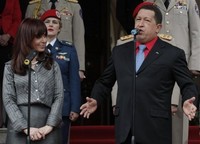
President Hugo Chavez recently announced that Venezuela will purchase dozens of Russian tanks and other arms, signaling growing military ties between the two countries -- and trouble ahead in the hemisphere.
The deal comes amid tensions with Colombia as Mr. Chavez continues to support the narco-terrorism of the Revolutionary Armed Forces of Colombia (FARC) and as he campaigns against the United States using Colombian facilities for anti-drug efforts in the Andes.
The announcement of pending Russian armor purchases follows revelations that the Colombian army recovered Swedish-made anti-tank weapons, sold to the Venezuelan army, in FARC weapons stocks. The Swedish government has confirmed the original sale to Venezuela. Because of the allegation, Mr. Chavez recalled his ambassador and is "freezing relations" with Colombia.
As senior leader and paymaster of anti-Americanism in South America, Mr. Chavez also wants to derail U.S. negotiations with Colombia that would grant American troops and aircraft access to seven Colombian military bases. Mr. Chavez denounces the U.S. effort as a "strategic threat," even though the number of U.S. personnel will not increase and the anti-drug surveillance aircraft will be moved from Ecuador to Colombia. The reason: Mr. Chavez's ally, Rafael Correa of Ecuador, voided the lease. Mr. Chavez's ire with the United States has increased following his failure to restore a deposed ally - former President Manuel Zelaya in Honduras.
The framework for the arms deal was partially laid during Russian deputy premier and energy czar Igor Sechin's visit to Caracas in July. During Mr. Sechin's trip, a number of wide-ranging cooperation accords covering energy, military and agricultural cooperation were signed. Mr. Sechin's trip was intended to prepare the ground for Mr. Chavez's upcoming visit to Moscow.
Mr. Sechin, the head of the siloviki (men of power), has emerged as Russia's point man on global energy geopolitics. He graduated from Leningrad State University (Vladimir Putin's alma mater) in 1984 as a linguist in Portuguese and French. In the 1980s, Mr. Sechin worked in Mozambique and in Angola, officially as an interpreter, but according to numerous intelligence sources, he was a Glavnoye Razvedyvatel'noye Upravleniye (GRU) officer there.
Read Full Article »