


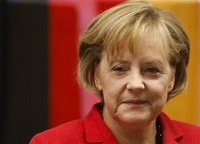
It is an apparent irony of European politics that in the middle of a crisis in capitalism, free-market, right of centre politics seems to be enjoying a resurgence. Nicolas Sarkozy is popular in France, David Cameron looks certain to be our next prime minister, and in Germany, Angela Merkel’s Christian Democrats have won a hugely significant election victory this weekend over their Social Democrat rivals, the SPD.
At last she can come out and call them rivals! That must be the biggest relief this morning for Bundeskanzlerin Merkel. For the last four years she has had to pussyfoot around, pretending that the so-called grand-coalition between CDU and SPD was useful, friendly even. In reality it was a stultifying political stodge.
Neither party could express its natural convictions for fear of upsetting the “consensus” so beloved in Germany. As a result both withered on the vine. Frau Merkel may be celebrating this morning but in fact she won less of the vote this time around than in 2005 (33.8 per cent compared with 35.2 per cent). The fact she is in power today is due not to her own achievements but the humiliation of the SPD.
The SPD has been marginalised by the dramatic emergence of the seriously Left-wing party Die Linke (which includes remnants of former East German communists). This used to be considered a minor party for minority interest groups. But with the SPD’s slice of the vote (23 per cent, down 10) now only 10 per cent greater than Die Linke (11.9 percent, up 3), people are beginning to ask: “Which is the main Left wing party?”
The SPD’s leader, Frank-Walter Steinmeier, has pledged to stay on, but has less personal appeal than Die Linke’s leader, or, for that matter, than Angela Merkel. Indeed her charms have been placed (at the expense of policy) front and centre in the CDU election campaign.
That is a tactic that is about to get a whole lot less satisfactory. She now has a genuine mandate for progressive centre-Right reform. That means upsetting a lot of people who are currently happy to view her vaguely as a loveable and capable leader.
On the Right, though, the message has gone out that it is time for her to turn from Mummy-figure into Iron Lady. Such a dramatic transformation is not necessary. But she does need to simplify and lower taxes and take on welfare reform, encouraging people to work, particularly for small and medium private business, rather than state-run behemoths. She may have to force Germans to swallow other bitter pills, like a clear and deepening commitment to Afghanistan and, most unpalatable of all to Germans, nuclear power.
For like the SPD, the CDU is also being harried by a minor party that it once swatted away. Angela Merkel may be delighted to be in a centre right coalition, but she would have been considerably happier if the CDU was a more dominant force in that coalition. Instead, the free-market FDP has won 14.6 per cent of the vote, up five, and will be in no mood to get bossed around in government. This weekend may have seemed a triumph but within months Merkel could find herself sniped at by her coalition’s junior party and challenged by malcontents in her own.
That is, however, for the future. What is certain for now is that the SPD is in very real crisis. So, while centre-Right parties may appear to be thriving in troubled economic times, the fact is that it is their opponents who are doing badly.
Britain’s Labour and France’s Socialists are in disarray. Meanwhile the SPD’s fortunes have not fallen so low in the history of post-war Germany. This morning Trevor Kavanagh of The Sun reminded Today listeners that there are suggestions Labour could be extinguished as a party in this country.
Predicting party death is always a temptingly dramatic game, particularly alluring when long political tides go out (the Tories in 1997, Labour in 2010, the SPD, after 11 years in power, in 2009). But some in Germany are indeed wondering whether the SPD can survive. It surely will. What is clear however, is that German politics, which for the last few years has had all the glamour and manoeuvrability of a cement mixer, is about to get a whole lot more exciting. The consensus is over.
Comments: 8
Interesting views, and in all probability not far from the truth. Frau Merkel has yet to convince me of her bona fides - she appears, like Cameron, to wobble between vague 'undertakings' and outright devious non-promises - something not lost on the German People. In more stable times, the 'rule' was that weak government ( coalitions ) was poor government. In this age of undemocratic, supranationalist bureaucratic dictatorships, maybe a form of coalition with its implied variances in policies and tendencies, will serve us all better than a singular 'no-policy' populist Blairite one ? Make our "VOTES" something worthy of our hopes and aspirations again - BRING BACK DEMOCRACY ! "Quicquid delirant reges plectuntur Europii ." ( whatever madness possesses the chiefs, it is the ordinary Europeans who get hurt .)
How Brown must envy Angela Merkel she is respected by so many while he is loathed and despised. The Germans at least have someone they can like and respect we on the other hand have have a man with blood on his hands and I do not mean just in Afghanistan he has hurt many people right here at home by stripping them of their independence in old age causing some to commit suicide.
Simon Coulter says: "Merkel's new coalition is surely to be more about the people creating the right circumstances for making money and lifting the economy - not the state micro-managing everything." But the state hasn't been micro-managing things over the last few years. It's not right to assume that the obsessions of the British government are also the same in Germany. As for extremists, the far right NPD got 1.5% of the vote nationally. They aren't a danger. It remains to be seen if the Linke are extremists. They have been pretty responsible in the state of Berlin, where they are taking good and sensible measures to clear up the huge debt that the CDU ran up in the 90s. One challenge in Germany is to make the welfare state viable in the future. Schr�der took some painful measure a few years ago (following decades of inertia) and these are still filtering through. It needs more though. The other main problem is the east. The last CDU/FDP government make a mess of reunification (with hindsight) and we're still paying for those mistakes.
"It is an apparent irony of European politics that in the middle of a crisis in capitalism, free-market, right of centre politics seems to be enjoying a resurgence." Only apparent. The so-called "crisis in capitalism" is really a crisis of government meddling. The rise of the Free Democrats is a sign that at least a fair number of Germans have realized this.
Mrs Merkel is a bit like Colonel Gadafi and his 40 years in power: they must both be doing something right !
Whilst we are slumbering ,The German People are biding their time. Whilst we were sleeping , they laid out millions of towels aross Europe and soon they will be occupying them all as one ! If the EU is to mean anything, surely The Great German People must be our rulers as forecast by Prof Helmut Muckerjee in his famously portentous and highly pretentious work : 'Mein's a Double-Weave Flanalette!' ( Dietrich & Goering, E6.95 Asda selected stores) This is not the end mein friends, das ist The New Beginning ! You are not free men and women under this ..., this so-called democracy of yours ! Nein ! you will only be free when the fat lady Merkel sings from the spare plinth in the former Trafalgar Square (to be renamed 'Mandlefoy Plaza') : 'Das Lied der Deutschen' ....altogether now ,eins, zwei, drei : Deutschland, Deutschland �ber alles, �ber alles in der Welt !
It is a measure of political immaturity at the level of tribal dogma to believe that parties such as SPD and CDU cannot work productively together. It is like saying that men and women can shag each other but cannot live together. History says that they can, but that understanding and mutual respect is required. The fundamental difference between parties is not right and wrong, but particular personality types and childhood experiences. This says that by targeting the remedies of each party to those who respond best to them, then more can be achieved than by favouring one group at the expense of the other. Does a married man think he can nurture a foetus? I hope not. Does that mean he starves pregnant women?? Of course not. If you think that political parties cannot work together, then you believe the above statements..... Markets and state are part of the whole, not enemies. And it is a measure of the state of nations that the number of journalists who cannot see this yet remain in post is higher in 'Western' nations than in 'less developed ones'. Think about it.
Merkel's new coalition is surely to be more about the people creating the right circumstances for making money and lifting the economy - not the state micro-managing everything. The other issue for Merkel is not so different to that facing other governments - the emergence of revitalised political parties to the Far Right and Far Left as the corollary to the relatively new confection of supposedly mainstream Centre-Right and Centre-Left political stances between which you cannot get a playing card and which are seriously frustrating voters who want policy differentials and real choice. From our perspective, both of these things are in evidence - we can expect both the BNP and UKIP to nibble away at the edges - and inertia to favour Labour since the Tories are yet to put Clear Blue Water between their policies and those of the government. Let us hope it does not lead to a new Lib-Lab coalition.
Post a comment
By submitting any material to us you confirm that you have read, and agree to, our terms and conditions
Your name *
Your email address *
Read Full Article »
