


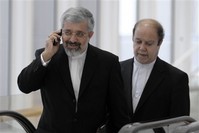
President Barack Obama will know by Friday whether he got the deal on Iranian nuclear material on which he has staked his engagement strategy. A third day of talks in Vienna ended inconclusively Wednesday, with the Iranian delegation requiring consultations with their government back in Tehran before signing off on a detailed plan to ship three-quarters of its current stockpile of enriched uranium to Russia for conversion into harmless reactor fuel. The parties to the deal have been given until Friday to report back, although reports from Vienna suggested that Tehran was pushing back against some of the terms being set for the deal by the U.S. and its partners — specifically over the timetable and scale of Iran's uranium delivery to Russia.
The points of contention not only highlight the differing objectives of the two sides in making a deal. They also serve as a reminder that as significant a confidence-building mechanism as the Vienna deal may be, it doesn't actually begin to address the deadlock between Iran and the West over whether the Islamic Republic will continue to enrich uranium. (See pictures of the world's worst nuclear disasters.)
The deal under discussion in Vienna was hatched when Iran approached the IAEA earlier this year for help in acquiring fuel for a medical research reactor in Tehran, which is not suspected of being part of any covert weapons program. U.S. officials took the opportunity to address "ticking clock" concerns that Iran had already amassed enough low-enriched uranium (LEU) that — if it expelled inspectors and reprocessed the material to weapons grade — could be fashioned into a single atomic bomb. So Washington proposed that Iran use its own stockpile of LEU as the basis for the reactor fuel, which would require shipping it to Russia and France for further enrichment and conversion into fuel rods that would be extremely difficult for Iran to weaponize. The deal obviously appealed to the West as a way to limit Iran's ability to potentially create a bomb; but the Iranians aren't viewing it as a concession. They see the deal as a tacit recognition that uranium-enrichment in Iran is an intractable reality, despite Western hopes of coaxing and cajoling Iran into abandoning it altogether in exchange for a package of political and economic incentives. (After all, the uranium that Russia and France would reprocess for Iran under the proposed deal was enriched in violation of U.N. Security Council resolutions.)
There's nothing unusual about a diplomatic solution containing elements that both sides can claim as a victory, but the competing agendas of Iran and its Western interlocutors may explain the disagreements currently clouding the talks. The West, eager to buy time for negotiations without Iran moving steadily closer to the capacity to make a weapon, wants the Iranian uranium that will be turned into reactor fuel under the deal to be delivered in a single shipment, and by the end of this year. But as much as Iran sees the agreement as an opportunity to build Western confidence in its intentions, and also acquire much-needed reactor fuel, it remains suspicious of foreign powers. Tehran sought this week to exclude France from participating in the deal on the grounds that it could not be trusted by Iran — and, indeed, President Nicolas Sarkozy has taken the hardest line among Western leaders on forcing a halt to Iran's uranium enrichment. But even Russia has been frequently accused by Tehran of dragging its feet over the construction of Iran's nuclear reactor at Bushehr. (See a graphic of the nuclear armed world.)
Iran plainly doesn't share the sense of urgency of the U.S. and its allies, and rejects the idea that its uranium stockpile represents a security threat. Its relatively low-level delegation in Vienna was not authorized to conclude an agreement. And reports from the talks suggest that the country was hoping to stagger its shipments into smaller parcels, and over a longer time frame. Western diplomats, however, are mindful of the fact that Iran will keep on enriching uranium — and fear that if its keeps its centrifuges running while shipping out smaller portions, it can maintain close to enough for a single bomb in its own stockpile.
Not surprisingly Friday's verdict remains uncertain. IAEA chief Dr. Mohammed ElBaradei says his "fingers are crossed" that the deal will be green-lighted, while U.S. officials warn that the offer is a key test of Iran's intentions. An Iranian rejection would pour cold water on the cautious optimism from the White House over the prospects for engagement. But even if Tehran agrees to the deal, it doesn't address the Western objective of ending uranium enrichment in Iran. The negotiations in Vienna, and on Oct. 1 in Geneva, have essentially sidestepped the issue of Iran's compliance with Security Council resolutions requiring that it suspend enrichment in order to strengthen safeguards against its nuclear material being used for military purposes.
Until now, the U.S. and its allies have insisted that Iran can't be allowed to possess enrichment capability even for peaceful purposes, because that gives it a "breakout" capacity to relatively quickly build nuclear weapons should it choose that option. Iran continues to insist that it has no intention of abandoning enrichment. But if Tehran combines its refusal to end enrichment with a more accommodating position on measures to safeguard against weaponization, it could put the West in a diplomatic bind — forced to choose between making progress on the basis of diminished goals, or facing an uphill battle to muster sufficient pressure to force Iran into retreat.
See TIME's Pictures of the Week.
See the Cartoons of the Week.
Time.com on Digg Upcoming Popular Today
POWERED BY digg
adFactory.getCmAd(300, 250, "global", "tout").write(); adFactory.getCmAd(300, 100, "article", "tout").write(); var ad = adFactory.getAd(142, 70); ad.setPosition(1) ad.write(); var ad = adFactory.getAd(142, 70); ad.setPosition(2) ad.write(); var ad = adFactory.getAd(142, 70); ad.setPosition(3) ad.write(); var ad = adFactory.getAd(142, 70); ad.setPosition(4) ad.write(); More News from Our Partners CNN Iraqis top list of refugees seeking asylum Iran accepts draft nuke deal 'in principle' Poland agrees to host part of U.S. missile plan Huffington Post Semion Mogilevich: Powerful Mobster Was Added To FBI's Most Wanted List Iraq Troops Sing Karaoke, Join Book Clubs, Rarely Go To War Current TV's "Vanguard"�: "Cuba: Waiting for a Revolution" AOL News Ancient Auditorium in Rome Unveiled Fugitive US Pedophile Nabbed in Israel Wariness Persists Over Iran Nuclear Deal Rotten Tomato Six Horrible Part Sixes See Saw with Alex, Day 5: Saw V RT on DVD: Land of the Lost and Hannah Montana Life Halloween 2009: The Top Costumes Happy 50th Birthday, Guggenheim! Detroit's 20 Greatest Successes Top Stories on TIME.com Can the World Agree on a Stimulus Exit Plan? How Drug Industry Lobbyists Got Their Way on Health Care Iran Keeps Obama Waiting on Nuclear Deal More on TIME.com » The Senate Prepares to Challenge the Czars Survey: Many Americans Now Plan to Work Past 67 H1N1: Swine Flu's Collateral Health Benefits in Bolivia Quotes of the Day » Get & Share $Launchpad.CreateMenu({ wid : "491cae4a5db36d0d", actionElement : "myWidget",servicesInclude: ['facebook','yahoo','email','google','live','myspace','netvibes', 'wordpress', 'digg','embed'] }); "There's no safety now — it's war." ABDUL RAHMAN, an ice cream vendor in Afghanistan's Kunduz province, saying the growing reach of the Taliban has made it too dangerous for him to leave his district More Quotes » var ad = adFactory.getAd(88, 31); ad.setPosition(13) ad.write(); Today in Pictures » Lecture Stay Connected with TIME.com Learn More » adFactory.getAd(965, 50).write(); Subscribe to RSS Feeds Sign Up for Newsletters Add TIME Widgets Read TIME Mobile on Your Phone Become a Fan of TIME Get TIME Twitter Updates adFactory.getCmAd(115, 42, "homepage", "tout").write(); © 2009 Time Inc. All rights reserved | Privacy Policy | RSS | Newsletter | TIME For Kids | LIFE.com Subscribe | Contact Us | Terms of Use | Media Kit | Reprints & Permissions | Opinion Leaders Panel | Help | Site Map TiiAdTrackRevSci(); function tiQuantcast() { } _qoptions={ qacct:"p-5dyPa639IrgIw", labels:tiQuantcast() } // Initialization var _loomia_scripts_loaded=0; if (typeof L_VARS=='undefined') { L_VARS = new Object() } // Loomia common settings L_VARS.publisher_key = 9065184586; L_VARS.anchor="recommendations_display"; L_VARS.guid ="1931597"; L_VARS.query_params = {"xid" : "Loomia"}; function _loomia_addScript(url) { var anchor=document.getElementsByTagName('HEAD')[0]; var script= document.createElement("SCRIPT"); script.src=url; anchor.appendChild(script); } function _loomia_addCS() { try {_loomia_rec_type = document.getElementById(L_VARS.anchor).className; } catch(e) { _loomia_rec_type='' } if (!_loomia_scripts_loaded) {_loomia_addScript("http://assets.loomia.com/js/clixdom.js"); if (_loomia_rec_type.indexOf('similarrecs') != -1) _loomia_addScript("http://assets.loomia.com/js/simitems.js"); } _loomia_scripts_loaded=1; } // Loads Loomia script after page has loaded if (window.addEventListener) { window.addEventListener("DOMContentLoaded", _loomia_addCS, false); window.addEventListener("load", _loomia_addCS, false); } else if (window.attachEvent) window.attachEvent("onload", _loomia_addCS); L_VARS.number = 3; Sphere.Inline.search("sphereFooter","http://www.time.com/time/world/article/0,8599,1931597,00.html")
Read Full Article »