


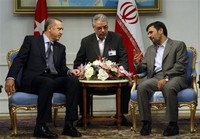
If the Iranian officials who negotiate for their country on the nuclear issue have a diplomatic handbook, their tactics might be inspired by the Persian folk stories of the "Arabian Nights". The most famous tale offers a masterly example of playing for time: a beautiful young woman avoids execution by regaling a tyrant with fascinating stories for 1,001 nights, until he forgets about killing her and offers his hand in marriage instead.
Today, Iran has promised to respond to the latest proposal for reducing the tension over its nuclear ambitions. Hopes are not high: over the past six years, Iran's diplomats have probably held 1,001 meetings with their Western counterparts on the "nuclear file". They have offered no charming tales – quite the contrary – but delay, procrastination and heel-dragging have been their stock in trade. And all the while, their nuclear programme has progressed, expanded and drawn closer to the vital moment when Iran's leaders will have the option of building the ultimate weapon.
Yet the endgame may finally be approaching. Last month's disclosure of a covert nuclear plant outside the holy city of Qom, and Iran's glaring failure to respond to any of President Obama's olive branches, have pushed the issue to the top of the Richter scale of diplomatic concern.
Today, Iran's nuclear programme is the number one preoccupation of those charged with protecting our safety, outranking Afghanistan, Pakistan and the general field of counter-terrorism. America, Britain and France have all pledged to review their entire approach towards Iran by the end of this year. Assuming that Tehran does not suddenly obey five separate United Nations resolutions and stop enriching uranium, this reassessment will be far from routine. Officials familiar with the issue say that everything will be on the table. Pressing the Security Council to impose more economic sanctions will be the most obvious next step, but the whole idea of negotiating with Iran on the nuclear issue using the present framework will also be up for grabs.
Britain, France and Germany began these talks as long ago as 2003. They were later joined by Russia and China, while Mr Obama made America a full member of the club earlier this year, even though Washington has no diplomatic relations with Tehran. This six-power group pursues what officials call a "twin-track approach", with "track one" being dialogue and incentives and "track two" being direct economic pressure.
Shorn of jargon, this is a stick-and-carrot process, with the aim of getting Iran to stop enriching uranium. Halting this process is the vital objective, because it could be used to produce weapons-grade uranium – the essential material for a nuclear bomb. Hence the six nations have formally offered to help Iran with a civil nuclear power programme and lift the country's isolation if Tehran turns off the centrifuges and stops enrichment. Meanwhile, they have passed three UN resolutions imposing economic sanctions on the regime.
But all their efforts have, in the words of Bernard Kouchner, the French foreign minister, yielded results that are "close to zero". The danger, according to another Western official, is that the whole exercise might stop being a "vehicle for resolving the issue" and become an invitation for Iran to trap its opponents in an "open-ended process", while buying the time needed to fulfil its nuclear ambitions.
In truth, not much is happening on either of the tracks. Iran does its best to avoid meetings with the six powers. The last was in Geneva on October 1 and that yielded little beyond a vague agreement allowing the renewal of a civilian reactor in Tehran.
The idea was that Iran would export about 80 per cent of its low-enriched uranium to Russia and then France, for processing into new fuel rods for this research reactor. Having ignored a deadline of last Friday set by the International Atomic Energy Agency, Iran now promises a final reply today.
But even if the answer is an unconditional "yes" – a most unlikely response – this would have nothing to do with the vital issue, namely Iran's continued enrichment of uranium. As for exerting direct pressure on Iran, the Security Council has not managed to impose any sanctions whatever since March last year. Russia and China have combined to sabotage every subsequent attempt to squeeze Iran's economy.
The last time the Security Council considered sanctions, Russia and China stripped every penalty out of the draft resolution, leaving nothing but a ringing declaration asking Iran to please stop enriching uranium.
Western officials are dismayed by what they see as a failure to take the issue seriously. Even now, when Iran has stockpiled more than a ton of low-enriched uranium and installed 4,592 operational centrifuges inside its underground plant in Natanz, there is no confidence that either country would allow the passage of another sanctions resolution.
In the past, China has shown the greatest reluctance. Alone among the Security Council's five permanent members, Beijing may not view a nuclear-armed Iran as a strategic threat, and the Asian giant certainly values its commercial ties with the Islamic Republic.
Meanwhile, Russia's position is more complicated. The Kremlin does not want Iran to get nuclear weapons, but nor does Russia like the idea of Tehran burying the hatchet with America and reaching an epoch-making settlement with Mr Obama.
An Iran under American influence may, in Moscow's view, amount to a greater threat than a nuclear-armed Iran. The Krem
By David Blair Published: 7:36PM GMT 28 Oct 2009
Comments 5 | Comment on this article
If the Iranian officials who negotiate for their country on the nuclear issue have a diplomatic handbook, their tactics might be inspired by the Persian folk stories of the "Arabian Nights". The most famous tale offers a masterly example of playing for time: a beautiful young woman avoids execution by regaling a tyrant with fascinating stories for 1,001 nights, until he forgets about killing her and offers his hand in marriage instead.
Today, Iran has promised to respond to the latest proposal for reducing the tension over its nuclear ambitions. Hopes are not high: over the past six years, Iran's diplomats have probably held 1,001 meetings with their Western counterparts on the "nuclear file". They have offered no charming tales – quite the contrary – but delay, procrastination and heel-dragging have been their stock in trade. And all the while, their nuclear programme has progressed, expanded and drawn closer to the vital moment when Iran's leaders will have the option of building the ultimate weapon.
Yet the endgame may finally be approaching. Last month's disclosure of a covert nuclear plant outside the holy city of Qom, and Iran's glaring failure to respond to any of President Obama's olive branches, have pushed the issue to the top of the Richter scale of diplomatic concern.
Today, Iran's nuclear programme is the number one preoccupation of those charged with protecting our safety, outranking Afghanistan, Pakistan and the general field of counter-terrorism. America, Britain and France have all pledged to review their entire approach towards Iran by the end of this year. Assuming that Tehran does not suddenly obey five separate United Nations resolutions and stop enriching uranium, this reassessment will be far from routine. Officials familiar with the issue say that everything will be on the table. Pressing the Security Council to impose more economic sanctions will be the most obvious next step, but the whole idea of negotiating with Iran on the nuclear issue using the present framework will also be up for grabs.
Britain, France and Germany began these talks as long ago as 2003. They were later joined by Russia and China, while Mr Obama made America a full member of the club earlier this year, even though Washington has no diplomatic relations with Tehran. This six-power group pursues what officials call a "twin-track approach", with "track one" being dialogue and incentives and "track two" being direct economic pressure.
Shorn of jargon, this is a stick-and-carrot process, with the aim of getting Iran to stop enriching uranium. Halting this process is the vital objective, because it could be used to produce weapons-grade uranium – the essential material for a nuclear bomb. Hence the six nations have formally offered to help Iran with a civil nuclear power programme and lift the country's isolation if Tehran turns off the centrifuges and stops enrichment. Meanwhile, they have passed three UN resolutions imposing economic sanctions on the regime.
But all their efforts have, in the words of Bernard Kouchner, the French foreign minister, yielded results that are "close to zero". The danger, according to another Western official, is that the whole exercise might stop being a "vehicle for resolving the issue" and become an invitation for Iran to trap its opponents in an "open-ended process", while buying the time needed to fulfil its nuclear ambitions.
In truth, not much is happening on either of the tracks. Iran does its best to avoid meetings with the six powers. The last was in Geneva on October 1 and that yielded little beyond a vague agreement allowing the renewal of a civilian reactor in Tehran.
The idea was that Iran would export about 80 per cent of its low-enriched uranium to Russia and then France, for processing into new fuel rods for this research reactor. Having ignored a deadline of last Friday set by the International Atomic Energy Agency, Iran now promises a final reply today.
But even if the answer is an unconditional "yes" – a most unlikely response – this would have nothing to do with the vital issue, namely Iran's continued enrichment of uranium. As for exerting direct pressure on Iran, the Security Council has not managed to impose any sanctions whatever since March last year. Russia and China have combined to sabotage every subsequent attempt to squeeze Iran's economy.
The last time the Security Council considered sanctions, Russia and China stripped every penalty out of the draft resolution, leaving nothing but a ringing declaration asking Iran to please stop enriching uranium.
Western officials are dismayed by what they see as a failure to take the issue seriously. Even now, when Iran has stockpiled more than a ton of low-enriched uranium and installed 4,592 operational centrifuges inside its underground plant in Natanz, there is no confidence that either country would allow the passage of another sanctions resolution.
In the past, China has shown the greatest reluctance. Alone among the Security Council's five permanent members, Beijing may not view a nuclear-armed Iran as a strategic threat, and the Asian giant certainly values its commercial ties with the Islamic Republic.
Meanwhile, Russia's position is more complicated. The Kremlin does not want Iran to get nuclear weapons, but nor does Russia like the idea of Tehran burying the hatchet with America and reaching an epoch-making settlement with Mr Obama.
An Iran under American influence may, in Moscow's view, amount to a greater threat than a nuclear-armed Iran. The Kremlin's biggest decisions are still made by Vladimir Putin, the prime minister, and he shows no willingness to help America overcome the foremost challenge to its foreign policy.
With neither of their "twin tracks" getting anywhere, Western governments may decide to scrap the whole approach. But officials privately acknowledge that their options are extremely limited. For example, they have not ruled out a military strike to destroy Iran's nuclear facilities. In reality, however, this is not regarded as a serious option. For starters, Tehran could retaliate by obstructing oil supplies and causing mayhem in Afghanistan and Iraq. But the most convincing objection is wholly practical: any installations destroyed by air strikes could simply be rebuilt. An attack would not halt Iran's nuclear ambitions, it would only buy time – and not very much time at that, perhaps less than five years.
The great danger is that Israel, which understandably views a nuclear-armed Iran as a mortal threat, might embark on a sudden, pre-emptive military campaign out of sheer despair. With every passing month, it becomes harder for Israel's Western allies to argue that a diplomatic solution is possible. The storm clouds for a great crisis are gathering with inexorable power. One way or another, this saga will probably be resolved next year. And in contrast to the "Arabian Nights," the story is unlikely to end happily.
Comments: 5
There are some pretty serious distortions in this article including the "priority" of Iran over Pakistan and the larger issues of terrorism. Yes, the Iranian situation is a huge problem but is not limited to simply Iran's refusal to ship out its materials for processing and concurrently stopping its advancement toward weaponry which it probably already has in its possession either on its own or "through friends". And Russia is not so afraid of Iran's build-up either, as it continues to be Russian staff and equipment performing a huge part of the work at Natanz and other facilities. So let's not misrepresent Russia's interests here. What the Iranian people do not want is an open confrontation between Russia and the US to take place on Iranian soil... and that seems to be what Israel is on the road to provoking for its own selfish interests. Forget the UN as they are completely useless in important matters. Hopefully France will continue to throw out a line in cooperation with Russia to create an environment that allows for Iran to transition by its own means into a different leadership. And Israel will be forced to point its weapons elsewhere other than on the principal Iranian population centres. Otherwise there will be at best a continuing stalemate as Iran moves more toward a hardline position that if Israel can have their weapons so can Iran. If Israel attacks Iran it will find that its defenses (and offenses) are much stronger than anything else to be encountered in the region, and whether it is Iran on its own or with a partner Israel itself will be at extreme risk as will the entire region. The key is encouraging and pushing a change in government which is supported by the people. That will take another 2+ years, and the risks of all out regional war are far less if that is allowed to work its way through its own process, much of which we westerners won't fully understand and which Israel will constantly object to because a strong independent well-run Iran is maybe not in the best interests of Israel particularly if that "new Iran" can be friendlier with the US under a transition partnership with Russia and France.
Hi, What a shamless and full of lies and biased piece of work. The author seems to be stuck in the stone age having no insight about real issues around him. Who used the only Atom Bombs? Who is slaughtering people around the world and in Middle East? Who has occupied a whole country since 1948? Who has been looting the minerals from Middle East and Africa in the past 200 years.....? What's the IAEA's view on Iranian Nuclear file?
I don't think Iran wants to build nuclear bombs per se, but rather to demonstrate that they have the capability should the need arise.
It's an inconvenient truth and probably unthinkable for most people but the only way that the world will stop Iran becoming a nuclear power is to bomb the enrichment plants. Simple really.
Here we go again. Another piece of propaganda by Zionist David Blair. His racist remarks, full of lies and half truths, is worthy of only Telegraph. As an example, Iran was never given a deadline of last Friday to respond. It was a suggestion and request at best. Then, he talks about Iran has for sure a plan for nuclear weapons which is repeatedly denied by Iran, IAEA, and even US reports. Finally, what if Iran gets nuclear bomb. Why is it OK for Israel and other countries to have them but not Iran? Isn't this racism? Why is he not even for a second worried about the Zionist regime and its numerous weapons aimed at 70 million Iranians? Is it because Iranian lives are not worth the zionists or their Western allies? SHAME ON YOU MR. BLAIR, SHAME ON YOU.
Post a comment
By submitting any material to us you confirm that you have read, and agree to, our terms and conditions
Your name *
Read Full Article »