


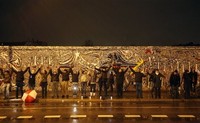
TWENTY years ago, dictatorships across Central and Eastern Europe toppled. During this season of remembering, the focus has rightly been on celebration of the new freedoms gained by the inhabitants of those countries: to speak freely, to travel, to vote and to choose their own national futures and alliances. Yet the legacy of 1989 has difficult aspects as well, mostly centering on the origins and legitimacy of later NATO expansion to former East German and Warsaw Pact territory; acknowledgment of them by the United States could greatly improve American and Russian relations.
Moscow has long asserted that the Soviet Union allowed Germany to unify only in return for a pledge from Washington never to expand the Atlantic alliance. Former advisers to Presidents George H. W. Bush, Bill Clinton and George W. Bush have transcended partisan differences in dismissing the Russian claim. An internal State Department review during the Clinton era concluded that no legally binding prohibition on NATO enlargement emerged from the era of German unification.
Since then, however, it has become possible to reconstruct what happened from first-hand evidence. Former Chancellor Helmut Kohl of Germany released the papers of his office, which inspired the former Soviet leader Mikhail Gorbachev to publish many of his own. A number of other leaders and institutions also opened files in advance of the 20th anniversary of the fall of the wall: the George H. W. Bush Presidential Library, Secretary of State James Baker, the German Foreign Ministry and the British Foreign and Commonwealth Office among them.
There are many twists and turns, but the story as we now understand it is as follows: The crucial month was February 1990. It had become apparent that the cold war order in Europe had collapsed. Some kind of new order needed to be established quickly. Bonn and Washington had agreed that it should center on the rapid unification of Germany.
Both countries also wanted to head off alternative visions to NATO’s continued primacy that were proposed by Mr. Gorbachev, who sought new European institutions from the Atlantic to the Urals, and by former Warsaw Pact dissidents-turned-rulers, who wanted a demilitarized Central and Eastern Europe to serve as a neutral bridge between East and West. Those plans would have diminished the leading role of the United States in Europe, whereas perpetuating the Atlantic alliance would maintain it.
The biggest obstacle was, of course, the Soviet Union. Despite economic hardship at home, the Soviets maintained 380,000 troops in East Germany and still held legal rights of occupation emanating from the unconditional German surrender in 1945. Bonn and Washington thus wanted Moscow to remove its troops and to renounce its claims, without forcing NATO troops out as part of the bargain.
What would Mr. Gorbachev demand in return? To learn the answer, Mr. Baker and Mr. Kohl journeyed to Moscow within a day of each other. On Feb. 9, 1990, Mr. Baker asked Mr. Gorbachev, “Would you prefer to see a unified Germany outside of NATO, independent and with no U.S. forces or would you prefer a unified Germany to be tied to NATO, with assurances that NATO’s jurisdiction would not shift one inch eastward from its present position?” Mr. Gorbachev, according to Mr. Baker, answered that “any extension of the zone of NATO would be unacceptable.” Their meeting ended without any final deals made. Mr. Baker left behind a secret letter, detailing what he had said, for Mr. Kohl in Moscow.
While Mr. Baker was in Moscow, though, members of the National Security Council back in Washington were worrying about his comment that NATO would not move eastward. To undo the damage they felt Mr. Baker had caused, they drafted a letter that President Bush sent to Mr. Kohl later that day.
The presidential letter included language that differed in a subtle but significant way from the language offered by the secretary of state. Instead of a pledge about NATO’s borders, Mr. Bush suggested that East German territory be given a “special military status” within NATO. What that status would consist of was to be negotiated later, but the core assumption was clear. NATO would grow and former East German areas would have a special status within the alliance as it did so.
Mary Elise Sarotte, a professor of international relations at the University of Southern California and a fellow of the American Academy in Berlin, is the author of “1989: The Struggle to Create Post-Cold War Europe.”
The new source for exclusive online commentary from The Times. Judith Warner, Timothy Egan, Olivia Judson, Stanley Fish, Linda Greenhouse, Dick Cavett and more.
Congress should extend federal standards to subway and light-rail lines, which are now haphazardly regulated.
Read Full Article »