


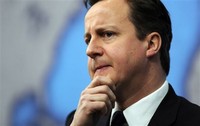
Britain's Conservative Party leader David Cameron speaks in central London Jan. 7, 2010. Cameron is likely to be Britain's next prime minister come later this year. (Toby Melville/Reuters)
LONDON, U.K. — The press was summoned early one recent morning to Chatham House, Britain's leading foreign affairs think tank, to hear the thoughts of Conservative leader David Cameron on Britain's national security. As Cameron is likely to become prime minister later this spring, attendance was high.
Anyone in the audience who, like me, thought they would hear a talk about his grand strategy for how to deal with threats to Britain's national security in these extremely insecure times was disappointed. Cameron, bright and confident, spent most of his brief remarks outlining how he intended to change the internal decision making of government on national security issues rather than outlining a new approach to Iran or China.
The strategic decisions made by the Labour government — e.g. joining the U.S. in invading Afghanistan and Iraq — weren't questioned ... it was how they were arrived at that provoked Cameron's criticism. The cabinet had been sidelined, he said. "Sofa government," the prime minister's unelected friends and advisors sitting comfortably on couches at Downing Street and deciding policy had replaced collective decision-making around the cabinet table. This would stop once he was prime minister, said Cameron. There would be a return to the traditions that had stood Britain in good stead. To facilitate cooperation among the various government departments he would form a "National Security Council."
The lack of a grand vision from the prime minister-in-waiting demonstrates the degree of convergence between the country's main political parties when it comes to security issues. On the major international crises of the last dozen years of Labour government it is hard to imagine that a Conservative government would have reacted differently.
Your Globalpost correspondent put the question to Cameron: Regardless of whether the decision was reached on a sofa or around the cabinet table, would he not have joined with the U.S. in bombing Belgrade in 1999, invading Afghanistan in 2001 and overthrowing Saddam in 2003?
"Let me work backward through those crises," he responded improvising an answer until he found the words to articulate a dissimilarity.
The big difference between the Conservatives and Labour, Cameron said, was one of "trust." There would be no spin doctor-authored dossiers about weapons of mass destruction if he took the country to war. And the next time Britain went shoulder to shoulder with the U.S. into any country there would have to be planning for a "proper reconstruction force" before he signed up to an invasion. It's a moot point to imagine the boyish Cameron standing up to the combined might of Dick Cheney and Donald Rumsfeld in the run up to the Iraq war and saying, "Sorry chaps, we will not deploy until you show me detailed plans for providing law and order the day after Saddam is overthrown."
No Comments.
Login or Register to post comments
Christopher Boucek - Worldview - January 22, 2010 10:24 ET
Disengagement programs should ideally replace a detainee's social network.
Michael Goldfarb - Worldview - January 22, 2010 07:39 ET
But will the world see a difference?
John Aloysius Farrell - Worldview - January 21, 2010 10:58 ET
Obama certainly hit the reset button. Problem is, he's still staring at a blank screen.
David Case - The Americas - January 21, 2010 09:58 ET
After every major disaster, misguided donations actually worsen the suffering.
Bill Dorman - Global Green - January 21, 2010 07:29 ET
Surely the US military has built up expertise with solar energy that could be shared.
C.M. Sennott - Worldview - January 20, 2010 18:17 ET
Reports from around the globe: How does the world view Obama one year into his presidency?
Mohamad Bazzi - Worldview - January 20, 2010 13:18 ET
What Arab activists need from Washington is support for an independent judiciary and a free press.
Jean MacKenzie - Worldview - January 20, 2010 07:26 ET
Analysis: To Afghans, the Obama administration has seemed uncertain, with promises sounding hollow.
HDS Greenway - Worldview - January 19, 2010 20:05 ET
Obama has changed the international conversation, but will need more audacity to deliver results.
Tom Fenton - Worldview - January 19, 2010 20:04 ET
They may see him as a "rational military commander," but Europeans still like Obama more than Americans do.
Sandro Contenta - Worldview - January 19, 2010 19:41 ET
Read Full Article »