


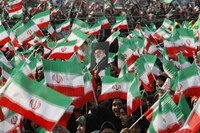
Yesterday was the 31st anniversary of the Islamic Republic's founding"”an annual celebration that comes as the culmination of a preceding 10-day commemoration of the "days of dawn" between Ayatollah Khomeini's return to Iran from exile on February 1, 1979 (the Shah had departed the country on January 16) and the proclamation of the Islamic Republic on February 11. Many Western-based Iran watchers and Western journalists covering Iran anticipated that this would be the occasion for mass protests that would rock the Iranian government to its foundations"”marking, as one journalist put it just a few says ago, the "beginning of the end" of the Islamic Republic. The most prominent establishment figures associated with the Green Movement"”Mir-Hossein Mousavi, Mehdi Karroubi, and Mohammad Khatami"”all called for their supporters to come out on February 11 to show the strength of their cause.
The anniversary observances have now concluded in Tehran and elsewhere in Iran, and the strength manifested by the Green Movement was hardly noticeable. There is nothing new about this. Ever since the Green Movement emerged in the run up to the Islamic Republic's June 12, 2009 presidential election, Western observers have been describing the rise of a broad-based social movement that would bring about fundamental change"”perhaps even "regime change"�"”in Iran. These observers told us, among other things, that the 3-, 7-, and 40-day mourning observances for those protestors who were killed in clashes with security forces would prompt ever larger protests"”as was the pattern during the revolution that ultimately overthrew the Shah. But that has not occurred. The protests on the Shi'a holy day of Ashura (December 27) were much smaller than some previous demonstrations by the Green Movement. Furthermore, no demonstrations of any significance were seen in Iran on the anniversary of the Shah's departure from Iran on January 16 or for Grand Ayatollah Montazeri's arbaeen (40-day mourning observance) on January 29.
Since the Iranian election, we have never saw evidence that the Green Movement commanded the support of a majority of Iranians. This judgment was in keeping with our assessment that President Ahmadinejad certainly could have commanded the support of the majority of the Iranian electorate in his re-election bid and that no hard and credible evidence of election fraud that would have fundamentally changed the outcome had been presented. But, the rush to judgment by the vast majority of Western observers, that the election result could only have been the product of fraud which "stole"� victory from Mousavi, skewed much subsequent analysis of the relative strengths of the government and the Green Movement. This distorted perception afflicted not only neoconservatives and other Green Movement partisans, but also some of our realist friends, like Richard Haass and Steven Walt.
But, from whatever base of support that the movement may have enjoyed in the immediate aftermath of the June 12 election, its support base has been contracting over time, not growing. This is displayed most obviously in the movement's shrinking ability to bring its partisans onto the streets, even when its most prominent leaders have called on them to turn out. As Borzou Daragahi, the Los Angeles Times correspondent who has been strongly supportive of the Green Movement in his reporting, said on France 24 yesterday, in the aftermath of today's events, the leaders of the Green Movement will need to reevaluate their strategy and tactics.
Of course, many Western observers now say that the Green Movement is not fading, but has been cruelly suppressed by an illegitimate regime fighting with every tool at its disposal to hang on to power. This claim needs to be evaluated both in historical perspective and in the context of the current Iranian state's capabilities. Historically, in the 12 months preceding the departure of the Shah from Iran and the founding of the Islamic Republic in 1979, Iranian security forces gunned down thousands"”perhaps even tens of thousands"”of anti-Shah protestors. But, even in the face of this brutality, protestors kept coming out, and the crowds demanding the Shah's removal kept growing until they overwhelmed the Pahlavi regime's massive security apparatus. That was a real revolution.
Contrast that with the response of the Islamic Republic to social unrest following the June 12, 2009 presidential election. Since last June, just over 100 people have been killed in clashes with security forces. Of course, every life lost is a tragedy. But this is not Tiananmen Square, with security forces mowing down hundreds of demonstrators in a single encounter. If one considers what the Iranian government is capable of doing, its response has, in fact, been relatively restrained. But, even in the face of this relatively restrained response, the Green Movement has been contracting. That is not the stuff of which revolutions are made.
Moreover, the Iranian government has dealt with the post-election protests and follow-on events in a manner that is seen by many inside Iran as legitimate within the context of the Islamic Republic's political order. The Guardian Council opened itself to receive formal complaints about the conduct of the election and ordered a partial recount of ballots"”in keeping with the roles prescribed to it by the Islamic Republic's constitution. At critical points following the election, the Supreme Leader, Ayatollah Ali Khamenei, made authoritative pronouncements"”in keeping with his constitutional role. When some who had been arrested following public protests were killed, raped, or otherwise abused in custody, the prison where the lion's share of abuses reportedly occurred was closed, and twelve security force personnel are now under indictment for their involvement in prisoner deaths and abuse. Many in the West may find these responses insufficient"”but they were perceived by many in Iran as important and legitimate responses, which has worked to minimize the number of Iranians who might be galvanized to action outside the established political order.
In sum, the Islamic Republic is not going away. It is remarkable how many Green Movement supporters outside Iran are now claiming that no one among them ever talked about "regime change"� or the Islamic Republic's "implosion"�. But many pro-opposition pundits have, in fact, spoken frequently in recent months about the imminent possibility of the Islamic Republic's disappearance. These assessments were, clearly, wrong. The erroneous analyses of those who have worked so hard in Washington to promote this view should not go unremarked now.
In this regard, we must take very strong exception to Steve Walt's statement yesterday about Iran that
"nobody — including the leaders of the Iranian government, the opposition, and all of us watching from outside — knows where they are headed or what the timetable for change might be. We’ll know who guessed (yes, guessed) right some weeks, months, years, or decades from now, but right now trying to handicap events there is a mug's game."�
We have all seen this bad movie before"”when those American "experts"� and some expatriate Iraqis who spent years working in Washington to build the case for coercive regime change in Iraq told us with such confidence that Saddam Husayn's regime had weapons of mass destruction and that Iraqis would welcome regime change imposed from outside. It wasn't bad luck for those who made these arguments that they turned out to be wrong"”it was bad analysis based on unquestioned but faulty assumptions. As on Iraq then, so on Iran today"”no one should be excused because they failed to ask hard questions.
Flynt Leverett appeared on PBS's Newshour last night to discuss many of these issues, on a segment that also featured David Albright from the Institute for Science and International Security and Reza Aslan. A link to the segment is provided here.
–Flynt Leverett and Hillary Mann Leverett
We were right, Leverrets. Good to see you are beginning to recieve the attention your analyses deserve.
kooshy:
you are dead wrong ;) the government brought millions to Tehran by buses, and with the promises of free food. and for the gathering in other cities, they brought people from outside of the country, like Hezbollah,… ;). see the crowds in other cities like Karaj, RodeHen, Shahrood,… which are close to Tehran closely, they are obviously from Venezuela !.
Reza Aslan talks like a MKE or a Monarchy. his out of touch style reminds me of those groups’ representatives in the past few years. these self styled experts don’t get the point. that small cities and villages, thanks to the technology, are aware of the situation, unlike the Shah’s time, and are strongly supportive of the system. watch the images and video from there also. it’s not the time that few thousands people could change the system in Tehran and others just watch them. Tehran is fast getting irrelevant in Iranian politics.
yes, many left the city for the holidays including some of my family members. they attended the gathering in other cities than Tehran. so, the analysis is indeed the opposite as the flow of supports to Tehran. do these guys know Iran at all? it’s seriously doubtful.
I think you are right regarding the waning of the Green movement. We can wish it were otherwise, but we must deal with reality. And I’m glad to see you point out how wrong the other side was about what would happen on 2/11. I was also gratified by what F.L. had to say on The Newshour yesterday. It’s very important that at least one person with establishment credentials is out there making the case to the public.
Still, even though the other side keeps making predictions that don’t pan out, the media isn’t focusing on these failures. The neocons continue to receive what amounts to a free pass to spread their errors in print, on television, and on the internet. This can only lead to bad things for the American people.
Only an idiot with no clue about how grass roots movements work would have thought that if the most important organizers of the green movement are rounded up prior to this event, and various forms of communications would have been hindered then the event would have turned out the same as if they were able to communicated effectively and organize this movement "“ and worse an evil person who isn’t a fool would boast on the movements results or worse suggest that its support base is contracting without mentioning the importance of having these factors for having any success!
Since the "�American' authors in this site love to make "�analogies' of what is going on in Iran NOW to what happened to Iraq before the run up to the war or what happened in Iran back in 1979 – let me stoop to their level and give them an American analogy that hopefully they understand. What happened yesterday was like a case of having a Cinderella team that has made it to the super bowl against a much favored and stronger opponent. Both are going into the game with their star QB but the Cinderella team is without all their starting offensive linemen and for the past two weeks they haven't been allowed to practice or watch any of the opposing team films (unlike the favored team)! And to make it worse the league is allowing the opponent to play with extra players. Now do you really expect the Cinderella team to win?
Going along the line of analogies you two sound like the white folks in America who in 1960's didn't get the magnitude of the civil right movement at its inception. So when in one of the rallys that MLK or other activists had started only several black American showed they suggested that these black are wasting their time.
Look average day Iranian who is not a political activist and yet is not happy with the direction that his or her country is heading is not trying to be a martyr just to make his or her point, and even the fewer ones that are activists and are in the frontlines are smart enough to know about both obvious effects of their action on their own lives but also in the future of their country.
The White House spokesman Robert Gibbs said: Iran is not capable to enrich uranium to 20% but the US Treasury Department imposed new sanctions and accused Iran of building nuclear weapons.
To build nu-clear weapons: uranium must be enriched to 90%
If USA believes that Iran is not even capable of enriching uranium to 20%, how can they accuse Iran of building nuclear weapons?
Read Full Article »