


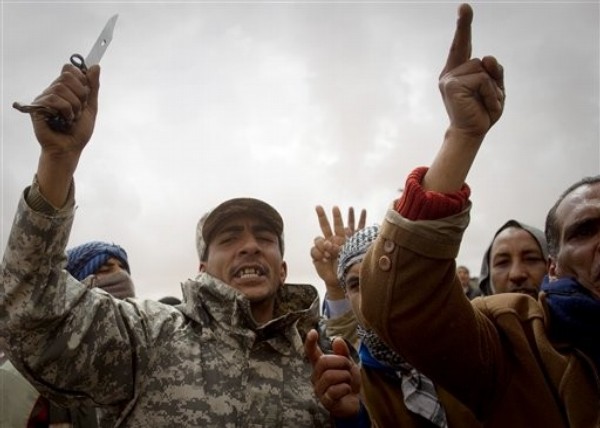
President Obama's decision to join an international military intervention in Libya has met with a largely negative response in the United States across the political spectrum. Critics correctly point to a wide range of problems with the intervention: the absence of any clear planning for what comes after Qaddafi or for what might happen if there is an extended stalemate, doubts about the opposition, the White House's ignoring of Congress and limited explanations to the American public, the selectivity bias in going to war for Libya while ignoring Bahrain and Yemen, the distraction from other urgent issues. I have laid out my own reservations about the intervention here and here.
This emerging consensus misses some extremely important context, however. Libya matters to the United States not for its oil or intrinsic importance, but because it has been a key part of the rapidly evolving transformation of the Arab world. For Arab protestors and regimes alike, Gaddafi's bloody response to the emerging Libyan protest movement had become a litmus test for the future of the Arab revolution. If Gaddafi succeeded in snuffing out the challenge by force without a meaningful response from the United States, Europe and the international community then that would have been interpreted as a green light for all other leaders to employ similar tactics. The strong international response, first with the tough targeted sanctions package brokered by the United States at the United Nations and now with the military intervention, has the potential to restrain those regimes from unleashing the hounds of war and to encourage the energized citizenry of the region to redouble their efforts to bring about change. This regional context may not be enough to justify the Libya intervention, but I believe it is essential for understanding the logic and stakes of the intervention by the U.S. and its allies.
Libya's degeneration from protest movement into civil war has been at the center of the Arab public sphere for the last month. It is not an invention of the Obama administration, David Cameron or Nikolas Sarkozy. Al-Jazeera has been covering events in Libya extremely closely, even before it tragically lost one of its veteran cameramen to Qaddafi's forces, and has placed it at the center of the evolving narrative of Arab uprisings. Over the last month I have heard personally or read comments from an enormous number of Arab activists and protest organizers and intellectuals from across the region that events in Libya would directly affect their own willingness to challenge their regimes. The centrality of Libya to the Arab transformation undermines arguments that Libya is not particularly important to the U.S. (it is, because it affects the entire region) or that Libya doesn't matter more than, say, Cote D'Ivoire (which is also horrible but lacks the broader regional impact).
The centrality of Libya to the Arab public sphere and to al-Jazeera carries a less attractive underside, though. The focus on Libya has gone hand in hand with al-Jazeera's relative inattention to next-door Bahrain, where a GCC/Saudi intervention has helped to brutally beat back a protest movement and tried to cast it as a sectarian, Iranian conspiracy rather than as part of the narrative of Arab popular uprisings. It has also distracted attention from Yemen, where rolling protests and mass government defections might finally today be bringing down the Ali Abdullah Saleh regime. The TV cameras have also largely moved on from the urgent issues surrounding the ongoing transitions in Tunisia and Egypt. Cynics might argue that the GCC and Arab League have been willing to support the intervention in Libya for precisely that reason, to keep the West distracted from their own depradations.
Finally, as I warned last week, Arab support for an intervention against Qaddafi to protect the Libyan people rapidly begins to fray when the action includes Western bombing of an Arab country. It should surprise nobody that the bombing campaign has triggered anger among a significant portion of the Arab public, which is still powerfully shaped by the Iraq war and aggrieved by perceived double standards (one of the most common lines in Arab debates right now is "where was the No Fly Zone over Gaza?"). Amr Moussa's flip-flopping on the Arab League's stance towards the intervention should be seen as part of that tension between the desire to help the Libyan people and continuing suspicion of Western motives. Skeptical voices matter too -- ignoring or ridiculing influential or representative voices simply because their message is unpalatable is a mistake too often made in this part of the world.
I continue to have many, many reservations about the military intervention, especially about the risk that it will degenerate into an extended civil war which will require troops regardless of promises made today. But as I noted on Twitter over the weekend, for all those reservations I keep remembering how I felt at the world's and America's failure in Bosnia and Rwanda. And I can't ignore the powerful place which Libya occupies in the emerging Arab transformations, and how the outcome there could shape the region's future. Failure to act would have damned Obama in the eyes of the emerging empowered Arab public, would have emboldened brutality across the region, and would have left Qaddafi in place to wreak great harm. I would have preferred a non-military response -- as, I am quite sure, the Obama administration would have preferred. But Qaddafi's military advances and the failure of the sanctions to split his regime left Obama and his allies with few choices. The intervention did not come out of nowhere. It came out of an intense international focus on the Arab transformations and a conviction that what happens now could shape the region for decades.
Hope may not be a plan, but for now I'll continue to hope that the gamble pays off quickly: that Qaddafi follows Saleh in rapidly toppling from the throne, that military action can be rapidly halted, that the momementum of the Arab uprising can be regained, and that all other regional leaders conclude that brute force will not sustain them in power. It may not have been a gamble I would have chosen, but now the die is cast.
U.S. Department of Defense, March 19, 2011
How the G-20Can Prevent a Food Crisis
Cyberwarfare Could CreateA Dozen Fukushimas
Egypt Can LearnFrom How Apartheid Ended
Will the U.S. Help Enforce the No-Fly Zone?
HIDE COMMENTS LOGIN OR REGISTER REPORT ABUSE
EJL
3:44 PM ET
March 21, 2011
Obama's Plan
From the Highchairanalyst.blogspot.com
In the midst of Egypt's uprising, a couple days after Mubarak stepped down, and before events in Libya spiraled the way they have, I wrote about Obama's Plan saying, "It's not that Obama isn't a student of history without a clue, it's precisely BECAUSE he and his advisers have followed history that they reacted in the way that they have. The events that are occurring all over the Middle East are not about, created or directed by the United States, they are indigenous movements spawned from the aspirations of people."
Referring back to what I wrote on Monday, February 14:
"We are in an age that allows us to be both incredibly global and local at the same time, but that doesn't mean just because we can see what's going across the oceans that we need to be anything other than spectators. We don't need to bring democracy to anyone, like Prometheus gifting fire to humanity, the world is a pretty capable place and it's a symptom of American Arrogance to think anything otherwise."
Yet, an Age of American Observation doesn't mean an Age of American Isolation either. It means being a global listener and observer and entering into meaningful dialogue that is neither dictations nor ultimatums. We have an almost uniquely American need for ACTION, and often that comes at the expense of our observations and prevents measured and thought out behavior.
While unfortunately restraint indeed gave way to action in Libya, I believe that this was not Obama's first choice. If indeed American military involvement is going to last "days, not weeks," I think that much of what I've said remains true: Obama would prefer to stay on the sidelines as events in MENA play out as an extremely interested observer and not as a nation builder or in another expanded role.
Finding myself going back to Obama's Cairo speech, two moments in his address keep striking me. Firstly, Obama's acknowledgment that, "tension [between the West and Muslim world] has been fed by colonialism that denied rights and opportunities to many Muslims, and a Cold War in which Muslim-majority countries were too often treated as proxies without regard to their own aspirations." And secondly his statement that, "[when] innocents in Bosnia and Darfur are slaughtered, that is a stain on our collective conscience. That is what it means to share this world in the 21st century. That is the responsibility we have to one another as human beings." When held together, these two lines are definitive of what is happening in Libya right now. They signify Obama's balancing act to both move away from a perspective that didn't pay any heed to Arab agency while also maintaining a global responsibility for humanitarian issues and human rights.
Read Full Article »