


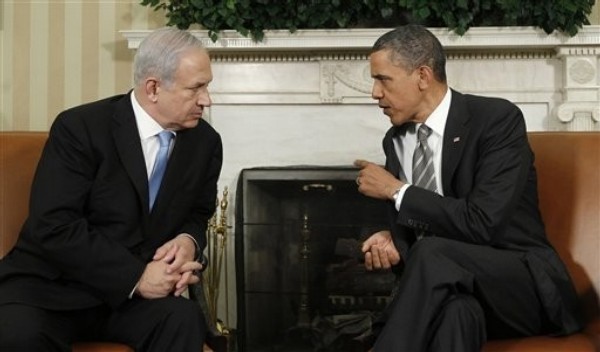
In his State Department speech last week, Barack Obama threw down the gauntlet to Benjamin Netanyahu. In the Oval Office a day later, and more fully in an address to Congress yesterday, Netanyahu picked it up and threw it right back.
The question now is whether this clash can be turned into a new understanding between the United States and Israel that improves the prospects for the two-state solution both parties say they want. To bring this about, Obama will have to make further tweaks to his approach and rethink his declared stance on Palestinian refugees, among other matters. For his part, Netanyahu will have to accept the fact that events have overtaken key aspects of the 2004 agreement between the Bush administration and former Prime Minister Sharon. If peace is possible, it is only along the lines former Israeli Prime Minister Ehud Olmert and Palestinian President Mahmoud Abbas explored during their 2006-2008 negotiations.
Obstacles to such a meeting of the minds between Obama and Netanyahu begin at the personal level. Whatever they may say in public, these two leaders genuinely dislike each other. Obama regards Netanyahu as an untrustworthy obstructionist; Netanyahu regards Obama as a blundering naïf.
Second, they disagree about the prospects presented by the status quo. Obama believes that changes on the ground have made it more dangerous to stand pat than to move forward, while Netanyahu believes the reverse. Obama, to his credit, has offered a clear and coherent argument for his position: The demography of the West Bank is shifting to Israel’s disadvantage; technological changes are making it harder for Israel to defend itself in the absence of genuine peace; as democratic movements surge throughout the Middle East and North Africa, Arab publics must see that peace is possible; and as the “international community” is becoming increasingly impatient, Israel is becoming more and more isolated. Resuming peace talks, the argument continues, is the only way of heading off a confrontation at the United Nations this summer that will leave Israel and the United States standing alone, not only against the developing world, but most of Europe as well.
For his part, Netanyahu believes that the turmoil in North Africa and the Middle East makes peace harder, not easier, to achieve and renders the status quo, for all its imperfections, the safer option for the time being. Until a new regime is established in Egypt and new leadership takes power, the future of the Israeli-Egyptian peace treaty—a linchpin of Israel’s security—will remain in doubt. The widening gulf between Israel and Turkey’s Islamist government is disconcerting. It may well be that changes in the region catalyzed the rapprochement between Fatah and Hamas, which only made a bad situation worse.
In addition, the two leaders have different views of the forthcoming UN vote on Palestinian statehood. Netanyahu is prepared to tough it out, even if the Europeans break toward the Palestinian side and only the United States is left to stand by Israel. That is the scenario Obama is desperate to avoid. If America is put in the position of being the last obstacle to international recognition of a Palestinian state, Obama’s aspiration to improve relations with the Arab and Muslim world would probably be thwarted for quite some time. Netanyahu doesn’t think that’s a problem; Obama does.
Even if these differences of perspective could be set aside, however, there’s a third problem: Obama and Netanyahu disagree about the conditions on which Israeli-Palestinian negotiations can and should resume, and the terms on which it should be resolved. Netanyahu’s baseline is the letter President Bush gave then-Prime Minister Sharon on April 14, 2004 as part of a sequence of events including Israel’s withdrawal from Gaza and the construction of its security fence. Here, verbatim, are the relevant portions of that letter:
“The United States is strongly committed to Israel’s well-being and security as a Jewish state.”
“As part of a final peace settlement, Israel must have secure and recognized borders, which should emerge from negotiations between the parties in accordance with UNSC Resolutions 242 and 338.”
“In light of new realities on the ground, including already existing major Israeli population centers, it is unrealistic to expect that the outcome of final status negotiations will be a full and complete return to the armistice lines of 1949, and all previous efforts to negotiate a two-state solution have reached the same conclusion. It is realistic to expect that any final status agreement will only be achieved on the basis of mutually agreed changes that reflect these realities.”
“[A]n agreed, just, fair, and realistic framework for a solution to the Palestinian refugee issue as part of any final status agreement will need to be found through the establishment of a Palestinian state, and the settling of Palestinian refugees there, rather than in Israel.”
“[T]he United States supports the establishment of a Palestinian state that is viable, contiguous, sovereign, and independent …”
It is against this baseline, which Israel’s right-wing coalition and its many American supporters cherish, that Netanyahu judged what Obama said at the State Department on May 19. Here are the corresponding sections from Obama’s speech:
“[A] lasting peace will involve two states for two peoples: Israel as a Jewish state and the homeland for the Jewish people, and the state of Palestine as the homeland for the Palestinian people …”
“[T]he borders of Israel and Palestine should be based on the 1967 lines with mutually agreed swaps …”
“The Palestinian people must have the right to govern themselves … in a sovereign and contiguous state.”
“I’m aware that these steps alone will not resolve the conflict, because two wrenching and emotional issues will remain: the future of Jerusalem, and the fate of Palestinian refugees.”
This schematic comparison clarifies what is and what is not in dispute between Netanyahu and Obama. They clearly agree on a two-state solution, on the need to recognize Israel as a Jewish state, and (less clearly) on the importance of territorial contiguity for a Palestinian state. And whatever Netanyahu might wish, both Bush’s letter and Obama’s speech leave open the final status of Jerusalem.
The comparison also identifies key points of difference between the Bush and Obama administrations, and between Obama and Netanyahu. First, along with the vast majority of Israelis, the Bush administration believed that the refugee problem could be resolved in only one way: The refugees would have the right to return to the new independent Palestinian state, but not to Israel. By contrast, Obama explicitly left that issue open. Whatever his rationale, any Israeli government is bound to find that stance disconcerting. Obama surely understands that any significant flow of Palestinian refugees to Israel would be a deal-breaker. If he’s in the business of saying out loud what everyone already knows, this would be an appropriate addition to the list.
Quite a bit of news on these fronts over the last few days.
This is a fair and balanced and clarifyingly helpful exposition.
Thanks.
Quite a bit of news on these fronts over the last few days.
This is a fair and balanced and clarifyingly helpful exposition.
Thanks.
The best thing about this piece is that Galston is not writing about finance and economics.
Nothing much to object to here, but I didn't learn anything about what has or has not changed in American policy and where the differences are between the US and Israel at this point, or where each is likely to go from here.
One point that I think deserves clarification: Galston says that Netanyahu was unable to persuade Livni to form a unity government. This suggests that it was Livni who was recalcitrant. I recall that at the time the problem was that Netanyahu refused publicly to endorse a two-state solution. He has no one but himself to blame for his dependence on the right wingnuts. He has the ... view full comment
The best thing about this piece is that Galston is not writing about finance and economics.
Nothing much to object to here, but I didn't learn anything about what has or has not changed in American policy and where the differences are between the US and Israel at this point, or where each is likely to go from here.
Read Full Article »