


I have visited Libya twice in the last six months: Tripoli in December, and Benghazi last week. I might as well have visited two different planets.
My visit to Tripoli in December was full of dark threats and ominous portents. The fear was palpable. One Libyan official told me that if you so much as dared to speak of Qadhafi’s paranoia and quirks you would be killed. Qadhafi’s thugs had taken to harassing our embassy personnel. It was a harbinger of worse things to come – violence and vicious threats directed not at foreign officials, but at Libya’s own citizens. Then in March, Qadhafi launched attacks on peaceful protesters and threatened to hunt them down “like rats.” The international community had no choice but to respond.
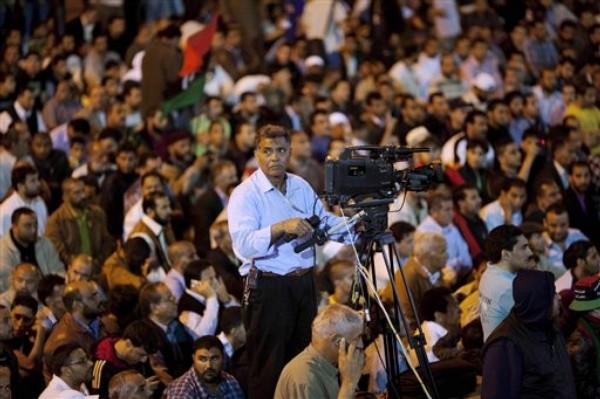
Last week in Benghazi, though, I saw what Libya could become – and it was clear as day why it is in the U.S. interest to see the Benghazi vision for Libya succeed over Qadhafi’s. The collective sense of joy and opportunity was unlike anything I have experienced in my diplomatic career – and that includes my posting in Budapest in 1989.
Everyone, from rights activists, to businessmen, to members of the Transitional National Council (TNC), projected a sense of exhilaration. Civil society organizations of every stripe seemed to pop up almost before my eyes. Citizens seemed astonished and delighted that they can at last speak their minds, and plan for a different Libya than the one they have endured for the past 40-plus years.
In the many years I have worked in the Middle East, I’ve never been to an Arab city so grateful to the United States. Libyans in Benghazi know how brutal their former ruler is. They are profoundly appreciative to have been spared what would have undoubtedly been a massacre of enormous proportions in mid-March, had NATO not intervened. Imagine walking in the main square of a teeming Arab city and having people wave the American flag, clamor for photographs with a visiting American official, and celebrate the United States as both savior and model.
Enthusiasm aside, the challenges facing Libya are great, and the struggle against Qadhafi is not over. The TNC seems sincere in its commitment to building an inclusive, democratic Libya that is a partner with us – but they and their supporters have a lot of work to do to turn their good words into action. And they are working to build functioning, accountable institutions from scratch, in the midst of an ongoing conflict.
I'm happy for the people of Libya and grateful to the international community for this collective military intervention. Gadhafi is finished. Everyday he loses more men, armored vehicles, territory, cities/towns and diplomatic support. With Russia and China beginning to engage in direct diplomatic negotiations with the TNC de facto government in Benghazi, the dictator has lost his last chances for a resolution favorable to him with support from other great powers. The loss of the port city of Misurata is the death blow to the regime. Losing control of this city has effectively cut the coastal highway from Tripoli to the eastern cities of Sirte, Ras Lanuf and Al-Brega (still under Gadhafi control). Remaining loyalists units in these cities/provinces are now completely isolated from Tripoli with no way for resupply. The intervention in Libya is only a beginning. The situations in Yemen and Syria may call for more UN sponsored collective military action. This will be hard, since Russia and China can veto any UN sponsored initiative - but there is hope. For those of us who have been studying this region either as hobby or academic interest, this is a very exciting time period that promises to bring about a dramatic transition in this region that will ideally combat the forces of extremism that has plagued the mid-east region, the USA, Europe and Israel for many decades.
Yes the people of Libya should be able to have the government they want, but not with the US taxpayer paying to rent out our navy and airforce to support rebels of dubious ( and in come cases downright nefarious) associations. They need to win this on their own WITHOUT the aid and money of the US and the US taxpayer. This is not in our strategic interest. If the UK and France feel it is in their interest let them do what they want - but don't ask the US to get involved in their foreign policy aims.
This is nothing but a wasteful expenditure of US taxpayer money which could be better used at home than paying for an intervention in Libya.
@worried1917: Perhaps re-reading the article, this time with open eyes, would be enlightening.
Assistant secretary of state for near east Feltman, has plenty of direct experience in the area. It's very encouraging that he doesn't observe an obvious threat to U.S. interests from the rebels. On the contrary, regime change and a shift toward broader representation for the Libyan people and an end to abject repression of Ghaddaffi and his clan bode well for Libya and the entire region.
Indeed, the Arab spring is acting as a release valve that could end with fewew bloody Autocrats and a lessening of tension against the United States, whose dalliance with dictators (Iraq, Iran, Saudi Arabia) has been fodder for Al Queda propaganda and Al Queda copycats for generations.
The most hopeful development is that the Arab Spring appears very home grown and not orchestrated and controlled by radical Islamicists a la Iran in 1979. The Right-wing scare tactics and Islamophibics at FOX news and elsewhere have lost this round big time.
And the U.S. and other power brokers won't have the likes of octogenerian Mubbarik or other despots to turn to to keep a lid things in the future. We are learning on a daily basis that Arabs and muslims can aspire to freedom and self-governance without turning to militant Islam; any other assertion is pure chauvinism.
Assistant secretary of state for near eastern Feltman, has plenty of direct experience in the area. It's very encouraging that he doesn't observe an obvious threat to U.S. interests from the rebels. On the contrary, regime change and shift toward broader representation for Libyan people and an end to abject repression of Ghaddaffi and his clan bode well for Libya and the entire region.
Indeed, the Arab spring is acting as a release valve that could end with few bloody Autocrats and a lessening of tension against the United States, whose dalliance with dictators (Iraq, Iran, Saudi Arabia) has been fodder for Al Queda and their copycats for generations.
The most hopeful development is that the Arab Spring appears very home grown and not orchestrated and controlled by radical Islamicists a la Iran in 1979. The Right-wing scare tac tics and Islamophibics have lost this round and will won't have the octogenerian Mubareks or other despots to turn to keep a lid on anymore. Arabs and muslims too can aspire to freedom; any other assertion is pure chauvinism.
@ worried -
I totally respect your opinions in regards to the intervention. I don't have any counter rebuttals or have intent to change your mind. I would just like to respond to a few things, with respect.
You wrote: ...to support rebels of dubious ( and in come cases downright nefarious) associations.
Good point. There are undoubtedly some elements within the rebel movement that have or had nefarious associations. This has been proven per intelligence reports by the US military in regards to AQ fighters in Iraq. But please take note, this is the mid-east. In any country that is currently imploding now due to political/sectarian/religious strife and may require UN intervention (Libya won't be the last), we and our allies will in likelihood encounter similar 'flickers' of AQ wherever we may end up next. I'm also a strong supporter of President Bush's decision to engage in Afghanistan in 2001 in the manner that it happened. To do this military operation and engage an enemy esconded in a land-locked nation required compromises. Hence - our 'alliance' with Pakistan that is still critical to this day for many things, mainly resupply to forces in Afghanistan. Few Americans are content with the alliance with Pakistan due to nefarious linkages, yet the alliance is critical to US interests at this moment. Geopolitics changes, but in the Af-Pak theatre such changes won't happen fast enough. And in Afghanistan, we seem to have bought and paid for an Army that can't defend itself well enough yet on its own and it seems to be thoroughly penetrated by AQ and Taliban, as evidenced by the numerous US and Coalition personnel that have been killed by soldiers that were supposedly loyal to us.
In short, these two illustrations are simply to demonstrate that the US has many openly known nefarious alliances and allies, yet these relationships are tolerated and do provide benefit. The Libyan people in the opposition movement have demonstrated that they are true seekers of democracy. They are not soldiers or trained fighters for the most part, just regular folks that just want a better life and had to take up arms to survive. I've been following the reports coming from the theatre from numerous sources, and if there was significant AQ or other Islamic extremists elements - these would have been manifested by now. The extremism characterized by the AQ signature has not surfaced yet, and I doubt that it will.
You wrote: This is not in our strategic interest.
I of course disagree. The US always has an interest to answer a call from the UN. The Security Council answered a plea for help from people being cluster bombed by a dictator. The USA can not sit idly by when the political forces aligned for the intervention (i.e. Arab League endorsement, Russia and China abstentions) can be mobilized to combat the truly despicable actions of this dictator. That is not what the USA does in this world. No government in the USA, D or R, could walk away from what was happening in Libya. That is why you see the House of Representatives point fingers and say harsh and meaningless words to the WH instead of initiating a greater legislative action. Everyone can see the importance of this intervention at the national level, even if politics prevents our congress persons from saying so in public.
For my part, I see two primary strategically important components that the US can achieve in Libya. Any president must honor the writ of The United Nations. Taking a stand for a just cause is always the right thing to do. But strategically, our primary interest in the region is Egypt. There were over 1M Egyptian foreign workers in Libya pre-Arab Spring. Most of these men have since returned home, mainly in the early part of the uprising. These are 1M now unemployed men returning to Egypt, a country is still imploding from its own democratic uprising. Moving forward.... non-intervention in Libya would have certainly led to massive immigration flows into Tunisia and Egypt. Refugees need to be fed and housed and consequently create a new stress for cash-starved society such as Egypt. The forces of instability in Libya could further jeopardize the movement to democracy in Egypt. Any future peace between the greater Arab world and Israel will require Egypt. Being part of this intervention consequently provides tangible assistance to Egypt which in my opinion, provides for a better long-term peaceful solution to the Israel-Palestine issue.
Secondly, another failed state scenario in the Mediterranean would be totally unacceptable. The USA has a strategic interest in keeping the Mediterranean as secure as possible. We know the situations well as has happened in Somalia and Afghanistan. Allowing such a possibility to occur in the Mediterranean would be absolutely unacceptable.
I do respect your disapproval of using US tax dollars for these purposes, and I know that we need it here at home. But we are a great power with great responsibility. No American administration could walk away from the Libyan intervention. We know definitively that John McCain would have intervened, in his case unilaterally without UN approval. Regardless of the Obama or McCain approach to the intervention, it was bound to happen because that is who Americans are. Americans will find a way to absorb the costs of the intervention. It's always possible even probable that the entire intervention will be paid for with Gadhafi frozen assets. Time will tell.
Anyway, we'll have to agree to disagree on all points I suspect - but I do hear your concerns.
Look, good argument and debate can be made for or against US military actions in Lybia...
But any US military action MUST BE CARRIED OUT LAWFULLY !
Obama is in BLATENT violation of the Constitution & the War Powers Act, BOTH....
Read Full Article »