


KONYA, Turkey
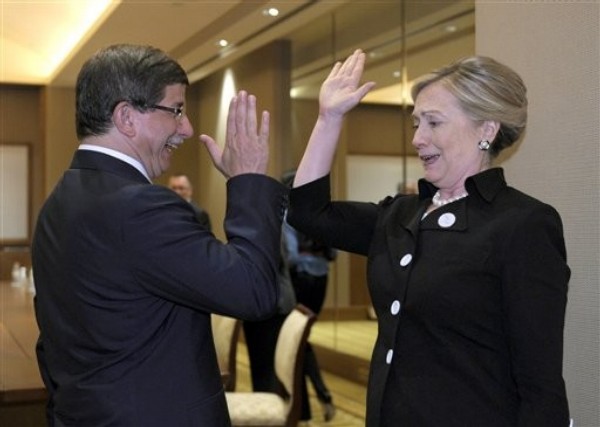
Ahmet Davutoglu, Turkey's foreign minister, greets villagers at a local festival in Konya. Davutoglu is running for the first time for a seat in Turkey's Parliament.
IT might have been the candidate’s unprompted riff on the influence of a 13th-century scholar on a religious awakening in the Seljuk Empire. Or maybe it was the seemingly sincere embarrassment at seeing his picture draped on the side of a minivan. But by the time his aides began passing out “Don Quixote” and “Great Expectations” to schoolchildren barely able to read, it was clear something was different.
Foreign Minister Ahmet Davutoglu (pronounced: dah-voo-TOH-loo), cerebral and soft-spoken, is running for the first time for a seat in Turkey’s Parliament on Sunday. In an election where only the size of his party’s majority is really in question, his descent from the ivory tower to the rollicking streets of a city known for its conservatism and cuisine makes his one of the more compelling races in Turkey’s increasingly vibrant and healthy democracy.
“No problems for Konya,” joked his spokesman, Osman Sert.
It was a play on Mr. Davutoglu’s famous assertion that Turkey would strive to have “zero problems” with its neighbors. Though he has had mixed success in making that a reality, the allure of his vision brought acclaim and attention to a man who spent 15 years as a professor of international relations in Malaysia and Turkey, then emerged as an architect of Turkey’s foreign relations after becoming chief foreign policy adviser in 2002. His most famous book was “Strategic Depth.” But he also penned this title: “Alternative Paradigms: The Impact of Islamic and Western Weltanschauungs on Political Theory.”
The latter book might not translate well into campaign literature. But rarely do politicians serve as ministers here without holding a seat in Parliament, and with his Justice and Development Party on the verge of entering its second decade in power, Mr. Davutoglu was put at the top of the slate for his hometown’s 14 seats in Parliament.
On the campaign trail, Prime Minister Recep Tayyip Erdogan has an almost innate sense for the crowd, but on this recent morning Mr. Davutoglu was still searching for the common touch. He looked more like a cross between earnest schoolboy and reclusive professor, and never seemed quite ready to take off his jacket.
“Some things are difficult to adapt to,” he said, as he drove to another event as part of a promise to visit all 31 districts of Turkey’s largest province. He had 9 to go.
Ahead was a minivan with four loudspeakers, the slogan under his portrait declaring, “Let stability continue, let Konya become stronger.” On the curb, onlookers waved at his car. Engrossed in conversation, he seemed not to notice them.
“As an academic, this was not the lifestyle I had planned for myself,” he said. “Now I see myself everywhere.” He turned his head to stare out the window. “You don’t have time to read, to think, to write, to study, to contemplate and to be alone,” he added.
THE Justice and Development Party, known by its acronym here as the AK Party, has presided over a remarkable period in Turkey. The country’s profile in the region and beyond has grown markedly, with much of the credit ascribed to Mr. Davutoglu’s success as a diplomat. The party’s policies have also delivered relatively efficient government to the country’s poor, and empowered an insurgent capitalist class that mirrors the party’s conservative background. Unlike past politicians, Turkey’s current leaders reflect the people they speak for: Mr. Erdogan sold lemonade as a youth, and President Abdullah Gul’s father was a factory worker.
For a while, Mr. Davutoglu fumbled a bit as he tried to channel that populism. Campaigning, he lamented, was about “horizontal communication instead of intellectual sophistication.” He gamely chatted with admiring children, who received copies of Cervantes, Dickens and Dumas and offered him a poem in return.
Connect with The New York Times on Facebook.
Also in Theater »
A discussion on the position of the black public intellectual.
Enough about Weiner, let’s talk about Yemen.
Read Full Article »