


Weather: Sydney 13°C - 20°C . A little light rain developing.
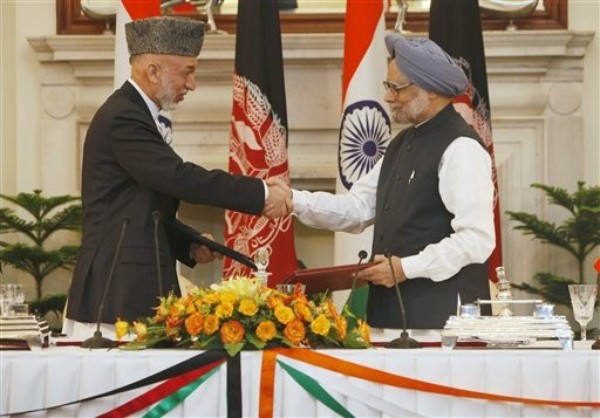
YESTERDAY'S signing in New Delhi of a "strategic partnership" between India and Afghanistan sends all the wrong signals at a delicate stage for Afghanistan.
Afghanistan badly needs a chance to develop its own system of governance following 30 years of external interference. India's strategic commitment to Hamid Karzai's government will probably push Pakistan further along the path of backing the Taliban, which it installed in government in Kabul in 1996.
Pakistan greatly fears the prospect that India will take up the work of the NATO forces. Pakistan's main productive land is strung along the Indus River. Islamabad sees Afghanistan as providing Pakistan with strategic depth in a situation in which a prime Indian military strategy has always been to cut the narrow country in two by a thrust from the Rajasthan salient.
Commentators, particularly those in India, are likely to respond that Pakistan will support the Taliban no matter what India does. Witness the claimed involvement of the Pakistani military intelligence agency, the ISI, in the assassination of Burhannudin Rabbani, who offered the main chance of brokering a compromise peace in Afghanistan.
They are oversimplifying a complex situation. Whatever the shortcomings of the Karzai government - and they are legion - the next time won't be like 1996, for a number of reasons.
Pashtuns, from the ranks of whom the main Taliban cadre are drawn, constitute roughly 40 per cent of Afghans.
Other groups include the Tajiks (the great anti-Soviet commander Massoud, and Rabbani, were both Tajiks), the Persian-speaking Shiite Hazaras and a number of other groups located to the north and west of the country.
The Hazaras have been under severe attack in Pakistan. An estimated 600 of them have been killed in Baluchistan by extremist groups such as Lashkar-e-Jhangvi. These extremists, located mainly in Southern Punjab, have been allowed by the Pakistan authorities to operate with near impunity. Iranian Sunni extremist groups have also entered Iran from Baluchistan to carry out attacks.
Iran is not amused. Tehran, which has been increasingly flexing it muscles throughout the region, is unlikely to let Afghanistan fall fully under Taliban/Pashtun influence this time round - or not without a fight.
Nor will Western influence and resources be entirely withdrawn from Afghanistan once their troops are pulled out. They will continue to provide training and military resources to the Afghan government. Ironically, they will share a common purpose with Iran in supporting a continuation of something like the status quo.
Negotiations, led by Rabbani and supported by the West, were all about defining what that something would involve. If elements of the Taliban could be induced to participate in government, so much the better for the peaceful future of Afghanistan.
There is evidence of a split on Afghan policy in Pakistan. Some elements in the military wish simply to rely on what they believe was in the past the successful policy of providing outright support to the Taliban. Others, including civilians and some elements of the army, aim to ensure that Pakistan has a seat at the negotiating table and that its strategic interests in Afghanistan - as outlined above - are met. That would require the establishment of a genuinely neutral government in Kabul, of whatever complexion.
Meanwhile, support of terrorist groups such as the Haqqani network could be maintained as insurance.
Enter India, which is already a major player in Afghanistan with aid pledges of $US2 billion ($2.09bn). But most of its aid is in the form of institutional support and economic development aid rather than strategic support.
The agreement between Mr Karzai and Indian Prime Minister Singh goes further, including by offering training to Afghan security forces.
That is bad policy. India, simply, cannot step into the shoes of NATO in offering military support to the current government in Kabul because it is not capable of doing so. More crucially, if Pakistan is pushed further from the Western position, it will close down vital supply routes into Afghanistan. Although Washington has made great play of having developed alternative routes through Central Asia, these can never be sufficient. That is why Washington has had to grit its teeth and persist with its reluctant Pakistani ally as long as it has.
So what is the apparent Indian strategic involvement likely to achieve? Pakistan will resume its policy of unbridled support to the Taliban. It will eventually close its borders to the flow of Western strategic materials into Afghanistan. This will make the Karzai government more reliant on Iran, where India is developing ports and railway systems.
Meanwhile, India will not be strategically placed to provide the type of support previously provided by the West
Once the West withdraws militarily, Afghanistan is likely to become locked into a new civil war, but one more likely to be stalemated than was the case in the 1990s.
To be fair, if the ISI or an element within it was indeed responsible for Rabbani's assassination, Pakistan would also have to share much of the blame. Either way, it is likely to be hapless Afghanistan that will suffer.
Dr Sandy Gordon is a visiting fellow at the Centre of Excellence in Policing and Security, RegNet, Australian National University
See the former CEO of Apple as he has introduced some of the most exciting new technology to the world's tech-loving audience
SHARES leapt the most in almost three years as sentiment improved on hope a solution is close for the euro-zone debt crisis.
THE Australian technology community has reacted with shock and sadness at Apple luminary Steve Jobs' death.
MONASH University has proved the big Australian winner in the latest Times Higher rankings, but there are still questions over the THE results.
SARAH Palin has confirmed she will not seek the Republican Party’s nomination for US president in next year's election.
FORMER Bulldogs forward Ryan Tandy has avoided a prison sentence after being found guilty of match-fixing in an NRL betting scam.
THE Palestinians are using settlements as an excuse to avoid returning to negotiations.
Copyright 2011 News Limited. All times AEDT (GMT +11).
Read Full Article »