


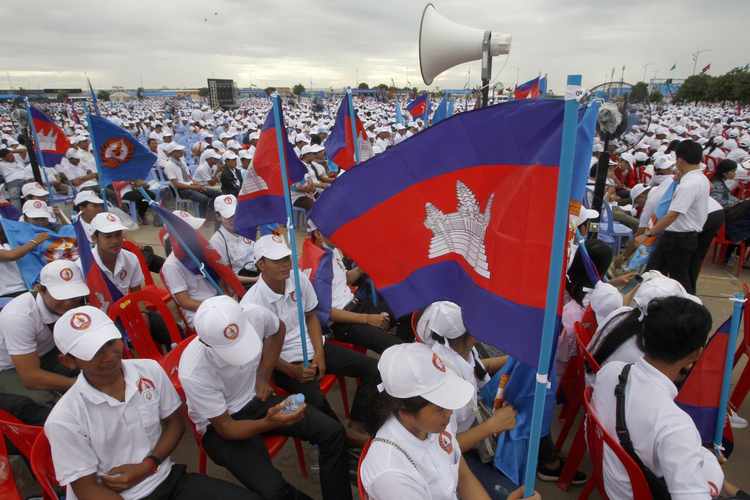
A European Union monitoring mission was in Cambodia this week to assess the country's compliance with the human rights obligations that lie at the core of the EU-Cambodia preferential trade deal.
The timing could not be more appropriate.
With national elections approaching on July 29, Cambodia is hurtling towards a one-party state under prime minister Hun Sen and the ruling Cambodian People's Party (CPP).
Over the past year, government-controlled courts have dissolved the opposition Cambodia National Rescue Party (CNRP). The party's leader, Kem Sokha, is in prison on spurious treason charges.
His predecessor, longtime opposition leader Sam Rainsy, has been in exile since 2015 after being convicted on trumped-up charges.
The government has effectively taken over the media, bankrupted or silenced independent newspapers, and ordered radio stations to stop broadcasting independent newscasts. Journalists have even been jailed for espionage for providing information to a foreign news organisation.
Those who stand up for victims are met with vitriol.
Last month Human Rights Watch published a 200-page report documenting serious abuses by a dozen senior Cambodian generals.
Hun Sen's response? He angrily said he would not investigate our allegations, would also not allow NGOs or the UN to investigate his generals, and that the country's 160,000 soldiers and police would oppose any such effort.
He denounced me personally and announced that I was banned from the country. Cambodians who make similar allegations face much worse: July 10 is the second anniversary of the assassination of Kem Ley, a wildly popular political commentator and Hun Sen critic.
Read Full Article »