


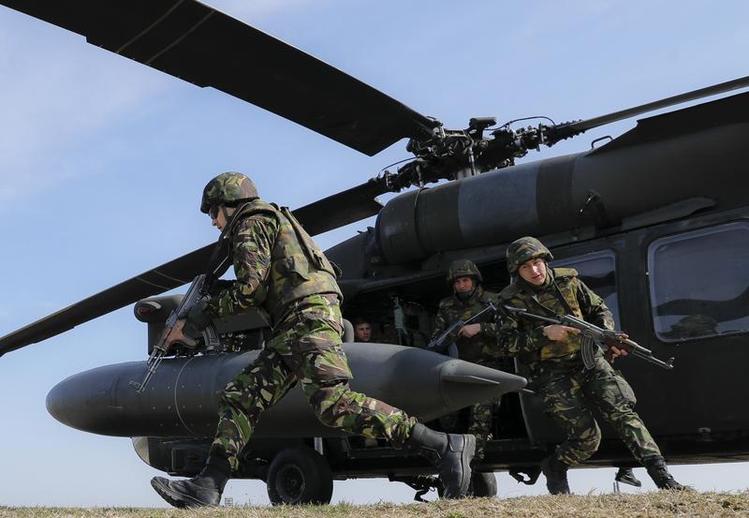
Russian and Chinese long-range fires, combined with non-lethal standoff able to shape the operational environment prior to conflict, have led the US Army to conclude that AirLand Battle – the underlying doctrine for its operations – has been ‘fractured'. Under its current posture, US forces would struggle to enter theatre within a politically relevant timeframe, and US sustainment capabilities would be under serious threat, if Russia were to launch an incursion into Eastern Europe. In response, the US Army has developed a new operating concept, ‘Multi-Domain Operations' (MDO). This concept calls for US forces to have a calibrated force posture, with forward and rotational deployments, and pre-positioned stock, so that the US can compete and deter adversaries below the threshold of armed conflict and be ready to fight if necessary. The second tenet of MDO is that the US military must maintain multi-domain formations, capable of operating across land, sea, air, space and cyberspace, conduct information operations, and contest the electromagnetic spectrum (EMS). MDO describes manoeuvring across these domains as convergence, with tactical commanders needing to understand how their actions shape other domains, and exploiting successes, or guarding against vulnerabilities that may emerge in them. By manoeuvring across domains, US forces seek to penetrate enemy anti-access and area denial (A2AD) systems, disintegrate them, exploit the breakdown of enemy cohesion to defeat their units in detail, and then set the terms to return to competition in a favourable position.
European Allies in US Multi-Domain Operations
Read Full Article »
Comment
Show comments
Hide Comments
Related Articles
