




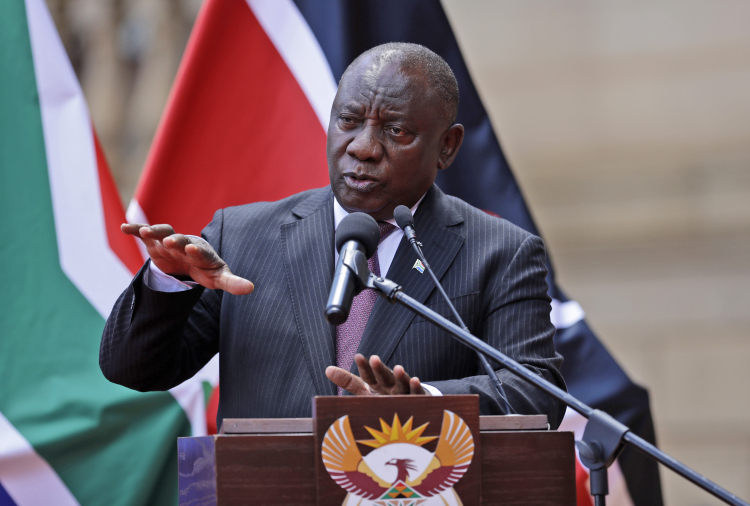
Today, South Africa’s President Cyril Ramaphosa is scheduled to visit President Trump. When he does, the mood will be distinctly different to the friendly reception he received from President Biden in 2022, and for good reason. With bipartisanship rare in Washington, South Africa has achieved the unusual feat of alienating both Democrats, by aligning itself with Russia against Ukraine; and Republicans, by siding with Hamas and Iran against Israel; and everyone in between by cozying up to China. If Ramaphosa is so inclined, he could propose putting South Africa on a different path, repairing relations with the U.S., and deepening ties between the two countries based on increased commerce to the benefit of South Africans and Americans alike. The alternative is to accelerate South Africa’s decline, further threatening Western interests, and making the world a more dangerous place.
For at least two decades, South Africa’s economic policy has been on the wrong track. Diminishing economic freedom has resulted in anemic growth, a collapsing infrastructure, and 30% unemployment. Real per capita income has fallen more than 6% over the past decade to about $4,000 annually. Investment has dried up thanks to race-based rules that require domestic and foreign investors to give up at least 30% ownership to black partners in key industries, such as mining, which was once the backbone of the economy. The ratio of gross fixed capital investment to GDP languishes at 15%, low by global and South Africa’s historic standards. Local economists estimate the ratio should be at least 25% to achieve a 4% annual growth rate, the minimum required to sustainably lower unemployment. Growth is possible, but it would require Ramaphosa to act on President Trump’s advice.
In February a White House executive order took aim at a new South African statute, signed into law by Ramaphosa, that allows the government to seize property if it deems it in the public interest, and pay below market rates – even zero – in compensation. Attention has focused on the potential impact this will have on the country’s white farmers, but the Expropriation Act extends to all physical and non-physical property and will harm South Africans of all races. If the race-based investment laws don’t deter entrepreneurs, this Act surely will. Secure property rights are the cornerstone of any successful, prosperous country. Ramaphosa would do well, therefore, to heed the White House’s advice, rescind the law, and comply with the country’s constitution that requires fair compensation based on market values. He should also rescind the racist investment laws that are failing the people they are purported to help. The laws also scratch at race-based wounds that were healing remarkably well in the early post-Apartheid years when the economy was growing and providing opportunities for all.
South Africa could gain bipartisan support in Washington DC by giving up its reflexive support for strongmen, like Vladimir Putin. It would also benefit from normalizing relations with Israel and dropping its legally and morally perverted case against the only Jewish state at the International Court of Justice. It could also appoint an ambassador to Washington who is not openly hostile to the sitting President or the West in general – for such was the last one, who earned persona non grata status for calling Trump a white supremacist.
Now that bilateral trade deals are on Trump’s to-do list, a new trade pact with South Africa, contingent on Ramaphosa adopting domestic policy reforms, could open considerable opportunities for American investors, who for years have been outdone by Chinese businessmen. Increased American trade and investment with South Africa could aid in pivoting the country away from the enemies of the West.
As China expands its influence across Africa, its navy now has a presence in many ports around the continent. It has a military base in Djibouti, rivaling a U.S. one. Directly across the Bab al-Mandab Straits, which lead to the Suez Canal, are Iran’s proxies, the Houthis. If they acted together, China and Iran could block the Straits completely. Thanks to the Houthis, shipping is already being forced around the southern tip of Africa, past Simonstown, South Africa’s naval base that China has been eyeing. Should the Chinese establish a presence in Simonstown, all global commerce could be imperiled in case of tensions between the superpowers. Furthermore, Simonstown’s strategic position means anyone who controls it also controls the southern Atlantic, giving them a back door into the U.S. sphere of influence.
Should Ramaphosa fail to secure a bilateral trade deal and a reset of relations with the U.S., the Trump Administration has other options. It could strengthen its already promising links with regional neighbors like Namibia and Angola. It has already announced a major summit to deepen commercial ties with West African countries. But if Ramaphosa comes to DC with an open mind, outstretched hand of friendship, and the offer of a deal, he could achieve a popular win for the people of South Africa. According to polling by the Social Research Foundation, a South African think tank, most South Africans hold Western values and identify with the western democracies over adversaries like Russia and China. Ramaphosa should understand that, and Donald Trump should also know that his popularity in South Africa will soar if he pushes the country back on the path to prosperity while securing U.S. strategic advantage in the South Atlantic.
Richard Tren is a director of the Yorktown Foundation for Freedom
