




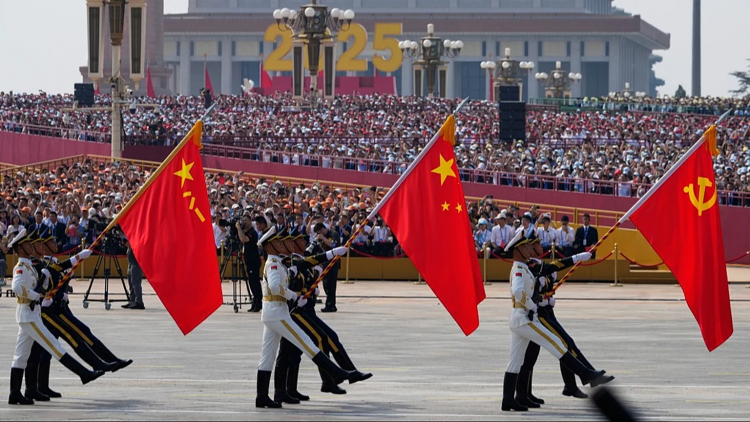
Last week marked 76 years since the People’s Republic of China was proclaimed. Beijing marked the occasion through the usual pomp and circumstance. Speeches and parades marked the Communists' pride in the founding of their regime. In the West, China’s National Day is an opportunity to reflect on the poignancy of the Domino Theory and the lessons for how to deal with modern China.
President Dwight Eisenhower first expatiated the Domino Theory back in the 1950s. The idea being that if one country fell to communism, it wouldn’t be long before neighboring countries also became communist. While this theory is often evoked to condemn the failure of the Vietnam War, the history is more complicated.
Russia is the first country to have a communist government, falling to the Bolsheviks after World War I and proclaiming the Soviet Union. The creation of the Soviet Union and its rise as a superpower after the Second World War created a springboard for the spread of communism. A strengthened Soviet Union was thus able to support fledgling communist movements across the world.
One of the biggest dominoes to fall was China. After the fall of the Qing Dynasty, China was divided among various warlords, all jostling for supremacy. This instability created an opportunity ripe for communists to exploit. Founded in 1921, the Chinese Communist Party (CCP) grew to become a major threat to the ruling Nationalist or Kuomintang (KMT), led for decades by Chiang Kai-shek.
The Invasion of China by the Japanese in the 1930s gave the CCP the respite they needed to bide their time. This external threat meant Chiang Kai-shek had to focus his attention on the invading Japanese, ignoring the CCP. While the KMT exhausted itself in the fight against Japan, Mao Zedong and the rest of the CCP could wait in the shadows.
After the defeat of Japan in 1945, Mao and the CCP received two helping hands from two of the Allied powers. First, a late declaration of war by the USSR on Japan meant the Red Army could secure territory and military equipment on behalf of the CCP. Second, US President Harry Truman restrained Chiang and the KMT by forcing them into what turned out to be failed peace negotiations. This pause gave Mao and the communists the needed time to secure territory and equipment previously cleared by the Red Army. Truman’s failure to back the Nationalists against Mao allowed the communists to win the Chinese Civil War and the banishment of the KMT to Taiwan. This decision had consequences that we are still feeling today.
For one thing, the PRC saved North Korea from certain defeat in the Korean War. The ensuing stalemate in that conflict allowed the Kim Regime to survive and continue to threaten the US and our Pacific allies with nuclear weapons. Not to mention the millions of people who have suffered under the boot of tyranny in North Korea.
In addition, Chinese intervention in the Vietnam War meant communism managed to take over that country as well. Often cited as evidence to disprove the Domino Theory, Vietnam was the domino that allowed communism to spread to Laos and Cambodia as well. Millions were killed by Pol Pot and the Khmer Rouge in Cambodia. That wouldn’t have happened without the CCP's support of communist takeovers in Vietnam and then Cambodia.
The threat of the CCP extends directly to the US as well. China continues to threaten Taiwan, the source of 90% of the world’s advanced microchips. While recent policies aim to expand production in the US, we will continue to depend on Taiwan for the computer chips needed in commercial and military goods. If China invades Taiwan, our military is beholden to one of our greatest adversaries for the technology it relies on to stay ahead.
China isn’t content to threaten our supply chains; they also threaten us at home. The CCP infiltrates cultural organizations to threaten dissidents and critics living abroad. The presence of Chinese police stations in New York City and elsewhere shows how grave this threat is. In addition, China is strategically buying up US farmland as well. Not only does this threaten our food security, but much of this land is very close to US military bases. This land would certainly be used by the CCP for attacks in the event we go to war.
To counter the threat of the CCP, the US needs to do a couple of things. First, secure our homeland against the CCP. Private citizens from outside the owning land are not a problem, but when it comes to countries that are strategic rivals, if not enemies, we must be on guard. In addition, the intelligence community needs to work closely with local law enforcement to counter CCP efforts to repress critics in the US.
Finally, we need to reaffirm our commitment to Taiwan. The Trump administration has hinted at changes in Taiwan policy to secure a trade deal, but this is short-sighted. Taiwan is critical to the United States’ long-term security, and we must make sure China cannot take it over by force or otherwise. Moreover, China repeatedly failed to follow agreements it signed with examples including a trade deal signed under the first Trump administration, as well as its obligations to Hong Kong. Why sacrifice a critical ally for a deal China won’t follow?
Common wisdom suggests the Domino Theory was overblown in its fear of communist takeover. However, the reverberations of a communist takeover of China have been felt in East Asia and beyond. To secure US interests against an increasingly aggressive China, we need policymakers in Washington and across the West to learn their lesson that the threat of communism is alive and well. Otherwise, dominoes will continue to fall.
Matt Cookson is an alumnus of the Young Voices Contributor Program and was a Middle East History and Policy Fellow with Young Voices. He also works in the supply chain for a U.S. Defense Contractor. His commentary has appeared in the Daily Wire, Mises Institute, Real Clear Politics, the National Interest, Providence Magazine, China Source, and the Idaho Freedom Foundation. You can follow him on X @MattCookson95 and Substack @thewaythecookiecrumbles.
