




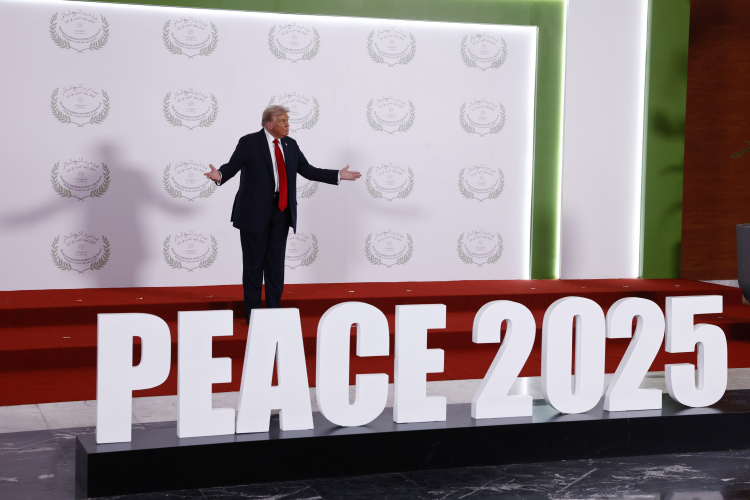
The Gaza cease-fire may be fragile, but the approach that achieved it is reshaping how the United States projects power. After two decades of failed experiments, from forced democratization to endless “peace processes,” Washington may have found a model that works. Trump’s diplomacy treats the Middle East not as a stage for moral appeals but as a negotiation table built on leverage, incentives, and enforcement rather than promises.
Trump’s 20-point Gaza peace plan, unveiled at a summit in Sharm el-Sheikh, lays out a step-by-step framework that ties each phase of the cease-fire to measurable conditions. It began with the release of all hostages within 72 hours of Israel’s acceptance, followed by a corresponding exchange of Palestinian detainees. Reconstruction now proceeds under a technocratic administration backed by an international “Board of Peace,” chaired by Trump, to manage funding and oversight. The plan also establishes an International Stabilization Force to train vetted Palestinian security units, with Israel set to withdraw in stages as demilitarization benchmarks are verified. Its sequencing and accountability distinguish it from earlier peace efforts that relied on trust rather than enforcement.
The groundwork was laid months earlier. In May 2025, Trump embarked on a four-day tour of Saudi Arabia, Qatar, and the United Arab Emirates—his first major foreign trip of his second term. Officially billed as a trade mission, the tour doubled as a diplomatic reset. In Riyadh, he and Crown Prince Mohammed bin Salman announced a “strategic economic partnership” built around semiconductors, energy, and space technology, alongside more than $600 billion in new investment commitments. In Doha, Trump secured a $96 billion Boeing sale to Qatar Airways and expanded defense cooperation through new basing and counter-drone agreements. In Abu Dhabi, a U.S.–Emirati consortium unveiled plans for what will become the world’s largest artificial intelligence data center outside the United States, backed by roughly $200 billion in new commercial agreements and tied to a broader $1.4 trillion UAE investment commitment over the next decade.
That network of deals formed the backbone of Trump’s later diplomacy. When U.S. and Israeli forces struck Iran’s Fordow and Natanz nuclear sites in June, reasserting deterrence after years of ambiguity, Washington gained the leverage to turn those partnerships into enforcement mechanisms. The same coalition that signed trade and defense pacts in May became the guarantor of peace in October: Egypt managed border crossings, Qatar financed humanitarian aid, and the Gulf states underwrote reconstruction. The cease-fire’s credibility rests on that structure because those who helped fund it are now responsible for keeping it.
That shift marks a clear break from the habits of U.S. diplomacy that came before. For over two decades, Washington oscillated between force and hesitation. George W. Bush tried to impose democracy through military intervention, leaving the region wary of American intentions. Barack Obama pursued consensus through multilateral diplomacy, but his restraint eroded U.S. leverage with both allies and adversaries. Joe Biden entered office promising stability but faced crises that reinforced perceptions of weakness. The chaotic withdrawal from Afghanistan undercut American credibility abroad, and his Gaza strategy relied on reactive diplomacy—urging cease-fires without enforcing compliance. In May 2024, Biden unveiled a new proposal for an Israeli cease-fire and hostage release, a plan that echoed later elements of Trump’s framework but lacked regional enforcement or economic incentives. By early 2025, Gulf capitals had deepened economic ties with Beijing through Belt and Road infrastructure projects, with trade rising above $225 billion in 2023 and projected to reach roughly $325 billion later this decade. Frustration with Washington’s rhetoric-over-results approach opened space for Trump’s model, grounded in leverage, incentives, and aligned interests, to begin reversing America’s diplomatic drift.
Trump’s critics call his diplomacy transactional. Supporters call it realism. Either way, it delivers. The Gaza plan established measurable steps, independent monitoring, and consequences for violations. It has held long enough to reopen crossings, lower tensions, and shift focus toward reconstruction—progress in a conflict that once defied every formula.
More broadly, Trump’s approach meets China’s checkbook diplomacy on equal terms. It leverages what the United States still does best: capital markets, technology, and credible security guarantees. In a region tired of moral lectures and broken promises, that combination has proved more persuasive than any speech. The peace may not last forever, but its logic of accountability tied to shared gain offers a smarter, more resilient American strategy.
Iulia Lupse is the founder of I&A Communications Solutions and a contributor with Young Voices. Born in Romania, she is now based in New York. Follow her on X at @IuliaL27
