




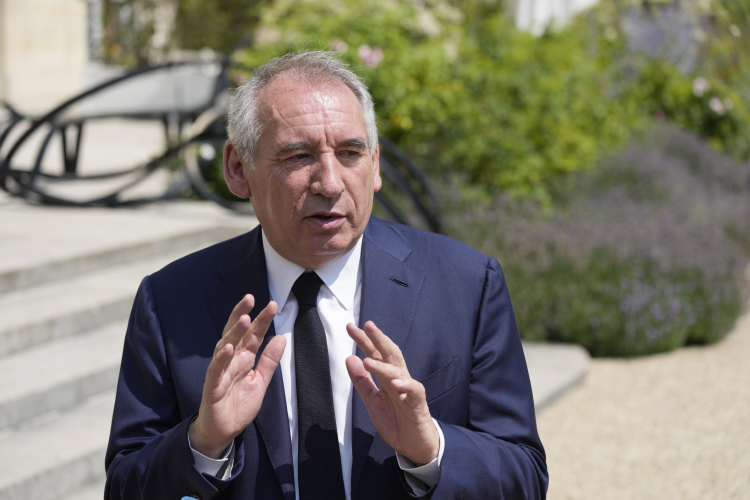
The month of September was not good for France. Former Prime Minister François Bayrou’s cabinet collapsed at the beginning of the month following a no-confidence vote. Fitch Ratings subsequently lowered France’s sovereign debt rating from A+ to AA– saying, “The government’s defeat in a confidence vote illustrates the increased fragmentation and polarization of domestic politics. This instability weakens the political system’s capacity to deliver substantial fiscal consolidation.”
France’s budget deficit reached over $197 billion in 2024 and national debt rose to $3.9 trillion. Efforts to introduce spending cuts have led to two consecutive prime ministers being overthrown. Sébastien Lecornu, the new prime minister and former Defense Minister, will also have a tough time getting a budget with spending cuts passed.
Meanwhile, Macron appointed Fabien Mandon as the new Chief of Defense Staff of the Armed Forces, taking over from Thierry Burkhard. Mandon is an air force general with extensive combat experience as a Mirage fighter pilot and a trusted advisor of Macron’s. Mandon will have to fight to secure the resources needed to ramp up the French armed forces for high-intensity operations. This is particularly important for areas where there are shortfalls in capabilities, such as long-range deep precision strikes, meaning the ability to strike key targets within enemies’ defenses.
There is a certain urgency to move forward on this front. Russia is an increasing threat and France does not have the ground capabilities for a protracted conflict. France has always preferred to purchase European-made armaments, unlike some other EU countries that purchase US weapons that Washington has the power to shut off: what Brussels calls “kill switches.” This fear has brought some other countries to join France in urging for EU “technology sovereignty,” so smart investments will need to be made despite an unfavorable budgetary context.
Promising Developments
France has projects underway that are worth getting excited about, particularly for air capabilities and the 2030-40 horizon is looking promising, thanks to strong political commitment. This was reinforced with the signing of the Lancaster 2.0 agreement in July between France and Britain in which both countries reiterated their commitment to the development of STRATUS, formerly known as the FC/ASW program, with technological and financial support from Italy as well.
Supervised by Emmanuel Chiva, then French Delegate General for Armaments (DGA), and his British counterpart, Luke Pollard, UK Minister of State for Defense Procurement and Industry, European corporation MBDA’s French and British subsidiaries are co-developing the two sides of the system designed to strike hardened, high-value, ground, air or naval targets, protected by the advanced Air-Defense systems of the next decade. On the one hand, the STRATUS RS missile, supersonic and highly maneuverable, and the subsonic, highly stealth and long-range STRATUS LO missile, which is designed for missions requiring discretion and survivability.
The two complementary missiles are also meant to arrive at the same time as the future F5 standard for the Rafale to provide vital SEAD capabilities. Gen. Jérôme Bellanger, Air and Space Force Chief of Staff, said “We’ve got to find their air defenses, pin them down, and knock them out—fast,” and that the new F5 equipped with the STRATUS RS will be able to do just that. Bellanger adds, “This is how we stay in the game.” And good thing because Russia just unveiled its new advanced anti-access/area denial [A2/AD] S-500 Prometheus Transporter Erector Launcher system able to intercept ballistic and hypersonic missiles and China has its own long-range surface-to-air defense missile system, the HQ-19.
Another important project on the horizon is the replacement of the Charles de Gaulle carrier with PANG, the future carrier being designed to accommodate the New-Generation Fighter (NGF) that France is working on with Spain and Germany as part of the Future Combat Air System. A parliamentary report suggested pushing the program, but Lecornu intervened stressing its importance. Adm. Nicolas Vaujour, chief of staff of the French Navy also recently argued, “If we want to achieve that transition between 2035-38, the program has to be launched quite soon.” Both the carrier and its aircraft are essential in delivering strikes deep into territory far from home.
Prioritizing Long-Range Ground Capabilities
If we now consider the ground forces, the situation is not as rosy. To confirm its position as a major contributor to NATO, France aspires to become a framework-nation for an army corps, but this is only possible if it possesses combat capabilities intrinsically linked to this high level of tactical responsibility – that includes ground-based deep strike capabilities. In order to carry weight and have strategic leadership in a coalition, an army corps framework-nation needs ambitious deep strike capabilities of more than 600 miles, giving it the ability to strike deep inside enemies’ territories.
Unfortunately, France has been more focused on depleted artillery and tactical weapons such as the DGA’s FLP-T (Frappe Longue Portée - Terrestre) program to replace the French army’s LRU systems with precision missiles with a range of 90 miles. While useful, this ignores the operational and strategic dimension that France needs if it is to carry clout in a coalition, especially during high-intensity protracted wars.
This operational and strategic capability could soon be provided with the arrival of the Land Cruise Missile (LCM), a ground-based variant of MBDA’s battle-proven MdCN combat system used by the Navy with a precision strike range of 600+ miles. The new cruise missile was presented at the 2025 Paris Air Show by the French Ministry of the Armed Forces and MBDA has been working with the DGA on system integration and test preparation. Col. Guillaume Kubala a fighter pilot and aerospace expert, says that by adding the LCM, “The aim is to have a complete deep-strike chain, including targeting, penetration of defenses as well as ground-to-ground, air-to-ground and anti-ship assets.” The project is gaining momentum as Emmanuel Chiva hosted a Polish delegation in July where they signed a letter of intent to cooperate on land-based cruise missiles.
Unfortunately, while Pierre Schill, French Army Chief of Staff, and his teams primarily focus on the future of artillery, some voices have suggested a ballistic solution. A surprising proposal, given that inexpensive ballistic solutions have proven ineffective, as demonstrated by the Israeli/Iranian confrontation where more than 90% of Iranian strikes were intercepted. Considering that solutions capable of overcoming the BMD and IAMD of a peer competitor are much more expensive than cruise missiles, the choice seems questionable given France’s enduring budget crisis.
However, previous procurement priorities showed that France lacked a mature understanding of deep strikes, too often confining this capability to the strategic level. The transition to widespread use in high-intensity warfare has not yet been sufficiently anticipated. This situation could be due to the fact that, in recent years, the highest decision-making positions have been mainly assigned to generals from the army, who are barely familiar with the subject. On the contrary, Fabien Mandon's operational and managerial experience in this field should enable him to make quick decisions, particularly in order to maintain the pace of build-up required with his allies, foremost among which is Great Britain. He just might have to fight a little harder given France’s budget crisis to secure the financial resources needed to bring France’s land, air and sea capabilities up to the level needed in today’s world.
Donald Ramsay is an Independent organizational consultant. Specializing in Defense and Security sectors, by passion and by profession.
