




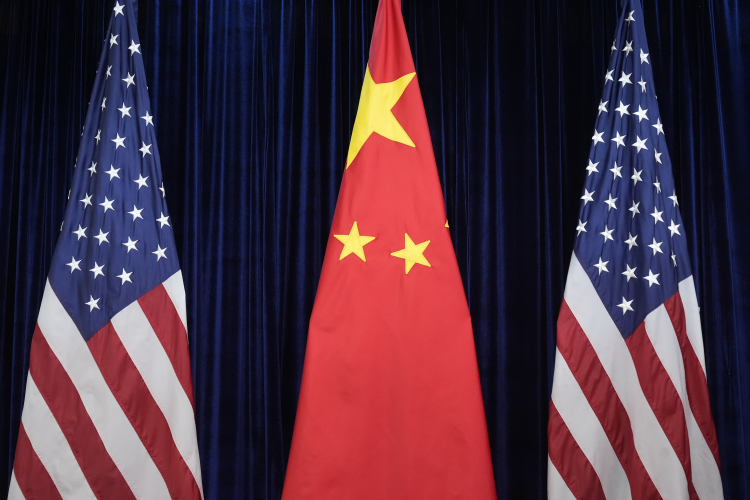
In an era defined by a Trump trade regime marked by the highest tariffs in decades—and the greatest policy volatility in modern history—the Supreme Court is poised to rule on the legality of those tariffs. That decision will shape the future of American trade authority. It also presents an opportunity to take a broader, overdue look at U.S. trade policy as a whole. Any such reassessment must include a clear-eyed evaluation of export controls, which now span the globe but fall most heavily on China. Beijing’s technological, industrial, and military progress—combined with its expanding economic weight—poses the most comprehensive challenge to U.S. power since the United States emerged from World War II as the dominant global actor.
Washington’s reflexive answer to China’s rise has been export controls targeting chips, software, next-generation tools, and other cutting-edge technologies that underpin U.S. strategic and economic advantages. The impulse is understandable: safeguarding technological leadership is central to both national security and long-term prosperity. Yet instinct is not strategy. Broad, blunt restrictions on U.S. firms selling to China risk imposing costs that exceed their benefits. A more calibrated and adaptive approach is needed—one that protects critical advantages without undermining the innovative ecosystem on which American power ultimately depends.
Supporters argue that export controls help delay China’s military modernization and its advances in AI. These are legitimate areas of concern. However, controls can only work if they significantly slow China in these domains while simultaneously giving the United States time to bolster its technological leadership. On both counts, current policy is falling short.
The semiconductor restrictions on sales to China announced in October 2022 placed sweeping limits on advanced AI chips and chip-making equipment. Although NVIDIA does not disclose exact figures, analysts estimate that roughly 20-25 percent of the company’s data-center revenue came from China prior to these rules. Cutting off such a large market at a moment of surging worldwide demand for AI processing power produced significant disruption across both commercial and strategic domains.
China responded quickly, evading the controls. Firms stockpiled compliant chips, including NVIDIA’s A800 as well as its H20 processors engineered specifically to meet U.S. rules. Chinese buyers secured restricted hardware through intermediaries in the Middle East, Southeast Asia, and Hong Kong while also accelerating domestic chip-design efforts. Huawei, widely assumed to have been severely weakened by post-2019 U.S. restrictions, returned in 2023 with a next-generation smartphone processor fabricated by SMIC using near leading-edge processes. At the same time, Chinese AI labs, unable to count on the highest-performance chips, emphasized algorithmic efficiency instead. Companies including DeepSeek released AI models in early 2025 that surprised many in Silicon Valley by achieving competitive performance at lower cost by using relatively modest hardware and software optimization.
These developments do not mean export controls failed entirely. They have slowed China’s access to cutting-edge chips and tools. But they did not halt China’s progress—and they have imposed real costs on U.S. companies. NVIDIA estimated an initial revenue hit of approximately $400 million dollars tied to the controls, and external estimates suggested cumulative lost revenue across the semiconductor sector reaching into the tens of billions. Precise figures are debated, but the strategic reality is not. In capital-intensive sectors, reduced markets quickly translate into diminished research and development—and R&D shortfalls today mean strategic weakness tomorrow.
Export controls are meant to buy time for U.S. renewal. However, too often they have become a substitute for strategy. The CHIPS and Science Act of 2022 included $52 billion in semiconductor funding, yet disbursement has lagged. Major domestic facilities have timelines that now extend to 2028 or later. Skilled-labor shortages have slowed flagship fabs in Arizona and other states; immigration bottlenecks continue to constrain the hiring of STEM talent; and domestic permitting remains slow and uneven across the country.
While the United States has struggled to execute at speed, China has invested hundreds of billions of dollars in semiconductor subsidies, research institutes, national talent programs and indigenous lithography efforts. Beyond chips, China has already established global leadership or gained strong momentum in electric vehicles, solar manufacturing, battery materials, grid-scale energy storage, shipbuilding, commercial drones, and rare-earth production. Indeed, according to the Australian Strategic Policy Institute, China now leads in 57 of 64 technologies critical to future economic development and security. Export controls alone cannot reverse technological momentum on this scale.
Broad export restrictions, moreover, can generate self-inflicted harm. American firms lose access to large markets and therefore lose scale and R&D funding. International competitors step in to fill the vacuum, as the Dutch company ASML did through expanded sales of slightly dated lithography tools to Chinese customers in 2023. China accelerates self-reliance and builds new supply and evasion networks through intermediary countries. Meanwhile, regulatory burdens grow at home. Indeed, the U.S. export-licensing process is now in turmoil and thousands of export approvals are stalled.
The pattern is clear. Washington constrains, Beijing adapts, and the United States congratulates itself on tactical disruptions while losing ground in the broader strategic contest.
Export controls remain necessary for true national-security chokepoints such as advanced lithography, specific military end-uses, and AI systems with direct battlefield relevance. But blanket commercial bans undermine competitiveness. The United States should refine controls focused on the highest-risk technologies. At the same time, it should accelerate CHIPS Act implementation through more standardized permitting processes and the creation of a task force dedicated to expediting the execution of permits. It should streamline fast-track innovation visas for PhD-level STEM talent, align incentives with allies in a sustained technology coalition framework, and expand tax incentives for domestic capital expenditures and public-private R&D in frontier fields.
Ultimately, the United States will maintain its technological lead not by shrinking markets but by expanding capability. Export controls may buy time, but only domestic dynamism can win the race. Using controls as a stand-in for strategy risks turning a tactical pause into a strategic retreat. The United States cannot sanction its way to technological leadership. It must build its way there.
Daniel Bob worked on Indo-Pacific trade, technology, and economic policy in the U.S. Senate Finance Committee, Senate Foreign Relations Committee, and House Foreign Affairs Committee and Council on Foreign Relations.
