




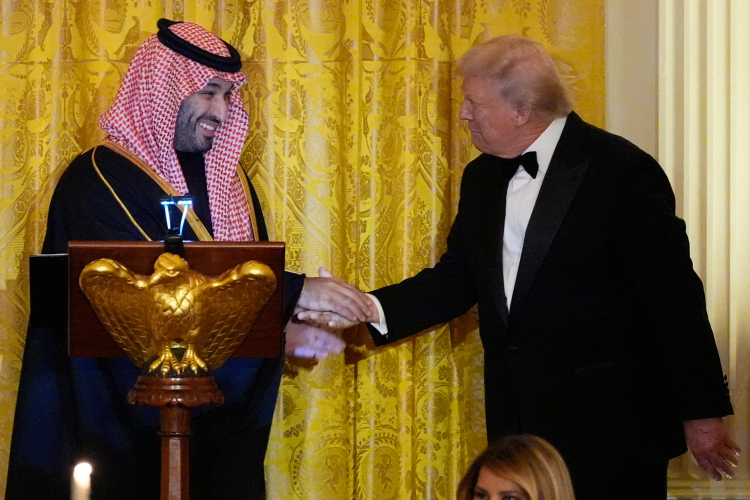
The U.S.-Saudi romance is back. That’s at least the story in most reports about the visit of Saudi Crown Prince Mohammed Bin Salman (MBS) to the White House, and the one the White House is selling: where Trump set aside concerns about Saudi Arabia’s human rights record, especially the murder of Saudi journalist and dissident Jamal Khashoggi, and put U.S. interests first to get a series of lucrative cooperative deals with the Saudis.
But the new deal with Saudi Arabia is essentially the old one, and MBS is a sideshow. The new initiatives are mostly press releases lacking substance. They reinforce the old, bipartisan set-up with the Saudis—one resting on a myth that U.S. energy security requires buying Saudi goodwill. The U.S. should distance itself from the Saudis instead of cozying up, not because MBS is a thug but because it’s in our interest to do so.
Recall that after the Khashoggi’s 2018 murder in Istanbul, which MBS reportedly ordered, Congress voted to halt most assistance for Saudi Arabia’s war in Yemen, although President Trump vetoed the law. Joe Biden insisted during his presidential campaign that Saudi Arabia be treated as a “pariah.”
Trump tried to turn the page in his meeting with the Prince, greeting him with royal pomp, denying his role in the killing, and even berating a reporter for asking about it. The message was that we’re back to business with Saudi Arabia in ways that serve U.S. interests, justice be damned.
The White House announced that the United States will grant Saudi Arabia Major Non-NATO Ally status, offer F-35 aircraft as part of a $142 billion weapons package, cooperate on Saudi civil nuclear development, sell previously restricted AI chips, and help build a Saudi rare earth processing facility to diversify supply for the United States. The Saudis meanwhile agreed, vaguely, to invest $1 trillion in the United States.
The deals sound impressive, but most are statements of intent, not enforceable pacts. The nuclear agreement is just a “precursor” to a formal “123” pact that would require congressional approval. The AI part is a “memorandum of understanding” lacking detail. The rare-earths deal is far from producing anything and unnecessary because the threat from Chinese dominance of the industry is overblown. Making Saudi Arabia a major non-NATO ally merely expedites defense cooperation and the purchase of U.S. weapons. It’s hardly the security guarantee Saudi leaders sought, and doesn’t even match the papier-mache sort Trump recently gave Qatar via executive order.
The weapons sales and pledged investments also ring hollow. The Saudis have promised huge weapons purchases before that subsequently failed to materialize. And it’s not clear whether the $1 trillion Saudi investment figure is new investment or double-counted, what time period it covers, or if it’s anything more than empty rhetoric.
So these new deals will not much change U.S. Saudi relations, even if they somewhat increase defense cooperation. What’s on offer here is more of the same, and that’s the real problem. The United States’ quasi alliance with Saudi Arabia is drag on U.S. interests.
The supposed bargain is that the United States, by pleasing Saudi leaders and keeping them safe, gets their cooperation in three key ways. First, Saudi Arabia is protected from predators who could disrupt its oil production or manipulate global prices to wreak havoc in the U.S economy. Second, we’re told that if we do not keep the Saudis on our side, they’ll do something with their oil wealth that benefits China at our expense. Third is the idea that Saudi Arabia as a “swing producer” of oil needs sweeteners to make production decisions that benefit the United States.
These misconceptions are bipartisan. President Biden, after all, quickly swallowed his tough talk about MBS and courted the Saudis (unsuccessfully) to help bring down oil prices and undermine the Russian war in Ukraine. He also worried that China would exploit any vacuum the U.S. left behind in the Gulf. The Trump administration buys into similar hokum.
The first concern is misplaced because no country can potentially threaten the U.S. economy by conquering Saudi Arabia or blocking its oil exports. The only actors who could have plausibly threatened Saudi oilfields – the Soviet Union and Saddam Hussein’s Iraq – are long gone. The Chinese threat isn’t comparable. China can’t dominate the Persian Gulf militarily, and it has dwindling reasons to try because its investments in EVs have already decreased its fuel demand. Smaller attacks on Saudi oil, like the 2019 drone strikes on Abqaiq, are easily compensated for by the market.
Nor could a jilted Saudi Arabia harm the United States by redirecting oil sales to China, which in a global market would rearrange deliveries without reducing supplies. In theory Saudi Arabia could price oil in renminbi instead of dollars to hurt the dollar’s status as a reserve currency. But getting flooded with renminbi, which is not a reserve currency for trade, would harm the Saudis themselves because they’d have nowhere to spend it.
The U.S. has long viewed Saudi Arabia as “special” because its spare oil production capacity purportedly gives it outsize influence over global oil markets. But just because Saudi Arabia can swing production to move prices doesn’t mean it does so at the behest of the United States. Whatever we pay them, the Saudis tend to make production decisions for their own reasons—as Biden found in 2022. Anyway, with the oil market facing a glut and global stockpiles topping 7.9 billion barrels according to the International Energy Agency (IEA), there is plenty of oil on hand to cushion markets without Saudi help.
Beyond being simply unnecessary, currying favor with the Saudis is counterproductive. Regional balances of power usually function best when external great powers butt out. The perception of U.S. military backing has encouraged Saudi recklessness in the past—the war on the Houthis, the Qatar blockade, destabilizing antagonism toward Iran, that threatened to pull the United States into war. Saudi behavior stabilized after the U.S. declined to respond to the Iran-backed 2019 drone attack on Abqaiq. U.S. inaction then prompted Saudi diplomacy with Iran, which led to the 2023 Saudi-Iran rapprochement.
So the lack of substance in Trump’s Saudi deals is hidden goods news. The path to distancing ourselves from Saudi Arabia remains open. That’s the policy we should pursue, not because MBS is a murderer, but because courting Saudi Arabia doesn’t pay for Americans.
Benjamin H. Friedman is Policy Director at Defense Priorities where Rosemary Kelanic is Director of the Middle East Program.
