




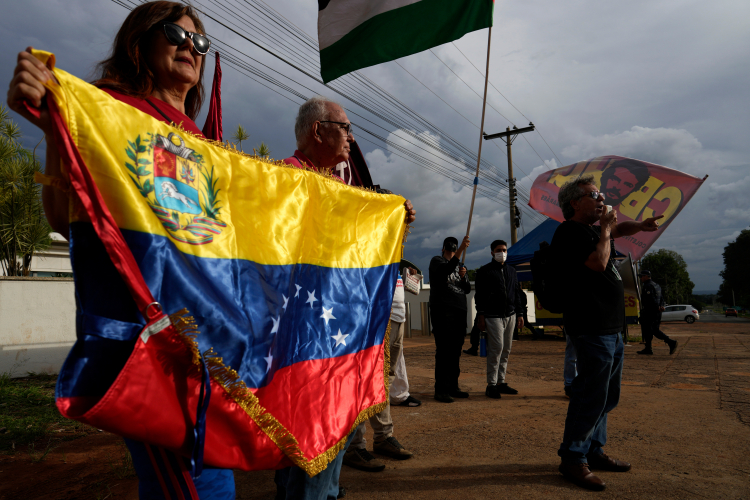
Tensions in Venezuela escalated dramatically recently, after President Donald Trump delivered a direct ultimatum to Nicolás Maduro during a phone call and subsequently urged that “the airspace above and around Venezuela be considered completely closed.” The warning, reported by The Washington Post, offered Maduro “the easy way or the hard way,” including safe passage to a friendly capital or, if he refused, the prospect of direct U.S. action. Maduro rejected the ultimatum as a “colonialist threat” and accused Washington of attempting an illegal intervention. The standoff has transformed what was already a fragile situation into a moment of acute geopolitical danger, sharpening the divisions within the American right over how far the United States should go in confronting the regime.
Trump’s escalation is not random. It reflects an effort to seize a moment in which Maduro stands at his weakest point in more than a decade, economically shattered, militarily divided, and with external sponsors increasingly unwilling or unable to sustain him. The Administration sees a brief opening in which pressure may genuinely produce results, before China reasserts economic influence or Russia regains strategic bandwidth. By acting now, Trump aims to prevent authoritarian rivals from consolidating a permanent foothold in the United States’ near abroad. The implications of this decision for the region and for the United States itself are profound, and their significance will become clearer as events unfold in Venezuela and across the region.
For years, Nicolás Maduro’s regime survived thanks to support from China and Russia, which provided credit, political backing, and enough diplomatic cover for Caracas to withstand Western isolation. But as some analysts now suggest, both powers may be quietly scaling back their involvement, Beijing for economic reasons, and Moscow for strategic ones. With external backing weakening, the regime has entered an unprecedented phase of fragility: rising inflation, growing tensions within its military, and the loss of control over peripheral regions. It is this combination of internal weakness and the tentative pullback of authoritarian allies that has pushed Washington to reassess its posture and intensify activity in the Caribbean. Behind the administration’s public narrative of counter-narcotics and counterterrorism lies a strategic calculation: This may be a rare moment in which the Maduro regime could actually crack.
Over the past decade, Venezuela has become the primary platform for authoritarian influence in the Western Hemisphere. Russian intelligence assets, Iranian clandestine networks, and Chinese economic and surveillance infrastructure have created a hostile foothold just off the Caribbean. If the regime collapses, the risks extend far beyond Venezuela’s borders. The post-Maduro landscape could take many forms, and none of them are risk-free for the U.S. In the best-case scenario, moderate military figures impose a controlled transition toward a provisional government. In the worst-case scenario, Washington fears a power vacuum filled by armed colectivos, dissident factions, paramilitary groups, and transnational criminal networks, turning Venezuela into a long-term source of instability at America’s doorstep.
This is the outcome Washington is trying to prevent. The buildup of U.S. naval operations in the Caribbean, the tightening of targeted sanctions, and the close monitoring of events in Caracas are not only aimed at pressuring Maduro, but at ensuring that any collapse, whether sudden or negotiated, does not spiral into chaos that undermines regional security. In this sense, the Administration’s posture is as much about managing the transition as it is about preventing China, Russia, or Iran from shaping Venezuela’s political future.
This moment also exposes ideological vulnerabilities within the American right. As pressure builds on Caracas, two competing visions of America’s role in the world come into sharper relief, a division that had been brewing for months but that President Trump’s phone ultimatum to Nicolás Maduro has now brought decisively to the surface.
On one side are conservatives inspired by the Reagan tradition, who believe the United States has a responsibility to counter authoritarian expansion in the hemisphere. Secretary of State Marco Rubio embodied this view when, on 2 September 2025, he publicly announced the first lethal U.S. strike against a narco-trafficking vessel that had departed from Venezuela and was being operated by a designated narco-terrorist organization, a deliberate escalation that framed the Maduro regime not merely as a failed state, but as an active sponsor of transnational terrorism and a direct threat to regional security.
For them, a retreat would be a strategic defeat, a dangerous concession at a time when China, Russia, and Iran are expanding their influence near America’s borders. They view the regime’s fragility as a historic opportunity to restore democratic stability in the region.
On the other side, the America First wing argues that the U.S. should not involve itself in external crises, no matter how geographically close. Senator Rand Paul gave voice to this position on 24 November 2025 when he condemned the escalating operations as the administration pretending to be “at war” with Venezuela in order to justify destroying boats without congressional vote, transparency, or accountability. To these conservatives, Venezuela’s collapse, orderly or chaotic, is a problem for Venezuelans to resolve. Any form of American involvement, even diplomatic or logistical, is seen as a misuse of resources and a return to the foreign-policy overreach of previous decades. Their priority is domestic: borders, crime, the economy, and national sovereignty.
The media and corporate sectors also shape this debate. Traditional conservative outlets frame the Venezuelan crisis as a strategic test, while America First platforms portray every U.S. move as provocation or excess. Energy companies with regional interests tend to prefer stability at any cost, even under authoritarian regimes, further complicating the picture.
The U.S. cannot ignore Venezuela. The crisis does not remain within the country’s borders: it spills across the continent, pressures neighboring states, fuels transnational criminal networks, and inevitably reaches the United States in the form of instability, migration, and security risks. Stepping back would not make the problem disappear; it would simply allow authoritarian powers to determine the outcome.
The dilemma is not between intervention and “doing nothing,” but between acting preventively, with calibrated tools, or allowing instability to organize itself at America’s doorstep in unpredictable ways. No U.S. administration can responsibly choose the latter.
How Washington acts now will determine not only the course of Venezuela’s transition but also the direction the American right will take in the coming decades.
Cláudia Nunes is a policy analyst with Young Voices, specializing in innovation and economic freedom. Follow her on social media @claudiashandi.
