




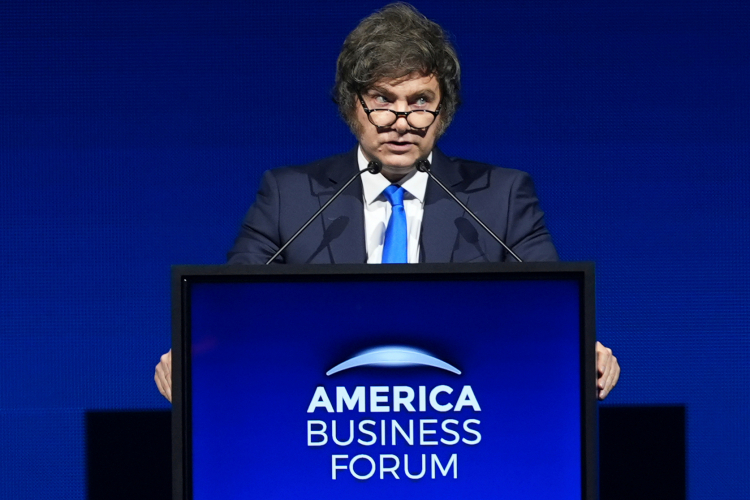
Since taking office, Javier Milei has sought to apply his recipe for pure liberalism to his government. In this sense, his administration has been both an example and a live experiment of how liberal ideas could be applied in practical terms to the dynamics of a country.
So far, the experience has worked in his favor, particularly regarding economic outcomes, but also in his ability to consolidate and expand his political capital. However, a vital issue for his administration has now appeared on the horizon: his defense policy.
In recent weeks, this area has attracted particular attention. On one hand, former Defense Minister Luis Petri resigned from his position to assume a seat in Congress, leaving the position vacant. In response, the President made a decision that caught the attention of much of the public and the political spectrum: He appointed Carlos Alberto Presti, an active military officer and current Chief of Staff of the Army since 2023, as the new Minister. This is an unusual move in contemporary democracies and, of course, touches a sensitive nerve in Argentina’s history: the military dictatorship that took place in the country from 1976 to 1983.
The appointment was heavily criticized by both local and international human rights organizations and was even seen as a provocative act by Milei. It is important to note that Presti’s appointment breaks with the established tradition of appointing a civilian to head the Ministry of Defense.
"For the first time since the return of democracy, a person with an impeccable military career, who has reached the highest rank in his military hierarchy, will lead the Ministry responsible for national defense and the Armed Forces, inaugurating a tradition that we hope the political leadership will continue from now on, and putting an end to the demonization of our officers, non-commissioned officers, and soldiers," read the official statement released by the President’s Office.
In Argentina, the issue of the dictatorship, even long after the return to democracy and the strong judicial processes against the military junta responsible for the coup and state terrorism, is that it was used by socialist governments to demonize the role of the Armed Forces and create a narrative of distrust that directly affected society.
The Narrative of Demonization
In the case of the Kirchnerist governments of Néstor (2004–2007) and Cristina Kirchner (2008–2011 / 2011–2015), as well as that of Alberto Fernández (2019–2023), their defense policy turned towards an exaltation of human rights. However, this stance also included a series of coordinated measures aimed at discrediting the professional record of army personnel or the families of military officers involved in the dictatorship.
In parallel, this policy was reflected in the defense budget, to the point that, by the end of her second term, Cristina Fernández de Kirchner reduced the funding by 3.4%, one of the lowest levels for this portfolio.
As a result of these initiatives, which were systematized and had a strong ideological imprint, Kirchnerism ended up creating a narrative enclosure materialized in the slogan "Memory, Truth, and
Justice," whose evident goal was none other than to keep alive the tension with various sectors of the civil population and our armed forces.
Healing the Wounds
In Argentina, when speaking of the dictatorship, one refers to a collective trauma. State terrorism, forced disappearances, and the violence of guerrilla groups (such as the Montoneros) are events that, despite the return to democracy 40 years ago—and having strong institutions that allow its subsistence despite the continuous political and economic crises—are still perceived as an open wound.
For decades, the suspicion generated around the Armed Forces led the country into a cycle of disinvestment, operational and technological deterioration, military stagnation, and a lack of strategic vision in defense policy. In this scenario, closing this wound in political terms seemed more like a problem than a long-term solution.
But modern geopolitical complexities were the elements Javier Milei relied on to try to introduce a change in this narrative: Can a country truly be called sovereign if it lacks the strategic, technological, and operational capacity to defend itself against external threats? And more importantly, how can a state protect its territory and citizens if it distrusts its own military?
The Argentine president answered these questions pragmatically rather than ideologically. With this vision, and not without criticism from opposition sectors, he ordered the purchase of 24 F-16 fighter jets from Denmark for a total of US$301.2 million, the acquisition of 8 striker vehicles from the United States, and a salary increase for all members of the Armed Forces, including personnel from the Army, Navy, and Air Force.
In this regard, both Milei and Defense Minister Presti—and his predecessor Luis Petri—aim to reclaim the role and contributions of the Argentine military while also bridging the gap with the civilian population, restoring a relationship deliberately damaged in the past by other governments. To the surprise of the opposition, the response from the Argentine people has been positive, refreshing, and supportive.
Last weekend, six of the recently acquired F-16 jets flew over much of the territory as part of an official presentation event. Prior to this, the President's Office and the Ministry of Defense had announced the initiative to invite citizens. That day, with the sky deeply blue as a backdrop and a decidedly euphoric atmosphere, the thousands of people who showed up with their flags—both as spectators and participants—marked the culmination of an almost unprecedented moment: The wound, at last, seems to be healing.
Agustina Sosa is an Argentine journalist and international affairs specialist. She is currently a member of the Young Voices Contributor program and she is the founder of Ladies of Liberty Alliance Argentina, an NGO that promotes female leadership with a classical liberal approach.
