




On January 3, 2026, the United States took historic action against a regime that had spent years exporting violence, narcotics, and instability far beyond its borders. In a joint operation involving the U.S. military and law enforcement, Venezuelan dictator Nicolás Maduro and his wife, Cilia Flores, were captured and removed from the country. Venezuelans around the world have poured into the streets to celebrate the collapse of a brutal dictatorship.
Operation Absolute Resolve was a demonstration of President Trump’s capability, restraint, and willingness to act on behalf of the American people, bringing evil to justice. It was also a reminder of something increasingly uncomfortable for Europe: when confronted with real evil that directly threatens the safety of citizens, the U.S. is willing to act decisively instead of surrendering to constructs of international law.
Nearly all the responses from our Western European allies show how far our most important and culturally consonant allies have drifted from reality, and how process-obsessed they have become.
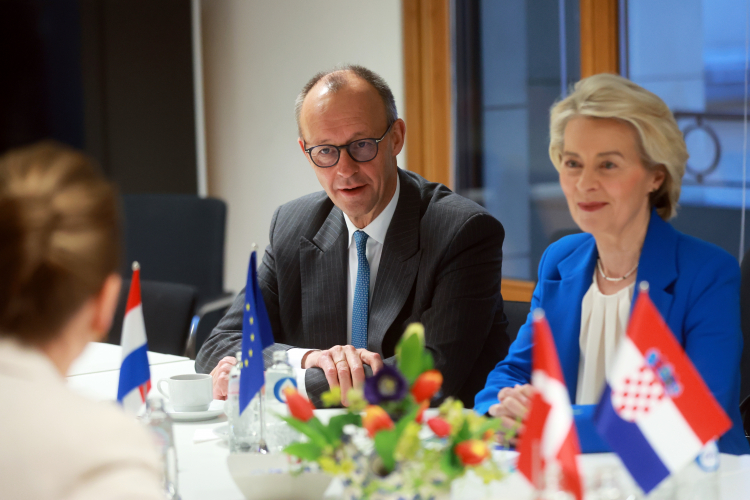
German Chancellor Friedrich Merz described the intervention as legally “complex,” urging caution and stating that “[i]nternational law remains the guiding framework.” Both Spain’s Prime Minister Pedro Sanchez and France’s foreign minister Jean-Noël Barrot condemned the strikes as a violation of international law. The European Union’s leadership and subsequent statement, signed by 26 member states, issued familiar calls for restraint and adherence to international law including the U.N. Charter. U.K. Prime Minister Kier Starmer was quick to confirm his noninvolvement in the strikes and remind the world that he is a "lifelong advocate of international law."
Unfortunately, these reactions are predictable—and deeply telling.
For decades, the European project has consequentially elevated excessive deliberation over decisively wielding power. In many cases, the U.S. fell into this trap too, putting process over outcomes, before President Trump. Lacking both political consensus and popular support for a serious defense posture, European institutions have substituted regulatory authority and for hard security. The “rules-based order” has won people over, not because it works, but because it requires little capacity to enforce.
Yet there is nothing complicated about recognizing a regime that trafficked enormous quantities of drugs past U.S. borders, directly fueled transnational criminal organizations like Tren de Aragua, and destabilized its neighbors while brutalizing its own population. There is nothing principled about invoking international law as an end in itself when that same legal order has failed—repeatedly—to restrain violent actors who abuse it without care.
International law did not stop Maduro. Strongly worded statements did not weaken his grip on power. Years of diplomatic process did not create a transition. But, President Trump’s military action did.
At the same time, European governments have deliberately undermined their own strategic position—shuttering heavy industry, offshoring critical production, and subordinating economic resilience to ideological climate targets. They have opened the door to mass migration at a scale that strains social cohesion and compromises internal security. As these problems intensify, the ability to set uniform standards matters far less than the ability to secure borders, protect supply chains, and deter adversaries. Unsurprisingly, E.U. leaders find themselves increasingly irrelevant in shaping outcomes even in their own neighborhood.
From this position of weakness, European elites still presume to lecture the U.S. for acting in defense of its people, and against Maduro, whose leadership they do not officially recognize either. This is the voice of a governing class that is far more invested in preserving a procedural worldview than in confronting facts on the ground.
Italy’s Prime Minister Giorgia Meloni offered a sharper and more realistic assessment, recognizing that the U.S.’s intervention can be legitimate when states weaponize criminal networks and hybrid threats against others. Her response, unlike the rest of Western Europe, reflects an understanding that sovereignty entails responsibility, including the pragmatic use of hard power.
President Trump was correct when he said that no other nation could have carried out this operation. Militarily, yes, but also as a recognition of the gap between rhetoric and action that plagues many of our allies. Secretary of State Marco Rubio described President Trump as a president of action. This administration’s seriousness marks a clear break from a Western orthodoxy that emerged after the Cold War—one that assumed conflict could be managed away through institutions, incentives, and norms.
The soft-power-first doctrine has failed. It failed to deter Russia. It strengthened China’s hand economically and strategically. It ceded influence in Africa and Latin America to adversarial powers. It left Europe unable to shape outcomes even where its interests are most immediate.
The discomfort many European elites feel toward President Trump stems from this rupture.
Trump rejects managed decline, and he refuses to simply admire the problem. He rejects the idea that Western nations must apologize for defending themselves or outsourcing their authority to institutions that do not share their interests. He insists that peace rests on strength, confidence, and the willingness to act.
The President’s worldview threatens a European elite consensus built on a heavy dose of self-doubt and proceduralism. But, by example, it may be able to offer Europe a bold path to renewal. The U.S. is not asking Europe to become American. It is asking whether Europe still intends to defend its people, and its sovereignty, or whether it prefers to remain a spectator, issuing statements while others lead boldly.
On January 3, 2026, America chose action in the defense of its people and for the cause of justice. Europe should consider why that choice felt so foreign—and what its own future looks like if it continues to avoid it.
Kristen Ziccarelli serves as Director for Civilizational Action at the America First Policy Institute.
