




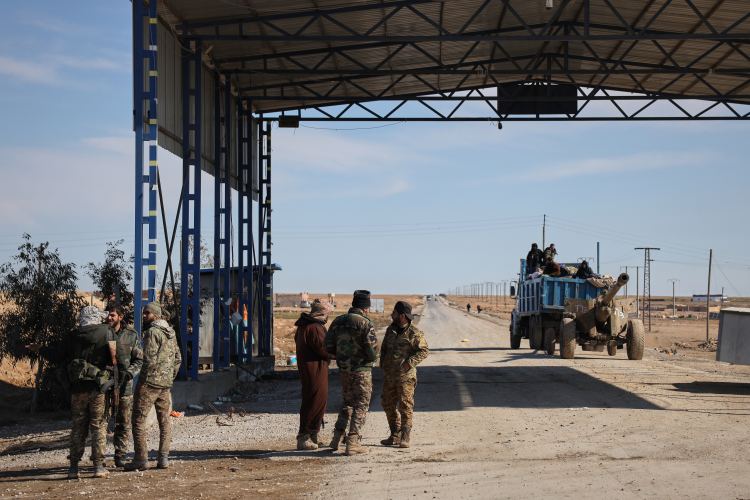
“Our Kurdish people, descendants of Saladin, beware of believing claims that we seek harm against you,” Syrian President Ahmad al-Sharaa said in a televised address on January 16 to Syria’s Kurdish community. The speech was delivered amid a dangerous escalation between Damascus and the Kurdish-led Syrian Democratic Forces (SDF), which has been a U.S. counterterrorism partner.
The SDF controlled roughly 30 percent of Syria following its role in defeating the Islamic State, most of it east of the Euphrates River, a natural barrier separating SDF-held territory from government-controlled areas, with only a handful of SDF positions west of the river. Sharaa followed the speech by signing a presidential decree granting Syrian Kurds a slate of long-denied rights, including recognition of Kurdish as a national language, designation of Nowruz, a celebration observed by Iranian peoplesas a national holiday, and the restoration of citizenship to stateless Kurds.
The decree corrected longstanding injustices and resonated with Kurdish civilians long denied basic rights, but its synchronization with battlefield escalation indicates it was deployed primarily as leverage against the SDF, meant to drain grassroots support from the group weakening it militarily and forcing it to accede to terms favorable to Damascus. The decree did not emerge from negotiations with the SDF but was issued over its head, signaling to Syria’s Kurdish community that the group played no role in securing their newfound rights and that Damascus alone sets the terms of political inclusion. Sharaa eventually extracted sweeping concessions from a chastened SDF, wielding both coercion and conciliation.
Even as Sharaa spoke, Syria intensified its military campaign against the SDF across multiple contested areas along the Euphrates. The government made rapid gains at key strategic locations. By stripping the SDF of the Kurdish-rights card, one of its few remaining sources of leverage, Sharaa forced the SDF back to the table.
This combined strategy produced results. A new integration framework, widely seen as favoring Damascus, expands central government control over formerly SDF-held areas in Deir Ezzour and Raqqa, and mandates the absorption of SDF fighters into the official Syrian military as individuals, rather than intact units. The latter point had been a core Damascus demand and a key stumbling block for the SDF despite a March agreement to bring the sides together.
While the March accord, signed by SDF commander Mazloum Abdi and Sharaa, called for integrating SDF forces into the Syrian army, it never defined a mechanism to do so. That ultimately sank the talks. The SDF had insisted on retaining local control over its troops and preventing Syrian army entry into its territory, citing security risks and the absence of credible guarantees following sectarian violence committed by Damascus’ forces elsewhere. The government refused the SDF’s conditions for several reasons, not the least of which is Turkey’s influence over Damascus. Turkey considers the SDF’s core component, the People’s Defense Units (YPG), an extension of the PKK — a U.S. and Turkish-designated terrorist organization.
Turkey consistently rejected the incorporation of SDF commanders as officers in the Syrian military and demanded that the group’s fighters be absorbed individually, not as units, a blow to the Kurds ability to defend themselves against Damascus, or Turkey itself., a position ultimately reflected in the final integration framework.
Until the complete breakdown of talks in December, clashes were brief, often lasting a single day and followed by talks to de-escalate. But Damascus’s two-pronged attack — half charm, half armed — swept all before it.
In Aleppo, the SDF had long controlled the Kurdish-majority neighborhoods of Sheikh Maqsoud and Ashrafiyeh, isolated enclaves surrounded by government territory, but SDF forces withdrew following four days of intense clashes. The speed of the collapse emboldened Damascus to expand the fight across Aleppo province, advancing into contested areas west of the Euphrates, including Deir Hafer and Maskanah, where the SDF again pulled back. Each withdrawal accelerated Syrian momentum, allowing government forces to take control over strategic nodes along the SDF’s frontier, including Tabqa in Raqqa province, a critical position that would allow Damascus to attack the city of Raqqa itself. Raqqa was the SDF’s largest and most symbolically important stronghold.
Riding a wave of battlefield momentum, Sharaa appears convinced that pressure, not talks, will deliver results. Reopening negotiations on provisions he already agreed with the SDF in March offered little upside when force produced visible gains that he could use to extort concessions from the SDF.
The SDF’s rapid collapse west of the Euphrates was due to internal fracturing. Fighters of Arab origin — who make up the bulk of the SDF’s ranks, despite its Kurdish leadership — defected or withdrew, allowing Syrian forces to walk into previously SDF-held positions.
Sharaa gambled that the same dynamic could be replicated east of the Euphrates, where, unlike Aleppo, the SDF holds contiguous territory. In those territories, Arab fighters also dominate the SDF’s manpower, and Damascus made the bet that sustained military pressure would trigger a wave of defections and withdrawal, weakening the SDF’s defensive positions. Damascus also exploited deep-seated local resentment toward SDF rule. These grievances sparked a tribal mobilization that resulted in militias temporarily seizing control of large parts of Deir Ezzour province and several districts across the Raqqa governorate.
The Syrian army did not enter those areas initially, because, unlike Aleppo and areas west of the river, the SDF-held areas east of the Euphrates fall squarely within the U.S. military's sphere of operations. U.S. Central Command (CENTCOM) warned Damascus against further escalation, and officials in Washington have signaled that any renewed large-scale offensive could trigger the snapback of sanctions against Sharaa.
Even as Sharaa cultivates a working relationship with Washington, pushing deeper into SDF-held territory east of the Euphrates risked antagonizing Washington. Instead, Damascus leveraged its military pressure to force the SDF into an new integration deal on terms that favor the central government. Washington was happy to endorse the deal, which is far more favorable to Damascus than the SDF, leaving its longtime allies out in the cold. With Washington’s blessing, Syrian troops entered areas east of the river.
The durability of this arrangement, however, is far from assured. Coercion may secure SDF compliance in the short term, but without an enforcement mechanism for the deal, fighting can start up again at any time — a lesson learned from the unraveling of the March agreement.
Washington has rewarded Sharaa in the hope he can stabilize and reform Syria, but stability remains elusive on multiple fronts: meaningful political inclusion Syria appears stalled, accountability for sectarian massacres committed over the past year remains absent, and it is still unclear whether Syria’s reconstituted military is aligned with U.S. counterterrorism priorities, most notably, whether jihadist elements will be excluded from its ranks.
Sharaa’s Syria remains a place of divisions, whatever the rhetoric coming from Damascus.
Ahmad Sharawi is a senior research analyst at the Foundation for Defense of Democracies, focusing on Middle East affairs and the Levant.
