




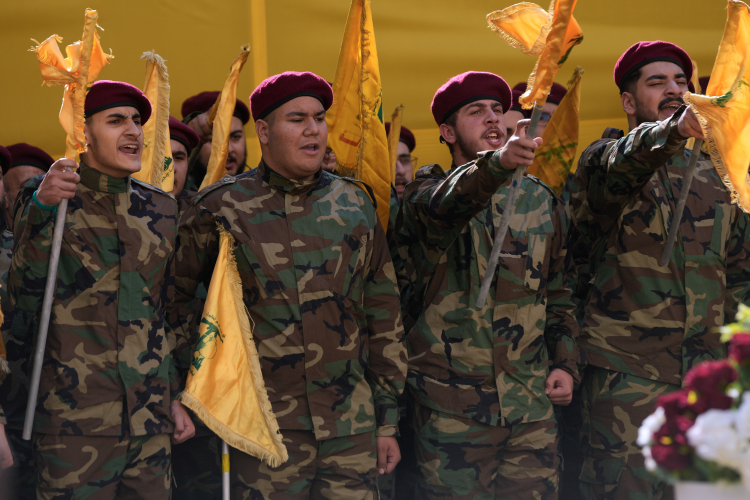
The Lebanese military has made little effort to disarm Hezbollah, despite the United States sending it $230 million in military aid in October. With this persistent failure, Israeli forces have conducted near-daily operations against the Iran-backed terrorist group, and the United States is preparing to condition some of its military aid to the Lebanese Armed Forces (LAF). However, with a bold strategy to verify disarmament and promote Lebanese economic growth, the United States and its partners can encourage the LAF’s counterterror engagement, maintain the U.S.-Lebanon relationship, and promote regional security.
For over four decades, Iran-funded Hezbollah transformed Lebanon into a terrorist haven. Monopolizing state resources and fostering civilian dependence on its services, such as recruiting child soldiers by framing military service as an “educational opportunity,” Hezbollah exploited the vulnerable and devastated Lebanon’s economy while bolstering its own fighters’ wealth.
As Iran funneled billions of dollars to its terror proxy, Hezbollah’s power expanded as the LAF and United Nations peacekeepers (UNIFIL) failed to enforce UN Security Council Resolution 1701, requiring Hezbollah’s disarmament and withdrawal from southern Lebanon. With limited funds and no political will to stabilize Lebanon, the LAF’s and UNIFIL’s failures enabled Hezbollah to fire nearly 18,000 projectiles at Israel between October 2023 and November 2024.
But Israel’s military campaign during its year-long war with Hezbollah, which concluded with the November 2024 ceasefire, brought new opportunities. While the ceasefire positioned the LAF and UNIFIL to patrol southern Lebanon, Israel’s degradation of the terrorist group’s capabilities provided the LAF the opportunity to take over counterterror operations, with the United States supporting a mechanism that grants Israel the freedom to intervene militarily when the LAF stalls.
With Hezbollah severely weakened, Lebanon’s parliament voted in favor of a plan for the LAF to disarm Hezbollah and seize the terrorist group’s weapons from south of the Litani River up to the Beqaa Valley. However, despite receiving advanced funding from the United States to disarm Hezbollah, the LAF has achieved little progress to independently secure Lebanon as it relies predominantly on Israeli counterterror operations, including a recent strike against Hezbollah commander Ali Tabatabai, to degrade the group’s capabilities.
While Hezbollah’s disarmament remains crucial, it cannot be the end goal. Ultimately, the United States needs a broader approach to promote long-lasting stability in Lebanon and combat the weak Lebanese governance that enabled Hezbollah to thrive. Therefore, the United States should develop a comprehensive verification strategy to not only enforce Hezbollah’s disarmament but also prevent the group from reasserting itself within Lebanese society.
To start, U.S. Central Command (CENTCOM) should work with Lebanon’s government, military, and UNIFIL to plan the disarmament process, ensuring Hezbollah does not conceal weapons or smuggle arms into the country post-disarmament. Within the plan, the LAF and UNIFIL must adhere to strict guidelines for reporting arms seizures, confiscating weapons-making materials, and storing hazardous materials in secure locations away from populated areas while also dismantling underground terrorist infrastructure built beneath civilian property. To position the LAF for future success, U.S. forces can also encourage Lebanon to expand its own intelligence collection and analysis capabilities.
CENTCOM should ensure the LAF and UNIFIL disarm all known Hezbollah sites by checking their reports against U.S., Israeli, and partner intelligence. Failing to cooperate with these requirements should prompt the Trump administration to reconsider providing military aid to Lebanon until its forces comply with U.S. expectations.
As part of a comprehensive strategy, the United States, along with European and Gulf allies, should fund employment opportunities for Lebanese citizens who cooperate with authorities to counter Hezbollah’s weapons proliferation, promoting economic growth and undermining Hezbollah’s support base. With approximately 44 percent of Lebanon living in poverty, an employment program similar to the U.S. Logistics Civil Augmentation Program in Iraq would aid the country and incentivize citizen assistance.
While the Lebanese government demands that Israel cease military operations in Lebanon and withdraw from its five remaining posts in the country, decades of LAF and UNIFIL failures to combat terrorism and Iran reportedly rearming Hezbollah indicate that prematurely halting Israeli operations in Lebanon could create a security vacuum for the group to reorganize. To ensure security and incentivize Lebanese action, the United States should demand the LAF and UNIFIL prove they can adequately address terrorism before Israeli forces withdraw. Following Israel’s eventual drawback, the United States should also demand that Israeli forces maintain the freedom to target terrorists if the LAF and UNIFIL abandon the disarmament process or fail to address future cross-border smuggling attempts from Syria.
The United States must act swiftly to advance Hezbollah’s disarmament while also seizing this pivotal moment to help reshape Lebanon, laying the groundwork for enduring regional security.
MajGen Austin Renforth, USMC (ret.) is the former Commanding General of the Marine Corps Air Ground Combat Center and a 2025 Jewish Institute for National Security of America (JINSA) Generals and Admirals Program participant. Sarah Havdala is a policy analyst at JINSA.
