




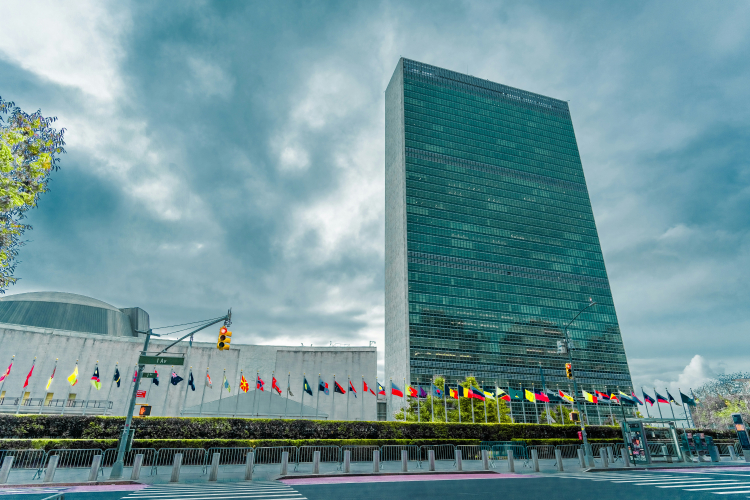
The Department of State recently announced that the U.S. had committed $2 billion in humanitarian assistance to the United Nations Office for the Coordination of Humanitarian Affairs (OCHA). The aid is focused on 17 countries in crisis and the UN Central Emergency Response Fund, with initiatives in other regions including the “occupied Palestinian territory.” Per the State Department, the funds are part of a new Memorandum of Understanding (MOU) implementing “vital reforms to make that work more impactful, efficient, and accountable to the American taxpayer.” In truth, any gains in efficiency will be more than offset by a total loss of accountability.
In short, the MOU represents an almost strings-free two-billion-dollar gift to the United Nations.
The Trump administration’s new “understanding” with the United Nations outlines a radical shift in allocation of U.S. humanitarian aid through United Nations. In the past, the U.S. would work with individual UN entities to address discrete objectives or crises. This arrangement was time-consuming but granted the U.S. a great amount of control over how and where its assistance was spent.
The new arrangement shifts that authority to OCHA. U.S. funds would go into a subaccount, and the U.S. will instruct OCHA which countries are eligible, but from there OCHA takes over. U.S. funds would be pooled with funding from other governments and OCHA would distribute them based on “reasoned judgment” of the UN Humanitarian Coordinator or Resident Coordinator, who are appointed by the UN Secretary General.
The UN prefers pooled funding because it grants more flexibility and discretion to the organization than when governments earmark funding for specific purposes. The U.S. has traditionally favored earmarked funding because it wants to ensure that U.S. funds support U.S. interests. Now, the U.S. is essentially ceding its ability to direct U.S. taxpayer dollars. Worse, American influence is diminished as now OCHA, not the U.S., will allocate U.S. funds to other UN agencies.
The U.S. “may” have membership on advisory boards for pooled funds, but it is not guaranteed. Regardless, the memo specifies, “Advisory Board membership does not permit members to hold back or decide quantity of funds for allocations; their role is simply an advisory one.”
For context, OCHA has never managed even half this amount of money -- the U.S. contribution would double OCHA’s 2025 funding. Nor does the new MOU improve oversight of assistance, leaving that to the UN’s Board of Auditors, Office of Internal Oversight Services and the Joint Inspection Unit – entities that the U.S. Mission to the UN has criticized as inadequate and lacking independence. Indeed, the MOU explicitly disallows audits by the U.S. government as required by U.S. law. This codifies past UN refusal to share information or cooperate with U.S. investigations.
It gets worse: The new agreement does not require OCHA to agree to waive UN immunities that have fostered a culture of sexual abuse, financial impropriety, and support for terrorism throughout the UN system. Instead, OCHA must report credible allegations of “misconduct, misuse, fraud, waste, abuse, diversion of assistance” to the State Department and its Office of Inspector General. But any use of that information would be confidential and in “accordance with the privileges and immunities of the United Nations.” In other words, the U.S. could not prosecute individuals unless the Secretary General waives those protections, which he has been unwilling to do for former UNRWA employees implicated in the October 7 terrorist attack in Israel.
And then there’s the festering sore of UNRWA, which the memo does not even mention. This is a direct contradiction of the Trump administration’s previous insistence it was defunding what is effectively an arm of Hamas at the UN. The new MOU makes clear that once U.S. funds are transferred to OCHA, it has complete discretion on their distribution. Tom Fletcher, the Undersecretary General that helms OCHA, has been unapologetic in his support for UNRWA despite is proven complicity with Hamas and support for extremism. Without clarification, the MOU likely allows OCHA to transfer funds to UNRWA or other organizations that the U.S. has defunded.
Relatedly, the memo states that it is the “policy of DOS to seek to ensure that none of its funds are used, directly or indirectly, to provide support to individuals or entities associated with terrorism.” But OCHA only promises to use “reasonable efforts” to actually safeguard U.S. taxpayer dollars from supporting terrorism. Even worse, under the terms of the memo, the determination of terrorists and terrorist entities is based on the Consolidated UN Security Council Sanctions List. Guess who’s not on the list? Hamas and Hezbollah.
In short, the MOU grants cosmetic changes to the U.S., such as quarterly consultation, membership on advisory boards, and a dedicated subaccount for U.S. funds. But OCHA remains in full control of funds once provided, makes no substantive reforms, and does not in any way commit waiving immunities in cases of fraud or criminality, or agree to abide by U.S. oversight, terror designations, or other prohibitions of use of funds in U.S. law.
Indeed, the only part of the Trump administration’s new understanding with the United Nations that makes sense is that it explicitly states that either party can discontinue it at any time. The U.S. should terminate it immediately and demand a new agreement that provides proper oversight, authority to direct U.S. assistance to support U.S. interests, specify that U.S. funds cannot be used to support UN organizations otherwise barred from receiving U.S. funding, and require OCHA to abide by U.S. terror designations. Because prior to this agreement, that was the policy of President Donald Trump.
Brett D. Schaefer is a senior fellow at the American Enterprise Institute (AEI), where he focuses on multilateral treaties, peacekeeping, the United Nations, and international organizations. Danielle Pletka is a distinguished senior fellow at AEI and the co-host of the podcast What the Hell Is Going On?
