




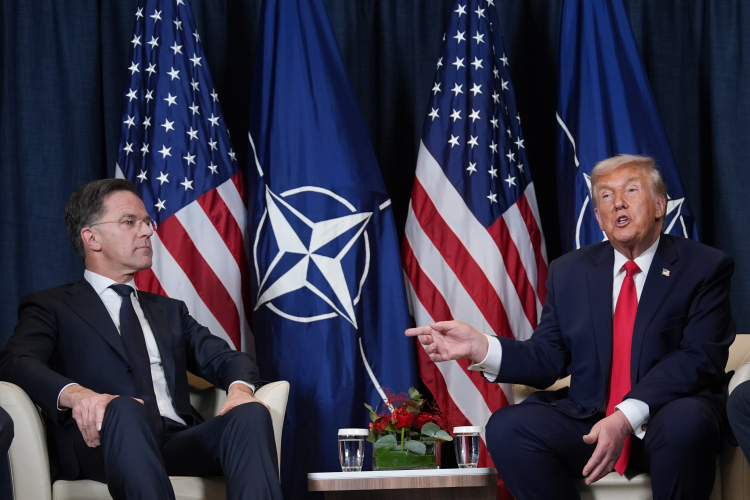
President Donald Trump’s address at the World Economic Forum in Davos was predictably met with a mix of applause, skepticism, and outright hostility, particularly over one flashpoint: Greenland. But reducing the speech to a single geopolitical controversy misses its broader significance. At Davos, Trump delivered not only a familiar defense of his economic record, but also a more revealing message about how he sees America’s relationship with Europe and the future of the transatlantic alliance.
“I am derived from Europe,” the President said, citing his Scottish and German ancestry. “We care about the people of Europe … We believe deeply in the bonds we share with Europe as a civilization.” These remarks stood out in a speech that came to focus heavily on topics of trade, energy, and security. But it makes a deeper point about how the administration’s engagement with Europe is not meant to be transactional, or superficial, but rooted in the sense of shared historical and cultural inheritance. For the European audience, this is a window into how the President situates himself within story of Western civilization, indicative as well of how many Americans feel a deep bond with their European heritage. But that isn’t the only hinge our partnerships rest on.
President Trump framed his critique of Europe as a call for renewal and partnership. He pointed to declining energy security, rigid trade frameworks, uncontrolled migration, and weak growth as long-term vulnerabilities. The issues he spotlighted are foundational weaknesses that undermine civil society and, by extension, the security of our entire alliance, namely NATO.
In the foreign policy of the Trump Administration, diplomacy flows from security, not the other way around. Our allies’ military strength, energy independence, for instance, are relevant factors in diplomacy, and ruptures in these vital areas cannot be written off due to mere sentimentality. As President Trump said, “We want strong allies, not seriously weakened ones ... we want Europe to be strong.”
Still, the reaction from European leaders and commentators largely interpreted the episode as evidence of imperial ambition. That reaction reflects a broader climate of distrust in transatlantic relations, in which American initiatives are often read in the worst possible light. Others, including Italian Prime Minister Giorgia Meloni, have taken a more cautious and pragmatic approach, emphasizing dialogue over rushing to condemnation.
The Greenland debate also highlights a tendency of the international community to focus intensely on Trump’s language rather than on U.S. policy. A more productive assessment looks at outcomes as well as rhetoric. The policies of the Trump Administration, like getting NATO members to increase defense spending and implementation of mutually beneficial trade deals, were initially received with contention, but they have positively reshaped long-standing assumptions about Europe’s role in its own defense. Many of these shifts have endured beyond his first presidency.
For European partners, the key question is what his approach means for the future of transatlantic cooperation. Echoing the language in previous international addresses, the Davos address underscored a preference for alliances grounded in reciprocity and resilience. Whether this strengthens or strains transatlantic ties depend largely on how European leaders and movements respond. Disagreement between allies is inevitable. Debate over borders, energy, defense, and trade is not a sign of breakdown, but of seriousness. What truly risks undermining cooperation is the assumption of bad faith on all sides. If American concerns are automatically dismissed as imperial, and European hesitation is read as weakness, meaningful dialogue becomes difficult.
In light of the U.S. National Security Strategy released in December, the Davos address aligns with the call for European renewal and greatness. The transatlantic relationship does indeed rest on more than defense budgets and trade balances, but also on “the civilizational integrity of faith, cultural continuity, strong families, and national identity.” As the document states explicitly, it would be self-defeating to write Europe off, but we cannot keep pretending that its current trajectory on either trade, security or culture is in good condition.
A real question posed at Davos was whether our allies can still speak productively about national security, economic strength, and civilizational survival without succumbing to bad faith. This is a highly consequential question because, as the President pointed out, the adversaries of the entire West–Russia, the CCP, and Iran–seek to destroy us.
America First is not America alone, meaning we need strong Western allies to defend our values, cultures, and ways of life. There is much to be proud of about our shared civilization, but we also need to realistically acknowledge areas for improvement. We need strong partners and creative solutions, predicated on serious conversations. Time and again, the battles against our adversaries show that alliances endure not through comfort, but through strength.
Kristen Ziccarelli serves as director of civilizational action at the America First Policy Institute.
