




Since President Trump’s successful removal of Venezuela’s Nicholas Maduro as head of state, the sachems of foreign policy have worried that the U.S. will again begin a program of nation-building. Their concern is no doubt enforced by recent Presidential promises to make Gaza a flourishing economy.
As with so many ideas in foreign affairs, nation-building once seemed like the thing to do -- the purpose of America abroad. Iraq played a key role in the idea falling from fashion. One reason was that there was little evidence that the U.S. could restore a working pre-war economy.
I recall during a briefing in Baghdad on the course of Operation Iraqi Freedom, after momentarily suspending the meeting when signaled by an aide, the general in charge returned to report that it appeared the purpose of America in Iraq might have just changed. “It seems we are no longer doing nation-building. Instead, we are here to promote democracy.”
As with so many fashionable ideas in foreign affairs, nation-building once seemed like the thing to do -- the purpose of America abroad. In Iraq decision-making for rebuilding that nation’s economy rested with an amorphous group in D.C., known as the 'Interagency,' which believed what was needed to get Iraq on its feet was a “whole of government” approach.
The thinking was that the expertise distributed through the executive agencies in D.C. was all that was necessary to restart an economy. What followed were missions from the Departments of Agriculture, Justice, Labor, and Commerce. In the lead was the U.S. Agency for International Development.
USAID lived (President Trump closed it last July) for years under false pretenses. Created by President Kennedy to counter Soviet efforts to woo countries after WWII and the collapse of European colonialism, the agency was supposed to assist countries deciding between authoritarian Soviet-style central planning regimes or free market models that would support democratic governance.
To accomplish this, USAID embraced a bespoke theory of economic development, devised in 1960 by Walter Rostow, that saw aspiring nations pursing independent integrated economies -- mini versions of ours with steel mills, factories, and a western-like retail sector. There was no accounting for international trade and even less for innovation.
Not surprisingly, the Agency never produced one example of changing the course of any nation’s economic future, nor was there evidence of an emerging nation embracing the U.S. as its model because of USAID’s efforts. Incapable of success with economic development, the agency’s leadership convinced Congress that its real purpose was to advance American “values.” Stripped of all niceties, it became a rogue programmatic arm of the State Department.
It lavishly supported NGOs to advance practices abroad, not in the least connected to economic development, which would offend most Americans were it not for USAID being particularly skilled at hiding the ball. Among them was conditioning aid to nations upon their adopting aggressive climate programs, expanding family planning efforts that included funding abortion clinics, promulgating DEI management principles in local companies and native bureaucracies, and promoting gender fluidity programs that included sex change therapy.
Fortunately, as the U.S. takes on the role of managing the Venezuelan economy, it can focus on the pragmatic steps needed to restore growth and stability without reference to USAID’s useless formulae. In such situations, the U.S. should engage the four elements of expeditionary economics to kick-start a stalled economy.
As a predicate, the tendency to develop a central plan must be resisted at all costs. This will be the misguided approach of the international banking community and development consultants. Put differently, in restarting an economy, some amount of chaos must be tolerated, recalling Friedrich Hayek's principle that every economy begins with spontaneous organization. Goals should be set, but many paths to their achievement should be encouraged.
The first focus of expeditionary economics is establishing the rule of law. In the case of Venezuela this means a frontal attack on corruption within the government itself. Without a sense that government decision making proceeds on rules that apply similarly to all citizens and organizations there will never be trust in institutions, including banks, that is a necessary first step towards growth.
Second, significant growth will not happen in an inflationary economy. Just as in the U.S., oil is largely determinative of what consumer prices are. In Venezuela, some of the nation’s petroleum wealth must be deployed in ways that increase real disposable income and the supply of consumer goods and lower prices. Simultaneously, the Bolivar, the nation’s currency, must be stabilized perhaps by pegging it to the dollar.
Creating access to risk capital is the third element of restarting an economy. Local banks should emerge as the principal source of capital for startups, mediating investment by Venezuelans, not foreign venture capital funds. Domestic financing should be the bedrock of any entrepreneurial economy.
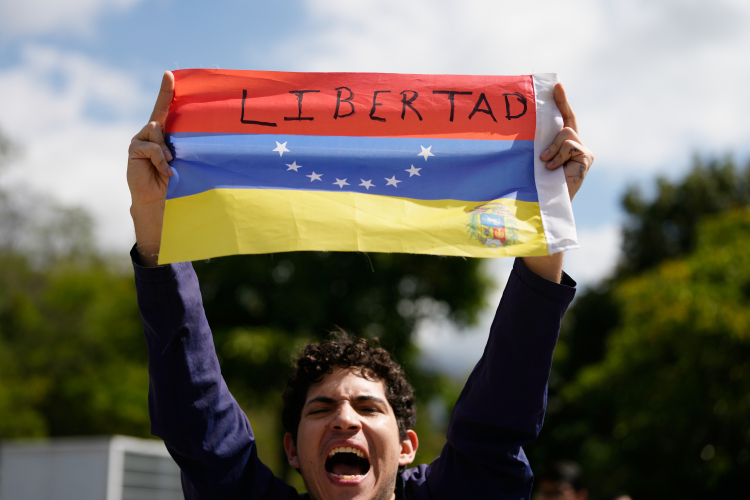
Finally, every effort must be made to encourage indigenous entrepreneurship. History suggests that when a nation is freed of the dampening effects of socialist controls a wave of business innovation will break out. The Venezuelan population is awash in creative people with innovative ideas desperate to express themselves by forming new businesses. Let the newly celebrated libertad assume the face of thousands of startups.
Carl Schramm is University Professor at Syracuse and a fellow at the Institute for Applied Economics, Global Health and the Study of Business Enterprise at Johns Hopkins. His Foreign Affairs article in 2010 first described expeditionary economics, once considered part of U.S. war planning.
