




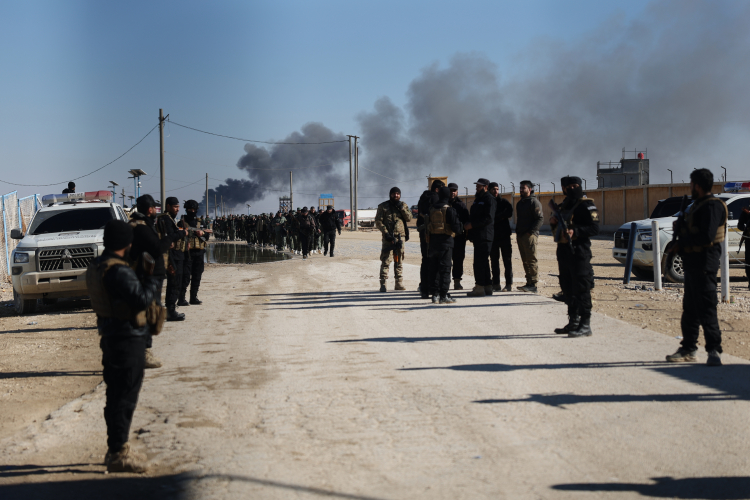
In a rapid maneuver, Syrian government forces recently consolidated power over the northeastern areas of their country following the collapse of the Kurdish-dominated Syrian Democratic Forces (SDF). The military operation, which followed a December 31 deadline for the Kurds to reintegrate and months of Kurdish refusals to do so, has prompted bitter accusations that the U.S. has “abandoned” the Kurds by allowing President Ahmed al-Sharaa to proceed.
While Americans should feel compassion for the Kurds in Syria, the narrative of U.S. “abandonment” is patently false. It misconstrues the origins of the U.S.-Kurdish partnership against ISIS, ignores the unsustainability of Kurdish occupation over Sunni Arab heartlands, and overlooks how the U.S. has protected Kurdish interests throughout Syria’s painful political transition.
The Syrian Kurds fought ISIS alongside the U.S. for self-preservation, not altruism. The danger the caliphate posed to the Kurds was existential and immediate while the threat to the U.S. was limited and remote. To the extent charity was involved, it came on the part of the United States.
The U.S. first partnered with the Kurds in Syria in October 2014 when they were on the verge of losing Kurdish-dominated Kobani to Islamic State fighters, despite ongoing U.S.-led airstrikes on ISIS positions around the city. President Obama airdropped weapons, ammunition, and medical supplies to help the Kurds retake Kobani, even at the cost of straining relations with Turkey, a NATO ally that has fought a long insurgency against Kurdish groups.
Once the Kurds proved capable of fighting ISIS, the U.S. extended them support to form the SDF, a Kurdish-dominated organization that incorporated Sunni Arab tribes into the anti-ISIS campaign. U.S. military advisors and combat air support bolstered the SDF ground campaign, successfully wiping ISIS off the map in 2019.
U.S. support led to success—and excess. The SDF advance granted the Kurds effective control over nearly one-third of Syria. Kurdish occupation expanded far beyond majority-Kurdish enclaves into the Sunni Arab and ethno-religiously mixed regions of northeast Syria where rich agricultural land and most Syrian oilfields are located. Over 80 percent of the population under SDF control at the start of 2026 was non-Kurdish, according to one estimate.
By many accounts, Kurdish minority rule was repressive, with groups such as Amnesty International documenting numerous human rights abuses committed in territories under SDF authority. When Arab tribes rebelled in Deir Az Zor and Aleppo in 2023, Kurdish authorities crushed them. The U.S. didn’t intervene, despite suffering damage to its public image. Permanent Kurdish rule over Syrian Arab territories was non-viable.
The United States never promised to support Kurdish independence in Syria and cannot be expected to prop up Kurdish political autonomy against U.S. interests.
For months, U.S. officials have made it clear that the United States favors Syrian reunification and the Kurds would have to accept some loss of autonomy in exchange for minority protections within greater Syria. Throughout U.S.-brokered negotiations between the Kurds and al-Sharaa’s government, the U.S. helped to secure the best terms possible for the Kurds, including the recognition of Kurdish culture, holidays, and traditions by the Syrian government and the declaration of Kurdish as a national language.
The U.S. has also demonstrated its loyalty by protecting Kurdish civilians during the advance of Syrian forces. Reports indicate U.S. leaders threatened to reimpose sanctions on Syria—a devastating consequence for al-Sharaa’s government—if it committed mass violence against the Kurds. On the ground, U.S. troops have shot flares to deter the Syrian army from entering Kurdish population centers.
U.S. interests lie with Syrian reunification under a central government that maintains order and is accountable to Washington for what happens within its borders. That’s especially true when it comes to securing the SDF-controlled prison camps that until recently held 8,000 ISIS fighters and tens of thousands of ISIS family members.
For years, the Kurds have used their control of ISIS camps as a form of bureaucratic hostage-taking by suggesting prisoners would escape if the U.S. withdrew troops from Syria or lessened financial assistance to the SDF. Yet the purported danger was never credible because the Kurds would never permit ISIS fighters en masse to roam SDF-controlled territory, even without U.S. funding.
Now that the SDF occupation is collapsing, however, some Kurdish forces have left their posts allowing ISIS detainees to escape, despite calls from U.S. officials for an orderly transition of authority to the Syrian government. The U.S. military has been forced to move 7,000 ISIS fighters into Iraq to prevent additional escapee incidents.
Washington’s best response to the problem of ISIS detainees is to recognize that if the Kurds cannot control ISIS prison camps without U.S. help, those prisoners must be moved or the facilities handed over to an entity that can: the Syrian central government.
Staying on the sidelines of the Kurdish-Syrian conflict, while difficult, is the only way the U.S. can incentivize political compromise between the parties that would survive in the absence of a U.S. military footprint.
