




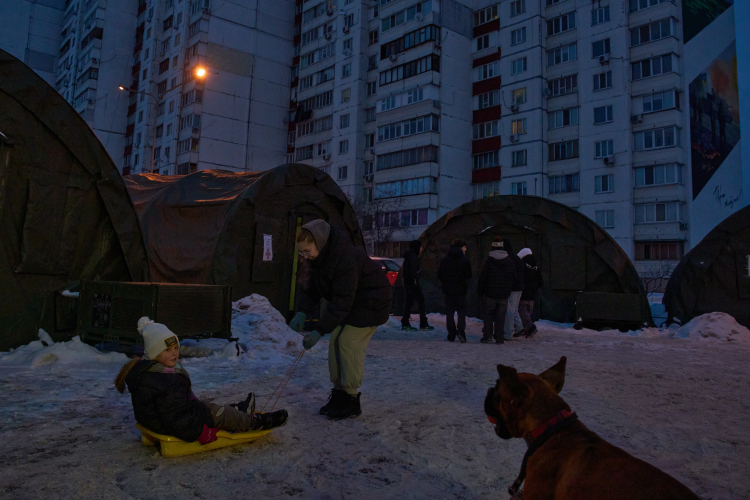
At 3 a.m. in Kyiv, Dmytro Pavlovsky woke to the sound of his microwave beeping. In most places, that sound means food is ready. In Kyiv, it means electricity has briefly returned.
Pavlovsky is a high school teacher, not a soldier. He lives in a city where Russian missiles routinely strike power stations, water pumps, and heating systems. Electricity now arrives unpredictably, sometimes for forty minutes, sometimes for two hours, sometimes not again for a day. When it does, civilians race the clock. They charge phones and laptops, heat water, cook what they can, and fill containers for drinking and toilet flushing before the pumps shut down again.
This is not a story about inconvenience. It is about infrastructure warfare and the strategic choice the West now faces.
Russian attacks have degraded Ukraine’s energy grid to the point where electricity must be rationed manually. Hospitals, emergency services, and transit systems receive priority. Civilians get what remains. In high-rise buildings, power outages mean no heat and no running water. In winter, pipes burst. Those failures often cannot be fully repaired until spring, because cracks in joints reveal themselves only when systems are warm and pressurized. Entire buildings become uninhabitable for months.
The scale of the damage is no longer abstract. After a Russian strike on January 24, Kyiv Mayor Vitali Klitschko reported that 1,676 high-rise residential buildings were left without power and nearly 6,000 were without heating. Those figures represent hundreds of thousands of civilians exposed to winter conditions in a city not at the front lines, but deliberately targeted.
Schools in Kyiv have closed, not because fighting is nearby, but because there is no reliable heat or electricity.
“When there is no electricity and no heat, your body goes into hibernation,” Pavlovsky told me. “You are not freezing; you wear layers, but your energy drops. You do not even feel like thinking.”
That effect is not incidental. It is the strategy.
Russia is using winter as a force multiplier, applying sustained pressure on civilians rather than seeking decisive battlefield breakthroughs. The method is proving effective. Infrastructure attacks degrade morale, drive displacement, and impose long term reconstruction costs that far exceed the price of the original strike.
At Davos this month, President Volodymyr Zelensky criticized Europe’s hesitation in blunt terms, warning that fear of escalation was allowing this strategy to succeed. His argument was not rhetorical. As long as Russian missiles can strike civilian infrastructure with relative impunity, Ukraine’s population will remain under continuous strain, and Moscow will conclude that this approach works.
The United States and its allies have the means to reduce that harm without entering the war or striking Russian territory.
They should deploy American and allied F-16s to conduct limited air policing near Ukraine’s border, with a narrowly defined mission to intercept missiles and aircraft headed toward civilian targets.
This would not be an act of war. It would be an act of defense.
Once a missile is launched, it is no longer a theoretical threat sitting on Russian soil. It is a weapon in flight aimed at civilians, power stations, hospitals, apartment buildings, and schools. Intercepting it is not escalation. It is the enforcement of a core principle of armed conflict.
Civilians and civilian infrastructure are not legitimate targets.
From a policy standpoint, the logic is straightforward. Attacks on energy infrastructure create cascading failures that long outlast the initial strike. Loss of power leads to loss of heat and water, which leads to burst pipes, evacuations, school closures, and long-term displacement. Western governments then spend billions on emergency aid and reconstruction to address damage that could have been prevented.
Preventing the strike is cheaper than rebuilding afterward.
Operationally, this is feasible. Ukrainian pilots flying Western aircraft have already demonstrated the ability to intercept missiles. The constraint is not capability, but scale and authorization. Even limited air policing along key corridors would significantly reduce the number of successful strikes on civilian infrastructure.
Nor would such a mission require blanket coverage of Ukrainian airspace. The goal would not be air superiority over Russia, but denial of access to civilian targets. Clear rules of engagement and a defined geographic scope would limit escalation risk while producing tangible effects on the ground.
There is also a broader deterrence issue. If a nuclear-armed state can systematically target civilian infrastructure without consequence, that tactic will not remain confined to Ukraine. Deterrence erodes when violations of core norms carry no operational cost.
Pavlovsky asks a question many Ukrainians now ask openly. Why is the West so afraid of Vladimir Putin?
History offers guidance. In 1948, during the Berlin Airlift, the United States and its allies did not allow Soviet intimidation to prevent them from supplying a besieged city. In 1940, during the Battle of Britain, control of the skies determined whether civilians could survive sustained attack.
Today’s lesson is similar. Control of the air, not speeches and not aid alone, will determine whether Russia can continue using winter and infrastructure as weapons.
For the United States, the choice is not between war and peace. It is between stopping a known method of civilian harm or accepting it as the new normal.
We should be clear-eyed about which option carries the greater long-term risk.
Mitzi Perdue is a Fellow, Institute of World Politics and a freelance journalist, reporting from and about Ukraine.
